wheel Seat Alhambra 2011 User Guide
[x] Cancel search | Manufacturer: SEAT, Model Year: 2011, Model line: Alhambra, Model: Seat Alhambra 2011Pages: 385, PDF Size: 7.92 MB
Page 67 of 385
65
Cockpit
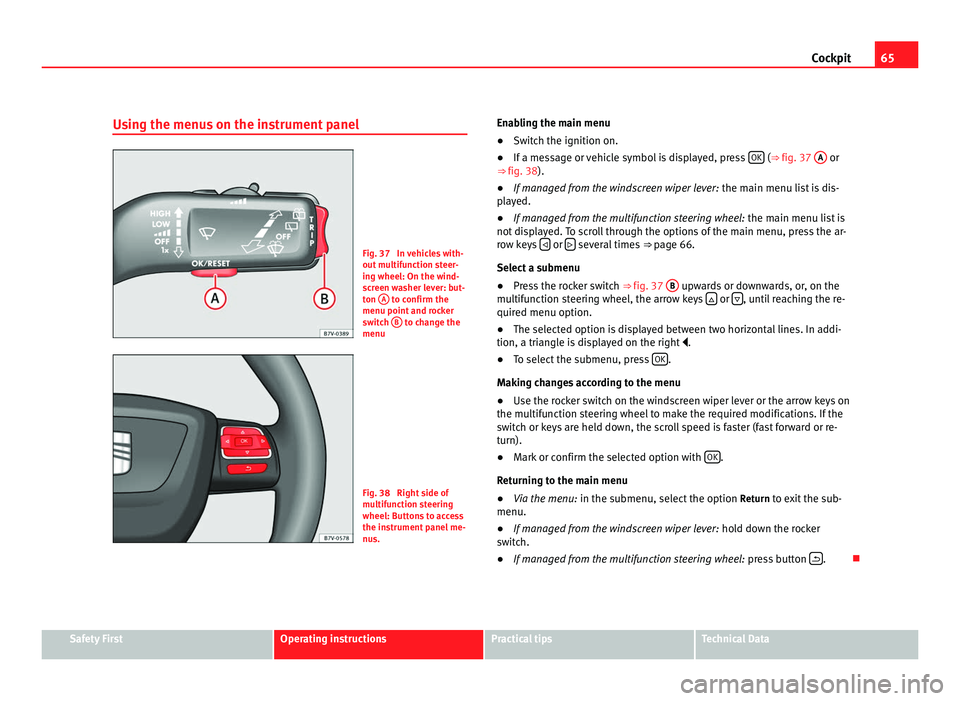
Using the menus on the instrument panel Fig. 37 In vehicles with-
out mu
ltif
unction steer-
ing wheel: On the wind-
screen washer lever: but-
ton A to confirm the
menu point and r oc
ker
switch B to change the
menu Fig. 38 Right side of
multif
u
nction steering
wheel: Buttons to access
the instrument panel me-
nus. Enabling the main menu
●
Switch the ignition on.
● If a message or vehicle symbol is displayed, press OK (⇒
fig. 37 A or
⇒ fig. 38).
● If managed from the windscreen wiper lever: the main menu lis
t is dis-
played.
● If managed from the multifunction steering wheel: the main menu lis
t is
not displayed. To scroll through the options of the main menu, press the ar-
row keys or
several times
⇒ pag
e 66.
Select a submenu
● Press the rocker switch ⇒ fig. 37 B upwards or downwards, or, on the
multif u
nction steering wheel, the arrow keys or
, until reaching the re-
quired menu option.
● The sel ect
ed option is displayed between two horizontal lines. In addi-
tion, a triangl
e is displayed on the right .
● To select the submenu, press OK .
Mak in
g changes according to the menu
● Use the rocker switch on the windscreen wiper lever or the arrow keys on
the multifu
nction steering wheel to make the required modifications. If the
switch or keys are held down, the scroll speed is faster (fast forward or re-
turn).
● Mark or confirm the selected option with OK .
Ret urnin
g to the main menu
● Via the menu: in the submenu, select
the option Return to exit the sub-
menu.
● If managed from the windscreen wiper lever: hold do
wn the rocker
switch.
● If managed from the multifunction steering wheel: pres
s button .
Safety First Operating instructions Practical tips Technical Data
Page 69 of 385
67
Cockpit Menu Function
Average fuel con-
sumption When the ignition is switched on, the average con-
sumption (in l/100 km or in mp
g) i
s displayed after
the vehicle has moved approximately 100 metres
(328 feet). Otherwise horizontal lines are displayed.
The value shown is updated approximately every 5
seconds. Distance to empty
(the dis
t
ance you
can travel with the
remaining fuel) Approximate distance in km (or miles) that can still
be trav
el
led with the fuel remaining in the tank, as-
suming the same style of driving is maintained. This
is calculated using the current fuel consumption. Distance covered Distance travelled, after ignition is switched on, in
km (or mil
e
s). Average speed After the ignition is switched on, the average speed
wi
l
l be shown after a distance of approximately 100
metres (328 feet) has been travelled. Otherwise hori-
zontal lines are displayed. The value shown is upda-
ted approximately every 5 seconds. Digital display of
speed Current speed displayed digitally.
Oil temperature digi-
ta
l
display Updated engine oil temperature digital display
Speed warning to ---
km/h If the stored speed is exceeded (between
30 - 250 km/h, or 18 - 155 mph), an audibl
e w
arning
is given together with a visual warning. Changing between display modes
●
In vehicles without multifunction steering wheel: pres
s the lever.
● Vehicles with a multifunction steering wheel: pres
s or
.
Storin g a s
peed for the speed warning
● Select the display Speed warnin
g at --- km/h.
● Press OK to store the current speed and switch off the warning. ●
In addition, set the required speed by pressing the rocker switch on the
w ind
screen wiper lever or buttons or
on the multifunction steering
wheel f or 5 sec
onds. Next, press OK again or wait a few seconds. The
speed i s
stored and the warning activated.
● To switch off , pres
s OK . The stored speed is deleted.
Manua l
ly erasing memory 1 or 2
● Select the memory to be erased.
● Press and hold OK for approximately two seconds.
Per son
alising the displays
It is possible to select which of the displays in the multifunction display you
wish to see on the instrument panel in the settings menu. The units of
measurement can also be modified ⇒ page 67.
Configuration Menu Configuration
Menu Function
Multifunction
dis
p
lay data Configuration of the multifunction display data which you
wi
sh t
o see on the instrument panel display ⇒ page 66. Compass Changing the magnetic region and calibration of the com-
pa
s
s. To calibrate the compass, please follow the instruc-
tions given on the instrument panel display. Convenience Changing vehicle convenience functions
⇒ page 68. Lights & visi-
bi
lity Configuration of vehicle lighting
⇒ page 69. Time Changing the hours and minutes of the clock and the navi-
gation sy
s
tem. The time can be set here and the choice
can be made between the 24 hour and 12 hour display.
The S in the upper part of the display indicates that the
clock is set to summer time. Safety First Operating instructions Practical tips Technical Data
Page 73 of 385
71
Unlocking and locking
Unlocking and locking
Vehicle key set
Introduction Additional information and warnings:
●
Adjustments to the SEAT information system ⇒ page 62
● C
entral locking and locking system ⇒ page 74
● St
art and stop the engine ⇒ page 170
● Not
es for the user ⇒ page 255
● Emer
gency locking and unlocking ⇒ page 314WARNING
Careless or incorrect use of vehicle keys may result in severe injury and
acc ident
.
● Always take all the keys with you whenever you leave the vehicle.
Childr
en and unauthorised individuals could lock the doors or the tail-
gate, start the engine or turn the ignition on activating electrical sys-
tems, for example: the electric windows.
● Never leave children or disabled people alone in the car. They could
be trapped in the c
ar in an emergency and will not be able to get them-
selves to safety. For example, depending on the time of the year, temper-
atures inside a locked and closed vehicle can be extremely high or ex-
tremely low resulting in serious injuries and illness or even death, partic-
ularly for young children.
● Never remove the key from the ignition if the vehicle is in motion. The
steerin
g may lock and it will not be possible to turn the steering wheel. Vehicle key
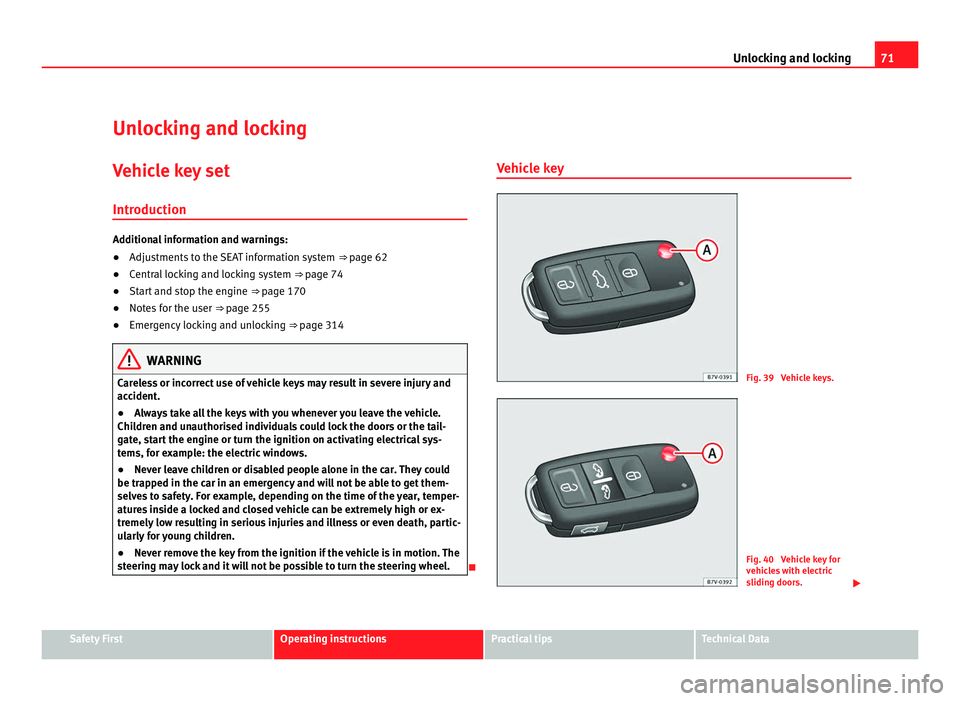
Fig. 39 Vehicle keys.
Fig. 40 Vehicle key for
vehic
l
es with electric
sliding doors. Safety First Operating instructions Practical tips Technical Data
Page 99 of 385
97
Lights and visibility
The control turn signals are switched on and off from the menu Lights & Visi-
bility on the instrument panel display ⇒ page 62. This function can be dis-
connected at a specialised workshop for those vehicles which do not have
the menu Lights & Visibility .WARNING
Incorrect use of the headlamps may cause accidents and serious injury,
as the m
ain beam may distract or dazzle other drivers. Note
● The turn signal only works when the ignition is switched on. The hazard
w arnin
g lights also work when the ignition is switched off ⇒ page 312.
● If a turn signal on the vehicle or trailer is faulty, the warning lamp flash-
es tw
ice as fast as usual.
● The main beam headligh
ts can only be switched on if the dipped beam
headlights are already on.
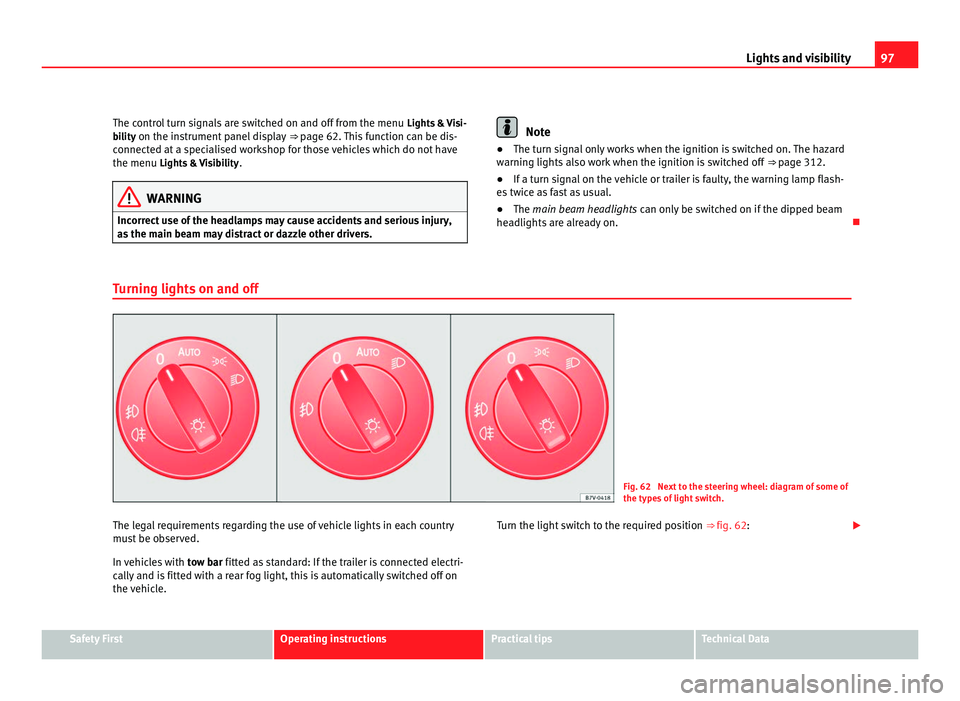
Turning lights on and off Fig. 62 Next to the steering wheel: diagram of some of
the type
s
of light switch.
The legal requirements regarding the use of vehicle lights in each country
mus t
be observed.
In vehicles with tow bar fitted as standard: If the trailer is connected electri-
cally and is fitted with a rear fog light, this is automatically switched off on
the vehicle. Turn the light switch to the required position
⇒ fig. 62:Safety First Operating instructions Practical tips Technical Data
Page 104 of 385
102
Lights and visibility
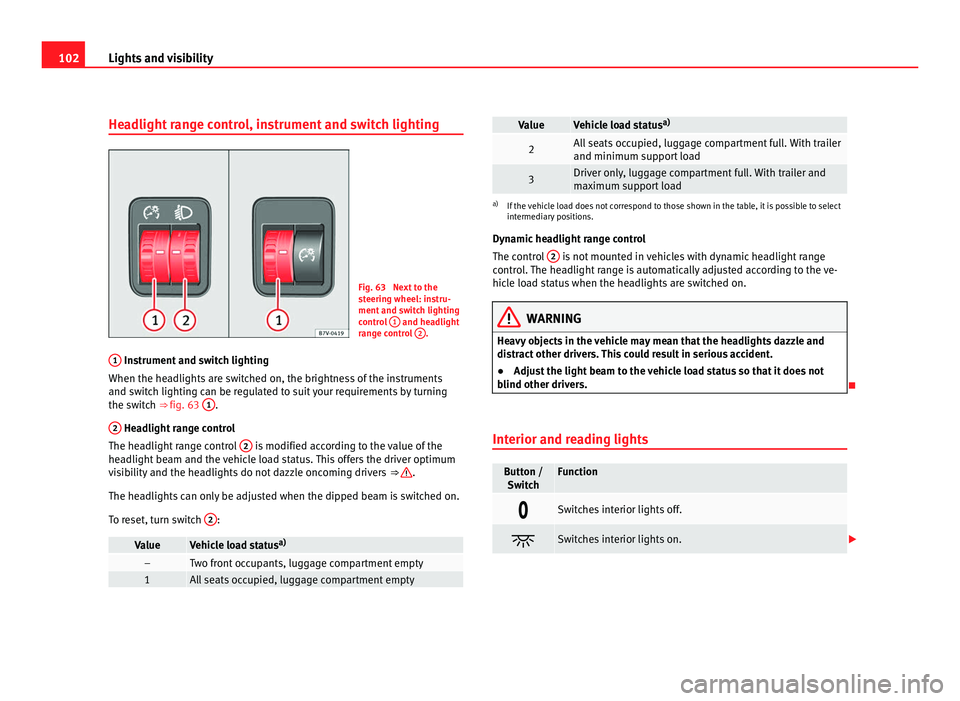
Headlight range control, instrument and switch lighting Fig. 63 Next to the
st
eerin
g wheel: instru-
ment and switch lighting
control 1 and headlight
ran g
e control 2 .
1 Instrument and switch lighting
When the hea dlights
are switched on, the brightness of the instruments
and switch lighting can be regulated to suit your requirements by turning
the switch ⇒ fig. 63 1 .
2 Headlight range control
The hea dlight
range control 2 is modified according to the value of the
hea dlight
beam and the vehicle load status. This offers the driver optimum
visibility and the headlights do not dazzle oncoming drivers ⇒ .
The hea dlights
can only be adjusted when the dipped beam is switched on.
To reset, turn switch 2 :
Value Vehicle load status
a) – Two front occupants, luggage compartment empty
1 All seats occupied, luggage compartment empty Value Vehicle load status
a) 2 All seats occupied, luggage compartment full. With trailer
and minimum sup
por
t load 3 Driver only, luggage compartment full. With trailer and
max
imum s
upport load a)
If the vehicle load does not correspond to those shown in the table, it is possible to select
intermedi ar
y positions.
Dynamic headlight range control
The control 2 is not mounted in vehicles with dynamic headlight range
contr o
l. The headlight range is automatically adjusted according to the ve-
hicle load status when the headlights are switched on. WARNING
Heavy objects in the vehicle may mean that the headlights dazzle and
dis tr
act other drivers. This could result in serious accident.
● Adjust the light beam to the vehicle load status so that it does not
blind other driver
s.
Interior and reading lights Button /
Swit c
h Function
Switches interior lights off.
Switches interior lights on.
Page 109 of 385
107
Lights and visibility
Windscreen wiper functions Windscreen wiper performance in different situations:
If the vehicle is at a stand-
sti
l
l: The activated position provisionally changes
to the pr
ev
ious position. During the automatic wipe: The air conditioning comes on for approxi-
mat
ely
30 seconds in air recirculation mode
to prevent the smell of the windscreen wash-
er fluid entering the inside of the vehicle. For the intermittent wipe: The intervals between wipes vary according
to the s
peed of
the vehicle. The higher the
vehicle speed the shorter the intervals. Heated windscreen washer jets
The heatin
g on
ly thaws the frozen jets, it does not thaw the water in the
washer hoses. The heated windscreen washer jets automatically adjust the
heat depending on the ambient temperature, when the ignition is switched
on.
Headlight wash /wipe system
The headlight washers/wipers clean the headlight lenses.
After the ignition is switched on, the first and every fifth time the wind-
screen washer is switched on, the headlights are also washed. Therefore,
the windscreen wiper lever should be pulled towards the steering wheel
when the dipped beam or main beam are on. Any incrusted dirt (such as in-
sects) should be cleaned regularly (e.g. when refuelling).
To ensure the headlight washers work correctly in winter, any snow which
has got into the bumper jet supports should be cleaned away. If necessary,
remove snow with an anti-icing spray. Note
The wiper will try to wipe away any obstacles that are on the windscreen.
The wiper w i
ll stop moving if the obstacle blocks its path. Remove the ob-
stacle and switch the wiper back on again.
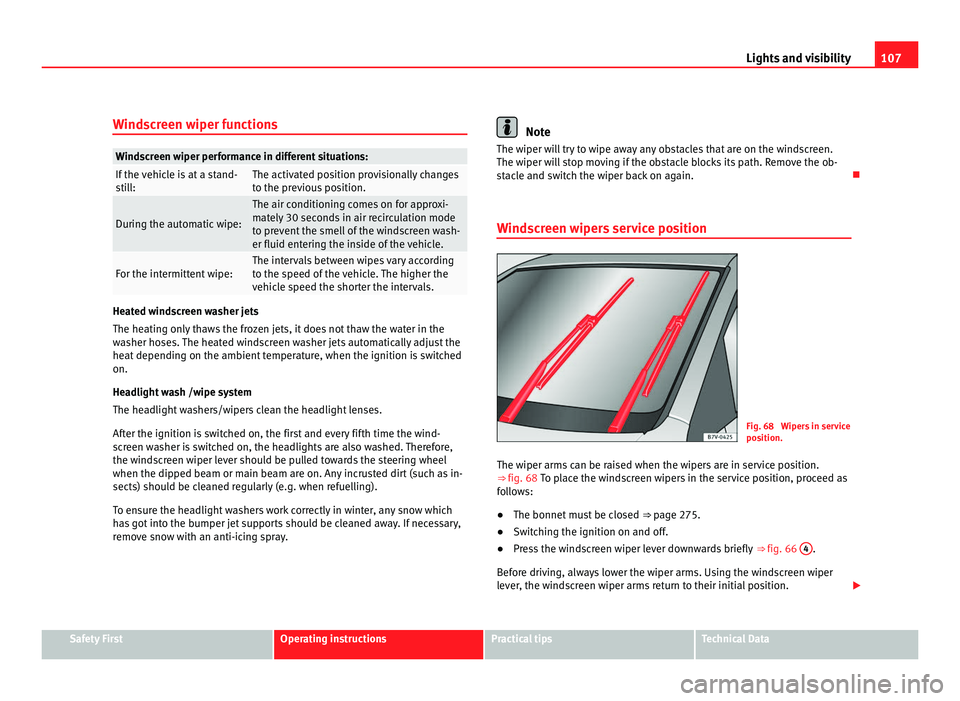
Windscreen wipers service position Fig. 68 Wipers in service
pos
ition.
The w
iper arms can be raised when the wipers are in service position.
⇒ fig. 68 To p l
ace the windscreen wipers in the service position, proceed as
follows:
● The bonnet must be closed ⇒ page 275.
● Sw
itching the ignition on and off.
● Press the windscreen wiper lever downwards briefly ⇒ fig. 66 4 .
Bef or
e driving, always lower the wiper arms. Using the windscreen wiper
lever, the windscreen wiper arms return to their initial position. Safety First Operating instructions Practical tips Technical Data
Page 116 of 385
114
Seats and storage compartments
Seats and storage compartments
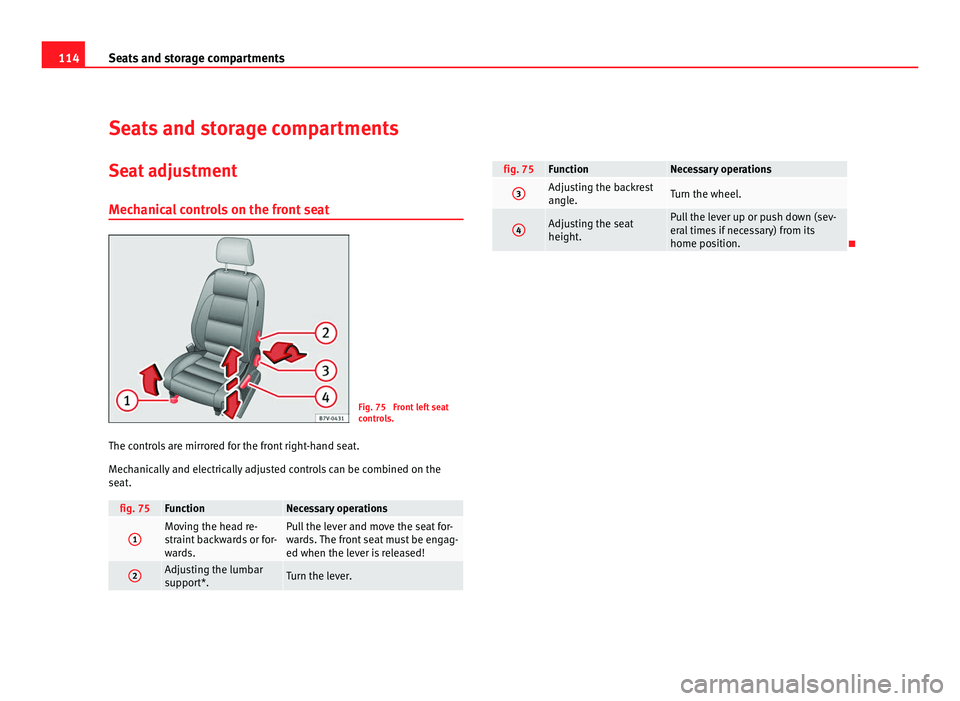
Seat adjustment
Mec h
anical controls on the front seat Fig. 75 Front left seat
contr
o
ls.
The controls are mirrored for the front right-hand seat.
Mech
anically and electrically adjusted controls can be combined on the
seat. fig. 75 Function Necessary operations
1 Moving the head re-
str
aint
backwards or for-
wards. Pull the lever and move the seat for-
war
d
s. The front seat must be engag-
ed when the lever is released! 2 Adjusting the lumbar
sup
por
t*. Turn the lever. fig. 75 Function Necessary operations
3 Adjusting the backrest
angl
e. Turn the wheel.
4 Adjusting the seat
height. Pull the lever up or push down (sev-
eral
time
s if necessary) from its
home position.
Page 127 of 385
125
Seats and storage compartments WARNING
Travelling with the head restraints removed or improperly adjusted in-
cr e
ases the risk of severe or fatal injuries in the event of accidents and
sudden braking or manoeuvres.
● Always fit and adjust the head restraint properly whenever a person
is oc
cupying a seat.
● Refit any removed head restraints immediately so that passengers
are properly
protected. CAUTION
On removing and fitting the head restraint, make sure the head restraint
does not
hit the interior roof of the vehicle or the backrest of the front seat.
This could damage the interior roof and other parts of the vehicle.
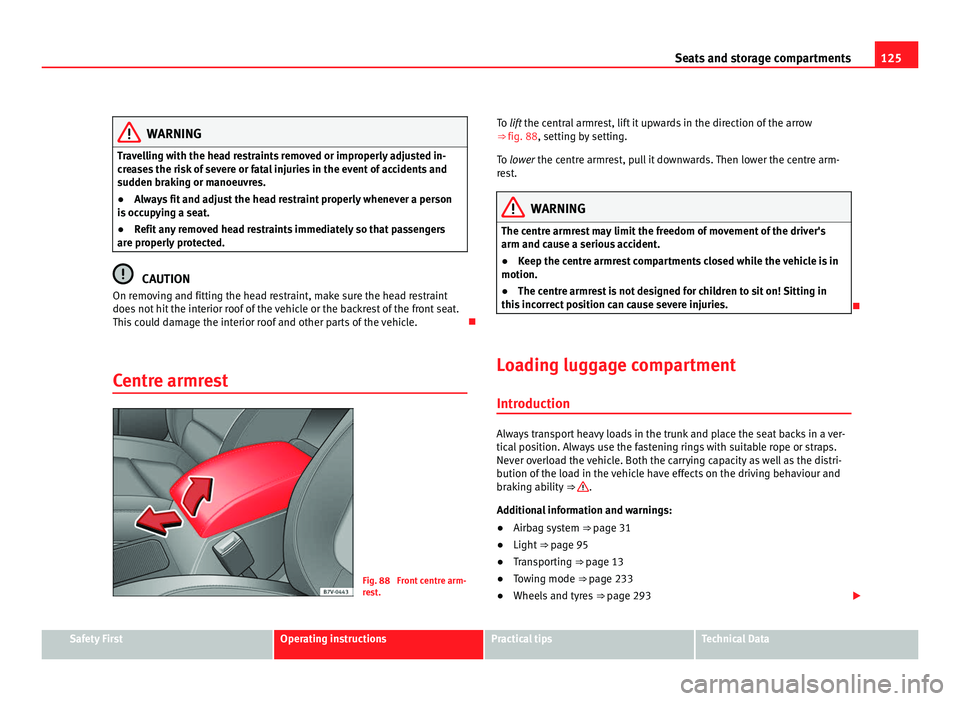
Centre armrest Fig. 88 Front centre arm-
re
s
t. To lift the central armrest, lift it upwards in the direction of the arrow
⇒ fig. 88
, setting by setting.
To lower the centre armrest, pull it downwards. Then lower the centre arm-
rest. WARNING
The centre armrest may limit the freedom of movement of the driver's
arm and cau se a seriou
s accident.
● Keep the centre armrest compartments closed while the vehicle is in
motion.
● The centre armrest is not designed for children to sit on! Sitting in
this inc
orrect position can cause severe injuries.
Loading luggage compartment Introduction Always transport heavy loads in the trunk and place the seat backs in a ver-
tical
po
sition. Always use the fastening rings with suitable rope or straps.
Never overload the vehicle. Both the carrying capacity as well as the distri-
bution of the load in the vehicle have effects on the driving behaviour and
braking ability ⇒ .
Addition a
l information and warnings:
● Airbag system ⇒ page 31
● Light
⇒ page 95
● Tr
ansporting ⇒ page 13
● T
owing mode ⇒ page 233
● Wheel
s and tyres ⇒ page 293 Safety First Operating instructions Practical tips Technical Data
Page 141 of 385
139
Seats and storage compartments
Additional information and warnings:
● Light ⇒ page 95
● Tr
ansporting ⇒ page 13
● E
cological driving ⇒ page 225
● Wheel
s and tyres ⇒ page 293
● A
ccessories, parts replacement, repairs and modifications ⇒ page 257WARNING
The risk of an accident is increased by transporting heavy or bulky loads
on the roof , whic
h affects the car's handling by shifting the centre of
gravity and increasing susceptibility to cross winds.
● Always secure loads correctly with suitable and undamaged attach-
ment rope or s
traps.
● Large, heavy, wide and flat loads negatively affect the vehicle aerody-
namics, c
entre of gravity and handling.
● Avoid brusque manoeuvres and sudden braking.
● Adjust your speed and driving style to visibility, road, traffic and
weather c
onditions. CAUTION
● Always remove the roof carrier system from the roof before entering a car
w a
sh.
● The height of your vehicle is changed by the installation of the roof carri-
er and the load sec
ured on it. Compare the vehicle height with the passage
height, for example in underground car parks or entering garage doors.
● The roof antenna, the range of the panoramic sliding roof and the tail-
gate shou
ld not be affected by the roof carrier system and the load being
transported.
● Take extra care not to let the tailgate strike the roof load when opening. For the sake of the environment
The vehicle uses more fuel when the roof carrier system is fitted.
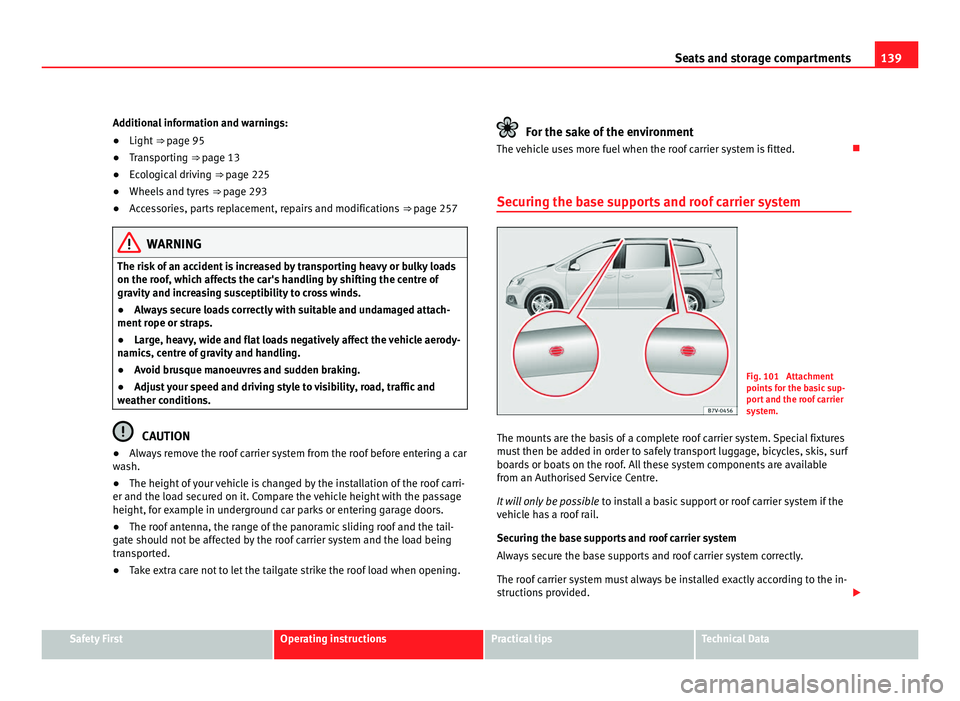
Securing the base supports and roof carrier system Fig. 101 Attachment
points
f
or the basic sup-
port and the roof carrier
system.
The mounts are the basis of a complete roof carrier system. Special fixtures
mus t
then be added in order to safely transport luggage, bicycles, skis, surf
boards or boats on the roof. All these system components are available
from an Authorised Service Centre.
It will only be possible to install a basic support or roof carrier system if the
vehicle has a roof rail.
Securing the base supports and roof carrier system
Always secure the base supports and roof carrier system correctly.
The roof carrier system must always be installed exactly according to the in-
structions provided. Safety First Operating instructions Practical tips Technical Data
Page 142 of 385
140
Seats and storage compartments
The position holes are located on the inner side of the rail ⇒ fig. 101.WARNING
If the base supports and the roof carrier system are incorrectly fitted or
used in an u n
suitable manner, the entire system could break free causing
accident and injury.
● Always take the manufacturer assembly instructions into account.
● Only use base supports and roof carrier systems that are not dam-
aged and are c
orrectly fitted.
● The base support should only be fitted to the points indicated in the
diagram
⇒ fig. 101.
● Secure the base supports and roof carrier system correctly.
● Check the screw fittings and attachments before driving and after a
short di
stance. During each long journey, check the attachments during
every break.
● Always fit the roof carrier system correctly for wheels, skis and surf-
board
s.
● Never change or repair the basic supports or roof carrier system. Note
Read and take into account the instructions included with the roof carrier
sys t
em fitted and keep them in the vehicle.
Loading the roof carrier system Loads can only be correctly secured when the roof carrier system is correctly
fitted
⇒ .
Max imum authori
sed roof load
The maximum authorised roof load is 100 kg (about 220 lbs). The roof load
includes the roof carrier system and the load being transported ⇒ .Always check the roof carrier system weight and the weight of the load to be
tran
s
ported and, if necessary, weigh them. Never exceed the maximum au-
thorised roof load.
If you are using a roof carrier with a lower weight rating, you cannot trans-
port the maximum roof load. Do not exceed the maximum weight limit for
the roof carrier given in the fitting instructions.
Distributing a load
Uniformly distribute loads and secure them correctly ⇒ .
Check att
achments
After fitting the base supports and the roof carrier system, always check the
attachments after a short trip or at regular intervals. WARNING
Exceeding the maximum authorised roof load can result in accidents
and/or v ehic
le damage.
● Always respect the maximum authorised weight for the roof, the max-
imum authorised weight
on the axles and the total maximum authorised
weight of the vehicle.
● Never exceed the capacity of the roof carrier system even if this is
les
s than the maximum authorised roof load.
● Secure heavy objects towards the front and distribute the load even-
ly. WARNING
Loose and incorrectly secured loads can fall from the roof carrier system
cau s
ing accidents and injury.
● Always use suitable ropes and straps in good condition.
● Always secure loads correctly.