wheel Seat Alhambra 2011 Workshop Manual
[x] Cancel search | Manufacturer: SEAT, Model Year: 2011, Model line: Alhambra, Model: Seat Alhambra 2011Pages: 385, PDF Size: 7.92 MB
Page 226 of 385
224
Driving
● The vehicle is fitted with snow chains.
● The wheel on one ax
le is changed.
There ma
y be a delay in the reaction of the tyre monitoring indicator or it
may not indicate anything under certain circumstances (e.g. sports driving,
snow-covered or unpaved roads).
Adaptation of the tyre monitoring indicator
On adjusting tyre pressure or changing one or more wheels, the ⇒ fig. 154
button on the tyre monitoring indicator must be kept pressed down, with
the ignition on, until a signal is heard. Do the same, for example, when the
front and rear wheels are swapped ⇒ fig. 175.
If the wheels are subjected to an excessive load (towing a trailer, heavy
load), the tyre pressure must be increased to the maximum recommended
pressure ⇒ page 293. Press the tyre monitoring indicator button to confirm
the new pressure value. Note
An erroneous indication may be given when snow chains are in use because
the ch ain
s increase the tread of the wheel.
Page 227 of 385
225
Driving and the environment
Practical tips Drivin g and the en
vironment
Running-in Please observe the instructions for running-in new components.
Ru
nnin
g-in the engine
The engine needs to be run-in over the first 1500 km (1000 miles). During
its first few hours of running, the internal friction in the engine is greater
than later on when all the moving parts have bedded down.
How the vehicle is driven for the first 1500 km (1000 miles) influences the
future engine performance. Throughout the life of the vehicle, it should be
driven at a moderate speed – especially when the engine is cold – this will
reduce engine wear and increase its useful life. Never drive at extremely low
engine speeds. Always engage a lower gear when the engine works “irregu-
larly”. For the first 1000 km or 600 miles, please note:
● Do not use full throttle.
● Do not force the engine above two thirds of its maximum speed.
● Do not tow a trailer.
Between 1000 and 1500 k
ilometres (600 to 1000 miles) , gradually in-
crease power until reaching the maximum speed and high engine speeds.
Running in new tyres and brake pads
● Replacement of new tyres and wheel rims ⇒ pag
e 293
● Notes on the brakes ⇒ pag
e 187 For the sake of the environment
If the engine is run in gently, the life of the engine will be increased and the
engine oi l
consumption reduced.
Ecological driving Introduction Fuel consumption, environmental impact and engine, brake and tyre wear
depend lar
g
ely on three factors:
● Personal driving style.
● Conditions of use (weather, road surface).
● Technical requirements.
Saving
s of up to 25% in fuel consumption are possible with an appropriate
driving style and the adoption of certain simple tips. WARNING
Always adapt your speed and the distance to the vehicles ahead in line
with v
isibility, weather conditions, the condition of the road and the traf-
fic situation.
Safety First Operating instructions Practical tips Technical Data
Page 233 of 385
231
Trailer towing
Trailer towing Introduction Always be aware of the legal requirements for each country to drive with a
trai
l
er and to use a trailer bracket.
Your car is intended mainly for transporting passengers however, it can also
be used to tow a trailer provided that it is fitted with the necessary equip-
ment. The additional load has an effect on the useful life, fuel consumption
and the vehicle performance and, in some cases, reduce the service inter-
vals.
Driving with a trailer requires more force from the vehicle and, thus, more
concentration from the driver.
For wintertime temperatures, fit winter tyres to the vehicle and the trailer.
Drawbar load
The maximum permitted Drawbar load exerted by the trailer drawbar on the
ball joint of the tow hitch must not exceed 100 kg (approximately 220 lbs).
Vehicles with the Start-Stop function
With a SEAT factory fitted or retrofitted trailer bracket, the Start-Stop func-
tion is automatically deactivated when a trailer is connected. For trailer
brackets not installed by SEAT, the Start-Stop function must be deactivated
manually using a button located on the dashboard before driving with a
trailer and it must remain off for the entire journey ⇒ .
Addition a
l information and warnings:
● Anti-theft alarm system ⇒ page 74
● Light
⇒ page 95
● Ec
ological driving ⇒ page 225
● St
arter assist systems (Start-Stop function) ⇒ page 194●
Wheel
s and tyres
⇒ p
age 293
● Accessories, parts replacement, repairs and modifications ⇒ page 257 WARNING
Never transport people in a trailer: this will endanger in their life and is
again s
t the law. WARNING
The incorrect use of the tow hitch can cause accidents and injury.
● Only use a tow hitch in good condition and correctly installed.
● Never change or repair a tow hitch.
● To reduce the risk of injury in case of a reversing collision, injury to
pedestri
ans and cyclists when parking, always keep the ball joint in
when a trailer is not being used.
● Never fit a trailer tow hitch “that distributes the load” or “balances
the load”.
Your vehicle has not been designed for this type of tow hitch.
The tow hitch may fail and the trailer will separate from the vehicle. WARNING
Driving with a trailer and transporting heavy or large objects can affect
vehic l
e handling and even cause an accident.
● Always secure loads correctly with suitable and undamaged attach-
ment rope or s
traps.
● Adjust your speed and driving style to visibility, road, traffic and
weather c
onditions. Safety First Operating instructions Practical tips Technical Data
Page 238 of 385
236
Trailer towing
Trailer electric socket
The electric c
onnection between vehicle and trailer is a 13-pin socket. If the
trailer plug has seven pins, an adapter cable must be used.
Trailer rear lights
Check the trailer rear lights to ensure they work correctly and remain legal.
Ensure that the trailer does not use more than the maximum power
⇒ page 233.
Trailer connected to the antitheft alarm:
● When a vehicle comes from the factory fitted with an antitheft alarm and
tow hit
ch.
● When the trailer is connected to the vehicle using the socket.
● When the vehicle and trailer electrical systems work correctly and are
not dam
aged.
● When the vehicle is locked using the vehicle key and the antitheft alarm
is t
urned on.
When the vehicle is locked, the alarm is triggered when the electrical con-
nection between the vehicle and the trailer is removed.
Always turn off the anti-theft alarm system before connecting or disconnect-
ing a trailer. Otherwise, the tilt sensor may erroneously activate the alarm. WARNING
Erroneous or unsuitable connection of electric cables may supply energy
to the tr ai
ler causing an anomaly in the vehicle electronics that could re-
sult in an accident with serious consequences.
● All work on the electrical system must be carried out only by a spe-
cia
list workshop.
● Never connect the trailer's electric system to the electrical connec-
tions of
the rear lights or any other power sources. CAUTION
Do not leave the trailer connected to the vehicle when parked; places on its
sup por
t wheel or its supports. For example, when changing the load or a
puncture, the vehicle will be pushed up or down. The force acting on the
tow hitch and the trailer could damage the vehicle or the trailer. Note
● In case of a fault in the vehicle or trailer electrical system or in case of
pr o
blems with the antitheft alarm system, have the system checked by a
specialist workshop.
● If the trailer accessories use energy from the socket when the engine is
stop
ped, the battery will be discharged.
● For technical reasons, trailers fitted with rear LED lights cannot be con-
nected to the antithef
t alarm system.
● If the vehicle battery is running low, the electrical connection with the
trail
er is automatically cut.
● With the engine running, the electrical equipment on the trailer will con-
sume pow
er.
Loading the trailer Trailer weight / drawbar load
The trai
l
er weight is the load that the vehicle can pull ⇒ . The drawbar
loa d i
s the vertical weight of the trailer hitch on the tow hitch ball
⇒ page 240.
The figures for trailer weights and draw bar weights given on the data plate
of the towing bracket are for values of this model only. The correct figures
for your specific vehicle, which may be lower than these figures for the tow
hitch, are given in the registration documents. The instructions in the offi-
cial vehicle documents take precedence.
Page 239 of 385
237
Trailer towing
For the sake of road safety, SEAT recommends using the maximum allowed
dra wb
ar load. The handling of the combined vehicle and trailer will be poor
if the drawbar load is too low.
The drawbar load increases the weight on the rear axle, reducing the vehicle
carrying capacity.
Gross combination weight
This figure refers to the combined weight of the loaded vehicle and loaded
trailer.
Loading the trailer
The combined vehicle and trailer must be balanced. Use the maximum
drawbar load authorised and do not overload the front or the rear of the
trailer:
● Distribute loads in the trailer so that heavy objects are as near to the
axle a
s possible or even above it.
● Correctly secure the trailer load.
Tyr
e pressure
Inflate the trailer tyres according to the manufacturer's instructions.
Inflate the towing vehicles tyres to the maximum ⇒ page 293.WARNING
Exceeding the maximum authorised axle load, drawbar load or the gross
comb in
ation weight of the towing vehicle and trailer could cause a seri-
ous accident with severe consequences.
● Never exceed the specifications.
● With the actual load on the front and rear axles, the maximum axle
load shou
ld never be exceeded. The weight on the front and rear should
never exceed the gross vehicle weight. WARNING
If the load moves, the stability and safety of the vehicle and trailer com-
bin ation w
ill be seriously affected and this could result in a serious acci-
dent.
● Always correctly load the trailer.
● Always secure loads correctly with suitable and undamaged attach-
ment rope or s
traps.
Driving with a trailer Adjusting the headlights
When to
w
ing a trailer, the front of the vehicle may rise and so the dipped
beam headlights may blind other drivers. Use the headlight range control to
lower the cone of light. If you do not have headlight range control, have the
headlights adjusted by a qualified dealership. Vehicles with high-intensity
discharge lamps adapt automatically and do not require adjustment.
Details of driving with a trailer
● If the trailer has an overru
n brake, apply the brakes gently at first and
then, firmly. This will prevent the jerking that can be caused by the trailer
wheels locking.
● As of the combined vehicle and trailer mass, braking distances will be
great
er.
● Select a low gear before driving down a steep hill to use the engine
brakin
g effect to slow down the vehicle. Otherwise, the braking system
could overheat and fail. Safety First Operating instructions Practical tips Technical Data
Page 245 of 385
243
Vehicle maintenance and cleaning
Washing the vehicle The longer substances such as insects, bird droppings, resinous tree sap,
ro
a
d dirt, industrial deposits, tar, soot or road salt and other aggressive ma-
terials remain on the vehicle, the more damage they do to the paintwork.
High temperatures (for instance due to strong sunlight) further intensify the
corrosive effect. The vehicle undercarriage should also be thoroughly wash-
ed at regular intervals.
Automatic car washes
Always observe the instructions provided at the automatic car wash. The
standard precautionary measures prior to entering the car wash should be
taken to avoid damage to the vehicle (close all windows, fold in exterior mir-
rors). If the vehicle is fitted with additional components (spoiler, roof-rack,
aerial...), check with the car wash supervisor whether these can enter the
car wash ⇒ .
The v ehic
le paintwork is so durable that the car can normally be washed
without problems in an automatic car washing tunnel. However, wear and
damage to the paintwork will depend on the type of car wash used. SEAT
recommends the use of car washed without brushes.
To remove traces of wax on windows and to prevent wiper blades from
scratching, please observe the following ⇒ page 245, Cleaning windows
and exterior mirrors.
Washing the car by hand
When washing the car by hand, use plenty of water to soften the dirt first,
and rinse off as well as possible.
Then clean the vehicle with a soft sponge, glove or brush using only slight
pressure. Start at the roof and work downwards. Special car shampoo
should only be used for very persistent dirt.
Rinse the sponge or glove thoroughly and often.
Wheels, sills and similar should be cleaned last. Use a second sponge for
this. WARNING
Sharp components on the vehicle may cause injury.
● Protect arms and hands from sharp edges when cleaning the vehicle
under c
arriage or the interior of the wheel hubs. WARNING
After the vehicle has been washed, the braking effect will be reduced
(and the brakin
g distance increased) due to moisture (and ice in winter)
on the brakes.
● Dry the brakes and remove ice by braking carefully. Ensure that you
are not end
angering other road-users or breaking traffic regulations in
the process. CAUTION
● The temperature of the water must not exceed +60°C (+140°F).
● To av
oid damage to the paintwork, do not wash the vehicle in full sun.
● Do not use rough sponges or similar which could damage the surface to
cle
an away the traces of insects.
● Never wipe the headlights with a dry cloth or sponge, always moisten
first
. It is best to use soapy water.
● Washing the vehicle in low temperatures: When washing the vehicle
with a hose, do not
direct water into the lock cylinders or the gaps around
the doors, tailgate, or sunroof. Locks and seals could freeze! CAUTION
To prevent damage to the vehicle, please observe the following before en-
terin g
an automatic car wash :
● Compare the distance between the vehicle wheels and the distance be-
tween the guide-rai
ls of the car wash to prevent damage to the wheels and
tyres! Safety First Operating instructions Practical tips Technical Data
Page 250 of 385
248
Vehicle maintenance and cleaning
● Use a clean, damp, lint-free cloth to clean anodized surfaces.
● If ther
e is a lot of dirt, use a special cleaning product which does not
contain
solvents. CAUTION
To prevent damage to the anodized surfaces:
● Do not use products containing solvents.
● Do not use polish or hard wax.
● Do not use abrasive products.
● Do not polish anodized surfaces in sandy or dusty environments.
● Do not polish dirty surfaces.
Cleaning wheels Cleaning steel wheels
Use an indu
s
trial cleaner to remove brake dust. Therefore, clean wheels reg-
ularly with a separate sponge.
Any damage to the paint on steel wheels should be touched up before the
metal starts to rust.
Caring for and cleaning alloy wheels
Remove road salt and brake dust by washing the wheels approximately
once a fortnight. Use an acid free detergent to clean the wheel rims. SEAT
recommends treating the wheels thoroughly with a wax compound about
once every three months.
It is important to remove road salt and brake dust by washing the wheels at
regular intervals, otherwise the finish will be impaired.
Always use an acid-free detergent for alloy wheel rims. Car polish or other
abrasive agents should not be used. If the protective coating on the paint has been damaged (for example, hit by
a stone), it
should be repaired immediately.
Caring for rubber seals The rubber seals on doors, windows, etc., remain flexible, provide a better
seal
and l
ast longer if they are regularly treated with a product specifically
designed for use on rubber.
Before applying the product, use a soft cloth to remove dust and dirt from
the rubber seals.
De-icing the door lock cylinder To de-ice the lock cylinders, SEAT recommend the use of genuine SEAT spray
with lubric
atin
g and anti-corrosive properties. CAUTION
The use of products containing degreasing agents to de-ice the locks may
rus t
the lock cylinder.
Protection of vehicle undercarriage The vehicle underbody is coated to protect it from chemical and mechanical
dam
ag
e. The protective coat on the undercarriage may wear through use
while driving. Therefore, SEAT recommends that the protective coating on
the undercarriage and on the running gear should be regularly checked, and
repaired if necessary.
Page 259 of 385
257
Accessories, parts replacement and modifications
Accessories, parts replacement and modifications Accessories, replacement of parts and
modification s
Intr
oduction WARNING
The use of spare parts and accessories, or incorrectly performed modifi-
cation s
or repairs may result in damage to the vehicle, accidents and se-
rious injury.
● SEAT strongly recommends you to only use SEAT approved accesso-
ries and
SEAT ®
original spare parts. These parts and accessories have
been specially tested by SEAT for suitability, reliability and safety.
● Have any repairs or modifications carried out at a Technical Service.
Qualified work
shops have the necessary tools, diagnostics equipment,
repair information and qualified personnel.
● Only mount parts with the same specifications as the parts fitted at
factor
y.
● Never mount, fasten or fit objects such as drink holders or telephone
cra
dles over the covers of the airbag modules or within their radius of ac-
tion.
● Only use wheels and tyre combinations which have been approved by
SEAT f
or your vehicle type.
Accessories and spare parts SEAT recommends you consult an Official Service before purchasing acces-
sories
and s
pare parts or consumables. For example, when fitting accesso- ries at a later date, or when replacing a component. A Technical Service will
advi
se you as to the legal requirements and manufacturer's recommenda-
tions regarding accessories, spare parts and other components.
SEAT recommend you use only approved SEAT accessories and genuine
SEAT spare parts ®
. These parts and accessories have been specially tested
by SEAT for suitability, reliability and safety. In addition the Technical Serv-
ice will guarantee that the assembly is carried out professionally.
Although we continually monitor the market, SEAT cannot guarantee that
products not approved by SEAT are reliable, safe and suitable for the vehi-
cle. Therefore, SEAT cannot accept liability, even in those cases authorised
by an officially recognised technical inspection office or other official body.
Any retro-fitted equipment which has a direct effect on the vehicle and/or
the way it is driven must be approved by SEAT for use in your vehicle and
bear the e mark (the European Union's authorisation symbol). This includes
cruise control systems or electronically controlled suspension.
If any additional electrical components are fitted which do not serve to con-
trol the vehicle itself, these must bear the mark (European Union manu-
facturer conformity declaration). This includes refrigerator boxes, laptops or
ventilator fans. WARNING
Unprofessional repairs or modifications to the vehicle may affect the per-
form anc
e of the airbags, resulting in operating faults or fatal accident.
● Never mount, fasten or fit objects such as drink holders or telephone
cra
dles over the covers of the airbag modules or within their radius of ac-
tion.
● Objects placed over the airbag covers, or within their radius of action,
coul
d lead to serious injury or loss of life if the airbags are triggered.
Safety First Operating instructions Practical tips Technical Data
Page 261 of 385
259
Accessories, parts replacement and modifications
The vehicle owner should keep the documentation for the additional equip-
ment s af
ely and hand it over to the scrap yard at the end of the vehicle's
service life. This ensures that any additional equipment mounted in end-of-
life vehicles is correctly disposed of with respect for the environment. WARNING
Repairs or modifications which are not performed correctly may result in
dam ag
e or errors in the vehicle operation, affecting the efficiency of the
driver assist systems. This could result in serious accident.
● All repairs and modifications to the vehicle should only be performed
by a
Technical Service.
Repair and faults in the airbag system When performing repairs and technical modifications, SEAT's directives
mus
t
be observed! ⇒ Modifications and repairs to the front bumper, doors, front seats, and re-
pair
s
to the roof or chassis should only be carried out in a Technical Service.
These components may contain parts or sensors belonging to the airbag
system.
If work is carried out on the airbag system or remove and fit parts of the sys-
tem when performing other repair work, parts of the airbag system may be
damaged. The consequence may be that, in the event of an accident, the
airbag inflates incorrectly or does not inflate at all.
So that the effectiveness of the airbag is not reduced and that removed
parts do not cause any injuries or environmental pollution, regulations must
be observed. These requirements are known to qualified dealerships.
Modifications to the vehicle suspension may affect the operation of the air-
bag system in the event of collision. For example, if wheel and tyre combi-
nations not approved by SEAT are used, or if the vehicle height is lowered, the suspension is stiffened or the suspension springs, telescopic arms,
dampers, et
c., are modified, the results received by the airbag sensors and
sent to the control unit may not be accurate. For example, some modifica-
tions to the suspension could increase the force measured by the sensors
and result in the triggering of the airbag systems in collisions. Under normal
conditions, the measured values would be lower and the airbag would not
have been triggered. Other modifications may reduce the forces measured
by the sensors and therefore the airbags are not triggered in situations
when they should have triggered. WARNING
Repairs or modifications which are not performed correctly may result in
dam ag
e or errors in the vehicle operation, affecting the efficiency of the
airbag systems. This could result in serious or fatal accident.
● All repairs and modifications to the vehicle should only be performed
by a
Technical Service.
● Airbag modules must never be repaired: if damaged, they must be re-
plac
ed.
● Never fit recycled or reused airbag components in your vehicle. WARNING
Modifications to the vehicle suspension, including the use of unauthor-
ised wheel and ty
re combinations, may affect the performance of the air-
bags and increase the risk of serious or fatal injury in the event of acci-
dent.
● Never fit suspension components which are not identical to the origi-
nal
parts mounted in the vehicle.
● Never use wheel and tyre combinations not approved by SEAT.
Safety First Operating instructions Practical tips Technical Data
Page 267 of 385
265
Checking and refilling levels WARNING (Continued)
– If you are using a metal fuel canister, the nozzle must always touch
the c ani
s
ter while it is being filled to avoid static electricity.
– Follow the legal requirements for the use, storage and transport of
spar
e fuel canisters.
– Insure that the fuel container complies with manufacturing stand-
ards, f
or example, ANSI or ASTM F852-86. CAUTION
● Always remove any fuel spilled on the vehicle paintwork immediately to
av oid d
amage to the wheel housing, the tyre and vehicle paintwork.
● Refuelling a petrol engine with diesel or a diesel engine with petrol can
cause seriou
s engine and fuel system damage; the resulting malfunctions
are not covered by the SEAT warranty. If you refuel with the wrong type of
fuel, never start the engine. This applies to even the smallest amount of the
wrong fuel. You should obtain professional assistance. With the engine run-
ning, the composition of the wrong fuel could significantly damage the fuel
system and the engine itself.
● In vehicles with a diesel engine, under no cir
cumstances should you re-
fuel or drive with petrol, kerosene, heating oil or any other type of different
fuel. Other types of fuels could cause serious damage to the engine and to
the fuel supply system and the resulting problems are not covered by the
SEAT warranty. For the sake of the environment
Fuels can contaminate the environment. Collect any spilt service fluids and
allo w a pr
ofessional to dispose of them. Note
There is no emergency mechanism for the manual release of the tank flap. If
nece s
sary, request assistance from specialised personnel. Control lamps and fuel gauge
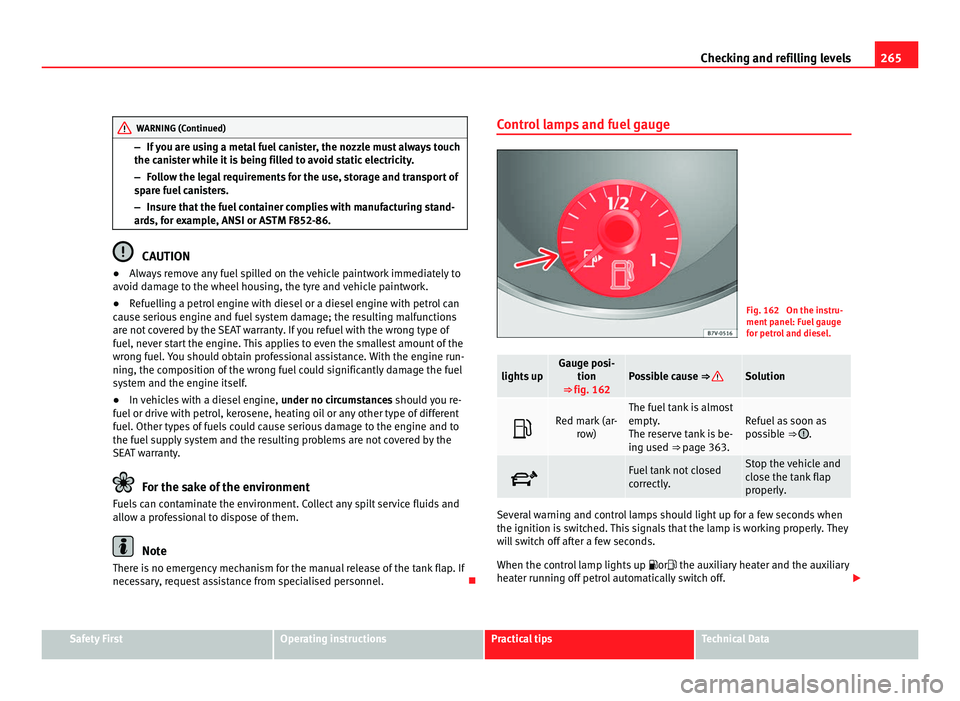
Fig. 162 On the instru-
ment p
anel: F
uel gauge
for petrol and diesel. lights up Gauge posi-
tion
⇒ fig. 162 Possible cause ⇒ Solution
Red mark (ar-
row) The fuel tank is almost
empty.
The r
e
serve tank is be-
ing used ⇒ page 363. Refuel as soon as
pos
s
ible ⇒ .
Fuel tank not closed
corr
ectly
. Stop the vehicle and
clo
se the t
ank flap
properly. Several warning and control lamps should light up for a few seconds when
the ignition is
sw
itched. This signals that the lamp is working properly. They
will switch off after a few seconds.
When the control lamp lights up or the auxiliary heater and the auxiliary
heater running off petrol automatically switch off. Safety First Operating instructions Practical tips Technical Data