maintenance Seat Alhambra 2011 Owner's Guide
[x] Cancel search | Manufacturer: SEAT, Model Year: 2011, Model line: Alhambra, Model: Seat Alhambra 2011Pages: 385, PDF Size: 7.92 MB
Page 253 of 385
251
Vehicle maintenance and cleaning CAUTION
Failure to observe the instructions in the check list for caring for your up-
hol s
tery could result in damage or discolouration of the upholstery and cov-
ers.
● Always follow the check list and perform the necessary operations. Note
SEAT recommends you take the vehicle to a Technical Service to treat any
stain
s on the upholstery caused by the discolouration of clothing.
Cleaning upholstery, textile covers and Alcantara ®
mat eri
alNormal cleaning
●
Before applying cleaning products, please read the instructions for han-
dling and the w arnin
gs shown on the container.
● The upholstery, textile covers, Alcantara ®
materi
al and mats should be
regularly vacuumed (with vacuum brush).
● We recommend that you use a soft sponge or lint-free, micro-fibre cloth
for normal
cleaning ⇒ .
● Clean Alcantara ®
sur f
aces with a damp lint-free cotton, wool or micro-
fibre cloth used for normal cleaning ⇒ .
General s
uperficial dirt on upholstery and textile covers can be cleaned with
a normal foam cleaning product.
If the upholstery and the material trims are very dirty, we recommend you
have them cleaned by a specialist cleaning form.
Cleaning stains
It may be necessary to clean the whole surface and not only the stain itself.
Especially if the surface has been dirtied through normal use. Otherwise, the stained area may become lighter than the rest of the surface after treat-
ment. Type of stain Cleaning the vehicle
Water-based stains
,
e.g. c off
ee or fruit
juice.
Use a sponge and wipe with a solution of water
and w oo
l wash.
Dry the area gently with a soft dry cloth. Persistent stains
,
e.g. c hoc
olate or
make-up.
Apply cleaning paste a)
dir ectly to the stain and
treat.
Next, rinse with clean water using a sponge or
damp cloth to remove the cleaning product deposits.
Carefully dry the area with an absorbent dry cloth. Grease-based
st
ain
s, e.g. oil or lip-
stick.
Apply a neutral soap or cleaning paste a)
and tr e at
the stain.
Apply absorbent material to loose colorants or par-
ticles of grease.
Then rinse the area with clean water. Take care not
to soak the upholstery. a)
Bile soap can be used as a cleaning paste. CAUTION
● Brushes should only be used to clean the mats and floor mat! Other sur-
f ac
es may be damaged if a brush is used.
● Do not use steam cleaning equipment, as the dirt becomes more incrus-
ted in the mat
erial when steam is applied.
● Alcantara ®
uphols
teries should never be soaked.
● Do not use leather cleaning products, solvents, wax polish, shoe cream,
spot r
emovers or similar products on Alcantara ®
.
● Never use brushes for cleaning damp material as they could damage the
surf
ace.
● Do not use steam cleaning equipment, as the dirt becomes more incrus-
ted in the mat
erial when steam is applied. Safety First Operating instructions Practical tips Technical Data
Page 254 of 385
252
Vehicle maintenance and cleaning
Cleaning and care of real leather upholstery In the event of query regarding the care or cleaning of the leather in your
vehic
l
e, please ask a Technical Service or specialised workshop.
Cleaning and care
Untreated Nappa is delicate as it is not covered with a layer of colour.
● Use a suitable impregnating cream with ultra-violet protection at regular
interv
als and after cleaning. This cream will nourish and moisturise the
leather, keep it supple and able to breathe. It will also form a protective
film.
● Clean the leather every two to three months and remove fresh dirt as
neces
sary.
● Leather should be treated every six months with a suitable leather care
product ⇒
.
● When using care and cleaning products, only apply the minimum re-
quired quantitie s.
● R
emove stains from fresh ball-pen and other inks, lipstick, shoe cream
and simil
ar stains as soon as possible.
● Caring for coloured leather. A special coloured cream will renew the col-
our of the le
ather when required and will eliminate differences in colour.
● Then wipe off with a soft, dry cloth.
Cle
aning the vehicle
SEAT recommends the use of a damp cotton or wool cloth for general clean-
ing.
Do not let the water soak through the leather or soak into the seams. Type of stain Cleaning the vehicle
More stubborn dirt
Apply a mild soap and water solution a)
u s
ing a
cloth. (Squeeze out the cloth well before applica-
tion).
Carefully dry the area with an absorbent dry cloth. Water-based stains
,
e.g. c off
ee, tea, fruit
juice, blood, etc.
Remove fresh stains with an absorbent cloth.
U se a s
uitable cleaning product to treat dried-in
stains ⇒ .
Grease-based
st
ain
s, e.g. oil or lip-
stick, etc.
Remove fresh stains with an absorbent cloth.
U se a s
uitable cleaning product if the stain has not
yet penetrated the surface ⇒ .
Tr e
at dry stains with a grease-removal spray ⇒ .
Dry
difficult stains ,
e. g. ink, f
elt-tip pen,
nail varnish, pig-
ment dispersions or
shoe polish.
Carefully dry the area with an absorbent dry cloth.
C l
ean using a special stain remover suitable for
use on leather. a)
Mild soap and water solution: two table spoons of neutral soap per litre of water. CAUTION
● On no acc ou
nt use solvents, wax polish, shoe cream, spot removers or
similar materials.
● In the event of spilt liquids, dry immediately with an absorbent cloth to
prevent
the liquid penetrating through the leather. CAUTION
If the car is left standing in the sun for long periods, the leather should be
prot ect
ed against direct sunlight to prevent it from fading. Note
However, slight colour variations will arise in normal use.
Page 255 of 385
253
Vehicle maintenance and cleaning
Cleaning leather upholstery Only use water and neutral cleaning products to clean imitation leather up-
hol
s
tery. CAUTION
On no account use solvents, wax polish, shoe cream, spot removers or simi-
lar m at
erials on imitation leather. These will stiffen the material, making it
more likely to crack sooner.
Cleaning storage compartments, drinks holders and
ashtr a
y Cleaning storage compartments and drinks holders
Some st
or
age compartments and drinks holders have a removable rubber
mat.
● Use a clean, damp, lint-free cloth to clean parts.
● If this does not provide satisfactory results, we recommend using a spe-
cial
solvent-free plastic cleaning product.
Cleaning the ashtray
● Extract the ashtray and empty it.
● Clean the ashtray with a dishcloth.
Use a toothpic
k or similar to remove ash from the area where cigarettes are
stubbed out. Care and cleaning of plastic parts, wooden trim and the
instrument
panel ●
Use a clean, damp, lint-free cloth to clean parts.
● Clean plastic parts (inside and outside the vehicle) and the instrument
pane l
with a special solvent-free product for the care and cleaning of plas-
tic, approved by SEAT ⇒ .
● Wash wooden trims with a mi
ld soap and water solution. WARNING
Solvents cause the surfaces of the airbag modules to become porous. If
an airbag i s
accidentally triggered, the detachment of plastic parts could
cause serious injury.
● Never clean the instrument panel and the surfaces of the airbag mod-
ule
s with cleaners containing solvents.
Cleaning seat belts If the seat belt is very dirty, the belt retractor may not work correctly thus
prev
entin
g the seat belt from operating correctly.
The seat belts should never be removed from the vehicle for cleaning.
● Use a soft brush to remove the worst dirt ⇒ .
● Pull the seat belt right out and leave it out.
● Clean dirty seat belts with a gentle so
ap and water solution.
● Wait until they are completely dry.
● Only allow the seat belt to retract when it is completely dry. Safety First Operating instructions Practical tips Technical Data
Page 256 of 385
254
Vehicle maintenance and cleaning WARNING
Check the condition of all the seat belts at regular intervals. If the web-
bin g or other p
arts of the belt are damaged, the vehicle should be taken
to a Technical Service immediately and the belts should be replaced. It is
extremely dangerous to drive using damaged seat belts and could result
in serious injury or loss of life.
● Seat belts and their components must never be cleaned with chemi-
cal
products, nor should they be allowed to come into contact with corro-
sive liquids, solvents or sharp objects. This could affect the strength of
the seat belt webbing.
● Seat belts should be completely dry before retracting. Damp could
damag
e the belt retractor so that it is does not operate correctly.
● Do not allow liquids or foreign bodies to enter the buckle fastenings.
This c
ould damage the buckles and seat belts.
● Never attempt to repair, modify or remove a seat belt yourself.
● Always have damaged seatbelts replaced immediately by seat belts
appro
ved for the vehicle in question by SEAT. Seat belts which have been
worn in an accident and stretched must be replaced by a Technical Serv-
ice. Renewal may be necessary even if there is no apparent damage. The
belt anchorage should also be checked.
Page 257 of 385
255
Vehicle maintenance and cleaning
Notes for the user Labels and p
latesSome parts in the engine compartment come from the factory with certifi-
cat
e
s of safety, labels or plates containing important information regarding
the operation of the vehicle, for example, on the petrol cap, on the passeng-
er's sun visor, on the driver's door strut, or on the floor of the luggage com-
partment.
● Never remove these certificates of safety, labels or plates, and ensure
they are k
ept in good condition and are legible.
● If a vehicle part, bearing a certificate of safety, label or plate, is re-
plac
ed, the qualified workshop should attach the information back in the
same place.
Certificate of safety
A certificate of safety on the door strut states that all the safety standards
and regulations established by the national traffic authorities responsible
for road safety were met at the time of manufacture. It may also give the
month and year of manufacture, together with the chassis number.
Warning of high voltage label*
There is a label close to the bonnet lock which warns of high voltage in the
vehicle electrical installation. The vehicle ignition system complies with sev-
eral standards, including the Canadian standard, ICES-002.
Using your vehicle in other countries and continents The vehicle is manufactured at the factory for use in a particular country in
acc
or
dance with the national legislation in force at the time of manufacture. If the vehicle is sold in another country or used in another country for an ex-
tended period of time, the ap
plicable legislation of that country should be
observed.
It may be necessary to fit or remove certain pieces of equipment or to deac-
tivate certain functions. Service work may also be affected. This is particu-
larly true if the vehicle is used in a different climate for an extended period
of time.
As there are different types of frequency bands around the world, you may
find that the radio or navigation system supplied at the factory does not
work in another country. CAUTION
● SEAT does not accept liability for any damage to the vehicle due to the
u se of
a lower quality fuel, an inadequate service or the non-availability of
genuine spare parts.
● SEAT does not accept liability if the vehicle does not comply in part or in
ful
l with the legal requirements of other countries or continents.
Radio reception and the aerial The aerial of radio and navigation systems fitted at the factory may be
mount
ed in diff
erent parts of the vehicle:
● On the inside of the rear window, next to the rear window heating,
● on the inside of the rear side windows,
● on the inside of the windscreen,
● on the roof of the car.
Aerials
mounted on the inside of a window can be recognised by the fine
wires. Safety First Operating instructions Practical tips Technical Data
Page 258 of 385
256
Vehicle maintenance and cleaning CAUTION
Aerials on the inside of windows may be damaged if knocked or if cleaned
with c orr
osive or acid cleaning products. Do not stick adhesive labels over
the heating elements and never clean the inside of the rear window with
corrosive or acid products or other similar chemical cleaning products. Note
If electrical equipment is used near an aerial built-into the window, you may
ob ser
ve interference in the reception of AM stations.
Notes on SEAT repairs WARNING
Repairs or modifications which are not performed correctly may result in
dam ag
e or errors in the vehicle operation, affecting the efficiency of the
driver assist and airbag systems. This could result in serious accident.
● Have any repairs or modifications carried out at a Technical Service.
Collection and scrapping of end-of-life vehicles Collection of end-of-life vehicles
An ext
en
sive network of used car reception centres already exists in much of
Europe. After the vehicle has been delivered, you will receive a certificate of
destruction describing the environmentally friendly scrapping of the vehicle
in accordance with applicable legislation.
We will collect the used vehicle free of charge, provided it complies with all
national legislation. Please see your Technical Service for further information about the collec-
tion and scr
apping of end-of-life vehicles.
Scrapping
The relevant safety requirements must be observed when the vehicle or
components of the airbag or belt tensioner systems are scrapped. These re-
quirements are known to qualified dealerships.
Page 263 of 385
261
Accessories, parts replacement and modifications
In vehicles equipped with an emergency call function via the mobile phone
or other app li
ances connected in the vehicle, it is possible to send the vehi-
cle position. If the control unit records an accident with airbag activation,
the system may automatically send a signal. This will depend on the net-
work operator. Normally, transmission is only possible in areas with good
coverage.
Event Data Recorder
The vehicle is not fitted with an event data recorder.
An event data recorder temporarily stores the vehicle information. There-
fore, in the event of accident, it is possible to obtain detailed information
about how the accident occurred. For example, in vehicles with airbag sys-
tems, data relating to speed of impact, seat belt status, seat positions and
airbag activation times may be stored. The volume of data depends on the
manufacturer.
Event data recorders can only be mounted with authorisation from the vehi-
cle owner and, in some countries, they are governed by local legislation.
Reprogramming control units
On the whole, all the data required for the component management is stor-
ed in the control units. The programming of certain convenience functions,
such as the convenience indicators, individual door opening and instruc-
tions on the display can be modified using special equipment at the work-
shop. If this is the case, the information and descriptions given in the in-
structions manual will not match the original functions. Therefore, SEAT rec-
ommends that any modifications are recorded in the section “Other work-
shop notes” in the Maintenance Programme.
The Technical Service must have a record of any modification to the pro-
gramming.
Reading the vehicle fault memory
There is a diagnostics connector in the vehicle interior for reading the vehi-
cle fault memory. The fault memory documents errors and deviations from
the theoretical values of the electronic control units. The diagnostics connector is in the driver's side footwell area, next to the
lever f
or opening the bonnet, below a cover.
The fault memory should only be read and reset by a Technical Service.
Using a mobile telephone in a vehicle without connection
to an ext
erior aerial Mobile telephones transmit and receive radio waves, both when in use and
when on st
and-b
y. Scientific studies state that radio waves exceeding cer-
tain values may be harmful to the human body. International committees
and authorities have established limits and directives in order to ensure
electromagnetic radiation from mobile phones remains within certain limits
that do not endanger human health. However, there is no available conclu-
sive scientific evidence that cordless phones are completely safe.
Therefore, some experts recommend that use of mobile phone be kept to a
minimum until the results of current research are published.
When a mobile phone not connected to an exterior aerial is used inside the
vehicle, the electromagnetic radiation may be greater than if the mobile
phone were connected to a built-in aerial or to another exterior aerial.
If the vehicle is fitted with a suitable hands-free device, it will comply with
the legislation in many countries which only permits the use of mobile
phones inside vehicles using a hands-free device.
The hands-free system mounted at the factory has been designed for use
with conventional mobile phones and phones with Bluetooth technology.
Mobile phones should be placed on a suitable phone cradle. In addition,
the cradle should always be correctly fitted into the base plate. This ensures
that the mobile phone is securely fastened to the instrument panel and con-
nected to the exterior aerial of the vehicle.
If the mobile phone is connected to an aerial incorporated into the vehicle
or an exterior aerial connected to the vehicle, this will help to reduce the Safety First Operating instructions Practical tips Technical Data
Page 269 of 385
267
Checking and refilling levels
Closing the tank cap
● Screw on the tank cap clockwise until it you hear it click into position.
● Press the tank flap until you hear it click into place. The tank flap must
be flush w ith the body
contour. WARNING
Do not continue refilling once the fuel nozzle has switched itself off. The
fuel t
ank may be filled too much. As a result, fuel may spurt out and spill.
This could lead to a fire, explosion and severe injuries. CAUTION
● Always remove any fuel spilled on the vehicle paintwork immediately to
av oid d
amage to the wheel housing, the tyre and vehicle paintwork. For the sake of the environment
Spilt fuel can contaminate the environment.
Refilling precautions Information on bulb replacement
⇒ pag
e 326.
Checklist
Never work on the engine or in the engine compartment if you are not famil-
iar with the operations to be carried out, the applicable safety standards
and especially if you do not have the instruments, liquids and tools neces-
sary ⇒ page 275, Working in the engine compartment! Have the work car-
ried out by a Technical Service if you are uncertain. Check the following reg-
ularly, preferably when you refuel:
● Windscreen washer fluid level ⇒ pag
e 105
● Engine oil level ⇒ pag
e 279 ●
Engine coolant level ⇒ p
age 283
● Brake fluid level ⇒ pag
e 183
● Tyre pressure ⇒ pag
e 293
● Vehicle lighting required to guarantee road safety:
Indicator
s
Side lights, dipped headlights and full beam headlights
Rear lights
Brake lights
Rear fog light ⇒ page 97 WARNING
Not following the checklist prepared for your own safety could lead to ac-
cident s
and severe injuries.
● Always follow the check list and perform the necessary operations.
Fuel Introduction You will find a factory-fitted sticker containing information on the type of
fuel
f
or your vehicle on the inside of the fuel tank flap.
Additional information and warnings:
● ⇒ Bookl et Maintenance Programme
● R
efuelling ⇒ pag e 264
● En
gine and exhaust system management ⇒ page 228
–
–
–
–
–
Safety First Operating instructions Practical tips Technical Data
Page 271 of 385
269
Checking and refilling levels
● If, in exceptional circumstances, petrol with a lower octane rating to that
r ec
ommended is used, only use moderate engine speeds and a light throt-
tle. Avoid using full throttle and overloading the engine. Otherwise you may
damage the engine. Fill up with fuel of a suitable octane rating as soon as
possible.
● Do not refuel if the filler indicates that the fuel contains metal. LRP (lead
repl
acement petrol) fuels also contain high concentrations of metal addi-
tives. This could damage the engine!
● Just one full tank of leaded fuel would seriously impair the efficiency of
the catalytic
converter and could damage it.
Diesel Diesel fuel
Diesel
f
uel must correspond to European standard EN 590 (In Germany,
EN 590 or DIN 51628).
The use of diesel fuel with a high sulphur percentage requires shorter serv-
ice intervals ⇒ Booklet Maintenance Programme ⇒ . Your qualified work-
shop wi l
l be able to tell you which countries have diesel with a high sulphur
content.
Do not mix fuel additives (thinners, or similar additives) with diesel fuel.
Winter-grade diesel
When using “summer-grade diesel fuel”, difficulties may be experienced at
temperatures below 0°C (+32°F) because the fuel thickens due to wax sepa-
ration. For this reason, “winter-grade diesel fuel” is available in Germany,
for example, during the cold months. It can be used at temperatures as low
as -20°C (-4°F).
In countries with different climatic conditions, other types of diesel fuel are
available that are suitable to local temperatures. SEAT qualified workshops
and filling stations in the country concerned will inform you on the type of
diesel fuels available. A cold diesel engine makes more noise during winter temperatures than
summer temper
atures. Furthermore, the exhaust fumes may turn slightly
bluish while the engine is heating. The quantity of exhaust gases will de-
pend on the outside temperature.
Filter pre-heater
Vehicles with a diesel engine are fitted with a fuel filter pre-heater. This en-
sures that the fuel system remains operational to approx. -24°C (-11.2°F),
provided you use winter-grade diesel which is safe to -15°C (+5°F).
However, if the fuel has waxed to such an extent that the engine will not
start at temperatures of under -24°C (-11.2°F), simply place the vehicle in a
warm garage or workshop for a while to heat up.
Auxiliary heater
Vehicles with a diesel engine may be fitted with an auxiliary heater. The
heater runs off the fuel from the fuel tank. On doing so, smells and steam
may be noticed outside the vehicle for a short period. This is normal and it
is not an indication of a fault in the vehicle.
Whenever there is little fuel in the tank (reserve), the auxiliary heater auto-
matically switches off. WARNING
Never use start boosters. An aerosol start booster could explode or cause
a sud den ri
se in engine speed leading to engine damage and serious in-
jury. Safety First Operating instructions Practical tips Technical Data
Page 273 of 385
271
Checking and refilling levels
Selective Catalytic Reduction* (AdBlue)
Introduction The AdBlue fill level must be checked when the vehicle is being serviced
⇒ Bookl
et
Maintenance Programme.
Additional information and warnings:
● Luggage compartment ⇒ p
age 125
● Fuel ⇒ page 267
● Wheels
and tyres ⇒ pag
e 293
● Accessories, parts replacement, repairs and modifications ⇒ page 257WARNING
If the AdBlue fill level is too low, the vehicle may not restart after switch-
ing the ignition off .
The emergency start or jump start will not be possi-
ble either!
● Top up with AdBlue at the latest 1000 km or 600 miles before it runs
out.
● Do not a
llow the AdBlue to run too low. WARNING
AdBlue is an irritant, corrosive liquid that can cause injuries if it touches
the skin, ey e
s or respiratory organs.
● If AdBlue get in contact with eyes and skin, rinse for at least 15 mi-
nutes
with plenty of water and seek medical help.
● If the AdBlue is swallowed, wash the mouth with plenty of water for at
lea
st 15 minutes. Do not try to provoke vomiting unless recommended by
a Doctor. Seek medical advice immediately. CAUTION
AdBlue damages surfaces such as painted vehicle parts, plastic, items of
clothin g and c
arpets. Spilt AdBlue should be removed as quickly as possi-
ble using a damp cloth and plenty of cold water.
● If the AdBlue has crystallised, remove with warm water and a sponge.
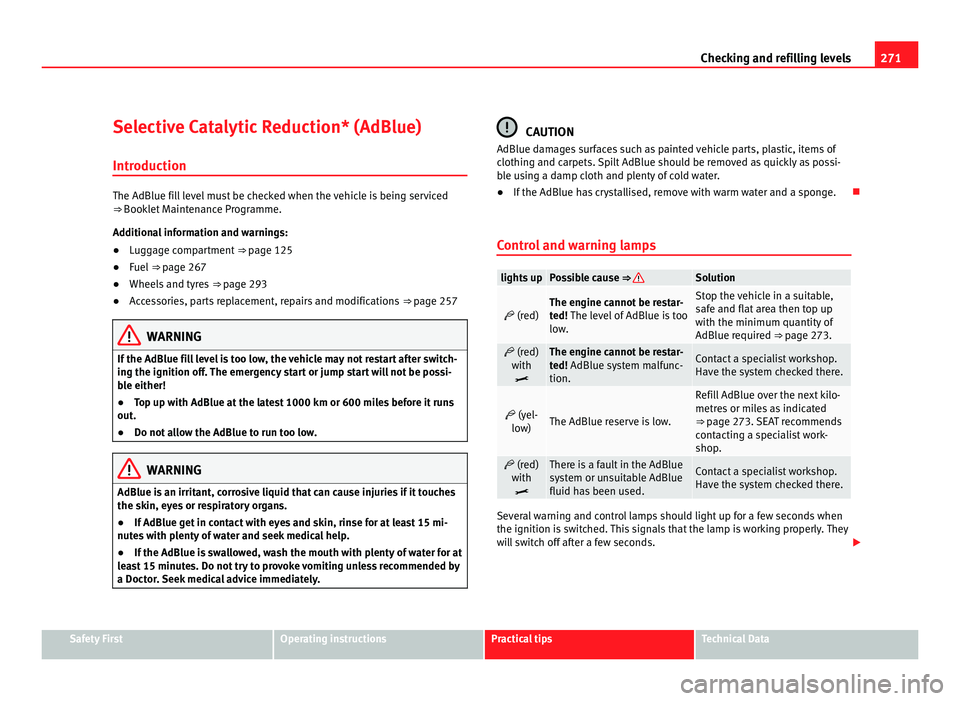
Control and warning lamps lights up Possible cause ⇒ Solution
(red) The engine cannot be restar-
ted!
The l
evel of AdBlue is too
low. Stop the vehicle in a suitable,
saf
e and fl
at area then top up
with the minimum quantity of
AdBlue required ⇒ page 273. (red)
with
The engine cannot be restar-
ted!
AdBlue sy
stem malfunc-
tion. Contact a specialist workshop.
Have the sy
s
tem checked there.
(yel-
lo w) The AdBlue reserve is low. Refill AdBlue over the next kilo-
metre
s
or miles as indicated
⇒ page 273. SEAT recommends
contacting a specialist work-
shop. (red)
with
There is a fault in the AdBlue
sys
t
em or unsuitable AdBlue
fluid has been used. Contact a specialist workshop.
Have the sy
s
tem checked there. Several warning and control lamps should light up for a few seconds when
the ignition is
sw
itched. This signals that the lamp is working properly. They
will switch off after a few seconds. Safety First Operating instructions Practical tips Technical Data