maintenance Seat Alhambra 2011 Owner's Guide
[x] Cancel search | Manufacturer: SEAT, Model Year: 2011, Model line: Alhambra, Model: Seat Alhambra 2011Pages: 385, PDF Size: 7.92 MB
Page 281 of 385
279
Checking and refilling levels CAUTION
● To avoid damage to the bonnet and to the windscreen wiper arms, only
open the bonnet when the w
indscreen wipers are in place against the wind-
screen.
● Before driving, always lower the wiper arms.
Engine oil Introduction Additional information and warnings:
●
⇒ Book l
et Maintenance Programme
● W
orking in the engine compartment ⇒ page 275
● A
ccessories, parts replacement, repairs and modifications ⇒ page 257WARNING
Incorrectly handling engine oil can cause injury and serious burns.
● Always protect your eyes when handling engine oil.
● Oil is toxic and must be kept out of the reach of children.
● Engine oil must only be kept closed in its original container. The same
app lie
s to use oil until it has been disposed of.
● Never store engine oil in empty food containers or bottles as other
people m
ay accidentally drink it.
● Regular contact with engine oil can be bad for the skin. If you come
into cont
act with engine oil, wash your skin with soap and water.
● With the engine running, the engine oil gets extremely hot and can
cause sev
ere skin burns. Always wait until the engine has fully cooled. For the sake of the environment
Similar to the other service liquids, spilled engine oil can be bad for the en-
vir onment
. Collect any spilt fluids in suitable containers and dispose of in
accordance with legislation and with the utmost respect for the environ-
ment.
Warning and control lamps lights up Possible cause Solution
Insufficient engine oil. Switch the engine off. Check the
engine oi
l
level ⇒ page 281. flashes Possible cause Solution
Engine oil pressure too low.
Stop the vehicle!
Sw it
ch off the engine. Check the
engine oil level.
- If the warning indicator flashes
although the oil level is correct,
do not continue driving or leave
the engine running. Otherwise,
the engine could be damaged.
You should obtain professional
assistance. Engine oil sensor faulty. Contact a specialist workshop.
Have the en
gine oi
l sensor
checked. Safety First Operating instructions Practical tips Technical Data
Page 284 of 385
282
Checking and refilling levels
● Unscrew the cap from engine oil filler opening on the cylinder head
⇒ fig. 169
. If you are not sure where the cap is, request help from a special-
ist.
● Only refill using engine oil expressly approved by SEAT and in small
quantities (not
more than 0.5 l or 1/2 a quarter of a gallon at a time)
⇒ page 280.
● To avoid adding too much oil, each time you add a quantity, wait until
the oil h
as flowed into the crankcase so that it can be measured with the
dipstick.
● Check the oil level before adding any more oil. Do not top up with too
much engine oi
l ⇒ .
● When the oil level is in at least the ⇒ fig. 168 B zone, insert the dip-
stic k
into the tube fully to avoid engine oil escaping when the engine is run-
ning.
● After topping up the oil, ensure that the cap is screwed on to the filler
mouth correctly
. WARNING
Oil could catch fire if it comes into contact with hot engine components.
This c
ould lead to a fire, explosion and severe injuries.
● Always ensure that after topping of oil, the engine oil filler cap is cor-
rectly tight
ened. This will avoid engine oil spilling onto hot engine parts
when the engine is running. CAUTION
● If the oil level is above the area A do not start the engine. You should
obt ain pr
ofessional assistance. Otherwise catalytic converter and engine
damage may occur.
● When refilling or changing service liquids, ensure that you put the liq-
uids int
o the right tank. Making a mistake when refilling could cause seri-
ous malfunctions and damage the engine! For the sake of the environment
The oil level must never be above area A . Otherwise oil can be drawn in
through the c r
ankcase breather and escape into the atmosphere via the ex-
haust system.
Engine oil consumption The consumption of engine oil can be different from one engine to another
and can
v
ary during the useful life of the engine.
Depending on driving style and the conditions of use, the consumption of
engine oil can reach 1 litre every 2000 km (one quarter of a gallon every
1200 miles); for new vehicles, this could be higher for the first 5000 km
(3000 miles). For this reason the engine oil level must be checked at regular
intervals, preferably when filling the tank and before a journey.
When the engine is working hard, for instance during sustained high-speed
motorway cruising in summer, when towing a trailer or climbing mountain
passes, the oil level should preferably be kept within area ⇒ fig. 168 A .
Changing the engine oil The engine oil must be changed regularly according to the specifications of
the Maint
en
ance Programme.
Due to the problems linked with disposing of used oil and the need for suit-
able tools and special knowledge, always visit a Technical Service to have
the engine oil and filter changed. SEAT recommends visiting a Technical
Service.
Detailed information on the service intervals are shown in the Maintenance
Programme.
Page 290 of 385
288
Checking and refilling levels
Vehicle battery
Introduction The battery is a component of the vehicle's electrical system.
Never w
ork
on the electrical system without fully understanding the opera-
tions required, the applicable safety standards and without the correct tools
⇒ ! Have the work carried out by a Technical Service if you are uncertain.
SEA T r
ecommends visiting a Technical Service. Negligent work can cause
serious injury.
Location and number of batteries in the vehicle
The battery is located in the engine compartment.
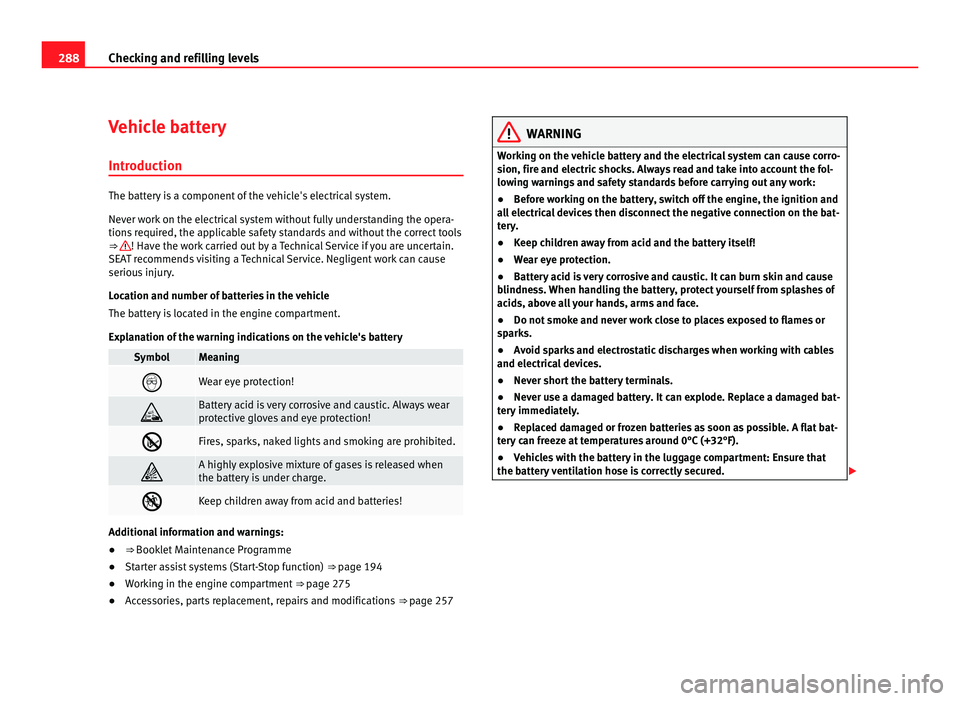
Explanation of the warning indications on the vehicle's battery Symbol Meaning
Wear eye protection!
Battery acid is very corrosive and caustic. Always wear
prot
ectiv
e gloves and eye protection! Fires, sparks, naked lights and smoking are prohibited.
A highly explosive mixture of gases is released when
the batt
er
y is under charge. Keep children away from acid and batteries!
Additional information and warnings:
●
⇒ Book l
et Maintenance Programme
● St
arter assist systems (Start-Stop function) ⇒ page 194
● W
orking in the engine compartment ⇒ page 275
● A
ccessories, parts replacement, repairs and modifications ⇒ page 257 WARNING
Working on the vehicle battery and the electrical system can cause corro-
sion, fir e and el
ectric shocks. Always read and take into account the fol-
lowing warnings and safety standards before carrying out any work:
● Before working on the battery, switch off the engine, the ignition and
all
electrical devices then disconnect the negative connection on the bat-
tery.
● Keep children away from acid and the battery itself!
● Wear eye protection.
● Battery acid is very corrosive and caustic. It can burn skin and cause
blindnes
s. When handling the battery, protect yourself from splashes of
acids, above all your hands, arms and face.
● Do not smoke and never work close to places exposed to flames or
spark
s.
● Avoid sparks and electrostatic discharges when working with cables
and electrica
l devices.
● Never short the battery terminals.
● Never use a damaged battery. It can explode. Replace a damaged bat-
tery
immediately.
● Replaced damaged or frozen batteries as soon as possible. A flat bat-
tery
can freeze at temperatures around 0°C (+32°F).
● Vehicles with the battery in the luggage compartment: Ensure that
the batter
y ventilation hose is correctly secured.
Page 292 of 385
290
Checking and refilling levels
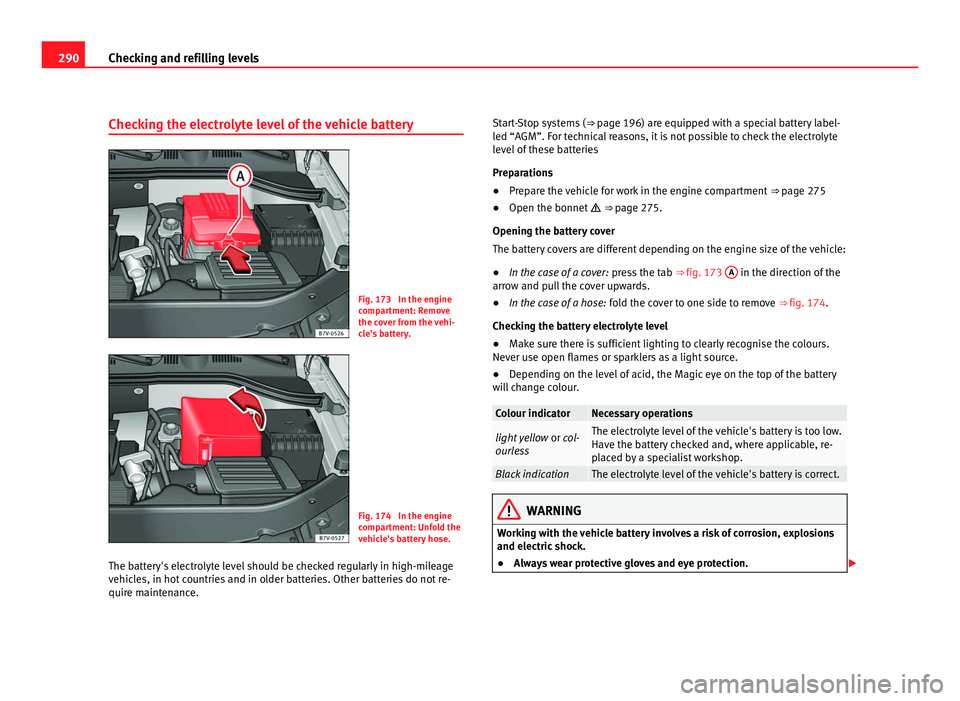
Checking the electrolyte level of the vehicle battery Fig. 173 In the engine
comp
ar
tment: Remove
the cover from the vehi-
cle's battery. Fig. 174 In the engine
comp
ar
tment: Unfold the
vehicle's battery hose.
The battery's electrolyte level should be checked regularly in high-mileage
vehicl
es, in hot countries and in older batteries. Other batteries do not re-
quire maintenance. Start-Stop systems (
⇒ page 196) ar
e equipped with a special battery label-
led “AGM”. For technical reasons, it is not possible to check the electrolyte
level of these batteries
Preparations
● Prepare the vehicle for work in the engine compartment ⇒ page 275
● Open the bonnet
⇒ p
age 275.
Opening the battery cover
The battery covers are different depending on the engine size of the vehicle:
● In the case of a cover: pres
s the tab ⇒ fig. 173 A in the direction of the
arro w and p
ull the cover upwards.
● In the case of a hose: fol
d the cover to one side to remove ⇒ fig. 174.
Checking the battery electrolyte level
● Make sure there is sufficient lighting to clearly recognise the colours.
Never use open fl
ames or sparklers as a light source.
● Depending on the level of acid, the Magic eye on the top of the battery
wil
l change colour. Colour indicator Necessary operations
light yellow
or col
-
ourless The electrolyte level of the vehicle's battery is too low.
Have the b
att
ery checked and, where applicable, re-
placed by a specialist workshop. Black indication The electrolyte level of the vehicle's battery is correct.
WARNING
Working with the vehicle battery involves a risk of corrosion, explosions
and electric shoc
k.
● Always wear protective gloves and eye protection.
Page 293 of 385
291
Checking and refilling levels WARNING (Continued)
● Battery acid is very corrosive and caustic. It can burn skin and cause
b lindne
ss. When handling the battery, protect yourself from splashes of
acids, above all your hands, arms and face.
● Never tilt the vehicle battery. Battery acid could spill out of the open-
ings
to release gases and cause corrosion damage.
● Never open the vehicle battery.
● If battery acid splashes on you, immediately rinse your eyes and skin
abund
antly with water for several minutes. Then seek medical care imme-
diately.
● If acid is swallowed by mistake, consult a doctor immediately.
Charging, replacing and connecting or disconnecting the
batt er
y Charging the battery
The v
ehic
le battery should be charged by a specialist workshop only, as bat-
teries using special technology have been installed and they must be charg-
ed in a controlled environment ⇒ . SEAT recommends visiting a Technical
Serv ic
e.
Replacing a vehicle battery
The battery has been developed to suit the conditions of its location and
has special safety features. If the battery must be replaced, consult a quali-
fied SEAT workshop for information on electromagnetic compatibility, the
size and maintenance, performance and safety requirements of the new bat-
tery in your vehicle before you purchase one. SEAT recommends you have
the battery replaced by a qualified SEAT workshop.
Use only maintenance-free genuine batteries conforming to TL 825 06 and
VW 7 50 73 Standards. These standards must be dated April 2008 or later. Start-Stop systems (
⇒ page 196) ar
e equipped with a special battery. There-
fore, it must only be replaced with a battery of the same specifications.
Disconnecting the vehicle's battery
If you must disconnect the battery from the electrical system, please note
the following:
● Switch off the ignition and all electrical equipment.
● The vehicle must be unlocked before disconnecting the battery, other-
wise the al
arm will be triggered.
● First disconnect the negative cable and then the positive ⇒ .
Connectin g the
vehicle's battery
● Before reconnecting the battery, switch off the engine, the ignition and
electric dev
ices.
● First reconnect the positive cable and then the negative ⇒ .
Differ ent
control lamps may light up after connecting the battery and switch-
ing the ignition on. They will be turned off after a short trip at a speed of
between 15 - 20 km/h (10 - 12 mph). If the warning indicators remain lit,
please visit a specialised workshop to have the vehicle checked.
If the battery has been disconnected for a long time, it is possible that the
next service date is not displayed or calculated correctly ⇒ page 57. Respect
the maximum service intervals permitted ⇒ Booklet Maintenance Pro-
gramme.
Automatic consumer disconnection
The intelligent vehicle electrical system automatically implements a range
of measures to prevent the battery from discharging when high demands
are made on it: Safety First Operating instructions Practical tips Technical Data
Page 294 of 385
292
Checking and refilling levels
● the idling s peed i s increased so that the alternator provides more elec-
tricity.
● where necessary, the power of the most powerful consumers is reduced
or even comp
letely disconnected.
● On starting the engine, the power supply from the 12-volt sockets and
the cigar
ette lighter may be interrupted for a short time.
The on-board management program cannot always prevent the battery from
running flat. For example, if the ignition is left on for a long period with the
engine off or if the side lights or parking lights are left on while the vehicle
is stationary.
Why does the battery run flat?
● When stationary for a long time without starting the engine, particularly
if the ignition is
switched on.
● Use of electrical consumers with the engine switched off.
● If the auxiliary heater is running ⇒ page 163.WARNING
Incorrectly securing the battery or using the wrong battery can cause
short -c
ircuits, fire and serious injuries.
● Always use only maintenance free batteries that do not run flat alone
and whose proper
ties, specifications and size correspond to the stand-
ard battery. The specifications are indicated on the battery case. WARNING
A highly explosive mixture of gases is released when the battery is under
ch ar
ge.
● The batteries should be charged in a well-ventilated room only.
● Never charge a frozen or recently thawed battery. A flat battery can
freeze at
temperatures around 0°C (+32°F). WARNING (Continued)
● Always replace a battery which has frozen.
● B
att
ery cables not correctly connected may cause a short circuit. Re-
connect fir
st the positive cable and then the negative cable. CAUTION
● Never disconnect the battery if the ignition is switched on or if the en-
gine i s
running. This could damage the electrical system or electronic com-
ponents.
● Never plug accessories supply current, such as solar panels or a battery
char
ger, to the 12-volt sockets or the cigarette lighter. This could damage
the vehicle's electrical system. For the sake of the environment
● Dispose of the battery in an environment-friendly manner. Batteries con-
t ain t
oxic substances such as sulphuric acid and lead.
● Battery acid can contaminate the environment. Collect any spilt service
fluids and al
low a dispose of them correctly.
Page 346 of 385
344
General notes on the technical data
Technical Data
Genera l
notes on the technical data
Outstanding information
Important All data in the official vehicle documents take precedence
ov
er
this data.
All data provided in this manual are valid for the standard model in Spain.
The vehicle data card included in the Inspection and Maintenance Plan in
the vehicles registration documents show which engine is installed in the
vehicle.
The figures may be different depending on if additional equipment is fitted,
for different models, for special vehicles and for other countries.
Additional information and warnings:
● Transporting ⇒ page 13
● E
cological driving ⇒ page 225
● F
uel ⇒ page 267
● Engine oi
l ⇒ page 279
● En
gine coolant ⇒ page 283
● Wheel
s and tyres ⇒ page 293
● Not
es for the user ⇒ page 255 Abbr
eviations used in the Technical Data section Abbrevia-
tion Meaning
kW Kilowatt, engine power measurement.
PS Pferdestärke (horsepower), formerly used to denote engine
pow
er
. rpm Revolutions per minute - engine speed.
Nm Newton metres, unit of engine torque.
l/100 km Fuel consumption in litres per 100 km.
g/km Carbon dioxide emissions in grams per km travelled.
CO
2 Carbon dioxide
CN Cetane number, indication of the diesel combustion power.
RON Research octane number, indication of the knock resistance
of petr
o
l. WARNING
Failure to observe requirements for weight, loads, dimensions and maxi-
mum speed m a
y lead to severe accident.
Page 347 of 385
345
General notes on the technical data
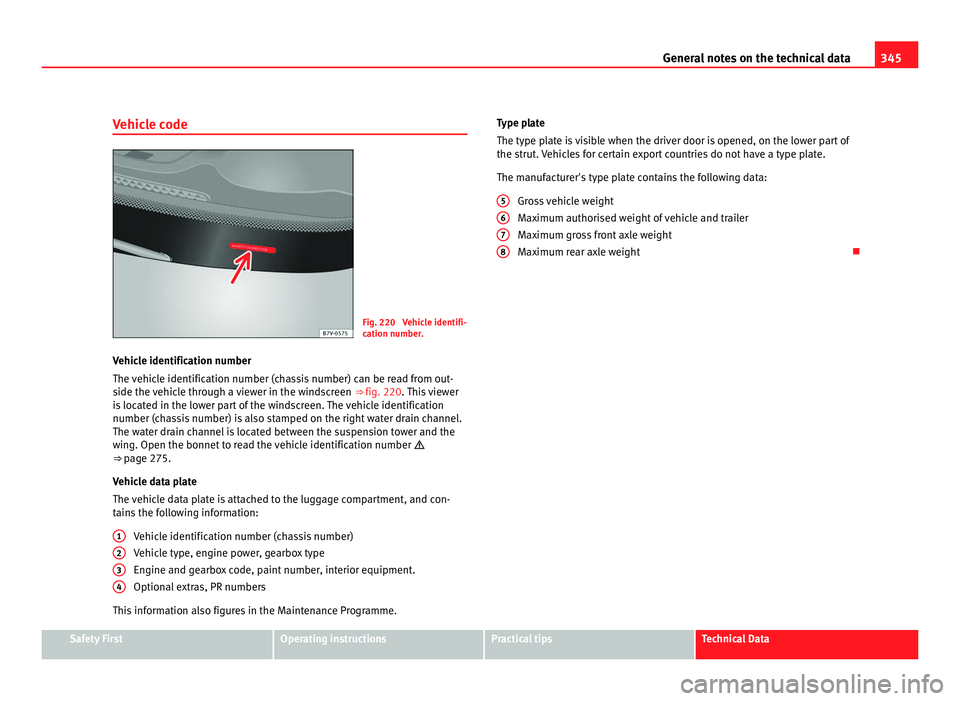
Vehicle code Fig. 220 Vehicle identifi-
cation number
.
V
ehicle identification number
The vehic
le identification number (chassis number) can be read from out-
side the vehicle through a viewer in the windscreen ⇒ fig. 220. This viewer
is located in the lower part of the windscreen. The vehicle identification
number (chassis number) is also stamped on the right water drain channel.
The water drain channel is located between the suspension tower and the
wing. Open the bonnet to read the vehicle identification number
⇒ page 275.
Vehicle data plate
The vehicle data plate is attached to the luggage compartment, and con-
tains the following information:
Vehicle identification number (chassis number)
Vehicle type, engine power, gearbox type
Engine and gearbox code, paint number, interior equipment.
Optional extras, PR numbers
This information also figures in the Maintenance Programme. 1 2
3
4 Type plate
The type pl
at
e is visible when the driver door is opened, on the lower part of
the strut. Vehicles for certain export countries do not have a type plate.
The manufacturer's type plate contains the following data:
Gross vehicle weight
Maximum authorised weight of vehicle and trailer
Maximum gross front axle weight
Maximum rear axle weight 5
6
7
8
Safety First Operating instructions Practical tips Technical Data
Page 375 of 385
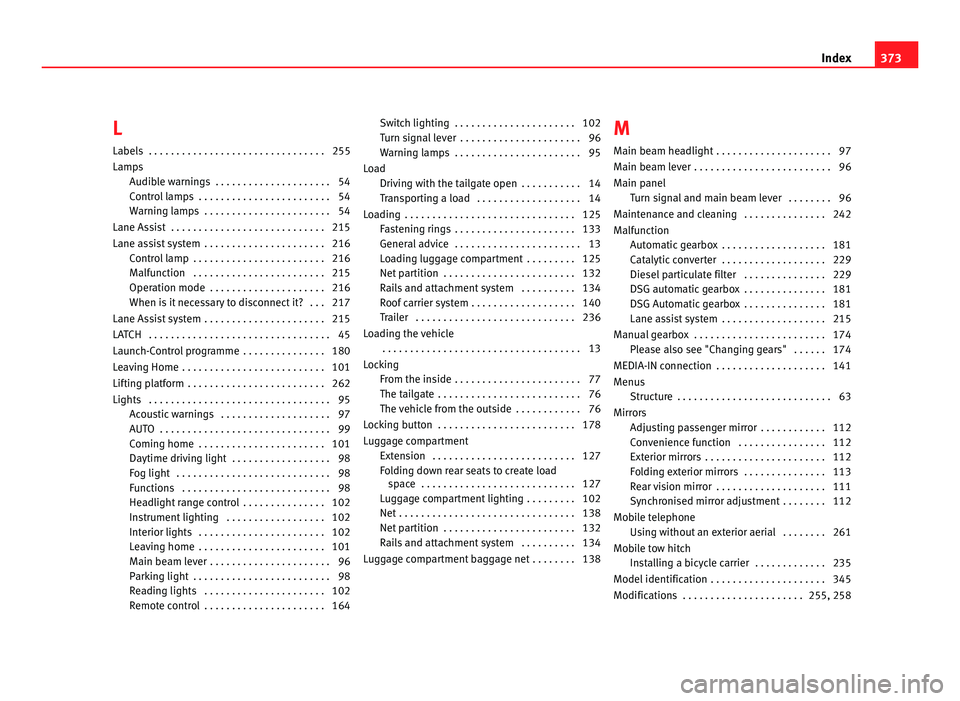
L
Labels . . . . . . . . . . . . . . . . . . . . . . . . . . . . . . . . 255
Lamp
s
Audible warnings . . . . . . . . . . . . . . . . . . . . . 54
Control lamps . . . . . . . . . . . . . . . . . . . . . . . . 54
Warning lamps . . . . . . . . . . . . . . . . . . . . . . . 54
Lane Assist . . . . . . . . . . . . . . . . . . . . . . . . . . . . 215
Lane assist system . . . . . . . . . . . . . . . . . . . . . . 216 Control lamp . . . . . . . . . . . . . . . . . . . . . . . . 216
Malfunction . . . . . . . . . . . . . . . . . . . . . . . . 215
Operation mode . . . . . . . . . . . . . . . . . . . . . 216
When is it necessary to disconnect it? . . . 217
Lane Assist system . . . . . . . . . . . . . . . . . . . . . . 215
LATCH . . . . . . . . . . . . . . . . . . . . . . . . . . . . . . . . . 45
Launch-Control programme . . . . . . . . . . . . . . . 180
Leaving Home . . . . . . . . . . . . . . . . . . . . . . . . . . 101
Lifting platform . . . . . . . . . . . . . . . . . . . . . . . . . 262
Lights . . . . . . . . . . . . . . . . . . . . . . . . . . . . . . . . . 95 Acoustic warnings . . . . . . . . . . . . . . . . . . . . 97
AUTO . . . . . . . . . . . . . . . . . . . . . . . . . . . . . . . 99
Coming home . . . . . . . . . . . . . . . . . . . . . . . 101
Daytime driving light . . . . . . . . . . . . . . . . . . 98
Fog light . . . . . . . . . . . . . . . . . . . . . . . . . . . . 98
Functions . . . . . . . . . . . . . . . . . . . . . . . . . . . 98
Headlight range control . . . . . . . . . . . . . . . 102
Instrument lighting . . . . . . . . . . . . . . . . . . 102
Interior lights . . . . . . . . . . . . . . . . . . . . . . . 102
Leaving home . . . . . . . . . . . . . . . . . . . . . . . 101
Main beam lever . . . . . . . . . . . . . . . . . . . . . . 96
Parking light . . . . . . . . . . . . . . . . . . . . . . . . . 98
Reading lights . . . . . . . . . . . . . . . . . . . . . . 102
Remote control . . . . . . . . . . . . . . . . . . . . . . 164 Switch lighting . . . . . . . . . . . . . . . . . . . . . . 102
Turn sign
al lever . . . . . . . . . . . . . . . . . . . . . . 96
Warning lamps . . . . . . . . . . . . . . . . . . . . . . . 95
Load Driving with the tailgate open . . . . . . . . . . . 14
Transporting a load . . . . . . . . . . . . . . . . . . . 14
Loading . . . . . . . . . . . . . . . . . . . . . . . . . . . . . . . 125 Fastening rings . . . . . . . . . . . . . . . . . . . . . . 133
General advice . . . . . . . . . . . . . . . . . . . . . . . 13
Loading luggage compartment . . . . . . . . . 125
Net partition . . . . . . . . . . . . . . . . . . . . . . . . 132
Rails and attachment system . . . . . . . . . . 134
Roof carrier system . . . . . . . . . . . . . . . . . . . 140
Trailer . . . . . . . . . . . . . . . . . . . . . . . . . . . . . 236
Loading the vehicle . . . . . . . . . . . . . . . . . . . . . . . . . . . . . . . . . . . .13
Locking From the inside . . . . . . . . . . . . . . . . . . . . . . . 77
The tailgate . . . . . . . . . . . . . . . . . . . . . . . . . . 76
The vehicle from the outside . . . . . . . . . . . . 76
Locking button . . . . . . . . . . . . . . . . . . . . . . . . . 178
Luggage compartment Extension . . . . . . . . . . . . . . . . . . . . . . . . . . 127
Folding down rear seats to create loadspace . . . . . . . . . . . . . . . . . . . . . . . . . . . . 127
Luggage compartment lighting . . . . . . . . . 102
Net . . . . . . . . . . . . . . . . . . . . . . . . . . . . . . . . 138
Net partition . . . . . . . . . . . . . . . . . . . . . . . . 132
Rails and attachment system . . . . . . . . . . 134
Luggage compartment baggage net . . . . . . . . 138 M
Main beam he adlight . . . . . . . . . . . . . . . . . . . . . 97
Main beam lever . . . . . . . . . . . . . . . . . . . . . . . . . 96
Main panel Turn signal and main beam lever . . . . . . . . 96
Maintenance and cleaning . . . . . . . . . . . . . . . 242
Malfunction Automatic gearbox . . . . . . . . . . . . . . . . . . . 181
Catalytic converter . . . . . . . . . . . . . . . . . . . 229
Diesel particulate filter . . . . . . . . . . . . . . . 229
DSG automatic gearbox . . . . . . . . . . . . . . . 181
DSG Automatic gearbox . . . . . . . . . . . . . . . 181
Lane assist system . . . . . . . . . . . . . . . . . . . 215
Manual gearbox . . . . . . . . . . . . . . . . . . . . . . . . 174 Please also see "Changing gears" . . . . . . 174
MEDIA-IN connection . . . . . . . . . . . . . . . . . . . . 141
Menus Structure . . . . . . . . . . . . . . . . . . . . . . . . . . . . 63
Mirrors Adjusting passenger mirror . . . . . . . . . . . . 112
Convenience function . . . . . . . . . . . . . . . . 112
Exterior mirrors . . . . . . . . . . . . . . . . . . . . . . 112
Folding exterior mirrors . . . . . . . . . . . . . . . 113
Rear vision mirror . . . . . . . . . . . . . . . . . . . . 111
Synchronised mirror adjustment . . . . . . . . 112
Mobile telephone Using without an exterior aerial . . . . . . . . 261
Mobile tow hitch Installing a bicycle carrier . . . . . . . . . . . . . 235
Model identification . . . . . . . . . . . . . . . . . . . . . 345
Modifications . . . . . . . . . . . . . . . . . . . . . . 255, 258 373
Index