wheel Seat Alhambra 2011 Manual Online
[x] Cancel search | Manufacturer: SEAT, Model Year: 2011, Model line: Alhambra, Model: Seat Alhambra 2011Pages: 385, PDF Size: 7.92 MB
Page 312 of 385
310
Wheels and tyres
Check list
For y
our own safety and that of other passengers, the following points
should be observed in the order given ⇒ :
Select a s
uitable flat and firm surface for raising the vehicle.
Switch off the engine, engage a gear (manual gearbox) or place the se-
lector lever in position P ⇒ page 174 and turn on the electronic parking
brake ⇒ page 183.
When towing a trailer: unhook the trailer from the towing vehicle and
park it correctly.
Loosen the wheel bolts on the wheel to be changed ⇒ page 307.
Look below the vehicle for the jacking point ⇒ fig. 183 closest to the
tyre which has to be changed.
Raise the jack with the handle until it can be inserted below the jacking
point.
Ensure that the foot of the jack is firmly on the ground and that it is
placed immediately below the lifting point on the vehicle ⇒ fig. 184.
Straighten the jack and continue raising it using the handle until the
claw holds the vertical reinforcement beneath the vehicle ⇒ fig. 184.
Raise the vehicle until the wheel is clear of the ground. WARNING
If the vehicle is not correctly raised, it could fall off the jack causing seri-
ous injur
y. Please observe the following rules to minimise the risk of in-
jury:
● You should only use a jack approved by SEAT for your vehicle. Other
jack
s, even those approved for other SEAT models, might slip out of
place.
● The ground should be firm and flat. If the ground is sloped or soft
then the vehic
le could slip and fall off the jack. If necessary, support the
jack on a wide solid base. 1.
2.
3.
4.
5.
6.
7.
8.
9. WARNING (Continued)
● If the ground is slippery (for example, on tiles), place a non-slip sur-
f ac
e (for example a floor mat) beneath the jack to avoid slipping.
● Only fit the jack at the prescribed jacking points. The claw of the jack
should grip the r
einforcement nerve on the underbody ⇒ fig. 184.
● You should never have any limbs beneath a raised vehicle which is
only s
upported by a jack.
● If you have to work underneath the vehicle, you must use suitable
stand
s additionally to support the vehicle, there is a risk of accident!.
● Never raise the vehicle if it is tilting to one side or the engine is run-
ning.
● Never s
tart the engine when the vehicle is raised. The vehicle may
come loose fr
om the jack due to the engine vibrations. WARNING
Failure to follow the checklist prepared for your own safety could lead to
acc ident
s and severe injuries.
● Always complete the operations given in the checklist and observe
the genera
l rules of safety.
Page 313 of 385
311
Wheels and tyres
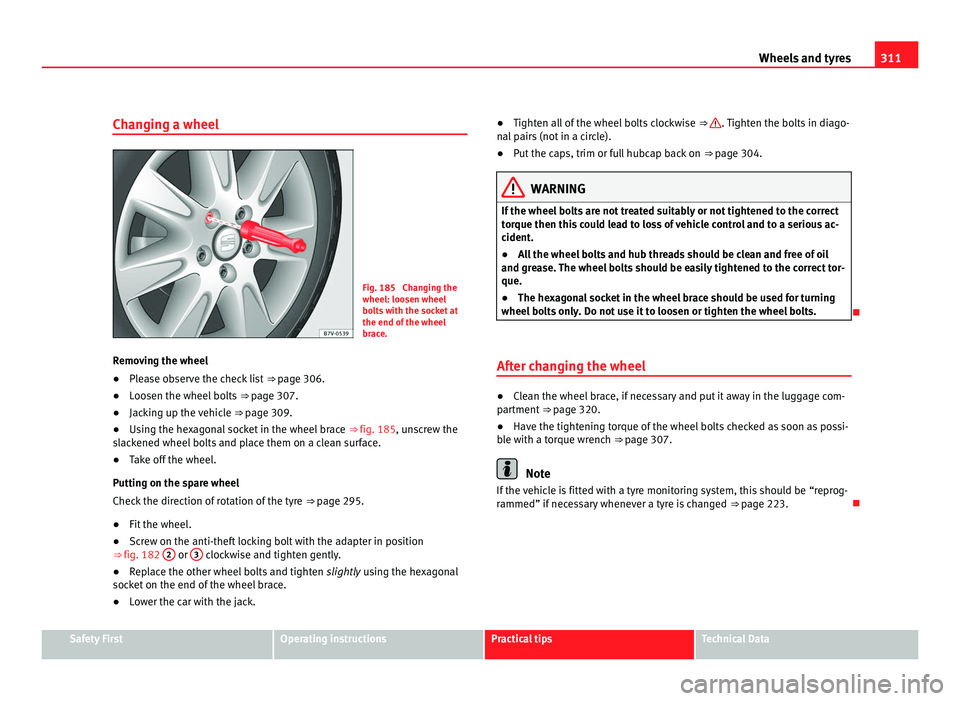
Changing a wheel Fig. 185 Changing the
wheel: loosen wheel
bo
lt
s with the socket at
the end of the wheel
brace.
Removing the wheel
● Please observe the check list ⇒ page 306.
● L
oosen the wheel bolts ⇒ page 307.
● Jac
king up the vehicle ⇒ page 309.
● U
sing the hexagonal socket in the wheel brace ⇒ fig. 185, uns
crew the
slackened wheel bolts and place them on a clean surface.
● Take off the wheel.
Putting on the s
pare wheel
Check the direction of rotation of the tyre ⇒ page 295.
● Fit the wheel.
● Screw on the anti-theft locking bolt with the adapter in position
⇒ fig. 182 2 or
3 clockwise and tighten gently.
● Replace the other wheel bolts and tighten slightl
y using the hexagonal
socket on the end of the wheel brace.
● Lower the car with the jack. ●
Tighten all of the wheel bolts clockwise ⇒ . Tighten the bolts in diago-
nal p
airs (not in a circle).
● Put the caps, trim or full hubcap back on ⇒ page 304. WARNING
If the wheel bolts are not treated suitably or not tightened to the correct
tor que then thi
s could lead to loss of vehicle control and to a serious ac-
cident.
● All the wheel bolts and hub threads should be clean and free of oil
and grea
se. The wheel bolts should be easily tightened to the correct tor-
que.
● The hexagonal socket in the wheel brace should be used for turning
wheel bolt
s only. Do not use it to loosen or tighten the wheel bolts.
After changing the wheel ●
Clean the wheel brace, if necessary and put it away in the luggage com-
par tment
⇒ page 320.
● Have the tightening torque of the wheel bolts checked as soon as possi-
ble w
ith a torque wrench ⇒ page 307. Note
If the vehicle is fitted with a tyre monitoring system, this should be “reprog-
rammed” if nec
essary whenever a tyre is changed ⇒ page 223.Safety First Operating instructions Practical tips Technical Data
Page 321 of 385
319
If and when
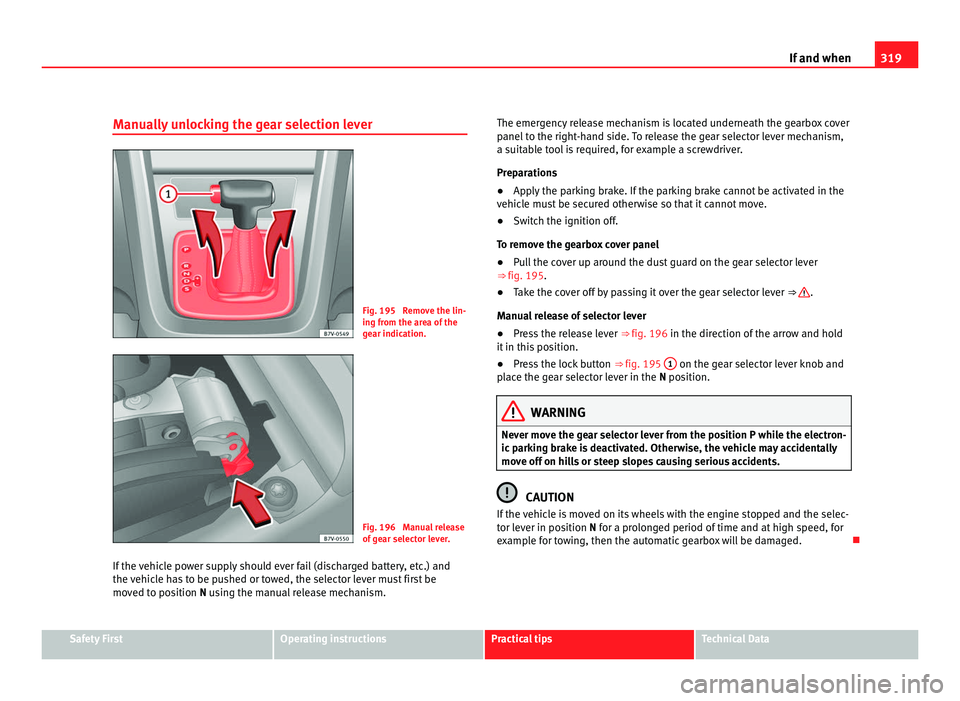
Manually unlocking the gear selection lever Fig. 195 Remove the lin-
ing fr
om the ar
ea of the
gear indication. Fig. 196 Manual release
of g
e
ar selector lever.
If the vehicle power supply should ever fail (discharged battery, etc.) and
the vehic
le has to be pushed or towed, the selector lever must first be
moved to position N using the manual release mechanism. The emergency release mechanism is located underneath the gearbox cover
panel t
o the right-hand side. To release the gear selector lever mechanism,
a suitable tool is required, for example a screwdriver.
Preparations
● Apply the parking brake. If the parking brake cannot be activated in the
vehicl
e must be secured otherwise so that it cannot move.
● Switch the ignition off.
To remo
ve the gearbox cover panel
● Pull the cover up around the dust guard on the gear selector lever
⇒ fig. 195.
● Take the cover off by passing it over the gear selector lever ⇒ .
Manua l
release of selector lever
● Press the release lever ⇒ fig. 196 in the direction of the arr
ow and hold
it in this position.
● Press the lock button ⇒ fig. 195 1 on the gear selector lever knob and
pl ac
e the gear selector lever in the N position. WARNING
Never move the gear selector lever from the position P while the electron-
ic p ark
ing brake is deactivated. Otherwise, the vehicle may accidentally
move off on hills or steep slopes causing serious accidents. CAUTION
If the vehicle is moved on its wheels with the engine stopped and the selec-
tor l ev
er in position N for a prolonged period of time and at high speed, for
example for towing, then the automatic gearbox will be damaged. Safety First Operating instructions Practical tips Technical Data
Page 322 of 385
320
If and when
Tools*
Introduction When securing the vehicle in case of a breakdown, please note the legal re-
quirements
f
or each country.
Additional information and warnings:
● Working in the engine compartment ⇒ page 275
● Ch
ange wheel ⇒ pag
e 305
● In case of emergency ⇒ pag
e 312WARNING
Loose objects in the passenger compartment can be violently fired
through the c omp
artment in case of a sudden manoeuvre or braking and
especially in accidents causing serious injury.
● Make sure that the vehicle tools are stored safely in the luggage com-
partment
. WARNING
Unsuitable or damaged on-board tools can cause injury or accidents.
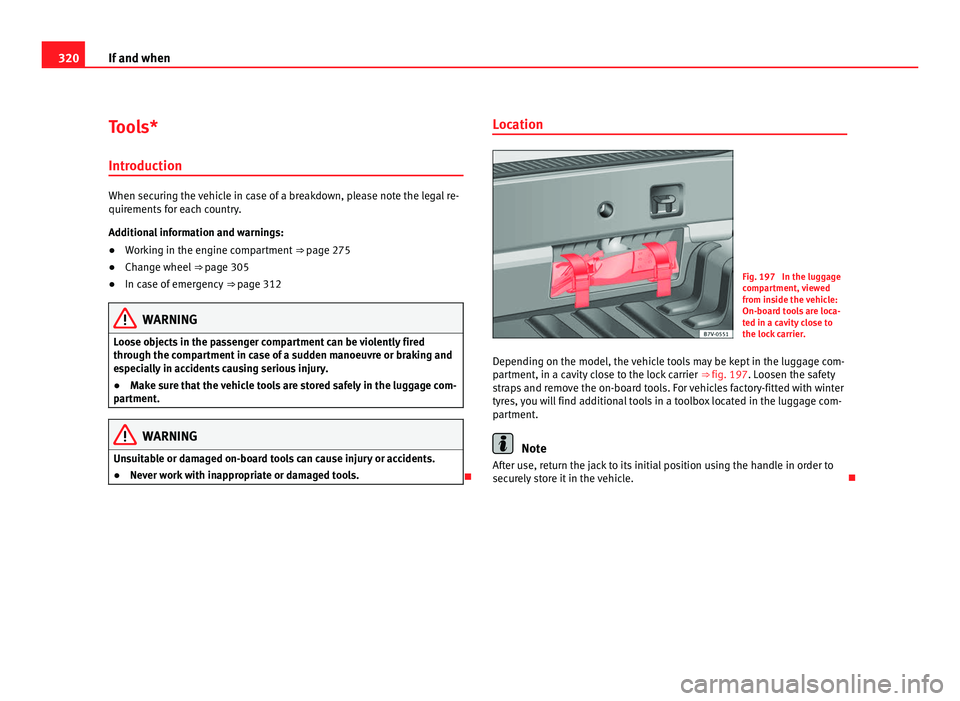
● Never work with inappropriate or damaged tools. Location Fig. 197 In the luggage
comp
ar
tment, viewed
from inside the vehicle:
On-board tools are loca-
ted in a cavity close to
the lock carrier.
Depending on the model, the vehicle tools may be kept in the luggage com-
partment, in a c
avity close to the lock carrier ⇒ fig. 197. Loosen the safety
straps and remove the on-board tools. For vehicles factory-fitted with winter
tyres, you will find additional tools in a toolbox located in the luggage com-
partment. Note
After use, return the jack to its initial position using the handle in order to
secur ely
store it in the vehicle.
Page 323 of 385
321
If and when
Components Fig. 198 Components of
the onboar
d t
ool kit.
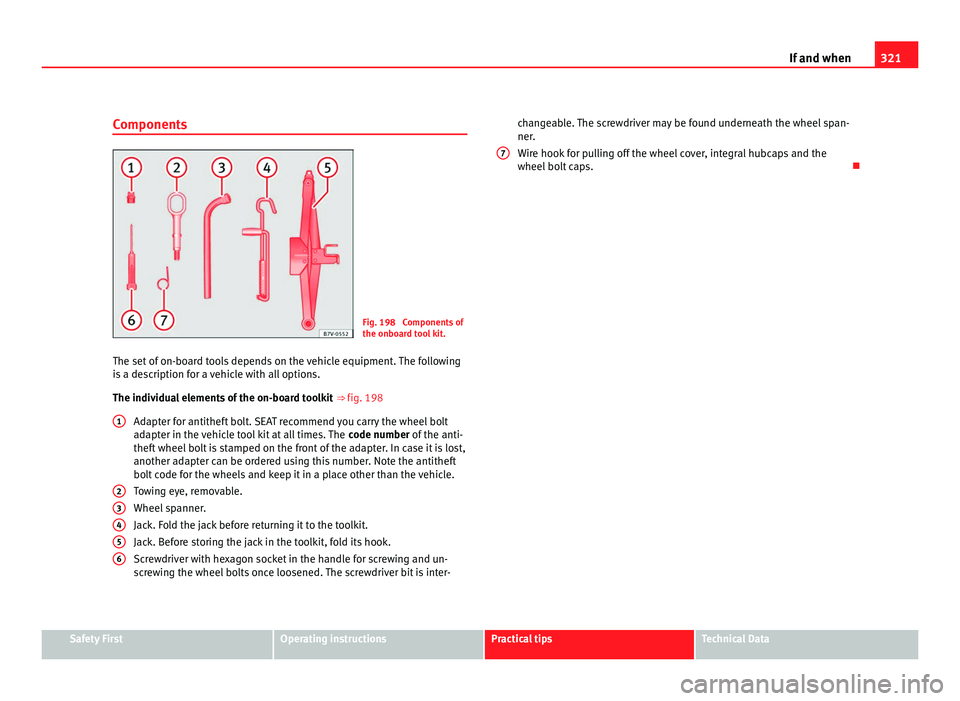
The set of on-board tools depends on the vehicle equipment. The following
is a de
scription for a vehicle with all options.
The individual elements of the on-board toolkit ⇒ fig. 198
Adapter for antitheft bolt. SEAT recommend you carry the wheel bolt
adapter in the vehicle tool kit at all times. The code number of the anti-
theft wheel bolt is stamped on the front of the adapter. In case it is lost,
another adapter can be ordered using this number. Note the antitheft
bolt code for the wheels and keep it in a place other than the vehicle.
Towing eye, removable.
Wheel spanner.
Jack. Fold the jack before returning it to the toolkit.
Jack. Before storing the jack in the toolkit, fold its hook.
Screwdriver with hexagon socket in the handle for screwing and un-
screwing the wheel bolts once loosened. The screwdriver bit is inter-
1 2
3
4
5
6 changeable. The screwdriver may be found underneath the wheel span-
ner.
W
ir
e hook for pulling off the wheel cover, integral hubcaps and the
wheel bolt caps. 7
Safety First Operating instructions Practical tips Technical Data
Page 342 of 385
340
If and when WARNING (Continued)
● Do not attach the negative cable to parts of the fuel system or to the
br ak
e hose/pipe.
● The non-insulated parts of the battery clamps must not be allowed to
touch. A
lso, the cable connected to the positive pole of the battery
should never enter into contact with electrically conductive parts of the
vehicle.
● Check the magic eye on the battery; use a lamp if necessary. If it is
cle
ar yellow or clear, do not start the vehicle: obtain specialist technical
assistance.
● Avoid static electricity discharges in the area around the battery. In
the event of
sparks, explosive gases coming from the battery could ig-
nite.
● Never use starting assistance if the vehicle battery is damaged, fro-
zen or ha
s been frozen.
Towing and tow starting Introduction When towing, always respect legal requirements.
For t
ec
hnical reasons, it is not possible to tow a vehicle if the battery is flat.
Additional information and warnings:
● Electronic power control and exhaust gases purification system
⇒ pag
e 228 WARNING
A vehicle with a flat battery should never be towed.
● Never remove the key from the ignition lock. The electronic steering
lock c
ould engage. Then the vehicle will be uncontrollable. You may lose
control of the vehicle and there is a risk of serious accident. WARNING
When towing the vehicle, the handling and braking efficiency change
cons
iderably. Please observe the following instructions to minimise the
risk of serious accidents and injury:
● As the driver of the vehicle being towed:
– The brake must be depressed must harder as the brake servo does
not operat
e. Always remain aware to avoid collision with the towing
vehicle.
– More strength is required at the steering wheel as the power steer-
ing does
not operate when the engine is switched off.
● As the driver of the towing vehicle:
– Accelerate gently and carefully.
– Avoid sudden braking and manoeuvres.
– Brake well in advance than usual and brake gently. CAUTION
● Carefully fit and remove the towing ring and its cover to avoid damage to
the v
ehicle (for example, paintwork).
● When towing, fuel could enter the catalytic converter and cause dam-
age!
Page 343 of 385
341
If and when
Instructions for tow starting In general, the vehicle should not be started by towing. Jump-starting is
much mor
e pr
eferable ⇒ page 337.
For technical reasons, the following vehicles can not be tow started:
● Vehicles with an automatic gearbox.
● Vehicles with an electronic parking brake, given that it is possible that
the brake w
ill not be disengaged.
● If the vehicle battery is flat, it is possible that the engine control units do
not operat
e correctly.
However, if your vehicle must absolutely be tow-started (manual gearbox):
● Engage the 2nd or 3rd gear.
● Keep the clutch pressed down.
● Switch on the ignition and the hazard warning lights.
● Release the clutch when both vehicles are moving.
● As soon as the engine starts, press the clutch and move the gear lever
into neutral
. This helps to prevent a collision with the towing vehicle. CAUTION
When tow-starting, fuel could enter the catalytic converter and damage it.
Towing instructions Tow-rope or tow-bar
When to
w
ing, the tow bar is the safest and vehicle friendly way. You should
only use a tow-rope if you do not have a tow-bar. A tow-rope should be slightly elastic to avoid damage to both vehicles. It is
advi
sable to use a tow-rope made of synthetic fibre or similarly elastic mate-
rial.
Only secure the tow rope or tow bar to the tow ring or specially designed
fitting.
Vehicles with a factory fitted towing device , can only be used for towing
with a tow-bar, specially designed to fit on a tow hitch ball ⇒ page 233.
Towing vehicles with an automatic gearbox
Note the following for a towed vehicle:
● Make sure the gear selector lever is in the N position.
● Do not
drive faster than 50 km/h (30 mph) when towing a vehicle.
● Do not tow further than 50 km (30 miles).
● If a breakdown truck is used, the vehicle must be towed with the front
wheels r
aised. Note the following instructions for towing four wheel drive
vehicles.
Instructions for towing four-wheel-drive vehicles
Four wheel drive vehicles can be towed using a toolbar or tow rope. If the
vehicle is towed with the front or rear axle raised, the engine must be turned
off to avoid transmission damage.
For vehicles with a double clutched DSG ®
(direct shift gearbox) the instruc-
tions for towing vehicles with an automatic gearbox apply ⇒ page 341.
Situations in which the vehicle should not be towed
In the following cases, the vehicle should not be towed but transported on a
trailer or special vehicle:
● If the vehicle gearbox does not contain lubricant due to a fault.
● If the vehicle battery is flat and, as a result, the electronic steering lock
and electronic
parking brake cannot be disengaged if applied.
● If the vehicle to be towed has an automatic gearbox and the distance to
be cov
ered is greater than 50 km (30 miles). Safety First Operating instructions Practical tips Technical Data
Page 345 of 385
343
If and when
Fitting the tow ring to the rear for vehicles without factory fitted tow hitch
● Take the tow ring from the on-board tools ⇒ page 320.
● Pr
ess on the upper cover and carefully remove it back. This may require
some stren
gth. Allow the cover to hang.
● Screw in the tow ring into its position anticlock
wise as far as it will go
⇒ . Use a suitable tool to firmly tighten the tow ring in its location.
● After towing, remove the tow ring by turning it clock
wise and put the
cover back in place. CAUTION
● The tow ring must always be completely and firmly tightened. Other-
w i
se, it could be released while towing and tow-starting.
● Vehicles with a factory fitted towing device, can on
ly be used for towing
with a tow-bar, specially designed to fit on a tow hitch ball. Otherwise, the
tow hitch ball and the vehicle may be damaged. Otherwise, a tow rope
should be used.
Towing advice Towing requires some experience, especially when using a tow-rope. Both
driver
s
should be familiar with the technique required for towing. For this
reason, inexperienced drivers should abstain.
While driving, avoid excessive traction forces and jerking. When towing on
an unpaved road, there is always a risk of overloading and damaging the
anchorage points.
If the vehicle is towed, with the hazard warning lights on and the ignition
switched on, the turn signal may be used to indicate changes of direction.
Simply operate the turn indicator lever as usual. Meanwhile, the hazard
warning lights will go off. When the turn signal lever is returned to the rest
position, the hazard warning lights will be turned on automatically. Notes for the driver of the towed vehicle
●
Leave the ignition on to avoid locking the steering wheel, to release the
electronic
parking brake and to activate the turn signal indicators, the horn
as well as the window wipers and window washers.
● As the power assisted steering does not work if the engine is not run-
ning, y
ou will need more strength to steer than normally.
● The brake must be depressed must harder as the brake servo does not
operate. A
void hitting the towing vehicle.
● Note the instructions and information contained in the instruction man-
ual for the
vehicle to be towed.
Notes for the driver of the towing vehicle
● Accelerate gently and carefully. Avoid sudden manoeuvres.
● Brake well in advance than usual and brake gently.
● Note the instructions and information contained in the instruction man-
ual for the
vehicle to be towed. Safety First Operating instructions Practical tips Technical Data
Page 346 of 385
344
General notes on the technical data
Technical Data
Genera l
notes on the technical data
Outstanding information
Important All data in the official vehicle documents take precedence
ov
er
this data.
All data provided in this manual are valid for the standard model in Spain.
The vehicle data card included in the Inspection and Maintenance Plan in
the vehicles registration documents show which engine is installed in the
vehicle.
The figures may be different depending on if additional equipment is fitted,
for different models, for special vehicles and for other countries.
Additional information and warnings:
● Transporting ⇒ page 13
● E
cological driving ⇒ page 225
● F
uel ⇒ page 267
● Engine oi
l ⇒ page 279
● En
gine coolant ⇒ page 283
● Wheel
s and tyres ⇒ page 293
● Not
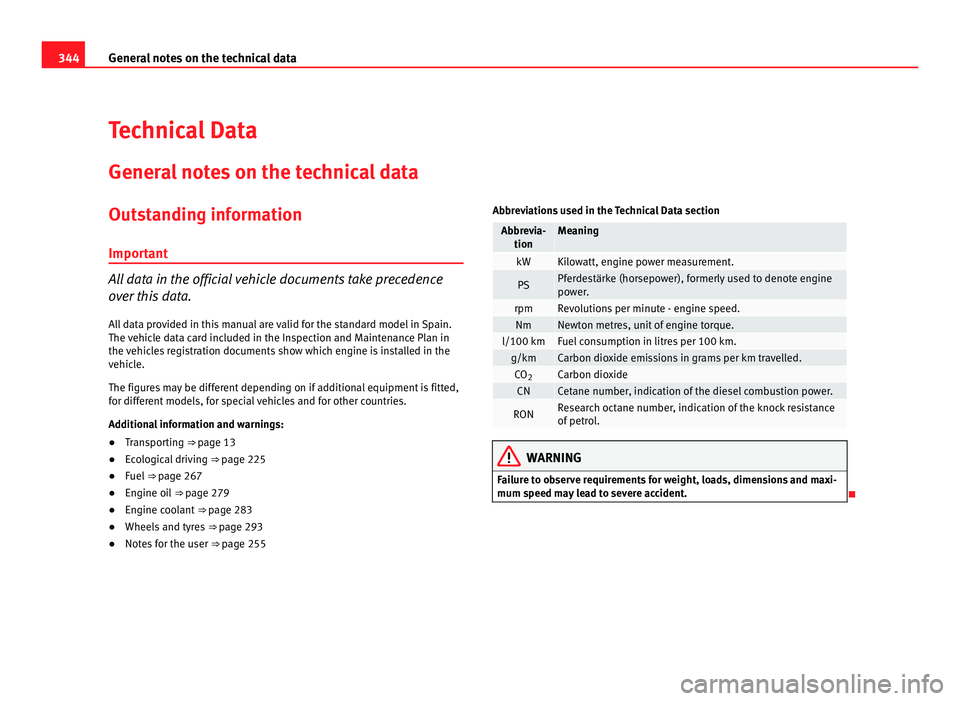
es for the user ⇒ page 255 Abbr
eviations used in the Technical Data section Abbrevia-
tion Meaning
kW Kilowatt, engine power measurement.
PS Pferdestärke (horsepower), formerly used to denote engine
pow
er
. rpm Revolutions per minute - engine speed.
Nm Newton metres, unit of engine torque.
l/100 km Fuel consumption in litres per 100 km.
g/km Carbon dioxide emissions in grams per km travelled.
CO
2 Carbon dioxide
CN Cetane number, indication of the diesel combustion power.
RON Research octane number, indication of the knock resistance
of petr
o
l. WARNING
Failure to observe requirements for weight, loads, dimensions and maxi-
mum speed m a
y lead to severe accident.
Page 349 of 385
347
General notes on the technical data
Towing a trailer Tr ai
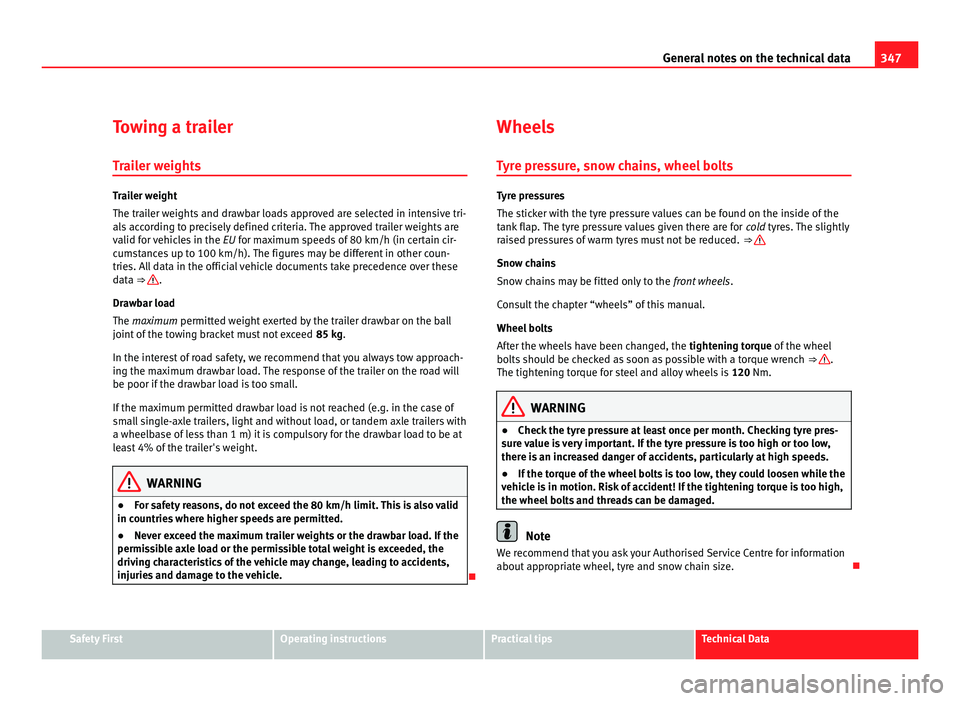
ler weights Trailer weight
The trai
l
er weights and drawbar loads approved are selected in intensive tri-
als according to precisely defined criteria. The approved trailer weights are
valid for vehicles in the EU for maximum speeds of 80 km/h (in certain cir-
cumstances up to 100 km/h). The figures may be different in other coun-
tries. All data in the official vehicle documents take precedence over these
data ⇒ .
Dra wb
ar load
The maximum permitted weight exerted by the trailer drawbar on the ball
joint of the towing bracket must not exceed 85 kg.
In the interest of road safety, we recommend that you always tow approach-
ing the maximum drawbar load. The response of the trailer on the road will
be poor if the drawbar load is too small.
If the maximum permitted drawbar load is not reached (e.g. in the case of
small single-axle trailers, light and without load, or tandem axle trailers with
a wheelbase of less than 1 m) it is compulsory for the drawbar load to be at
least 4% of the trailer's weight. WARNING
● For safety reasons, do not exceed the 80 km/h limit. This is also valid
in c ou
ntries where higher speeds are permitted.
● Never exceed the maximum trailer weights or the drawbar load. If the
permiss
ible axle load or the permissible total weight is exceeded, the
driving characteristics of the vehicle may change, leading to accidents,
injuries and damage to the vehicle. Wheels
Ty r
e pressure, snow chains, wheel bolts Tyre pressures
The stic
k
er with the tyre pressure values can be found on the inside of the
tank flap. The tyre pressure values given there are for cold tyres. The slightly
raised pressures of warm tyres must not be reduced. ⇒ Snow chains
Snow c
h
ains may be fitted only to the front wheels.
Consult the chapter “wheels” of this manual.
Wheel bolts
After the wheels have been changed, the tightening torque of the wheel
bolts should be checked as soon as possible with a torque wrench ⇒ .
The tightenin g t
orque for steel and alloy wheels is 120 Nm. WARNING
● Check the tyre pressure at least once per month. Checking tyre pres-
s ur
e value is very important. If the tyre pressure is too high or too low,
there is an increased danger of accidents, particularly at high speeds.
● If the torque of the wheel bolts is too low, they could loosen while the
vehicl
e is in motion. Risk of accident! If the tightening torque is too high,
the wheel bolts and threads can be damaged. Note
We recommend that you ask your Authorised Service Centre for information
about ap pr
opriate wheel, tyre and snow chain size. Safety First Operating instructions Practical tips Technical Data