wheel Seat Alhambra 2011 Repair Manual
[x] Cancel search | Manufacturer: SEAT, Model Year: 2011, Model line: Alhambra, Model: Seat Alhambra 2011Pages: 385, PDF Size: 7.92 MB
Page 269 of 385
267
Checking and refilling levels
Closing the tank cap
● Screw on the tank cap clockwise until it you hear it click into position.
● Press the tank flap until you hear it click into place. The tank flap must
be flush w ith the body
contour. WARNING
Do not continue refilling once the fuel nozzle has switched itself off. The
fuel t
ank may be filled too much. As a result, fuel may spurt out and spill.
This could lead to a fire, explosion and severe injuries. CAUTION
● Always remove any fuel spilled on the vehicle paintwork immediately to
av oid d
amage to the wheel housing, the tyre and vehicle paintwork. For the sake of the environment
Spilt fuel can contaminate the environment.
Refilling precautions Information on bulb replacement
⇒ pag
e 326.
Checklist
Never work on the engine or in the engine compartment if you are not famil-
iar with the operations to be carried out, the applicable safety standards
and especially if you do not have the instruments, liquids and tools neces-
sary ⇒ page 275, Working in the engine compartment! Have the work car-
ried out by a Technical Service if you are uncertain. Check the following reg-
ularly, preferably when you refuel:
● Windscreen washer fluid level ⇒ pag
e 105
● Engine oil level ⇒ pag
e 279 ●
Engine coolant level ⇒ p
age 283
● Brake fluid level ⇒ pag
e 183
● Tyre pressure ⇒ pag
e 293
● Vehicle lighting required to guarantee road safety:
Indicator
s
Side lights, dipped headlights and full beam headlights
Rear lights
Brake lights
Rear fog light ⇒ page 97 WARNING
Not following the checklist prepared for your own safety could lead to ac-
cident s
and severe injuries.
● Always follow the check list and perform the necessary operations.
Fuel Introduction You will find a factory-fitted sticker containing information on the type of
fuel
f
or your vehicle on the inside of the fuel tank flap.
Additional information and warnings:
● ⇒ Bookl et Maintenance Programme
● R
efuelling ⇒ pag e 264
● En
gine and exhaust system management ⇒ page 228
–
–
–
–
–
Safety First Operating instructions Practical tips Technical Data
Page 273 of 385
271
Checking and refilling levels
Selective Catalytic Reduction* (AdBlue)
Introduction The AdBlue fill level must be checked when the vehicle is being serviced
⇒ Bookl
et
Maintenance Programme.
Additional information and warnings:
● Luggage compartment ⇒ p
age 125
● Fuel ⇒ page 267
● Wheels
and tyres ⇒ pag
e 293
● Accessories, parts replacement, repairs and modifications ⇒ page 257WARNING
If the AdBlue fill level is too low, the vehicle may not restart after switch-
ing the ignition off .
The emergency start or jump start will not be possi-
ble either!
● Top up with AdBlue at the latest 1000 km or 600 miles before it runs
out.
● Do not a
llow the AdBlue to run too low. WARNING
AdBlue is an irritant, corrosive liquid that can cause injuries if it touches
the skin, ey e
s or respiratory organs.
● If AdBlue get in contact with eyes and skin, rinse for at least 15 mi-
nutes
with plenty of water and seek medical help.
● If the AdBlue is swallowed, wash the mouth with plenty of water for at
lea
st 15 minutes. Do not try to provoke vomiting unless recommended by
a Doctor. Seek medical advice immediately. CAUTION
AdBlue damages surfaces such as painted vehicle parts, plastic, items of
clothin g and c
arpets. Spilt AdBlue should be removed as quickly as possi-
ble using a damp cloth and plenty of cold water.
● If the AdBlue has crystallised, remove with warm water and a sponge.
Control and warning lamps lights up Possible cause ⇒ Solution
(red) The engine cannot be restar-
ted!
The l
evel of AdBlue is too
low. Stop the vehicle in a suitable,
saf
e and fl
at area then top up
with the minimum quantity of
AdBlue required ⇒ page 273. (red)
with
The engine cannot be restar-
ted!
AdBlue sy
stem malfunc-
tion. Contact a specialist workshop.
Have the sy
s
tem checked there.
(yel-
lo w) The AdBlue reserve is low. Refill AdBlue over the next kilo-
metre
s
or miles as indicated
⇒ page 273. SEAT recommends
contacting a specialist work-
shop. (red)
with
There is a fault in the AdBlue
sys
t
em or unsuitable AdBlue
fluid has been used. Contact a specialist workshop.
Have the sy
s
tem checked there. Several warning and control lamps should light up for a few seconds when
the ignition is
sw
itched. This signals that the lamp is working properly. They
will switch off after a few seconds. Safety First Operating instructions Practical tips Technical Data
Page 277 of 385
275
Checking and refilling levels
Working in the engine compartment Introduction Before working in the engine compartment, make sure that the vehicle is
park
ed on horiz
ontal and firm ground.
The engine compartment of the vehicle is a hazardous area. Never work on
the engine or in the engine compartment if you are not familiar with the op-
erations to be carried out, the applicable safety standards and especially if
you do not have the instruments, liquids and tools necessary ⇒ ! Have
the work c
arried out by a Technical Service if you are uncertain. Negligent
work can cause serious injury.
Additional information and warnings:
● Windscreen wash system ⇒ page 105
● St
art and stop the engine ⇒ page 170
● Br
ake fluid ⇒ page 183
● V
ehicle battery ⇒ page 288
● Chec
ks when filling up ⇒ page 264
● En
gine oil ⇒ page 279
● En
gine coolant ⇒ page 283
● A
ccessories, parts replacement, repairs and modifications ⇒ page 257 WARNING
If the vehicle moves unexpectedly, this could cause serious injury.
● Never work underneath the vehicle if it is not secured against moving.
If y
ou must work underneath the vehicle with the wheels in contact with
the ground then it should be parked on flat ground, the wheels should be
prevented from moving and the key must be removed from the ignition.
● If you have to work underneath the vehicle, you must use suitable
stand
s additionally to support the vehicle, there is a risk of accident!.
The jack is not intended for this kind of work and its failure could lead to
severe injuries. WARNING
The engine compartment is a dangerous area capable of causing serious
injury .
● F
or all type of work, always take the utmost precautions, work care-
ful
ly and note the general safety standards in force. Never take personal
risks.
● Never work on the engine or in the engine compartment if you are not
famili
ar with the necessary operations. If you are not sure about proce-
dures then visit a Technical Service to carry out the necessary work. In-
correct work can cause serious injuries.
● Never open the bonnet if you see steam or coolant escaping from the
engine comp
artment. Hot vapours and coolant can cause serious burns.
Always wait until you cannot see or hear the sound of steam or coolant
coming from the engine compartment.
● Always allow the engine to cool down before opening the bonnet.
● Contact with hot elements of the engine and the exhaust system can
cause b
urns. Safety First Operating instructions Practical tips Technical Data
Page 295 of 385
293
Wheels and tyres
Wheels and tyres
Wheels
Introduction The SEAT Alhambra is equipped as standard with anti-puncture technology
tyr
e
s (Conti-Seal). In the event of a puncture or air leak of up to 5 mm, the
tyre seals the hole with a protective layer inside the tread.
SEAT recommend that all work on tyres and wheels is carried out by a Tech-
nical Service. They have the necessary special tools and replacement parts,
trained personnel and facilities for disposing of the old tyres. SEAT recom-
mends visiting a Technical Service.
Additional information and warnings:
● Transporting ⇒ page 13
● T
owing mode ⇒ page 233
● Br
aking, stopping and parking ⇒ page 183
● P
ark assist system ⇒ page 202
● T
yre control systems ⇒ page 221
● C
aring for and cleaning the vehicle exterior ⇒ page 242
● Wheel
trims ⇒ page 304
● Ch
ange wheel ⇒ page 305
● Not
es for the user ⇒ page 255 WARNING
The vehicle cannot be totally controlled or braked if the tyres (new or
used) ar e w
orn or damaged.
● Incorrect use of wheels and tyres could make driving more dangerous
and res
ult in serious accidents and damage.
● All four wheels must be fitted with radial tyres of the same type, size
(rol
ling circumference) and the same tread pattern.
● New tyres do not give maximum grip and will not have reached their
maximum br
aking capacity to start with, and therefore need running in.
To prevent accidents and major damage, extreme caution should be tak-
en for the first 600 km (370 miles).
● Check tyre pressures regularly and ensure they are maintained at the
pres
sures indicated. If the tyre pressure is too low, the tyres could over-
heat, resulting in tread detachment or even burst tyres.
● Never drive on damaged (punctured, cut, cracked or dented) or worn
tyre
s. Driving on damaged or worn tyres could result in burst tyres, seri-
ous accidents or damage. Worn or damaged tyres must be replaced im-
mediately.
● Never exceed the maximum permitted speed or loads specified for the
type of ty
re fitted on your vehicle.
● The efficiency of driver and brake assist systems also depends on the
grip of the tyr
es.
● If you notice unusual vibration or if the vehicle pulls to one side when
driving, s
top the car immediately and check the tyres and wheels for
damage.
● To minimise the risk of losing control of the vehicle or causing a seri-
ous ac
cident, never undo the bolted joints of beadlock wheels. Safety First Operating instructions Practical tips Technical Data
Page 296 of 385
294
Wheels and tyres WARNING (Continued)
● Nev er mount used tyres or wheels if you are not sure of their previous
hi s
tory. They may be damaged, although the damage is not immediately
visible.
● Old tyres, even if they have never been used, may lose air or burst un-
expectedly
while driving, resulting in serious accident or damage. If tyres
are over six years old, they should only be used in an emergency and
with extreme caution. Note
● For technical reasons, it is not generally possible to use the wheels from
other v
ehicles. In some cases, this may also be true for the same model of
wheel. Please refer to the vehicle documents or ask at a SEAT qualified
workshop.
● If you decide to fit your vehicle with conventional tyres, remember that
you mus
t carry a puncture repair kit, not available in the tools that come
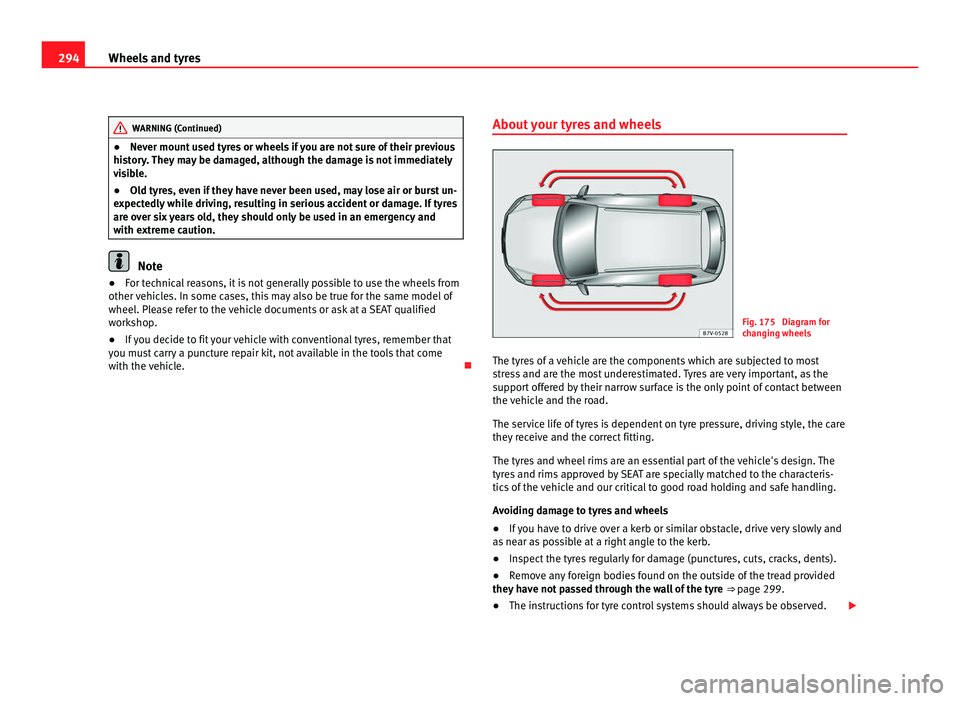
with the vehicle. About your tyres and wheels Fig. 175 Diagram for
ch
an
ging wheels
The tyres of a vehicle are the components which are subjected to most
stre
ss and are the most underestimated. Tyres are very important, as the
support offered by their narrow surface is the only point of contact between
the vehicle and the road.
The service life of tyres is dependent on tyre pressure, driving style, the care
they receive and the correct fitting.
The tyres and wheel rims are an essential part of the vehicle's design. The
tyres and rims approved by SEAT are specially matched to the characteris-
tics of the vehicle and our critical to good road holding and safe handling.
Avoiding damage to tyres and wheels
● If you have to drive over a kerb or similar obstacle, drive very slowly and
as ne
ar as possible at a right angle to the kerb.
● Inspect the tyres regularly for damage (punctures, cuts, cracks, dents).
● Remove any foreign bodies found on the outside of the tread provided
they hav
e not passed through the wall of the tyre ⇒ page 299.
● The instructions for tyre control systems should always be observed.
Page 297 of 385
295
Wheels and tyres
● Replace damaged or worn tyres as soon as possible ⇒ p age 299.
● Regularly check tyres for non-visible damage ⇒ page 299.
● Nev
er exceed the maximum permitted speed or loads specified for the
type of tyr
e fitted on your vehicle ⇒ page 302.
● Do not allow tyres to come into contact with aggressive substances,
grea
se, oil, fuel or brake fluid ⇒ .
● Lost valve caps should be replaced immediately.
Ty r
es with directional tread pattern
Tyres with directional tread pattern have been designed to operate best
when rotating in only one direction. An arrow on the tyre sidewall indicates
the direction of rotation on tyres with directional tread ⇒ page 302. Always
observe the direction of rotation indicated when mounting the wheel. This
guarantees optimum grip and helps to avoid aquaplaning, excessive noise
and wear.
If the tyre is mounted in the opposite direction of rotation, drive with ex-
treme caution, as the tyre is no longer being used correctly. This is of partic-
ular importance when the road surface is wet. Change the tyre as soon as
possible or remount it with the correct direction of rotation.
Interchanging tyres
To ensure that the wear is equal on all tyres the wheels should be changed
round from time to time according to the system ⇒ fig. 175. All the tyres will
then last for about the same time.
SEAT recommends you take the vehicle to a Technical Service to have the
tyres changed.
Tyres that are over 6 years old
Tyres are subject to an ageing process as a result of physical and chemical
processes. This may affect their performance. Tyres which are stored for
long periods of time without being used, harden and become more fragile
than tyres which are in constant use.
SEAT recommends that tyres over six years old are replaced with new tyres.
This also applies to tyres which appear to be in perfect condition on the out- side and which have a tread depth within the values stipulated by the Law
⇒ .
The dat e of
manufacture, part of the tyre identification number (TIN), indi-
cates the age of the tyre ⇒ page 302.
Storing tyres
Mark tyres when you remove them to indicate the direction of rotation (left,
right, forwards, backwards). This ensures you will be able to mount them
correctly when you replace them. When removed, the wheels and/or tyres
should be stored in a cool, dry and preferably dark location. Do not place
tyres mounted on the wheel in a vertical position.
Protect tyres not mounted on wheels from dirt by storing them in suitable
bags and standing them on the ground on their tread. WARNING
Aggressive fluids or substances could result in visible or invisible dam-
age w ith the c
onsequent risks.
● Always ensure that tyres do not come into contact with chemical
products, oi
l, grease, fuel, brake fluid or other aggressive substances. WARNING
Old tyres, even if they have never been used, may lose air or burst unex-
pectedly whi
le driving, resulting in serious accident or damage.
● If tyres are over six years old, they should only be used in an emer-
gency and w
ith extreme caution. For the sake of the environment
Old tyres must be disposed of by qualified personnel according to the laws
in the cou ntr
y concerned. Safety First Operating instructions Practical tips Technical Data
Page 298 of 385
296
Wheels and tyres
Wheel rims The design of wheel bolts is matched to the rims. If different rims are fitted,
the corr
ect
wheel bolts with the right length and correctly shaped bolt
heads must be used. This ensures that wheels are fitted securely and that
the brake system functions correctly ⇒ page 305.
For technical reasons, it is not generally possible to use the wheels from
other vehicles. In some cases, this may also be true for the same model of
wheel.
The tyres and rims approved by SEAT are specially matched to the character-
istics of the vehicle and are critical to good road holding and safe handling.
Wheel bolts
Wheel bolts must be tightened to the correct torque ⇒ page 305.
Beadlock wheel rims
Beadlock wheel rims have various components. These are joined together
by special bolts using a special procedure. This ensures good performance,
a better seal, improved safety and wheel run out. Therefore, worn rims
should always be replaced and must only be repaired in a Technical Service.
SEAT recommends visiting a Technical Service ⇒ .
Wheel rims w
ith bolted trims
Wheel rims may be fitted with interchangeable trim parts which are attach-
ed to the rim using self-locking bolts. Worn trims should only be replaced at
a Technical Service. SEAT recommends visiting a Technical Service ⇒ .
WARNING
The use of worn or damaged wheel rims could make driving more danger-
ous and r
esult in serious accidents and damage.
● Only wheel rims which have been approved for use with your vehicle
should be u
sed.
● Inspect wheel rims regularly for damage and replace as required. WARNING
If the bolted joints of wheel rims with bolted ring trims are not correctly
tightened or loo sened, thi
s could result in serious accident.
● Never loosen the bolted joints of wheel rims with bolted ring trims.
● Any work relating to wheel rims with bolted rims should be carried
out at qua
lified workshop. SEAT recommends visiting a Technical Service.
Replacement of new tyres and wheel rims New tyres
●
When tyres are new, drive with extreme caution for the first 500 km
(310 mil e
s), as all tyres need to be run-in. Tyres which have not been run-in
do not have such good grip ⇒ or braking capacity
⇒ .
● All four wheels must be fitted with radial tyres of the same type, size
(ro l
ling circumference) and the same tread pattern.
● The tread depth of new tyres may vary, according to the type and make
of tyr
e and the tread pattern.
Replacing tyres
● Where possible, always replace both wheels on an axle (both wheels on
the front ax
le or both wheels on the rear axle) ⇒ .
● Old tyres should only be replaced by SEAT approved tyres for the vehicle
in ques tion, and in ac
cordance with the maximum permitted size, diameter,
load and speed capacity.
● Never use tyres which are larger than SEAT approved tyres. If the tyres
are too b
ig, they may knock or rub against the chassis or other components,
resulting in damage.
Page 299 of 385
297
Wheels and tyres WARNING
New tyres do not give maximum grip and will not have reached their max-
imum brak in
g capacity to start with, and therefore need running in.
● To prevent accidents and major damage, extreme caution should be
taken f
or the first 600 km (370 miles). WARNING
There should be adequate space between the tyres and the vehicle in ac-
cord
ance with the vehicle design. If this is not the case, the tyres may
rub against parts of the running gear, chassis or brake lines, leading to
faults in the brake system or to tread detachment, and the risk of burst
tyres.
● The true tyre dimension should not be greater than the dimensions of
tyre
s manufactured and approved by SEAT and should not rub against
parts of the vehicle. Note
● Although tyres may be shown as being the same size, the true dimen-
s ion
s of different types of tyre may vary with respect to the nominal size, or
tread patterns may be different.
● If you use tyres that are approved by SEAT, you can be sure that the true
tyre dimen
sions will be correct for your vehicle. For other tyre models, the
tyre vendor should provide the manufacturer's certificate with the tyre, indi-
cating that this type of tyre is suitable for your vehicle. This certificate
should always be carried with the vehicle. Tyre pressures
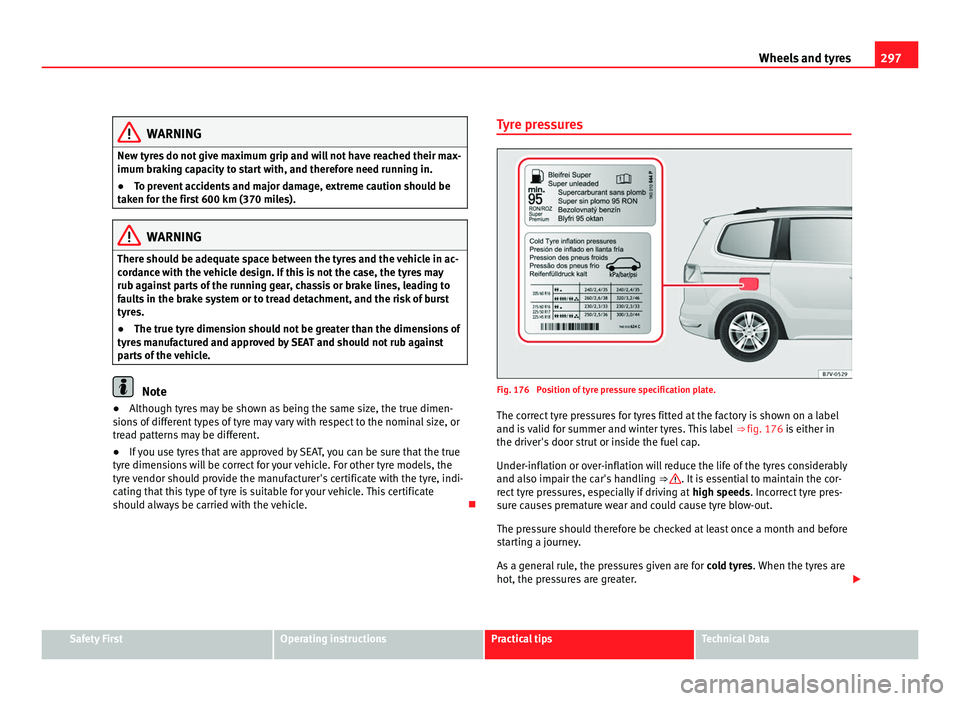
Fig. 176 Position of tyre pressure specification plate.
The corr ect
tyre pressures for tyres fitted at the factory is shown on a label
and is valid for summer and winter tyres. This label ⇒ fig. 176 is either in
the driver's door strut or inside the fuel cap.
Under-inflation or over-inflation will reduce the life of the tyres considerably
and also impair the car's handling ⇒ . It is essential to maintain the cor-
rect ty
re pressures, especially if driving at high speeds. Incorrect tyre pres-
sure causes premature wear and could cause tyre blow-out.
The pressure should therefore be checked at least once a month and before
starting a journey.
As a general rule, the pressures given are for cold tyres. When the tyres are
hot, the pressures are greater. Safety First Operating instructions Practical tips Technical Data
Page 300 of 385
298
Wheels and tyres
Never deflate a hot tyre in order to obtain the required pressure. This could
re s
ult in very low tyre pressures which may lead to sudden blow-outs.
Checking tyre pressures
Tyre pressures should only be checked when the vehicle has not been driv-
en for more than a few kilometres (miles) at low speeds in the past three
hours.
● The tyre pressures should be checked regularly, and only when the tyres
are co
ld. Always check all the tyres. Tyre pressures should be checked more
often in colder regions, and only when the vehicle has not been driven re-
cently. Always use a correctly-operating tyre gauge.
● Adjust tyre pressures to the loads carried in the vehicle.
● After checking the pressure, always replace the valve caps, and where
applic
able, observe the instructions given for adjusting the tyre control sys-
tem ⇒ page 221. WARNING
If tyre pressures are too high or too low, the tyre may deflate or burst
sud den
ly while driving. This could result in serious accident.
● If the tyre pressure is too low, the tyres could overheat, resulting in
trea
d detachment or even burst tyres.
● When driving at high speeds and/or fully loaded, the tyre could sud-
denly o
verheat, burst or be subject to tread detachment, with the resul-
tant loss of control of the vehicle.
● Tyre pressures which are too high or too low reduce the service life of
the tyre, aff
ecting the vehicle's performance.
● Tyre pressures should be checked regularly, at least once a month
and before lon
g journeys.
● Adjust the pressures of all the tyres to the vehicle load.
● Never deflate excess pressure from hot tyres. CAUTION
● Take care not to tilt the manometer when placing it on the valve. Other-
w i
se, the valve may be damaged.
● To avoid damage to the valves, always replace valve caps correctly.
Check th
at the caps are identical to the standard caps and have been cor-
rectly tightened. For the sake of the environment
Under-inflated tyres will increase the fuel consumption. Note
When checking tyre pressures, please observe the instructions for the tyre
contr o
l system ⇒ page 221.
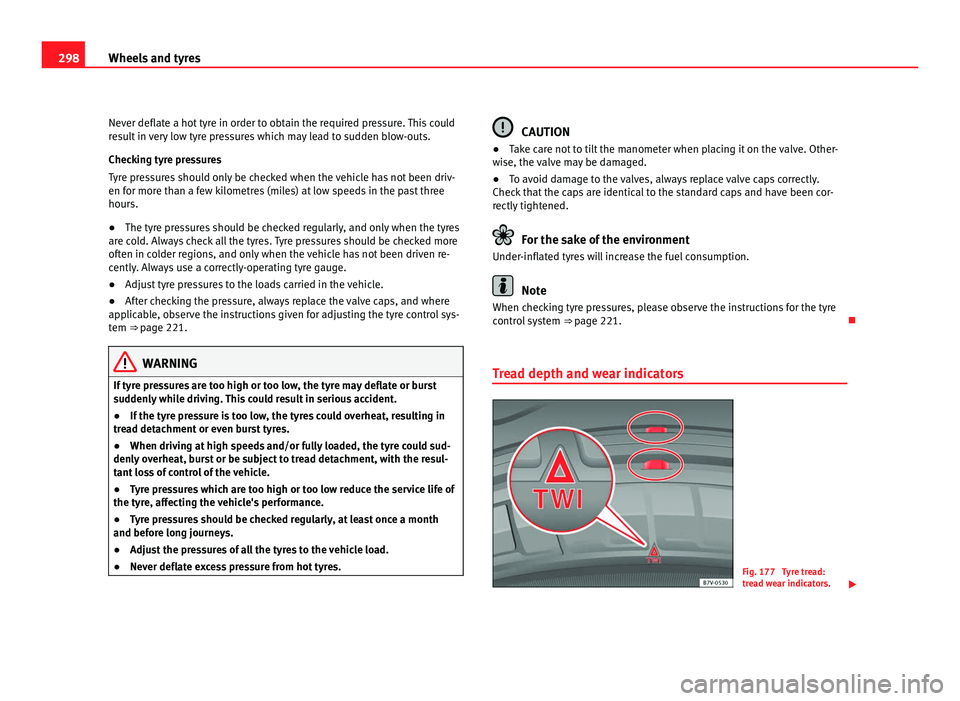
Tread depth and wear indicators Fig. 177 Tyre tread:
tre
a
d wear indicators.
Page 301 of 385

299
Wheels and tyres
Tread depth
Cer t
ain driving conditions require a deeper tread, as well as needing the
tread to be approximately the same on the front and rear tyres. This is par-
ticularly important when driving in winter, in cold temperatures and on wet
roads ⇒ .
The minimum tre a
d depth required by law in the majority of cases is 1.6 mm
(1/16 of an inch), measured in the tread grooves next to the tread wear indi-
cators. Observe legal requirements in each country.
The performance of winter tyres is much reduced when the tread has worn
to 4 mm (5/32 inch).
The tread depth of new tyres may vary, according to the type and make of
tyre and the tread pattern.
Wear indicators on the tyre
The original tyres on your vehicle have 1.6 mm (1/16 inch) high ⇒ fig. 177
tread wear indicators running across the tread. A number of these indicators
are equally spaced around the tyre tread. Certain marks on the tyre walls
(for example, the letters “TWI” or other symbols) indicate the position of the
wear indicators.
Tread wear indicators indicate if a tyre is worn. Tyres must always be re-
placed before the tyre tread has worn to the level of the indicator. WARNING
Driving with worn tyres is dangerous, and may lead to loss of control of
the v ehic
le with serious consequences.
● Tyres must be replaced before the wear indicators are at the same lev-
el as
the tread pattern. WARNING (Continued)
● Worn tyres have significantly reduced grip, especially on wet surfa-
c e
s, increasing the risk of “aquaplaning”.
● Worn tyres make control of the vehicle more difficult in normal or dif-
ficult
driving conditions, increasing the braking distance and the risk of
skidding.
Damaged tyres Damage to wheels and tyres is often not immediately visible. If you notice
unu
s
ual vibration or the car pulling to one side, this may indicate that one
of the tyres is damaged ⇒ .
● Slow down immediately if you think you have a damaged wheel.
● Check the wheels and tyres for damage.
● If tyres are worn, stop driving and seek qualified assistance.
● If there is no visible exterior damage, drive slowly and carefully to the
near e
st qualified workshop and have the vehicle checked.
Foreign bodies in the tyre
● Do not remove foreign bodies if they have penetrated through the tyre
wall!
● Y
ou should obtain professional assistance immediately.
The sealant
at the lower part of the tyre tread wraps around the foreign body
and provisionally seals the tyre.
Wear of tyres
The wear of tyres depends on a number of factors, for example:
● Driving style.
● Unbalanced wheels.
● Running gear settings. Safety First Operating instructions Practical tips Technical Data