clutch Seat Alhambra 2011 Owner's Manual
[x] Cancel search | Manufacturer: SEAT, Model Year: 2011, Model line: Alhambra, Model: Seat Alhambra 2011Pages: 385, PDF Size: 7.92 MB
Page 12 of 385
10
Safe driving
Adjusting the seat position
Introduction Number of seats
Dependin
g on the equipment,
your vehicle has a total of five or seven seats.
Each seat is equipped with a seat belt. Equipment Seats in the
front Seats in the sec-
ond ro w Seats in the
third r o
w 5 seats 2 3 –
7 seats 2 3 2
Additional information and warnings:
●
Seat functions ⇒ page 117
● Se
at belts ⇒ page 21
● Airb
ag system ⇒ page 31
● Chi
ld seats (accessories) ⇒ page 39WARNING
An incorrect sitting position in the vehicle can lead to severe injuries or
death in the ev ent
of sudden braking or manoeuvres, collision or acci-
dents or if the airbag deploys.
● Before the vehicle moves, assume the proper sitting position and
maintain it
throughout the trip. This also includes fastening the seat
belt.
● Never transport more people than there are seats with a seat belt
avail
able in the vehicle. WARNING (Continued)
● Children must always be protected with an approved child restraint
sy s
tem suited to their height and weight ⇒ page 39, ⇒ page 31.
● Always keep your feet in the footwell while the vehicle is in motion.
Never, f
or example, put your feet on the surface of a seat or on the dash
panel and never put them out of a window. Otherwise the airbag and seat
belt offer insufficient protection and the risk of injury in the event of an
accident is increased. WARNING
Before every trip, adjust the seat, the seat belt and the head restraints
and ins truct
your passengers to fasten their seat belts properly.
● Move the front passenger seat back as far as possible.
● Adjust the driver's seat so that there is a distance of at least 25 cm
(10 inches) betw
een the centre of your chest and the hub of the steering
wheel. Adjust the driver's seat so that you are able to press the accelera-
tor, brake and clutch pedals to the floor with your knees slightly angled
and that the distance between your knees and the dash panel is at least
10 cm (4 inches). If you physical constitution prevents you from meeting
these requirements, contact a Technical Service to make any modifica-
tions required.
● Never drive with the backrest tilted far back. The further the backrests
are tilt
ed to the rear, the greater the risk of injury due to incorrect posi-
tioning of the belt web or to the incorrect sitting position.
● Never drive with the backrest tilted forwards. Should a front airbag
deploy
, it could throw the backrest backwards and injure the passengers
of the rear seats.
● Sit as far away as possible from the steering wheel and the dash pan-
el.
Page 14 of 385
12
Safe driving
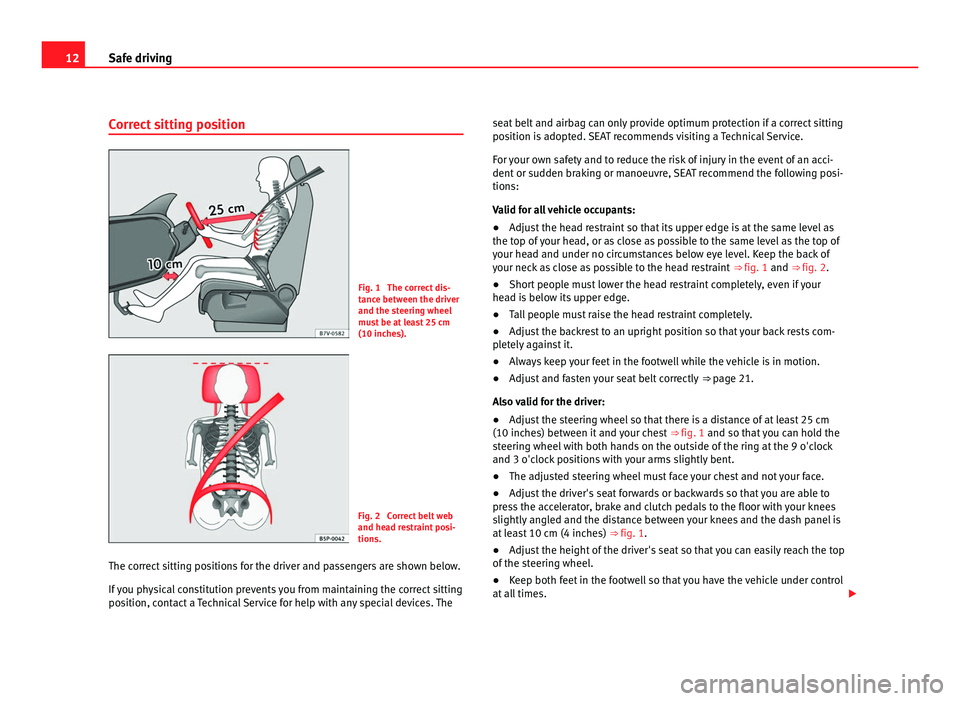
Correct sitting position Fig. 1 The correct dis-
tanc
e betw
een the driver
and the steering wheel
must be at least 25 cm
(10 inches). Fig. 2 Correct belt web
and hea
d r
estraint posi-
tions.
The correct sitting positions for the driver and passengers are shown below.
If y
ou physical constitution prevents you from maintaining the correct sitting
position, contact a Technical Service for help with any special devices. The seat belt and airbag can only provide optimum protection if a correct sitting
position i
s adopted. SEAT recommends visiting a Technical Service.
For your own safety and to reduce the risk of injury in the event of an acci-
dent or sudden braking or manoeuvre, SEAT recommend the following posi-
tions:
Valid for all vehicle occupants:
● Adjust the head restraint so that its upper edge is at the same level as
the top of
your head, or as close as possible to the same level as the top of
your head and under no circumstances below eye level. Keep the back of
your neck as close as possible to the head restraint ⇒ fig. 1 and ⇒ fig. 2.
● Short people must lower the head restraint completely, even if your
head i
s below its upper edge.
● Tall people must raise the head restraint completely.
● Adjust the backrest to an upright position so that your back rests com-
plet
ely against it.
● Always keep your feet in the footwell while the vehicle is in motion.
● Adjust and fasten your seat belt correctly ⇒ page 21.
A
lso valid for the driver:
● Adjust the steering wheel so that there is a distance of at least 25 cm
(10 inches) betw
een it and your chest ⇒ fig. 1 and so that you can hold the
steering wheel with both hands on the outside of the ring at the 9 o'clock
and 3 o'clock positions with your arms slightly bent.
● The adjusted steering wheel must face your chest and not your face.
● Adjust the driver's seat forwards or backwards so that you are able to
pres
s the accelerator, brake and clutch pedals to the floor with your knees
slightly angled and the distance between your knees and the dash panel is
at least 10 cm (4 inches) ⇒ fig. 1.
● Adjust the height of the driver's seat so that you can easily reach the top
of the st
eering wheel.
● Keep both feet in the footwell so that you have the vehicle under control
at all
times.
Page 174 of 385
172
Driving
Key not authorised for the vehicle
If a k ey
which is not authorised for this vehicle is inserted in the ignition
lock, it can be removed as follows:
● Automatic gearbox: the key cannot be removed from the ignition lock.
Pres
s and release the selector lever locking button. Key can be removed
from the vehicle.
● Manual gearbox: Remove the key from the ignition. WARNING
Unsuitable or careless use of the vehicle key could result in serious in-
jury .
● A
lways take all the keys with you whenever you leave the vehicle. The
engine cou
ld accidentally be started and electrical equipment such as
the windows could accidentally be operated resulting in serious injury.
● Never leave children or disabled people alone in the car. They could
be trapped in the c
ar in an emergency and will not be able to get them-
selves to safety. For example, depending on the time of the year, temper-
atures inside a locked and closed vehicle can be extremely high or ex-
tremely low resulting in serious injuries and illness or even death, partic-
ularly for young children.
● Never remove the key from the ignition if the vehicle is in motion. The
steerin
g may lock and it will not be possible to turn the steering wheel. Note
● If the key is left in the ignition lock with the engine off for long periods,
the v
ehicle battery will run flat.
● For automatic gearbox vehicles the key
can only be removed from the ig-
nition lock if the gear selector lever is in position P. In this case, press and
release the selector lever locking button. Starting the engine Complete operations only in the sequence given:
Step
1. Press the brake pedal and keep pressed until step 5 has been
comp
l
eted. 1 a. In vehicles with a manual gearbox:
Pres
s the clutch pedal all
the way and keep pressed until the engine starts. 2. Put the gearstick in neutral or the selector lever in position
P
or N. 3. Only in vehicles with diesel engine:
To prehe
at, turn the key
in the ignition lock to position ⇒ fig. 127 1 . A warning lamp
lights up in the c ontr
ol panel . 4. Turn the key in the ignition lock to position
⇒ fig. 127 2 ; do
not pr e
ss the accelerator. 5. When the engine has started, release the key in the ignition
lock.
6. If the engine does not start, stop the process and try again af-
ter one minut
e. 7. Disconnect the electronic parking brake when you wish to
st
ar
t driving ⇒ page 183. WARNING
Never leave the vehicle unattended if the engine is running. The vehicle
cou l
d move off suddenly, especially if it is in gear, resulting in an acci-
dent and serious injury.
Page 178 of 385
176
Driving
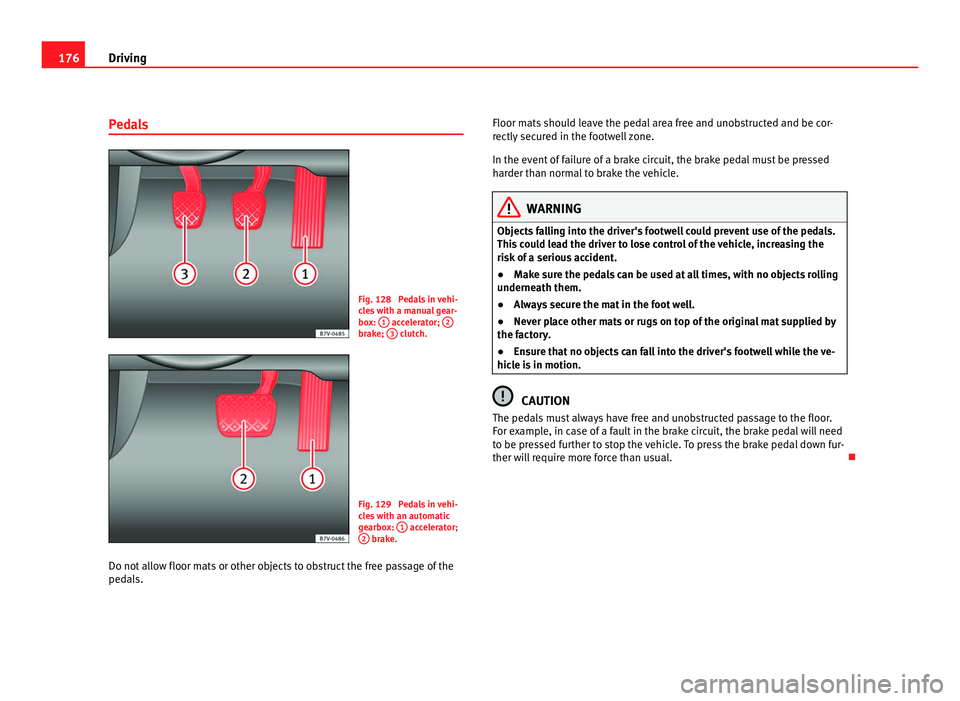
Pedals Fig. 128 Pedals in vehi-
cl
e
s with a manual gear-
box: 1 accelerator;
2 brake;
3 clutch.
Fig. 129 Pedals in vehi-
cl
e
s with an automatic
gearbox: 1 accelerator;
2 brake.
Do not allow floor mats or other objects to obstruct the free passage of the
pedal s. Floor m
ats should leave the pedal area free and unobstructed and be cor-
rectly sec
ured in the footwell zone.
In the event of failure of a brake circuit, the brake pedal must be pressed
harder than normal to brake the vehicle. WARNING
Objects falling into the driver's footwell could prevent use of the pedals.
This c
ould lead the driver to lose control of the vehicle, increasing the
risk of a serious accident.
● Make sure the pedals can be used at all times, with no objects rolling
underneath them.
● A
lways secure the mat in the foot well.
● Never place other mats or rugs on top of the original mat supplied by
the factor
y.
● Ensure that no objects can fall into the driver's footwell while the ve-
hicle i
s in motion. CAUTION
The pedals must always have free and unobstructed passage to the floor.
For e x
ample, in case of a fault in the brake circuit, the brake pedal will need
to be pressed further to stop the vehicle. To press the brake pedal down fur-
ther will require more force than usual.
Page 179 of 385
177
Driving
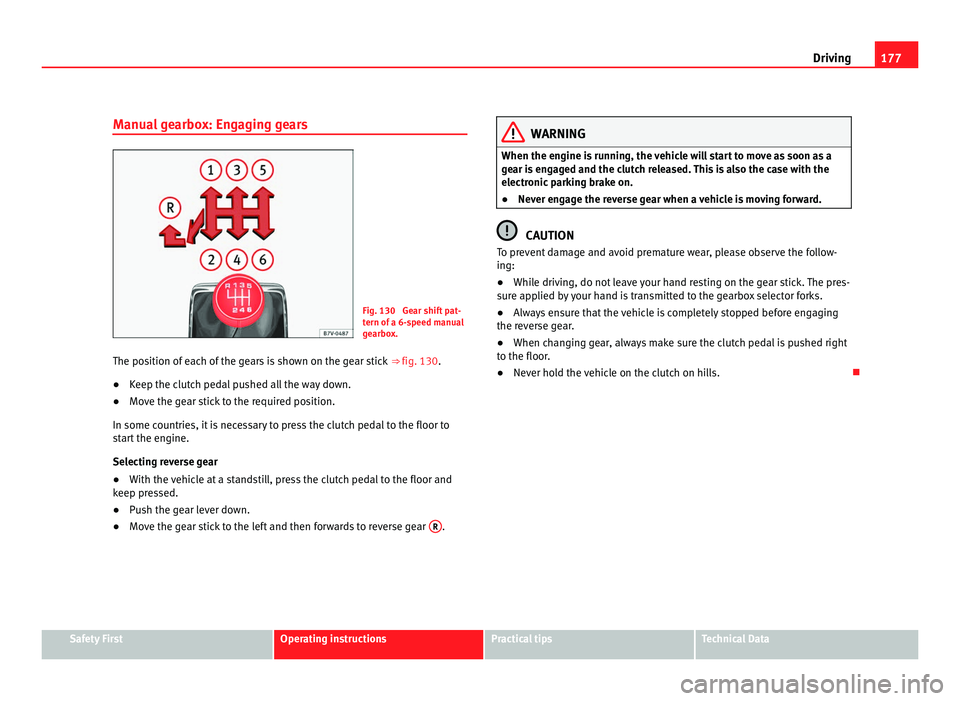
Manual gearbox: Engaging gears Fig. 130 Gear shift pat-
tern of
a 6-
speed manual
gearbox.
The position of each of the gears is shown on the gear stick ⇒ fig. 130.
● Keep the clutch pedal pushed all the way down.
● Move the gear stick to the required position.
In some countrie
s, it is necessary to press the clutch pedal to the floor to
start the engine.
Selecting reverse gear
● With the vehicle at a standstill, press the clutch pedal to the floor and
keep pre
ssed.
● Push the gear lever down.
● Move the gear stick to the left and then forwards to reverse gear R . WARNING
When the engine is running, the vehicle will start to move as soon as a
ge ar i
s engaged and the clutch released. This is also the case with the
electronic parking brake on.
● Never engage the reverse gear when a vehicle is moving forward. CAUTION
To prevent damage and avoid premature wear, please observe the follow-
ing:
● Whi l
e driving, do not leave your hand resting on the gear stick. The pres-
sure ap
plied by your hand is transmitted to the gearbox selector forks.
● Always ensure that the vehicle is completely stopped before engaging
the rever
se gear.
● When changing gear, always make sure the clutch pedal is pushed right
to the floor.
● Nev
er hold the vehicle on the clutch on hills. Safety First Operating instructions Practical tips Technical Data
Page 183 of 385
181
Driving
● You should reduce speed accordingly.
● Pre
ss the selector lever from position D to the right int
o the Tiptronic se-
lector gate ⇒ page 180.
● Gently pull the selector lever back to change down a gear.
● ALTERNATIVELY: Reduce u
sing the steering wheel paddles ⇒ page 180.
Emergency program
If all the selector lever positions on the instrument panel display are shown
with a light-coloured background, this means there is a fault in the system.
The automatic gearbox will operate in emergency programme mode. When
the emergency program is activated, it is possible to drive the vehicle how-
ever, at low speeds and within a selected range of gears.
For the DSG ®
dual clutch gearbox, in some cases, this may mean that re-
verse gear does not engage . The gearbox should be checked by a Technical
Service as soon as possible.
Overload protection for the 6-speed DSG gearbox ®
When the clutch is overloaded, the vehicle begins to jerk and the selector
lever position indicator begins to flash. To prevent damage to the clutch,
this interrupts the power transmission between the engine and the gearbox.
There is no more traction and it is not possible to accelerate. If the clutch is
opened automatically due to overloading, press the brake pedal. Wait a few
seconds before starting to move again.
Kick-down
The kick-down system provides maximum acceleration when the gear selec-
tor lever is in the positions D, S or in the Tiptronic position.
When the accelerator pedal is pressed right down, the automatic gearbox
will shift down to a lower gear, depending on road speed and engine speed.
This takes advantage of the maximum acceleration of the vehicle ⇒ .
When the acc el
erator is pressed to the floor, the automatic gearbox shifts to
the next gear only after the engine reaches the specified maximum engine
speed. Launch-Control Programme
The Launch-C
ontrol programme enables maximum acceleration while at a
standstill.
● Deactivate the ASR (TCS) ⇒ page 183.
● Pr
ess and hold the brake pedal with your left foot.
● Place the selector lever in position S or Tiptronic
.
● Press the accelerator with the right foot until the vehicle reaches an en-
gine speed of ap
proximately 3200 rpm.
● Lift the left foot off the brake ⇒ . The vehicle starts with maximum ac-
cel er
ation.
● Turn on the ASR (TCS) after accelerating! WARNING
Rapid acceleration can cause loss of traction and skidding, especially on
slip per
y ground. This could cause loss of control of the vehicle resulting
in an accident and considerable damage.
● Only use kick-down and rapid acceleration when weather conditions,
surf
ace conditions and traffic conditions permit; accelerate and drive in a
manner that does not endanger other road users.
● Please remember that the drive wheels can slip and the vehicle can
skid if the ASR (T
CS) is turned off, especially on slippery ground.
● Turn on the ASR (TCS) after accelerating. CAUTION
● If you stop on a hill with a gear ratio engaged, do not try to prevent the
v ehic
le from rolling back by pressing on the accelerator. This could cause
overheating and damage the automatic gearbox.
● Never allow the vehicle to move with the gear selector lever in N, espe-
c
ially with the engine turned off. The automatic gearbox will not be lubrica-
ted and could be damaged. Safety First Operating instructions Practical tips Technical Data
Page 184 of 385
182
Driving
Recommended gear indication In some vehicles, the recommended gear for reducing fuel consumption is
dis
p
layed on the instrument panel: Display Meaning
Optimum gear.
Recommendation to change up a gear.
Recommendation to change down a gear.
Information for cleaning the diesel particulate filter
The exh
au
st gas system control recognises when the diesel particulate filter
is blocked, and helps to clean it by recommending a specific gear for driv-
ing. It may therefore be necessary to drive with the engine at an exception-
ally high speed ⇒ page 228. WARNING
The recommended gear display is intended as a guideline only; it should
never r ep
lace the driver's attention to driving carefully.
● Responsibility for selecting the correct gear for each situation contin-
ues t
o lie with the driver, for example when overtaking, climbing a hill or
towing a trailer. For the sake of the environment
Selecting the most appropriate gear for the situation will help you to save
fuel . Note
The recommended gear display is switched off when the clutch pedal is
pre s
sed.
Page 188 of 385
186
Driving
Automatic release of the electronic parking brake on starting the engine
The electr onic
parking brake is automatically released when the vehicle
starts moving, if the driver's door is closed and the driver is wearing his/her
seat belt. In vehicles with a manual gearbox the clutch pedal should also be
pressed to the floor before starting the engine so that the system recogni-
ses that the parking brake should be released.
Emergency braking function
Only use the emergency braking function if the vehicle cannot be stopped
with the brake pedal ⇒ !
● Pull button hard to stop the vehicle. The warning display will be ac-
c omp
anied by the corresponding warning chime.
● To stop the braking process, release the button or press the accelerator. WARNING
The incorrect use of the electronic parking brake may result in serious ac-
cident .
● Nev
er use the electronic parking brake to brake the vehicle except in
an emergency
. The braking distance is considerably longer, because
braking is only applied to the rear wheels. Always use the foot brake.
● Never accelerate from the engine compartment with the engine run-
ning and a ge
ar or a gear range engaged. The vehicle could move, even if
the parking brake is applied. Note
● In vehicles with a manual gearbox: When the clutch pedal is released
and the ac c
elerator pressed at the same time, the electronic parking brake
is automatically released.
● If the vehicle battery is flat, it will not be possible to disconnect the elec-
tronic p
arking brake. Use the jump-start ⇒ page 337. ●
When the electronic
parking brake is applied or released, noises may be
heard.
● If the electronic parking brake has not been used for a long while, the
syst
em sometimes performs automatic and audible checks while the vehi-
cle is at a standstill.
Parking When parking your vehicle, all legal requirements should be observed.
To p
ark
the vehicle
Complete operations only in the sequence given.
● Park the vehicle on a suitable surface ⇒ .
● Press and hold the brake pedal until the vehicle comes to a standstill.
● Connect the electronic parking brake ⇒ page 185.
● F
or an automatic gearbox, move the selector lever to position P.
● Switch off the engine and release the brake pedal.
● Remove the key from the ignition.
● If necessary, turn the steering wheel slightly to lock the steering.
● With a manual gearbox, engage the 1st gear on flat ground and slopes,
or even the rev
erse gear on hills, and release the clutch pedal.
● Ensure that all passengers leave the vehicle, especially children.
● When leaving the vehicle, take all keys with you.
● Lock the vehicle.
Additiona
l information for steep slopes and hills
Before switching off the engine, rotate the steering wheel so that if the vehi-
cle should move then it will be held by the kerb.
Page 197 of 385
195
Driving
If any of the conditions necessary for the Auto Hold function change while
the v ehic
le stopped, the system is turned off as is the indicator on the but-
ton ⇒ fig. 138. The electronic parking brake engages where necessary to
park the vehicle safely ⇒ .
Condition s
for keeping the vehicle at a standstill with Auto Hold:
● The driver's door must be closed.
● The driver's seat belt must be buckled.
● The engine must be running.
● The ASR (TCS) system must be switched on ⇒ page 183.
Sw
itching Auto Hold on and off manually
Press the AUTO HOLD button ⇒ . The control lamp on the button switches
off when the Aut o Ho
ld function is switched off.
Permanent Auto Hold connection
The Auto Hold function must be switched on every time the engine is star-
ted. However, to switch the Auto Hold function on permanently, the mark
must be switched on in the Settings menu, “Autohold” submenu
⇒ page 62.
Auto Hold works automatically under the following conditions: All points must be fulfilled simultaneously ⇒ :
manual gearbox Automatic gearbox
1. If the vehicle is
stop
ped using the brake pedal on a flat or slope.2. The engine must be running smoothly.
3. On a slope, the 1st gear is engag-
ed uphil
l
or the reverse gear is en-
gaged for a downhill. The clutch
must be held down. A gear for driving is selected from
R, D or S.
Upon accelerating and pressing in
the clut
c
h simultaneously, the
brake releases gradually. Upon accelerating, the brake re-
le
a
ses gradually. Auto Hold turns off automatically under the following conditions:
manual gearbox Automatic gearbox
1. If one of the conditions mentioned in table on page 195 changes.
2. If the engine is not running regularly or if there is a malfunction.
3. When changing to idle speed. If the selector lever is placed in
neutral
(N
). 4. If the engine is turned off or stalls. If the engine is switched off.
5. If the driver accelerates while
pre
s
sing the clutch in. If the vehicle is accelerated.
6. When one of the wheels has mini-
mal
c
ontact with the ground (for
example, on uneven ground). WARNING
The Auto Hold technology is limited by the laws of physics. The improved
comf or
t provided by Auto Hold should never prompt you to take risks.
● Never leave the vehicle running and with the Auto Hold function
switc
hed on.
● Auto Hold cannot always stop the vehicle uphill and downhill (for ex-
ample, if
the ground is slippery or frozen). CAUTION
Before entering an automatic car wash, alwa
ys switch the Auto Hold func-
tion off, as it could be damaged when the electronic parking brake automat-
ically engages. Safety First Operating instructions Practical tips Technical Data
Page 198 of 385
196
Driving
Start-Stop Function* Fig. 139 Detailed view of
the centr
e c
onsole: Start-
Stop function button.
In Start-Stop mode, the engine is automatically switched off when the vehi-
cle i
s at a standstill. The engine restarts automatically when required.
The function is enabled automatically whenever the ignition is switched on.
The instrument panel displays information on the current status.
Vehicles with a manual gearbox
● When the vehicle is at a standstill, leave it in neutral and take your foot
off the clut
ch. The engine switches off.
● Simply depress the clutch pedal to move off again.
Vehicl
es with an automatic gearbox
● When the vehicle is at a standstill, depress the brake or keep it pressed
down. The en
gine switches off.
● The engine will start again as soon as you release the brake pedal.
● With the gear lever set to P, the engine wi
ll not start until a range of
gears is selected or the accelerator pedal is depressed. Important conditions for the engine to automatically switch off
●
The driver seat belt must be buckled.
● The driver door must be closed.
● The bonnet must be closed.
● The factory-fitted towing bracket must not be electrically connected to a
trail
er.
● A minimum engine temperature has been reached.
● The vehicle has moved since the last stop.
● In vehicles with Climatronic: The temperature inside the vehicle is within
the preset
temperature range.
● The temperature set is neither very high nor very low.
● The air conditioning defrost function is not switched on.
● In vehicles with Climatronic: the blower has not been manually set to a
high speed.
● The pow
er level of the vehicle's battery is sufficient.
● The vehicle's battery temperature is neither too high nor too low.
● The vehicle is not on a steep gradient or slope.
● The front wheels are not overly turned.
● The heated windscreen is not switched on.
● Reverse gear is not engaged.
● The park assist system is not switched on.
Conditions
for automatically restarting the engine
The engine may automatically restart under the following conditions:
● If the vehicle interior is too hot or too cold.
● If the vehicle moves.
● If the vehicle's battery voltage drops.
Conditions
requiring the key to restart the engine
The engine must be started using the key under the following conditions: