warning Seat Alhambra 2012 Owner's Guide
[x] Cancel search | Manufacturer: SEAT, Model Year: 2012, Model line: Alhambra, Model: Seat Alhambra 2012Pages: 388, PDF Size: 6.72 MB
Page 32 of 388
30Airbag system
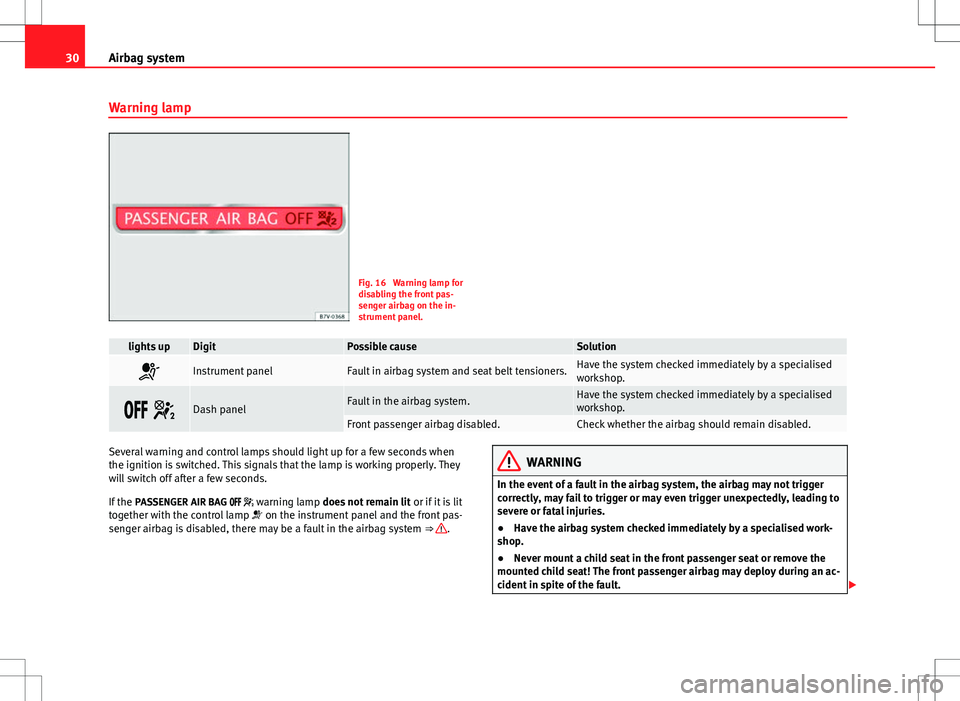
Warning lamp
Fig. 16 Warning lamp for
disabling the front pas-
senger airbag on the in-
strument panel.
lights upDigitPossible causeSolution
Instrument panelFault in airbag system and seat belt tensioners.Have the system checked immediately by a specialised
workshop.
Dash panelFault in the airbag system.Have the system checked immediately by a specialised
workshop.
Front passenger airbag disabled.Check whether the airbag should remain disabled.
Several warning and control lamps should light up for a few seconds when
the ignition is switched. This signals that the lamp is working properly. They
will switch off after a few seconds.
If the PASSENGER AIR BAG warning lamp does not remain lit or if it is lit
together with the control lamp on the instrument panel and the front pas-
senger airbag is disabled, there may be a fault in the airbag system ⇒
.
WARNING
In the event of a fault in the airbag system, the airbag may not trigger
correctly, may fail to trigger or may even trigger unexpectedly, leading to
severe or fatal injuries.
● Have the airbag system checked immediately by a specialised work-
shop.
● Never mount a child seat in the front passenger seat or remove the
mounted child seat! The front passenger airbag may deploy during an ac-
cident in spite of the fault.
Page 33 of 388
31
Airbag system
CAUTION
Always pay attention to any lit lamps and to the corresponding descriptions
and instructions to avoid damage to the vehicle.
Airbag system Description and function of the airbag
The airbag can protect vehicle occupants in the event of an accidents, cush-
ioning the movement of the occupants in the direction of the collision in
frontal and side accidents.
Deployed airbags fill with a propellant gas. This causes the airbag covers to
break and the airbags to deploy extremely quickly in their entire deploy-
ment space within fractions of a second. When an occupant with the seat
belt properly fastened puts pressure on the inflated airbag, the propellant
gas escapes to absorb the force of the impact and slow the movement. This
reduces the risk of severe or fatal injuries. Airbag deployment does not
mean that other types of injury such as swelling, bruising, burns and skin
injuries can be ruled out.
Airbags do not protect the arms or the lower part of the body.
The most important factors for triggering the airbag are the type of accident,
the angle of impact, the vehicle speed and the characteristics of the object
the vehicle hits. Therefore, airbags are not triggered every time the vehicle
is visibly damaged.
The airbag system is designed to be triggered in collisions with a severe im-
pact. The front, curtain, side and knee airbags may be triggered under spe-
cial circumstances. The scope of any visible damage to the vehicle is not an
indication of airbag deployment. Airbags act in conjunction with three-point seat belts in the event of certain
accidents, when the vehicle deceleration rate is severe enough to trigger
the airbags. Airbags only deploy once and only under certain circumstan-
ces. Seat belts remain present to offer protection in situations where air-
bags are not triggered or where they have already deployed. For example,
when a vehicle hits another after an initial collision or is hit by another vehi-
cle.
The airbag system is an integral part of the car's passive safety system. The
airbag system can only work effectively when the occupants are wearing
their seat belts correctly and have adjusted the head restraints properly
⇒ page 10.
Vehicle safety components
The following safety equipment makes up the vehicle safety design to re-
duce the risk of severe and fatal injuries. Depending on the vehicle equip-
ment, some equipment may not be fitted in the vehicle or may not be avail-
able in some markets.
● Optimised seat belts for all seats.
● Belt tension devices for the driver and front passenger and, where appli-
cable, on the outer seats of the second row of seats in combination with the
side airbags.
● Furthermore, belt tension limiters for the driver's and front passenger's
seat belt.
● Belt height adjustment for the front seats and, where applicable, the
outer seats of the second row of seats.
● Seat belt warning lamp
● Frontal airbags for driver and passenger.
● Side airbags for the driver, front passenger and, where applicable, the
outer seats of the second row of seats.
● Left and right curtain airbags.
● One airbag for the driver's knees.
● Airbag control lamp .
● PASSENGER AIR BAG control lamp.
Safety FirstOperating instructionsPractical tipsTechnical Specifications
Page 36 of 388
34Airbag system
The front airbag for the driver is located in the steering wheel ⇒ fig. 17 and
the airbag for the front passenger is located in the dash panel ⇒ fig. 18. Air-
bags are identified by the word “AIRBAG”.
When the front airbags are triggered they fill the zones marked in red (de-
ployment area) ⇒ fig. 17. Therefore, objects should never be placed or
mounted in these areas ⇒
, Factory-fitted accessories are outside the
range of the front airbag for the driver and the front passenger, e.g. the
baseplate for the mobile phone support.
The airbag covers fold out of the steering wheel or dash panel when the
driver and front passenger airbags are triggered ⇒ fig. 18. The airbag covers
remain connected to the steering wheel or the dash panel.
WARNING
The airbag is deployed at high speed in fractions of a second.
● Always keep the deployment areas of the front airbags free.
● Never secure objects to the covers or in the deployment area of the
airbag modules, e.g. cup holders or phone supports.
● The deployment space between the front passengers and the airbags
must not in any case be occupied by other passenger, pets and objects.
● Never fix any object to the windscreen above the front airbag on the
front passenger side.
● Do not alter, cover or stick anything to the steering wheel hub or the
surface of the airbag module on the passenger side of the dash panel.
WARNING
Front airbags are deployed in front of the steering wheel ⇒ fig. 17 and
the dash panel ⇒ fig. 18.
● When driving, always hold the steering wheel on the outer edge of
the ring with both hands: 9 o'clock and 3 o'clock position.
WARNING (Continued)
● Adjust the driver seat so that there is at least 25 cm distance between
your chest and the hub of the steering wheel. If you physical constitution
prevents you from meeting these requirements, make sure you contact a
specialised workshop.
● Adjust the front passenger's seat so there is as much distance as pos-
sible between the front passenger and the dash panel.
Types of front passenger airbag systems
There are two different SEAT front passenger airbag systems:
ABCharacteristics of the front passen-
ger airbag that can only be disabled
in a specialised workshop.Characteristics of the front passen-
ger airbag that can be disabled
manually ⇒ page 35.
Name: airbag system Name: airbag system with front
passenger airbag disabling.
Warning lamp on the instru-
ment panel. Warning lamp on the instru-
ment panel.
Front passenger airbag located in
the dash panel.
Front passenger airbag located in
the dash panel.
PASSENGER AIR BAG warning
lamp on the instrument panel.
Key switch in the glove compart-
ment on the front passenger side of
the dash panel.
Page 37 of 388
35
Airbag system
Deactivating and activating the front passenger airbag
using the key switch
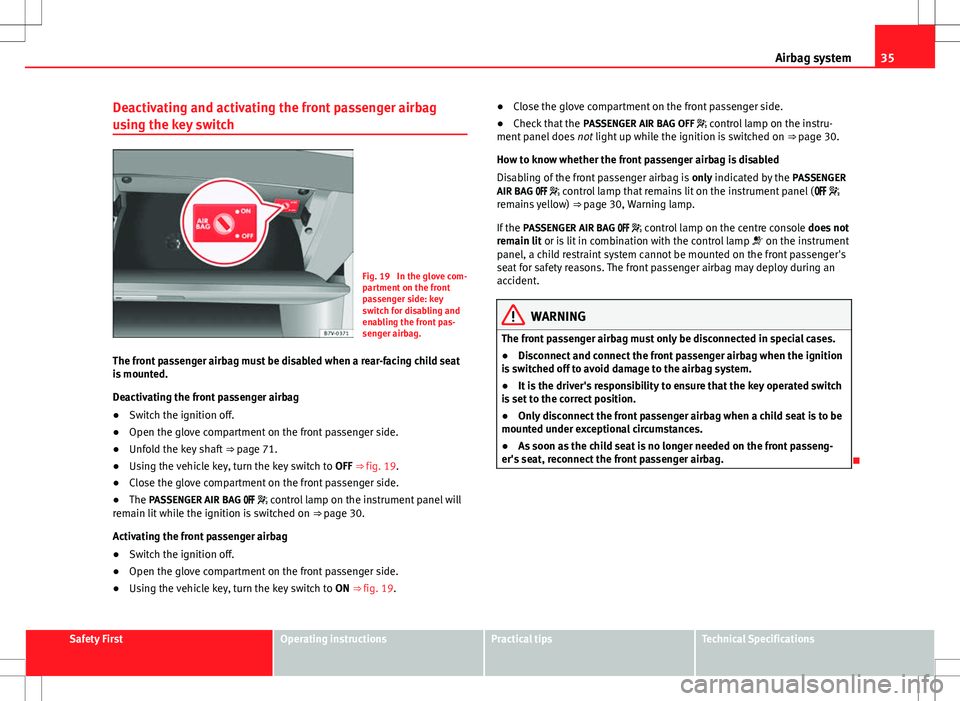
Fig. 19 In the glove com-
partment on the front
passenger side: key
switch for disabling and
enabling the front pas-
senger airbag.
The front passenger airbag must be disabled when a rear-facing child seat
is mounted.
Deactivating the front passenger airbag
● Switch the ignition off.
● Open the glove compartment on the front passenger side.
● Unfold the key shaft ⇒ page 71.
● Using the vehicle key, turn the key switch to OFF ⇒ fig. 19.
● Close the glove compartment on the front passenger side.
● The PASSENGER AIR BAG control lamp on the instrument panel will
remain lit while the ignition is switched on ⇒ page 30.
Activating the front passenger airbag
● Switch the ignition off.
● Open the glove compartment on the front passenger side.
● Using the vehicle key, turn the key switch to ON ⇒ fig. 19. ●
Close the glove compartment on the front passenger side.
● Check that the PASSENGER AIR BAG OFF control lamp on the instru-
ment panel does not light up while the ignition is switched on ⇒ page 30.
How to know whether the front passenger airbag is disabled
Disabling of the front passenger airbag is only indicated by the PASSENGER
AIR BAG control lamp that remains lit on the instrument panel (
remains yellow) ⇒ page 30, Warning lamp.
If the PASSENGER AIR BAG control lamp on the centre console does not
remain lit or is lit in combination with the control lamp on the instrument
panel, a child restraint system cannot be mounted on the front passenger's
seat for safety reasons. The front passenger airbag may deploy during an
accident.
WARNING
The front passenger airbag must only be disconnected in special cases.
● Disconnect and connect the front passenger airbag when the ignition
is switched off to avoid damage to the airbag system.
● It is the driver's responsibility to ensure that the key operated switch
is set to the correct position.
● Only disconnect the front passenger airbag when a child seat is to be
mounted under exceptional circumstances.
● As soon as the child seat is no longer needed on the front passeng-
er's seat, reconnect the front passenger airbag.
Safety FirstOperating instructionsPractical tipsTechnical Specifications
Page 38 of 388
36Airbag system
Side airbags
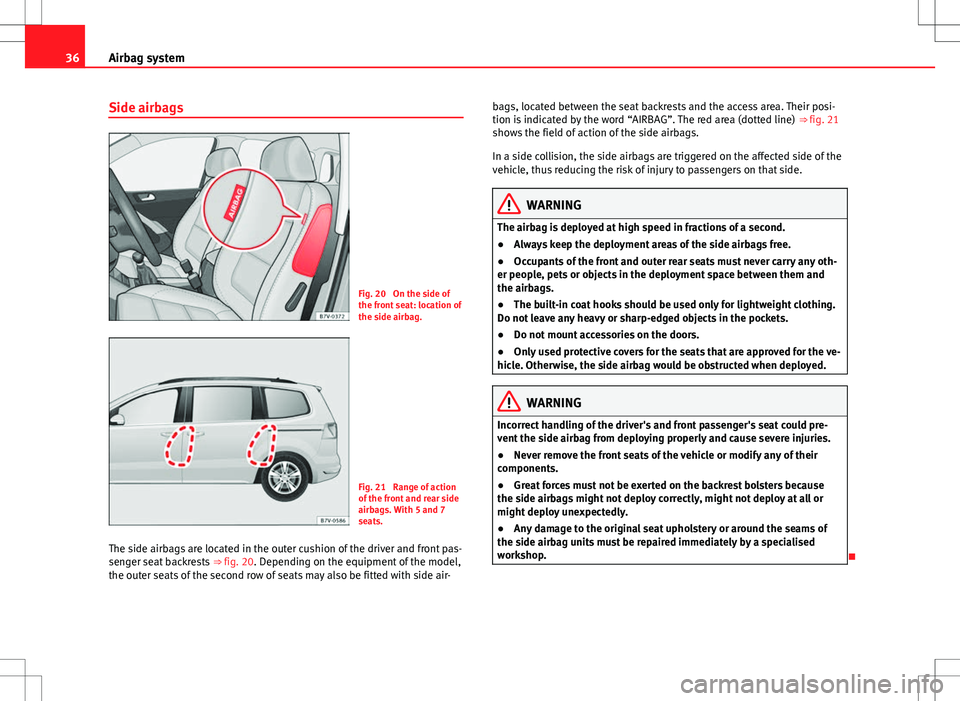
Fig. 20 On the side of
the front seat: location of
the side airbag.
Fig. 21 Range of action
of the front and rear side
airbags. With 5 and 7
seats.
The side airbags are located in the outer cushion of the driver and front pas-
senger seat backrests ⇒ fig. 20. Depending on the equipment of the model,
the outer seats of the second row of seats may also be fitted with side air- bags, located between the seat backrests and the access area. Their posi-
tion is indicated by the word “AIRBAG”. The red area (dotted line)
⇒ fig. 21
shows the field of action of the side airbags.
In a side collision, the side airbags are triggered on the affected side of the
vehicle, thus reducing the risk of injury to passengers on that side.
WARNING
The airbag is deployed at high speed in fractions of a second.
● Always keep the deployment areas of the side airbags free.
● Occupants of the front and outer rear seats must never carry any oth-
er people, pets or objects in the deployment space between them and
the airbags.
● The built-in coat hooks should be used only for lightweight clothing.
Do not leave any heavy or sharp-edged objects in the pockets.
● Do not mount accessories on the doors.
● Only used protective covers for the seats that are approved for the ve-
hicle. Otherwise, the side airbag would be obstructed when deployed.
WARNING
Incorrect handling of the driver's and front passenger's seat could pre-
vent the side airbag from deploying properly and cause severe injuries.
● Never remove the front seats of the vehicle or modify any of their
components.
● Great forces must not be exerted on the backrest bolsters because
the side airbags might not deploy correctly, might not deploy at all or
might deploy unexpectedly.
● Any damage to the original seat upholstery or around the seams of
the side airbag units must be repaired immediately by a specialised
workshop.
Page 39 of 388

37
Airbag system
Curtain airbags
Fig. 22 On the left side of the vehicle: location and de-
ployment area of the curtain airbag.
Fig. 23 Deployed curtain
airbags
The curtain airbags are located on the driver and front passenger side
above the doors ⇒ fig. 22. Airbags are identified by the word “AIRBAG”. The area framed red ⇒ fig. 22 is covered by the curtain airbag when it is de-
ployed (deployment area). Therefore, objects should never be placed or
mounted in these areas.
In a side collision, the curtain airbag on the side affected will be deployed.
The airbag covers the windows and pillars.
In a side collision, the curtain airbags for the front and outer rear seats re-
duce the risk of injury to the areas of the body facing the impact.
WARNING
The airbag is deployed at high speed in fractions of a second.
● Always keep the deployment areas of the curtain airbags free.
● Do not fix objects to the cover or in the deployment area of the cur-
tain airbag.
Safety FirstOperating instructionsPractical tipsTechnical Specifications
Page 40 of 388
38Airbag system
WARNING (Continued)
● Occupants of the front and outer rear seats must never carry any oth-
er people, pets or objects in the deployment space between them and
the airbags.
● The built-in coat hooks should be used only for lightweight clothing.
Do not leave any heavy or sharp-edged objects in the pockets.
● Do not mount accessories on the doors.
● Do not fit curtains to the windows other than those expressly ap-
proved for use in the vehicle.
● Only turn the sun blinds towards the windows if there is no object,
e.g. pens or garage remote controls, secured to the sun blind.
Knee airbag
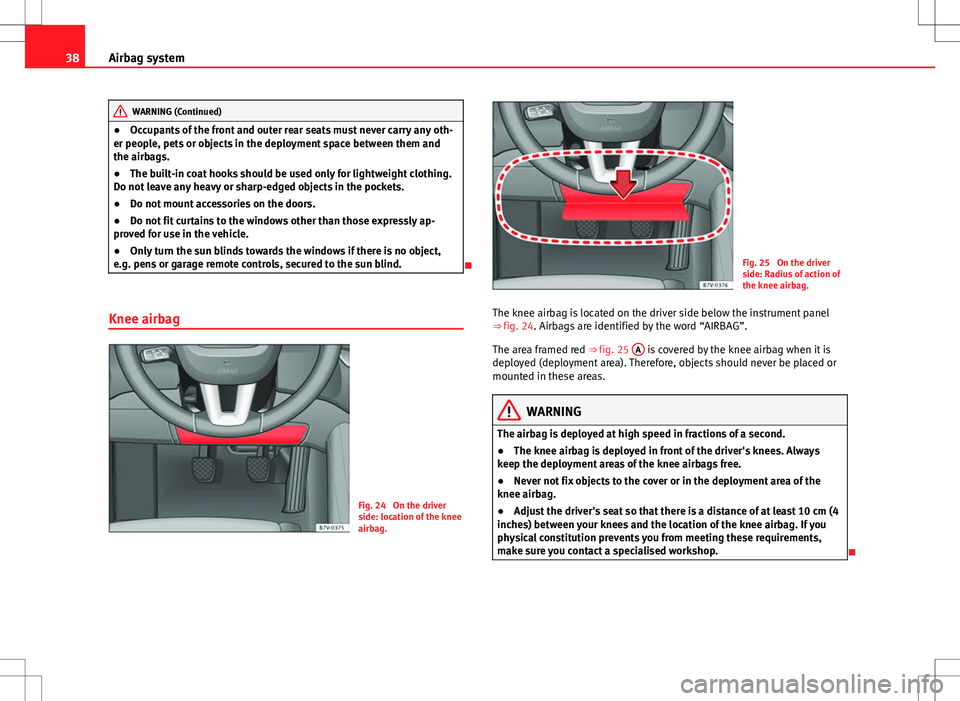
Fig. 24 On the driver
side: location of the knee
airbag.
Fig. 25 On the driver
side: Radius of action of
the knee airbag.
The knee airbag is located on the driver side below the instrument panel
⇒ fig. 24. Airbags are identified by the word “AIRBAG”.
The area framed red ⇒ fig. 25 A
is covered by the knee airbag when it is
deployed (deployment area). Therefore, objects should never be placed or
mounted in these areas.
WARNING
The airbag is deployed at high speed in fractions of a second.
● The knee airbag is deployed in front of the driver's knees. Always
keep the deployment areas of the knee airbags free.
● Never not fix objects to the cover or in the deployment area of the
knee airbag.
● Adjust the driver's seat so that there is a distance of at least 10 cm (4
inches) between your knees and the location of the knee airbag. If you
physical constitution prevents you from meeting these requirements,
make sure you contact a specialised workshop.
Page 41 of 388

39
Child safety
Child safety
Child seats (accessories) Introduction
Please read the information regarding the airbag system fully before trans-
porting babies and children in a child seat or other child restraint system
installed on the front passenger seat.
This information is extremely important for driver and passenger safety, par-
ticularly that of babies and children.
SEAT recommends the use of child seats from the SEAT accessory pro-
gramme. These child seats have been designed and tested for use in SEAT
vehicles. You can purchase child seats with different mountings from a
Technical Service.
Using child restraint systems with a base or foot
Some child retention systems are secured to the seat using a base or foot.
For certain equipment the use of an additional accessory will be necessary
(for example, the accessory for the floor compartment) to fit the child reten-
tion system correctly and securely.
Additional information and warnings:
● Airbag system ⇒ page 31
● Integrated child seats ⇒ page 45
WARNING
Make sure children are properly belted in and correctly secured to avoid
severe or fatal injuries while the vehicle is in motion.
● Never use a rear-facing child seat in the front passenger seat if the
front passenger airbag is enabled.
● Children up to 12 years old should always travel on the rear seat.
● Children must always be protected with an approved child restraint
system suited to their height and weight.
● Children must assume the proper sitting position and be properly bel-
ted in while travelling.
● Ensure the backrest of a seat is upright when a child seat is being
used on it.
● Do not allow the child's head or other part of his or her body to fall
into the deployment area of the side airbags.
● Make sure the belt webbing is correctly positioned.
● Never hold children or babies on your lap or in your arms.
● Only one child may occupy a child seat.
● If you are using a child seat with a base or foot, always install this
base or foot correctly and safely.
● If the vehicle has a storage compartment in the foot well in front of
the last row of seats, this compartment cannot be used as designed; on
the contrary: It must be filled using the specially designed accessory so
that the base or foot is correctly supported by the closed compartment
and the child seat is secured properly. If this compartment is not suitably
secured when using a child seat with a base or foot then the compart-
ment cover could rupture in an accident and the child will be ejected and
suffer serious injury.
● Please read and observe the child seat manufacturer's handling in-
structions.
Safety FirstOperating instructionsPractical tipsTechnical Specifications
Page 42 of 388
40Child safety
WARNING
An empty or loose child seat could fly uncontrollably around the vehicle
interior and cause injuries in the event of an accident or sudden braking.
● When not in use while the vehicle is in motion, always safely secure it
or store it in the luggage compartment.
Note
Replace the child seat after an accident, as it may have invisible damage.
General information on transporting children in the vehicle
Legal regulations and provisions will always take priority over the descrip-
tions of this instruction manual. There are different regulations and provi-
sions for the use of child seats and their mountings ( ⇒ table on page 41).
In some countries, for example, the use of child seats on certain seats in the
vehicle may be forbidden.
The physical principles and the forces acting on the vehicle in the event of a
collision or other type of accidents also apply to children ⇒ page 21. Howev-
er, unlike adults and youngsters, children do not have fully developed mus-
cle and bone structures. In the event of an accident, children are subject to
a greater risk than adults of sustaining severe injuries.
Given that children's bodies are not yet fully developed, child restraint sys-
tems must be used that are especially adapted to their height, weight and
constitution. There are laws in force in many countries that determine the
use of approved seat systems for transporting babies and children.
Only used authorised, approved child seats that are suitable for the vehicle.
Always consult with a Technical Service or a specialised workshop should
you have any doubts. Checklist
To transport children in the vehicle
⇒
:
● Observe the legal requirements specific to each country.
● For safety reasons, SEAT recommends that children under 12 years of
age are transported on the rear seats.
● Only if you have no alternative should a child travel on the front passen-
ger seat ⇒ page 42. The safest place in the vehicle is on the rear seat be-
hind the front passenger seat.
● Child must always use a child restraint system when travelling in the ve-
hicle. The child restraint system must be suitable for the height, weight and
constitution of the child.
● Only one child may occupy a child seat.
● Follow the user instructions from the child seat manufacturer and always
keep them in the vehicle.
● If the child seat is secured using the seat belt, guide the seat belt
through or around the child seat according to the instructions of the child
seat manufacturer.
● Make sure the belt webbing is correctly positioned and that the child is
sitting properly.
● The child seat should be installed on the rear seat behind the front pas-
senger seat so that the child can exit the car on the kerb side.
● Do not leave toys or other loose objects on the child seat or on the seat
while the vehicle is in motion.
Specific child seat regulations for each country (selection)
RegulationFurther informationECE-R 44 a)Technical Service or qualified work-
shop
a)
ECE-R: Economic Comission for Europe Regulation.
Page 43 of 388

41
Child safety
Categorisation of child seats according to ECE-R 44
Weight cate- goryWeight of the childInstallation of the child seat
Group 0children up to 10 kgRear-facing. On rear seats, optionallyusing the ISOFIX system.
Group 0+children up to 13 kg
Group 19 to 18 kgForward-facing. On rear seats, optional-ly using the ISOFIX system.
Group 215 to 25 kg
Forward-facing. On the outer rear seatsor in the centre seat of the second row of seats and on all seats in the thirdrow. Optionally with ISOFIX system.
Group 322 to 36 kgForward-facing.
Not all children fit in the seat of their weight group. Nor do all seats adapt to
the vehicle. Therefore, always check whether the child fits properly in the
child seat and whether the seat can be installed safely in the vehicle.
The rear seats are suitable for child seats with the ISOFIX system specially
designed for this type of vehicle in accordance with regulation ECE-R 44.
Child seats approved under the ECE-R 44 regulation are fitted with the corre-
sponding approval symbol. The sign is an upper-case E in a circle with the
identification number below it.
WARNING
Not following the checklist prepared for your own safety could lead to ac-
cidents and severe injuries.
● Always follow the check list and perform the necessary operations.
WARNING
In general, the rear seat is always the safest place for correctly belted in
children in the event of an accident.
● A suitable child seat that is correctly installed and used on one of the
rear seats offer the most protection possible for babies and small chil-
dren in most accidents.
Note
Other accessories may be required to fit the child retention system with a
base or foot security and safely. Contact a Technical Service or specialised
workshop.
Different mounting systems
Fig. 26 On the rear seats: figure A shows the basic child restraint system mounting
using lower retaining rings and the upper retaining strap. Figure B shows the child
restraint system mounting using the vehicle's seat belt.
Safety FirstOperating instructionsPractical tipsTechnical Specifications