tow Seat Alhambra 2012 Workshop Manual
[x] Cancel search | Manufacturer: SEAT, Model Year: 2012, Model line: Alhambra, Model: Seat Alhambra 2012Pages: 388, PDF Size: 6.72 MB
Page 246 of 388
244Trailer towing
247 mm (10 inches)
596 mm (23 inches)
1097 mm (43 inches)
1102 mm (43 inches)
WARNING
Erroneous or unsuitable connection of electric cables may cause anoma-
lies in the vehicle electronics that could result in an accident with serious
consequences.
● Never connect the trailer's electric system to the electrical connec-
tions of the rear lights or any other unsuitable power sources. Only use
suitable connectors to connect a trailer.
● Visit a specialised workshop if you wish to retrofit a tow hitch to the
vehicle.
WARNING
If the tow hitch is badly fitted or unsuitable, the trailer may separate from
the vehicle while driving. This could result in serious accident.
Note
Use only tow hitches approved by SEAT for the vehicle.
Maximum gross trailer weight
The instructions in the official vehicle documents take precedence. All the
technical data provided in this documentation is applicable to the basic
model. The vehicle data label in the Maintenance Programme or the vehicle
documents show which engine is installed in your vehicle. E
FGH
The figures may be different depending on if additional equipment is fitted,
for different models and for special vehicles.
WARNING
Exceeding the maximum trailer weight indicated could cause a serious
accident.
● Never exceed the indicated trailer weight.
CAUTION
Exceeding the maximum trailer weight indicated could cause damage to the
vehicle.
● Never exceed the indicated trailer weight.
Gross combined vehicle weight rating
The instructions in the official vehicle documents take precedence. All the
technical data provided in this documentation is applicable to the basic
model. The vehicle data label in the Maintenance Programme or the vehicle
documents show which engine is installed in your vehicle.
The figures may be different depending on if additional equipment is fitted,
for different models and for special vehicles.
The maximum combined weights listed are only applicable for altitudes up
to 1000 m above sea level. The weight of the car and trailer must be re-
duced by about 10% for every further 1000 m (or part thereof).
WARNING
Exceeding the maximum weight indicated could cause a serious accident.
● Never exceed the gross combined weight rating.
Page 247 of 388
245
Trailer towing
CAUTION
Exceeding the maximum gross combined weight rating indicated could
cause damage to the vehicle.
● Never exceed the gross combined weight rating.
Safety FirstOperating instructionsPractical tipsTechnical Specifications
Page 266 of 388
264Accessories, parts replacement and modifications
Retro-fitting of two-way radios
An exterior aerial is required for the use of two-way radios in the vehicle.
The retro-fitting of electrical or electronic appliances in the vehicle is sub-
ject to their approval for use in your vehicle. Under certain circumstances,
this could mean that your vehicle registration documents are no longer val-
id.
SEAT has approved your vehicle for use with two-way radios providing the
following conditions are observed:
●The exterior aerial must be mounted professionally.
● The maximum transmitting power is 10 watts.
An only external aerial is needed to give the equipment its optimal reach.
Check first with a qualified dealer if you wish to use a two-way radio with a
transmitting power of over 10 watts. The qualified workshops are familiar
with the technical options for installation. SEAT recommends visiting a Tech-
nical Service.
All legal requirements, together with the instructions for the use of two-way
radios must be observed.
WARNING
If the two-way radio is not securely fastened in position, it could be sent
flying around the vehicle in the event of sharp braking, sudden manoeu-
vres or accident, causing injury.
● While driving, two-way radios must be securely fastened in position,
outside the radius of action of the airbags, or safely stowed away.
WARNING
When using a two-way radio without a connection to an exterior aerial,
the maximum permitted levels of electromagnetic radiation may be ex-
ceeded. This is also the case if the aerial has not been correctly installed.
● You should only use a two-way radio inside the vehicle if it has first
been correctly connected to an exterior aerial.
Information stored by the control units
Your vehicle is fitted at the factory with a series of electronic control units
responsible for the engine and gearbox management. In addition, the con-
trol units supervise the performance of the exhaust gas system and the air-
bag systems.
Therefore, while the vehicle is being driven, these electronic control units
are continuously analysing the vehicle data. In the event of faults or devia-
tions from the theoretical values, only this data is stored. Normally, the
warning lamps on the instrument panel light up in the event of faults.
This data can only be read and analysed using special equipment.
The storing of the data allows specialised workshops to detect and repair
faults. Stored data may include:
● Data relating to the engine or the gearbox
● Speed
● Direction of travel
● Braking force
● Detection of seat belt
The vehicle control units never record conversations held by passengers in
the vehicle.
Page 268 of 388
266Accessories, parts replacement and modifications
electromagnetic radiation transmitted and the risk to human health. It will
also improve the quality of the connection.
If the phone is used inside the vehicle without the hands-free system, it will
not be securely fastened and will not be connected to the exterior aerial of
the vehicle telephone. Nor will the telephone charge if it is not on the sup-
port. In addition, some calls may break off and the quality of the connection
will be affected.
Mobile phones should only be used inside the vehicle if they are connected
to a hands-free system with an exterior aerial.
WARNING
If the mobile phone is not securely fastened in position, it could be sent
flying around the vehicle in the event of sharp braking, sudden manoeu-
vres or accident, causing injury.
● While driving, mobile phones must be securely fastened in position,
outside the radius of action of the airbags, or safely stowed away.
WARNING
When using a mobile phone without a connection to an exterior aerial,
the maximum permitted levels of electromagnetic radiation may be ex-
ceeded. This is also the case if the aerial has not been correctly installed.
● A minimum of 20 centimetres should be kept between mobile phone
aerials and artificial pacemakers, as mobile telephones may affect the
working of pacemakers.
● Do not carry a mobile phone in your breast pocket directly over the
pacemaker when the phone is switched on.
● If you suspect interference, switch the mobile phone off immediately.
Jacking points for raising vehicle
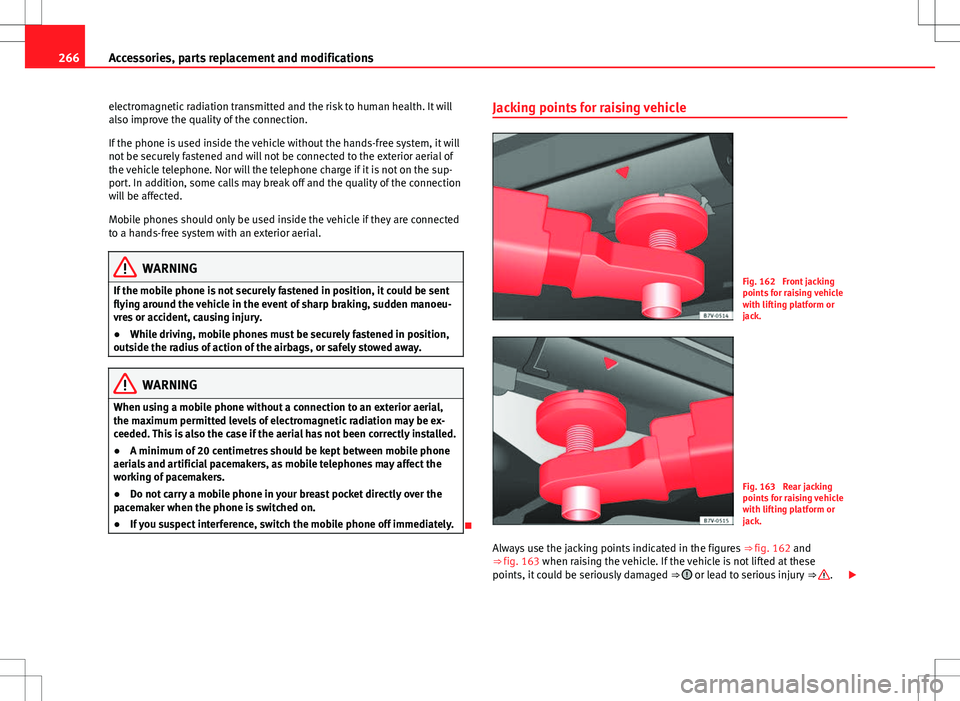
Fig. 162 Front jacking
points for raising vehicle
with lifting platform or
jack.
Fig. 163 Rear jacking
points for raising vehicle
with lifting platform or
jack.
Always use the jacking points indicated in the figures ⇒ fig. 162 and
⇒ fig. 163 when raising the vehicle. If the vehicle is not lifted at these
points, it could be seriously damaged ⇒
or lead to serious injury ⇒ .
Page 288 of 388
286Checking and refilling levels
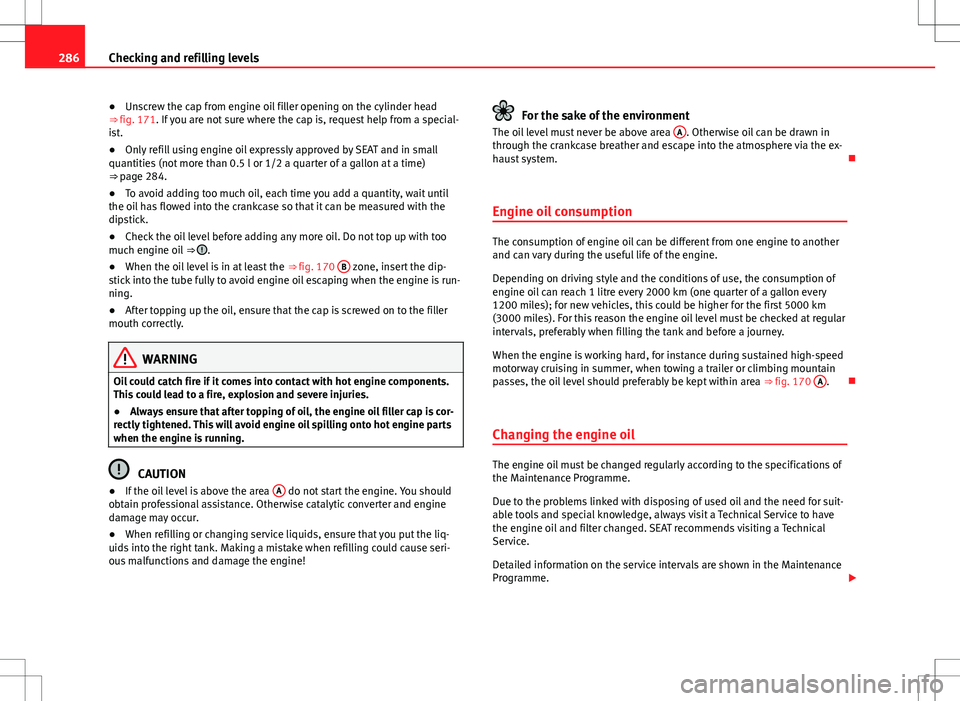
● Unscrew the cap from engine oil filler opening on the cylinder head
⇒ fig. 171. If you are not sure where the cap is, request help from a special-
ist.
● Only refill using engine oil expressly approved by SEAT and in small
quantities (not more than 0.5 l or 1/2 a quarter of a gallon at a time)
⇒ page 284.
● To avoid adding too much oil, each time you add a quantity, wait until
the oil has flowed into the crankcase so that it can be measured with the
dipstick.
● Check the oil level before adding any more oil. Do not top up with too
much engine oil ⇒
.
● When the oil level is in at least the ⇒ fig. 170 B zone, insert the dip-
stick into the tube fully to avoid engine oil escaping when the engine is run-
ning.
● After topping up the oil, ensure that the cap is screwed on to the filler
mouth correctly.
WARNING
Oil could catch fire if it comes into contact with hot engine components.
This could lead to a fire, explosion and severe injuries.
● Always ensure that after topping of oil, the engine oil filler cap is cor-
rectly tightened. This will avoid engine oil spilling onto hot engine parts
when the engine is running.
CAUTION
● If the oil level is above the area A do not start the engine. You should
obtain professional assistance. Otherwise catalytic converter and engine
damage may occur.
● When refilling or changing service liquids, ensure that you put the liq-
uids into the right tank. Making a mistake when refilling could cause seri-
ous malfunctions and damage the engine!
For the sake of the environment
The oil level must never be above area A. Otherwise oil can be drawn in
through the crankcase breather and escape into the atmosphere via the ex-
haust system.
Engine oil consumption
The consumption of engine oil can be different from one engine to another
and can vary during the useful life of the engine.
Depending on driving style and the conditions of use, the consumption of
engine oil can reach 1 litre every 2000 km (one quarter of a gallon every
1200 miles); for new vehicles, this could be higher for the first 5000 km
(3000 miles). For this reason the engine oil level must be checked at regular
intervals, preferably when filling the tank and before a journey.
When the engine is working hard, for instance during sustained high-speed
motorway cruising in summer, when towing a trailer or climbing mountain
passes, the oil level should preferably be kept within area ⇒ fig. 170 A
.
Changing the engine oil
The engine oil must be changed regularly according to the specifications of
the Maintenance Programme.
Due to the problems linked with disposing of used oil and the need for suit-
able tools and special knowledge, always visit a Technical Service to have
the engine oil and filter changed. SEAT recommends visiting a Technical
Service.
Detailed information on the service intervals are shown in the Maintenance
Programme.
Page 289 of 388
287
Checking and refilling levels
Engine oil additives make new oil darker after the engine has been running
for a short period. This is normal and does not mean more frequent oil
changes are required.
WARNING
If, in exceptional circumstances, you must change the engine oil yourself,
please note the following:
● Wear eye protection.
● Always wait until the engine has completely cooled to avoid being
burned.
● Always keep your arms horizontal when unscrewing the oil drainage
bolt so that the oil does not run down your arms when it begins to drain.
● Use a suitable and large enough container to collect all of the used oil
in the engine.
● Never collect engine oil in empty food containers, cans, bottles and
other containers as not all people are able to identify engine oil.
● Oil is toxic and must be kept out of the reach of children.
For the sake of the environment
Before changing the engine oil, find a suitable location or service for proper
disposal.
For the sake of the environment
Always dispose of engine oil with the utmost respect for the environment.
Never dispose of used engine oil in places such as a garden, woods, drains,
roads, paths, rivers and drainage systems. Engine coolant
Introduction
Never work on the engine cooling system or if you are not familiar with the
operations to be carried out, the applicable safety standards and especially
if you do not have the instruments, liquids and tools necessary ⇒
! Have
the work carried out by a specialised workshop if you are uncertain. SEAT
recommends visiting a Technical Service.
Negligent work can cause serious injury.
Additional information and warnings:
● Towing mode ⇒ page 237
● Working in the engine compartment ⇒ page 279
● Accessories, parts replacement, repairs and modifications ⇒ page 261
WARNING
Engine coolant is toxic!
● Only keep engine coolant in its original container, tightly shut and in
a safe place.
● Never store engine coolant in empty food containers or bottles as
other people may accidentally drink it.
● Always keep engine coolant out of reach of children.
● Ensure that the proportion of engine coolant additive corresponds to
the lowest outside temperature to which the vehicle will be exposed.
● If the outside temperature is extremely low, the engine coolant could
freeze causing the vehicle to stop. As this would also cause the heating
to stop working, passengers without sufficient clothing could freeze.
Safety FirstOperating instructionsPractical tipsTechnical Specifications
Page 299 of 388
297
Wheels and tyres
Wheels and tyres
Wheels
Introduction
The SEAT Alhambra is equipped as standard with anti-puncture technology
tyres (Conti-Seal). In the event of a puncture or air leak of up to 5 mm, the
tyre seals the hole with a protective layer inside the tread.
SEAT recommend that all work on tyres and wheels is carried out by a Tech-
nical Service. They have the necessary special tools and replacement parts,
trained personnel and facilities for disposing of the old tyres. SEAT recom-
mends visiting a Technical Service.
Additional information and warnings:
● Transporting ⇒ page 13
● Towing mode ⇒ page 237
● Braking, stopping and parking ⇒ page 185
● Park assist system ⇒ page 204
● Tyre control systems ⇒ page 225
● Caring for and cleaning the vehicle exterior ⇒ page 246
● Wheel trims ⇒ page 308
● Change wheel ⇒ page 309
● Notes for the user ⇒ page 259
WARNING
The vehicle cannot be totally controlled or braked if the tyres (new or
used) are worn or damaged.
● Incorrect use of wheels and tyres could make driving more dangerous
and result in serious accidents and damage.
● All four wheels must be fitted with radial tyres of the same type, size
(rolling circumference) and the same tread pattern.
● New tyres do not give maximum grip and will not have reached their
maximum braking capacity to start with, and therefore need running in.
To prevent accidents and major damage, extreme caution should be tak-
en for the first 600 km (370 miles).
● Check tyre pressures regularly and ensure they are maintained at the
pressures indicated. If the tyre pressure is too low, the tyres could over-
heat, resulting in tread detachment or even burst tyres.
● Never drive on damaged (punctured, cut, cracked or dented) or worn
tyres. Driving on damaged or worn tyres could result in burst tyres, seri-
ous accidents or damage. Worn or damaged tyres must be replaced im-
mediately.
● Never exceed the maximum permitted speed or loads specified for the
type of tyre fitted on your vehicle.
● The efficiency of driver and brake assist systems also depends on the
grip of the tyres.
● If you notice unusual vibration or if the vehicle pulls to one side when
driving, stop the car immediately and check the tyres and wheels for
damage.
● To minimise the risk of losing control of the vehicle or causing a seri-
ous accident, never undo the bolted joints of beadlock wheels.
Safety FirstOperating instructionsPractical tipsTechnical Specifications
Page 312 of 388
310Wheels and tyres
WARNING (Continued)
● Only use suitable tools that are not damaged when changing a wheel.
● Always stop the engine, turn on the electronic parking brake and
place the gear selector lever in position P, for an automatic gearbox, or
engage a gear for a manual gearbox to reduce the risk of the vehicle mov-
ing accidentally.
● Have the tightening torque of the wheel bolts checked as soon as
possible with a reliable torque wrench.
Preparations for changing a wheel
Check list
Before changing a wheel, complete the following operations in the order
given ⇒
:
Park the vehicle on an even and solid surface.
Connect the electronic parking brake ⇒ page 185.
Automatic gearbox: Move selector lever to position P ⇒ page 176.
Stop the engine and remove the key from the ignition ⇒ page 172.
Manual gearbox: Select a gear ⇒ page 176.
Have all vehicle occupants get out of the vehicle and wait in a safe
place (for example, behind the safety barrier).
Block the opposite wheel with wedges or a similar object.
When towing a trailer: unhook the trailer from the towing vehicle and
park it correctly.
If the luggage compartment is full: take the baggage out of the vehicle. Take the vehicle tool kit out of the luggage compartment.
Remove the wheel trims ⇒ page 308.
1.
2.
3.
4.
5.
6.
7.
8.
9.
10.
11.
WARNING
Failure to follow the checklist prepared for your own safety could lead to
accidents and severe injuries.
● Always complete the operations given in the checklist and observe
the general rules of safety.
Page 316 of 388
314Wheels and tyres
Check list
For your own safety and that of other passengers, the following points
should be observed in the order given ⇒
:
Select a suitable flat and firm surface for raising the vehicle.
Switch off the engine, engage a gear (manual gearbox) or place the se-
lector lever in position P ⇒ page 176 and turn on the electronic parking
brake ⇒ page 185.
When towing a trailer: unhook the trailer from the towing vehicle and
park it correctly.
Loosen the wheel bolts on the wheel to be changed ⇒ page 311.
Look below the vehicle for the jacking point ⇒ fig. 185 closest to the
tyre which has to be changed.
Raise the jack with the handle until it can be inserted below the jacking
point.
Ensure that the foot of the jack is firmly on the ground and that it is
placed immediately below the lifting point on the vehicle ⇒ fig. 186.
Straighten the jack and continue raising it using the handle until the
claw holds the vertical reinforcement beneath the vehicle ⇒ fig. 186.
Raise the vehicle until the wheel is clear of the ground.
WARNING
If the vehicle is not correctly raised, it could fall off the jack causing seri-
ous injury. Please observe the following rules to minimise the risk of in-
jury:
● You should only use a jack approved by SEAT for your vehicle. Other
jacks, even those approved for other SEAT models, might slip out of
place.
● The ground should be firm and flat. If the ground is sloped or soft
then the vehicle could slip and fall off the jack. If necessary, support the
jack on a wide solid base.
1.
2.
3.
4.
5.
6.
7.
8.
9.
WARNING (Continued)
● If the ground is slippery (for example, on tiles), place a non-slip sur-
face (for example a floor mat) beneath the jack to avoid slipping.
● Only fit the jack at the prescribed jacking points. The claw of the jack
should grip the reinforcement nerve on the underbody ⇒ fig. 186.
● You should never have any limbs beneath a raised vehicle which is
only supported by a jack.
● If you have to work underneath the vehicle, you must use suitable
stands additionally to support the vehicle, there is a risk of accident!.
● Never raise the vehicle if it is tilting to one side or the engine is run-
ning.
● Never start the engine when the vehicle is raised. The vehicle may
come loose from the jack due to the engine vibrations.
WARNING
Failure to follow the checklist prepared for your own safety could lead to
accidents and severe injuries.
● Always complete the operations given in the checklist and observe
the general rules of safety.
Page 318 of 388
316If and when
If and when
In case of emergency
Introduction
Additional information and warnings:
● Braking, stopping and parking ⇒ page 185
● Emergency locking and unlocking ⇒ page 318
● Vehicle tools ⇒ page 324
WARNING
A faulty vehicle in traffic represents a risk of accident for the driver and
for other road users.
● Stop the vehicle safely as soon as possible. Park the vehicle a safe
distance from surrounding traffic to lock all the doors in case of an emer-
gency. Turn on the hazard warning lights to warn other road users.
● Never leave children or disabled people alone in the vehicle if the
doors are to be locked. In case of an emergency, passengers will be trap-
ped inside the vehicle. Individuals locked in the vehicle can be exposed
to very high or very low temperatures.
Protecting yourself and securing the vehicle
Fig. 188 In the centre of
the instrument panel:
Switch for hazard warn-
ing lights.
Always fulfil legal requirements for securing a broken down vehicle. In a
number of countries it is now obligatory, for example, to turn on the hazard
warning lights and use a reflective safety vest ⇒ page 318.
When being towed with the hazard warning lights on, a change in direction
or traffic lane can be indicated as usual using the turn indicator lever. The
hazard lights will be interrupted temporarily.
Checklist
For your own safety and that of other passengers, the following points
should be observed in the order given ⇒
:
Park the vehicle a safe distance from traffic and on suitable ground
⇒
.
Turn on the hazard warning lights with the button ⇒
fig. 188.
Connect the electronic parking brake ⇒ page 185.
1.
2.
3.