warning Seat Alhambra 2013 Owner's Manual
[x] Cancel search | Manufacturer: SEAT, Model Year: 2013, Model line: Alhambra, Model: Seat Alhambra 2013Pages: 387, PDF Size: 6.13 MB
Page 256 of 387
254Vehicle maintenance and cleaning
CAUTION
If you ignore this checklist, which is important for maintaining your seat up-
holstery, the fabric may be damaged or stained.
● Consult the checklist and carry out the operations it describes.
Note
SEAT recommends you take the vehicle to a specialised workshop to treat
any stains on the upholstery caused by the discolouration of clothing.
How to clean the upholstery, trim fabrics and Alcantara ®
Cleaning the fabric on heated seats and electrically adjustable seats or
seats with airbag components
It is possible that there are important airbag components and electrical con-
nections inside the driver seat, passenger seat and possibly the outer rear
seats. If these seats and seat backrests are damaged, or are cleaned and
are treated incorrectly, or if they get wet, the vehicle electric system may be
destroyed and the airbag system damaged
⇒
.
Electric and heated seats contain components and electrical connections
that may be damaged if the seats are cleaned or incorrectly treated ⇒
.
Similarly, damage might be caused at other points in the vehicle's electric
system.
For this reason, bear the following indications in mind for cleaning:
● Do not use high-pressure or steam cleaning equipment or cold aerosols.
● Do not use cream detergents or detergent-based solutions for delicate
garments.
● Prevent the fabric from getting wet at all times.
● Only use cleaning products approved by SEAT.
● If in doubt, take the vehicle to a professional cleaning company. Cleaning the fabric on unheated seats, non-electrically adjustable seats
and seats without airbag components
●
Before using any cleaning products, consult and keep in mind the in-
structions of use, indications and warnings on the container.
● Use a vacuum cleaner (with the brush attachment) on the trim and seat
fabrics, the Alcantara ®
upholstery of the seats and the carpet.
● Do not use high-pressure or steam cleaning equipment or cold aerosols.
● For general cleaning, use a soft sponge or an ordinary lint-free microfi-
bre cloth ⇒
.
● Clean Alcantara ®
surfaces with a slightly damp cotton or woollen cloth,
or a standard lint-free microfibre cloth ⇒
.
If the dirt on the trim and upholstery fabrics is only superficial, you can use
a standard foam cleaner.
If the upholstery and trim are very dirty, before cleaning them we recom-
mend you find out about the most suitable cleaning options from a profes-
sional cleaning company. If necessary, the cleaning should be carried out
by a specialised company.
Stain removal
When removing stains, it may be necessary to clean the whole surface and
not just the stain itself. Especially if the surface has been dirtied through
normal use. If you only clean the stained area, that part may then look light-
er than the rest. If in doubt, take the vehicle to a professional cleaning com-
pany.
WARNING
If there is a fault in the airbag system, it is likely that the airbag will not
deploy correctly, not deploy at all, or do so unexpectedly, which could
cause serious or fatal injuries.
● Have the system checked immediately by a specialised workshop.
Page 259 of 387
257
Vehicle maintenance and cleaning
WARNING
Solvents cause the surfaces of the airbag modules to become porous. If
an airbag is accidentally triggered, the detachment of plastic parts could
cause serious injury.
● Never clean the dash panel and the surfaces of the airbag modules
with cleaners containing solvents.
Cleaning seat belts
If the seat belt is very dirty, the belt retractor may not work correctly thus
preventing the seat belt from operating correctly.
The seat belts should never be removed from the vehicle for cleaning.
● Use a soft brush to remove the worst dirt ⇒
.
● Pull the seat belt right out and leave it out.
● Clean dirty seat belts with a gentle soap and water solution.
● Wait until they are completely dry.
● Only allow the seat belt to retract when it is completely dry.
WARNING
Check the condition of all the seat belts at regular intervals. If the web-
bing or other parts of the belt are damaged, the vehicle should be taken
to a specialised workshop immediately and the belts should be replaced.
It is extremely dangerous to drive using damaged seat belts and could re-
sult in serious injury or loss of life.
● Seat belts and their components must never be cleaned with chemi-
cal products, nor should they be allowed to come into contact with corro-
sive liquids, solvents or sharp objects. This could affect the strength of
the seat belt webbing.
● Seat belts should be completely dry before retracting. Damp could
damage the belt retractor so that it is does not operate correctly.
● Do not allow liquids or foreign bodies to enter the buckle fastenings.
This could damage the buckles and seat belts.
● Never attempt to repair, modify or remove a seat belt yourself.
● Always have damaged seatbelts replaced immediately by seat belts
approved for the vehicle in question by SEAT. Seat belts which have been
worn in an accident and stretched must be replaced by a specialised
workshop. Renewal may be necessary even if there is no apparent dam-
age. The belt anchorage should also be checked.
Safety FirstOperating instructionsPractical tipsTechnical Specifications
Page 260 of 387
258Vehicle maintenance and cleaning
Notes for the user
Labels and plates
Some parts in the engine compartment come from the factory with certifi-
cates of safety, labels or plates containing important information regarding
the operation of the vehicle, for example, on the petrol cap, on the passeng-
er's sun visor, on the driver door strut, or on the floor of the luggage com-
partment.
● Never remove these certificates of safety, labels or plates, and ensure
they are kept in good condition and are legible.
● If a vehicle part, bearing a certificate of safety, label or plate, is re-
placed, the specialised workshop should attach the information back in the
same place.
Certificate of safety
A certificate of safety on the door strut states that all the safety standards
and regulations established by the national traffic authorities responsible
for road safety were met at the time of manufacture. It may also give the
month and year of manufacture, together with the chassis number.
Warning of high voltage label*
There is a label close to the bonnet lock which warns of high voltage in the
vehicle electrical installation. The vehicle ignition system complies with sev-
eral standards, including the Canadian standard, ICES-002.
Using your vehicle in other countries and continents
The vehicle is manufactured at the factory for use in a particular country in
accordance with the national legislation in force at the time of manufacture. If the vehicle is sold in another country or used in another country for an ex-
tended period of time, the applicable legislation of that country should be
observed.
It may be necessary to fit or remove certain pieces of equipment or to deac-
tivate certain functions. Service work may also be affected. This is particu-
larly true if the vehicle is used in a different climate for an extended period
of time.
As there are different types of frequency bands around the world, you may
find that the radio or navigation system supplied at the factory does not
work in another country.
CAUTION
● SEAT does not accept liability for any damage to the vehicle due to the
use of a lower quality fuel, an inadequate service or the non-availability of
genuine spare parts.
● SEAT does not accept liability if the vehicle does not comply in part or in
full with the legal requirements of other countries or continents.
Radio reception and the aerial
The aerial of radio and navigation systems fitted at the factory may be
mounted in different parts of the vehicle:
● On the inside of the rear window, next to the rear window heating,
● on the inside of the rear side windows,
● on the inside of the windscreen,
● on the roof of the vehicle.
Aerials mounted on the inside of a window can be recognised by the fine
wires.
Page 261 of 387
259
Vehicle maintenance and cleaning
CAUTION
Aerials on the inside of windows may be damaged if knocked or if cleaned
with corrosive or acid cleaning products. Do not stick adhesive labels over
the heating elements and never clean the inside of the rear window with
corrosive or acid products or other similar chemical cleaning products.
Note
If electrical equipment is used near an aerial built-into the window, you may
observe interference in the reception of AM stations.
Notes on SEAT repairs
WARNING
Repairs or modifications which are not performed correctly may result in
damage or errors in the vehicle operation, affecting the effectiveness of
the driver assist and airbag systems. This could result in serious acci-
dent.
● Have any repairs or modifications carried out at a specialised work-
shop.
Collection and scrapping of end-of-life vehicles
Collection of end-of-life vehicles
An extensive network of used car reception centres already exists in much of
Europe. After the vehicle has been delivered, you will receive a certificate of
destruction describing the environmentally friendly scrapping of the vehicle
in accordance with applicable legislation. We will collect the used vehicle free of charge, provided it complies with all
national legislation.
Please see your Technical Service for further information about the collec-
tion and scrapping of end-of-life vehicles.
Scrapping
The relevant safety requirements must be observed when the vehicle or
components of the airbag or belt tensioner systems are scrapped. These re-
quirements are known to specialised workshops.
Safety FirstOperating instructionsPractical tipsTechnical Specifications
Page 262 of 387
260Accessories, replacement of parts and modifications
Accessories, replacement of parts and modifications
Accessories, replacement of parts and
modifications Introduction
WARNING
The use of spare parts and accessories, or incorrectly performed modifi-
cations or repairs may result in damage to the vehicle, accidents and se-
rious injury.
● SEAT strongly recommends you to only use SEAT approved accesso-
ries and SEAT ®
original spare parts. These parts and accessories have
been specially tested by SEAT for suitability, reliability and safety.
● Have any repairs or modifications carried out at a specialised work-
shop. Specialised workshops have the necessary tools, diagnostics
equipment, repair information and qualified personnel.
● Only mount parts with the same specifications as the parts fitted at
factory.
● Never mount, fasten or fit objects such as drink holders or telephone
cradles over the covers of the airbag modules or within their radius of ac-
tion.
● Only use wheels and tyre combinations which have been approved by
SEAT for your vehicle type.
Accessories and spare parts
SEAT recommends you consult an Official Service before purchasing acces-
sories and spare parts or consumables. For example, when fitting accesso- ries at a later date, or when replacing a component. A Technical Service will
advise you as to the legal requirements and manufacturer's recommenda-
tions regarding accessories, spare parts and other components.
SEAT recommend you use only approved
SEAT accessories and genuine
SEAT spare parts ®
. These parts and accessories have been specially tested
by SEAT for suitability, reliability and safety. In addition the Technical Serv-
ices will guarantee that the assembly is carried out professionally.
Although we continually monitor the market, SEAT cannot guarantee that
products not approved by SEAT are reliable, safe and suitable for the vehi-
cle. Therefore, SEAT cannot accept liability, even in those cases authorised
by an officially recognised technical inspection office or other official body.
Any retro-fitted equipment which has a direct effect on the vehicle and/or
the way it is driven must be approved by SEAT for use in your vehicle and
bear the e mark (the European Union's authorisation symbol). This includes
cruise control systems or electronically controlled suspension.
If any additional electrical components are fitted which do not serve to con-
trol the vehicle itself, these must bear the mark (European Union manu-
facturer conformity declaration). This includes refrigerator boxes, laptops or
ventilator fans.
WARNING
Unprofessional repairs or modifications to the vehicle may affect the per-
formance of the airbags, resulting in operating faults or fatal accident.
● Never mount, fasten or fit objects such as drink holders or telephone
cradles over the covers of the airbag modules or within their radius of ac-
tion.
● Objects placed over the airbag covers, or within their radius of action,
could lead to serious injury or loss of life if the airbags are triggered.
Page 263 of 387

261
Accessories, replacement of parts and modifications
Fluids and consumables
All vehicle fluids and consumables , such as notched belts, tyres, coolant
fluids, engine oils, spark plugs and batteries are continually being devel-
oped. Therefore all fluids and consumables should be changed at a special-
ised workshop. Technical Services are permanently informed of any modifi-
cations.
WARNING
The incorrect use or handling of fluids or consumables may result in acci-
dent, serious injury, burns or intoxication.
● Therefore, fluids must always be stored closed in their original con-
tainer.
● Never store fluids in empty food containers or bottles as other people
may accidentally drink the fluid.
● Keep all fluids and consumables out of reach of children.
● Read and observe the information and warnings given on the fluid
containers.
● Only work in the open air or in well-ventilated zones, when using
products which give off harmful vapours.
● Never use fuel, turpentine, engine oil, acetone or any other volatile
liquid in the maintenance of the vehicle. These are toxic and highly flam-
mable. They could lead to fire or explosions!
CAUTION
● Only use appropriate fluids. Never mix the fluids. Using the wrong fluids
could cause serious malfunctions and engine damage!
● Accessories and other components mounted in front of the air inlet re-
duce the cooling effect of the coolant. If the engine is running under great
strain in high outside temperatures, it could overheat.
For the sake of the environment
Leaking fluids could pollute the environment. Collect any spilt fluids in suit-
able containers and dispose of in accordance with legislation and with re-
spect for the environment.
Repairs and technical changes
When performing repairs and technical modifications, SEAT's directives
must be observed! ⇒
Unauthorised modifications to the electronic components or software in the
vehicle may cause malfunctions. Due to the way the electronic components
are linked together in networks, other indirect systems may be affected by
the faults. This may significantly affect the vehicle's performance, increase
component wear and could mean that the vehicle registration documents
are no longer valid.
Your Technical Service cannot be held liable for any damage caused by tech-
nical modifications or repairs performed incorrectly.
The Technical Service does not accept liability for damage resulting from
technical modifications or repairs performed incorrectly; neither is the SEAT
warranty valid in these cases.
SEAT recommends you have any technical modifications or repairs per-
formed at a Technical Service and that you use genuine SEAT spare parts®
.
Vehicles with special accessories and equipment
The manufacturers of additional equipment guarantee that the equipment
complies with applicable laws and regulations with respect to the environ-
ment, in particular Directives 2000/53/CE and 2003/11/CE. The first direc-
tive governs the disposal of end-of-life vehicles while the second refers to
the restrictions on the marketing and use of certain dangerous substances
and preparations.
Safety FirstOperating instructionsPractical tipsTechnical Specifications
Page 264 of 387
262Accessories, replacement of parts and modifications
The vehicle owner should keep the documentation for the additional equip-
ment safely and hand it over to the scrap yard at the end of the vehicle's
service life. This ensures that any additional equipment mounted in end-of-
life vehicles is correctly disposed of with respect for the environment.
WARNING
Repairs or modifications which are not performed correctly may result in
damage or errors in the vehicle operation, affecting the effectiveness of
the driver assist systems. This could result in serious accident.
● All repairs and modifications to the vehicle should only be performed
by a specialised workshop.
Repair and faults in the airbag system
When performing repairs and technical modifications, SEAT's directives
must be observed! ⇒
Modifications and repairs to the front bumper, doors, front seats, and re-
pairs to the roof or chassis should only be carried out in a specialised work-
shop. These components may contain parts or sensors belonging to the air-
bag system.
If work is carried out on the airbag system or parts have to be removed and
fitted on the system when performing other repair work, parts of the airbag
system may be damaged. The consequence may be that, in the event of an
accident, the airbag inflates incorrectly or does not inflate at all.
So that the effectiveness of the airbag is not reduced and that removed
parts do not cause any injuries or environmental pollution, regulations must
be observed. These requirements are known to specialised workshops.
Modifications to the vehicle suspension may affect the operation of the air-
bag system in the event of collision. For example, if wheel and tyre combi-
nations not approved by SEAT are used, or if the vehicle height is lowered, the suspension is stiffened or the suspension springs, telescopic arms,
dampers, etc., are modified, the results received by the airbag sensors and
sent to the control unit may not be accurate. For example, some modifica-
tions to the suspension could increase the force measured by the sensors
and result in the triggering of the airbag systems in collisions. Under normal
conditions, the measured values would be lower and the airbag would not
have been triggered. Other modifications may reduce the forces measured
by the sensors and therefore the airbags are not triggered in situations
when they should have triggered.
WARNING
Repairs or modifications which are not performed correctly may result in
damage or errors in the vehicle operation, affecting the effectiveness of
the airbag systems. This could result in serious or fatal accident.
● All repairs and modifications to the vehicle should only be performed
by a specialised workshop.
● Airbag modules must never be repaired: if damaged, they must be re-
placed.
● Never fit recycled or reused airbag components in your vehicle.
WARNING
Modifications to the vehicle suspension, including the use of unauthor-
ised wheel and tyre combinations, may affect the performance of the air-
bags and increase the risk of serious or fatal injury in the event of acci-
dent.
● Never fit suspension components which are not identical to the origi-
nal parts mounted in the vehicle.
● Never use wheel and tyre combinations not approved by SEAT.
Page 265 of 387
263
Accessories, replacement of parts and modifications
Retro-fitting of two-way radios
An exterior aerial is required for the use of two-way radios in the vehicle.
The retro-fitting of electrical or electronic appliances in the vehicle is sub-
ject to their approval for use in your vehicle. Under certain circumstances,
this could mean that your vehicle registration documents are no longer val-
id.
SEAT has approved your vehicle for use with two-way radios providing the
following conditions are observed:
● The exterior aerial must be mounted professionally.
● The maximum transmitting power is 10 watts.
The optimal reach of the equipment is only achieved with an external aerial.
Check first with a specialised workshop if you wish to use a two-way radio
with a transmitting power of over 10 watts. The specialised workshops are
familiar with the technical options for installation. SEAT recommends visit-
ing a Technical Service.
All legal requirements, together with the instructions for the use of two-way
radios must be observed.
WARNING
If the two-way radio is not securely fastened in position, it could be sent
flying around the vehicle in the event of sharp braking, sudden manoeu-
vres or accident, causing injury.
● While driving, two-way radios must be securely fastened in position,
outside the radius of action of the airbags, or safely stowed away.
WARNING
When using a two-way radio without a connection to an exterior aerial,
the maximum permitted levels of electromagnetic radiation may be ex-
ceeded. This is also the case if the aerial has not been correctly installed.
● You should only use a two-way radio inside the vehicle if it has first
been correctly connected to an exterior aerial.
Information stored by the control units
Your vehicle is fitted at the factory with a series of electronic control units
responsible for the engine and gearbox management. In addition, the con-
trol units supervise the performance of the exhaust gas system and the air-
bag systems.
Therefore, while the vehicle is being driven, these electronic control units
are continuously analysing the vehicle data. In the event of faults or devia-
tions from the theoretical values, only this data is stored. Normally, the
warning lamps on the instrument panel light up in the event of faults.
This data can only be read and analysed using special equipment.
The storing of the data allows specialised workshops to detect and repair
faults. Stored data may include:
● Data relating to the engine or the gearbox
● Speed
● Direction of travel
● Braking force
● Detection of seat belt
The vehicle control units never record conversations held by passengers in
the vehicle.
Safety FirstOperating instructionsPractical tipsTechnical Specifications
Page 267 of 387
265
Accessories, replacement of parts and modifications
electromagnetic radiation transmitted and the risk to human health. It will
also improve the quality of the connection.
If the phone is used inside the vehicle without the hands-free system, it will
not be securely fastened and will not be connected to the exterior aerial of
the vehicle telephone. Nor will the telephone charge if it is not on the sup-
port. In addition, some calls may break off and the quality of the connection
will be affected.
Mobile phones should only be used inside the vehicle if they are connected
to a hands-free system with an exterior aerial.
WARNING
If the mobile phone is not securely fastened in position, it could be sent
flying around the vehicle in the event of sharp braking, sudden manoeu-
vres or accident, causing injury.
● While driving, mobile phones must be securely fastened in position,
outside the radius of action of the airbags, or safely stowed away.
WARNING
When using a mobile phone without a connection to an exterior aerial,
the maximum permitted levels of electromagnetic radiation may be ex-
ceeded. This is also the case if the aerial has not been correctly installed.
● A minimum of 20 centimetres should be kept between mobile phone
aerials and artificial pacemakers, as mobile telephones may affect the
working of pacemakers.
● Do not keep mobile phones in breast pockets directly above pacemak-
ers.
● Switch off the mobile phone immediately if you suspect there may be
interference.
Jacking points for raising vehicle
Fig. 162 Front jacking
points for raising vehicle
with lifting platform or
jack
Fig. 163 Rear jacking
points for raising vehicle
with lifting platform or
jack
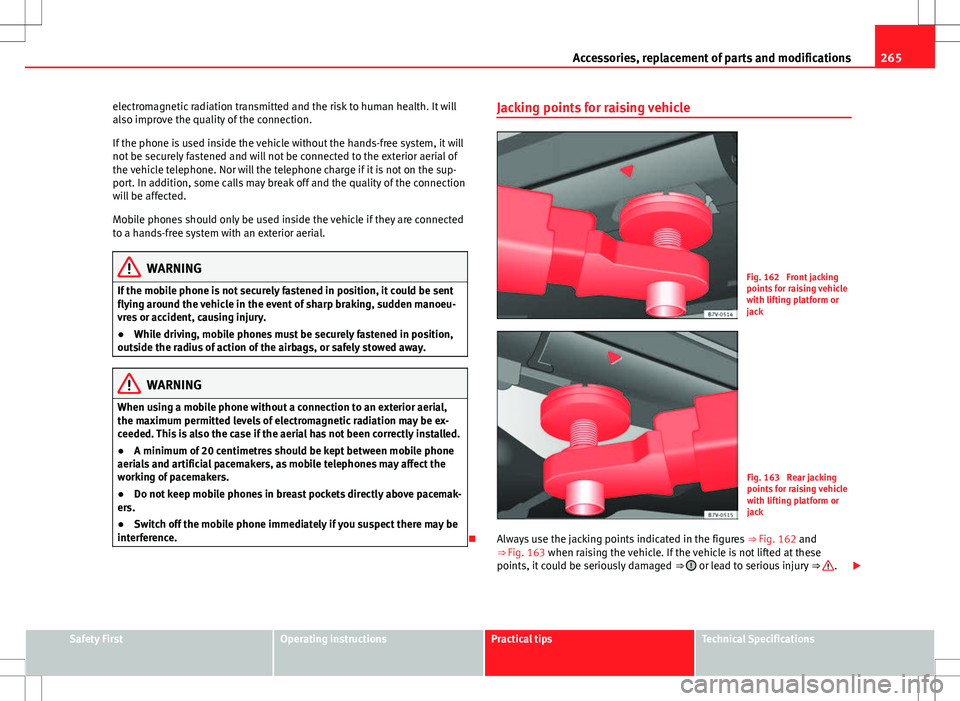
Always use the jacking points indicated in the figures ⇒ Fig. 162 and
⇒ Fig. 163 when raising the vehicle. If the vehicle is not lifted at these
points, it could be seriously damaged ⇒
or lead to serious injury ⇒ .
Safety FirstOperating instructionsPractical tipsTechnical Specifications
Page 268 of 387
266Accessories, replacement of parts and modifications
The vehicle should not be lifted using lifting platforms with lift pads con-
taining fluid.
When raising a vehicle using a platform or jack, a series of precautionary
measures are required. Never raise the vehicle with a lifting platform or jack
unless you have received training in how to do so and know how to lift the
vehicle safely.
Notes on raising the vehicle with a jack ⇒ page 312.
WARNING
The improper use of the lifting platform or the jack when raising the vehi-
cle may result in accidents or serious injury.
● Before raising the vehicle, please observe the manufacturer's instruc-
tions for the platform or jack, and the legal requirements, where applica-
ble.
● There should not be anyone inside the vehicle when it is being raised
or once it is in the air.
● Only use the jacking points indicated in the figures ⇒ Fig. 162 and
⇒ Fig. 163 when raising the vehicle. If the vehicle is not lifted at the indi-
cated points, it may fall from the platform while the engine or gearbox is
being dismounted, for example.
● The jacking points should be centrally aligned and firmly positioned
on the platform support plates.
● Never start the engine when the vehicle is raised! The vehicle may fall
from the platform due to the engine vibrations.
● If it is necessary to work underneath the vehicle while it is raised, you
should check that the supporting stands have an adequate load capacity.
● Never climb onto the lifting platform.
● Always make sure that the weight of the vehicle does not exceed the
lifting platform load capacity.
CAUTION
● Never raise the vehicle at the engine oil sump, the gearbox or the rear or
front axles.
● Always use an intermediate rubber support to prevent damage to the
vehicle underbody. Check that the arms of the lifting platform are able to
move with obstruction.
● The arms should not come into contact with the side running boards or
other parts of the vehicle.