warning Seat Alhambra 2013 Owner's Manual
[x] Cancel search | Manufacturer: SEAT, Model Year: 2013, Model line: Alhambra, Model: Seat Alhambra 2013Pages: 387, PDF Size: 6.13 MB
Page 302 of 387
300Wheels and tyres
Replacing tyres
● Where possible, always replace both wheels on an axle (both wheels on
the front axle or both wheels on the rear axle) ⇒
.
● Old tyres should only be replaced by SEAT approved tyres for the vehicle
in question, and in accordance with the maximum permitted size, diameter,
load and speed capacity.
● Never use tyres which are larger than SEAT approved tyres. If the tyres
are too big, they may knock or rub against the chassis or other components,
resulting in damage.
WARNING
New tyres do not give maximum grip and will not have reached their max-
imum braking capacity to start with, and therefore need running in.
● To prevent accidents and major damage, extreme caution should be
taken for the first 600 km (370 miles).
WARNING
There should be adequate space between the tyres and the vehicle in ac-
cordance with the vehicle design. If this is not the case, the tyres may
rub against parts of the running gear, chassis or brake lines, leading to
faults in the brake system or to tread detachment, and the risk of burst
tyres.
● The true tyre dimension should not be greater than the dimensions of
tyres manufactured and approved by SEAT and should not rub against
parts of the vehicle.
Note
● Although tyres may be shown as being the same size, the true dimen-
sions of different types of tyre may vary with respect to the nominal size, or
tread patterns may be different.
● If you use tyres that are approved by SEAT, you can be sure that the true
tyre dimensions will be correct for your vehicle. For other tyre models, the
tyre vendor should provide the manufacturer's certificate with the tyre, indi-
cating that this type of tyre is suitable for your vehicle. This certificate
should always be carried with the vehicle.
Tyre pressures
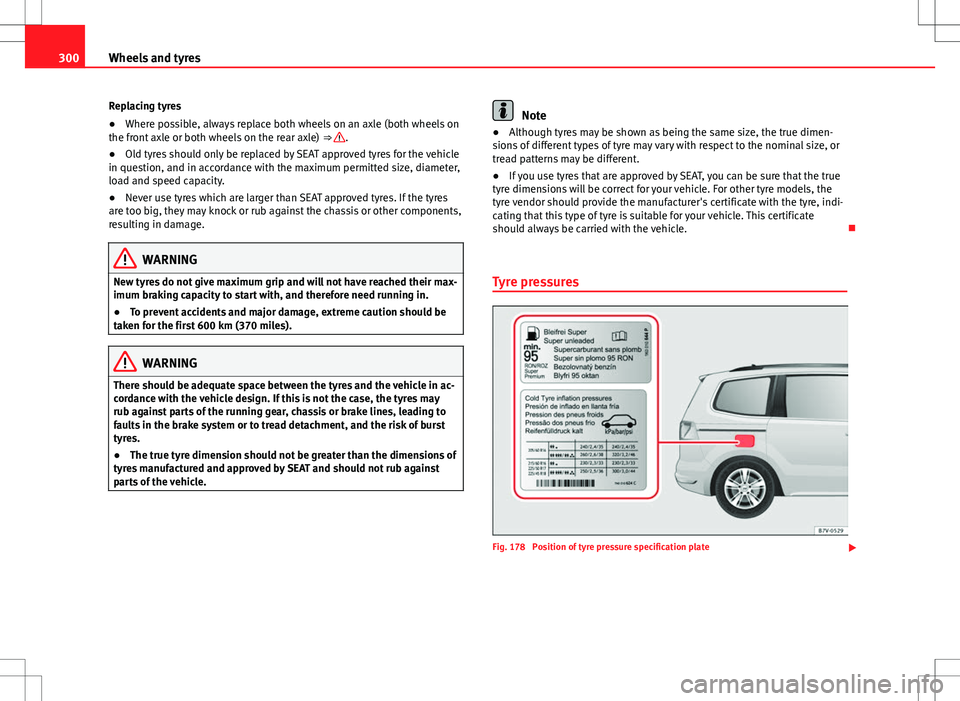
Fig. 178 Position of tyre pressure specification plate
Page 303 of 387
301
Wheels and tyres
The correct tyre pressures for tyres fitted at the factory is shown on a label
and is valid for summer and winter tyres. This label ⇒ Fig. 178 is either in
the driver door strut or inside the fuel cap.
Under-inflation or over-inflation will reduce the life of the tyres considerably
and also impair the car's handling ⇒
. It is essential to maintain the cor-
rect tyre pressures, especially if driving at high speeds. Incorrect tyre pres-
sure causes premature wear and could cause tyre blow-out.
The pressure should therefore be checked at least once a month and before
starting a journey.
As a general rule, the pressures given are for cold tyres. When the tyres are
hot, the pressures are greater.
Never deflate a hot tyre in order to obtain the required pressure. This could
result in very low tyre pressures which may lead to sudden blow-outs.
Checking tyre pressures
Tyre pressures should only be checked when the vehicle has not been driv-
en for more than a few kilometres (miles) at low speeds in the past three
hours.
● The tyre pressures should be checked regularly, and only when the tyres
are cold. Always check all the tyres. Tyre pressures should be checked more
often in colder regions, and only when the vehicle has not been driven re-
cently. Always use a correctly-operating tyre gauge.
● Adjust tyre pressures to the loads carried in the vehicle.
● After checking the pressure, always replace the valve caps, and where
applicable, observe the instructions given for adjusting the tyre control sys-
tem ⇒ page 224.
WARNING
If tyre pressures are too high or too low, the tyre may deflate or burst
suddenly while driving. This could result in a serious accident.
● If the tyre pressure is too low, the tyres could overheat, resulting in
tread detachment or even burst tyres.
● When driving at high speeds and/or fully loaded, the tyre could sud-
denly overheat, burst or be subject to tread detachment, with the resul-
tant loss of control of the vehicle.
● Tyre pressures which are too high or too low reduce the service life of
the tyre, affecting the vehicle's performance.
● Tyre pressures should be checked regularly, at least once a month
and before long journeys.
● Adjust the pressures of all the tyres to the vehicle load.
● Never deflate excess pressure from hot tyres.
CAUTION
● Take care not to tilt the manometer when placing it on the valve. Other-
wise, the valve may be damaged.
● To avoid damage to the valves, always replace valve caps correctly.
Check that the caps are identical to the standard caps and have been cor-
rectly tightened.
For the sake of the environment
Under-inflated tyres will increase the fuel consumption.
Note
When checking tyre pressures, please observe the instructions for the tyre
control system ⇒ page 224.
Safety FirstOperating instructionsPractical tipsTechnical Specifications
Page 304 of 387
302Wheels and tyres
Tread depth and wear indicators
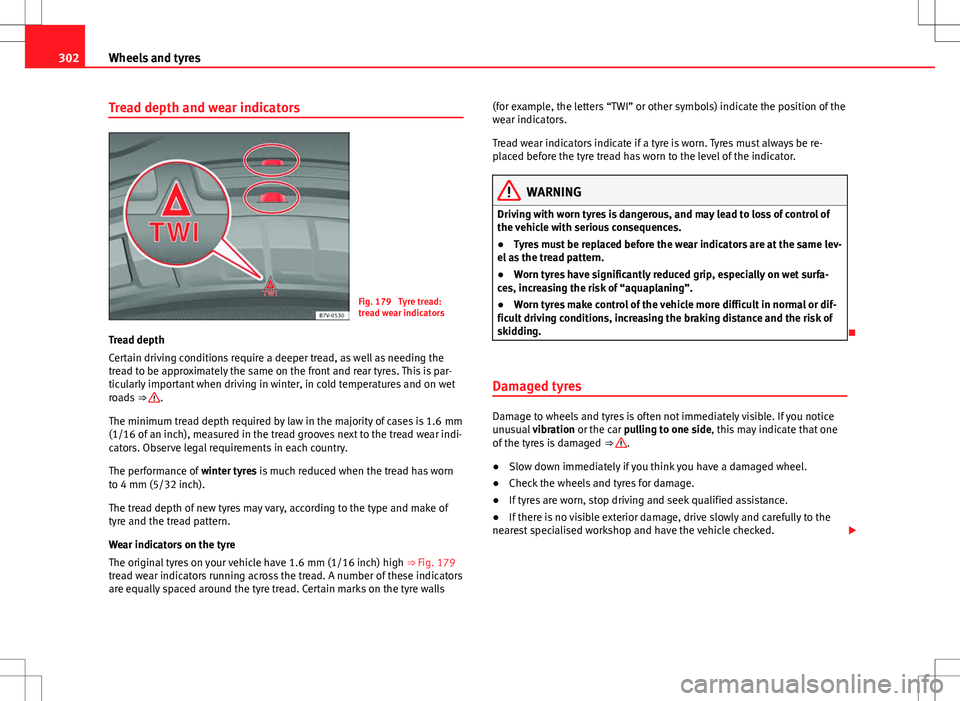
Fig. 179 Tyre tread:
tread wear indicators
Tread depth
Certain driving conditions require a deeper tread, as well as needing the
tread to be approximately the same on the front and rear tyres. This is par-
ticularly important when driving in winter, in cold temperatures and on wet
roads ⇒
.
The minimum tread depth required by law in the majority of cases is 1.6 mm
(1/16 of an inch), measured in the tread grooves next to the tread wear indi-
cators. Observe legal requirements in each country.
The performance of winter tyres is much reduced when the tread has worn
to 4 mm (5/32 inch).
The tread depth of new tyres may vary, according to the type and make of
tyre and the tread pattern.
Wear indicators on the tyre
The original tyres on your vehicle have 1.6 mm (1/16 inch) high ⇒ Fig. 179
tread wear indicators running across the tread. A number of these indicators
are equally spaced around the tyre tread. Certain marks on the tyre walls (for example, the letters “TWI” or other symbols) indicate the position of the
wear indicators.
Tread wear indicators indicate if a tyre is worn. Tyres must always be re-
placed before the tyre tread has worn to the level of the indicator.
WARNING
Driving with worn tyres is dangerous, and may lead to loss of control of
the vehicle with serious consequences.
● Tyres must be replaced before the wear indicators are at the same lev-
el as the tread pattern.
● Worn tyres have significantly reduced grip, especially on wet surfa-
ces, increasing the risk of “aquaplaning”.
● Worn tyres make control of the vehicle more difficult in normal or dif-
ficult driving conditions, increasing the braking distance and the risk of
skidding.
Damaged tyres
Damage to wheels and tyres is often not immediately visible. If you notice
unusual vibration or the car pulling to one side, this may indicate that one
of the tyres is damaged ⇒
.
● Slow down immediately if you think you have a damaged wheel.
● Check the wheels and tyres for damage.
● If tyres are worn, stop driving and seek qualified assistance.
● If there is no visible exterior damage, drive slowly and carefully to the
nearest specialised workshop and have the vehicle checked.
Page 305 of 387
303
Wheels and tyres
Foreign bodies in the tyre
● Do not remove foreign bodies if they have penetrated through the tyre
wall!
● You should obtain professional assistance immediately.
The sealant at the lower part of the tyre tread wraps around the foreign body
and provisionally seals the tyre.
Wear of tyres
The wear of tyres depends on a number of factors, for example:
● Driving style.
● Unbalanced wheels.
● Running gear settings.
Driving style : driving round bends fast or sudden acceleration or braking
speed up the wear of tyres. When the driving style is normal, if the tyres
wear too quickly, have the running gear settings checked at a specialised
workshop.
Wheel run-out: The wheels on new vehicles are balanced. However, certain
circumstances may lead to imbalance (run-out), which is detected as vibra-
tions in the steering wheel. Run-out leads to wear of the steering and sus-
pension. In the event of run out, the wheels should be balanced again.
When a new wheel is fitted, it should be balanced again.
Running gear settings : an incorrectly positioned running gear increases the
wear of tyres and affects your safety while driving. If tyres wear too quickly,
have the wheel alignment checked at a specialised workshop.
WARNING
If you notice unusual vibration or the car pulls to one side while driving,
this may indicate that one of the tyres is damaged.
● Reduce speed immediately and stop, while observing the highway
code.
● Check the wheels and tyres for damage.
● Never carry on driving on worn tyres or wheels. Request qualified as-
sistance immediately.
● If there is no visible exterior damage, drive slowly and carefully to the
nearest specialised workshop and have the vehicle checked.
Winter tyres*
In winter conditions winter tyres will considerably improve the vehicle's han-
dling. The design of summer tyres (width, rubber compound, tread pattern)
gives less grip on ice and snow. Winter tyres also improve the vehicle brak-
ing performance, reducing the braking distance in winter weather. SEAT rec-
ommend that winter tyres be fitted to the vehicle at temperatures below
+7 °C (+45 °F).
The performance of winter tyres is much reduced if the tyre tread is worn be-
low 4 mm (1/16 inch). The age of the tyre is another factor affecting per-
formance, regardless of the depth of the tyre tread.
Please observe the following when using winter tyres:
● Observe legal requirements in each country.
● Winter tyres must be fitted on all four wheels.
● Only use winter tyres in wintery weather conditions.
● Only use winter tyres of the size authorised for the vehicle.
Safety FirstOperating instructionsPractical tipsTechnical Specifications
Page 306 of 387
304Wheels and tyres
● Only use radial winter tyres of the same type, size (rolling circumference)
and tread pattern.
● Adjust speeds to within the limits indicated (code letter on tyre) ⇒
.
Speed limit
A code letter indicating the speed limit is stamped on all winter tyres
⇒ page 307.
In some vehicles, it is possible to set a speed warning in the MFA (multifunc-
tion display) menu on the instrument panel ⇒ page 62.
If you use V-rated tyres the speed limits and tyre pressure will be deter-
mined by engine size. Please ask your Technical Service for further informa-
tion on the maximum permitted speed and the required pressures for the tyres.
All-wheel drive*
Thanks to its all-wheel drive, your car will have plenty of traction in winter
conditions, even with the standard tyres. Nevertheless, SEAT still recom-
mend that winter tyres or all-season tyres should be fitted on all four wheels
when winter road conditions are expected, mainly because this will give a
better braking response.
Please observe all instructions and warnings when using snow chains
⇒ page 304.
WARNING
Although winter tyres help to make driving safer in the winter, you
should not take unnecessary risks.
● Adjust your speed and driving style to visibility, road, traffic and
weather conditions.
● Never exceed the maximum permitted speed or loads specified for the
type of winter tyre fitted on your vehicle.
For the sake of the environment
When winter is over, change back to summer tyres. In temperatures above
+7 °C (+45 °F), performance will be improved if summer tyres are used. Fuel
consumption, wear and noises while driving will all be reduced.
Note
● If the vehicle is fitted with a tyre control system, this should be “reprog-
rammed” whenever a tyre is changed ⇒ page 226.
● Please ask at a Technical Service for information about the permitted
sizes for winter tyres.
Snow chains
When using snow chains, applicable local legislation and maximum permit-
ted speed limits must be observed.
In winter weather, snow chains not only help to improve grip but also im-
prove the braking capacity.
Snow chains must only be mounted on the front wheels, even on all-wheel
drive vehicles, and only with the tyre and rim combinations listed below:
Tyre sizeWheel rim205/60 R166 1/2 J x 16 ET 33
SEAT recommends you ask a Technical Service for further information on
wheel, tyre and chain sizes.
Wherever possible use fine-link chains measuring less than 15 mm
(37/64 inch) including the lock.
Remove wheel hub covers and trim rings before fitting snow chains ⇒
.
The wheel bolts should be covered with caps for safety reasons. These are
available from Technical Services.
Page 307 of 387
305
Wheels and tyres
WARNING
The use of unsuitable or incorrectly fitted chains could lead to serious ac-
cidents and damage.
● Always the appropriate snow chains.
● Observe the fitting instructions provided by the snow chain manufac-
turer.
● Never exceed the maximum permitted speeds when driving with snow
chains.
CAUTION
● Remove the snow chains to drive on roads without snow. Otherwise they
will impair handling, damage the tyres and wear out very quickly.
● Wheel rims may be damaged or scratched if the chains come into direct
contact with them. SEAT recommends the use of covered snow chains.
Note
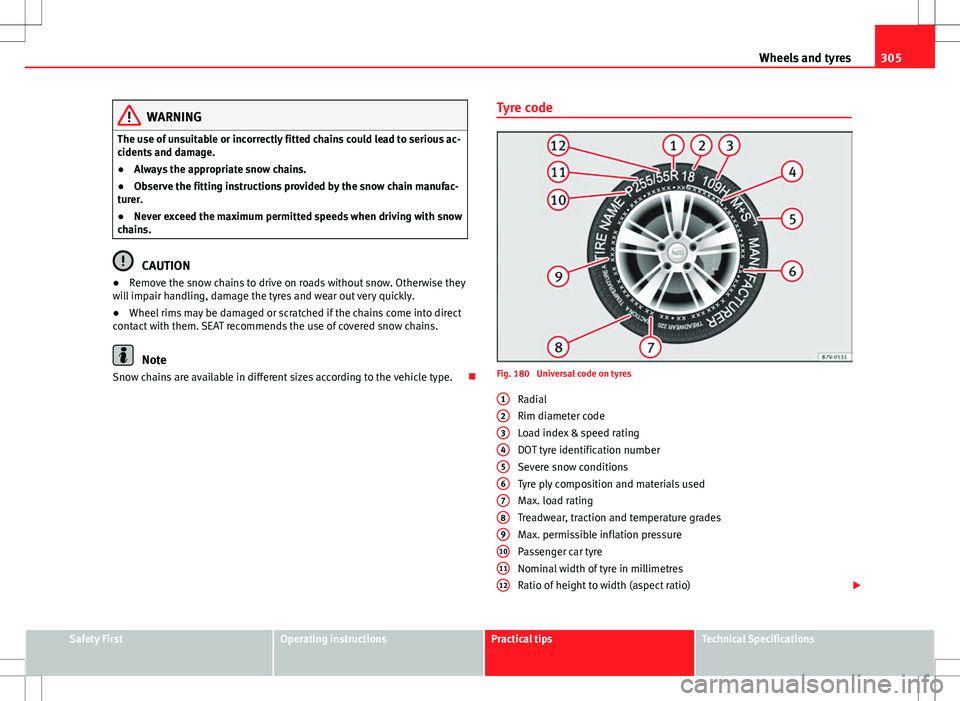
Snow chains are available in different sizes according to the vehicle type. Tyre codeFig. 180 Universal code on tyres
Radial
Rim diameter code
Load index & speed rating
DOT tyre identification number
Severe snow conditions
Tyre ply composition and materials used
Max. load rating
Treadwear, traction and temperature grades
Max. permissible inflation pressure
Passenger car tyre
Nominal width of tyre in millimetres
Ratio of height to width (aspect ratio)
1
23456789101112
Safety FirstOperating instructionsPractical tipsTechnical Specifications
Page 309 of 387
307
Wheels and tyres
Tyre load rating
The load rating code indicates the maximum load in kilogrammes each
wheel can carry (load capacity). 615 kg (1356 pounds)
650 kg (1433 pounds)
690 kg (1521 pounds)
730 kg (1609 pounds)
775 kg (1709 pounds)
Speed rating
The speed rating indicates the maximum speed permitted for the tyres.
max. 150 km/h (93 mph)
max. 160 km/h (99 mph)
max. 170 km/h (106 mph)
max. 180 km/h (112 mph)
max. 190 km/h (118 mph)
max. 200 km/h (124 mph)
max. 210 km/h (130 mph)
max. 240 km/h (149 mph)
max. 240 km/h (149 mph)
max. 270 km/h (168 mph)
max. 300 km/h (186 mph)
Some manufacturers use the letters “ZR” for tyres with a maximum author-
ised speed above 240 km/h (149 miles).
91
93
95
97
99
P
Q
R
S
T
U
H
V
Z
W
Y Wheel trims*
Introduction
Additional information and warnings:
● Caring for and cleaning the vehicle exterior ⇒ page 245
● Change wheel ⇒ page 309
● Vehicle tools ⇒ page 323
WARNING
If the wheel trims are not appropriate or not fitted correctly, they could
cause major accidents or damage.
● Incorrectly mounted wheel trims may come off while driving and en-
danger other road users.
● Damaged trims must never be mounted on the wheels.
● Always ensure that the brake ventilation and cooling is not cut off or
blocked. This is also valid if hubcaps are fitted later. If there is not
enough air, you may require significantly longer braking distances.
CAUTION
Remove and remount wheel trims taking care to avoid damage to the vehi-
cle.
Safety FirstOperating instructionsPractical tipsTechnical Specifications
Page 311 of 387
309
Wheels and tyres
Changing a wheel* Introduction
The tyres mounted on the vehicle are anti-puncture. The wheels should only
be changed when switching from summer to winter tyres or vice-versa. See
⇒ page 302
You should only change the wheels yourself if the vehicle is parked in a safe
place, you are familiar with the procedure and you have all the necessary
tools! Otherwise, you should seek professional assistance.
Additional information and warnings:
● Vehicle key set ⇒ page 71
● Wheels and tyres ⇒ page 296
● Wheel trims ⇒ page 307
● Vehicle tools ⇒ page 323
WARNING
Changing a wheel can be dangerous, especially on the hard shoulder.
Please observe the following rules to minimise the risk of injury:
● Stop the vehicle safely as soon as possible. Park your vehicle as safe
distance from surrounding traffic to change a wheel.
● When changing a wheel, keep all passengers and particularly chil-
dren a safe distance away from the work area.
● Turn on the hazard warning lights to warn other road users.
● Ensure the ground on which you park is flat and solid. If necessary,
support the jack on a wide solid base.
● If you are changing a wheel yourself, you should be familiar with the
required procedure. Otherwise, you should seek professional assistance.
WARNING (Continued)
● Only use suitable tools that are not damaged when changing a wheel.
● Always stop the engine, turn on the electronic parking brake and
place the gear selector lever in position P, for an automatic gearbox, or
engage a gear for a manual gearbox to reduce the risk of the vehicle mov-
ing accidentally.
● Have the tightening torque of the wheel bolts checked as soon as
possible with a reliable torque wrench.
Preparations for changing a wheel
Check list
Before changing a wheel, complete the following operations in the order
given ⇒
:
Park the vehicle on an even and solid surface.
Connect the electronic parking brake ⇒ page 184.
Automatic gearbox: move the selector lever to position P ⇒ page 175.
Stop the engine and remove the key from the ignition ⇒ page 171.
Manual gearbox: Select a gear ⇒ page 175.
Have all vehicle occupants get out of the vehicle and wait in a safe
place (for example, behind the safety barrier).
Block the opposite wheel with wedges or a similar object.
When towing a trailer: unhook the trailer from the towing vehicle and
park it correctly.
If the luggage compartment is full: take the baggage out of the vehicle. Take the vehicle tool kit out of the luggage compartment.
Remove the wheel trims ⇒ page 307.
1.
2.
3.
4.
5.
6.
7.
8.
9.
10.
11.
Safety FirstOperating instructionsPractical tipsTechnical Specifications
Page 312 of 387
310Wheels and tyres
WARNING
Failure to follow the checklist prepared for your own safety could lead to
accidents and severe injuries.
● Always complete the operations given in the checklist and observe
the general rules of safety.
Wheel bolts
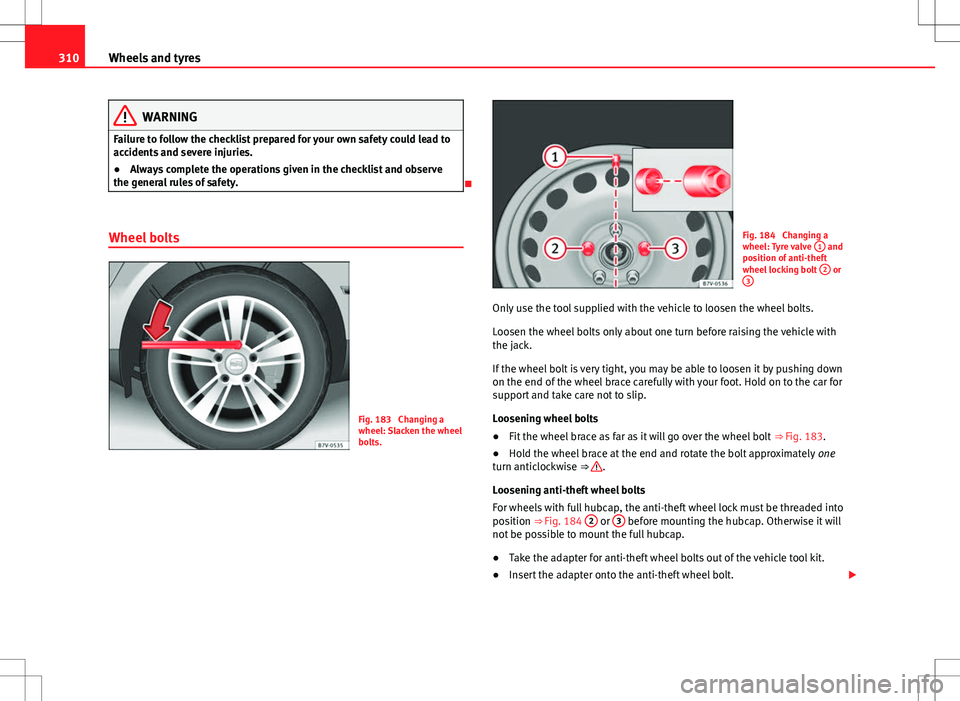
Fig. 183 Changing a
wheel: Slacken the wheel
bolts.
Fig. 184 Changing a
wheel: Tyre valve 1 and
position of anti-theft
wheel locking bolt 2
or
3
Only use the tool supplied with the vehicle to loosen the wheel bolts.
Loosen the wheel bolts only about one turn before raising the vehicle with
the jack.
If the wheel bolt is very tight, you may be able to loosen it by pushing down
on the end of the wheel brace carefully with your foot. Hold on to the car for
support and take care not to slip.
Loosening wheel bolts
● Fit the wheel brace as far as it will go over the wheel bolt
⇒ Fig. 183.
● Hold the wheel brace at the end and rotate the bolt approximately one
turn anticlockwise ⇒
.
Loosening anti-theft wheel bolts
For wheels with full hubcap, the anti-theft wheel lock must be threaded into
position ⇒ Fig. 184 2
or 3 before mounting the hubcap. Otherwise it will
not be possible to mount the full hubcap.
● Take the adapter for anti-theft wheel bolts out of the vehicle tool kit.
● Insert the adapter onto the anti-theft wheel bolt.
Page 313 of 387
311
Wheels and tyres
● Fit the wheel brace onto the adapter as far as possible.
● Hold the wheel brace at the end and rotate the bolt approximately one
turn anticlockwise ⇒
.
Important information about wheel bolts
The wheel rims and bolts have been designed to be fitted to factory op-
tions. If different rims are fitted, the correct wheel bolts with the right length
and correctly shaped bolt heads must be used. This ensures that wheels are
fitted securely and that the brake system functions correctly.
In some circumstances, wheel bolts from the same model vehicle should
not be used.
Wheel bolt tightening torque
The prescribed tightening torque for wheel bolts for steel and alloy wheels
is 140 Nm. Have the tightening torque of the wheel bolts checked as soon
as possible with a reliable torque wrench.
If wheel bolts are rusty and it is difficult to tighten them, the threads should
be replaced and cleaned before checking the tightening torque.
Never grease or lubricate wheel bolts or the wheel hub threads. Although
they have been tightened to the prescribed torque, they could come loose
while driving.
WARNING
If the wheel bolts are not fitted correctly they could be released while
driving leading to loss of vehicle control and serious damage.
● Only use wheel bolts which correspond to the wheel rims in question.
● Never use different wheel bolts.
● The bolts and threads should be clean, free of oil and grease and easy
to thread.
● To loosen and tighten the wheel bolts, always use the wheel brace
supplied with the vehicle.
● Loosen the wheel bolts only about one turn before raising the vehicle
with the jack.
● Never grease or lubricate wheel bolts or the wheel hub threads. Al-
though they have been tightened to the prescribed torque, they could
come loose while driving.
● Never loosen the bolted joints of wheel rims with bolted ring trims.
● If the wheel bolts are not tightened to the correct torque, they may
come loose while driving, and the bolts and rims may come out. If the
tightening torque is too high, the wheel bolts and threads can be dam-
aged.
Safety FirstOperating instructionsPractical tipsTechnical Specifications