wheel Seat Alhambra 2013 Repair Manual
[x] Cancel search | Manufacturer: SEAT, Model Year: 2013, Model line: Alhambra, Model: Seat Alhambra 2013Pages: 387, PDF Size: 6.13 MB
Page 248 of 387
246Vehicle maintenance and cleaning
Washing the vehicle
The longer substances such as insects, bird droppings, resinous tree sap,
road dirt, industrial deposits, tar, soot or road salt and other aggressive ma-
terials remain on the vehicle, the more damage they do to the paintwork.
High temperatures (for instance due to strong sunlight) further intensify the
corrosive effect. The vehicle undercarriage should also be thoroughly wash-
ed at regular intervals.
Automatic car washes
Always observe the instructions provided at the automatic car wash. The
standard precautionary measures prior to entering the car wash should be
taken to avoid damage to the vehicle (close all windows, fold in exterior mir-
rors). If the vehicle is fitted with additional components (spoiler, roof-rack,
aerial...), check with the car wash supervisor whether these can enter the
car wash ⇒
.
The vehicle paintwork is so durable that the vehicle can normally be washed
without problems in an automatic car wash tunnel. However, wear and dam-
age to the paintwork will depend on the type of car wash used. SEAT recom-
mends the use of car washed without brushes.
To remove traces of wax on windows and to prevent wiper blades from
scratching, please observe the following ⇒ page 248, Cleaning windows
and exterior mirrors.
Washing the car by hand
When washing the car by hand, use plenty of water to soften the dirt first,
and rinse off as well as possible.
Then clean the vehicle with a soft sponge, glove or brush using only slight
pressure. Start at the roof and work downwards. Special car shampoo
should only be used for very persistent dirt.
Rinse the sponge or glove thoroughly and often.
Wheels, sills and similar should be cleaned last. Use a second sponge for
this.
WARNING
Sharp components on the vehicle may cause injury.
● Protect arms and hands from sharp edges when cleaning the vehicle
undercarriage or the interior of the wheel hubs.
WARNING
After the vehicle has been washed, the braking effect will be reduced
(and the braking distance increased) due to moisture (and ice in winter)
on the brakes.
● Dry the brakes and remove ice by braking carefully. Ensure that you
are not endangering other road-users or breaking traffic regulations in
the process.
CAUTION
● The temperature of the water must not exceed +60 °C (+140 °F).
● To avoid damage to the paintwork, do not wash the vehicle in full sun.
● Do not use rough sponges or similar which could damage the surface to
clean away the traces of insects.
● Never wipe the headlights with a dry cloth or sponge, always moisten
first. It is best to use soapy water.
● Washing the vehicle in low temperatures: When washing the vehicle
with a hose, do not direct water into the lock cylinders or the gaps around
the doors, rear lid, or sunroof. Locks and seals could freeze!
CAUTION
To prevent damage to the vehicle, please observe the following before en-
tering an automatic car wash :
● Compare the distance between the vehicle wheels and the distance be-
tween the guide-rails of the car wash to prevent damage to the wheels and
tyres!
Page 253 of 387
251
Vehicle maintenance and cleaning
● Use a clean, damp, lint-free cloth to clean anodized surfaces.
● If there is a lot of dirt, use a special cleaning product which does not
contain solvents.
CAUTION
To prevent damage to the anodized surfaces:
● Do not use products containing solvents.
● Do not use polish or hard wax.
● Do not use abrasive products.
● Do not polish anodized surfaces in sandy or dusty environments.
● Do not polish dirty surfaces.
Cleaning wheels
Cleaning steel wheels
Use an industrial cleaner to remove brake dust. Therefore, clean wheels reg-
ularly with a separate sponge.
Any damage to the paint on steel wheels should be touched up before the
metal starts to rust.
Caring for and cleaning alloy wheels
Remove road salt and brake dust by washing the wheels approximately
once a fortnight. Use an acid free detergent to clean the wheel rims. SEAT
recommends treating the wheels thoroughly with a wax compound about
once every three months.
It is important to remove road salt and brake dust by washing the wheels at
regular intervals, otherwise the finish will be impaired.
Always use an acid-free detergent for alloy wheel rims. Car polish or other
abrasive agents should not be used for maintaining the rims. If the protective coating on the paint has been damaged (for example, hit by
a stone), it should be repaired immediately.
Caring for rubber seals
The rubber seals on doors, windows, etc., remain flexible, provide a better
seal and last longer if they are regularly treated with a product specifically
designed for use on rubber.
Before applying the product, use a soft cloth to remove dust and dirt from
the rubber seals.
De-icing the door lock cylinder
To de-ice the lock cylinders, SEAT recommend the use of genuine SEAT spray
with lubricating and anti-corrosive properties.
CAUTION
The use of products containing degreasing agents to de-ice the locks may
rust the lock cylinder.
Protection of vehicle undercarriage
The vehicle underbody is coated to protect it from chemical and mechanical
damage. The protective coat on the undercarriage may wear through use
while driving. Therefore, SEAT recommends that the protective coating on
the undercarriage and on the running gear should be regularly checked, and
repaired if necessary.
Safety FirstOperating instructionsPractical tipsTechnical Specifications
Page 262 of 387
260Accessories, replacement of parts and modifications
Accessories, replacement of parts and modifications
Accessories, replacement of parts and
modifications Introduction
WARNING
The use of spare parts and accessories, or incorrectly performed modifi-
cations or repairs may result in damage to the vehicle, accidents and se-
rious injury.
● SEAT strongly recommends you to only use SEAT approved accesso-
ries and SEAT ®
original spare parts. These parts and accessories have
been specially tested by SEAT for suitability, reliability and safety.
● Have any repairs or modifications carried out at a specialised work-
shop. Specialised workshops have the necessary tools, diagnostics
equipment, repair information and qualified personnel.
● Only mount parts with the same specifications as the parts fitted at
factory.
● Never mount, fasten or fit objects such as drink holders or telephone
cradles over the covers of the airbag modules or within their radius of ac-
tion.
● Only use wheels and tyre combinations which have been approved by
SEAT for your vehicle type.
Accessories and spare parts
SEAT recommends you consult an Official Service before purchasing acces-
sories and spare parts or consumables. For example, when fitting accesso- ries at a later date, or when replacing a component. A Technical Service will
advise you as to the legal requirements and manufacturer's recommenda-
tions regarding accessories, spare parts and other components.
SEAT recommend you use only approved
SEAT accessories and genuine
SEAT spare parts ®
. These parts and accessories have been specially tested
by SEAT for suitability, reliability and safety. In addition the Technical Serv-
ices will guarantee that the assembly is carried out professionally.
Although we continually monitor the market, SEAT cannot guarantee that
products not approved by SEAT are reliable, safe and suitable for the vehi-
cle. Therefore, SEAT cannot accept liability, even in those cases authorised
by an officially recognised technical inspection office or other official body.
Any retro-fitted equipment which has a direct effect on the vehicle and/or
the way it is driven must be approved by SEAT for use in your vehicle and
bear the e mark (the European Union's authorisation symbol). This includes
cruise control systems or electronically controlled suspension.
If any additional electrical components are fitted which do not serve to con-
trol the vehicle itself, these must bear the mark (European Union manu-
facturer conformity declaration). This includes refrigerator boxes, laptops or
ventilator fans.
WARNING
Unprofessional repairs or modifications to the vehicle may affect the per-
formance of the airbags, resulting in operating faults or fatal accident.
● Never mount, fasten or fit objects such as drink holders or telephone
cradles over the covers of the airbag modules or within their radius of ac-
tion.
● Objects placed over the airbag covers, or within their radius of action,
could lead to serious injury or loss of life if the airbags are triggered.
Page 264 of 387
262Accessories, replacement of parts and modifications
The vehicle owner should keep the documentation for the additional equip-
ment safely and hand it over to the scrap yard at the end of the vehicle's
service life. This ensures that any additional equipment mounted in end-of-
life vehicles is correctly disposed of with respect for the environment.
WARNING
Repairs or modifications which are not performed correctly may result in
damage or errors in the vehicle operation, affecting the effectiveness of
the driver assist systems. This could result in serious accident.
● All repairs and modifications to the vehicle should only be performed
by a specialised workshop.
Repair and faults in the airbag system
When performing repairs and technical modifications, SEAT's directives
must be observed! ⇒
Modifications and repairs to the front bumper, doors, front seats, and re-
pairs to the roof or chassis should only be carried out in a specialised work-
shop. These components may contain parts or sensors belonging to the air-
bag system.
If work is carried out on the airbag system or parts have to be removed and
fitted on the system when performing other repair work, parts of the airbag
system may be damaged. The consequence may be that, in the event of an
accident, the airbag inflates incorrectly or does not inflate at all.
So that the effectiveness of the airbag is not reduced and that removed
parts do not cause any injuries or environmental pollution, regulations must
be observed. These requirements are known to specialised workshops.
Modifications to the vehicle suspension may affect the operation of the air-
bag system in the event of collision. For example, if wheel and tyre combi-
nations not approved by SEAT are used, or if the vehicle height is lowered, the suspension is stiffened or the suspension springs, telescopic arms,
dampers, etc., are modified, the results received by the airbag sensors and
sent to the control unit may not be accurate. For example, some modifica-
tions to the suspension could increase the force measured by the sensors
and result in the triggering of the airbag systems in collisions. Under normal
conditions, the measured values would be lower and the airbag would not
have been triggered. Other modifications may reduce the forces measured
by the sensors and therefore the airbags are not triggered in situations
when they should have triggered.
WARNING
Repairs or modifications which are not performed correctly may result in
damage or errors in the vehicle operation, affecting the effectiveness of
the airbag systems. This could result in serious or fatal accident.
● All repairs and modifications to the vehicle should only be performed
by a specialised workshop.
● Airbag modules must never be repaired: if damaged, they must be re-
placed.
● Never fit recycled or reused airbag components in your vehicle.
WARNING
Modifications to the vehicle suspension, including the use of unauthor-
ised wheel and tyre combinations, may affect the performance of the air-
bags and increase the risk of serious or fatal injury in the event of acci-
dent.
● Never fit suspension components which are not identical to the origi-
nal parts mounted in the vehicle.
● Never use wheel and tyre combinations not approved by SEAT.
Page 270 of 387
268Checking and refilling levels
WARNING (Continued)
– If you are using a metal fuel canister, the nozzle must always touch
the canister while it is being filled to avoid static electricity.
– Follow the legal requirements for the use, storage and transport of
spare fuel canisters.
– Insure that the fuel container complies with manufacturing stand-
ards, for example, ANSI or ASTM F852-86.
CAUTION
● Always remove any fuel spilled on the vehicle paintwork immediately to
avoid damage to the wheel housing, the tyre and vehicle paintwork.
● Refuelling a petrol engine with diesel or a diesel engine with petrol can
cause serious engine and fuel system damage; the resulting malfunctions
are not covered by the SEAT warranty. If you refuel with the wrong type of
fuel, never start the engine. This applies to even the smallest amount of the
wrong fuel. You should obtain professional assistance. With the engine run-
ning, the composition of the wrong fuel could significantly damage the fuel
system and the engine itself.
● In vehicles with a diesel engine, under no circumstances should you re-
fuel or drive with petrol, kerosene, heating oil or any other type of different
fuel. Other types of fuels could cause serious damage to the engine and to
the fuel supply system and the resulting problems are not covered by the
SEAT warranty.
For the sake of the environment
Fuels can contaminate the environment. Collect any spilt service fluids and
allow a professional to dispose of them.
Note
There is no emergency mechanism for the manual release of the tank flap. If
necessary, request assistance from specialised personnel. Control lamps and fuel gauge
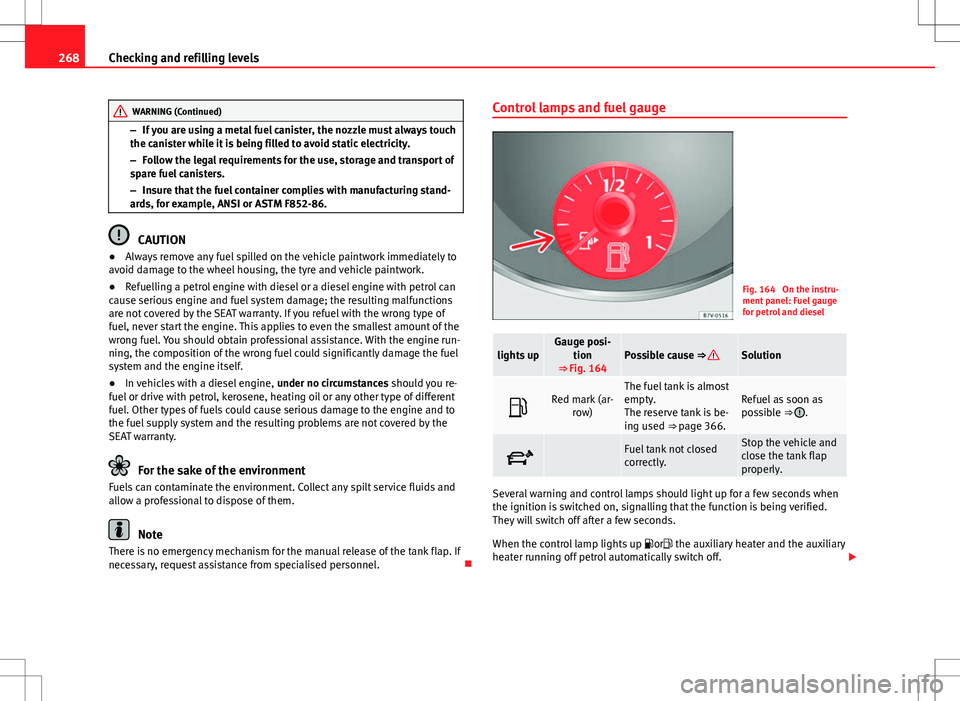
Fig. 164 On the instru-
ment panel: Fuel gauge
for petrol and diesel
lights upGauge posi-
tion
⇒ Fig. 164Possible cause ⇒ Solution
Red mark (ar- row)The fuel tank is almost
empty.
The reserve tank is be-
ing used ⇒ page 366.Refuel as soon as
possible ⇒ .
Fuel tank not closed
correctly.Stop the vehicle and
close the tank flap
properly.
Several warning and control lamps should light up for a few seconds when
the ignition is switched on, signalling that the function is being verified.
They will switch off after a few seconds.
When the control lamp lights up or the auxiliary heater and the auxiliary
heater running off petrol automatically switch off.
Page 272 of 387
270Checking and refilling levels
Closing the fuel tank flap
● Screw on the tank cap clockwise until it you hear it click into position.
● Press the tank flap until you hear it click into place. The tank flap must
be flush with the body contour.
WARNING
Do not continue refilling once the fuel nozzle has switched itself off. The
fuel tank may be filled too much. As a result, fuel may spurt out and spill.
This could lead to a fire, explosion and severe injuries.
CAUTION
● Always remove any fuel spilled on the vehicle paintwork immediately to
avoid damage to the wheel housing, the tyre and vehicle paintwork.
For the sake of the environment
Spilt fuel can contaminate the environment.
Refilling precautions
Information on bulb replacement ⇒ page 329.
Checklist
Never work on the engine or in the engine compartment if you are not famil-
iar with the operations to be carried out, the applicable safety standards
and especially if you do not have the instruments, liquids and tools neces-
sary ⇒ page 278, Working in the engine compartment! Have the work car-
ried out by a specialised workshop if you are uncertain. Check the following
regularly, preferably when you refuel:
● Windscreen washer fluid level ⇒ page 105
● Engine oil level ⇒ page 282 ●
Engine coolant level ⇒ page 286
● Brake fluid level ⇒ page 184
● Tyre pressure ⇒ page 296
● Vehicle lighting required to guarantee road safety:
Turn signals
Side lights, dipped beam headlights and main beam headlights
Rear lights
Brake lights
Rear fog light ⇒ page 97
WARNING
Not following the checklist prepared for your own safety could lead to ac-
cidents and severe injuries.
● Always follow the check list and perform the necessary operations.
Fuel Introduction
You will find a factory-fitted sticker containing information on the type of
fuel for your vehicle on the inside of the fuel tank flap.
Additional information and warnings:
● ⇒ Booklet Maintenance Programme
● Refuelling ⇒ page 267
● Engine and exhaust system management ⇒ page 231
–
–
–
–
–
Page 276 of 387
274Checking and refilling levels
Selective Catalytic Reduction* (AdBlue)
Introduction
The AdBlue fill level must be checked when the vehicle is being serviced.
Additional information and warnings:
● Luggage compartment ⇒ page 126
● Fuel ⇒ page 270
● Wheels and tyres ⇒ page 296
● Accessories, parts replacement, repairs and modifications ⇒ page 260
WARNING
If the AdBlue fill level is too low, the vehicle may not restart after switch-
ing the ignition off. The emergency start or jump start will not be possi-
ble either!
● Top up with AdBlue at the latest 1000 km or 600 miles before it runs
out.
● Do not allow the AdBlue to run too low.
WARNING
AdBlue is an irritant, corrosive liquid that can cause injuries if it touches
the skin, eyes or respiratory organs.
● If AdBlue get in contact with eyes and skin, rinse for at least 15 mi-
nutes with plenty of water and seek medical help.
● If the AdBlue is swallowed, wash your mouth with plenty of water for
at least 15 minutes. Do not try to provoke vomiting unless recommended
by a Doctor. Seek medical advice immediately.
CAUTION
AdBlue damages surfaces such as painted vehicle parts, plastic, items of
clothing and carpets. Spilt AdBlue should be removed as quickly as possi-
ble using a damp cloth and plenty of cold water.
● If the AdBlue has crystallised, remove with warm water and a sponge.
Control and warning lamps
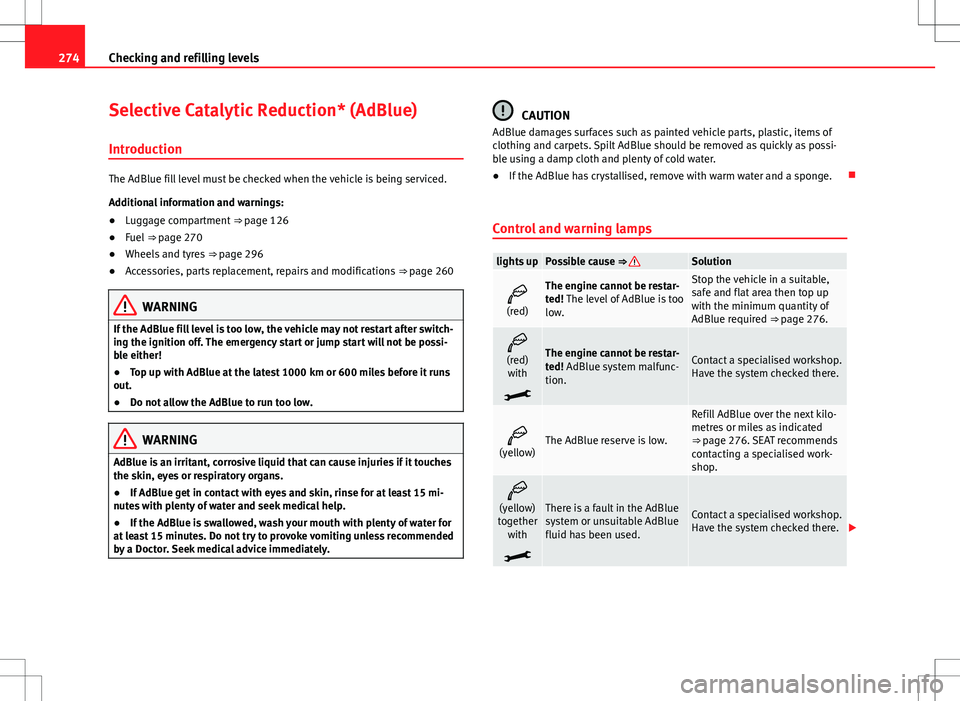
lights upPossible cause ⇒ Solution
(red)The engine cannot be restar-
ted! The level of AdBlue is too
low.Stop the vehicle in a suitable,
safe and flat area then top up
with the minimum quantity of
AdBlue required ⇒ page 276.
(red)
with
The engine cannot be restar-
ted! AdBlue system malfunc-
tion.Contact a specialised workshop.
Have the system checked there.
(yellow)The AdBlue reserve is low.
Refill AdBlue over the next kilo-
metres or miles as indicated
⇒ page 276. SEAT recommends
contacting a specialised work-
shop.
(yellow)
together with
There is a fault in the AdBlue
system or unsuitable AdBlue
fluid has been used.Contact a specialised workshop.
Have the system checked there.
Page 280 of 387
278Checking and refilling levels
Working in the engine compartment
Introduction
Before working in the engine compartment, make sure that the vehicle is
parked on horizontal and firm ground.
The engine compartment of the vehicle is a hazardous area. Never work on
the engine or in the engine compartment if you are not familiar with the op-
erations to be carried out, the applicable safety standards and especially if
you do not have the instruments, liquids and tools necessary ⇒
! Have
the work carried out by a specialised workshop if you are uncertain. Negli-
gent work can cause serious injury.
Additional information and warnings:
● Windscreen wash system ⇒ page 105
● Start and stop the engine ⇒ page 171
● Brake fluid ⇒ page 184
● Vehicle battery ⇒ page 291
● Checks when filling up ⇒ page 267
● Engine oil ⇒ page 282
● Engine coolant ⇒ page 286
● Accessories, parts replacement, repairs and modifications ⇒ page 260
WARNING
If the vehicle moves unexpectedly, this could cause serious injury.
● Never work underneath the vehicle if it is not secured against moving.
If you must work underneath the vehicle with the wheels in contact with
the ground then it should be parked on flat ground, the wheels should be
prevented from moving and the key must be removed from the ignition.
● If you have to work underneath the vehicle, you must use suitable
stands additionally to support the vehicle, there is a risk of accident!.
The jack is not intended for this kind of work and its failure could lead to
severe injuries.
WARNING
The engine compartment is a dangerous area capable of causing serious
injury.
● For all type of work, always take the utmost precautions, work care-
fully and note the general safety standards in force. Never take personal
risks.
● Never work on the engine or in the engine compartment if you are not
familiar with the necessary operations. If you are not sure about proce-
dures then visit a specialised workshop to carry out the necessary work.
Incorrect work can cause serious injuries.
● Never open the bonnet if you see steam or coolant escaping from the
engine compartment. Hot vapours and coolant can cause serious burns.
Always wait until you cannot see or hear the sound of steam or coolant
coming from the engine compartment.
● Always allow the engine to cool down before opening the bonnet.
● Contact with hot elements of the engine and the exhaust system can
cause burns.
Page 298 of 387
296Wheels and tyres
Wheels and tyres
Wheels
Introduction
The SEAT Alhambra is equipped as standard with anti-puncture technology
tyres (Conti-Seal). In the event of a puncture or air leak of up to 5 mm, the
tyre seals the hole with a protective layer inside the tread.
The inclusion of such technology means that there is no type of spare
wheel, nor puncture repair kit included in the vehicle's inventory.
SEAT recommend that all work on tyres and wheels is carried out by a speci-
alised workshop. They have the necessary special tools and replacement
parts, trained personnel and facilities for disposing of the old tyres. SEAT
recommends visiting a Technical Service.
Additional information and warnings:
● Transporting ⇒ page 13
● Towing mode ⇒ page 236
● Braking, stopping and parking ⇒ page 184
● Park assist system ⇒ page 203
● Tyre control systems ⇒ page 224
● Caring for and cleaning the vehicle exterior ⇒ page 245
● Wheel trims ⇒ page 307
● Change wheel ⇒ page 309
● Notes for the user ⇒ page 258
WARNING
The vehicle cannot be totally controlled or braked if the tyres (new or
used) are worn or damaged.
● Incorrect use of wheels and tyres could make driving more dangerous
and result in serious accidents and damage.
● All four wheels must be fitted with radial tyres of the same type, size
(rolling circumference) and the same tread pattern.
● New tyres do not give maximum grip and will not have reached their
maximum braking capacity to start with, and therefore need running in.
To prevent accidents and major damage, extreme caution should be tak-
en for the first 600 km (370 miles).
● Check tyre pressures regularly and ensure they are maintained at the
pressures indicated. If the tyre pressure is too low, the tyres could over-
heat, resulting in tread detachment or even burst tyres.
● Never drive on damaged (punctured, cut, cracked or dented) or worn
tyres. Driving on damaged or worn tyres could result in burst tyres, seri-
ous accidents or damage. Worn or damaged tyres must be replaced im-
mediately.
● Never exceed the maximum permitted speed or loads specified for the
type of tyre fitted on your vehicle.
● The effectiveness of driver and brake assist systems also depends on
the grip of the tyres.
● If you notice unusual vibration or if the vehicle pulls to one side when
driving, stop the car immediately and check the tyres and wheels for
damage.
● To minimise the risk of losing control of the vehicle or causing a seri-
ous accident, never undo the bolted joints of beadlock wheels.
Page 299 of 387
297
Wheels and tyres
WARNING (Continued)
● Never mount used tyres or wheels if you are not sure of their previous
history. They may be damaged, although the damage is not immediately
visible.
● Old tyres, even if they have never been used, may lose air or burst un-
expectedly while driving, resulting in serious accident or damage. If tyres
are over six years old, they should only be used in an emergency and
with extreme caution.
Note
● For technical reasons, it is not generally possible to use the wheels from
other vehicles. In some cases, this may also be true for the same model of
wheel. Please refer to the vehicle documentation or ask at a Technical Serv-
ice.
● If you decide to fit your vehicle with conventional tyres, remember that
you must carry a puncture repair kit, not available in the tools that come
with the vehicle. About your tyres and wheels
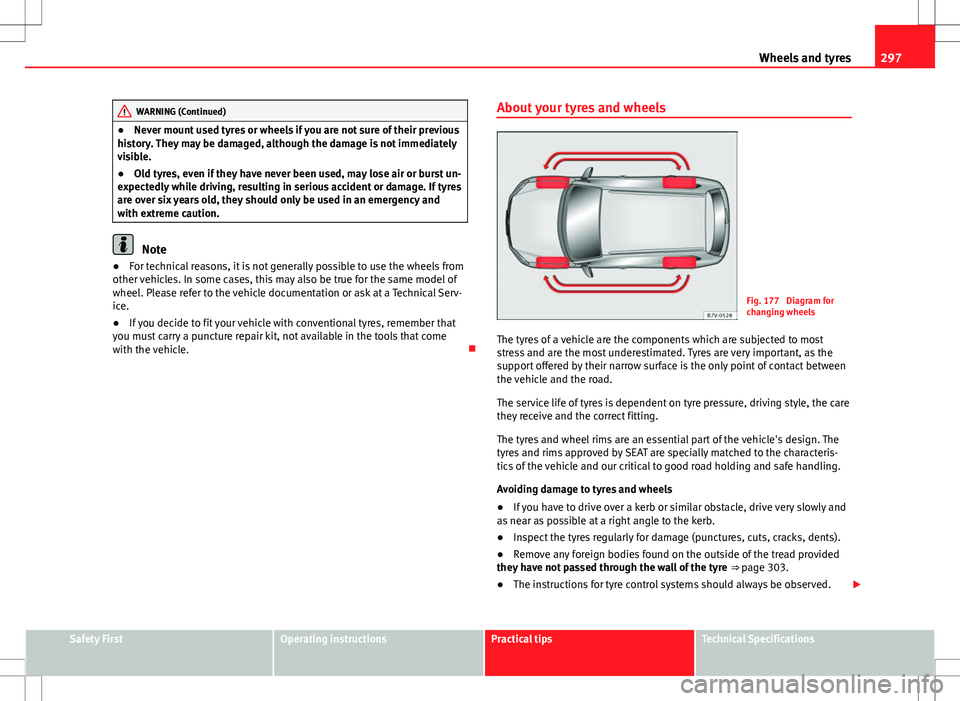
Fig. 177 Diagram for
changing wheels
The tyres of a vehicle are the components which are subjected to most
stress and are the most underestimated. Tyres are very important, as the
support offered by their narrow surface is the only point of contact between
the vehicle and the road.
The service life of tyres is dependent on tyre pressure, driving style, the care
they receive and the correct fitting.
The tyres and wheel rims are an essential part of the vehicle's design. The
tyres and rims approved by SEAT are specially matched to the characteris-
tics of the vehicle and our critical to good road holding and safe handling.
Avoiding damage to tyres and wheels
● If you have to drive over a kerb or similar obstacle, drive very slowly and
as near as possible at a right angle to the kerb.
● Inspect the tyres regularly for damage (punctures, cuts, cracks, dents).
● Remove any foreign bodies found on the outside of the tread provided
they have not passed through the wall of the tyre ⇒ page 303.
● The instructions for tyre control systems should always be observed.
Safety FirstOperating instructionsPractical tipsTechnical Specifications