ESP Seat Alhambra 2015 Owner's Manual
[x] Cancel search | Manufacturer: SEAT, Model Year: 2015, Model line: Alhambra, Model: Seat Alhambra 2015Pages: 305, PDF Size: 5.46 MB
Page 250 of 305
Advice
If the wheel bolt is very tight, you may be
able to loosen it by pushing down on the end
of the wheel brace carefully with your foot.
Hold on to the vehicle for support and take
care not to slip.
Loosening wheel bolts
● Fit the wheel brace as far as it will go over
the wheel bolt ››› Fig. 185 .
● Ho l
d the wheel brace at the end and rotate
the bolt approximately one turn anticlockwise
››
› .
Loosening anti-theft wheel bolts
For wheels with full trim, the anti-theft wheel
lock must be threaded into position
››› Fig. 186 2 or
3 . Otherwise it will not be
possible to mount the entire hubcap.
● Take the adapter for anti-theft wheel bolts
out of the vehicle tool kit.
● Insert the adapter onto the anti-theft wheel
bolt.
● Fit the wheel brace onto the adapter as far
as possible.
● Hold the wheel brace at the end and rotate
the bolt approximately one turn anticlockwise
› ›
› .
Important information about wheel bolts
The wheel rims and bolts have been de-
signed to be fitted to factory options. If differ- ent rims are fitted, the correct wheel bolts
with the right length and correctly shaped
bolt heads must be used. This ensures that
wheels are fitted securely and that the brake
system functions correctly.
In some circumstances, wheel bolts from the
same model vehicle should not be used.
Wheel bolt tightening torque
The prescribed tightening torque for wheel
bolts for steel and alloy wheels is
140 Nm.
Hav e the tight
ening torque of the wheel bolts
checked as soon as possible with a reliable
torque wrench.
If wheel bolts are rusty and it is difficult to
tighten them, the threads should be replaced
and cleaned before checking the tightening
tor
que.
Never grease or lubricate wheel bolts or the
wheel hub threads. Although they have been
tightened to the prescribed torque, they
could come loose while driving. WARNING
If the wheel bolts are not fitted correctly they
could be released while driving leading to
loss of vehicle control and serious damage.
● Only use wheel bolts which correspond to
the wheel rims in question.
● Never use different wheel bolts. ●
The bolts and threads should be clean, free
of oil and grease and easy to thread.
● To loosen and tighten the wheel bolts, al-
ways use the wheel brace supplied with the
vehicle.
● Loosen the wheel bolts only about one turn
before raising the vehicle with the jack.
● Never grease or lubricate wheel bolts or the
wheel hub threads. Although they have been
tightened to the prescribed torque, they
could come loose while driving.
● Never loosen the bolted joints of wheel
rims with bolted ring trims.
● If the wheel bolts are not tightened to the
correct torque, they may come loose while
driving, and the bolts and rims may come
out. If the tightening torque is too high, the
wheel bolts and threads can be damaged. 248
Page 253 of 305
Emergencies
and the necessary safety measures, and if
you have the right kit! Otherwise, you should
seek professional assistance.
The tyre sealant should not be used in the
following cases:
● If the wheel is damaged.
● The outside temperature is lower than -20
℃ (-4 °F).
● If the tear or puncture on the tyre is over 4
mm wide.
● If you have driven with very low pressure or
a flat tyre.
● If the expiry date on the bottle of tyre seal-
ant has passed. WARNING
Using the tyre mobility system can be dan-
gerous, especially when filling the tyre at the
roadside. Please observe the following rules
to minimise the risk of injury:
● Stop the vehicle safely as soon as possible.
Park it at a safe distance from surrounding
traffic to fill the tyre.
● Ensure the ground is flat and firm.
● All occupants, and especially children,
should always be at a safe distance outside
the work area.
● Turn on the hazard warning lights to warn
other road users. ●
Use the tyre mobility system only if you are
familiar with the necessary procedures. Oth-
erwise, you should seek professional assis-
tance.
● Only use the tyre mobility system in the
event of an emergency to get to the nearest
workshop.
● Replace the repaired tyre with the tire mo-
bility set as soon as possible.
● The sealant is hazardous for your health
and if it touches your skin, it must be imme-
diately washed off.
● Keep children away from the tyre mobility
system.
● Never use a jack even if it is approved for
the vehicle.
● To reduce the risk of the vehicle possibly
moving on its own, always turn off the en-
gine, set the electronic parking brake and put
the selector lever in position P or put into
gear if the gearbox is a manual. WARNING
A tyre repaired with sealant does not have
the normal drive properties.
● Never drive faster than 80 km/h (50 mph).
● Avoid hard acceleration, heavy braking and
fast cornering.
● Check the tyre after travelling 10 minutes
at no more than 80 km/h (50 mph). For the sake of the environment
Once used or expired, dispose of the sealant
according to legal provisions. Note
● Sealant bottles can be purchased from
SEAT dealers.
● Observe the usage instructions provided by
the snow chain manufacturer. Contents of the tyre mobility system*
Fig. 190
Standard representation: Contents
of the tyre mobility system. The tyre mobility system is located under-
neath the floor covering in the boot. It in-
cludes the following components
››› Fig. 190 :
»
251Technical specifications
Advice
Operation
Safety
Page 257 of 305
Emergencies
Starting
7. Start the engine of the vehicle with the boosting battery and let it run at idling
speed.
8. Start the engine of the vehicle with the flat battery and wait 2 or 3 minutes until the
engine is “running”.
Removing the jump leads
9. Before you remove the jump leads, switch off the dipped beam headlights (if they
are switched on).
10. Turn on the heater blower and heated rear
w indo
w in the vehicle with the flat battery.
This helps minimise voltage peaks which
are generated when the leads are discon-
nected.
11.When the engine is running, disconnect the leads in reverse order to the details
given above.
Connect the battery clamps so they have
good metal-to-metal contact with the battery
terminals.
If the engine fails to start, switch off the start-
er after about 10 seconds and try again after
about 1 minute. WARNING
● Please note the safety warnings referring to
working in the engine compartment
››› page 214.
● The b att
ery providing assistance must have
the same voltage as the flat battery (12V) and
approximately the same capacity (see imprint
on battery). Failure to comply could result in
an explosion.
● Never use jump leads when one of the bat-
teries is frozen. Danger of explosion! Even af-
ter the battery has thawed, battery acid could
leak and cause chemical burns. If a battery
freezes, it should be replaced.
● Keep sparks, flames and lighted cigarettes
away from batteries, danger of explosion.
Failure to comply could result in an explo-
sion.
● Observe the instructions provided by the
manufacturer of the jump leads.
● Do not connect the negative cable from the
other vehicle directly to the negative terminal
of the flat battery. The gas emitted from the
battery could be ignited by sparks. Danger of
explosion.
● Do not attach the negative cable from the
other vehicle to parts of the fuel system or to
the brake line.
● The non-insulated parts of the battery
clamps must not be allowed to touch. The
jump lead attached to the positive battery
terminal must not touch metal parts of the ve-
hicle, this can cause a short circuit. ●
Position the leads in such a way that they
cannot come into contact with any moving
parts in the engine compartment.
● Do not lean on the batteries. This could re-
sult in chemical burns. Note
The vehicles must not touch each other, oth-
erwise electricity could flow as soon as the
positive terminals are connected. Towing and tow starting
Introduction When towing, always respect legal require-
ments.
For technical reasons, it is not possible to
tow a vehicle if the battery is flat.
If the vehicle comes with the Keyless Access
system, towing is only allowed with the igni-
tion on!
The vehicle battery drains if the vehicle is
towed with the engine switched off and the
ignition connected. Depending on the battery
charge status, the drop in voltage may be so
large, even after just a few minutes, that no
electrical device in the vehicle may work e.g.
the hazard warning lights. In vehicles with
»
255
Technical specifications
Advice
Operation
Safety
Page 260 of 305
Advice
● After towing, remove the towline anchorage
by turning it clockwise and put the cover
b ac
k in place. CAUTION
The towline anchorage must always be com-
pletely and firmly tightened. Otherwise, it
could be released while towing and tow-start-
ing. Fitting the rear towline anchorage
Fig. 195
On the rear bumper, to the right
hand side: Tow ring in position The location for the removable towline an-
chorage is on the right-hand side of the rear
bumper
››› Fig. 195 . For
vehicles with a facto-
ry
fitted towing bracket , there is no fitting be-
hind the cover to insert the towline anchor-
age. For towing, fit and use the tow hitch
››› page 179, ››› . Note the instructions for towing
››› page 256.
Fitting the towline anchorage to the rear for
vehicles without factory fitted tow hitch ● Take the towline anchorage from the vehi-
cle tool kit in the luggage compartment
››› page 244 .
● Pr e
ss on the upper cover and carefully re-
move it back. This may require some
strength. Allow the cover to hang.
● Screw in the towline anchorage into its po-
sition anticlockwise as far as it will go ›
›› .
Use a suitable tool to firmly tighten the tow-
line anchorage in its location.
● After towing, remove the towline anchorage
by turning it clockwise and put the cover
b ac
k in place. CAUTION
● The towline anchorage must always be
completely and firmly tightened. Otherwise,
it could be released while towing and tow-
starting.
● Vehicles with a factory fitted towing brack-
et, can only be used for towing with a tow
bar, specially designed to fit on a tow hitch
ball. Otherwise, the tow hitch ball and the ve-
hicle may be damaged. Otherwise, a tow rope
should be used. Towing advice
Towing requires some experience, especially
when using a tow rope. Both drivers should
be familiar with the technique required for
towing. For this reason, inexperienced drivers
should abstain.
While driving, avoid excessive traction forces
and jerking. When towing on an unpaved
road, there is always a risk of overloading
and damaging the anchorage points.
If the vehicle is towed, with the hazard warn-
ing lights on and the ignition switched on,
the turn signal may be used to indicate
changes of direction. Simply operate the turn
signal lever as usual. Meanwhile, the hazard
warning lights will go off. When the turn sig-
nal lever is returned to the rest position, the
hazard warning lights will be turned on auto-
matically.
Notes for the driver of the towed vehicle
●
Leave the ignition on to avoid locking the
steering wheel, to release the electronic
parking brake and to activate the turn sig-
nals, the horn as well as the window wipers
and window washers.
● As the power assisted steering does not
work if the engine is not running, you will
need more strength to steer than normally.
258
Page 265 of 305
Emergencies
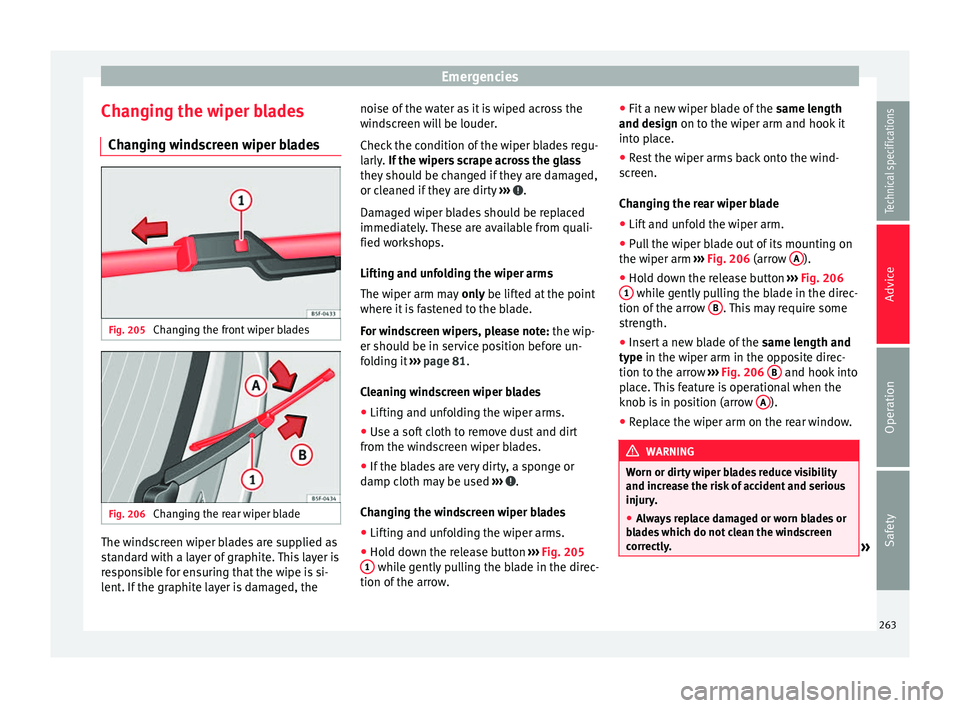
Changing the wiper blades Changing windscreen wiper blades Fig. 205
Changing the front wiper blades Fig. 206
Changing the rear wiper blade The windscreen wiper blades are supplied as
standard with a layer of graphite. This layer is
responsible for ensuring that the wipe is si-
lent. If the graphite layer is damaged, the noise of the water as it is wiped across the
windscreen will be louder.
Check the condition of the wiper blades regu-
larly.
If the wipers scrape across the glass
they shou
ld be changed if they are damaged,
or cleaned if they are dirty ››› .
Damaged wiper blades should be replaced
immediately. These are available from quali-
fied workshops.
Lifting and unfolding the wiper arms
The wiper arm may only be lifted at the point
wher e it
is fastened to the blade.
For windscreen wipers, please note: the wip-
er should be in service position before un-
folding it ››› page 81.
Cl
eaning windscreen wiper blades
● Lifting and unfolding the wiper arms.
● Use a soft cloth to remove dust and dirt
from the windscreen wiper blades.
● If the blades are very dirty, a sponge or
damp cloth may be used ››› .
Changing the windscreen wiper blades
● Lifting and unfolding the wiper arms.
● Hold down the release button ››› Fig. 205
1 while gently pulling the blade in the direc-
tion of the arrow. ●
Fit a new wiper blade of the same length
and design on to the wiper arm and hook it
int o p
lace.
● Rest the wiper arms back onto the wind-
screen.
Changing the rear wiper blade
● Lift and unfold the wiper arm.
● Pull the wiper blade out of its mounting on
the wiper arm ››› Fig. 206 (arrow A ).
● Hold down the release button ››› Fig. 206
1 while gently pulling the blade in the direc-
tion of the arrow B . This may require some
strength.
● Insert a new blade of the same length and
type in the wiper arm in the opposite direc-
tion t o the arr
ow ››› Fig. 206 B and hook into
place. This feature is operational when the
knob is in position (arrow A ).
● Replace the wiper arm on the rear window. WARNING
Worn or dirty wiper blades reduce visibility
and increase the risk of accident and serious
injury.
● Always replace damaged or worn blades or
blades which do not clean the windscreen
correctly. » 263
Technical specifications
Advice
Operation
Safety
Page 268 of 305
Advice
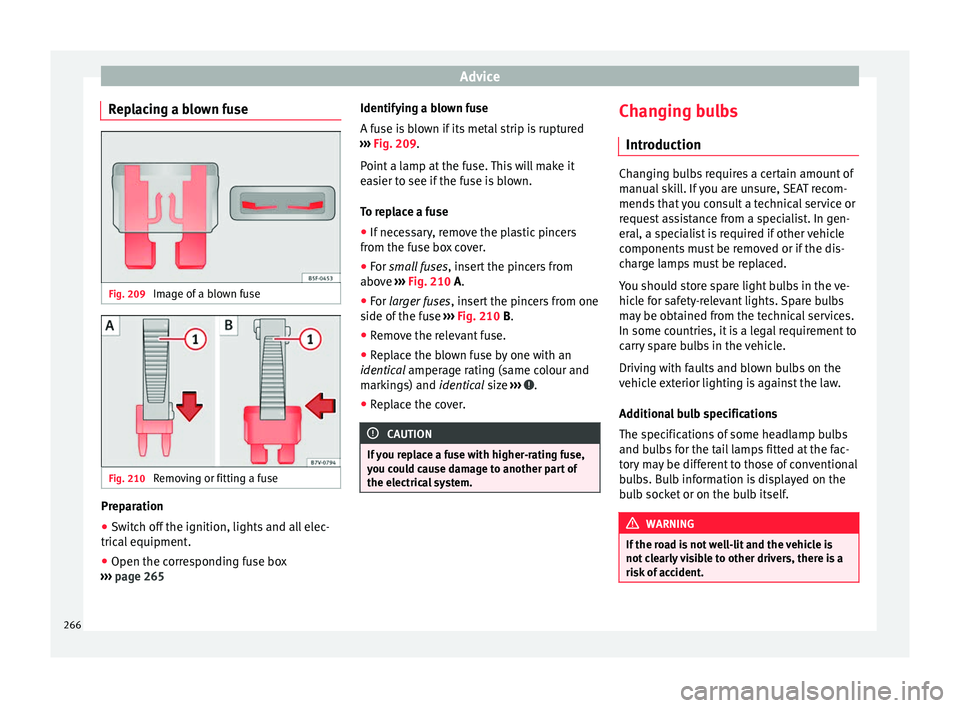
Replacing a blown fuse Fig. 209
Image of a blown fuse Fig. 210
Removing or fitting a fuse Preparation
● Switch off the ignition, lights and all elec-
trical equipment.
● Open the corresponding fuse box
››› page 265 Identifying a blown fuse
A fuse is blown if its metal strip is ruptured
››› Fig. 209 .
P oint
a lamp at the fuse. This will make it
easier to see if the fuse is blown.
To replace a fuse
● If necessary, remove the plastic pincers
from the fuse box cover.
● For
small fuses, insert the pincers from
above ››› Fig. 210 A.
● For
larger fuses , insert the pincers from one
side of the fuse ››› Fig. 210 B.
● Remove the relevant fuse.
● Replace the blown fuse by one with an
identical amperage rating (same colour and
mark
ings) and identical size ››› .
● Replace the cover. CAUTION
If you replace a fuse with higher-rating fuse,
you could cause damage to another part of
the electrical system. Changing bulbs
Introduction Changing bulbs requires a certain amount of
manual skill. If you are unsure, SEAT recom-
mends that you consult a technical service or
request assistance from a specialist. In gen-
eral, a specialist is required if other vehicle
components must be removed or if the dis-
charge lamps must be replaced.
You should store spare light bulbs in the ve-
hicle for safety-relevant lights. Spare bulbs
may be obtained from the technical services.
In some countries, it is a legal requirement to
carry spare bulbs in the vehicle.
Driving with faults and blown bulbs on the
vehicle exterior lighting is against the law.
Additional bulb specifications
The specifications of some headlamp bulbs
and bulbs for the tail lamps fitted at the fac-
tory may be different to those of conventional
bulbs. Bulb information is displayed on the
bulb socket or on the bulb itself.
WARNING
If the road is not well-lit and the vehicle is
not clearly visible to other drivers, there is a
risk of accident. 266
Page 269 of 305
Fuses and bulbs
WARNING
Failure to replace bulbs correctly may cause
serious accidents.
● Before carrying out any work in the engine
compartment please read and observe the
warnings ››› page 214. In any vehicle, the en-
gine c omp
artment is a hazardous area and
could cause severe injury.
● Discharge lamps work with high-voltage
and can cause serious or fatal injury if han-
dled incorrectly.
● H7 and discharge lamps are highly pressur-
ised and could explode when being changed.
● Only replace the bulbs concerned when
they have cooled.
● Never replace bulbs alone if you are not fa-
miliar with the operations necessary. If you
are not sure about procedures then visit a
specialised workshop to carry out the neces-
sary work.
● Never touch the bulb glass directly. Finger-
prints will be evaporated by the heat of the
operating bulb thus “fogging” up the reflec-
tor.
● The headlamp frameworks in the engine
compartment and the tail lamps contain sharp elements. Always protect your hands
when changing bulbs.
CAUTION
● After changing a bulb, if the rubber covers
are not replaced correctly on the headlamp
framework, the electrical installation may be
damaged, especially if water is allowed to en-
ter.
● Remove the ignition key before working on
the electric system. Otherwise, a short circuit
could occur.
● Switch off the lights and the parking light
before changing a bulb.
● Take good care to avoid damaging any com-
ponents. Control lamp
It
lights upPossible causeSolution
A vehicle exterior
lighting bulb is not
working.Replace the faulty
bulb. Several warning and control lamps light up
for a few seconds when the ignition is switch-
ed on, signalling that the function is being
verified. They will switch off after a few sec-
onds.
Checking the bulbs of a trailer
For vehicles with the factory fitted towing
bracket, certain trailer lights are also control-
led if the power socket is correctly connected.
A fault on a trailer turn signal is indicated on
the instrument panel by the turn signal blink-
ing twice as fast (
or ) ››› page 74.
● General fault of all turn signals on one side.
● Fault in one tail light (on some models, al-
so the registration light).
● Fault in two brake lights. WARNING
Observe the safety warnings ››› in Control
and warning lamps on page 47. Note
A fault in the LED on the tail lights will not be
indicated. However, if the fault affects all the
LEDs then this will be indicated by the control
lamp . 267
Technical specifications
Advice
Operation
Safety
Page 278 of 305
Technical specifications
Towing a trailer Trailer weights Trailer weight
The trailer weights and drawbar loads ap-
proved are selected in intensive trials accord-
ing to precisely defined criteria. The ap-
proved trailer weights are valid for vehicles in
the EU
for maximum speeds of 80 km/h (50
mph) (in c ertain circumstances up to 100
km/h (62 mph)). The figures may be different
in other countries. All data in the official vehi-
cle documentation takes precedence over
these data at all times ››› .
Drawbar loads
The maximum
permitted drawbar load on the
b
all joint of the towing bracket must not ex-
ceed
100 kg.
In the interest of road safety, we recommend
that you always tow approaching the maxi-
mum drawbar load. The response of the trail-
er on the road will be poor, if the drawbar
load is too small.
If the maximum permissible drawbar load
cannot be met (e.g. with small, empty and
light-weight single axle trailers or tandem
axle trailers with a wheelbase of less than 1
metre), a minimum of 4% of the actual trailer
weight is legally required for the drawbar
load. WARNING
● For safety reasons, do not exceed the 80
km/h (50 mph) limit. This is also valid in
countries where higher speeds are permitted.
● Never exceed the maximum trailer weights
or the drawbar load. If the permissible axle
load or the permissible total weight is excee-
ded, the driving characteristics of the vehicle
may change, leading to accidents, injuries
and damage to the vehicle. Wheels
Tyre pressure, snow chains, wheel
bolts Tyre pressures
The sticker with the tyre pressure values can
be found on the inside of the fuel tank flap.
The tyre pressure values given there are for
cold
tyres. The slightly raised pressures of
w arm ty
res must not be reduced. ››› Snow chains
Snow chains may be fitted only to the
front
wheels .
C on
sult the section “wheels” of this manual. Wheel bolts
After the wheels have been changed, the
tightening torque
of the wheel bolts should
be checked as soon as possible with a torque
wrench ››› . The tightening torque for steel
and alloy wheels is 140 Nm. WARNING
● Check the tyre pressure at least once per
month. Checking the tyre pressure is very im-
portant. If the tyre pressure is too high or too
low, there is an increased danger of accidents
- particularly at high speeds.
● If the tightening torque of the wheel bolts
is too low, they could loosen while the vehi-
cle is in motion. Risk of accident! If the tight-
ening torque is too high, the wheel bolts and
threads can be damaged. Note
We recommend that you ask your Technical
Service for information about appropriate
wheel, tyre and snow chain size. 276