light Seat Alhambra 2015 Owner's Manual
[x] Cancel search | Manufacturer: SEAT, Model Year: 2015, Model line: Alhambra, Model: Seat Alhambra 2015Pages: 305, PDF Size: 5.46 MB
Page 213 of 305
Checking and refilling levels
A cold diesel engine makes more noise dur-
ing winter temperatures than summer tem-
peratures. Furthermore, the exhaust gases
may turn slightly bluish while the engine is
heating. The quantity of exhaust gases will
depend on the outside temperature.
Filter pre-heater
Vehicles with a diesel engine are fitted with a
fuel filter pre-heating system. This ensures
that the fuel system remains operational to
approx. -24 °C (-11.2 °F), provided you use
winter-grade diesel which is safe to -15 °C
(+5.0 °F).
However, if the fuel has waxed to such an ex-
tent that the engine will not start at tempera-
tures of under -24 °C (-11.2 °F), simply place
the vehicle in a warm garage or workshop for
a while to heat up.
Auxiliary heater
Vehicles with a diesel engine may be fitted
with an auxiliary heater. The heater runs off
the fuel from the fuel tank. On doing so,
smells and steam may be noticed outside the
vehicle for a short period. This is normal and
it is not an indication of a fault in the vehicle.
Whenever there is little fuel in the tank (re-
serve), the auxiliary heater automatically
switches off. WARNING
Never use start boosters. An aerosol start
booster could explode or cause a sudden rise
in engine speed leading to engine damage
and serious injury. CAUTION
● The vehicle is not prepared for the use of
biodiesel. Never, under any circumstances re-
fuel with biodiesel. It could damage the fuel
system and subsequently lead to engine
faults!
● The addition of biodiesel to diesel by the
diesel producer according to Standard EN 590
or other equivalent (DIN 51628 in Germany,
for example) is authorised and causes no
type of damage to the engine or the fuel sys-
tem.
● The diesel engine has been designed for to
use diesel fuel exclusively. Therefore, never
use petrol, fuel oil or other unsuitable fuels.
The composition of these fuels may signifi-
cantly damage the fuel system and the en-
gine.
● The use of diesel fuels with a high sulphur
percentage could considerably reduce the
service life of the diesel particulate filter.
Your technical service centre will be able to
tell you which countries have diesel with a
high sulphur content. Information on fuel consumption
The consumption and emission values indi-
cated do not refer to one specific vehicle.
They are only to be used to compare the val-
ues of the different vehicle versions. The fuel
consumption and CO
2 emissions of a vehicle
not only depend on the effective use of fuel.
They also depend on your driving style and
other non-technical factors.
Calculation of fuel consumption
Fuel consumption and emission values are
determined according to the current version
of the 715/2007/EC or 80/1268/EEC regula-
tion and are valid for the vehicle kerb weight.
The specifications do not
refer to an individu-
al
vehicle. Two measuring cycles are carried
out on a rolling road test bed to calculate fuel
consumption. The test criteria are as follows:
Urban cy-
cleMeasurement of the urban cycle starts
with an engine cold start. City driving is si-
mulated below at between 0 and 50 km/h
(31 mph).
Road cycle
In the road cycle simulation, the car under-
goes frequent acceleration and braking in
all gears, as in normal everyday driving.
The road speed ranges from 0 to
120 km/h (0 and 75 mph).
Combined
The average combined consumption is cal-
culated with a weighting of around 37 %
for the urban cycle and 63 % for the road
cycle.
» 211
Technical specifications
Advice
Operation
Safety
Page 214 of 305
AdviceCO
2 emis-
sions of
the combi-
nationThe exhaust gases are collected during
both driving cycles to calculate carbon di-
oxide emissions (urban and road). The gas
composition is then analysed to evaluate
the CO 2 content and other emissions. Note
● The kerb weight may vary according to the
vehicle equipment. This could raise consump-
tion and the CO 2 emissions slightly.
● In practice, consumption values could be
different to the values calculated based on
the 715/2007/EC or 80/1268/EEC regula-
tions. Selective catalytic reduction*
(AdBlue)
Introduction The AdBlue fill level must be checked when
the vehicle is being serviced.
WARNING
If the AdBlue fill level is too low, the vehicle
may not restart after switching the ignition
off. The emergency start or jump start will not
be possible either!
● Top up with AdBlue at the latest 1,000 km
or 600 miles before it runs out.
● Do not allow the AdBlue to run too low. WARNING
AdBlue is an irritant, corrosive liquid that can
cause injuries if it touches the skin, eyes or
respiratory organs.
● If AdBlue get in contact with eyes and skin,
rinse for at least 15 minutes with plenty of
water and seek medical help.
● If the AdBlue is swallowed, wash your
mouth with plenty of water for at least 15 mi-
nutes. Do not try to provoke vomiting unless
recommended by a Doctor. Seek medical ad-
vice immediately. CAUTION
AdBlue damages surfaces such as painted ve-
hicle parts, plastic, items of clothing and car-
pets. Spilt AdBlue should be removed as
quickly as possible using a damp cloth and
plenty of cold water.
● If the AdBlue has crystallised, remove with
warm water and a sponge. Control and warning lamps
It lights
upPossible causeSolution
(red)
The engine cannot
be restarted! The
level of AdBlue is
too low.Stop the vehicle in a
suitable, safe and flat
area then top up with
the minimum quanti-
ty of AdBlue required
››› page 213.
(red)
with
The engine cannot
be restarted! AdBl-
ue system malfunc-
tion.Contact a specialised
workshop. Have the
system checked
there.
(yellow)The AdBlue reserve
is low.
Refill AdBlue over the
next kilometres or
miles as indicated
››› page 213. SEAT
recommends contact-
ing a specialised
workshop.
(yellow)
together with
There is a fault in
the AdBlue system
or unsuitable AdBl-
ue fluid has been
used.Contact a specialised
workshop. Have the
system checked
there. Several warning and control lamps should
light up for a few seconds when the ignition
is switched on, signalling that the function is
212
Page 215 of 305
Checking and refilling levels
being verified. They will switch off after a few
seconds. WARNING
Observe the safety warnings ››› in Control
and warning lamps on page 47. Information on AdBlue
In vehicles with "Selective Catalytic Reduc-
tion", a special urea solution (AdBlue) is in-
jected into the exhaust gas system in front of
the catalytic converter to reduce nitrogen ox-
ide emissions.
The consumption of AdBlue depends on indi-
vidual driving style, the temperature at which
the system operates and the outside temper-
ature where the vehicle is driven.
AdBlue is kept in an independent tank in the
vehicle and should be refilled at an official
supplier. The AdBlue tank holds about 17 li-
tres.
A message will be displayed on the dash
panel around 2,400 km before the next serv-
ice to indicate that AdBlue must be refilled
››› page 213 . If you ignore this message and
do not r
efill, you will be unable to start the
engine afterwards ›››
page 212.
SEAT recommends contacting a specialised
workshop. If not possible, it should be parti-
ally filled with a minimum 10 litres of AdBlue. Only refill using AdBlue expressly approved
by SEAT.
When the indicators
and
light simulta-
neously, there is a fault. SEAT recommends
visiting the closest specialised workshop.
AdBlue ®
is a registered trademark in the US,
Germany, the European Union and other
countries belonging to the German automo-
bile industry ("Verband der Automobilindus-
trie e. V.", VDA).
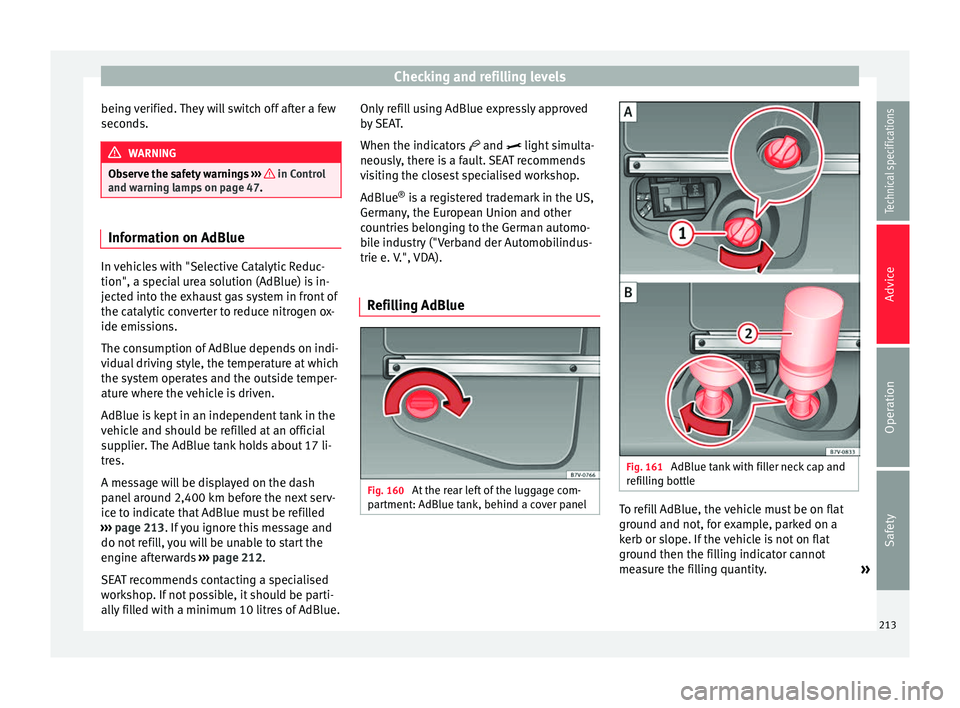
Refilling AdBlue Fig. 160
At the rear left of the luggage com-
partment: AdBlue tank, behind a cover panel Fig. 161
AdBlue tank with filler neck cap and
refilling bottle To refill AdBlue, the vehicle must be on flat
ground and not, for example, parked on a
kerb or slope. If the vehicle is not on flat
ground then the filling indicator cannot
measure the filling quantity.
»
213
Technical specifications
Advice
Operation
Safety
Page 220 of 305
Advice
The checking and refilling of service fluids
are carried out on the components men-
tioned above. These operations are descri-
bed in ››› page 214 .
Ov er
view
Further explanations, instructions and restric-
tions on the technical data are contained as
of ››› page 274
Engine oil Introduction WARNING
Incorrectly handling engine oil can cause in-
jury and serious burns.
● Always protect your eyes when handling
engine oil.
● Oil is toxic and must be kept out of the
reach of children.
● Engine oil should only be kept in its origi-
nal packaging; the same goes for used oil un-
til it is disposed of.
● Never store engine oil in empty food con-
tainers or bottles as other people may acci-
dentally drink it.
● Regular contact with engine oil can be bad
for the skin. If you come into contact with en-
gine oil, wash your skin with soap and water. ●
With the engine running, the engine oil
gets extremely hot and can cause severe skin
burns. Always wait until the engine has fully
cooled. For the sake of the environment
Similar to the other service liquids, spilled
engine oil can be bad for the environment.
Collect these liquids in suitable containers
and dispose of them while respecting the en-
vironment. Warning and control lamps
It lights
upPossible causeSolution
Insufficient engine
oil.Switch the ignition
off. Check the en-
gine oil level
››› page 219.
FlashesPossible causeSolution
Engine oil pres-
sure too low.
Stop the vehicle!
Switch off the en-
gine. Check the en-
gine oil level.
- If the warning lamp
flashes although the
oil level is correct,
do not continue driv-
ing or leave the en-
gine running. Other-
wise, the engine
could be damaged.
Seek specialist as-
sistance.
Engine oil sensor
faulty.Contact a special-
ised workshop. Have
the engine oil sensor
checked.
WARNING
Observe the safety warnings ››› in Control
and warning lamps on page 47. Engine oil specifications
Replacement engine oil must strictly comply
with the specifications.
The correct oil must be used to ensure the
correct operation and long service life of the
engine. The engine comes with a high-quality
multigrade oil that can generally be used all
year round.
218
Page 224 of 305
Advice
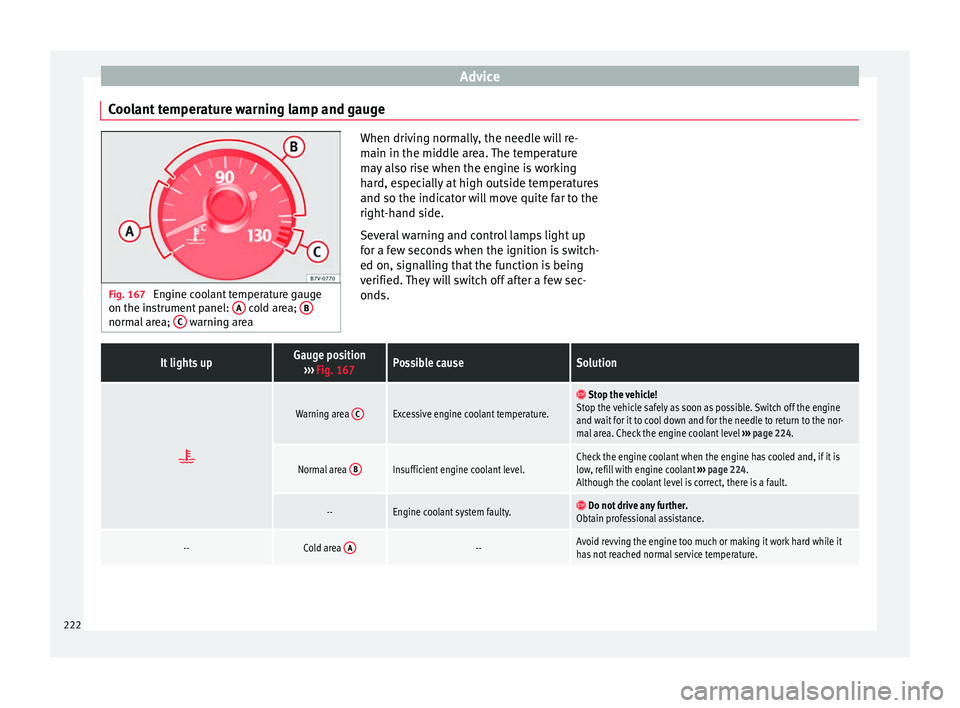
Coolant temperature warning lamp and gauge Fig. 167
Engine coolant temperature gauge
on the instrument panel: A cold area;
B normal area;
C warning area When driving normally, the needle will re-
main in the middle area. The temperature
may also rise when the engine is working
hard, especially at high outside temperatures
and so the indicator will move quite far to the
right-hand side.
Several warning and control lamps light up
for a few seconds when the ignition is switch-
ed on, signalling that the function is being
verified. They will switch off after a few sec-
onds.It lights upGauge position
››› Fig. 167Possible causeSolution
Warning area
CExcessive engine coolant temperature.
Stop the vehicle!
Stop the vehicle safely as soon as possible. Switch off the engine
and wait for it to cool down and for the needle to return to the nor-
mal area. Check the engine coolant level ››› page 224.
Normal area BInsufficient engine coolant level.Check the engine coolant when the engine has cooled and, if it is
low, refill with engine coolant
››› page 224.
Although the coolant level is correct, there is a fault.
--Engine coolant system faulty. Do not drive any further.
Obtain professional assistance.
--Cold area A--Avoid revving the engine too much or making it work hard while it
has not reached normal service temperature.222
Page 225 of 305
Checking and refilling levelsFlashesPossible causeSolution
Engine coolant sys-
tem faulty.Seek specialist as-
sistance.
WARNING
Observe the safety warnings ››› in Control
and warning lamps on page 47. Engine coolant specifications
The engine cooling system is supplied from
the factory with a specially treated mixture of
water and, at least, 40 % of the additive
G 13
(TLVW 774 J). The engine coolant additive is
recognisable by its purple colour. This mix-
ture of water and additive gives the necessa-
ry frost protection down to -25°C (-13 F) and
protects the light alloy parts of the cooling
system against corrosion. It also prevents
scaling and considerably raises the boiling
point of the coolant.
To protect the engine cooling system, the
percentage of additive must always be at
l e
ast 40 %, even in warm climates where an-
ti-freeze protection is not required.
If greater frost protection is required in very
cold climates, the proportion of additive can
be increased. However, the percentage of ad-
ditive should not exceed 60%, as this would
reduce the frost protection and, in turn, de-
crease the cooling capacity. When the coolant is topped up, use a mixture
of
distilled water and, at least, 40 % of the G
13 or G 12 plu
s-plus (TL-VW 774 G) additive
(both are purple) to obtain an optimum anti-
corrosion protection ››› . The mixture of G
13 with G 12 plus (TL-VW 774 F), G 12 (red) or
G 11 (green-blue) engine coolants will signifi-
cantly reduce the anticorrosion protection
and should, therefore be avoided ››› .
WARNING
If there is not enough anti-freeze in the cool-
ant system, the engine may fail leading to se-
rious damage.
● Please make sure that the percentage of
additive is correct with respect to the lowest
expected ambient temperature in the zone in
which the vehicle is to be used.
● When the outside temperature is very low,
the coolant could freeze and the vehicle
would be immobilised. In this case, the heat-
ing would not work either and inadequately
dressed passengers could die of cold. CAUTION
The original additives should never be mixed
with coolants which are not approved by
SEAT. Otherwise, you run the risk of causing
severe damage to the engine and the engine
cooling system. ● If the fluid in the expansion tank is not pur-
ple but is, for example, brown, this indicates
that the G 13 additive has been mixed with an inadequate coolant. The coolant must be
changed as soon as possible if this is the
case! This could result in serious faults and
engine damage.
For the sake of the environment
Coolants and additives can contaminate the
environment. If any fluids are spilled, they
should be collected and correctly disposed
of, with respect to the environment. 223
Technical specifications
Advice
Operation
Safety
Page 226 of 305
Advice
Checking the engine coolant level and
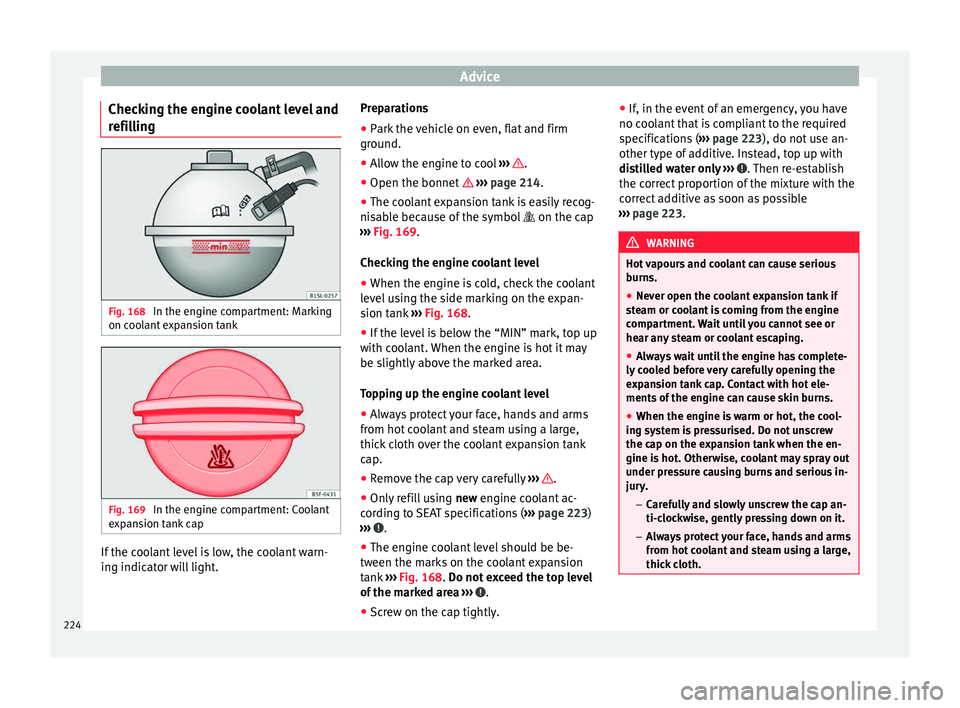
refilling Fig. 168
In the engine compartment: Marking
on coolant expansion tank Fig. 169
In the engine compartment: Coolant
expansion tank cap If the coolant level is low, the coolant warn-
ing indicator will light. Preparations
● Park the vehicle on even, flat and firm
ground.
● Allow the engine to cool ››› .
● Open the bonnet ››› page 214.
● The coolant expansion tank is easily recog-
nisable because of the symbol on the cap
› ›
› Fig. 169.
Check
ing the engine coolant level
● When the engine is cold, check the coolant
level using the side marking on the expan-
sion tank ››› Fig. 168.
● If the l
evel is below the “MIN” mark, top up
with coolant. When the engine is hot it may
be slightly above the marked area.
Topping up the engine coolant level
● Always protect your face, hands and arms
from hot coolant and steam using a large,
thick cloth over the coolant expansion tank
cap.
● Remove the cap very carefully ››› .
● Only refill using new engine coolant ac-
c or
ding to SEAT specifications ( ››› page 223)
››› .
● The engine coolant level should be be-
tween the marks on the coolant expansion
tank ››› Fig. 168 .
Do not exceed the top level
of
the marked area ››› .
● Screw on the cap tightly. ●
If, in the event of an emergency, you have
no coolant that is compliant to the required
specifications ( ››› page 223 ), do not use an-
other type of a
dditive. Instead, top up with
distilled water only ››› . Then re-establish
the correct proportion of the mixture with the
correct additive as soon as possible
››› page 223 . WARNING
Hot vapours and coolant can cause serious
burns.
● Never open the coolant expansion tank if
steam or coolant is coming from the engine
compartment. Wait until you cannot see or
hear any steam or coolant escaping.
● Always wait until the engine has complete-
ly cooled before very carefully opening the
expansion tank cap. Contact with hot ele-
ments of the engine can cause skin burns.
● When the engine is warm or hot, the cool-
ing system is pressurised. Do not unscrew
the cap on the expansion tank when the en-
gine is hot. Otherwise, coolant may spray out
under pressure causing burns and serious in-
jury.
– Carefully and slowly unscrew the cap an-
ti-clockwise, gently pressing down on it.
– Always protect your face, hands and arms
from hot coolant and steam using a large,
thick cloth. 224
Page 228 of 305
Advice
It is not always possible to check the level of
the brake fluid, as in some models the en-
gine components make it difficult to see the
brake fluid reservoir. If you cannot read the
exact brake fluid level, consult a specialist.
The brake fluid level drops slightly when the
vehicle is being used due to wear of the
brake pads and the automatic readjustment
of the brake.
Changing the brake fluid
The brake fluid should be changed in accord-
ance with the instructions given in the Main-
tenance Programme. Have the brake fluid
changed by a specialised workshop. SEAT
recommends taking your car in for technical
service. This means that only brake fluid
complying with the required specifications
will be used. WARNING
If the brake fluid level is low or unsuita-
ble/old brake fluid is used, the brake system
may fail or braking power may be reduced.
● Check the brake system and the brake fluid
level regularly!
● The brake fluid should be changed regular-
ly in accordance with the instructions given
in the Maintenance Programme.
● When the brake fluid is used and brakes
are subjected to extreme braking forces, bub-
bles of vapour form in the brake system. These bubbles can significantly reduce brak-
ing power, notably increasing braking dis-
tance, and could result in the total failure of
the brake system.
●
Only used brake fluid that conforms to the
VW 501 14 standard, FMVSS 116 DOT 4
standard or even the DIN ISO 4925 CLASS 4
standard. Other types of brake fluid could af-
fect brake operation and reduce braking pow-
er. Do not use a brake fluid if the container
does not specify compliance with the
VW 501 14, FMVSS 116 DOT 4 or
DIN ISO 4925 CLASS 4 standards.
● The replacement brake fluid must be new.
● Always ensure that you use suitable brake
fluid. Do not use a brake fluid if the container
does not specify compliance with the
VW 501 14, FMVSS 116 DOT 4 or
DIN ISO 4925 CLASS 4 standards. WARNING
Brake fluid is poisonous.
● To reduce the risk of poisoning, do not keep
brake fluid in drinks bottles/containers or
similar. Other people could drink from these
recipients even if the contents are clearly
marked.
● Always keep brake fluid in the original con-
tainer; keep it correctly sealed and out of
reach of children. CAUTION
Brake fluid damages the vehicle paintwork.
Wipe off any brake fluid from the paintwork
immediately. For the sake of the environment
Brake fluid is an environmental pollutant.
Collect any spilt service fluids and allow a
professional to dispose of them. Checking and topping up the
windscreen washer reservoir with
water
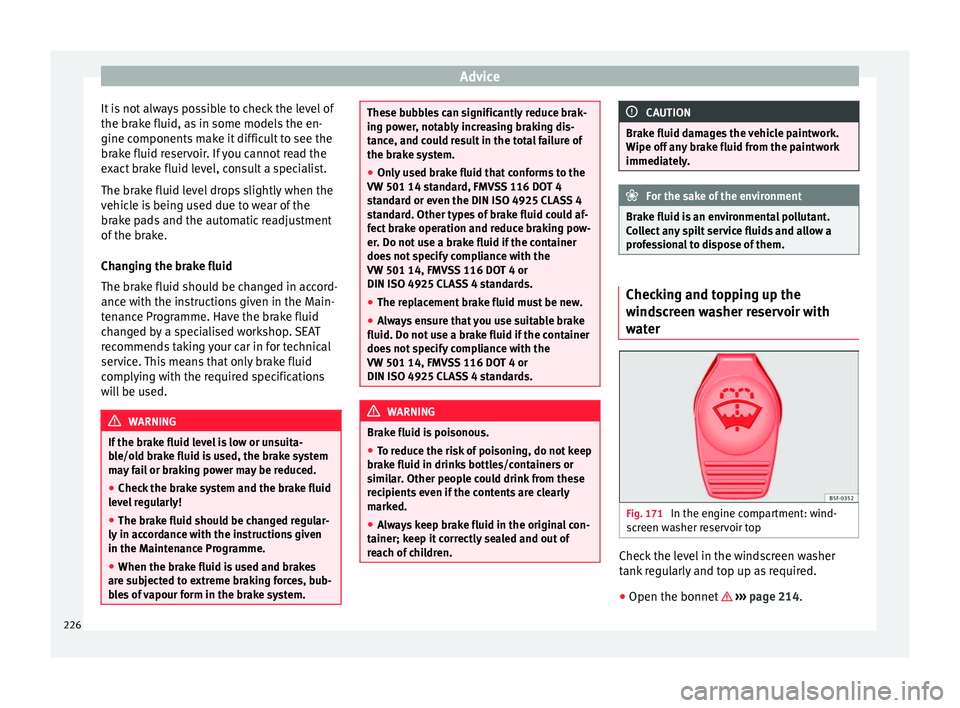
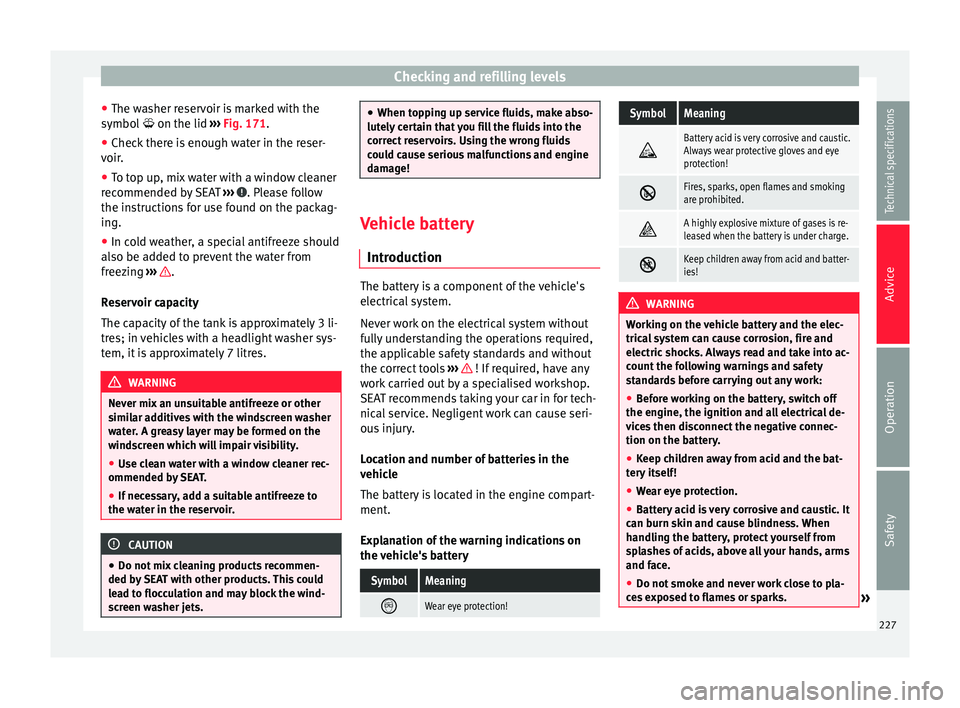
Fig. 171
In the engine compartment: wind-
screen washer reservoir top Check the level in the windscreen washer
tank regularly and top up as required.
● Open the bonnet ››› page 214.
226
Page 229 of 305
Checking and refilling levels
● The washer reservoir is marked with the
symbol on the lid
›
›› Fig. 171.
● Check there is enough water in the reser-
voir.
● To top up, mix water with a window cleaner
recommended by SEAT ››› . Please follow
the instructions for use found on the packag-
ing.
● In cold weather, a special antifreeze should
also be added to prevent the water from
freezing ››› .
Reservoir capacity
The capacity of the tank is approximately 3 li-
tres; in vehicles with a headlight washer sys-
tem, it is approximately 7 litres. WARNING
Never mix an unsuitable antifreeze or other
similar additives with the windscreen washer
water. A greasy layer may be formed on the
windscreen which will impair visibility.
● Use clean water with a window cleaner rec-
ommended by SEAT.
● If necessary, add a suitable antifreeze to
the water in the reservoir. CAUTION
● Do not mix cleaning products recommen-
ded by SEAT with other products. This could
lead to flocculation and may block the wind-
screen washer jets. ●
When topping up service fluids, make abso-
lutely certain that you fill the fluids into the
correct reservoirs. Using the wrong fluids
could cause serious malfunctions and engine
damage! Vehicle battery
Introduction The battery is a component of the vehicle's
electrical system.
Never work on the electrical system without
fully understanding the operations required,
the applicable safety standards and without
the correct tools
››› ! If required, have any
work carried out by a specialised workshop.
SEAT recommends taking your car in for tech-
nical service. Negligent work can cause seri-
ous injury.
Location and number of batteries in the
vehicle
The battery is located in the engine compart-
ment.
Explanation of the warning indications on
the vehicle's battery
SymbolMeaning
Wear eye protection!
SymbolMeaning
Battery acid is very corrosive and caustic.
Always wear protective gloves and eye
protection!
Fires, sparks, open flames and smoking
are prohibited.
A highly explosive mixture of gases is re-
leased when the battery is under charge.
Keep children away from acid and batter-
ies!
WARNING
Working on the vehicle battery and the elec-
trical system can cause corrosion, fire and
electric shocks. Always read and take into ac-
count the following warnings and safety
standards before carrying out any work:
● Before working on the battery, switch off
the engine, the ignition and all electrical de-
vices then disconnect the negative connec-
tion on the battery.
● Keep children away from acid and the bat-
tery itself!
● Wear eye protection.
● Battery acid is very corrosive and caustic. It
can burn skin and cause blindness. When
handling the battery, protect yourself from
splashes of acids, above all your hands, arms
and face.
● Do not smoke and never work close to pla-
ces exposed to flames or sparks. » 227
Technical specifications
Advice
Operation
Safety
Page 230 of 305
Advice
●
Avoid sparks and electrostatic discharges
when working with cables and electrical devi-
ces.
● Never short the battery terminals.
● Never use a damaged battery. It can ex-
plode. Replace a damaged battery immedi-
ately.
● Replaced damaged or frozen batteries as
soon as possible. A flat battery can also
freeze at temperatures close to 0 °C (+32 °F).
● For vehicles with the battery in the luggage
compartment: Check that the battery gas
ventilation hose is securely attached. CAUTION
● Never disconnect the battery if the ignition
is switched on or if the engine is running.
This could damage the electrical system or
electronic components.
● Do not expose the battery to direct sunlight
over a long period of time, as the intense ul-
traviolet radiation can damage the battery
housing.
● If the car is left standing for long periods,
protect the battery from extreme cold temper-
ature so that it does not “freeze up” and be-
come damaged. Warning lampIt
lights upPossible causeSolution
Faulty generator.
Contact a specialised
workshop. Have the
electrical system
checked.
Disconnect any unneces-
sary electrical devices.
The generator does not
charge the battery while
the vehicle is in motion.
Several warning and control lamps light up
for a few seconds when the ignition is switch-
ed on, signalling that the function is being
verified. They will switch off after a few sec-
onds.
WARNING
If the warning lamps and messages are ignor-
ed, the vehicle may stall in traffic, or may
cause accidents and severe injuries.
● Never ignore the warning lamps or text
messages.
● Stop the vehicle safely as soon as possible. CAUTION
Failure to heed the control lamps and text
messages when they appear may result in
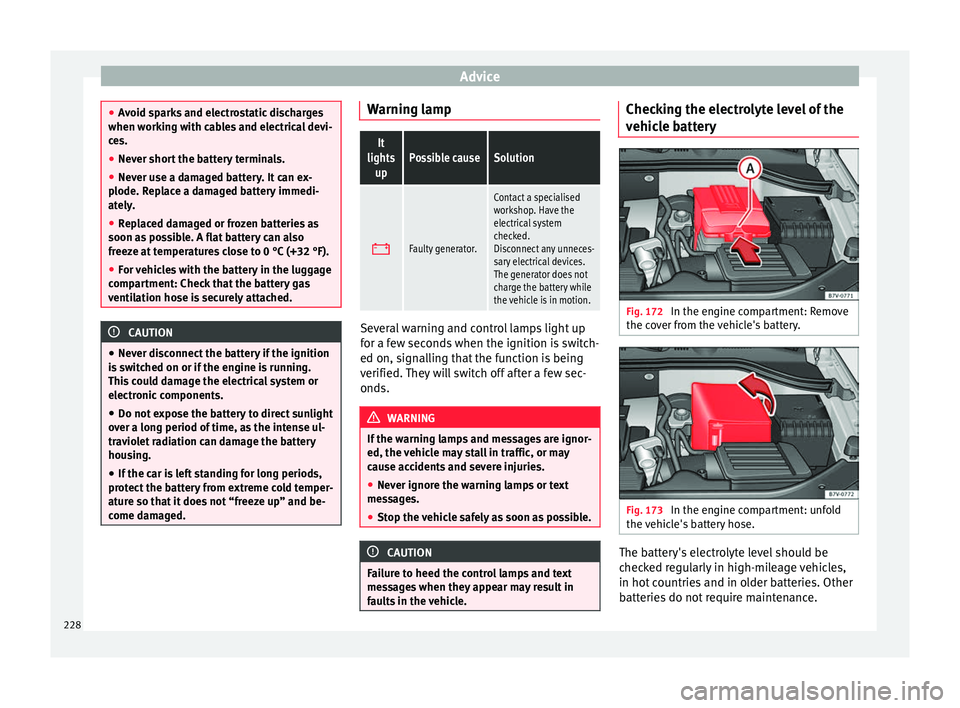
faults in the vehicle. Checking the electrolyte level of the
vehicle battery
Fig. 172
In the engine compartment: Remove
the cover from the vehicle's battery. Fig. 173
In the engine compartment: unfold
the vehicle's battery hose. The battery's electrolyte level should be
checked regularly in high-mileage vehicles,
in hot countries and in older batteries. Other
batteries do not require maintenance.
228