child lock Seat Alhambra 2015 User Guide
[x] Cancel search | Manufacturer: SEAT, Model Year: 2015, Model line: Alhambra, Model: Seat Alhambra 2015Pages: 305, PDF Size: 5.46 MB
Page 71 of 305
Opening and closing
In case of difficulty or obstruction, automatic
opening of the rear lid is interrupted.
Electronically opening the rear lid does not
work when a trailer is electrically connected
and hitched to a factory fitted tow hitch
››› page 179 .
The r e
ar lid can be opened manually by ap-
plying more force.
Closing the rear lid
● Press and hold the button on the vehi-
cle key for approximately 1 second.
● OR: press and hold the button on the
centre console for approximately 1 second
››› Fig. 52 .
● OR: press the ›
›› Fig. 53
boot hatch button
(arro
w).
● Press the button on the open rear lid
››› Fig. 55
›
›› .
● Manually push the rear lid down to close it.
The rear lid will move down to the closed po-
sition to close and lock itself automatically
using the power-close feature ››› .
In case of difficulty or obstruction, automatic
closing of the rear lid is interrupted and it will
open slightly.
Check why the rear lid could not close.
Attempt to close it once more. Interrupting the opening and closing process
Rear lid opening and closing can be stopped
by pressing one of the
buttons. Each time
one of the buttons is pressed, the rear lid
moves to its initial position.
Then, it can be opened or closed by hand. To
do this, apply a little more force.
Memorising the opening angle
The rear lid must be at least half open to
memorise an opening angle.
● Stop automatic opening in the opening po-
sition required ››› page 69 .
● Ho l
d down the button ››› Fig. 55
with the
rear lid open for at least three seconds. The
opening angle is memorised.
Memorisation is confirmed by blinking of the
hazard warning lights and an audible warn-
ing.
To fully open the boot hatch again, the open-
ing angle must be memorised once more.
● Release the rear lid and open it to the
memorised height.
● Push the rear lid all the way up. To do this,
apply a little more force.
● Hold down the button ››› Fig. 55
with the
rear lid open for at least three seconds.
● The opening angle is reset to the original
factory setting. WARNING
Unsuitable or careless closing and locking of
the rear lid could cause serious injuries.
● Never allow children to play inside or
around the vehicle without supervision, espe-
cially if the rear lid is open. Children could
enter the luggage compartment, close the
rear lid and become trapped. A locked vehicle
can be subjected to extremely high and low
temperatures, depending on the time of year,
resulting in serious injuries/illness or even
death. WARNING
It is possible that the rear lid does not open
completely or, if it is open, closes alone if a
large amount of snow has built up on it or if a
luggage rack is fitted. In this case, the rear lid
must be supported. CAUTION
● When using a trailer, ensure that there is
sufficient space to open and close the rear
lid.
● Before opening the rear lid, any kind of
equipment carrier should be removed, for ex-
ample a bicycle carrier. CAUTION
In case of repeated short-term use, the sys-
tem is turned off to avoid overheating. » 69
Technical specifications
Advice
Operation
Safety
Page 72 of 305
Operation
●
When it has cooled, it may be used once
again. During this time, the rear lid may be
manually opened or closed applying a little
more effort.
● If the vehicle battery is disconnected or the
fuse blows when the rear lid is open, the rear
lid system must be re-initialised. To do this,
close the rear lid. Note
Before closing the rear lid, make sure that the
key has not been left inside the luggage com-
partment. Electric windows
Opening and closing the electric
windows Fig. 56
In the driver door: Buttons for front
and rear electric windows and child safety
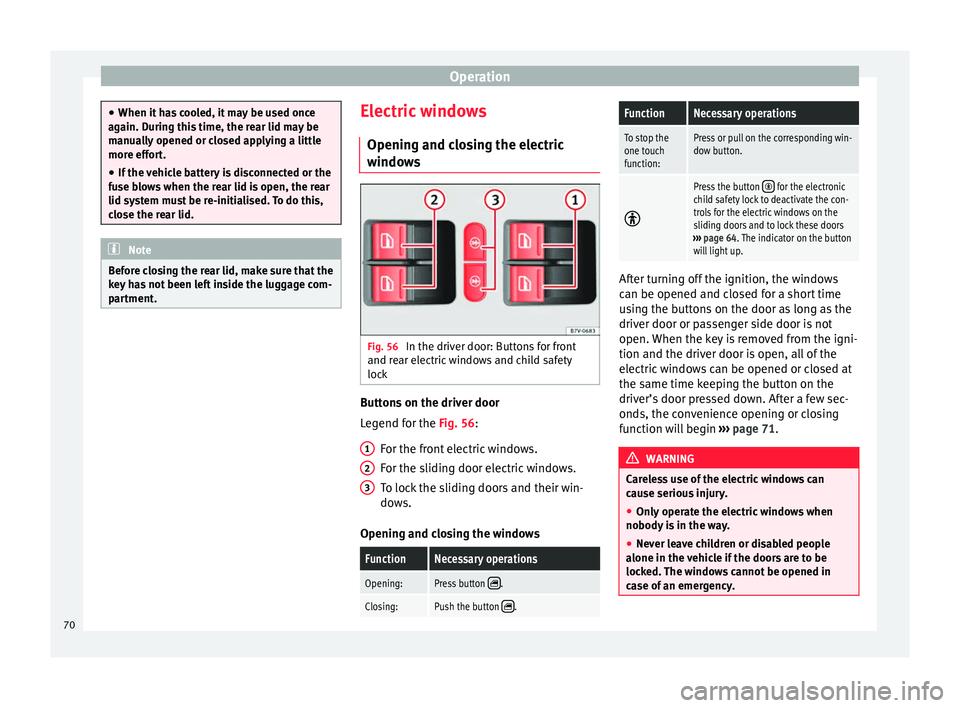
lock Buttons on the driver door
Legend for the
Fig. 56
:
F
or the front electric windows.
For the sliding door electric windows.
To lock the sliding doors and their win-
dows.
Opening and closing the windows
FunctionNecessary operations
Opening:Press button .
Closing:Push the button . 1
2
3
FunctionNecessary operations
To stop the
one touch
function:Press or pull on the corresponding win-
dow button.
Press the button for the electronic
child safety lock to deactivate the con-
trols for the electric windows on the
sliding doors and to lock these doors
››› page 64. The indicator on the button
will light up. After turning off the ignition, the windows
can be opened and closed for a short time
using the buttons on the door as long as the
driver door or passenger side door is not
open. When the key is removed from the igni-
tion and the driver door is open, all of the
electric windows can be opened or closed at
the same time keeping the button on the
driver’s door pressed down. After a few sec-
onds, the convenience opening or closing
function will begin
›››
page 71. WARNING
Careless use of the electric windows can
cause serious injury.
● Only operate the electric windows when
nobody is in the way.
● Never leave children or disabled people
alone in the vehicle if the doors are to be
locked. The windows cannot be opened in
case of an emergency. 70
Page 73 of 305
Opening and closing
●
Always take all the keys with you whenever
you leave the vehicle. After turning off the ig-
nition, the windows can be opened and
closed for a short time using the buttons on
the door as long as the driver door or passen-
ger side door is not open.
● When transporting children in the rear
seats, always deactivate the rear electric win-
dows with the child safety lock so that they
cannot be opened and closed. Electric windows: functions
One-touch opening and closing
The one-touch automatic opening and clos-
ing is used to open or close the windows
completely. It will not be necessary to hold
the button of the corresponding electric win-
dow.
For the one-touch closing function: pull the
button for the corresponding window up-
wards until it reaches the second position.
For the one-touch opening function:
push the
b utt
on for the corresponding window down-
wards until it reaches the second position.
To stop the one touch function:
push or pull
on the button of the corresponding window.
Restoring one-touch opening and closing
The one-touch opening and closing function
is not active after the vehicle battery has been disconnected or is flat and will have to
be reset.
● Close all windows and doors.
● Pull the button of the corresponding win-
dow and hold it for one second in this posi-
tion.
● Release the button and pull upwards and
hold again. The one-touch function is now
ready for operation.
The automatic one-touch electric windows
can be reinitialised individually or several at
a time.
Convenience opening and closing function
The electric windows can be opened or
closed from outside using the vehicle key:
● Keep the vehicle unlocking or locking but-
ton pressed. All windows which function elec-
trically will be either opened or closed.
● To interrupt the function, release the lock-
ing or unlocking button.
During convenience closing, first the win-
dows and then the sliding sunroof will be
closed.
In the Configuration - convenience menu, there are different settings for operating the
windows ››› page 47. Note
The one-touch function and roll-back function
will not work if there is a malfunction in the
electric windows. Visit a specialised work-
shop. Electric Windows anti-trap function
The anti-trap function of the electric windows
can reduce the risk of injury when opening
and closing the electric windows
››› . If a
window is not able to close because it is stiff
or because of an obstruction, it will automati-
cally open again.
● Check why the window does not close.
● Attempt to close the window again.
● If you try within the following 10 seconds
and the window closes with difficulty or there
is an obstruction once again, the one-touch
closing will stop working for 10 seconds.
● If the window is still obstructed, it will stop
at the corresponding position. When the but-
ton is operated within 10 seconds, the win-
dow will close without the anti-trap function
››› .
To close windows without the anti-trap
function
● Attempt to close the corresponding electric
window within 10 seconds after by holding
the button. The window is closed without the
»
71
Technical specifications
Advice
Operation
Safety
Page 74 of 305
Operation
anti-trap function, deactivated for a short
time.
● After more than 10 seconds, the anti-trap
function is reactivated. The window will stop
once again if there is another difficulty or ob-
stacle.
● If the window will still not close, visit a spe-
cialised workshop. WARNING
Closing the electric windows without the an-
ti-trap function can cause serious injury.
● Always close the electric windows careful-
ly.
● Nobody should be in the way of the electric
windows, especially when the anti-trap func-
tion is deactivated.
● The anti-trap function does not prevent fin-
gers or other parts of the body getting
pinched against the window frame and caus-
ing injury. Note
The anti-trap function also operates if the
windows are closed from the outside of the
vehicle using the ignition key for convenience
closing ››› page 71. Panoramic sliding sunroof*
Introduction WARNING
Careless or uncontrolled use of the panoram-
ic sliding sunroof can cause serious injuries.
● Only close the panoramic sliding sunroof
and the sun blind when nobody is in the way.
● Always take all the keys with you whenever
you leave the vehicle.
● Never leave children or disabled persons in
the vehicle, particularly if they have access to
the keys. Uncontrolled use of the key could
lock the vehicle, start the engine, turn on the
ignition and operate the panoramic sliding
sunroof.
● The panoramic sliding sunroof can be oper-
ated for up to about ten minutes after the ig-
nition has been switched off, provided the
driver door and the front passenger door are
not opened. Note
In case of a fault in the operation of the pan-
oramic sliding sunroof, the anti-trap function
will not operate correctly. Visit a specialised
workshop. Opening or closing the panoramic
sliding sunroof
Fig. 57
On the interior roof lining: use the ro-
tary button for opening and closing Fig. 58
On the interior roof lining: Press the
button and pull on it to lift and close the slid-
ing sunroof. To open the panoramic sliding sunroof, the
switch must be in the position
1 .
72
Page 98 of 305
Operation
WARNING
Careless or uncontrolled use of the conven-
ient entry assistant may result in severe in-
jury and accident.
● Never use the convenient entry function
when the vehicle is in motion.
● Avoid trapping or damaging the seat belt
when folding the rear seats back.
● Keep your hands, fingers, feet and other
body parts out of the hinges and the seat
locking mechanism when folding and unfold-
ing.
● Mats or other objects can be caught in the
hinges of the seat backrests or rear seat. This
could prevent the seat backrest from locking
safely when positioned upright.
● All seat backrests must engage correctly for
the seat belts on the rear seats to work prop-
erly. When the seat backrest of an occupied
seat is not correctly locked in place, the pas-
senger can be thrust forward with the seat
backrest in case of sudden braking, sudden
manoeuvres or an accident.
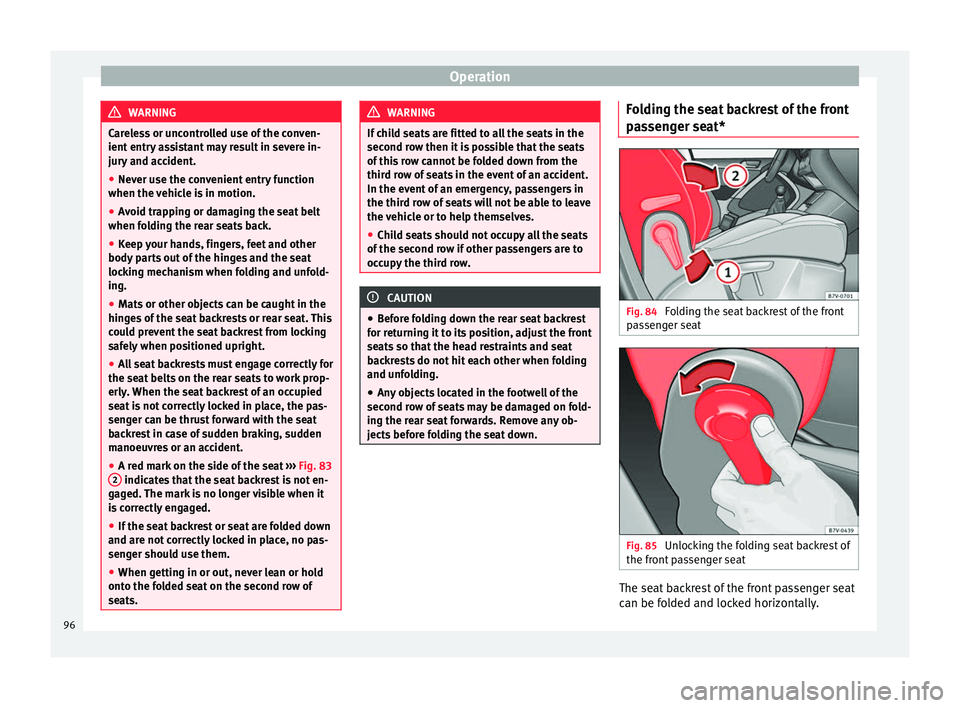
● A red mark on the side of the seat ››› Fig. 83
2 indicates that the seat backrest is not en-
gaged. The mark is no longer visible when it
is correctly engaged.
● If the seat backrest or seat are folded down
and are not correctly locked in place, no pas-
senger should use them.
● When getting in or out, never lean or hold
onto the folded seat on the second row of
seats. WARNING
If child seats are fitted to all the seats in the
second row then it is possible that the seats
of this row cannot be folded down from the
third row of seats in the event of an accident.
In the event of an emergency, passengers in
the third row of seats will not be able to leave
the vehicle or to help themselves.
● Child seats should not occupy all the seats
of the second row if other passengers are to
occupy the third row. CAUTION
● Before folding down the rear seat backrest
for returning it to its position, adjust the front
seats so that the head restraints and seat
backrests do not hit each other when folding
and unfolding.
● Any objects located in the footwell of the
second row of seats may be damaged on fold-
ing the rear seat forwards. Remove any ob-
jects before folding the seat down. Folding the seat backrest of the front
passenger seat*
Fig. 84
Folding the seat backrest of the front
passenger seat Fig. 85
Unlocking the folding seat backrest of
the front passenger seat The seat backrest of the front passenger seat
can be folded and locked horizontally.
96
Page 99 of 305
Seats and head restraints
The front passenger front airbag must be dis-
abled ››› page 20 if objects are being trans-
por t
ed on the folded front passenger seat.
Folding the seat backrest of the front
passenger seat
● Remove any objects from the front passen-
ger seat cushion ››› .
● Adjust the front passenger seat to its low-
est position ››› page 6 .
● Pu
sh the head restraint down as far as it
will go ››› page 6
.
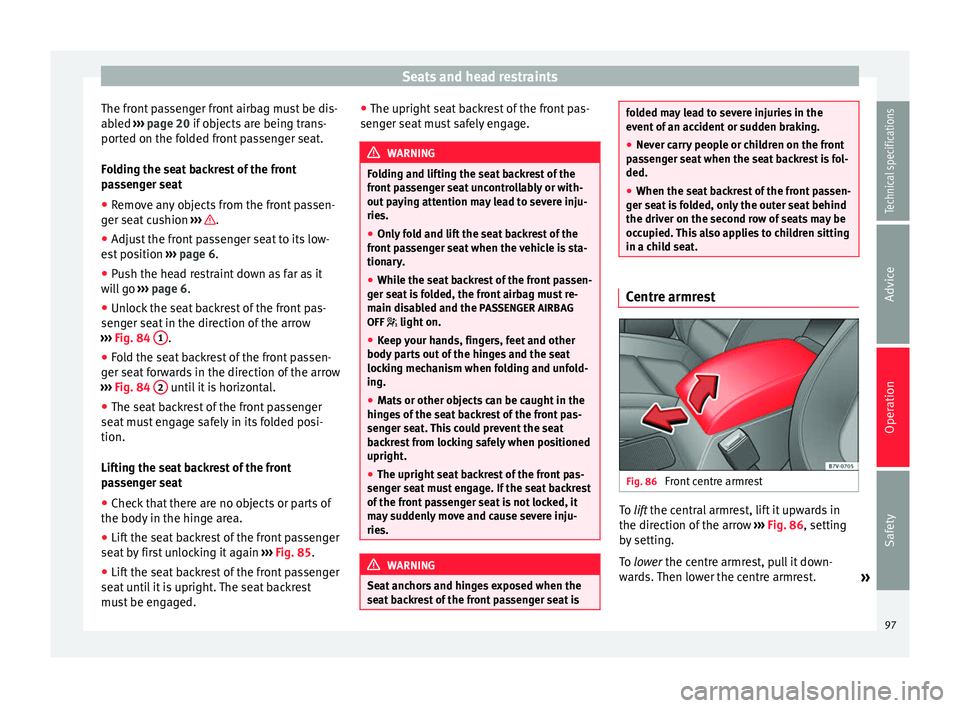
● Unlock the seat backrest of the front pas-
senger seat in the direction of the arrow
››› Fig. 84 1 .
● Fold the seat backrest of the front passen-
ger seat forwards in the direction of the arrow
››› Fig. 84 2 until it is horizontal.
● The seat backrest of the front passenger
seat must engage safely in its folded posi-
tion.
Lifting the seat backrest of the front
passenger seat
● Check that there are no objects or parts of
the body in the hinge area.
● Lift the seat backrest of the front passenger
seat by first unlocking it again ››› Fig. 85 .
● Lif t
the seat backrest of the front passenger
seat until it is upright. The seat backrest
must be engaged. ●
The upright seat backrest of the front pas-
senger seat must safely engage. WARNING
Folding and lifting the seat backrest of the
front passenger seat uncontrollably or with-
out paying attention may lead to severe inju-
ries.
● Only fold and lift the seat backrest of the
front passenger seat when the vehicle is sta-
tionary.
● While the seat backrest of the front passen-
ger seat is folded, the front airbag must re-
main disabled and the PASSENGER AIRBAG OFF light on.
● Keep
your hands, fingers, feet and other
body parts out of the hinges and the seat
locking mechanism when folding and unfold-
ing.
● Mats or other objects can be caught in the
hinges of the seat backrest of the front pas-
senger seat. This could prevent the seat
backrest from locking safely when positioned
upright.
● The upright seat backrest of the front pas-
senger seat must engage. If the seat backrest
of the front passenger seat is not locked, it
may suddenly move and cause severe inju-
ries. WARNING
Seat anchors and hinges exposed when the
seat backrest of the front passenger seat is folded may lead to severe injuries in the
event of an accident or sudden braking.
●
Never carry people or children on the front
passenger seat when the seat backrest is fol-
ded.
● When the seat backrest of the front passen-
ger seat is folded, only the outer seat behind
the driver on the second row of seats may be
occupied. This also applies to children sitting
in a child seat. Centre armrest
Fig. 86
Front centre armrest To
lift
the central armrest, lift it upwards in
the dir
ection of the arrow ››› Fig. 86, setting
by
setting.
To
lower the centre armrest, pull it down-
wards. Then lower the centre armrest. »
97
Technical specifications
Advice
Operation
Safety
Page 102 of 305
Operation
● Avoid sudden braking and manoeuvres.
● Brake early.
● If necessary, read the instructions for driv-
ing with a trailer ››› page 179.
● If necessary, read the instructions for driv-
ing with a roof carrier system ››› page 110. WARNING
A sliding load could considerably affect the
stability and safety of the vehicle resulting in
an accident with serious consequences.
● Secure loads correctly so they do not move.
● When transporting heavy objects, use suit-
able ropes or straps.
● Lock the seat backs in vertical position. Loading luggage compartment
Introduction Always transport heavy loads in the luggage
compartment and place the seat backs in a
vertical position. Always use the fastening
rings with suitable rope or straps. Never over-
load the vehicle. Both the carrying capacity
as well as the distribution of the load in the
vehicle have effects on the driving behaviour
and braking ability
››› . WARNING
When the vehicle is not in use or being
watched, always lock the doors and the rear
lid to reduce the risk of serious injury or
death.
● Do not leave children unwatched, especial-
ly when the boot is open. Children could
climb into the luggage compartment, close
the rear lid from inside and be unable to es-
cape themselves. This could lead to serious
injury or death.
● Never allow children to play in or around
the vehicle.
● Never transport people in the luggage com-
partment. WARNING
Unsecured or incorrectly secured objects can
cause serious injury in case of a sudden ma-
noeuvring or breaking or in case of an acci-
dent. This is especially true when objects are
struck by a detonating airbag and fired
through the vehicle interior. To reduce the
risks, please note the following:
● Secure all objects in the vehicle. Always
place equipment and heavy objects in the
boot.
● Always secure objects with suitable ropes
or straps so that they cannot be pushed in-
side the cabin and move around the areas
around the front or side airbags in the event
of sudden braking or an accident. ●
While driving, always keep object compart-
ments closed.
● Do not place hard, heavy or sharp objects
inside the vehicle interior, in open storage
compartments, the rear shelf or on the dash
panel.
● Remove hard, heavy and sharp objects from
clothes and pockets inside the vehicle and
store securely. WARNING
The transport of heavy object changes vehi-
cle handling and increases braking distance.
Heavy loads that have not been stored or se-
cured correctly could cause loss of control
and result in serious injury.
● Vehicle handling changes when transport-
ing heavy objects due to a change in the cen-
tre of gravity.
● Distribute the load as uniformly and as low
down on the vehicle as possible.
● Store heavy objects in the luggage com-
partment as far from the rear axle as possi-
ble. CAUTION
● Hard objects on the rear shelf could chafe
the wires of the heating element and antenna
of the rear window and cause damage.
● The side window antenna could be dam-
aged due to chafing from objects. 100
Page 103 of 305
Transport and practical equipment
Note
The ventilating slits between the heated rear
window and the shelf must not be covered so
that used air can escape from the vehicle. Folding down rear seats to create load
space
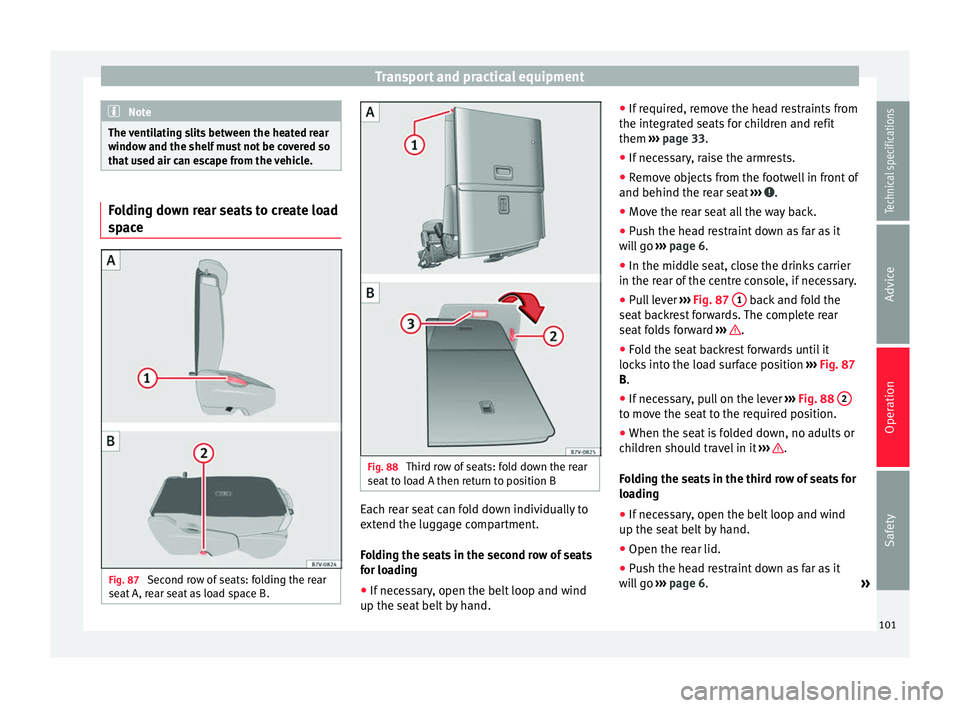
Fig. 87
Second row of seats: folding the rear
seat A, rear seat as load space B. Fig. 88
Third row of seats: fold down the rear
seat to load A then return to position B Each rear seat can fold down individually to
extend the luggage compartment.
Folding the seats in the second row of seats
for loading
●
If necessary, open the belt loop and wind
up the seat belt by hand. ●
If required, remove the head restraints from
the integrated seats for children and refit
them ››› page 33 .
● If nec
essary, raise the armrests.
● Remove objects from the footwell in front of
and behind the rear seat ››› .
● Move the rear seat all the way back.
● Push the head restraint down as far as it
will go ››› page 6 .
● In the mid dl
e seat, close the drinks carrier
in the rear of the centre console, if necessary.
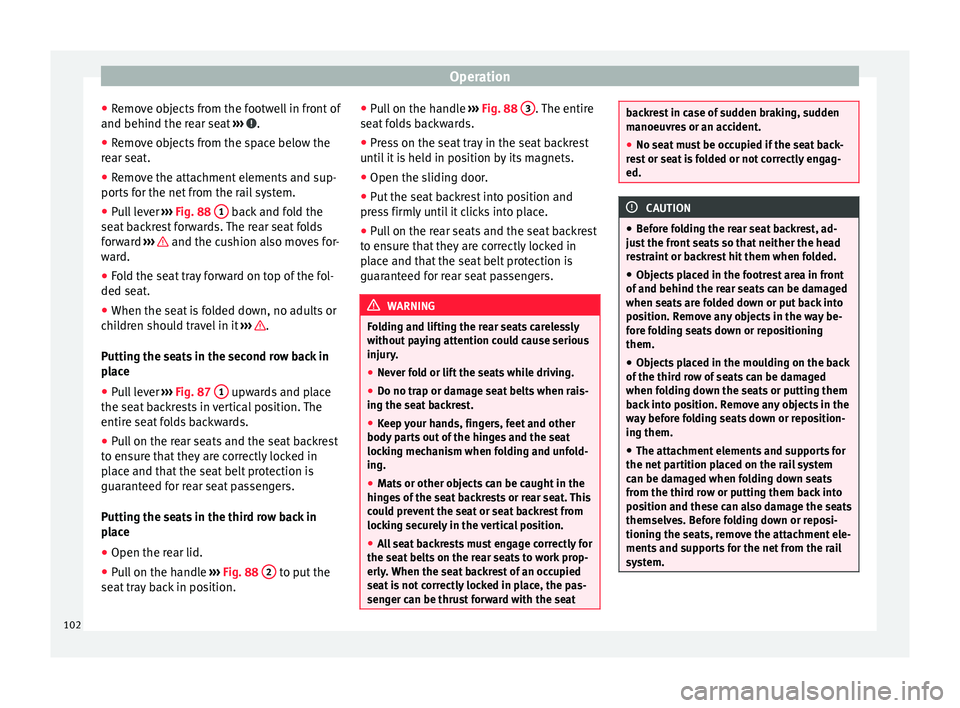
● Pull lever ››› Fig. 87
1 back and fold the
seat backrest forwards. The complete rear
seat folds forward ››› .
● Fold the seat backrest forwards until it
locks into the load surface position ››› Fig. 87
B .
● If nec
essary, pull on the lever ››› Fig. 88 2 to move the seat to the required position.
●
When the seat is folded down, no adults or
children should travel in it ››› .
Folding the seats in the third row of seats for
loading
● If necessary, open the belt loop and wind
up the seat belt by hand.
● Open the rear lid.
● Push the head restraint down as far as it
will go ››› page 6 .
»
101
Technical specifications
Advice
Operation
Safety
Page 104 of 305
Operation
● Remove objects from the footwell in front of
and behind the rear seat ››› .
● Remove objects from the space below the
rear seat.
● Remove the attachment elements and sup-
ports for the net from the rail system.
● Pull lever ››› Fig. 88 1 back and fold the
seat backrest forwards. The rear seat folds
forward ››› and the cushion also moves for-
ward.
● Fold the seat tray forward on top of the fol-
ded seat.
● When the seat is folded down, no adults or
children should travel in it ››› .
Putting the seats in the second row back in
place
● Pull lever ››› Fig. 87 1 upwards and place
the seat backrests in vertical position. The
entire seat folds backwards.
● Pull on the rear seats and the seat backrest
to ensure that they are correctly locked in
place and that the seat belt protection is
guaranteed for rear seat passengers.
Putting the seats in the third row back in
place
● Open the rear lid.
● Pull on the handle ››› Fig. 88 2 to put the
seat tray back in position. ●
Pull on the handle ››› Fig. 88 3 . The entire
seat folds backwards.
● Press on the seat tray in the seat backrest
until it is held in position by its magnets.
● Open the sliding door.
● Put the seat backrest into position and
press firmly until it clicks into place.
● Pull on the rear seats and the seat backrest
to ensure that they are correctly locked in
place and that the seat belt protection is
guaranteed for rear seat passengers. WARNING
Folding and lifting the rear seats carelessly
without paying attention could cause serious
injury.
● Never fold or lift the seats while driving.
● Do no trap or damage seat belts when rais-
ing the seat backrest.
● Keep your hands, fingers, feet and other
body parts out of the hinges and the seat
locking mechanism when folding and unfold-
ing.
● Mats or other objects can be caught in the
hinges of the seat backrests or rear seat. This
could prevent the seat or seat backrest from
locking securely in the vertical position.
● All seat backrests must engage correctly for
the seat belts on the rear seats to work prop-
erly. When the seat backrest of an occupied
seat is not correctly locked in place, the pas-
senger can be thrust forward with the seat backrest in case of sudden braking, sudden
manoeuvres or an accident.
●
No seat must be occupied if the seat back-
rest or seat is folded or not correctly engag-
ed. CAUTION
● Before folding the rear seat backrest, ad-
just the front seats so that neither the head
restraint or backrest hit them when folded.
● Objects placed in the footrest area in front
of and behind the rear seats can be damaged
when seats are folded down or put back into
position. Remove any objects in the way be-
fore folding seats down or repositioning
them.
● Objects placed in the moulding on the back
of the third row of seats can be damaged
when folding down the seats or putting them
back into position. Remove any objects in the
way before folding seats down or reposition-
ing them.
● The attachment elements and supports for
the net partition placed on the rail system
can be damaged when folding down seats
from the third row or putting them back into
position and these can also damage the seats
themselves. Before folding down or reposi-
tioning the seats, remove the attachment ele-
ments and supports for the net from the rail
system. 102
Page 122 of 305
Operation
●
Unshielded equipment can cause interfer-
ence on the radio equipment and the vehi-
cle's electrical system.
● Interference can occur on the radio's AM
waveband if electrical appliances are used
near the rear window aerial. Vehicle power sockets
Fig. 118
Centre console, rear section: 12 volt
socket Fig. 119
Rear centre console: 230 Volt Euro
power socket Depending on your vehicle version, you may
have a 12-volt power socket and/or a 230
volt power socket.
Maximum power consumptionPower sock-
etMaximum power consumption
12 Volts120 Watts
230 Volts150 Watts (300 Watt peak)
The maximum capacity of each power socket
must not be exceeded. The power consump-
tion is indicated on the rating plate of each
appliance.
Where two or more appliances are connected
at the same time, the total rating of all the
connected devices must never exceed 190
Watts
››› .12 volt power socket
The 12 Volt power socket will only work with
the ignition on.
Using electrical appliances with the engine
stopped and the ignition switched on will
drain the battery. Therefore, electrical devi-
ces connected to the power socket can only
be used when the engine is running.
To prevent voltage variations from causing
damage, switch off the electrical consumer
connected to the 12 Volt power socket before
switching the ignition on or off and before
starting the engine.
12 Volt power sockets can be found in the
following locations in the vehicle:
●
Compartment in the centre of the centre
console.
● Compartment in the front centre console.
● Storage compartment in the front central
armrest.
● Rear centre console ››› Fig. 118 .
● At the r
ear right of the luggage compart-
ment.
230 Volt Euro power socket*
The power socket only works when the en-
gine is running ››› .
Connecting an electrical appliance: plug the
device into the power socket as far as possi-
ble to unlock the built-in childproof lock. The
120