clock Seat Alhambra 2015 User Guide
[x] Cancel search | Manufacturer: SEAT, Model Year: 2015, Model line: Alhambra, Model: Seat Alhambra 2015Pages: 305, PDF Size: 5.46 MB
Page 226 of 305
Advice
Checking the engine coolant level and
refilling Fig. 168
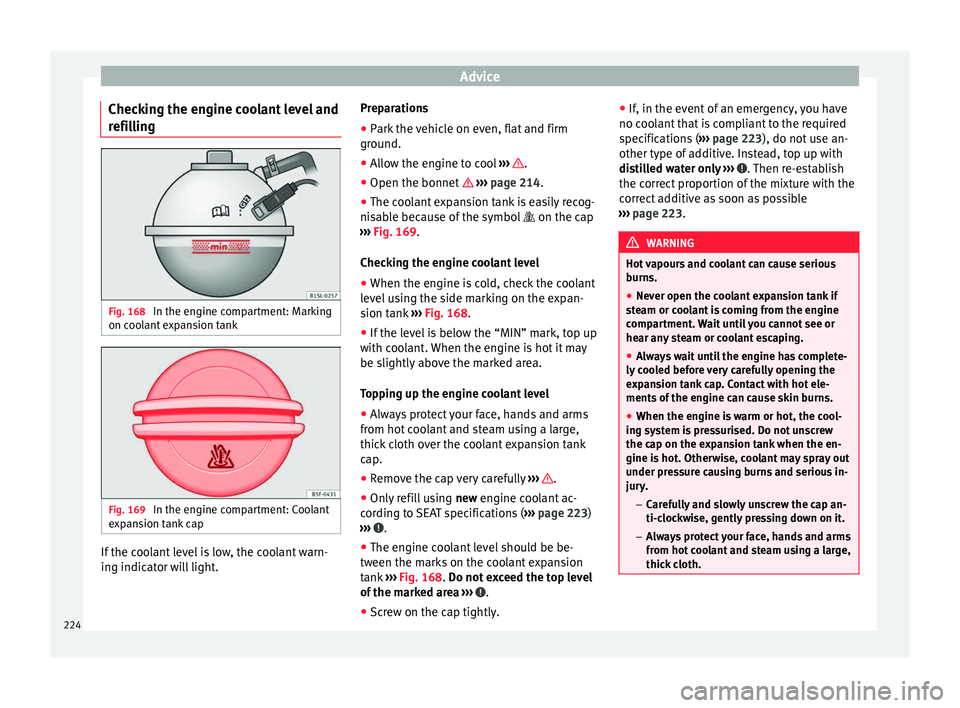
In the engine compartment: Marking
on coolant expansion tank Fig. 169
In the engine compartment: Coolant
expansion tank cap If the coolant level is low, the coolant warn-
ing indicator will light. Preparations
● Park the vehicle on even, flat and firm
ground.
● Allow the engine to cool ››› .
● Open the bonnet ››› page 214.
● The coolant expansion tank is easily recog-
nisable because of the symbol on the cap
› ›
› Fig. 169.
Check
ing the engine coolant level
● When the engine is cold, check the coolant
level using the side marking on the expan-
sion tank ››› Fig. 168.
● If the l
evel is below the “MIN” mark, top up
with coolant. When the engine is hot it may
be slightly above the marked area.
Topping up the engine coolant level
● Always protect your face, hands and arms
from hot coolant and steam using a large,
thick cloth over the coolant expansion tank
cap.
● Remove the cap very carefully ››› .
● Only refill using new engine coolant ac-
c or
ding to SEAT specifications ( ››› page 223)
››› .
● The engine coolant level should be be-
tween the marks on the coolant expansion
tank ››› Fig. 168 .
Do not exceed the top level
of
the marked area ››› .
● Screw on the cap tightly. ●
If, in the event of an emergency, you have
no coolant that is compliant to the required
specifications ( ››› page 223 ), do not use an-
other type of a
dditive. Instead, top up with
distilled water only ››› . Then re-establish
the correct proportion of the mixture with the
correct additive as soon as possible
››› page 223 . WARNING
Hot vapours and coolant can cause serious
burns.
● Never open the coolant expansion tank if
steam or coolant is coming from the engine
compartment. Wait until you cannot see or
hear any steam or coolant escaping.
● Always wait until the engine has complete-
ly cooled before very carefully opening the
expansion tank cap. Contact with hot ele-
ments of the engine can cause skin burns.
● When the engine is warm or hot, the cool-
ing system is pressurised. Do not unscrew
the cap on the expansion tank when the en-
gine is hot. Otherwise, coolant may spray out
under pressure causing burns and serious in-
jury.
– Carefully and slowly unscrew the cap an-
ti-clockwise, gently pressing down on it.
– Always protect your face, hands and arms
from hot coolant and steam using a large,
thick cloth. 224
Page 250 of 305
Advice
If the wheel bolt is very tight, you may be
able to loosen it by pushing down on the end
of the wheel brace carefully with your foot.
Hold on to the vehicle for support and take
care not to slip.
Loosening wheel bolts
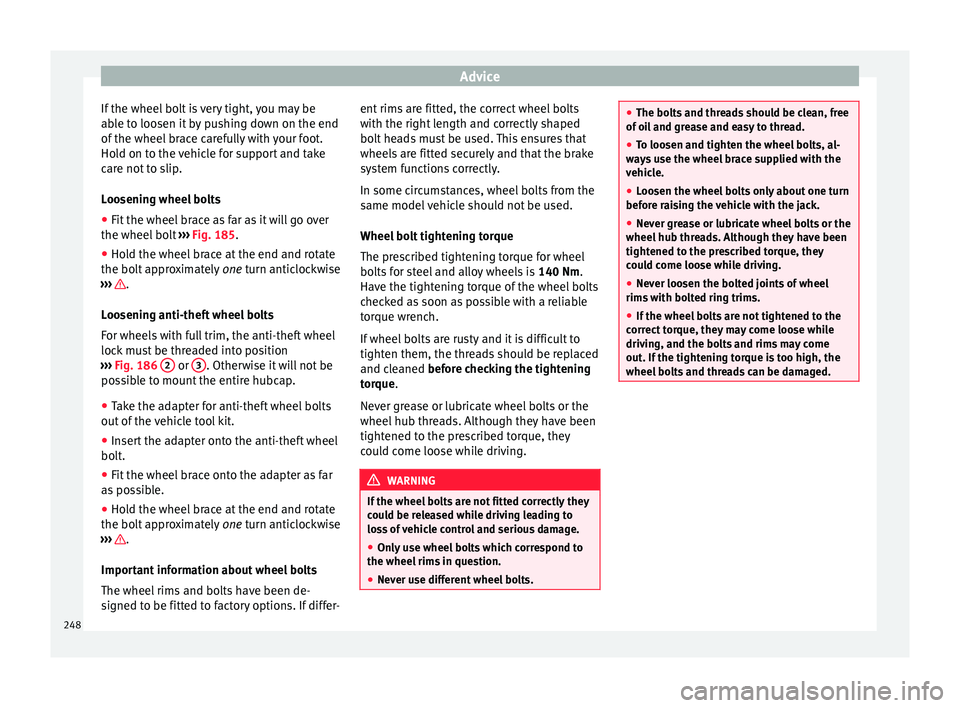
● Fit the wheel brace as far as it will go over
the wheel bolt ››› Fig. 185 .
● Ho l
d the wheel brace at the end and rotate
the bolt approximately one turn anticlockwise
››
› .
Loosening anti-theft wheel bolts
For wheels with full trim, the anti-theft wheel
lock must be threaded into position
››› Fig. 186 2 or
3 . Otherwise it will not be
possible to mount the entire hubcap.
● Take the adapter for anti-theft wheel bolts
out of the vehicle tool kit.
● Insert the adapter onto the anti-theft wheel
bolt.
● Fit the wheel brace onto the adapter as far
as possible.
● Hold the wheel brace at the end and rotate
the bolt approximately one turn anticlockwise
› ›
› .
Important information about wheel bolts
The wheel rims and bolts have been de-
signed to be fitted to factory options. If differ- ent rims are fitted, the correct wheel bolts
with the right length and correctly shaped
bolt heads must be used. This ensures that
wheels are fitted securely and that the brake
system functions correctly.
In some circumstances, wheel bolts from the
same model vehicle should not be used.
Wheel bolt tightening torque
The prescribed tightening torque for wheel
bolts for steel and alloy wheels is
140 Nm.
Hav e the tight
ening torque of the wheel bolts
checked as soon as possible with a reliable
torque wrench.
If wheel bolts are rusty and it is difficult to
tighten them, the threads should be replaced
and cleaned before checking the tightening
tor
que.
Never grease or lubricate wheel bolts or the
wheel hub threads. Although they have been
tightened to the prescribed torque, they
could come loose while driving. WARNING
If the wheel bolts are not fitted correctly they
could be released while driving leading to
loss of vehicle control and serious damage.
● Only use wheel bolts which correspond to
the wheel rims in question.
● Never use different wheel bolts. ●
The bolts and threads should be clean, free
of oil and grease and easy to thread.
● To loosen and tighten the wheel bolts, al-
ways use the wheel brace supplied with the
vehicle.
● Loosen the wheel bolts only about one turn
before raising the vehicle with the jack.
● Never grease or lubricate wheel bolts or the
wheel hub threads. Although they have been
tightened to the prescribed torque, they
could come loose while driving.
● Never loosen the bolted joints of wheel
rims with bolted ring trims.
● If the wheel bolts are not tightened to the
correct torque, they may come loose while
driving, and the bolts and rims may come
out. If the tightening torque is too high, the
wheel bolts and threads can be damaged. 248
Page 252 of 305
Advice
●
Never raise the vehicle if it is tilting to one
side or the engine is running.
● Never start the engine when the vehicle is
raised. The vehicle may come loose from the
jack due to the engine vibrations. Changing a wheel
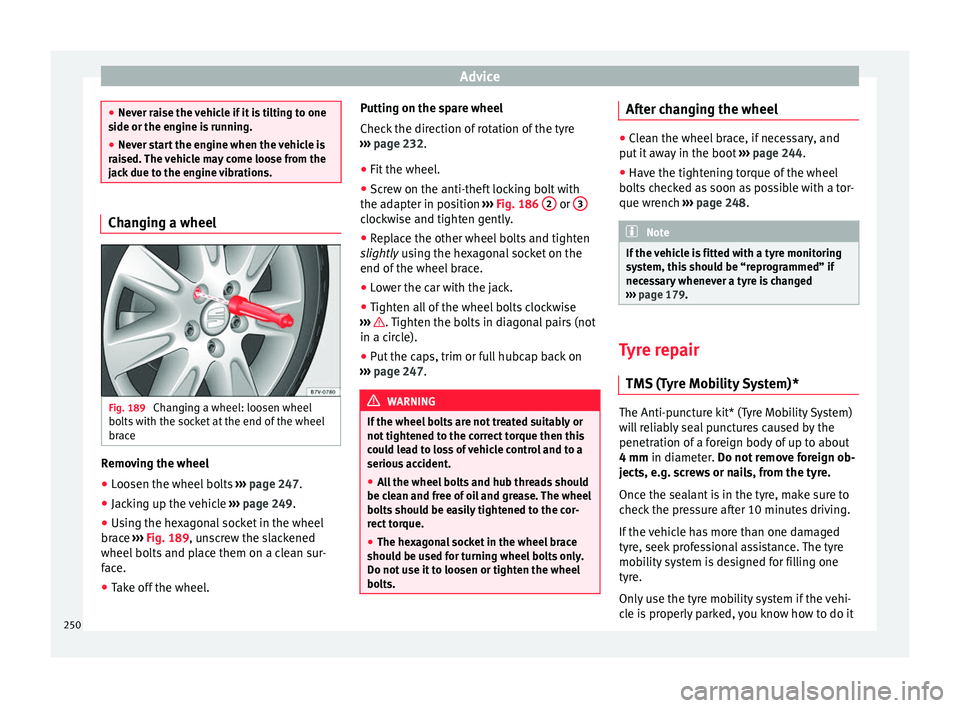
Fig. 189
Changing a wheel: loosen wheel
bolts with the socket at the end of the wheel
brace Removing the wheel
● Loosen the wheel bolts ››› page 247 .
● Jacking up the vehicle ››› page 249.
● Using the hexagonal socket in the wheel
brace ››› Fig. 189 , unscrew the slackened
wheel bo
lts and place them on a clean sur-
face.
● Take off the wheel. Putting on the spare wheel
Check the direction of rotation of the tyre
››› page 232.
● Fit the wheel
.
● Screw on the anti-theft locking bolt with
the adapter in position ››› Fig. 186 2 or
3 clockwise and tighten gently.
●
Replace the other wheel bolts and tighten
slightly using the hexagonal socket on the
end of the wheel
brace.
● Lower the car with the jack.
● Tighten all of the wheel bolts clockwise
››› . Tighten the bolts in diagonal pairs (not
in a circle).
● Put the caps, trim or full hubcap back on
››› page 247 . WARNING
If the wheel bolts are not treated suitably or
not tightened to the correct torque then this
could lead to loss of vehicle control and to a
serious accident.
● All the wheel bolts and hub threads should
be clean and free of oil and grease. The wheel
bolts should be easily tightened to the cor-
rect torque.
● The hexagonal socket in the wheel brace
should be used for turning wheel bolts only.
Do not use it to loosen or tighten the wheel
bolts. After changing the wheel
●
Clean the wheel brace, if necessary, and
put it away in the boot ››› page 244.
● Have the tightening torque of the wheel
bolts checked as soon as possible with a tor-
que wrench ››› page 248. Note
If the vehicle is fitted with a tyre monitoring
system, this should be “reprogrammed” if
necessary whenever a tyre is changed
››› page 179. Tyre repair
TMS (Tyre Mobility System)* The Anti-puncture kit* (Tyre Mobility System)
will reliably seal punctures caused by the
penetration of a foreign body of up to about
4 mm
in diameter.
Do not remove foreign ob-
j
ects, e.g. screws or nails, from the tyre.
Once the sealant is in the tyre, make sure to
check the pressure after 10 minutes driving.
If the vehicle has more than one damaged
tyre, seek professional assistance. The tyre
mobility system is designed for filling one
tyre.
Only use the tyre mobility system if the vehi-
cle is properly parked, you know how to do it
250
Page 254 of 305
Advice
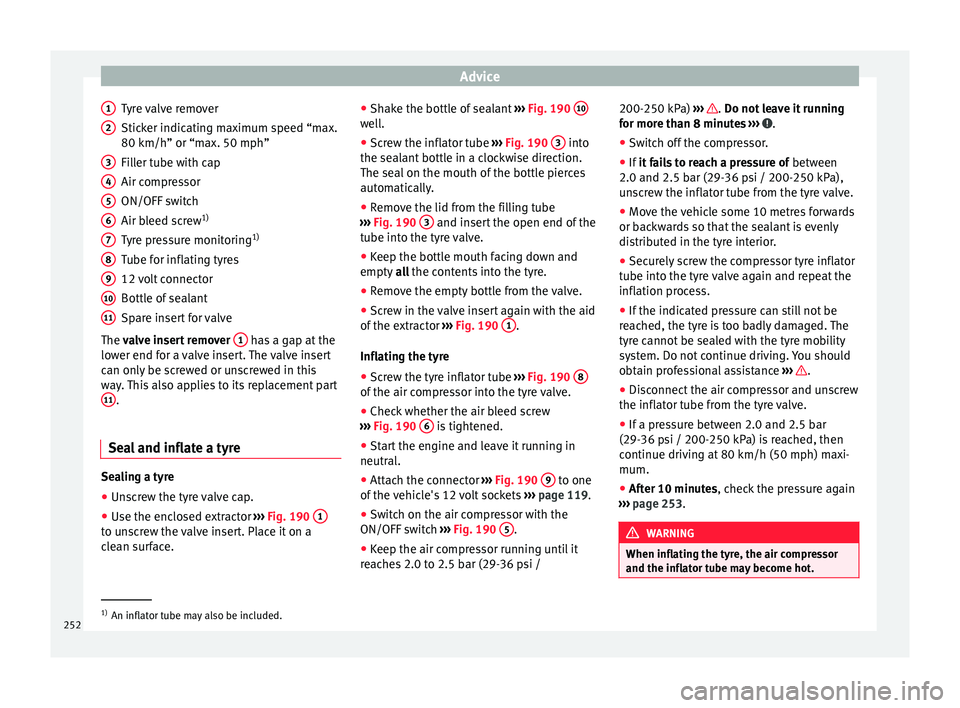
Tyre valve remover
Sticker indicating maximum speed “max.
80 km/h” or “max. 50 mph”
Filler tube with cap
Air compressor
ON/OFF switch
Air bleed screw 1)
Tyre pressure monitoring 1)
Tube for inflating tyres
12 volt connector
Bottle of sealant
Spare insert for valve
The valve insert remover
1 has a gap at the
lower end for a valve insert. The valve insert
can only be screwed or unscrewed in this
way. This also applies to its replacement part 11 .
Seal and inflate a tyre Sealing a tyre
● Unscrew the tyre valve cap.
● Use the enclosed extractor ›››
Fig. 190 1 to unscrew the valve insert. Place it on a
clean surface.1 2
3
4
5
6
7
8
9
10
11 ●
Shake the bottle of sealant ››› Fig. 190 10 well.
●
Screw the inflator tube ››› Fig. 190 3 into
the sealant bottle in a clockwise direction.
The seal on the mouth of the bottle pierces
automatically.
● Remove the lid from the filling tube
››› Fig. 190 3 and insert the open end of the
tube into the tyre valve.
● Keep the bottle mouth facing down and
empty all the contents into the tyre.
● Remo
ve the empty bottle from the valve.
● Screw in the valve insert again with the aid
of the extractor ››› Fig. 190
1 .
Inflating the tyre
● Screw the tyre inflator tube ››› Fig. 190 8 of the air compressor into the tyre valve.
●
Check whether the air bleed screw
››› Fig. 190 6 is tightened.
● Start the engine and leave it running in
neutral.
● Attach the connector ››› Fig. 190 9 to one
of the vehicle's 12 volt sockets ››› page 119.
● Switch on the air compressor with the
ON/OFF switch ››› Fig. 190 5 .
● Keep the air compressor running until it
reaches 2.0 to 2.5 bar (29-36 psi / 200-250 kPa)
››› .
Do not leave it running
f or mor
e than 8 minutes ››› .
● Switch off the compressor.
● If it fails to reach a pressure of between
2.0 and 2.5 bar (29-36 psi / 200-250 kPa),
unscrew the inflator tube from the tyre valve.
● Move the vehicle some 10 metres forwards
or backwards so that the sealant is evenly
distributed in the tyre interior.
● Securely screw the compressor tyre inflator
tube into the tyre valve again and repeat the
inflation process.
● If the indicated pressure can still not be
reached, the tyre is too badly damaged. The
tyre cannot be sealed with the tyre mobility
system. Do not continue driving. You should
obtain professional assistance ››› .
● Disconnect the air compressor and unscrew
the inflator tube from the tyre valve.
● If a pressure between 2.0 and 2.5 bar
(29-36 psi / 200-250 kPa) is reached, then
continue driving at 80 km/h (50 mph) maxi-
mum.
● After 10 minutes , check the pressure again
› ›
› page 253. WARNING
When inflating the tyre, the air compressor
and the inflator tube may become hot. 1)
An inflator tube may also be included.
252
Page 259 of 305
Emergencies
Towing vehicles with an automatic gearbox
Note the following for a towed vehicle:
● Make sure the gear selector lever is in the N
position.
● Do not drive faster than 50 km/h (30 mph).
● Do not tow further than 50 km (30 miles).
● If a breakdown truck is used, the vehicle
must be towed with the front wheels raised.
Note the following instructions for towing
four all-wheel drive vehicles.
Instructions for towing all-wheel drive
vehicles
All-wheel drive vehicles can be towed using a
toolbar or tow rope. If the vehicle is towed
with the front or rear axle raised, the engine
must be turned off to avoid transmission
damage.
For vehicles with a double clutched DSG ®
(di-
rect shift gearbox) the instructions for towing
vehicles with an automatic gearbox apply
››› page 257 .
Sit uation
s in which the vehicle should not be
towed
In the following cases, the vehicle should not
be towed but transported on a trailer or spe-
cial vehicle:
● If the vehicle gearbox does not contain lu-
bricant due to a fault. ●
If the vehicle battery is flat and, as a result,
the electronic steering lock and electronic
parking brake cannot be disengaged if ap-
plied.
● If the vehicle to be towed has an automatic
gearbox and the distance to be covered is
greater than 50 km (30 miles). Note
● The vehicle can only be towed if the elec-
tronic parking brake and steering lock are de-
activated. If the vehicle has no power supply
or there is an electric system fault, the en-
gine must be started using jump leads to de-
activate the electronic parking brake and
electronic steering lock.
● Vehicles with the Keyless Access locking
and ignition system should only be towed
with the ignition connected since, otherwise,
the electronic steering lock will not unlock. Fitting the front towline anchorage
Fig. 194
On the right-hand side of the front
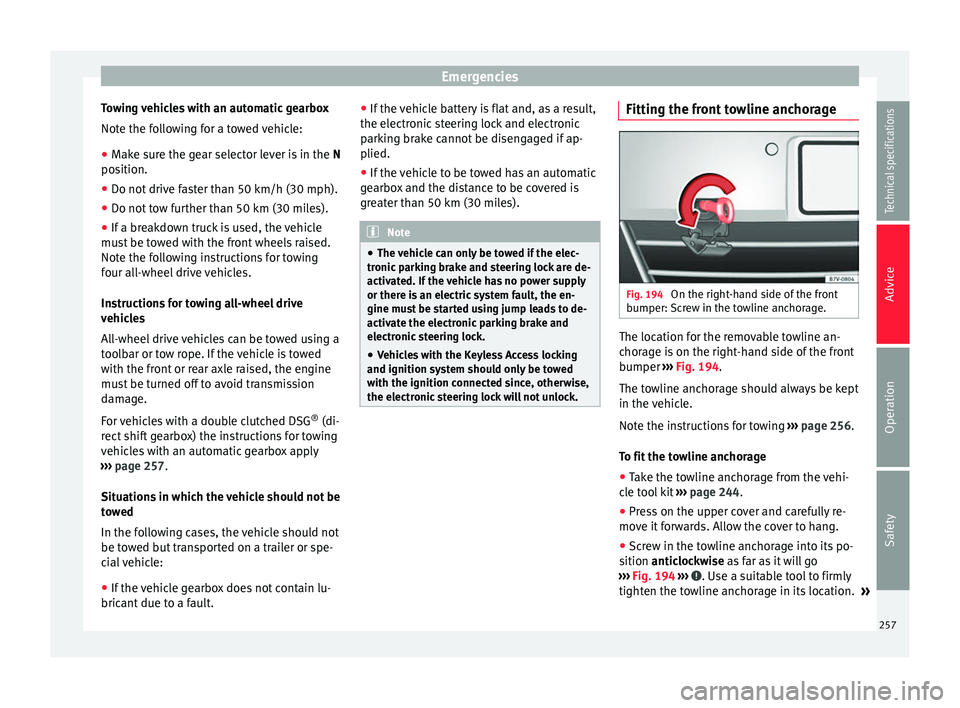
bumper: Screw in the towline anchorage. The location for the removable towline an-
chorage is on the right-hand side of the front
bumper
››› Fig. 194 .
The t o
wline anchorage should always be kept
in the vehicle.
Note the instructions for towing ››› page 256.
To fit the towline anchorage
● Take the towline anchorage from the vehi-
cle tool kit ››› page 244.
● Pre
ss on the upper cover and carefully re-
move it forwards. Allow the cover to hang.
● Screw in the towline anchorage into its po-
sition anticlockwise as far as it will go
›
›› Fig. 194 ››› . Use a suitable tool to firmly
tighten the towline anchorage in its location. »
257
Technical specifications
Advice
Operation
Safety
Page 260 of 305
Advice
● After towing, remove the towline anchorage
by turning it clockwise and put the cover
b ac
k in place. CAUTION
The towline anchorage must always be com-
pletely and firmly tightened. Otherwise, it
could be released while towing and tow-start-
ing. Fitting the rear towline anchorage
Fig. 195
On the rear bumper, to the right
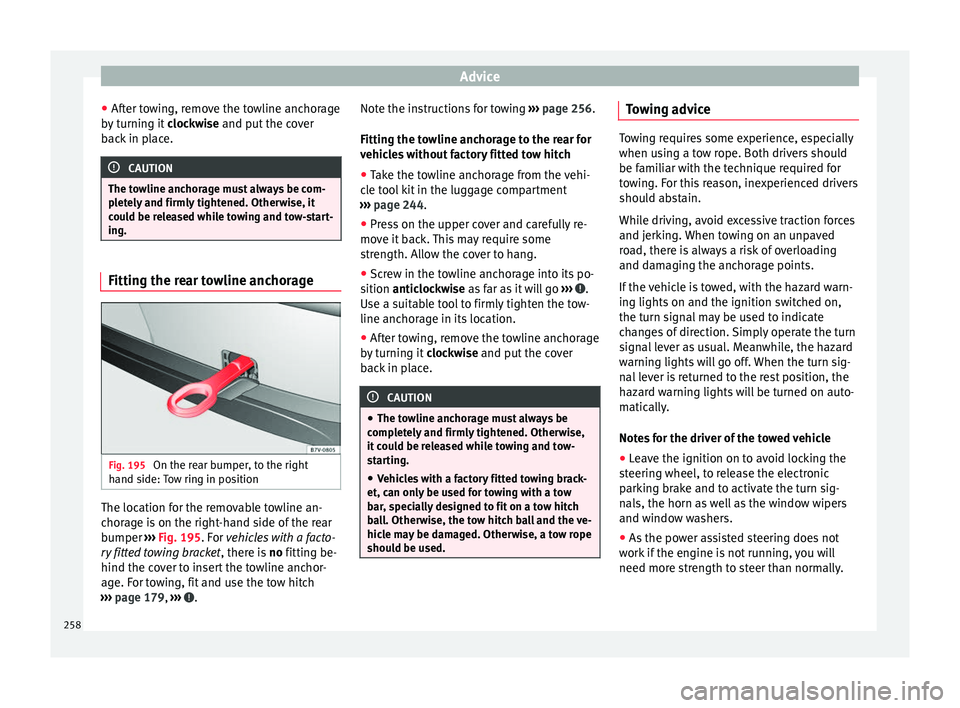
hand side: Tow ring in position The location for the removable towline an-
chorage is on the right-hand side of the rear
bumper
››› Fig. 195 . For
vehicles with a facto-
ry
fitted towing bracket , there is no fitting be-
hind the cover to insert the towline anchor-
age. For towing, fit and use the tow hitch
››› page 179, ››› . Note the instructions for towing
››› page 256.
Fitting the towline anchorage to the rear for
vehicles without factory fitted tow hitch ● Take the towline anchorage from the vehi-
cle tool kit in the luggage compartment
››› page 244 .
● Pr e
ss on the upper cover and carefully re-
move it back. This may require some
strength. Allow the cover to hang.
● Screw in the towline anchorage into its po-
sition anticlockwise as far as it will go ›
›› .
Use a suitable tool to firmly tighten the tow-
line anchorage in its location.
● After towing, remove the towline anchorage
by turning it clockwise and put the cover
b ac
k in place. CAUTION
● The towline anchorage must always be
completely and firmly tightened. Otherwise,
it could be released while towing and tow-
starting.
● Vehicles with a factory fitted towing brack-
et, can only be used for towing with a tow
bar, specially designed to fit on a tow hitch
ball. Otherwise, the tow hitch ball and the ve-
hicle may be damaged. Otherwise, a tow rope
should be used. Towing advice
Towing requires some experience, especially
when using a tow rope. Both drivers should
be familiar with the technique required for
towing. For this reason, inexperienced drivers
should abstain.
While driving, avoid excessive traction forces
and jerking. When towing on an unpaved
road, there is always a risk of overloading
and damaging the anchorage points.
If the vehicle is towed, with the hazard warn-
ing lights on and the ignition switched on,
the turn signal may be used to indicate
changes of direction. Simply operate the turn
signal lever as usual. Meanwhile, the hazard
warning lights will go off. When the turn sig-
nal lever is returned to the rest position, the
hazard warning lights will be turned on auto-
matically.
Notes for the driver of the towed vehicle
●
Leave the ignition on to avoid locking the
steering wheel, to release the electronic
parking brake and to activate the turn sig-
nals, the horn as well as the window wipers
and window washers.
● As the power assisted steering does not
work if the engine is not running, you will
need more strength to steer than normally.
258
Page 292 of 305
Index
Other storage compartments . . . . . . . . . . . . . . 116
Portable waste bin . . . . . . . . . . . . . . . . . . . . . . 116
Rear footwell . . . . . . . . . . . . . . . . . . . . . . . . . . . 115
Roof console . . . . . . . . . . . . . . . . . . . . . . . . . . . 113
Spectacle case . . . . . . . . . . . . . . . . . . . . . . . . . 112
Compass . . . . . . . . . . . . . . . . . . . . . . . . . . . . . . . . . 43
Components . . . . . . . . . . . . . . . . . . . . . . . . . . . . . 189
Connectors Faults . . . . . . . . . . . . . . . . . . . . . . . . . . . . . . . . . 121
Consumption How it is determined . . . . . . . . . . . . . . . . . . . . 211
Information . . . . . . . . . . . . . . . . . . . . . . . . . . . . 211
Control lamp AdBlue . . . . . . . . . . . . . . . . . . . . . . . . . . . . . . . . 212
Airbag system . . . . . . . . . . . . . . . . . . . . . . . . . . . 25
Brake pad wear indication . . . . . . . . . . . . . . . . 138
Brake system . . . . . . . . . . . . . . . . . . . . . . . . . . 138
Catalytic converter . . . . . . . . . . . . . . . . . . . . . . 151
Changing bulbs . . . . . . . . . . . . . . . . . . . . . . . . 267
Changing gear . . . . . . . . . . . . . . . . . . . . . . . . . 143
Checking the engine oil level . . . . . . . . . . . . . 218
Coolant . . . . . . . . . . . . . . . . . . . . . . . . . . . . . . . 222
Cruise control system (CCS) . . . . . . . . . . . . . . . 170
Diesel particulate filter . . . . . . . . . . . . . . . . . . . 151
Engine management . . . . . . . . . . . . . . . . . . . . 151
Engine oil sensor . . . . . . . . . . . . . . . . . . . . . . . 218
ESC . . . . . . . . . . . . . . . . . . . . . . . . . . . . . . . . . . 138
Exhaust gas purification system . . . . . . . . . . . 151
Filling the tank . . . . . . . . . . . . . . . . . . . . . . . . . 208
Fuel level . . . . . . . . . . . . . . . . . . . . . . . . . . . . . . 208
Lane assist system . . . . . . . . . . . . . . . . . . . . . . 172
Pressing the brake . . . . . . . . . . . . . . . . . . . . . . 138
Steering column lock . . . . . . . . . . . . . . . . . . . . 132
Tyre monitoring indicator . . . . . . . . . . . . . . . . . 178
Tyre monitoring systems . . . . . . . . . . . . . . . . . 178
Windscreen wiper fluid level . . . . . . . . . . . . . . . 82 Control lamps
Lights . . . . . . . . . . . . . . . . . . . . . . . . . . . . . . . . . 75
Controlling function Electric exterior mirrors . . . . . . . . . . . . . . . . . . . 87
Control of function Rain sensor . . . . . . . . . . . . . . . . . . . . . . . . . . . . . 84
Control units . . . . . . . . . . . . . . . . . . . . . . . . . . . . . 192 Reprogramming . . . . . . . . . . . . . . . . . . . . . . . . 192
Convenience closing Electric windows . . . . . . . . . . . . . . . . . . . . . . . . . 71
Panoramic sliding sunroof . . . . . . . . . . . . . . . . . 73
Convenience functions Reprogramming . . . . . . . . . . . . . . . . . . . . . . . . 192
Convenience opening Electric windows . . . . . . . . . . . . . . . . . . . . . . . . . 71
Panoramic sliding sunroof . . . . . . . . . . . . . . . . . 73
Convenient entry function for the third row of seats . . . . . . . . . . . . . . . . . . . . . . . . . . . . . . . . . . 95
Coolant Control lamp . . . . . . . . . . . . . . . . . . . . . . . . . . . 222
See engine coolant . . . . . . . . . . . . . . . . . . . . . . 221
Temperature gauge . . . . . . . . . . . . . . . . . . . . . 222
Warning lamp . . . . . . . . . . . . . . . . . . . . . . . . . . 222
Counter steering assistance system . . . . . . . . . . 133
Crossing a river Salt water . . . . . . . . . . . . . . . . . . . . . . . . . . . . . 153
Cruise control . . . . . . . . . . . . . . . . . . . . . . . . . . . . 169
Cruise control system . . . . . . . . . . . . . . . . . . . . . . 169
Cruise control system (CCS) Control lamp . . . . . . . . . . . . . . . . . . . . . . . . . . . 170
Operations . . . . . . . . . . . . . . . . . . . . . . . . . . . . 171
Warning lamp . . . . . . . . . . . . . . . . . . . . . . . . . . 170
Curb weight . . . . . . . . . . . . . . . . . . . . . . . . . . . . . 275
D Damaged tyres . . . . . . . . . . . . . . . . . . . . . . . . . . . 237
Dangers of not using your seat belt . . . . . . . . . . . 13 Dash panel . . . . . . . . . . . . . . . . . . . . . . . . . . . . . . . 39
Airbag system . . . . . . . . . . . . . . . . . . . . . . 20, 204
Data link connector (DLC) . . . . . . . . . . . . . . . . . . 193
Data plate . . . . . . . . . . . . . . . . . . . . . . . . . . . . . . . 274 Model identification . . . . . . . . . . . . . . . . . . . . . 274
Technical specifications . . . . . . . . . . . . . . . . . . 274
Vehicle chassis number . . . . . . . . . . . . . . . . . . 274
Data registry . . . . . . . . . . . . . . . . . . . . . . . . . . . . . 192
Data storage during the journey . . . . . . . . . . . . . 192
Data stored by the control units . . . . . . . . . . . . . 192
Daytime driving light . . . . . . . . . . . . . . . . . . . . . . . 77
De-icing the door lock cylinder . . . . . . . . . . . . . . 199
De-icing the locks . . . . . . . . . . . . . . . . . . . . . . . . . 199
Deadlock . . . . . . . . . . . . . . . . . . . . . . . . . . . . . . . . . 61
Details Driving with a trailer . . . . . . . . . . . . . . . . . . . . . 185
Device disconnection . . . . . . . . . . . . . . . . . . . . . . 230
Diagnostics connection . . . . . . . . . . . . . . . . . . . . 193
Diesel . . . . . . . . . . . . . . . . . . . . . . . . . . . . . . . . . . 210 Auxiliary heater . . . . . . . . . . . . . . . . . . . . . . . . . 211
Biodiesel . . . . . . . . . . . . . . . . . . . . . . . . . . . . . . 211
Filling the tank . . . . . . . . . . . . . . . . . . . . . . . . . 208
Filter pre-heater . . . . . . . . . . . . . . . . . . . . . . . . 211
Fuel gauge . . . . . . . . . . . . . . . . . . . . . . . . . . . . 208
Winter-grade diesel . . . . . . . . . . . . . . . . . . . . . 210
Diesel particulate filter . . . . . . . . . . . . . . . . . . . . 152 Control lamp . . . . . . . . . . . . . . . . . . . . . . . . . . . 151
Malfunction . . . . . . . . . . . . . . . . . . . . . . . . . . . . 152
Recommended gear . . . . . . . . . . . . . . . . . . . . . 147
Things to note . . . . . . . . . . . . . . . . . . . . . . . . . . 211
Differential lock See "Brake assist systems" . . . . . . . . . . . . . . . 155
Digital clock . . . . . . . . . . . . . . . . . . . . . . . . . . . . . . 40
Dimensions . . . . . . . . . . . . . . . . . . . . . . . . . . . . . . 285
Dipped beam headlight . . . . . . . . . . . . . . . . . . . . . 75
Dipstick . . . . . . . . . . . . . . . . . . . . . . . . . . . . . . . . . 219
Display . . . . . . . . . . . . . . . . . . . . . . . . . . . . . . . 40, 41
290