key battery Seat Alhambra 2015 User Guide
[x] Cancel search | Manufacturer: SEAT, Model Year: 2015, Model line: Alhambra, Model: Seat Alhambra 2015Pages: 305, PDF Size: 5.46 MB
Page 138 of 305
Operation
Starting the engine Complete operations only in the sequence
given: Vehicles without
Keyless AccessVehicles with
Keyless Access
1.Press and hold the brake pedal until step 5 is per- formed.
1a.In vehicles with a manual gearbox: press and
hold the clutch down until the engine starts.
2.Put the gearbox lever in neutral or the selector lever in position P or N.
3.
Only in vehicles with
diesel engines: for pre-
heating, turn the key in the ignition lock to po-
sition ››› Fig. 125 1
. A
control lamp lights up
on the dash panel
.
4.
Turn the key in the igni- tion lock to position
››› Fig. 125 2
; do not
press the accelerator.
Press the starter button ››› Fig. 126; do not
press the accelerator. There needs to be a
valid key inside the ve- hicle for the engine to start.
5.Once the engine starts,release the key in the ignition lock.Once the engine starts,release the start-up button.
Vehicles without
Keyless AccessVehicles with
Keyless Access
6.
If the engine does not
start, stop and wait for around 1 minute to try again.If the engine does not
start, stop and wait for around 1 minute to try again. If necessary,
perform an emergency start ››› page 135.
7.Disconnect the electronic parking brake when you
are about to start driving ››› page 137. WARNING
Never leave the vehicle unattended if the en-
gine is running. The vehicle could move off
suddenly, especially if it is in gear, resulting
in an accident and serious injury. WARNING
Cold start sprays could explode or cause a
sudden increase in the engine speed.
● Never use start boosters. CAUTION
● An attempt to start the engine while driving
or starting the engine immediately after turn-
ing it off can cause damage to the engine or
starter motor.
● When the engine is cold, avoid high revs
and heavy acceleration and do not make the
engine work hard. ●
Do not push or tow start the engine. Un-
burnt fuel could damage the catalytic con-
verter. For the sake of the environment
Do not warm the engine at idle speed; start
driving immediately if the visibility is OK.
This helps the engine reach operating tem-
perature faster and reduces emissions. Note
● For example, if the key battery is very worn
or flat, the engine cannot be started with the
starter button. In this case, remove the igni-
tion button from the lock and insert the key.
● Electrical devices with a high power con-
sumption are switched off temporarily when
the engine starts.
● When the engine is started cold, there may
be strong vibrations for a few moments for
technical reasons. This is quite normal, and
no cause for concern.
● At temperatures below +5 °C (+41 °F),
smoke may be given off below the vehicle
when the additional heater is connected. Stopping the engine
Complete operations only in the sequence
given:
136
Page 161 of 305
Driver assistance systems
Conditions requiring the key to restart the
engine
The engine must be started manually under
the following conditions:
● If the driver unbuckles his/her seat belt.
● If the driver door is opened.
● If the bonnet is opened.
● In vehicles with a manual gearbox: if a gear
has been selected.
Switching Start-Stop mode on and off
manually
● Press the button on the centre console
››› Fig. 136 .
● The b utt
on will light up when the Start-Stop
function is switched off.
The engine will start immediately if the vehi-
cle is in Stop mode when it is switched off
manually. WARNING
The brake servo and the power steering do
not work when the engine is switched off.
● Never allow the vehicle to move when the
engine is switched off. CAUTION
Using the Start-Stop function for a long peri-
od at very high outside temperatures could
damage the vehicle's battery. Note
● In some cases, you may have to restart the
vehicle using the key. Observe the corre-
sponding message on the instrument panel
display.
● If the steering wheel is turned more than
270°, Stop will not function; however, the an-
gle of steering wheel turn does not affect
starting the vehicle. Parking sensor system*
Introduction The parking sensor system assists the driver
when parking. When the vehicle approaches
an obstacle, forwards or backwards, an inter-
mittent audible warning will be heard, higher
or lower depending on the distance. The
shorter the distance, the shorter the intervals
between tones. If the vehicle is too close to
the obstacle, the audible warning becomes
constant.
If you continue to approach an obstacle when
the sound is continuous, this means the sys-
tem can no longer measure the distance.
The sensor system on the bumpers transmit
and receive ultrasound. Using the ultrasound
signal (transmission, reflection from the ob-
stacle and reception), this system continu-ously calculates the distance between the
bumper and the obstacle. WARNING
The parking sensor system and the optical
parking system cannot replace driver aware-
ness.
● The sensors have blind spots in which ob-
stacles and people are not registered.
● Always observe the area around the vehi-
cle, as the sensors do not always detect
small children, animals or objects.
● The surface of certain objects and some
clothing do not reflect the ultrasound signals
from the parking distance system. The sys-
tem cannot detect or incorrectly detects
these objects and people wearing these
types of clothes.
● External sound sources can affect the park-
ing distance aid signals. In this case, under
certain circumstances, people and objects
will not be detected. CAUTION
● The sensors may not always be able to de-
tect objects such as trailer draw bars, thin
rails, fences, posts, trees and open boots,
etc. This could result in damage to your car.
● Although the parking sensor system de-
tects and warns of the presence of an obsta-
cle, the obstacle could disappear from the an-
gle of measurement of the sensors if it is too
high or low and the system would no longer » 159
Technical specifications
Advice
Operation
Safety
Page 186 of 305
Operation
If the system detects that a trailer has been
connected electrically, the electrical equip-
ment on the trailer will receive voltage
through this connection (pins 9 and 10). Pin
9 has a permanent live. This powers, for ex-
ample, the trailer's interior lighting. Electrical
devices such as a fridge in a caravan only re-
c eiv
e electrical power if the engine is running
(through pin 10).
The earth wires, pin 3 and pin 13, should not
be connected to each other to avoid over-
loading the electrical system.
If the trailer has a 7-contact connector , you
will need to use an adapter cable. In this case
the function corresponding to pin 10 will not
be available.
Trailer cable
Always secure the trailer cable to the towing
vehicle correctly. Leave a little bit of slack in
the cable for turning. However, ensure that
the cable does not rub off the ground while
driving.
Trailer rear lights
Check the trailer rear lights to ensure they
work correctly and remain legal. Ensure that
the trailer does not use more than the maxi-
mum power ›››
page 181. Tr
ailer connected to the anti-theft alarm:
● When a vehicle comes from the factory fit-
ted with an anti-theft alarm and tow hitch.
● When the trailer is connected to the vehicle
using the socket.
● When the vehicle and trailer electrical sys-
tems work correctly and are not damaged.
● When the vehicle is locked using the vehi-
cle key and the anti-theft alarm is turned on.
When the vehicle is locked, the alarm is trig-
gered when the electrical connection be-
tween the vehicle and the trailer is removed.
Always turn off the anti-theft alarm system
before connecting or disconnecting a trailer.
Otherwise, the tilt sensor may erroneously
activate the alarm.
Trailer with rear LED lights
For technical reasons, trailers fitted with rear
LED lights cannot be connected to the anti-
theft alarm system.
When the vehicle is locked, the alarm does
not trigger if the electrical connection with
the trailer is cut if it has rear light with light-
emitting diodes. WARNING
Erroneous or unsuitable connection of elec-
tric cables may supply energy to the trailer
causing an anomaly in the vehicle electronics that could result in an accident with serious
consequences.
●
All work on the electrical system must be
carried out only by a specialised workshop.
● Never connect the trailer's electric system
to the electrical connections of the rear lights
or any other power sources. CAUTION
Do not leave the trailer connected to the vehi-
cle when parked; places on its support wheel
or its supports. For example, when changing
the load or a puncture, the vehicle will be
pushed up or down. The force acting on the
tow hitch and the trailer could damage the
vehicle or the trailer. Note
● In the event of a fault in the vehicle or trail-
er electrical system or in the event of prob-
lems with the anti-theft alarm system, have
the system checked by a specialised work-
shop.
● If the trailer accessories use energy from
the power socket when the engine is stop-
ped, the battery will be discharged.
● For technical reasons, trailers fitted with
rear LED lights cannot be connected to the
anti-theft alarm system.
● If the vehicle battery is running low, the
electrical connection with the trailer is auto-
matically cut. 184
Page 217 of 305
Checking and refilling levels
carried out by a specialised workshop if you
are uncertain. Negligent work can cause seri-
ous injury. WARNING
If the vehicle moves unexpectedly, this could
cause serious injury.
● Never work under the vehicle if it has not
been immobilized. If you must work under-
neath the vehicle with the wheels in contact
with the ground then it should be parked on
flat ground, the wheels should be prevented
from moving and the key should be removed
from the ignition.
● If you have to work underneath the vehicle,
you must use suitable stands additionally to
support the vehicle, there is a risk of acci-
dent!. The jack is not intended for this kind of
work and its failure could lead to severe inju-
ries. WARNING
The engine compartment is a dangerous area
capable of causing serious injury.
● For all type of work, always take the utmost
precautions, work carefully and note the gen-
eral safety standards in force. Never take per-
sonal risks.
● Never work on the engine or in the engine
compartment if you are not familiar with the
necessary operations. If you are not sure
about procedures then visit a specialised
workshop to carry out the necessary work. Working incorrectly can cause serious inju-
ries.
●
Never open the bonnet if you see steam or
coolant escaping from the engine compart-
ment. This may cause serious burns. Always
wait until you cannot see or hear the sound of
steam or coolant coming from the engine
compartment.
● Always allow the engine to cool down be-
fore opening the bonnet.
● Contact with hot elements of the engine
and the exhaust system can cause burns.
● Once the engine has cooled, follow the in-
structions below before opening the bonnet:
– Turn on the electronic parking brake and
place the gear selector lever in P or the
gearbox lever in neutral.
– Remove the key from the ignition.
– Keep children away from the engine com-
partment and never leave them unsuper-
vised.
● When the engine is warm or hot, the cool-
ing system is pressurised. Do not unscrew
the cap on the expansion tank when the en-
gine is hot. Otherwise, coolant may spray out
under pressure causing burns and serious in-
jury.
– Carefully and slowly unscrew the cap an-
ticlockwise, gently pressing down on it.
– Always protect your face, hands and arms
from hot coolant and steam using a large,
thick cloth. ●
When refilling liquids, avoid spilling them
on parts of the engine and the exhaust sys-
tem. Spilled liquids could cause a fire. WARNING
The high voltages of the electrical system can
give electric shocks as well as causing burns
and serious injury and possibly even death!
● Never cause short circuits in the electrical
system. The battery could explode.
● To minimise the risk of electric shock and
serious consequences while the engine is
running or starting the engine, note the fol-
lowing:
– Never touch the electrical wiring of the
ignition system.
– Never touch electric cables or the gas dis-
charge lamps. WARNING
In the engine compartment, there are rotat-
ing parts that could cause serious injury.
● Never place your hands on or near the radi-
ator fan. Touching the rotor blades could seri-
ously harm you. The ventilator works accord-
ing to the engine temperature and could start
suddenly even when the ignition is turned off
and the key is removed.
● If any work has to be performed when the
engine is started or with the engine running,
there is an additional, potentially fatal, safety » 215Technical specifications
Advice
Operation
Safety
Page 232 of 305
Advice
● The vehicle must be unlocked before dis-
connecting the battery, otherwise the alarm
will be triggered.
● First disconnect the negative cable and
then the positive ››› .
Connecting the vehicle's battery
● Before reconnecting the battery, switch off
the engine and all electrical devices.
● First reconnect the positive cable and then
the negative ››› .
Different control lamps may light up after
connecting the battery and switching the ig-
nition on. They will be turned off after a short
trip at a speed of between 15-20 km/h
(10-12 mph). If the warning indicators remain
lit, please visit a specialised workshop to
have the vehicle checked.
If the battery has been disconnected for a
long time, it is possible that the next service
date is not displayed or calculated correctly
››› page 40 . Respect the maximum service in-
t er
vals permitted ››› Booklet Maintenance
Programme.
Vehic
les with Keyless Access (››› page 59): if,
after connecting the battery, the ignition can-
not be switched on, lock and unlock the vehi-
cle from outside. Then try to switch on the ig-
nition again. If the ignition does not work,
seek professional assistance. Automatic device disconnection
The intelligent vehicle electrical system auto-
matically implements a range of measures to
prevent the battery from discharging when
high demands are made on it:
● the idling speed is increased so that the al-
ternator provides more electricity.
● where necessary, the power of the most
powerful devices is reduced or even com-
pletely disconnected.
● On starting the engine, the power supply
from the 12-volt power sockets and the ciga-
rette lighter may be interrupted for a short
time.
The on-board management program cannot
always prevent the battery from running flat.
For example, if the ignition is left on for a
long period with the engine off or if the side
lights or parking lights are left on while the
vehicle is stationary.
Why does the battery run flat?
● When stationary for a long time without
starting the engine, particularly if the ignition
is switched on.
● Use of electrical devices with the engine
switched off.
● If the auxiliary heater is running
››› page 128
. WARNING
Incorrectly securing the battery or using the
wrong battery can cause short-circuits, fire
and serious injuries.
● Always use only maintenance free batteries
that do not run flat alone and whose proper-
ties, specifications and size correspond to
the standard battery. The specifications are
indicated on the battery case. WARNING
A highly explosive mixture of gases is re-
leased when the battery is under charge.
● The batteries should be charged in a well-
ventilated room only.
● Never charge a frozen or recently thawed
battery. A flat battery can also freeze at tem-
peratures close to 0 °C (+32 °F).
● Always replace a battery which has frozen.
● Battery cables not correctly connected may
cause a short circuit. Reconnect first the posi-
tive cable and then the negative cable. CAUTION
● Never disconnect the battery if the ignition
is switched on or if the engine is running.
This could damage the electrical system or
electronic components.
● Never plug accessories that supply current,
such as solar panels or a battery charger, to
the 12-volt power sockets or the cigarette 230
Page 257 of 305
Emergencies
Starting
7. Start the engine of the vehicle with the boosting battery and let it run at idling
speed.
8. Start the engine of the vehicle with the flat battery and wait 2 or 3 minutes until the
engine is “running”.
Removing the jump leads
9. Before you remove the jump leads, switch off the dipped beam headlights (if they
are switched on).
10. Turn on the heater blower and heated rear
w indo
w in the vehicle with the flat battery.
This helps minimise voltage peaks which
are generated when the leads are discon-
nected.
11.When the engine is running, disconnect the leads in reverse order to the details
given above.
Connect the battery clamps so they have
good metal-to-metal contact with the battery
terminals.
If the engine fails to start, switch off the start-
er after about 10 seconds and try again after
about 1 minute. WARNING
● Please note the safety warnings referring to
working in the engine compartment
››› page 214.
● The b att
ery providing assistance must have
the same voltage as the flat battery (12V) and
approximately the same capacity (see imprint
on battery). Failure to comply could result in
an explosion.
● Never use jump leads when one of the bat-
teries is frozen. Danger of explosion! Even af-
ter the battery has thawed, battery acid could
leak and cause chemical burns. If a battery
freezes, it should be replaced.
● Keep sparks, flames and lighted cigarettes
away from batteries, danger of explosion.
Failure to comply could result in an explo-
sion.
● Observe the instructions provided by the
manufacturer of the jump leads.
● Do not connect the negative cable from the
other vehicle directly to the negative terminal
of the flat battery. The gas emitted from the
battery could be ignited by sparks. Danger of
explosion.
● Do not attach the negative cable from the
other vehicle to parts of the fuel system or to
the brake line.
● The non-insulated parts of the battery
clamps must not be allowed to touch. The
jump lead attached to the positive battery
terminal must not touch metal parts of the ve-
hicle, this can cause a short circuit. ●
Position the leads in such a way that they
cannot come into contact with any moving
parts in the engine compartment.
● Do not lean on the batteries. This could re-
sult in chemical burns. Note
The vehicles must not touch each other, oth-
erwise electricity could flow as soon as the
positive terminals are connected. Towing and tow starting
Introduction When towing, always respect legal require-
ments.
For technical reasons, it is not possible to
tow a vehicle if the battery is flat.
If the vehicle comes with the Keyless Access
system, towing is only allowed with the igni-
tion on!
The vehicle battery drains if the vehicle is
towed with the engine switched off and the
ignition connected. Depending on the battery
charge status, the drop in voltage may be so
large, even after just a few minutes, that no
electrical device in the vehicle may work e.g.
the hazard warning lights. In vehicles with
»
255
Technical specifications
Advice
Operation
Safety
Page 258 of 305
Advice
the Keyless Access system, the steering
wheel could lock ››› .
WARNING
A vehicle with a flat battery should never be
towed.
● Never remove the key from the ignition
lock. Otherwise, the steering wheel lock
could suddenly lock. The vehicle would not
be controlled and a serious accident could
ensue. WARNING
When towing the vehicle, the handling and
braking efficiency change considerably.
Please observe the following instructions to
minimise the risk of serious accidents and in-
jury:
● As the driver of the vehicle being towed:
– The brake must be depressed must hard-
er as the brake servo does not operate.
Always remain aware to avoid collision
with the towing vehicle.
– More strength is required at the steering
wheel as the power steering does not op-
erate when the engine is switched off.
● As the driver of the towing vehicle:
– Accelerate gently and carefully.
– Avoid sudden braking and manoeuvres.
– Brake well in advance than usual and
brake gently. CAUTION
● Carefully fit and remove the towline anchor-
age and its cover to avoid damage to the ve-
hicle (e.g. paintwork).
● When towing, fuel could enter the catalytic
converter and cause damage! Instructions for tow starting
In general, the vehicle should not be started
by towing. Jump-starting is much more pref-
erable
› › ›
page 253.
For technical reasons, the following vehicles
can
not be tow started:
● Vehicles with an automatic gearbox.
● Vehicles with the Keyless Access locking
and ignition system, since the electronic
steering lock may not unlock.
● Vehicles with an electronic parking brake,
given that it is possible that the brake will
not be disengaged.
● If the vehicle battery is flat, it is possible
that the engine control units do not operate
correctly.
However, if your vehicle must absolutely be
tow-started (manual gearbox):
● Put it into second or third gear.
● Keep the clutch pressed down. ●
Switch on the ignition and the hazard warn-
ing lights.
● Release the clutch when both vehicles are
moving.
● As soon as the engine starts, press the
clutch and move the gear lever into neutral.
This helps to prevent a collision with the tow-
ing vehicle. CAUTION
When tow-starting, fuel could enter the cata-
lytic converter and damage it. Towing instructions
Tow rope or tow bar
When towing, the tow bar is the safest and
vehicle friendly way. You should only use a
tow rope if you do not have a tow bar.
A tow rope should be slightly elastic to avoid
damage to both vehicles. It is advisable to
use a tow rope made of synthetic fibre or sim-
ilarly elastic material.
Only secure the tow rope or tow bar to the
towline anchorage or specially designed fit-
ting.
Vehicles with a
factory fitted towing device ,
can only
be used for towing with a tow bar,
s
pecially designed to fit on a tow hitch ball
››› page 179.
256
Page 259 of 305
Emergencies
Towing vehicles with an automatic gearbox
Note the following for a towed vehicle:
● Make sure the gear selector lever is in the N
position.
● Do not drive faster than 50 km/h (30 mph).
● Do not tow further than 50 km (30 miles).
● If a breakdown truck is used, the vehicle
must be towed with the front wheels raised.
Note the following instructions for towing
four all-wheel drive vehicles.
Instructions for towing all-wheel drive
vehicles
All-wheel drive vehicles can be towed using a
toolbar or tow rope. If the vehicle is towed
with the front or rear axle raised, the engine
must be turned off to avoid transmission
damage.
For vehicles with a double clutched DSG ®
(di-
rect shift gearbox) the instructions for towing
vehicles with an automatic gearbox apply
››› page 257 .
Sit uation
s in which the vehicle should not be
towed
In the following cases, the vehicle should not
be towed but transported on a trailer or spe-
cial vehicle:
● If the vehicle gearbox does not contain lu-
bricant due to a fault. ●
If the vehicle battery is flat and, as a result,
the electronic steering lock and electronic
parking brake cannot be disengaged if ap-
plied.
● If the vehicle to be towed has an automatic
gearbox and the distance to be covered is
greater than 50 km (30 miles). Note
● The vehicle can only be towed if the elec-
tronic parking brake and steering lock are de-
activated. If the vehicle has no power supply
or there is an electric system fault, the en-
gine must be started using jump leads to de-
activate the electronic parking brake and
electronic steering lock.
● Vehicles with the Keyless Access locking
and ignition system should only be towed
with the ignition connected since, otherwise,
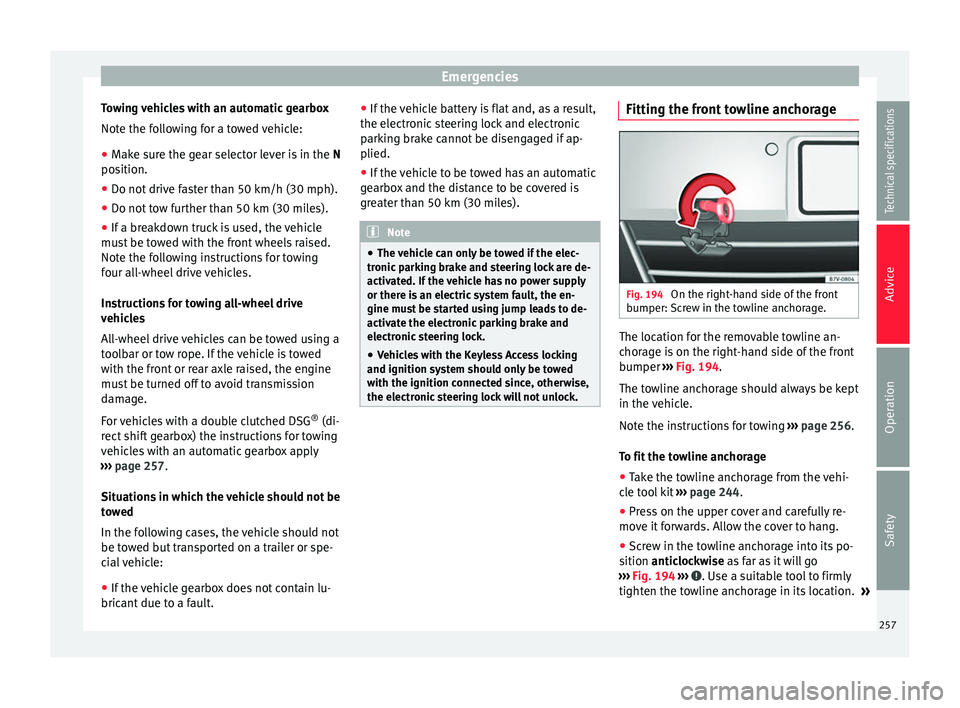
the electronic steering lock will not unlock. Fitting the front towline anchorage
Fig. 194
On the right-hand side of the front
bumper: Screw in the towline anchorage. The location for the removable towline an-
chorage is on the right-hand side of the front
bumper
››› Fig. 194 .
The t o
wline anchorage should always be kept
in the vehicle.
Note the instructions for towing ››› page 256.
To fit the towline anchorage
● Take the towline anchorage from the vehi-
cle tool kit ››› page 244.
● Pre
ss on the upper cover and carefully re-
move it forwards. Allow the cover to hang.
● Screw in the towline anchorage into its po-
sition anticlockwise as far as it will go
›
›› Fig. 194 ››› . Use a suitable tool to firmly
tighten the towline anchorage in its location. »
257
Technical specifications
Advice
Operation
Safety
Page 290 of 305
Index
Assistance systems Cruise control system . . . . . . . . . . . . . . . . . . . . 169
Electronic differential lock system (EDL andXDS) . . . . . . . . . . . . . . . . . . . . . . . . . . . . . . . . 155
Electronic Stability Control (ESC) . . . . . . . . . . . 154
Assist systems Anti-lock brake system (ABS) . . . . . . . . . . . . . . 154
Auto Hold . . . . . . . . . . . . . . . . . . . . . . . . . . . . . 156
Braking assist . . . . . . . . . . . . . . . . . . . . . . . . . . 155
Lane Assist . . . . . . . . . . . . . . . . . . . . . . . . . . . . 172
Lane Assist system . . . . . . . . . . . . . . . . . . . . . . 172
Optical parking system . . . . . . . . . . . . . . . . . . 161
Park Assist . . . . . . . . . . . . . . . . . . . . . . . . . . . . 162
Park Assist system . . . . . . . . . . . . . . . . . . . . . . 162
Parking aid . . . . . . . . . . . . . . . . . . . . . . . . . . . . 160
Parking sensor system . . . . . . . . . . . . . . . . . . . 160
Rear Assist . . . . . . . . . . . . . . . . . . . . . . . . . . . . 166
Rear assist system . . . . . . . . . . . . . . . . . . . . . . 166
Sign Assist . . . . . . . . . . . . . . . . . . . . . . . . . . . . 174
Start-Stop . . . . . . . . . . . . . . . . . . . . . . . . . . . . . 158
Start assist . . . . . . . . . . . . . . . . . . . . . . . . . . . . 156
Traction control system (ASR) . . . . . . . . . . . . . 156
Traction control when accelerating (ASR) . . . . 155
Tyre monitoring indicator . . . . . . . . . . . . . . . . . 179
Auto Hold . . . . . . . . . . . . . . . . . . . . . . . . . . . . . . . 156
Automatic belt retainer . . . . . . . . . . . . . . . . . . . . . 17
Automatic car wash . . . . . . . . . . . . . . . . . . . . . . . 195 Switching Auto Hold off . . . . . . . . . . . . . . . . . . 158
Switching the start assist off . . . . . . . . . . . . . . 158
Automatic device disconnection . . . . . . . . . . . . . 230
Automatic dipped beam control . . . . . . . . . . . . . . 77
Automatic gearbox . . . . . . . . . . . . . . . . . . . . . . . . 143 Changing gear . . . . . . . . . . . . . . . . . . . . . . . . . 144
Driving . . . . . . . . . . . . . . . . . . . . . . . . . . . . . . . . 146
DSG automatic gearbox . . . . . . . . . . . . . . . . . . 146
Ignition key removal lock . . . . . . . . . . . . . . . . . 134
Kickdown system . . . . . . . . . . . . . . . . . . . . . . . 146 Launch-Control programme . . . . . . . . . . . . . . . 146
Malfunction . . . . . . . . . . . . . . . . . . . . . . . 146, 147
Manually unlocking the gear selector lever . . 262
Please also see "Changing gears" . . . . . . . . . 143
See "Automatic gearbox" . . . . . . . . . . . . . . . . . 143
Towing . . . . . . . . . . . . . . . . . . . . . . . . . . . . . . . . 256
AUX-IN connection . . . . . . . . . . . . . . . . . . . . . . . . 112
Auxiliary heater . . . . . . . . . . . . . . . . . . . . . 128, 211 Automatic off . . . . . . . . . . . . . . . . . . . . . . . . . . 208
Operating instructions . . . . . . . . . . . . . . . . . . . 131
Programming . . . . . . . . . . . . . . . . . . . . . . . . . . 130
Remote control . . . . . . . . . . . . . . . . . . . . . . . . . 129
Remote control range . . . . . . . . . . . . . . . . . . . . 129
Remote control: Replacing the battery . . . . . . 129
Switching off . . . . . . . . . . . . . . . . . . . . . . . . . . . 128
Switching on . . . . . . . . . . . . . . . . . . . . . . . . . . . 128
Things to note . . . . . . . . . . . . . . . . . . . . . 128, 131
Auxiliary heater remote control Replacing the battery . . . . . . . . . . . . . . . . . . . . 129
Axle loads . . . . . . . . . . . . . . . . . . . . . . . . . . . . . . . 275
B BAS See "Brake assist systems" . . . . . . . . . . . . . . . 155
Battery Discharge . . . . . . . . . . . . . . . . . . . . . . . . . . . . . 131
Discharging . . . . . . . . . . . . . . . . . . . . . . . . . . . . 244
See Vehicle battery . . . . . . . . . . . . . . . . . . . . . . 227
Battery acid . . . . . . . . . . . . . . . . . . . . . . . . . . . . . . 229
Before starting the vehicle . . . . . . . . . . . . . . . . . . . 5
Belt height adjustment . . . . . . . . . . . . . . . . . . . . . 16
Belt tensioner . . . . . . . . . . . . . . . . . . . . . . . . . . . . . 17 Disposal . . . . . . . . . . . . . . . . . . . . . . . . . . . . . . . 17
Service and disposal . . . . . . . . . . . . . . . . . . . . . 17
Belt tension limiter . . . . . . . . . . . . . . . . . . . . . . . . . 17 Bicycle carrier
Installing a bicycle carrier . . . . . . . . . . . . . . . . 183
Maximum load . . . . . . . . . . . . . . . . . . . . . . . . . 183
Biodiesel . . . . . . . . . . . . . . . . . . . . . . . . . . . . . . . . 211
Bonnet Closing . . . . . . . . . . . . . . . . . . . . . . . . . . . . . . . 216
Opening . . . . . . . . . . . . . . . . . . . . . . . . . . . . . . 216
Bottle holders . . . . . . . . . . . . . . . . . . . . . . . . . . . . 117
Brake . . . . . . . . . . . . . . . . . . . . . . . . . . . . . . . . . . . 137 Brake servo . . . . . . . . . . . . . . . . . . . . . . . . . . . . 142
Electronic parking brake . . . . . . . . . . . . . . . . . 140
Emergency braking function . . . . . . . . . . . . . . 140
Parking brake . . . . . . . . . . . . . . . . . . . . . . . . . . 140
Brake assist systems . . . . . . . . . . . . . . . . . . . . . . 154
Brake assist system (BAS) . . . . . . . . . . . . . . . . . . 155
Brake fluid . . . . . . . . . . . . . . . . . . . . . . . . . . . . . . 225 Specification . . . . . . . . . . . . . . . . . . . . . . . . . . . 225
Brakes Brake assist systems . . . . . . . . . . . . . . . . . . . . 154
Brake fluid . . . . . . . . . . . . . . . . . . . . . . . . . . . . . 225
Brake fluid level . . . . . . . . . . . . . . . . . . . . . . . . 225
Brake pads . . . . . . . . . . . . . . . . . . . . . . . . . . . . 141
Changing the brake fluid . . . . . . . . . . . . . . . . . 226
Control lamp . . . . . . . . . . . . . . . . . . . . . . . . . . . 138
Emergency brake indicator in case of suddenbraking . . . . . . . . . . . . . . . . . . . . . . . . . . . . . 244
Running-in brake pads . . . . . . . . . . . . . . . . . . . 141
Warning lamp . . . . . . . . . . . . . . . . . . . . . . . . . . 138
Brake servo . . . . . . . . . . . . . . . . . . . . . . . . . 142, 154
Brake system Malfunction . . . . . . . . . . . . . . . . . . . . . . . . . . . . 142
Brake systems . . . . . . . . . . . . . . . . . . . . . . . . . . . 154
Braking assist . . . . . . . . . . . . . . . . . . . . . . . . . . . . 155 Brake assist system (BAS) . . . . . . . . . . . . . . . . 155
Breakdown Securing the vehicle . . . . . . . . . . . . . . . . . . . . . 243
Bulb fault See changing bulbs . . . . . . . . . . . . . . . . . . . . . 266
288
Page 291 of 305
Index
C
Card compartments . . . . . . . . . . . . . . . . . . . . . . . 114
Care See "Care of your vehicle" . . . . . . . . . . . . . . . . 195
Vehicle interior . . . . . . . . . . . . . . . . . . . . . . . . . 200
Care of your vehicle Exterior . . . . . . . . . . . . . . . . . . . . . . . . . . . . . . . 195
Caring for paintwork . . . . . . . . . . . . . . . . . . . . . . . 198
Carrier system . . . . . . . . . . . . . . . . . . . . . . . . . . . . 110
Catalytic converter . . . . . . . . . . . . . . . . . . . . . . . . 152 Control lamp . . . . . . . . . . . . . . . . . . . . . . . . . . . 151
Malfunction . . . . . . . . . . . . . . . . . . . . . . . . . . . . 152
CCS . . . . . . . . . . . . . . . . . . . . . . . . . . . . . . . . . . . . 169
CD changer . . . . . . . . . . . . . . . . . . . . . . . . . 112, 117
Central locking . . . . . . . . . . . . . . . . . . . . . . . . . 57, 59 Anti-theft alarm . . . . . . . . . . . . . . . . . . . . . . . . . . 62
Keyless Access . . . . . . . . . . . . . . . . . . . . . . . . . . 59
Locking/unlocking the vehicle . . . . . . . . . . . . . 58
Central locking system After airbag deployment . . . . . . . . . . . . . . . . . . 58
Description . . . . . . . . . . . . . . . . . . . . . . . . . . . . . 57
Opening doors individually . . . . . . . . . . . . . . . . 57
Centre armrest . . . . . . . . . . . . . . . . . . . . . . . . . . . . 97
Changing Windscreen wiper blades . . . . . . . . . . . . . . . . . 263
Changing a wheel . . . . . . . . . . . . . . . . . . . . . . . . 246 Changing a wheel . . . . . . . . . . . . . . . . . . . . . . . 250
Raising the vehicle . . . . . . . . . . . . . . . . . . . . . . 249
Wheel bolts . . . . . . . . . . . . . . . . . . . . . . . . . . . . 247
Changing bulbs . . . . . . . . . . . . . . . . . . . . . . . . . . 266 Bodywork . . . . . . . . . . . . . . . . . . . . . . . . . . . . . 271
Control lamp . . . . . . . . . . . . . . . . . . . . . . . . . . . 267
Front bumper . . . . . . . . . . . . . . . . . . . . . . . . . . 270
Halogen headlights . . . . . . . . . . . . . . . . . . . . . 268
Number plate light . . . . . . . . . . . . . . . . . . . . . . 273
Rear lid . . . . . . . . . . . . . . . . . . . . . . . . . . . . . . . 271 Sea changing bulbs . . . . . . . . . . . . . . . . . . . . . 266
Tail lights . . . . . . . . . . . . . . . . . . . . . . . . . . . . . . 271
Xenon headlights . . . . . . . . . . . . . . . . . . . . . . . 269
Changing gear . . . . . . . . . . . . . . . . . . . . . . . . . . . 143 Automatic gearbox . . . . . . . . . . . . . . . . . . . . . . 144
Engaging gears (manual gearbox) . . . . . . . . . 143
Manual gearbox . . . . . . . . . . . . . . . . . . . . . . . . 143
Manually unlocking the gear selector lever . . 262
Selecting gears (automatic gearbox) . . . . . . . 144
Warning and control lamps . . . . . . . . . . . . . . . 143
Changing gears Gear recommendation . . . . . . . . . . . . . . . . . . . 147
Tiptronic . . . . . . . . . . . . . . . . . . . . . . . . . . . . . . 146
Changing the battery of the vehicle key . . . . . . . . . . . . . . . . . . . . . . . . 56
Changing the wheel After changing the wheel . . . . . . . . . . . . . . . . . 250
Checking Tyre pressures . . . . . . . . . . . . . . . . . . . . . . . . . . 235
Checking the oil level . . . . . . . . . . . . . . . . . . . . . . 219
Child safety . . . . . . . . . . . . . . . . . . . . . . . . . . . . . . . 26
Child safety seat Securing with seat belt . . . . . . . . . . . . . . . . . . . 31
Child seat . . . . . . . . . . . . . . . . . . . . . . . . . . . . . . . . 26 Fix with ISOFIX . . . . . . . . . . . . . . . . . . . . . . . . . . 32
Integrated child seat . . . . . . . . . . . . . . . . . . . . . 33
ISOFIX child seat on rear seats . . . . . . . . . . . . . 30
Mounting child seats . . . . . . . . . . . . . . . . . . . . . 29
Mounting systems . . . . . . . . . . . . . . . . . . . . . . . 29
On rear seats . . . . . . . . . . . . . . . . . . . . . . . . . . . . 30
On the front passenger seat . . . . . . . . . . . . . . . 29
Regulations . . . . . . . . . . . . . . . . . . . . . . . . . . . . . 28
Securing using a Top Tether retaining strap . . . 32
Transporting children in the vehicle . . . . . . . . . 28
Weight categories . . . . . . . . . . . . . . . . . . . . . . . . 28
Child seats Disabling the front passenger front airbag . . . . 25 Cigarette lighter . . . . . . . . . . . . . . . . . . . . . 118, 119
Cleaning
dash panel . . . . . . . . . . . . . . . . . . . . . . . . . . . . 204
Engine compartment . . . . . . . . . . . . . . . . . . . . 200
Seat belts . . . . . . . . . . . . . . . . . . . . . . . . . . . . . 204
See "Care of your vehicle" . . . . . . . . . . . . . . . . 195
wheels . . . . . . . . . . . . . . . . . . . . . . . . . . . . . . . . 199
Windscreen wiper blades . . . . . . . . . . . . . . . . . 263
Cleaning chrome parts . . . . . . . . . . . . . . . . . . . . . 199
Cleaning the vehicle Folding exterior mirrors . . . . . . . . . . . . . . . . . . . 87
Climatronic see "Air conditioner" . . . . . . . . . . . . . . . . . . . . 122
Closing Doors . . . . . . . . . . . . . . . . . . . . . . . . . . . . . . . . . . 63
Electric sliding door . . . . . . . . . . . . . . . . . . . . . . 65
Electric windows . . . . . . . . . . . . . . . . . . . . . . . . . 70
Panoramic sliding sunroof . . . . . . . . . . . . . . . . . 72
Rear lid . . . . . . . . . . . . . . . . . . . . . . . . . . . . . . . . 68
See "Locking" . . . . . . . . . . . . . . . . . . . . . . . . . . . 58
Sliding doors . . . . . . . . . . . . . . . . . . . . . . . . . . . 64
Sun blind . . . . . . . . . . . . . . . . . . . . . . . . . . . . . . . 73
Coat hooks . . . . . . . . . . . . . . . . . . . . . . . . . . . . . . 116
Cockpit . . . . . . . . . . . . . . . . . . . . . . . . . . . . . . . . . . 39
Code number . . . . . . . . . . . . . . . . . . . . . . . . . . . . 245
Collection of end-of-life vehicles . . . . . . . . . . . . . 206
Combined weight rating . . . . . . . . . . . . . . . . . . . 188
Coming Home . . . . . . . . . . . . . . . . . . . . . . . . . . . . . 78
Compartment Glove compartment . . . . . . . . . . . . . . . . . . . . . 114
Compartments Card compartments . . . . . . . . . . . . . . . . . . . . . 114
Centre console . . . . . . . . . . . . . . . . . . . . . . . . . 113
Drawers . . . . . . . . . . . . . . . . . . . . . . . . . . . . . . . 115
Folding table . . . . . . . . . . . . . . . . . . . . . . . . . . . 116
Front central armrest . . . . . . . . . . . . . . . . . . . . 114
Instrument panel . . . . . . . . . . . . . . . . . . . . . . . 113
289