open bonnet Seat Alhambra 2015 User Guide
[x] Cancel search | Manufacturer: SEAT, Model Year: 2015, Model line: Alhambra, Model: Seat Alhambra 2015Pages: 305, PDF Size: 5.46 MB
Page 226 of 305
Advice
Checking the engine coolant level and
refilling Fig. 168
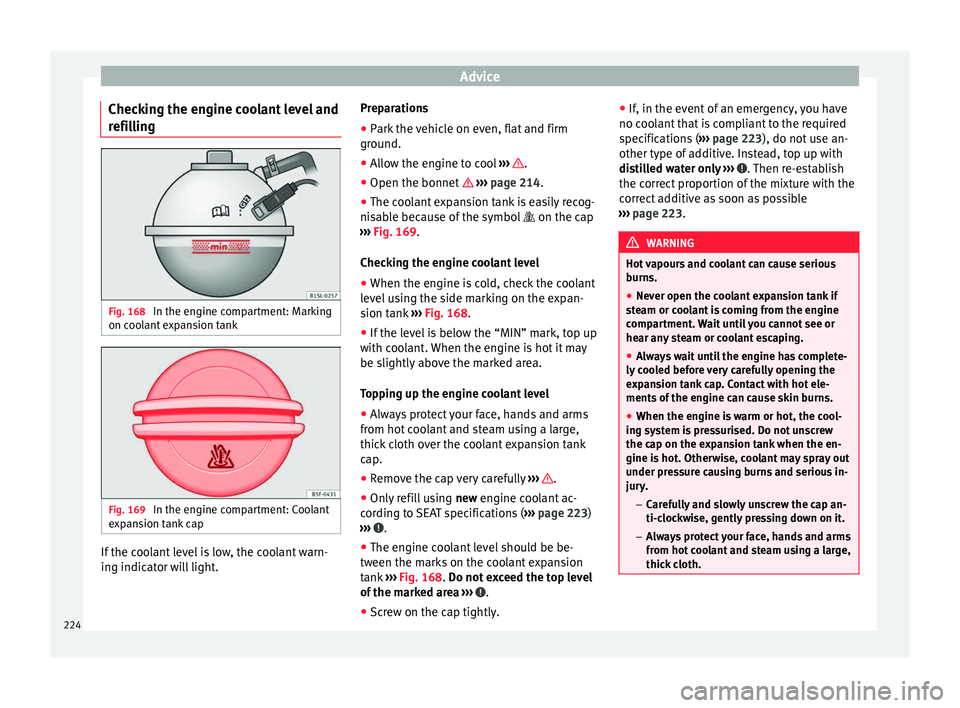
In the engine compartment: Marking
on coolant expansion tank Fig. 169
In the engine compartment: Coolant
expansion tank cap If the coolant level is low, the coolant warn-
ing indicator will light. Preparations
● Park the vehicle on even, flat and firm
ground.
● Allow the engine to cool ››› .
● Open the bonnet ››› page 214.
● The coolant expansion tank is easily recog-
nisable because of the symbol on the cap
› ›
› Fig. 169.
Check
ing the engine coolant level
● When the engine is cold, check the coolant
level using the side marking on the expan-
sion tank ››› Fig. 168.
● If the l
evel is below the “MIN” mark, top up
with coolant. When the engine is hot it may
be slightly above the marked area.
Topping up the engine coolant level
● Always protect your face, hands and arms
from hot coolant and steam using a large,
thick cloth over the coolant expansion tank
cap.
● Remove the cap very carefully ››› .
● Only refill using new engine coolant ac-
c or
ding to SEAT specifications ( ››› page 223)
››› .
● The engine coolant level should be be-
tween the marks on the coolant expansion
tank ››› Fig. 168 .
Do not exceed the top level
of
the marked area ››› .
● Screw on the cap tightly. ●
If, in the event of an emergency, you have
no coolant that is compliant to the required
specifications ( ››› page 223 ), do not use an-
other type of a
dditive. Instead, top up with
distilled water only ››› . Then re-establish
the correct proportion of the mixture with the
correct additive as soon as possible
››› page 223 . WARNING
Hot vapours and coolant can cause serious
burns.
● Never open the coolant expansion tank if
steam or coolant is coming from the engine
compartment. Wait until you cannot see or
hear any steam or coolant escaping.
● Always wait until the engine has complete-
ly cooled before very carefully opening the
expansion tank cap. Contact with hot ele-
ments of the engine can cause skin burns.
● When the engine is warm or hot, the cool-
ing system is pressurised. Do not unscrew
the cap on the expansion tank when the en-
gine is hot. Otherwise, coolant may spray out
under pressure causing burns and serious in-
jury.
– Carefully and slowly unscrew the cap an-
ti-clockwise, gently pressing down on it.
– Always protect your face, hands and arms
from hot coolant and steam using a large,
thick cloth. 224
Page 228 of 305
Advice
It is not always possible to check the level of
the brake fluid, as in some models the en-
gine components make it difficult to see the
brake fluid reservoir. If you cannot read the
exact brake fluid level, consult a specialist.
The brake fluid level drops slightly when the
vehicle is being used due to wear of the
brake pads and the automatic readjustment
of the brake.
Changing the brake fluid
The brake fluid should be changed in accord-
ance with the instructions given in the Main-
tenance Programme. Have the brake fluid
changed by a specialised workshop. SEAT
recommends taking your car in for technical
service. This means that only brake fluid
complying with the required specifications
will be used. WARNING
If the brake fluid level is low or unsuita-
ble/old brake fluid is used, the brake system
may fail or braking power may be reduced.
● Check the brake system and the brake fluid
level regularly!
● The brake fluid should be changed regular-
ly in accordance with the instructions given
in the Maintenance Programme.
● When the brake fluid is used and brakes
are subjected to extreme braking forces, bub-
bles of vapour form in the brake system. These bubbles can significantly reduce brak-
ing power, notably increasing braking dis-
tance, and could result in the total failure of
the brake system.
●
Only used brake fluid that conforms to the
VW 501 14 standard, FMVSS 116 DOT 4
standard or even the DIN ISO 4925 CLASS 4
standard. Other types of brake fluid could af-
fect brake operation and reduce braking pow-
er. Do not use a brake fluid if the container
does not specify compliance with the
VW 501 14, FMVSS 116 DOT 4 or
DIN ISO 4925 CLASS 4 standards.
● The replacement brake fluid must be new.
● Always ensure that you use suitable brake
fluid. Do not use a brake fluid if the container
does not specify compliance with the
VW 501 14, FMVSS 116 DOT 4 or
DIN ISO 4925 CLASS 4 standards. WARNING
Brake fluid is poisonous.
● To reduce the risk of poisoning, do not keep
brake fluid in drinks bottles/containers or
similar. Other people could drink from these
recipients even if the contents are clearly
marked.
● Always keep brake fluid in the original con-
tainer; keep it correctly sealed and out of
reach of children. CAUTION
Brake fluid damages the vehicle paintwork.
Wipe off any brake fluid from the paintwork
immediately. For the sake of the environment
Brake fluid is an environmental pollutant.
Collect any spilt service fluids and allow a
professional to dispose of them. Checking and topping up the
windscreen washer reservoir with
water
Fig. 171
In the engine compartment: wind-
screen washer reservoir top Check the level in the windscreen washer
tank regularly and top up as required.
● Open the bonnet ››› page 214.
226
Page 231 of 305
Checking and refilling levels
Start-Stop systems ( ››› page 158) are equip-
ped with a special battery labelled “AGM”.
For technical reasons, it is not possible to
check the electrolyte level of these batteries
Preparations
● Prepare the vehicle for work in the engine
compartment ››› page 214
● Open the bonnet ››› page 214.
Opening the battery cover
The battery covers are different depending on
the engine size of the vehicle:
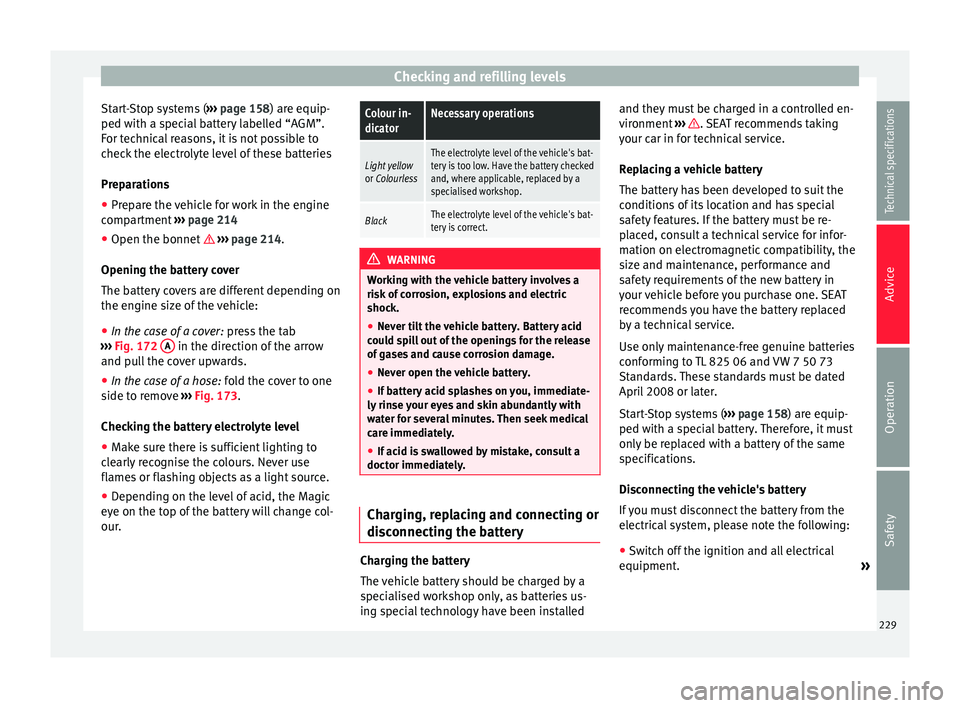
● In the case of a cover: press the tab
››› Fig. 172 A in the direction of the arrow
and pull the cover upwards.
● In the case of a hose: fold the cover to one
side to remove ››› Fig. 173 .
Chec k
ing the battery electrolyte level
● Make sure there is sufficient lighting to
clearly recognise the colours. Never use
flames or flashing objects as a light source.
● Depending on the level of acid, the Magic
eye on the top of the battery will change col-
our.
Colour in-
dicatorNecessary operations
Light yellow
or ColourlessThe electrolyte level of the vehicle's bat-
tery is too low. Have the battery checked
and, where applicable, replaced by a
specialised workshop.
BlackThe electrolyte level of the vehicle's bat-
tery is correct. WARNING
Working with the vehicle battery involves a
risk of corrosion, explosions and electric
shock.
● Never tilt the vehicle battery. Battery acid
could spill out of the openings for the release
of gases and cause corrosion damage.
● Never open the vehicle battery.
● If battery acid splashes on you, immediate-
ly rinse your eyes and skin abundantly with
water for several minutes. Then seek medical
care immediately.
● If acid is swallowed by mistake, consult a
doctor immediately. Charging, replacing and connecting or
disconnecting the battery
Charging the battery
The vehicle battery should be charged by a
specialised workshop only, as batteries us-
ing special technology have been installedand they must be charged in a controlled en-
vironment
››› . SEAT recommends taking
your car in for technical service.
Replacing a vehicle battery
The battery has been developed to suit the
conditions of its location and has special
safety features. If the battery must be re-
placed, consult a technical service for infor-
mation on electromagnetic compatibility, the
size and maintenance, performance and
safety requirements of the new battery in
your vehicle before you purchase one. SEAT
recommends you have the battery replaced
by a technical service.
Use only maintenance-free genuine batteries
conforming to TL 825 06 and VW 7 50 73
Standards. These standards must be dated
April 2008 or later.
Start-Stop systems ( ››› page 158) are equip-
ped with a special battery. Therefore, it must
only be replaced with a battery of the same
specifications.
Disconnecting the vehicle's battery
If you must disconnect the battery from the
electrical system, please note the following:
● Switch off the ignition and all electrical
equipment. »
229Technical specifications
Advice
Operation
Safety
Page 267 of 305
Fuses and bulbs
●
Several components may run on a single
fuse. Vehicle fuses
Fig. 207
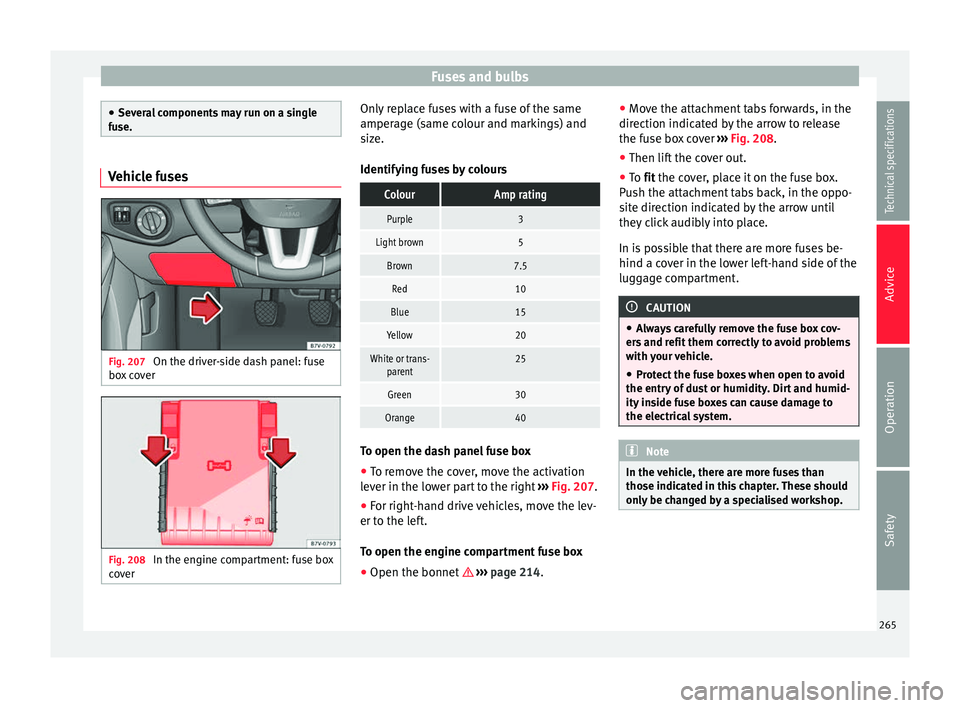
On the driver-side dash panel: fuse
box cover Fig. 208
In the engine compartment: fuse box
cover Only replace fuses with a fuse of the same
amperage (same colour and markings) and
size.
Identifying fuses by coloursColourAmp rating
Purple3
Light brown5
Brown7.5
Red10
Blue15
Yellow20
White or trans-
parent25
Green30
Orange40 To open the dash panel fuse box
●
To remove the cover, move the activation
lever in the lower part to the right ››› Fig. 207.
● For right-hand drive vehicles, move the lev-
er to the left.
To open the engine compartment fuse box
● Open the bonnet ››› page 214. ●
Move the attachment tabs forwards, in the
direction indicated by the arrow to release
the fuse box cover ››› Fig. 208 .
● Then lif t
the cover out.
● To
fit the cover, place it on the fuse box.
Push the attachment tabs back, in the oppo-
site direction indicated by the arrow until
they click audibly into place.
In is possible that there are more fuses be-
hind a cover in the lower left-hand side of the
luggage compartment. CAUTION
● Always carefully remove the fuse box cov-
ers and refit them correctly to avoid problems
with your vehicle.
● Protect the fuse boxes when open to avoid
the entry of dust or humidity. Dirt and humid-
ity inside fuse boxes can cause damage to
the electrical system. Note
In the vehicle, there are more fuses than
those indicated in this chapter. These should
only be changed by a specialised workshop. 265
Technical specifications
Advice
Operation
Safety
Page 270 of 305
Advice
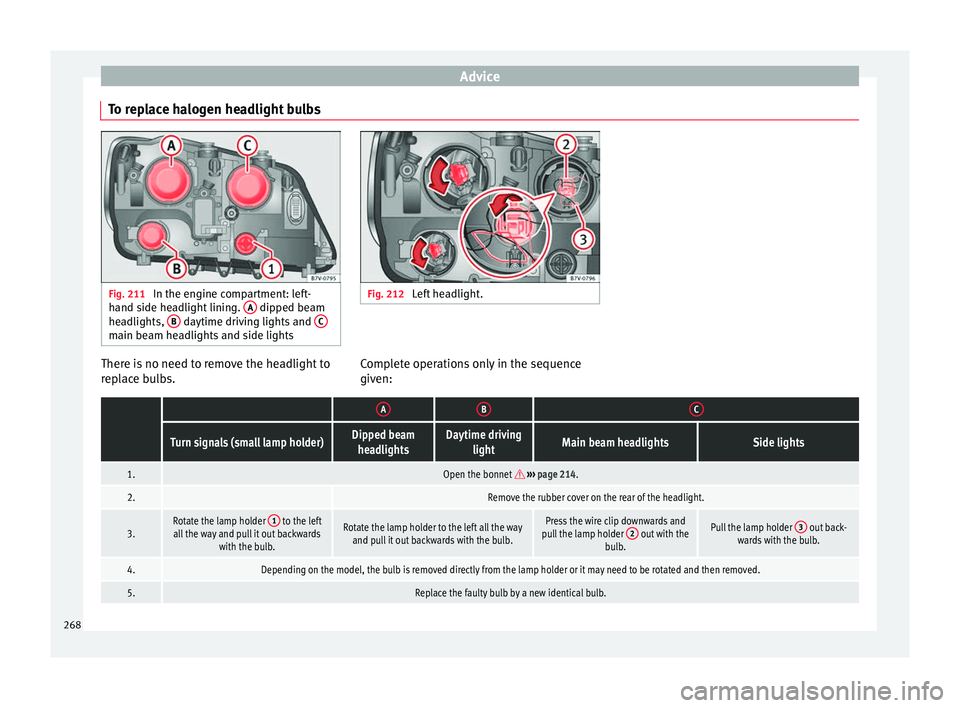
To replace halogen headlight bulbs Fig. 211
In the engine compartment: left-
hand side headlight lining. A dipped beam
headlights, B daytime driving lights and
Cmain beam headlights and side lights Fig. 212
Left headlight. There is no need to remove the headlight to
replace bulbs.
Complete operations only in the sequence
given:
ABC
Turn signals (small lamp holder)Dipped beam
headlightsDaytime driving lightMain beam headlightsSide lights
1.Open the bonnet ››› page 214.
2. Remove the rubber cover on the rear of the headlight.
3.Rotate the lamp holder 1 to the left
all the way and pull it out backwards with the bulb.Rotate the lamp holder to the left all the wayand pull it out backwards with the bulb.Press the wire clip downwards and
pull the lamp holder 2 out with the
bulb.Pull the lamp holder 3 out back-
wards with the bulb.
4.Depending on the model, the bulb is removed directly from the lamp holder or it may need to be rotated and then removed.
5.Replace the faulty bulb by a new identical bulb. 268
Page 271 of 305
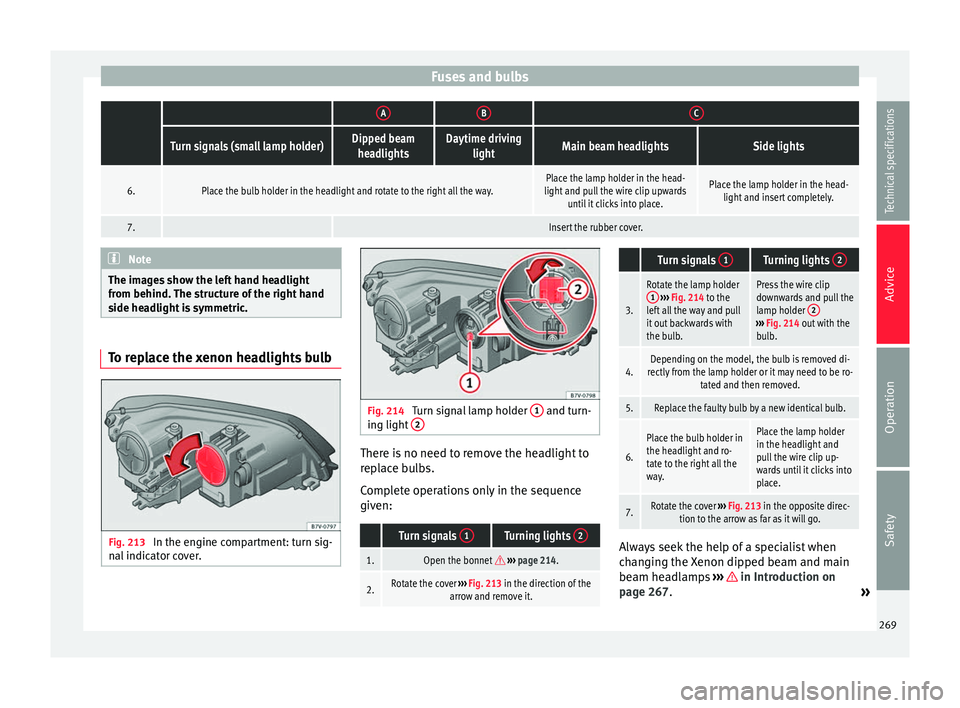
Fuses and bulbs
ABC
Turn signals (small lamp holder)Dipped beam
headlightsDaytime driving lightMain beam headlightsSide lights
6.Place the bulb holder in the headlight and rotate to the right all the way.Place the lamp holder in the head-
light and pull the wire clip upwards until it clicks into place.Place the lamp holder in the head-light and insert completely.
7. Insert the rubber cover. Note
The images show the left hand headlight
from behind. The structure of the right hand
side headlight is symmetric. To replace the xenon headlights bulb
Fig. 213
In the engine compartment: turn sig-
nal indicator cover. Fig. 214
Turn signal lamp holder 1 and turn-
ing light 2 There is no need to remove the headlight to
replace bulbs.
Complete operations only in the sequence
given:
Turn signals
1Turning lights 2
1.Open the bonnet
››› page 214.
2.Rotate the cover ››› Fig. 213 in the direction of the
arrow and remove it.
Turn signals 1Turning lights 2
3.
Rotate the lamp holder
1 ››› Fig. 214 to the
left all the way and pull
it out backwards with
the bulb.Press the wire clip
downwards and pull the
lamp holder 2
›››
Fig. 214 out with the
bulb.
4.Depending on the model, the bulb is removed di-
rectly from the lamp holder or it may need to be ro- tated and then removed.
5.Replace the faulty bulb by a new identical bulb.
6.
Place the bulb holder in
the headlight and ro-
tate to the right all the
way.Place the lamp holder
in the headlight and
pull the wire clip up-
wards until it clicks into
place.
7.Rotate the cover ››› Fig. 213 in the opposite direc-
tion to the arrow as far as it will go. Always seek the help of a specialist when
changing the Xenon dipped beam and main
beam headlamps
››› in Introduction on
page 267. »
269
Technical specifications
Advice
Operation
Safety
Page 290 of 305
Index
Assistance systems Cruise control system . . . . . . . . . . . . . . . . . . . . 169
Electronic differential lock system (EDL andXDS) . . . . . . . . . . . . . . . . . . . . . . . . . . . . . . . . 155
Electronic Stability Control (ESC) . . . . . . . . . . . 154
Assist systems Anti-lock brake system (ABS) . . . . . . . . . . . . . . 154
Auto Hold . . . . . . . . . . . . . . . . . . . . . . . . . . . . . 156
Braking assist . . . . . . . . . . . . . . . . . . . . . . . . . . 155
Lane Assist . . . . . . . . . . . . . . . . . . . . . . . . . . . . 172
Lane Assist system . . . . . . . . . . . . . . . . . . . . . . 172
Optical parking system . . . . . . . . . . . . . . . . . . 161
Park Assist . . . . . . . . . . . . . . . . . . . . . . . . . . . . 162
Park Assist system . . . . . . . . . . . . . . . . . . . . . . 162
Parking aid . . . . . . . . . . . . . . . . . . . . . . . . . . . . 160
Parking sensor system . . . . . . . . . . . . . . . . . . . 160
Rear Assist . . . . . . . . . . . . . . . . . . . . . . . . . . . . 166
Rear assist system . . . . . . . . . . . . . . . . . . . . . . 166
Sign Assist . . . . . . . . . . . . . . . . . . . . . . . . . . . . 174
Start-Stop . . . . . . . . . . . . . . . . . . . . . . . . . . . . . 158
Start assist . . . . . . . . . . . . . . . . . . . . . . . . . . . . 156
Traction control system (ASR) . . . . . . . . . . . . . 156
Traction control when accelerating (ASR) . . . . 155
Tyre monitoring indicator . . . . . . . . . . . . . . . . . 179
Auto Hold . . . . . . . . . . . . . . . . . . . . . . . . . . . . . . . 156
Automatic belt retainer . . . . . . . . . . . . . . . . . . . . . 17
Automatic car wash . . . . . . . . . . . . . . . . . . . . . . . 195 Switching Auto Hold off . . . . . . . . . . . . . . . . . . 158
Switching the start assist off . . . . . . . . . . . . . . 158
Automatic device disconnection . . . . . . . . . . . . . 230
Automatic dipped beam control . . . . . . . . . . . . . . 77
Automatic gearbox . . . . . . . . . . . . . . . . . . . . . . . . 143 Changing gear . . . . . . . . . . . . . . . . . . . . . . . . . 144
Driving . . . . . . . . . . . . . . . . . . . . . . . . . . . . . . . . 146
DSG automatic gearbox . . . . . . . . . . . . . . . . . . 146
Ignition key removal lock . . . . . . . . . . . . . . . . . 134
Kickdown system . . . . . . . . . . . . . . . . . . . . . . . 146 Launch-Control programme . . . . . . . . . . . . . . . 146
Malfunction . . . . . . . . . . . . . . . . . . . . . . . 146, 147
Manually unlocking the gear selector lever . . 262
Please also see "Changing gears" . . . . . . . . . 143
See "Automatic gearbox" . . . . . . . . . . . . . . . . . 143
Towing . . . . . . . . . . . . . . . . . . . . . . . . . . . . . . . . 256
AUX-IN connection . . . . . . . . . . . . . . . . . . . . . . . . 112
Auxiliary heater . . . . . . . . . . . . . . . . . . . . . 128, 211 Automatic off . . . . . . . . . . . . . . . . . . . . . . . . . . 208
Operating instructions . . . . . . . . . . . . . . . . . . . 131
Programming . . . . . . . . . . . . . . . . . . . . . . . . . . 130
Remote control . . . . . . . . . . . . . . . . . . . . . . . . . 129
Remote control range . . . . . . . . . . . . . . . . . . . . 129
Remote control: Replacing the battery . . . . . . 129
Switching off . . . . . . . . . . . . . . . . . . . . . . . . . . . 128
Switching on . . . . . . . . . . . . . . . . . . . . . . . . . . . 128
Things to note . . . . . . . . . . . . . . . . . . . . . 128, 131
Auxiliary heater remote control Replacing the battery . . . . . . . . . . . . . . . . . . . . 129
Axle loads . . . . . . . . . . . . . . . . . . . . . . . . . . . . . . . 275
B BAS See "Brake assist systems" . . . . . . . . . . . . . . . 155
Battery Discharge . . . . . . . . . . . . . . . . . . . . . . . . . . . . . 131
Discharging . . . . . . . . . . . . . . . . . . . . . . . . . . . . 244
See Vehicle battery . . . . . . . . . . . . . . . . . . . . . . 227
Battery acid . . . . . . . . . . . . . . . . . . . . . . . . . . . . . . 229
Before starting the vehicle . . . . . . . . . . . . . . . . . . . 5
Belt height adjustment . . . . . . . . . . . . . . . . . . . . . 16
Belt tensioner . . . . . . . . . . . . . . . . . . . . . . . . . . . . . 17 Disposal . . . . . . . . . . . . . . . . . . . . . . . . . . . . . . . 17
Service and disposal . . . . . . . . . . . . . . . . . . . . . 17
Belt tension limiter . . . . . . . . . . . . . . . . . . . . . . . . . 17 Bicycle carrier
Installing a bicycle carrier . . . . . . . . . . . . . . . . 183
Maximum load . . . . . . . . . . . . . . . . . . . . . . . . . 183
Biodiesel . . . . . . . . . . . . . . . . . . . . . . . . . . . . . . . . 211
Bonnet Closing . . . . . . . . . . . . . . . . . . . . . . . . . . . . . . . 216
Opening . . . . . . . . . . . . . . . . . . . . . . . . . . . . . . 216
Bottle holders . . . . . . . . . . . . . . . . . . . . . . . . . . . . 117
Brake . . . . . . . . . . . . . . . . . . . . . . . . . . . . . . . . . . . 137 Brake servo . . . . . . . . . . . . . . . . . . . . . . . . . . . . 142
Electronic parking brake . . . . . . . . . . . . . . . . . 140
Emergency braking function . . . . . . . . . . . . . . 140
Parking brake . . . . . . . . . . . . . . . . . . . . . . . . . . 140
Brake assist systems . . . . . . . . . . . . . . . . . . . . . . 154
Brake assist system (BAS) . . . . . . . . . . . . . . . . . . 155
Brake fluid . . . . . . . . . . . . . . . . . . . . . . . . . . . . . . 225 Specification . . . . . . . . . . . . . . . . . . . . . . . . . . . 225
Brakes Brake assist systems . . . . . . . . . . . . . . . . . . . . 154
Brake fluid . . . . . . . . . . . . . . . . . . . . . . . . . . . . . 225
Brake fluid level . . . . . . . . . . . . . . . . . . . . . . . . 225
Brake pads . . . . . . . . . . . . . . . . . . . . . . . . . . . . 141
Changing the brake fluid . . . . . . . . . . . . . . . . . 226
Control lamp . . . . . . . . . . . . . . . . . . . . . . . . . . . 138
Emergency brake indicator in case of suddenbraking . . . . . . . . . . . . . . . . . . . . . . . . . . . . . 244
Running-in brake pads . . . . . . . . . . . . . . . . . . . 141
Warning lamp . . . . . . . . . . . . . . . . . . . . . . . . . . 138
Brake servo . . . . . . . . . . . . . . . . . . . . . . . . . 142, 154
Brake system Malfunction . . . . . . . . . . . . . . . . . . . . . . . . . . . . 142
Brake systems . . . . . . . . . . . . . . . . . . . . . . . . . . . 154
Braking assist . . . . . . . . . . . . . . . . . . . . . . . . . . . . 155 Brake assist system (BAS) . . . . . . . . . . . . . . . . 155
Breakdown Securing the vehicle . . . . . . . . . . . . . . . . . . . . . 243
Bulb fault See changing bulbs . . . . . . . . . . . . . . . . . . . . . 266
288