radio Seat Alhambra 2015 User Guide
[x] Cancel search | Manufacturer: SEAT, Model Year: 2015, Model line: Alhambra, Model: Seat Alhambra 2015Pages: 305, PDF Size: 5.46 MB
Page 163 of 305
Driver assistance systems
Note
If the parking sensor system is faulty, a con-
stant audible warning will be emitted the first
time it is switched on and the button will
flash. Switch the parking sensor system off
using the button and take the vehicle to a
specialised workshop to have the system
checked as soon as possible. Optical parking system* (OPS)
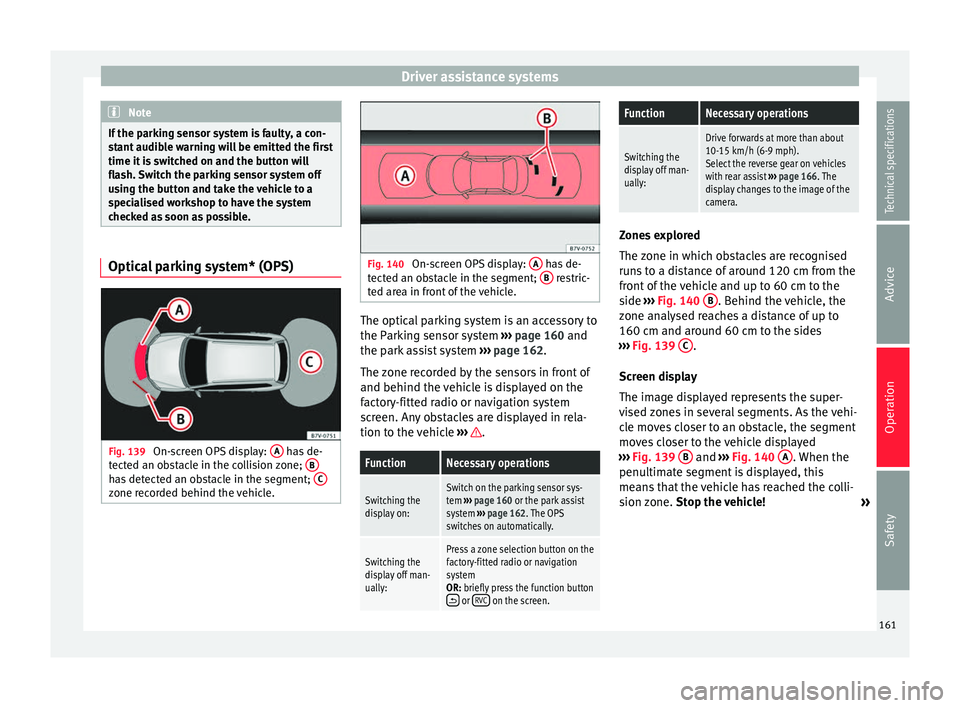
Fig. 139
On-screen OPS display: A has de-
tected an obstacle in the collision zone; Bhas detected an obstacle in the segment;
Czone recorded behind the vehicle. Fig. 140
On-screen OPS display: A has de-
tected an obstacle in the segment; B restric-
ted area in front of the vehicle. The optical parking system is an accessory to
the Parking sensor system
››› page 160 and
the park assist system ››› page 162.
The zone recorded by the sensors in front of
and behind the vehicle is displayed on the
factory-fitted radio or navigation system
screen. Any obstacles are displayed in rela-
tion to the vehicle ››› .FunctionNecessary operations
Switching the
display on:Switch on the parking sensor sys-
tem
››› page 160 or the park assist
system ››› page 162. The OPS
switches on automatically.
Switching the
display off man-
ually:Press a zone selection button on the
factory-fitted radio or navigation
system
OR: briefly press the function button
or RVC on the screen.
FunctionNecessary operations
Switching the
display off man-
ually:
Drive forwards at more than about
10-15 km/h (6-9 mph).
Select the reverse gear on vehicles
with rear assist ››› page 166. The
display changes to the image of the
camera. Zones explored
The zone in which obstacles are recognised
runs to a distance of around 120 cm from the
front of the vehicle and up to 60 cm to the
side
›››
Fig. 140 B . Behind the vehicle, the
zone analysed reaches a distance of up to
160 cm and around 60 cm to the sides
››› Fig. 139 C .
Screen display
The image displayed represents the super-
vised zones in several segments. As the vehi-
cle moves closer to an obstacle, the segment
moves closer to the vehicle displayed
››› Fig. 139 B and
›››
Fig. 140 A . When the
penultimate segment is displayed, this
means that the vehicle has reached the colli-
sion zone. Stop the vehicle!
»
161
Technical specifications
Advice
Operation
Safety
Page 164 of 305
OperationDistance from the
vehicle to the ob-
stacleAudible
warn- ing
Displayed in
colour on the
screen: colour
of the segment if an obstacleis recognised
Front: approx. 31 -
120 cm
Behind: approx. 31 -
160 cmBeeping soundYellow
Approximately 0 –
30 cm in front or be-
hind a)Perma-
nent
soundRed
a) The permanent sound starts at a somewhat greater distance
on vehicles with a factory-fitted towing bracket.
With towing bracket
A specific image is displayed on the screen of
vehicles with a factory-fitted towing bracket
and an electrically connected trailer. In this
case, the distances behind the vehicle are
not indicated.
Switching the parking sensor system sound
on and off
If the button on the radio or navigation
system screen may mute the sound of OPS
warnings. To switch the warnings back on,
press the button again briefly.
When the OPS is switched off and back on
again, muting is cancelled. Error messages
cannot be switched off. WARNING
Do not be distracted from the traffic when
looking at the screen. Park Assist system*
Introduction The Park Assist system helps the driver to
find a suitable place to park, to insert the ve-
hicle into parallel and perpendicular parking
places and to leave parallel parking places.
The Park Assist system is limited to the sys-
tem abilities and requires that the driver is
especially attentive
››› .
The parking sensor system is a component of
the Park Assist system that helps to park the
vehicle.
For vehicles with the optical parking system
(OPS), the radio navigation systems screen
displays the detected zones in front of and
behind the vehicle, indicating - within the
limits of the system - the position of obsta-
cles in relation to the vehicle.
The park assist system cannot be switched
on if the factory-fitted towing bracket is elec-
trically connected to a trailer. WARNING
Despite the assistance provided by the park
assist system, do not run any risks when
parking. The system is not a replacement for
driver awareness.
● Unintentional movements of the vehicle
could cause serious injury.
● Adjust your speed and driving style to visi-
bility, road, traffic and weather conditions.
● The surface of certain objects and items of
clothing and external sound sources may
have a negative affect on the park assist sig-
nals or on the system sensors or may not re-
flect its signals.
● The sensors have blind spots in which ob-
stacles and people are not registered.
● Always observe the area around the vehi-
cle, as the sensors do not always detect
small children, animals or objects. CAUTION
● The park assist system aims exclusively at
other parked vehicles, without taking curbs
or other circumstances into account. Make
sure you do not damage the tyres and wheel
rims when parking. Where necessary, stop
manoeuvring to avoid damaging the vehicle.
● The sensors may not always be able to de-
tect objects such as trailer draw bars, thin
rails, fences, posts and trees, etc. This could
result in damage to your car. 162
Page 168 of 305
Operation
● Press the foot brake ››› !
Following the intervention of the brakes, the
Park Assist will stop. WARNING
Despite the assistance provided by the park
assist system, do not run any risks when
parking. The system is not a replacement for
driver awareness.
● Always be ready to brake.
● Automatic brake intervention will end after
1.5 seconds approximately. Following auto-
matic intervention of the brakes, stop the ve-
hicle yourself. Rear Assist system*
Introduction The camera fitted to the rear lid helps drivers
during parking or reversing manoeuvres. The
camera image and certain orientation points
generated by the system are indicated on the
factory-fitted radio or navigation system
screen.
Two types of location point (modes) can be
selected:
● Mode 1: reverse parking perpendicular to
the road (e.g. in a car park). ●
Mode 2 : reverse parking parallel to the
c urb
.
The mode can be changed by pressing the
button on the radio or navigation system
screen. Only the mode to which the points
can be changed will be displayed. WARNING
Use of the camera to calculate the distance
from obstacles (people, vehicles, etc.) is inac-
curate and may cause accidents and severe
injuries.
● The camera lens expands and distorts the
field of vision and displays the objects on the
screen in a different, vague manner.
● Some objects may not be displayed or may
not be very clear (e.g. very thin posts or fen-
ces), due to the resolution of the monitor or if
the light is dim.
● The camera has blind spots in which obsta-
cles and people are not detected.
● Keep the camera lens clean and clear of
snow and ice. Do not cover it. WARNING
The intelligent technology in the rear assist
system cannot change the limits imposed by
the laws of physics and by the system itself.
Careless or uncontrolled use of the rear assist
system may result in severe injuries and acci-
dents. The system is not a replacement for
driver awareness. ●
Adjust your speed and driving style to visi-
bility, road, traffic and weather conditions.
● Always keep a close eye on the area around
the vehicle and always look towards where
you are parking. The display shows the path
of the rear end of the vehicle using the cur-
rent steering angle. The front of the vehicle
turns more in comparison with the rear.
● Do not be distracted from the traffic when
looking at the screen.
● Always observe the area around the vehi-
cle, as the cameras do not always detect chil-
dren, animals or objects.
● The system might not show all areas clear-
ly.
● Only use the rear assist system when the
boot hatch is completely closed. CAUTION
● The camera only displays 2D images on the
screen. Due to the lack of depth, it might be
difficult or impossible to recognise protrud-
ing objects or cracks in the road.
● The cameras may not always be able to de-
tect objects such as thin rails, fences, posts
and trees, etc. This could result in damage to
your car. 166
Page 169 of 305
Driver assistance systems
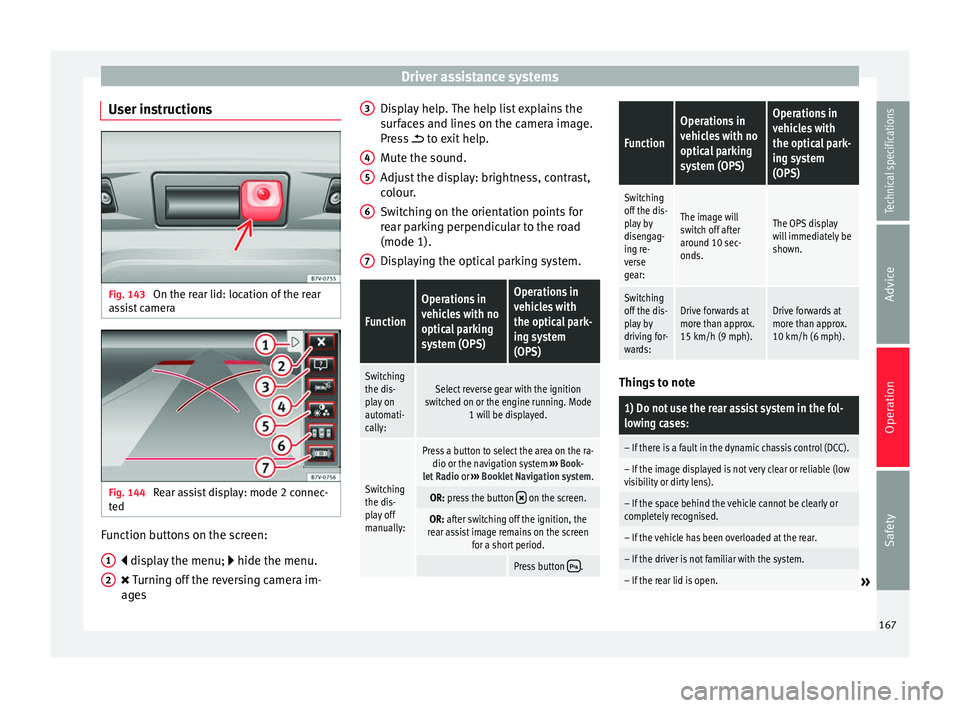
User instructions Fig. 143
On the rear lid: location of the rear
assist camera Fig. 144
Rear assist display: mode 2 connec-
ted Function buttons on the screen:
display the menu;
hide the menu.
Turning off the reversing camera im-
ages
1 2 Display help. The help list explains the
surfaces and lines on the camera image.
Press
to exit help.
M ut
e the sound.
Adjust the display: brightness, contrast,
colour.
Switching on the orientation points for
rear parking perpendicular to the road
(mode 1).
Displaying the optical parking system.
Function
Operations in
vehicles with no
optical parking
system (OPS)Operations in
vehicles with
the optical park-
ing system
(OPS)
Switching
the dis-
play on
automati-
cally:Select reverse gear with the ignition
switched on or the engine running. Mode 1 will be displayed.
Switching
the dis-
play off
manually:
Press a button to select the area on the ra-dio or the navigation system ››› Book-
let Radio or ››› Booklet Navigation system.
OR: press the button on the screen.
OR: after switching off the ignition, the
rear assist image remains on the screen for a short period.
Press button . 3
4
5
6
7
Function
Operations in
vehicles with no
optical parking
system (OPS)Operations in
vehicles with
the optical park-
ing system
(OPS)
Switching
off the dis-
play by
disengag-
ing re-
verse
gear:
The image will
switch off after
around 10 sec-
onds.The OPS display
will immediately be
shown.
Switching
off the dis-
play by
driving for-
wards:Drive forwards at
more than approx.
15 km/h (9 mph).Drive forwards at
more than approx.
10 km/h (6 mph).
Things to note
1) Do not use the rear assist system in the fol-
lowing cases:
– If there is a fault in the dynamic chassis control (DCC).
– If the image displayed is not very clear or reliable (low
visibility or dirty lens).
– If the space behind the vehicle cannot be clearly or
completely recognised.
– If the vehicle has been overloaded at the rear.
– If the driver is not familiar with the system.
– If the rear lid is open.»
167
Technical specifications
Advice
Operation
Safety
Page 193 of 305
Care and maintenance
●
All repairs and modifications to the vehicle
should only be performed by a specialised
workshop. Repair and faults in the airbag system
When performing repairs and technical mod-
ifications, SEAT's directives must be ob-
served!
››› Modifications and repairs to the front bump-
er, doors, front seats, and repairs to the roof
or chassis should only be carried out in a
specialised workshop. These components
may contain parts or sensors belonging to
the airbag system.
If work is carried out on the airbag system or
parts have to be removed and fitted on the
system when performing other repair work,
parts of the airbag system may be damaged.
The consequence may be that, in the event of
an accident, the airbag inflates incorrectly or
does not inflate at all.
So that the effectiveness of the airbag is not
reduced and that removed parts do not cause
any injuries or environmental pollution, regu-
lations must be observed. These require-
ments are known to specialised workshops.
Modifications to the vehicle suspension may
affect the operation of the airbag system in
the event of collision. For example, if wheel
and tyre combinations not approved by SEAT are used, or if the vehicle height is lowered,
the suspension is stiffened or the suspension
springs, telescopic arms, dampers, etc., are
modified, the results received by the airbag
sensors and sent to the control unit may not
be accurate. For example, some modifica-
tions to the suspension could increase the
force measured by the sensors and result in
the triggering of the airbag systems in colli-
sions. Under normal conditions, the meas-
ured values would be lower and the airbag
would not have been triggered. Other modifi-
cations may reduce the forces measured by
the sensors and prevent the airbags from be-
ing triggered when they should.
WARNING
Repairs or modifications which are not per-
formed correctly may result in damage or er-
rors in the vehicle operation, affecting the ef-
fectiveness of the airbag systems. This could
result in serious or fatal accidents.
● All repairs and modifications to the vehicle
should only be performed by a specialised
workshop.
● Airbag modules must never be repaired: if
damaged, they must be replaced.
● Never fit recycled or reused airbag compo-
nents in your vehicle. WARNING
Modifications to the vehicle suspension, in-
cluding the use of unauthorised wheel and tyre combinations, may affect the perform-
ance of the airbags and increase the risk of
serious or fatal injury in the event of acci-
dent.
●
Never fit suspension components which are
not identical to the original parts in the vehi-
cle.
● Never use wheel and tyre combinations not
approved by SEAT. Retro-fitting of two-way radios
An exterior aerial is required for the use of
two-way radios in the vehicle.
The retro-fitting of electrical or electronic ap-
pliances in the vehicle is subject to their ap-
proval for use in your vehicle. Under certain
circumstances, this could mean that your ve-
hicle registration documents are no longer
valid.
SEAT has approved your vehicle for use with
two-way radios providing the following condi-
tions are observed:
● The exterior aerial must be mounted pro-
fessionally.
● The maximum transmitting power is 10
watts.
The optimal reach of the equipment is only
achieved with an external aerial. »
191Technical specifications
Advice
Operation
Safety
Page 194 of 305
Advice
Check first with a specialised workshop that
understands the technical possibilities of in-
stallation if you wish to use a two-way radio
with a transmitting power of over 10 watts.
SEAT recommends taking your car in for tech-
nical service.
All legal requirements, together with the in-
structions for the use of two-way radios must
be observed. WARNING
If the two-way radio is not securely fastened
in position, it could be sent flying around the
vehicle in the event of sharp braking, sudden
manoeuvres or accident, causing injury.
● While driving, two-way radios must be se-
curely fastened in position, outside the radi-
us of action of the airbags, or safely stowed
away. WARNING
When using a two-way radio without a con-
nection to an exterior aerial, the maximum
permitted levels of electromagnetic radiation
may be exceeded. This is also the case if the
aerial has not been correctly installed.
● You should only use a two-way radio inside
the vehicle if it has first been correctly con-
nected to an exterior aerial. Information stored by the control
units
Your vehicle is fitted at the factory with a ser-
ies of electronic control units responsible for
the engine and gearbox management. In ad-
dition, the control units supervise the per-
formance of the exhaust gas system and the
airbag systems.
Therefore, while the vehicle is being driven,
these electronic control units are continuous-
ly analysing the vehicle data. In the event of
faults or deviations from the theoretical val-
ues, only this data is stored. Normally, the
warning lamps on the instrument panel light
up in the event of faults.
This data can only be read and analysed us-
ing special equipment.
The storing of the data allows specialised
workshops to detect and repair faults. Stored
data may include:
● Data relating to the engine or the gearbox
● Speed
● Direction of travel
● Braking force
● Detection of seat belt
The vehicle control units never record conver-
sations held by passengers in the vehicle.
In vehicles equipped with an emergency call
function via the mobile phone or other appli- ances connected in the vehicle, it is possible
to send the vehicle position. If the control
unit records an accident with airbag activa-
tion, the system may automatically send a
signal. This will depend on the network oper-
ator. Normally, transmission is only possible
in areas with good coverage.
Event Data Recorder
The vehicle is
not
fitted with an event data re-
c or
der.
An event data recorder temporarily stores the
vehicle information. Therefore, in the event of
an accident, it is possible to obtain detailed
information about how the accident occur-
red. For example, in vehicles with airbag sys-
tems, data relating to speed of impact, seat
belt status, seat positions and airbag activa-
tion times may be stored. The volume of data
depends on the manufacturer.
Event data recorders can only be mounted
with authorisation from the vehicle owner
and, in some countries, they are governed by
local legislation.
Reprogramming control units
On the whole, all the data required for the
component management is stored in the con-
trol units. The programming of certain con-
venience functions, such as the turn signals,
individual door opening and instructions on
the display can be modified using special
192
Page 195 of 305
Care and maintenance
equipment at the workshop. If this is the
case, the information and descriptions given
in the Instruction Manual will not match the
original functions. Therefore, SEAT recom-
mends that any modifications be recorded in
the section “Other workshop notes” in the
Maintenance Programme.
The technical service centre must have a re-
cord of any modification to the programming.
Reading the vehicle fault memory
There is a diagnostics connector in the vehi-
cle interior for reading the vehicle fault mem-
ory. The fault memory documents errors and
deviations from the theoretical values of the
electronic control units.
The diagnostics connector is in the driver
side footwell area, next to the lever for open-
ing the bonnet, below a cover.
The fault memory should only be read and re-
set by a specialised workshop.
Using a mobile telephone in a vehicle
without connection to an exterior
aerial Mobile telephones transmit and receive radio
waves, both when in use and when on stand-
by. Scientific studies state that radio waves
exceeding certain values may be harmful to
the human body. International committees and authorities have established limits and
directives in order to ensure electromagnetic
radiation from mobile phones remains within
certain limits that do not endanger health.
Nevertheless, there is no conclusive scientif-
ic evidence that wireless telephones are to-
tally safe.
Therefore, some experts recommend that use
of mobile phone be kept to a minimum until
the results of current research are published.
When a mobile phone not connected to an
exterior aerial is used inside the vehicle, the
electromagnetic radiation may be greater
than if the mobile phone were connected to a
built-in aerial or to another exterior aerial.
If the vehicle is fitted with a suitable hands-
free device, it will comply with the legislation
in many countries which only permits the use
of mobile phones inside vehicles using a
hands-free device.
The hands-free system mounted at the facto-
ry has been designed for use with conven-
tional mobile phones and phones with Blue-
tooth technology. Mobile phones should be
placed on a suitable phone cradle. In addi-
tion, the cradle should always be correctly fit-
ted into the base plate. This ensures that the
mobile phone is securely attached to the
dash panel, it is always within reach of the
driver and is connected to the vehicle exterior
aerial.
If the mobile phone is connected to an aerial
incorporated into the vehicle or an exterior
aerial connected to the vehicle, it will help re-
duce the electromagnetic radiation transmit-
ted and the risk to human health. It will also
improve the quality of the connection.
If the phone is used inside the vehicle with-
out the hands-free system, it will not be se-
curely fastened and will not be connected to
the exterior aerial of the vehicle telephone.
Nor will the telephone charge if it is not on
the support. In addition, some calls may
break off and the quality of the connection
will be affected.
Mobile phones should only be used inside
the vehicle if they are connected to a hands-
free system with an exterior aerial.
WARNING
If the mobile phone is not securely fastened
in position, it could be sent flying around the
vehicle in the event of sharp braking, sudden
manoeuvres or accident, causing injury.
● While driving, mobile phones must be se-
curely fastened in position, outside the radi-
us of action of the airbags, or safely stowed
away. WARNING
When using a mobile phone without a con-
nection to an exterior aerial, the maximum
permitted levels of electromagnetic radiation » 193Technical specifications
Advice
Operation
Safety
Page 207 of 305
Care and maintenance
Notes for the user Labels and plates Some parts in the engine compartment come
from the factory with certificates of safety, la-
bels or plates containing important informa-
tion regarding the operation of the vehicle,
for example, on the petrol cap, on the pas-
senger's sun visor, on the driver door strut, or
on the floor of the boot.
● Never remove these certificates of safety,
labels or plates, and ensure they are kept in
good condition and are legible.
● If a vehicle part, bearing a certificate of
safety, label or plate, is replaced, the special-
ised workshop should attach the information
back in the same place.
Certificate of safety
A certificate of safety on the door strut states
that all the safety standards and regulations
established by the national traffic authorities
responsible for road safety were met at the
time of manufacture. It may also give the
month and year of manufacture, together
with the chassis number.
Warning of high voltage label*
There is a label close to the bonnet lock
which warns of high voltage in the vehicle's
electrical system. The vehicle ignition system complies with several standards, including
the Canadian standard, ICES-002.
Using your vehicle in other countries
and continents The vehicle is manufactured at the factory for
use in a particular country in accordance with
the national legislation in force at the time of
manufacture.
If the vehicle is sold in another country or
used in another country for an extended peri-
od of time, the applicable legislation of that
country should be observed.
It may be necessary to fit or remove certain
pieces of equipment or to deactivate certain
functions. Service work may also be affected.
This is particularly true if the vehicle is used
in a different climate for an extended period
of time.
As there are different types of frequency
bands around the world, you may find that
the radio or navigation system supplied at
the factory does not work in another country.
CAUTION
● SEAT does not accept liability for any dam-
age to the vehicle due to the use of a lower
quality fuel, an inadequate service or the
non-availability of genuine spare parts. ●
SEAT does not accept liability if the vehicle
does not comply in part or in full with the le-
gal requirements of other countries or conti-
nents. Radio reception and the aerial
The aerial of radio and navigation systems
fitted at the factory may be mounted in differ-
ent parts of the vehicle:
● On the inside of the rear window, next to
the rear window heating,
● on the inside of the rear side windows,
● on the inside of the windscreen,
● on the roof of the vehicle.
Aerials mounted on the inside of a window
can be recognised by the fine wires. CAUTION
Aerials on the inside of windows may be dam-
aged if knocked or if cleaned with corrosive or
acid cleaning products. Do not stick adhesive
labels over the heating elements and never
clean the inside of the rear window with cor-
rosive or acid products or other similar chem-
ical cleaning products. » 205Technical specifications
Advice
Operation
Safety
Page 208 of 305
Advice
Note
If electrical equipment is used near an aerial
built-into the window, you may observe inter-
ference in the reception of AM stations. Notes on SEAT repairs
WARNING
Repairs or modifications which are not per-
formed correctly may result in damage or er-
rors in the vehicle operation, affecting the ef-
fectiveness of the driver assist and airbag
systems. This could result in serious acci-
dent.
● Have any repairs or modifications carried
out at a specialised workshop. Collection and scrapping of end-of-life
vehicles
Collection of end-of-life vehicles
An extensive network of used car reception
centres already exists in much of Europe. Af-
ter the vehicle has been delivered, you will
receive a certificate of destruction describing
the environmentally friendly scrapping of the
vehicle in accordance with applicable legisla-
tion. We will collect the used vehicle free of
charge, provided it complies with all national
legislation.
Please see your technical service for further
information about the collection and scrap-
ping of end-of-life vehicles.
Scrapping
The relevant safety requirements must be ob-
served when the vehicle or components of
the airbag or belt tensioner systems are
scrapped. These requirements are known to
specialised workshops. Checking and refilling levels
Filling the tank Introduction The fuel tank flap is on the rear right of the
vehicle.
WARNING
Refuelling or handling fuel carelessly can
cause an explosion or fire resulting in serious
burns and injuries.
● Always make sure that you correctly close
the fuel cap to avoid evaporation and fuel
spillage.
● Fuels are highly explosive and inflammable
substances that can cause serious burns and
injuries.
● Fuel could leak out or be spilt if the engine
is not switched off or if the filler fuel nozzle is
not fully inserted into the tank filler neck
when refuelling. This could lead to a fire, ex-
plosion and severe injuries.
● When refuelling, turn off the engine, the
auxiliary heating ( ››› page 128) and turn off
the ignition f or s
afety reasons.
● Always turn off mobile telephones, radio
apparatus and other radio wave emitting
equipment before refuelling. Electromagnetic
waves could cause sparks and lead to a fire. 206
Page 297 of 305
Index
See "Unlocking" . . . . . . . . . . . . . . . . . . . . . . . . . 58
Sliding doors . . . . . . . . . . . . . . . . . . . . . . . . . . . 64
Sun blind . . . . . . . . . . . . . . . . . . . . . . . . . . . . . . . 73
vehicle, with Keyless Access . . . . . . . . . . . . . . . 59
Opening doors individually . . . . . . . . . . . . . . . . . . 57
Operating fault Immobiliser . . . . . . . . . . . . . . . . . . . . . . . . . . . . 133
Operating faults Radio reception . . . . . . . . . . . . . . . . . . . . . . . . 206
Optical parking system . . . . . . . . . . . . . . . . . . . . 161
Outside temperature . . . . . . . . . . . . . . . . . . . . . . . 42
Overview dash panel . . . . . . . . . . . . . . . . . . . . . . . . . . . . . 39
P Panoramic sliding sunroof . . . . . . . . . . . . . . . . . . . 72 Anti-trap function . . . . . . . . . . . . . . . . . . . . . . . . 74
Closing . . . . . . . . . . . . . . . . . . . . . . . . . . . . . . . . 72
Convenience closing . . . . . . . . . . . . . . . . . . . . . 73
Convenience opening . . . . . . . . . . . . . . . . . . . . . 73
Emergency locking . . . . . . . . . . . . . . . . . . . . . . 261
Fault . . . . . . . . . . . . . . . . . . . . . . . . . . . . . . . . . . . 72
Opening . . . . . . . . . . . . . . . . . . . . . . . . . . . . . . . 72
Sun blind . . . . . . . . . . . . . . . . . . . . . . . . . . . . . . . 73
Park Assist . . . . . . . . . . . . . . . . . . . . . . . . . . . . . . 162 Brake operation . . . . . . . . . . . . . . . . . . . . . . . . 165
Park assist system Automatic stoppage . . . . . . . . . . . . . . . . . . . . . 165
Fault . . . . . . . . . . . . . . . . . . . . . . . . . . . . . . . . . . 163
Leaving the parking space . . . . . . . . . . . . . . . . 165
Parking . . . . . . . . . . . . . . . . . . . . . . . . . . . . . . . 164
Preparing to park . . . . . . . . . . . . . . . . . . . . . . . 163
Stopping . . . . . . . . . . . . . . . . . . . . . . . . . . . . . . 164
Switching on or off (leaving the parkingspace) . . . . . . . . . . . . . . . . . . . . . . . . . . . . . . 165
Switching on or off (parking) . . . . . . . . . . . . . . 164
Park Assist system . . . . . . . . . . . . . . . . . . . . . . . . 162 Parking . . . . . . . . . . . . . . . . . . . . . . . . . . . . 137, 140
Parking aid . . . . . . . . . . . . . . . . . . . . . . . . . . . . . . 160
Parking aid system
Use of high pressure cleaning equipment . . . 197
Parking brake . . . . . . . . . . . . . . . . . . . . . . . . . . . . 140 Automatic release . . . . . . . . . . . . . . . . . . . . . . . 140
Connection . . . . . . . . . . . . . . . . . . . . . . . . . . . . 140
Emergency braking function . . . . . . . . . . . . . . 140
Release . . . . . . . . . . . . . . . . . . . . . . . . . . . . . . . 140
See "Parking brake" . . . . . . . . . . . . . . . . . . . . . 140
Parking distance warning system Use of high pressure cleaning equipment . . . 197
Parking indicator . . . . . . . . . . . . . . . . . . . . . . . . . 160
Parking light . . . . . . . . . . . . . . . . . . . . . . . . . . . . . . 76
Parking sensor system . . . . . . . . . . . . . . . . 159, 160 Fault . . . . . . . . . . . . . . . . . . . . . . . . . . . . . . . . . . 161
Optical parking system . . . . . . . . . . . . . . . . . . 161
With towing bracket . . . . . . . . . . . . . . . . . . . . . 160
Particulate filter . . . . . . . . . . . . . . . . . . . . . . . . . . 152
Pedals . . . . . . . . . . . . . . . . . . . . . . . . . . . . . . . . . . 7, 9
Petrol Additives . . . . . . . . . . . . . . . . . . . . . . . . . . . . . . 209
Filling the tank . . . . . . . . . . . . . . . . . . . . . . . . . 208
Fuel . . . . . . . . . . . . . . . . . . . . . . . . . . . . . . . . . . 209
Fuel gauge . . . . . . . . . . . . . . . . . . . . . . . . . . . . 208
Types . . . . . . . . . . . . . . . . . . . . . . . . . . . . . . . . . 209
Physical principles behind a frontal collision . . . . 13
Plates . . . . . . . . . . . . . . . . . . . . . . . . . . . . . . . . . . 205
Polishing . . . . . . . . . . . . . . . . . . . . . . . . . . . . . . . . 198
Portable waste bin . . . . . . . . . . . . . . . . . . . . . . . . 116
Power sockets . . . . . . . . . . . . . . . . . . . . . . . . . . . . 119 12 Volts . . . . . . . . . . . . . . . . . . . . . . . . . . . . . . . 120
Faults . . . . . . . . . . . . . . . . . . . . . . . . . . . . . . . . . 121
Trailer . . . . . . . . . . . . . . . . . . . . . . . . . . . . . . . . . 183
Pre-heating . . . . . . . . . . . . . . . . . . . . . . . . . . . . . . 136 Preparation
Checking the engine coolant level . . . . . . . . . 224
Vehicle battery . . . . . . . . . . . . . . . . . . . . . . . . . 228
Preparations Checking the engine oil level . . . . . . . . . . . . . 219
Topping up the engine oil level . . . . . . . . . . . . 219
Protection of vehicle undercarriage . . . . . . . . . . 200
Pushing . . . . . . . . . . . . . . . . . . . . . . . . . . . . . . . . . 133
R
Radio reception Aerial . . . . . . . . . . . . . . . . . . . . . . . . . . . . . . . . . 205
Operating faults . . . . . . . . . . . . . . . . . . . . . . . . 206
Rails and attachment element system Baggage net . . . . . . . . . . . . . . . . . . . . . . . . . . . 108
Rails and attachment system . . . . . . . . . . . . . . . 106
Rain sensor . . . . . . . . . . . . . . . . . . . . . . . . . . . . . . . 84 Control of function . . . . . . . . . . . . . . . . . . . . . . . 84
Raising the vehicle Jack . . . . . . . . . . . . . . . . . . . . . . . . . . . . . . . . . . 249
Raising vehicle Lifting platform . . . . . . . . . . . . . . . . . . . . . . . . . 194
With a lifting platform . . . . . . . . . . . . . . . . . . . 194
Reading the Fault memory . . . . . . . . . . . . . . . . . . . . . . . . . . 193
Rear assist Fault . . . . . . . . . . . . . . . . . . . . . . . . . . . . . . . . . . 168
Mode 1 . . . . . . . . . . . . . . . . . . . . . . . . . . . . . . . 168
Mode 2 . . . . . . . . . . . . . . . . . . . . . . . . . . . . . . . 169
Screen . . . . . . . . . . . . . . . . . . . . . . . . . . . . . . . . 167
Things to note . . . . . . . . . . . . . . . . . . . . . . . . . . 167
User instructions . . . . . . . . . . . . . . . . . . . . . . . 167
Rear Assist . . . . . . . . . . . . . . . . . . . . . . . . . . . . . . 166
Rear assist systems . . . . . . . . . . . . . . . . . . . . . . . 166
Rear lid . . . . . . . . . . . . . . . . . . . . . . . . . . . . . . . . . . 66 Closing . . . . . . . . . . . . . . . . . . . . . . . . . . . . . . . . 68
Driving with the rear lid open . . . . . . . . . . . . . . 99
295