sunroof Seat Alhambra 2015 Owner's Manual
[x] Cancel search | Manufacturer: SEAT, Model Year: 2015, Model line: Alhambra, Model: Seat Alhambra 2015Pages: 305, PDF Size: 5.46 MB
Page 5 of 305
Table of Contents
Table of Contents
Safety . . . . . . . . . . . . . . . . . . . . . . . . . . . . . . . . 5
Safe driving . . . . . . . . . . . . . . . . . . . . . . . . . . . . 5
Safety first! . . . . . . . . . . . . . . . . . . . . . . . . . . . . . 5
Tips for driving . . . . . . . . . . . . . . . . . . . . . . . . . . 5
Sitting position for occupants . . . . . . . . . . . . . . 6
Pedal area . . . . . . . . . . . . . . . . . . . . . . . . . . . . . . 9
Seat belts . . . . . . . . . . . . . . . . . . . . . . . . . . . . . . 10
The whys and wherefores of seat belts . . . . . . . 10
How to properly adjust your seatbelt . . . . . . . . 14
Seat belt tensioners . . . . . . . . . . . . . . . . . . . . . . 17
Airbag system . . . . . . . . . . . . . . . . . . . . . . . . . . 18
Brief introduction . . . . . . . . . . . . . . . . . . . . . . . . 18
General overview of the airbag . . . . . . . . . . . . . 20
Deactivating airbags . . . . . . . . . . . . . . . . . . . . . 25
Transporting children safely . . . . . . . . . . . . . . . 26
Child safety . . . . . . . . . . . . . . . . . . . . . . . . . . . . . 26
Integrated child seat . . . . . . . . . . . . . . . . . . . . . 33
Operation . . . . . . . . . . . . . . . . . . . . . . . . . . . . . 39
Cockpit . . . . . . . . . . . . . . . . . . . . . . . . . . . . . . . . 39
Overview . . . . . . . . . . . . . . . . . . . . . . . . . . . . . . . 38
Instruments . . . . . . . . . . . . . . . . . . . . . . . . . . . . 40
Control lamps . . . . . . . . . . . . . . . . . . . . . . . . . . . 45
SEAT information system . . . . . . . . . . . . . . . . . . 47
Three button unit in headliner . . . . . . . . . . . . . . 53
Opening and closing . . . . . . . . . . . . . . . . . . . . . 54
Vehicle key set . . . . . . . . . . . . . . . . . . . . . . . . . . 54
Central locking and locking system . . . . . . . . . 57
Doors . . . . . . . . . . . . . . . . . . . . . . . . . . . . . . . . . . 63
Sliding doors . . . . . . . . . . . . . . . . . . . . . . . . . . . 64
Rear lid . . . . . . . . . . . . . . . . . . . . . . . . . . . . . . . . 66
Electric windows . . . . . . . . . . . . . . . . . . . . . . . . . 70
Panoramic sliding sunroof* . . . . . . . . . . . . . . . . 72 Lights and visibility
. . . . . . . . . . . . . . . . . . . . . . 74
Lights . . . . . . . . . . . . . . . . . . . . . . . . . . . . . . . . . 74
Visibility . . . . . . . . . . . . . . . . . . . . . . . . . . . . . . . 80
Windscreen wiper and window wiper systems . 81
Rear vision mirror . . . . . . . . . . . . . . . . . . . . . . . . 85
Seats and head restraints . . . . . . . . . . . . . . . . . 88
Adjusting the seats and head restraints . . . . . . 88
Seat functions . . . . . . . . . . . . . . . . . . . . . . . . . . 93
Transport and practical equipment . . . . . . . . . 98
Transporting objects . . . . . . . . . . . . . . . . . . . . . 98
Loading luggage compartment . . . . . . . . . . . . . 100
Roof carrier system* . . . . . . . . . . . . . . . . . . . . . . 110
Storage compartments . . . . . . . . . . . . . . . . . . . 112
Drink holders . . . . . . . . . . . . . . . . . . . . . . . . . . . 117
Ashtray and cigarette lighter* . . . . . . . . . . . . . . 118
Power sockets . . . . . . . . . . . . . . . . . . . . . . . . . . . 119
Air conditioning . . . . . . . . . . . . . . . . . . . . . . . . . 122
Air conditioner . . . . . . . . . . . . . . . . . . . . . . . . . . 122
Auxiliary heater* (additional heater) . . . . . . . . 128
Driving . . . . . . . . . . . . . . . . . . . . . . . . . . . . . . . . 131
Address . . . . . . . . . . . . . . . . . . . . . . . . . . . . . . . . 131
Stopping and starting the engine . . . . . . . . . . . 133
Braking and parking . . . . . . . . . . . . . . . . . . . . . 137
Changing gear . . . . . . . . . . . . . . . . . . . . . . . . . . 143
Run-in and economical driving . . . . . . . . . . . . . 148
Engine management and exhaust gas
purification system . . . . . . . . . . . . . . . . . . . . . . 151
Driving abroad . . . . . . . . . . . . . . . . . . . . . . . . . . 153
Driving along flooded roadways . . . . . . . . . . . . 153
Driver assistance systems . . . . . . . . . . . . . . . . . 154
Braking and stability systems . . . . . . . . . . . . . . 154
Start assist systems . . . . . . . . . . . . . . . . . . . . . . 156
Parking sensor system* . . . . . . . . . . . . . . . . . . . 159
Park Assist system* . . . . . . . . . . . . . . . . . . . . . . 162
Rear Assist system* . . . . . . . . . . . . . . . . . . . . . . 166
Cruise control* (Cruise control system - CCS) . . 169
Lane Assist system* . . . . . . . . . . . . . . . . . . . . . . 172
Sign Assist* . . . . . . . . . . . . . . . . . . . . . . . . . . . . 174 Tiredness detection (recommendation to take
a break) . . . . . . . . . . . . . . . . . . . . . . . . . . . . . . . . 176
Tyre monitoring systems . . . . . . . . . . . . . . . . . . 177
Towing bracket device
. . . . . . . . . . . . . . . . . . . . 179
Driving with a trailer . . . . . . . . . . . . . . . . . . . . . . 179
Advice . . . . . . . . . . . . . . . . . . . . . . . . . . . . . . . . 189
Care and maintenance . . . . . . . . . . . . . . . . . . . . 189
Accessories, replacement of parts and
modifications . . . . . . . . . . . . . . . . . . . . . . . . . . . 189
Care and cleaning the vehicle exterior . . . . . . . 195
Caring for and cleaning the vehicle interior . . . 200
Notes for the user . . . . . . . . . . . . . . . . . . . . . . . . 205
Checking and refilling levels . . . . . . . . . . . . . . . 206
Filling the tank . . . . . . . . . . . . . . . . . . . . . . . . . . 206
Fuel . . . . . . . . . . . . . . . . . . . . . . . . . . . . . . . . . . . 209
Selective catalytic reduction* (AdBlue) . . . . . . 212
Working in the engine compartment . . . . . . . . 214
Engine oil . . . . . . . . . . . . . . . . . . . . . . . . . . . . . . 218
Engine coolant . . . . . . . . . . . . . . . . . . . . . . . . . . 221
Brake fluid . . . . . . . . . . . . . . . . . . . . . . . . . . . . . 225
Checking and topping up the windscreen
washer reservoir with water . . . . . . . . . . . . . . . . 226
Vehicle battery . . . . . . . . . . . . . . . . . . . . . . . . . . 227
Wheels and tyres . . . . . . . . . . . . . . . . . . . . . . . . 231
Wheels . . . . . . . . . . . . . . . . . . . . . . . . . . . . . . . . 231
Winter service . . . . . . . . . . . . . . . . . . . . . . . . . . . 241
Emergencies . . . . . . . . . . . . . . . . . . . . . . . . . . . . 242
In case of emergency . . . . . . . . . . . . . . . . . . . . . 242
Vehicle tool kit* . . . . . . . . . . . . . . . . . . . . . . . . . 244
Changing a wheel* . . . . . . . . . . . . . . . . . . . . . . . 246
Tyre repair . . . . . . . . . . . . . . . . . . . . . . . . . . . . . . 250
Starting assistance . . . . . . . . . . . . . . . . . . . . . . 253
Towing and tow starting . . . . . . . . . . . . . . . . . . . 255
3
Page 60 of 305
Operation
Locking the vehicle after the airbags have
been deployed
If the airbags are deployed due to an acci-
dent, the vehicle will be automatically and
completely unlocked. Depending on the
amount of damage, it can be locked follow-
ing an accident in the following ways:FunctionAction
Lock the vehicle
by pushing the
central locking
button:– Switch off the ignition.
– Open a door of the vehicle and
close it again.
– Push the central locking button
.
Lock the vehicle
with the vehicle
key:– Disconnect the ignition button.
OR: remove the key from the igni-
tion.
– Open a door once.
– Lock the vehicle with the key. Note
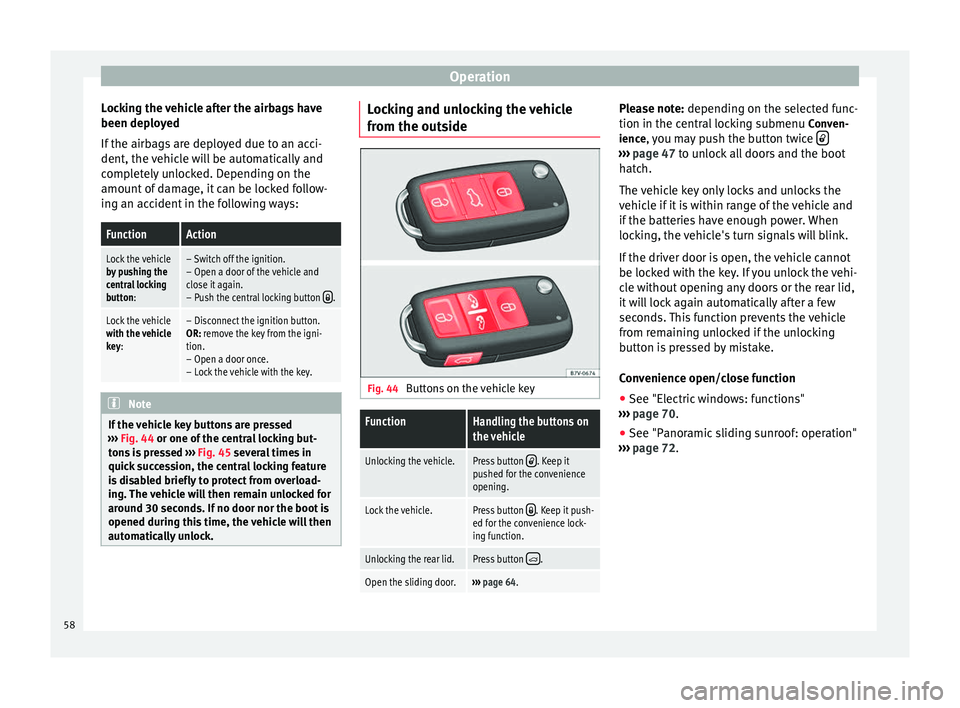
If the vehicle key buttons are pressed
››› Fig. 44 or one of the central locking but-
t on
s is pressed ››› Fig. 45 several times in
quick
succession, the central locking feature
is disabled briefly to protect from overload-
ing. The vehicle will then remain unlocked for
around 30 seconds. If no door nor the boot is
opened during this time, the vehicle will then
automatically unlock. Locking and unlocking the vehicle
from the outside
Fig. 44
Buttons on the vehicle key
FunctionHandling the buttons on
the vehicle
Unlocking the vehicle.Press button . Keep it
pushed for the convenience
opening.
Lock the vehicle.Press button . Keep it push-
ed for the convenience lock-
ing function.
Unlocking the rear lid.Press button .
Open the sliding door.››› page 64. Please note:
depending on the selected func-
tion in the c entr
al locking submenu Conven-
ience, you may push the button twice ›››
page 47 to unlock all doors and the boot
h at
ch.
The vehicle key only locks and unlocks the
vehicle if it is within range of the vehicle and
if the batteries have enough power. When
locking, the vehicle's turn signals will blink.
If the driver door is open, the vehicle cannot
be locked with the key. If you unlock the vehi-
cle without opening any doors or the rear lid,
it will lock again automatically after a few
seconds. This function prevents the vehicle
from remaining unlocked if the unlocking
button is pressed by mistake.
Convenience open/close function
● See "Electric windows: functions"
››› page 70.
● See "Panor
amic sliding sunroof: operation"
››› page 72.
58
Page 65 of 305
Opening and closing
monitoring function (arrow) is not guaran-
teed to work freely.
Use the key to lock the vehicle. If the anti-
theft alarm is turned on, the interior monitor-
ing and the anti-tow systems are also activa-
ted.
Switching off the interior monitoring and the
anti-tow systems
The interior monitoring is switched off by
pressing the remote control lock button twice.
● Lock all doors and rear lid.
● Use the key to lock the vehicle. The interior
monitoring and / or anti-towing alarm are
switched off until the next time the vehicle is
locked.
To turn off the interior monitoring and anti-
tow systems before unlocking the vehicle, for
example in the following situations:
● When leaving animals inside the vehicle
››› page 57 .
● When the v
ehicle must be loaded.
● When the vehicle is being transported, for
example, by ferry.
● When the vehicle must be towed with the
axle raised. Risk of false alarms
The interior monitoring system will only oper-
ate correctly if the vehicle is completely
closed. Observe legal requirements. The
alarm may be accidentally triggered in the
following cases:
●
When a window is completely or partially
open.
● If the sunglasses storage compartment in
the roof console is open.
● When the panoramic sliding sunroof is
completely or partially open.
● When suspended objects are hung from
the interior mirror (air freshener) or there are
loose papers in the vehicle.
● If the separation net is fitted and moves
(due to heating).
● Due to a vibrating mobile telephone inside
the vehicle. Note
Upon activating the alarm, if any door or the
rear lid is open, only the anti-theft alarm will
be activated. The interior monitoring and an-
ti-tow systems will only be activated when
the doors and rear lid are fully closed. Doors
Introduction WARNING
If a door is not correctly closed, it could open
unexpectedly when driving and cause serious
injuries.
● Always stop immediately and close the
door.
● When closing, ensure that the door has
closed correctly. A closed door should be
flush with the corresponding parts of the
bodywork.
● Open and close doors only when nobody is
in the way of the door. WARNING
A door held open by its retainer could be
blown closed by the wind or close if the vehi-
cle is on a hill, causing injury.
● When opening and closing doors, always
use the door handle. 63
Technical specifications
Advice
Operation
Safety
Page 73 of 305
Opening and closing
●
Always take all the keys with you whenever
you leave the vehicle. After turning off the ig-
nition, the windows can be opened and
closed for a short time using the buttons on
the door as long as the driver door or passen-
ger side door is not open.
● When transporting children in the rear
seats, always deactivate the rear electric win-
dows with the child safety lock so that they
cannot be opened and closed. Electric windows: functions
One-touch opening and closing
The one-touch automatic opening and clos-
ing is used to open or close the windows
completely. It will not be necessary to hold
the button of the corresponding electric win-
dow.
For the one-touch closing function: pull the
button for the corresponding window up-
wards until it reaches the second position.
For the one-touch opening function:
push the
b utt
on for the corresponding window down-
wards until it reaches the second position.
To stop the one touch function:
push or pull
on the button of the corresponding window.
Restoring one-touch opening and closing
The one-touch opening and closing function
is not active after the vehicle battery has been disconnected or is flat and will have to
be reset.
● Close all windows and doors.
● Pull the button of the corresponding win-
dow and hold it for one second in this posi-
tion.
● Release the button and pull upwards and
hold again. The one-touch function is now
ready for operation.
The automatic one-touch electric windows
can be reinitialised individually or several at
a time.
Convenience opening and closing function
The electric windows can be opened or
closed from outside using the vehicle key:
● Keep the vehicle unlocking or locking but-
ton pressed. All windows which function elec-
trically will be either opened or closed.
● To interrupt the function, release the lock-
ing or unlocking button.
During convenience closing, first the win-
dows and then the sliding sunroof will be
closed.
In the Configuration - convenience menu, there are different settings for operating the
windows ››› page 47. Note
The one-touch function and roll-back function
will not work if there is a malfunction in the
electric windows. Visit a specialised work-
shop. Electric Windows anti-trap function
The anti-trap function of the electric windows
can reduce the risk of injury when opening
and closing the electric windows
››› . If a
window is not able to close because it is stiff
or because of an obstruction, it will automati-
cally open again.
● Check why the window does not close.
● Attempt to close the window again.
● If you try within the following 10 seconds
and the window closes with difficulty or there
is an obstruction once again, the one-touch
closing will stop working for 10 seconds.
● If the window is still obstructed, it will stop
at the corresponding position. When the but-
ton is operated within 10 seconds, the win-
dow will close without the anti-trap function
››› .
To close windows without the anti-trap
function
● Attempt to close the corresponding electric
window within 10 seconds after by holding
the button. The window is closed without the
»
71
Technical specifications
Advice
Operation
Safety
Page 74 of 305
Operation
anti-trap function, deactivated for a short
time.
● After more than 10 seconds, the anti-trap
function is reactivated. The window will stop
once again if there is another difficulty or ob-
stacle.
● If the window will still not close, visit a spe-
cialised workshop. WARNING
Closing the electric windows without the an-
ti-trap function can cause serious injury.
● Always close the electric windows careful-
ly.
● Nobody should be in the way of the electric
windows, especially when the anti-trap func-
tion is deactivated.
● The anti-trap function does not prevent fin-
gers or other parts of the body getting
pinched against the window frame and caus-
ing injury. Note
The anti-trap function also operates if the
windows are closed from the outside of the
vehicle using the ignition key for convenience
closing ››› page 71. Panoramic sliding sunroof*
Introduction WARNING
Careless or uncontrolled use of the panoram-
ic sliding sunroof can cause serious injuries.
● Only close the panoramic sliding sunroof
and the sun blind when nobody is in the way.
● Always take all the keys with you whenever
you leave the vehicle.
● Never leave children or disabled persons in
the vehicle, particularly if they have access to
the keys. Uncontrolled use of the key could
lock the vehicle, start the engine, turn on the
ignition and operate the panoramic sliding
sunroof.
● The panoramic sliding sunroof can be oper-
ated for up to about ten minutes after the ig-
nition has been switched off, provided the
driver door and the front passenger door are
not opened. Note
In case of a fault in the operation of the pan-
oramic sliding sunroof, the anti-trap function
will not operate correctly. Visit a specialised
workshop. Opening or closing the panoramic
sliding sunroof
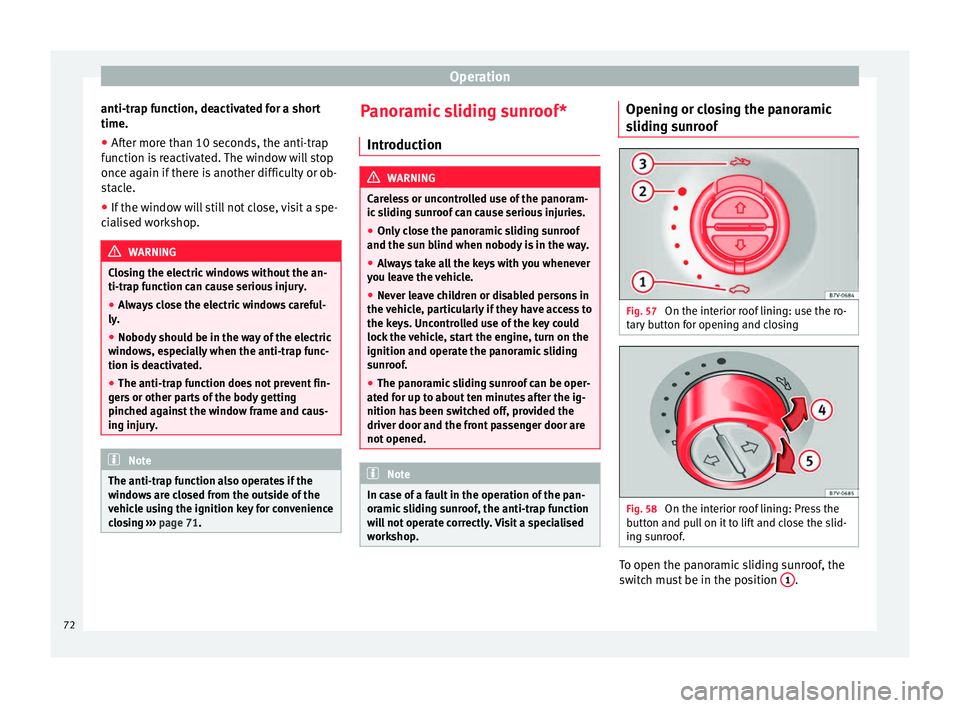
Fig. 57
On the interior roof lining: use the ro-
tary button for opening and closing Fig. 58
On the interior roof lining: Press the
button and pull on it to lift and close the slid-
ing sunroof. To open the panoramic sliding sunroof, the
switch must be in the position
1 .
72
Page 75 of 305
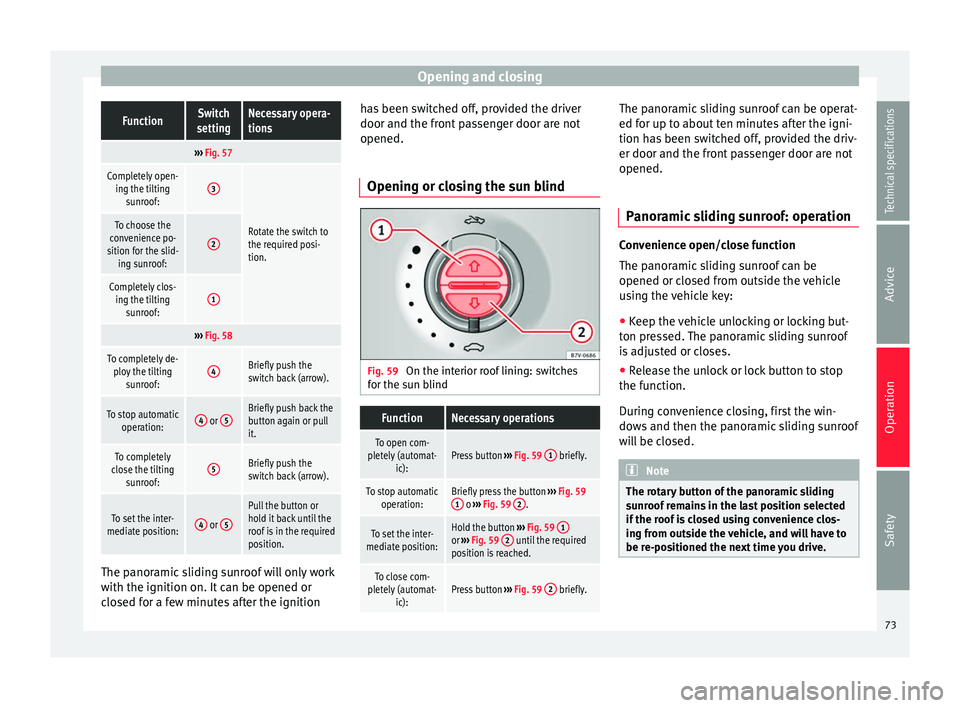
Opening and closingFunctionSwitch
settingNecessary opera-
tions
››› Fig. 57
Completely open-
ing the tilting sunroof:3
Rotate the switch to
the required posi-
tion.To choose the
convenience po-
sition for the slid- ing sunroof:
2
Completely clos-ing the tilting sunroof:1
››› Fig. 58
To completely de-
ploy the tilting sunroof:4Briefly push the
switch back (arrow).
To stop automatic operation:4 or 5Briefly push back the
button again or pull
it.
To completely
close the tilting sunroof:5Briefly push the
switch back (arrow).
To set the inter-
mediate position:4 or 5
Pull the button or
hold it back until the
roof is in the required
position. The panoramic sliding sunroof will only work
with the ignition on. It can be opened or
closed for a few minutes after the ignition has been switched off, provided the driver
door and the front passenger door are not
opened.
Opening or closing the sun blind Fig. 59
On the interior roof lining: switches
for the sun blind
FunctionNecessary operations
To open com-
pletely (automat- ic):Press button ››› Fig. 59 1 briefly.
To stop automatic
operation:Briefly press the button ››› Fig. 59
1 o ››› Fig. 59 2.
To set the inter-
mediate position:Hold the button ››› Fig. 59 1or
››› Fig. 59 2 until the required
position is reached.
To close com-
pletely (automat- ic):Press button ››› Fig. 59 2 briefly. The panoramic sliding sunroof can be operat-
ed for up to about ten minutes after the igni-
tion has been switched off, provided the driv-
er door and the front passenger door are not
opened.
Panoramic sliding sunroof: operation Convenience open/close function
The panoramic sliding sunroof can be
opened or closed from outside the vehicle
using the vehicle key:
● Keep the vehicle unlocking or locking but-
ton pressed. The panoramic sliding sunroof
is adjusted or closes.
● Release the unlock or lock button to stop
the function.
During convenience closing, first the win-
dows and then the panoramic sliding sunroof
will be closed. Note
The rotary button of the panoramic sliding
sunroof remains in the last position selected
if the roof is closed using convenience clos-
ing from outside the vehicle, and will have to
be re-positioned the next time you drive. 73
Technical specifications
Advice
Operation
Safety
Page 76 of 305
Operation
Anti-trap function of the panoramic
sliding sunroof and the sun blind The anti-trap function reduces the risk of in-
jury when opening and closing the panoram-
ic sliding sunroof and sun blind
››› . When
they encounter an obstacle while closing,
they reopen.
● Check why the panoramic sliding sunroof
or the sun blind did not close.
● Attempt to close the panoramic sliding
sunroof or sun blind once again.
● If the panoramic sliding sunroof or sun
blind is still obstructed, it will stop at the cor-
responding position. Close it without the an-
ti-trap function.
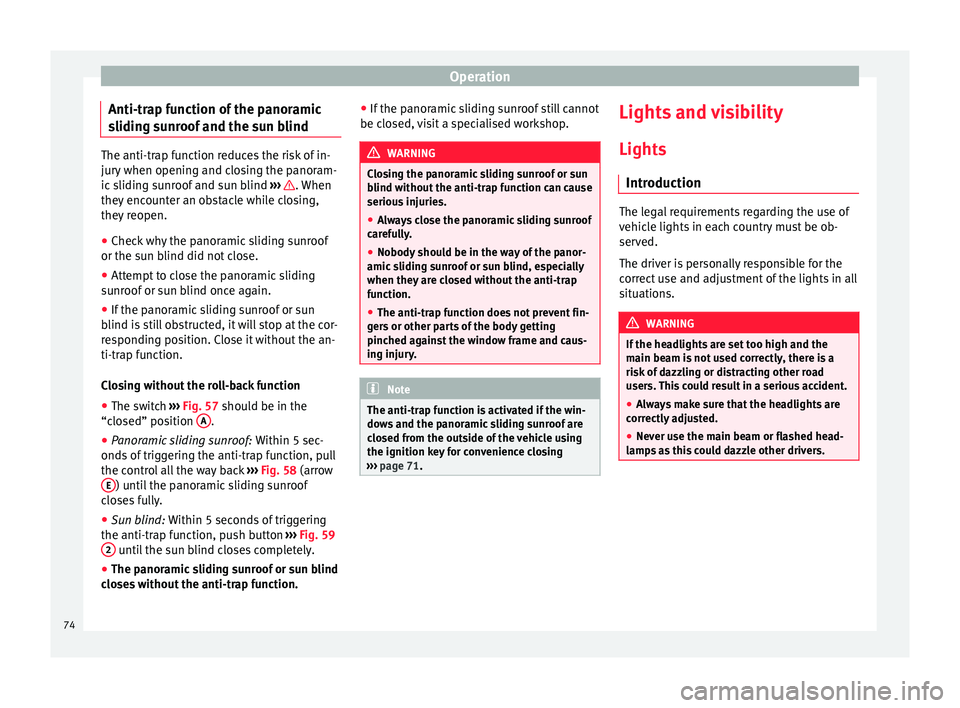
Closing without the roll-back function
● The switch ›››
Fig. 57 should be in the
“c lo
sed” position A .
● Panoramic sliding sunroof: Within 5 sec-
onds of triggering the anti-trap function, pull
the control all the way back ›››
Fig. 58 (arrow
E ) until the panoramic sliding sunroof
closes fully.
● Sun blind: Within 5 seconds of triggering
the anti-tr ap f
unction, push button ›››
Fig. 59
2 until the sun blind closes completely.
● The panoramic sliding sunroof or sun blind
closes without the anti-trap function. ●
If the panoramic sliding sunroof still cannot
be closed, visit a specialised workshop. WARNING
Closing the panoramic sliding sunroof or sun
blind without the anti-trap function can cause
serious injuries.
● Always close the panoramic sliding sunroof
carefully.
● Nobody should be in the way of the panor-
amic sliding sunroof or sun blind, especially
when they are closed without the anti-trap
function.
● The anti-trap function does not prevent fin-
gers or other parts of the body getting
pinched against the window frame and caus-
ing injury. Note
The anti-trap function is activated if the win-
dows and the panoramic sliding sunroof are
closed from the outside of the vehicle using
the ignition key for convenience closing
››› page 71. Lights and visibility
Lights Introduction The legal requirements regarding the use of
vehicle lights in each country must be ob-
served.
The driver is personally responsible for the
correct use and adjustment of the lights in all
situations.
WARNING
If the headlights are set too high and the
main beam is not used correctly, there is a
risk of dazzling or distracting other road
users. This could result in a serious accident.
● Always make sure that the headlights are
correctly adjusted.
● Never use the main beam or flashed head-
lamps as this could dazzle other drivers. 74
Page 112 of 305
Operation
● Carefully unhook the baggage net hooks
from the fastening rings ››› Fig. 98 2 .
WARNING
The elastic baggage net stretches when it is
secured to the luggage compartment fasten-
ing rings. The secured baggage net is taut.
The hooks on the net can cause injury if the
net is incorrectly hooked or unhooked.
● Always ensure that the hooks do not sud-
denly release from the fastening rings when
hooking or un-hooking.
● Always keep your face and eyes protected
at a safe distance to avoid injury should a
hook slip while hooking or unhooking.
● Always engage the hooks in the order giv-
en. If a baggage net hook springs back this
can cause injury. Roof carrier system*
Introduction The vehicle roof has been designed to opti-
mise aerodynamics. For this reason, conven-
tional roof carrier systems cannot be secured
to the roof water drain channel.
Given that the water drains have been incor-
porated into the roof for aerodynamic rea-
sons, only the SEAT approved basic supports
and roof carrier systems can be used. When should the roof carrier system be
removed?
● When it is not being used.
● When the vehicle is being washed in a car
wash.
● When the vehicle height exceeds the maxi-
mum height (e.g. in a garage). WARNING
The risk of an accident is increased by trans-
porting heavy or bulky loads on the roof,
which affects the car's handling by shifting
the centre of gravity and increasing suscepti-
bility to cross winds.
● Always secure loads correctly with suitable
and undamaged attachment rope or straps.
● Large, heavy, wide and flat loads negatively
affect the vehicle aerodynamics, centre of
gravity and handling.
● Avoid brusque manoeuvres and sudden
braking.
● Adjust your speed and driving style to visi-
bility, road, traffic and weather conditions. CAUTION
● Always remove the roof carrier system from
the roof before entering a car wash.
● The height of your vehicle is changed by
the installation of the roof carrier and the
load secured on it. Compare the vehicle
height with the passage height, for example
in underground car parks or for garage doors. ●
The roof antenna, the range of the panor-
amic sliding sunroof and the boot hatch
should not be affected by the roof carrier sys-
tem and the load being transported.
● Take extra care not to let the hatch strike
the roof load when opening. For the sake of the environment
The vehicle uses more fuel when the roof car-
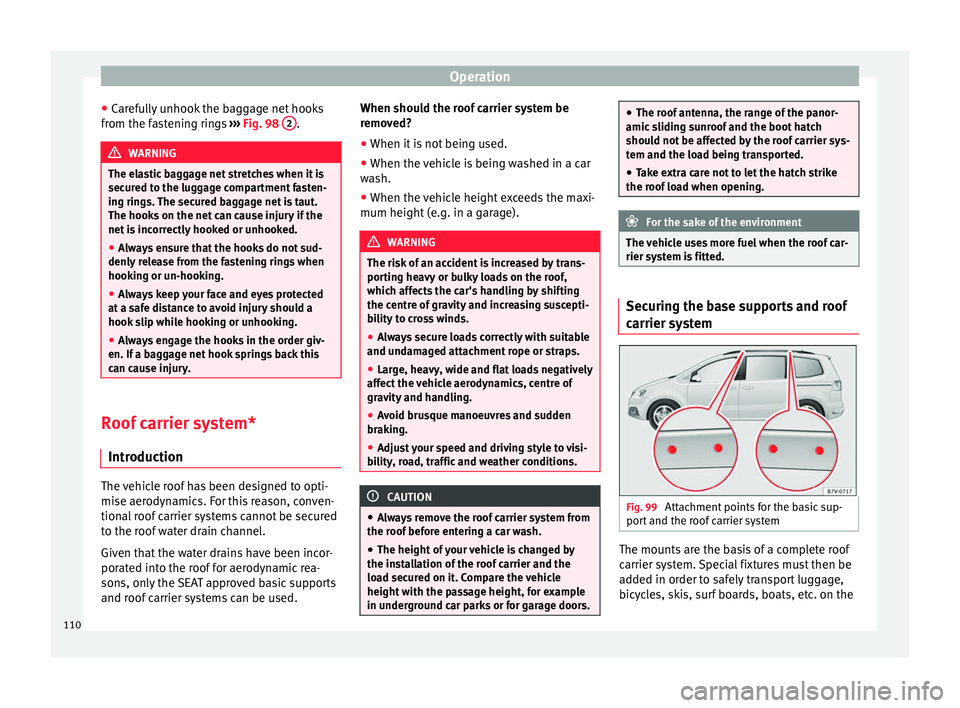
rier system is fitted. Securing the base supports and roof
carrier system
Fig. 99
Attachment points for the basic sup-
port and the roof carrier system The mounts are the basis of a complete roof
carrier system. Special fixtures must then be
added in order to safely transport luggage,
bicycles, skis, surf boards, boats, etc. on the
110
Page 127 of 305
Air conditioningCon-
trol
buttonAdditional information. Electronic
manual air conditioning ››› Fig. 120;
Climatronic ››› Fig. 121.
Climatronic: press the
REAR button to adjust
the air conditioner for the rear seats from the
front seats. A lamp is lit on the REAR
button if
the feature is activated. The settings for the
rear seats will be displayed. Press the button
again to switch the function off or do not
touch any other button for around 10 sec-
onds.
Climatronic: Press the
REST button to use the
heat that the engine produces. When the en-
gine is still warm but the ignition switched
off, the heat given off by the engine can be
used to keep the vehicle interior warm. The REST
button will light up when the function is
switched on. The function will switch off after
around 30 minutes and if the battery level is
low.
a)
Switch off.
Electronic manual air conditioning
: turn the
fan switch to setting 0.
Climatronic: press the OFF
button or manual-
ly set the fan to 0. When the device is switch-
ed off the OFF
button will light up.
a)
Depending on the version of the model. Note
● Not all Climatronic buttons are operational
in REAR mode.
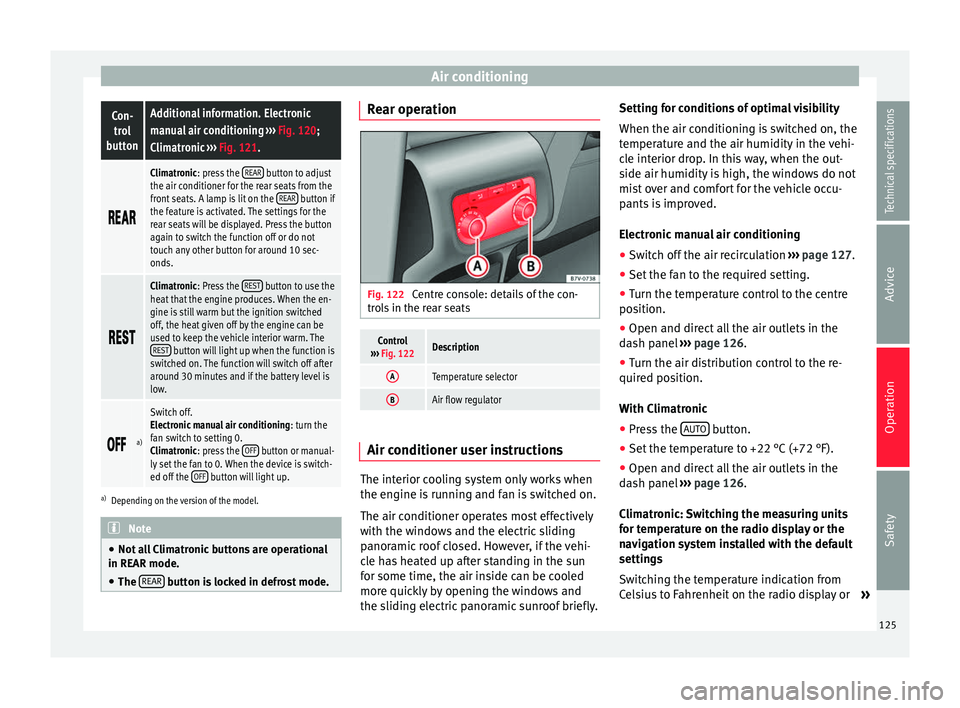
● The REAR button is locked in defrost mode. Rear operation
Fig. 122
Centre console: details of the con-
trols in the rear seats
Control
››› Fig. 122Description
ATemperature selector
BAir flow regulator Air conditioner user instructions
The interior cooling system only works when
the engine is running and fan is switched on.
The air conditioner operates most effectively
with the windows and the electric sliding
panoramic roof closed. However, if the vehi-
cle has heated up after standing in the sun
for some time, the air inside can be cooled
more quickly by opening the windows and
the sliding electric panoramic sunroof briefly.Setting for conditions of optimal visibility
When the air conditioning is switched on, the
temperature and the air humidity in the vehi-
cle interior drop. In this way, when the out-
side air humidity is high, the windows do not
mist over and comfort for the vehicle occu-
pants is improved.
Electronic manual air conditioning
● Switch off the air recirculation ››› page 127.
● Set the fan to the required setting.
● Turn the temperature control to the centre
position.
● Open and direct all the air outlets in the
dash panel ››› page 126 .
● Turn the air di
stribution control to the re-
quired position.
With Climatronic
● Press the AUTO button.
● Set the temperature to +22 °C (+72 °F).
● Open and direct all the air outlets in the
dash panel ››› page 126 .
C lim
atronic: Switching the measuring units
for temperature on the radio display or the
navigation system installed with the default
settings
Switching the temperature indication from
Celsius to Fahrenheit on the radio display or »
125
Technical specifications
Advice
Operation
Safety
Page 261 of 305
Emergencies
● The brake must be depressed must harder
as the brake servo does not operate. Avoid
hitting the towing vehicle.
● Note the instructions and information con-
tained in the Instruction Manual for the vehi-
cle to be towed.
Notes for the driver of the towing vehicle
● Accelerate gently and carefully. Avoid sud-
den manoeuvres.
● Brake well in advance than usual and brake
gently.
● Note the instructions and information con-
tained in the Instruction Manual for the vehi-
cle to be towed.
Emergency locking and
unlocking
Introduction The doors, rear lid and panoramic sliding
sunroof can be locked manually and partially
opened, for example if the key or the central
locking is damaged.
WARNING
Opening and closing doors carelessly can
cause serious injury. ●
If the vehicle is locked from outside, the
doors and windows cannot be opened from
the inside.
● Never leave children or disabled people
alone in the car. They could be trapped in the
car in an emergency and will not be able to
get themselves to safety.
● Depending on the time of the year, temper-
atures inside a locked and closed vehicle can
be extremely high or extremely low resulting
in serious injuries and illness or even death,
particularly for young children. WARNING
Getting in the way of the doors and the pan-
oramic sliding sunroof is dangerous and can
lead to serious injury.
● Open and close the doors and the panor-
amic sliding sunroof only when nobody is in
the way. CAUTION
When opening and closing in an emergency,
carefully disassemble components and then
reassemble them carefully to avoid damage
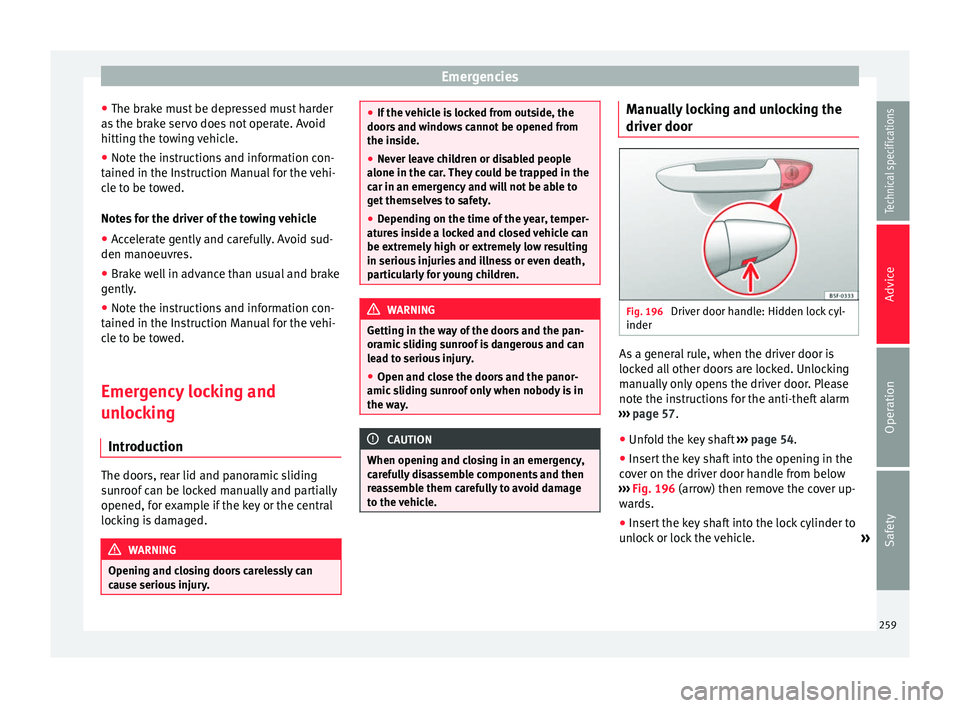
to the vehicle. Manually locking and unlocking the
driver door
Fig. 196
Driver door handle: Hidden lock cyl-
inder As a general rule, when the driver door is
locked all other doors are locked. Unlocking
manually only opens the driver door. Please
note the instructions for the anti-theft alarm
››› page 57 .
● Unf o
ld the key shaft ››› page 54.
● Insert the key shaft into the opening in the
cover on the driver door handle from below
››› Fig. 196 (arrow) then remove the cover up-
war
ds.
● Insert the key shaft into the lock cylinder to
unlock or lock the vehicle. »
259
Technical specifications
Advice
Operation
Safety