remove seats Seat Alhambra 2015 User Guide
[x] Cancel search | Manufacturer: SEAT, Model Year: 2015, Model line: Alhambra, Model: Seat Alhambra 2015Pages: 305, PDF Size: 5.46 MB
Page 98 of 305
Operation
WARNING
Careless or uncontrolled use of the conven-
ient entry assistant may result in severe in-
jury and accident.
● Never use the convenient entry function
when the vehicle is in motion.
● Avoid trapping or damaging the seat belt
when folding the rear seats back.
● Keep your hands, fingers, feet and other
body parts out of the hinges and the seat
locking mechanism when folding and unfold-
ing.
● Mats or other objects can be caught in the
hinges of the seat backrests or rear seat. This
could prevent the seat backrest from locking
safely when positioned upright.
● All seat backrests must engage correctly for
the seat belts on the rear seats to work prop-
erly. When the seat backrest of an occupied
seat is not correctly locked in place, the pas-
senger can be thrust forward with the seat
backrest in case of sudden braking, sudden
manoeuvres or an accident.
● A red mark on the side of the seat ››› Fig. 83
2 indicates that the seat backrest is not en-
gaged. The mark is no longer visible when it
is correctly engaged.
● If the seat backrest or seat are folded down
and are not correctly locked in place, no pas-
senger should use them.
● When getting in or out, never lean or hold
onto the folded seat on the second row of
seats. WARNING
If child seats are fitted to all the seats in the
second row then it is possible that the seats
of this row cannot be folded down from the
third row of seats in the event of an accident.
In the event of an emergency, passengers in
the third row of seats will not be able to leave
the vehicle or to help themselves.
● Child seats should not occupy all the seats
of the second row if other passengers are to
occupy the third row. CAUTION
● Before folding down the rear seat backrest
for returning it to its position, adjust the front
seats so that the head restraints and seat
backrests do not hit each other when folding
and unfolding.
● Any objects located in the footwell of the
second row of seats may be damaged on fold-
ing the rear seat forwards. Remove any ob-
jects before folding the seat down. Folding the seat backrest of the front
passenger seat*
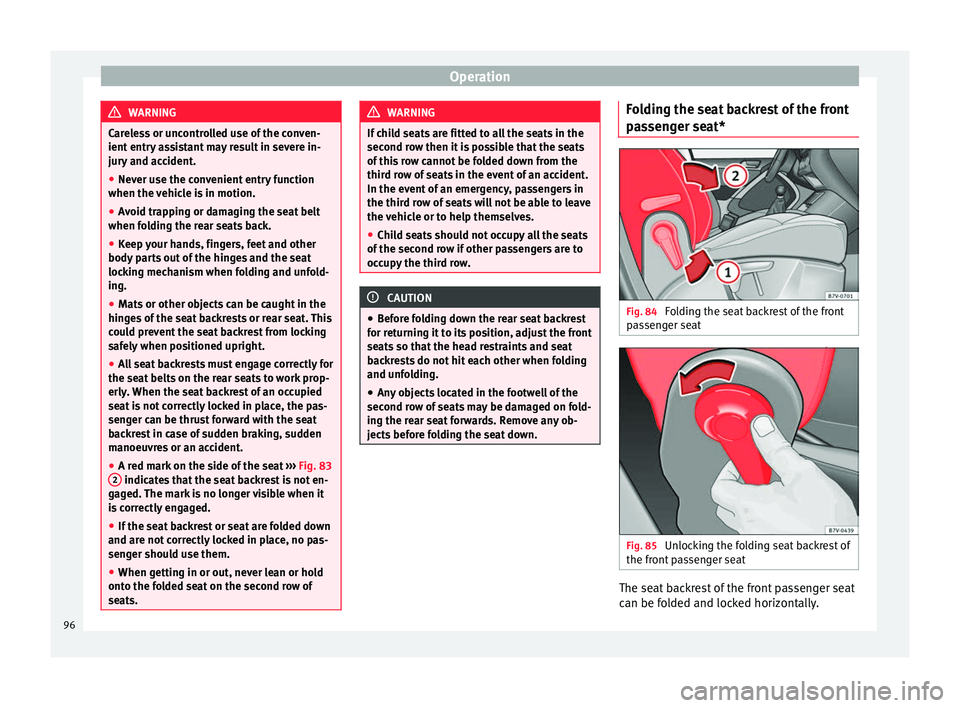
Fig. 84
Folding the seat backrest of the front
passenger seat Fig. 85
Unlocking the folding seat backrest of
the front passenger seat The seat backrest of the front passenger seat
can be folded and locked horizontally.
96
Page 99 of 305
Seats and head restraints
The front passenger front airbag must be dis-
abled ››› page 20 if objects are being trans-
por t
ed on the folded front passenger seat.
Folding the seat backrest of the front
passenger seat
● Remove any objects from the front passen-
ger seat cushion ››› .
● Adjust the front passenger seat to its low-
est position ››› page 6 .
● Pu
sh the head restraint down as far as it
will go ››› page 6
.
● Unlock the seat backrest of the front pas-
senger seat in the direction of the arrow
››› Fig. 84 1 .
● Fold the seat backrest of the front passen-
ger seat forwards in the direction of the arrow
››› Fig. 84 2 until it is horizontal.
● The seat backrest of the front passenger
seat must engage safely in its folded posi-
tion.
Lifting the seat backrest of the front
passenger seat
● Check that there are no objects or parts of
the body in the hinge area.
● Lift the seat backrest of the front passenger
seat by first unlocking it again ››› Fig. 85 .
● Lif t
the seat backrest of the front passenger
seat until it is upright. The seat backrest
must be engaged. ●
The upright seat backrest of the front pas-
senger seat must safely engage. WARNING
Folding and lifting the seat backrest of the
front passenger seat uncontrollably or with-
out paying attention may lead to severe inju-
ries.
● Only fold and lift the seat backrest of the
front passenger seat when the vehicle is sta-
tionary.
● While the seat backrest of the front passen-
ger seat is folded, the front airbag must re-
main disabled and the PASSENGER AIRBAG OFF light on.
● Keep
your hands, fingers, feet and other
body parts out of the hinges and the seat
locking mechanism when folding and unfold-
ing.
● Mats or other objects can be caught in the
hinges of the seat backrest of the front pas-
senger seat. This could prevent the seat
backrest from locking safely when positioned
upright.
● The upright seat backrest of the front pas-
senger seat must engage. If the seat backrest
of the front passenger seat is not locked, it
may suddenly move and cause severe inju-
ries. WARNING
Seat anchors and hinges exposed when the
seat backrest of the front passenger seat is folded may lead to severe injuries in the
event of an accident or sudden braking.
●
Never carry people or children on the front
passenger seat when the seat backrest is fol-
ded.
● When the seat backrest of the front passen-
ger seat is folded, only the outer seat behind
the driver on the second row of seats may be
occupied. This also applies to children sitting
in a child seat. Centre armrest
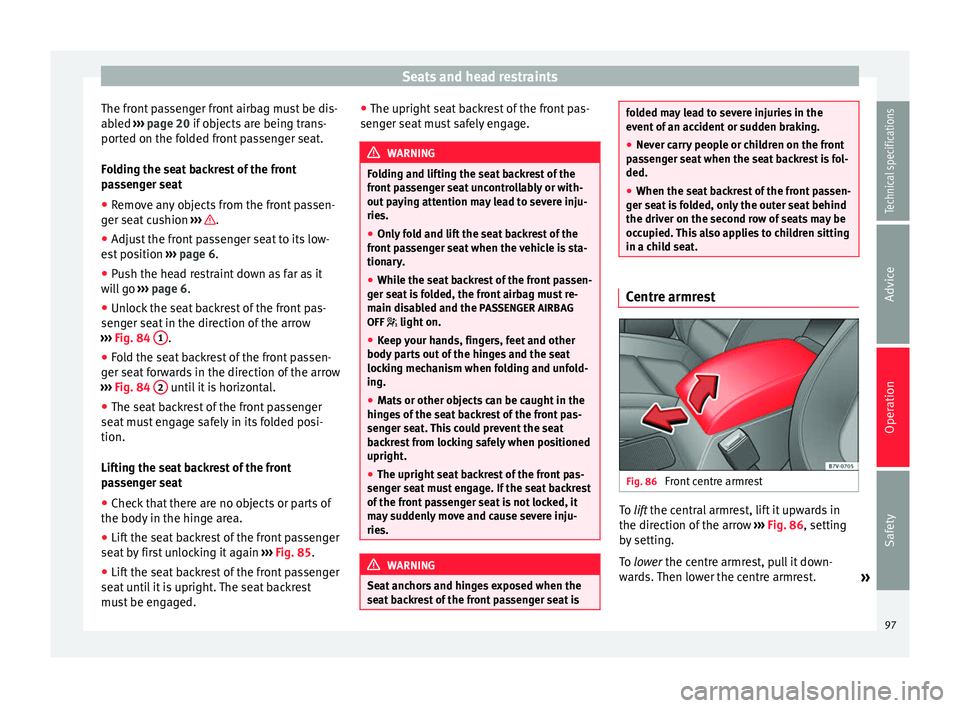
Fig. 86
Front centre armrest To
lift
the central armrest, lift it upwards in
the dir
ection of the arrow ››› Fig. 86, setting
by
setting.
To
lower the centre armrest, pull it down-
wards. Then lower the centre armrest. »
97
Technical specifications
Advice
Operation
Safety
Page 103 of 305
Transport and practical equipment
Note
The ventilating slits between the heated rear
window and the shelf must not be covered so
that used air can escape from the vehicle. Folding down rear seats to create load
space
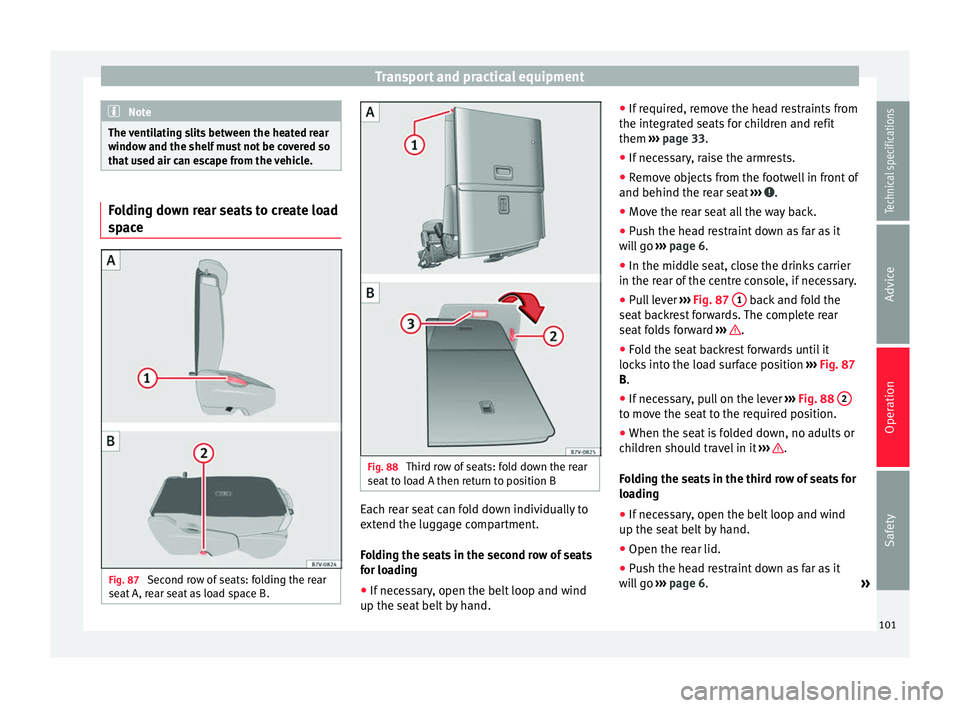
Fig. 87
Second row of seats: folding the rear
seat A, rear seat as load space B. Fig. 88
Third row of seats: fold down the rear
seat to load A then return to position B Each rear seat can fold down individually to
extend the luggage compartment.
Folding the seats in the second row of seats
for loading
●
If necessary, open the belt loop and wind
up the seat belt by hand. ●
If required, remove the head restraints from
the integrated seats for children and refit
them ››› page 33 .
● If nec
essary, raise the armrests.
● Remove objects from the footwell in front of
and behind the rear seat ››› .
● Move the rear seat all the way back.
● Push the head restraint down as far as it
will go ››› page 6 .
● In the mid dl
e seat, close the drinks carrier
in the rear of the centre console, if necessary.
● Pull lever ››› Fig. 87
1 back and fold the
seat backrest forwards. The complete rear
seat folds forward ››› .
● Fold the seat backrest forwards until it
locks into the load surface position ››› Fig. 87
B .
● If nec
essary, pull on the lever ››› Fig. 88 2 to move the seat to the required position.
●
When the seat is folded down, no adults or
children should travel in it ››› .
Folding the seats in the third row of seats for
loading
● If necessary, open the belt loop and wind
up the seat belt by hand.
● Open the rear lid.
● Push the head restraint down as far as it
will go ››› page 6 .
»
101
Technical specifications
Advice
Operation
Safety
Page 104 of 305
Operation
● Remove objects from the footwell in front of
and behind the rear seat ››› .
● Remove objects from the space below the
rear seat.
● Remove the attachment elements and sup-
ports for the net from the rail system.
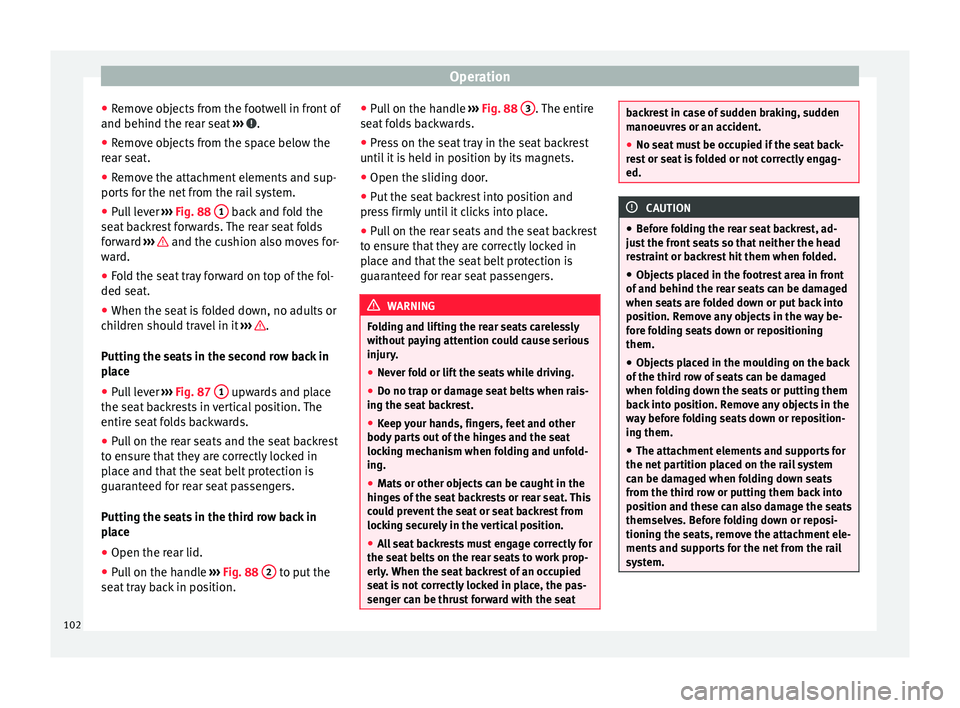
● Pull lever ››› Fig. 88 1 back and fold the
seat backrest forwards. The rear seat folds
forward ››› and the cushion also moves for-
ward.
● Fold the seat tray forward on top of the fol-
ded seat.
● When the seat is folded down, no adults or
children should travel in it ››› .
Putting the seats in the second row back in
place
● Pull lever ››› Fig. 87 1 upwards and place
the seat backrests in vertical position. The
entire seat folds backwards.
● Pull on the rear seats and the seat backrest
to ensure that they are correctly locked in
place and that the seat belt protection is
guaranteed for rear seat passengers.
Putting the seats in the third row back in
place
● Open the rear lid.
● Pull on the handle ››› Fig. 88 2 to put the
seat tray back in position. ●
Pull on the handle ››› Fig. 88 3 . The entire
seat folds backwards.
● Press on the seat tray in the seat backrest
until it is held in position by its magnets.
● Open the sliding door.
● Put the seat backrest into position and
press firmly until it clicks into place.
● Pull on the rear seats and the seat backrest
to ensure that they are correctly locked in
place and that the seat belt protection is
guaranteed for rear seat passengers. WARNING
Folding and lifting the rear seats carelessly
without paying attention could cause serious
injury.
● Never fold or lift the seats while driving.
● Do no trap or damage seat belts when rais-
ing the seat backrest.
● Keep your hands, fingers, feet and other
body parts out of the hinges and the seat
locking mechanism when folding and unfold-
ing.
● Mats or other objects can be caught in the
hinges of the seat backrests or rear seat. This
could prevent the seat or seat backrest from
locking securely in the vertical position.
● All seat backrests must engage correctly for
the seat belts on the rear seats to work prop-
erly. When the seat backrest of an occupied
seat is not correctly locked in place, the pas-
senger can be thrust forward with the seat backrest in case of sudden braking, sudden
manoeuvres or an accident.
●
No seat must be occupied if the seat back-
rest or seat is folded or not correctly engag-
ed. CAUTION
● Before folding the rear seat backrest, ad-
just the front seats so that neither the head
restraint or backrest hit them when folded.
● Objects placed in the footrest area in front
of and behind the rear seats can be damaged
when seats are folded down or put back into
position. Remove any objects in the way be-
fore folding seats down or repositioning
them.
● Objects placed in the moulding on the back
of the third row of seats can be damaged
when folding down the seats or putting them
back into position. Remove any objects in the
way before folding seats down or reposition-
ing them.
● The attachment elements and supports for
the net partition placed on the rail system
can be damaged when folding down seats
from the third row or putting them back into
position and these can also damage the seats
themselves. Before folding down or reposi-
tioning the seats, remove the attachment ele-
ments and supports for the net from the rail
system. 102
Page 105 of 305
Transport and practical equipment
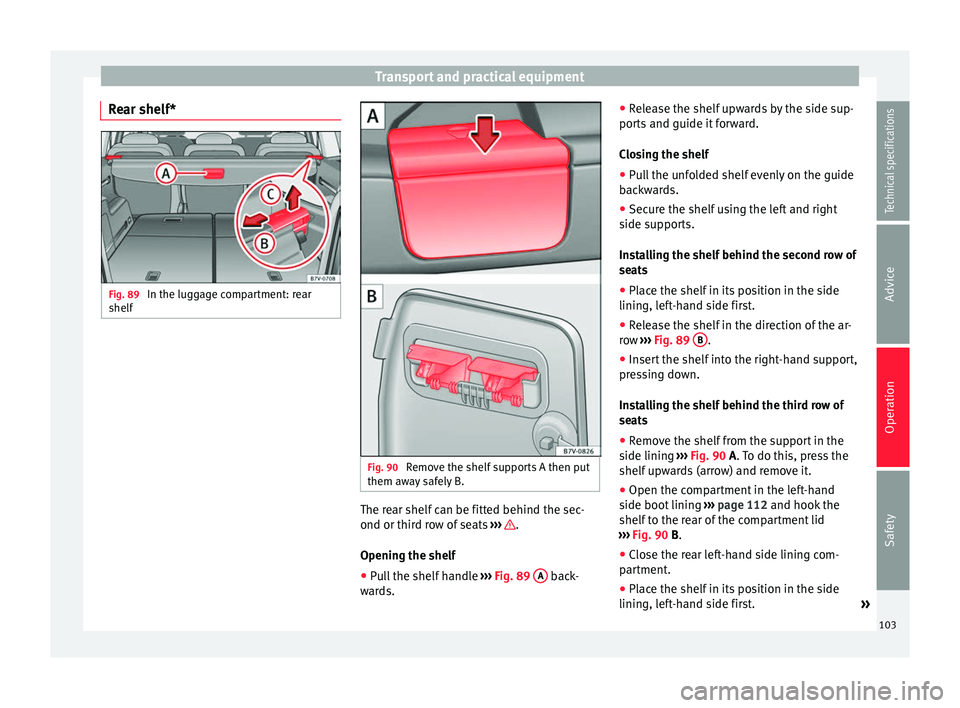
Rear shelf* Fig. 89
In the luggage compartment: rear
shelf Fig. 90
Remove the shelf supports A then put
them away safely B. The rear shelf can be fitted behind the sec-
ond or third row of seats
››› .
Opening the shelf
● Pull the shelf handle ›››
Fig. 89 A back-
wards. ●
Release the shelf upwards by the side sup-
ports and guide it forward.
Closing the shelf
● Pull the unfolded shelf evenly on the guide
backwards.
● Secure the shelf using the left and right
side supports.
Installing the shelf behind the second row of
seats
● Place the shelf in its position in the side
lining, left-hand side first.
● Release the shelf in the direction of the ar-
row ››› Fig. 89 B .
● Insert the shelf into the right-hand support,
pressing down.
Installing the shelf behind the third row of
seats
● Remove the shelf from the support in the
side lining ››› Fig. 90
A. To do this, press the
shelf upwards (arrow) and remove it.
● Open the compartment in the left-hand
side boot lining ››› page 112 and hook the
shelf to the rear of the compartment lid
››› Fig. 90 B
.
● Close the rear left-hand side lining com-
partment.
● Place the shelf in its position in the side
lining, left-hand side first. »
103
Technical specifications
Advice
Operation
Safety
Page 106 of 305
Operation
● Lift the shelf off in direction of the arrow
››› Fig. 89 B .
● Insert the shelf into the right-hand support,
pressing down.
Removing the shelf
● Release the shelf in the direction of the ar-
row ››› Fig. 89 B and lift it in the direction of
the arrow C .
● Remove the shelf from the right-hand side
support.
● In addition, when removing the shelf be-
hind the third row of seats: cover the side lin-
ing supports with their covers.
● Only with 5 places: support the released
shelf by placing it on the front section of the
boot floor ››› page 112 . WARNING
If the shelf is placed on one of the rear seats,
this could cause serious injury in case of sud-
den braking or an accident.
● Whenever it the third row seats are occu-
pied, the shelf should be put behind this row. WARNING
Unsecured or incorrectly secured objects or
animals on the rear shelf could cause serious
injuries in case of a sudden manoeuvre or
braking or even an accident. ●
Do not leave hard, heavy or sharp objects
(loose or in bags) on the rear shelf.
● Never transport animals on the rear shelf. Net partition*
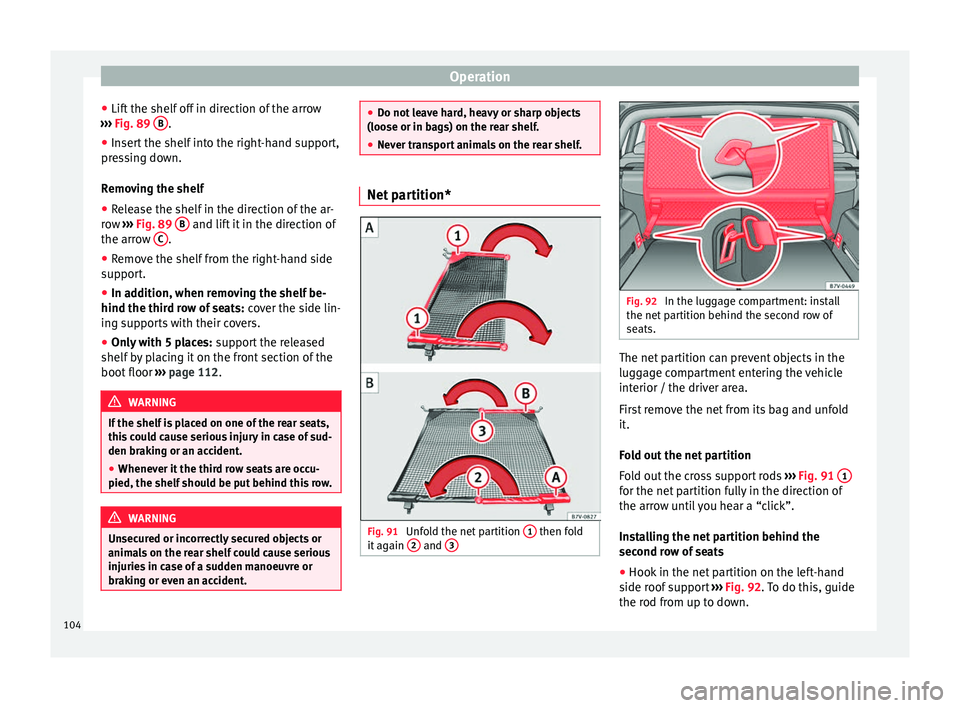
Fig. 91
Unfold the net partition 1 then fold
it again 2 and
3 Fig. 92
In the luggage compartment: install
the net partition behind the second row of
seats. The net partition can prevent objects in the
luggage compartment entering the vehicle
interior / the driver area.
First remove the net from its bag and unfold
it.
Fold out the net partition
Fold out the cross support rods
››› Fig. 91 1 for the net partition fully in the direction of
the arrow until you hear a “click”.
Installing the net partition behind the
second row of seats
●
Hook in the net partition on the left-hand
side roof support ››› Fig. 92 . To do this, guide
the r od fr
om up to down.
104
Page 108 of 305
Operation
●
Always use suitable ropes and straps in
good condition.
● Secure the ropes and straps to the fasten-
ing rings.
● Loose objects in the luggage compartment
can suddenly slide and change the way the
vehicle handles.
● Secure all objects, little and large.
● Never secure a load that is too heavy for
the fastening rings.
● Never secure a child seat to the fastening
rings. Note
● The maximum load of the fastening rings is
approximately 3.5 kN (3.57 kp).
● You can find suitable transport straps and
load securing systems at a specialised work-
shop. SEAT recommends taking your car in for
technical service. Rails and attachment system*
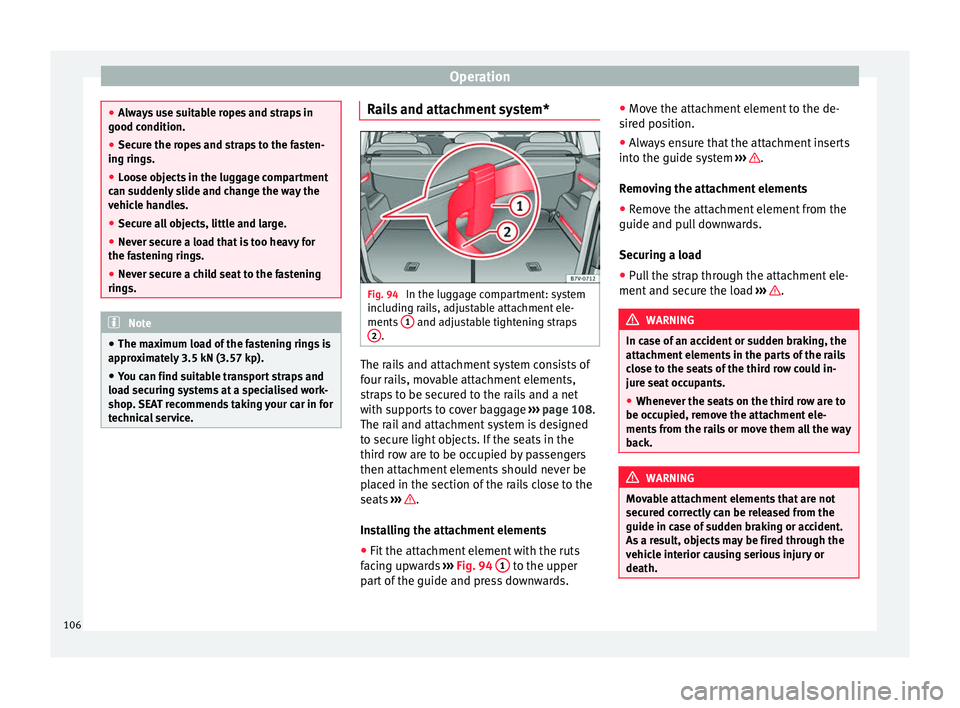
Fig. 94
In the luggage compartment: system
including rails, adjustable attachment ele-
ments 1 and adjustable tightening straps
2 .
The rails and attachment system consists of
four rails, movable attachment elements,
straps to be secured to the rails and a net
with supports to cover baggage
››› page 108.
The rail and attachment system is designed
to secure light objects. If the seats in the
third row are to be occupied by passengers
then attachment elements should never be
placed in the section of the rails close to the
seats ››› .
Installing the attachment elements
● Fit the attachment element with the ruts
facing upwards ››› Fig. 94 1 to the upper
part of the guide and press downwards. ●
Move the attachment element to the de-
sired position.
● Always ensure that the attachment inserts
into the guide system ››› .
Removing the attachment elements
● Remove the attachment element from the
guide and pull downwards.
Securing a load
● Pull the strap through the attachment ele-
ment and secure the load ››› .
WARNING
In case of an accident or sudden braking, the
attachment elements in the parts of the rails
close to the seats of the third row could in-
jure seat occupants.
● Whenever the seats on the third row are to
be occupied, remove the attachment ele-
ments from the rails or move them all the way
back. WARNING
Movable attachment elements that are not
secured correctly can be released from the
guide in case of sudden braking or accident.
As a result, objects may be fired through the
vehicle interior causing serious injury or
death. 106
Page 109 of 305
Transport and practical equipment
●
Always ensure that the movable attach-
ment elements are correctly inserted into the
guides. WARNING
Unsuitable or damaged ropes or straps may
be released in case of sudden braking or an
accident. As a result, objects may be fired
through the vehicle interior causing serious
injury or death.
● Always use the attachment straps of the
rail and attachment system.
● Secure the attachment straps firmly to the
attachment elements.
● Loose objects in the luggage compartment
can suddenly slide and change the way the
vehicle handles.
● Secure all objects, little and large.
● Never secure a child seat to the attachment
elements. CAUTION
● The attachment elements placed on the rail
system can be damaged when folding down
seats from the third row or putting them back
into position and these can also damage the
seats themselves. Before folding down or re-
positioning the seats, remove the attachment
elements and supports for the net from the
rail system. 107Technical specifications
Advice
Operation
Safety
Page 111 of 305
Transport and practical equipment
Removing the baggage net supports
● Remove the net attachment element from
the rail and pull it out downwards. WARNING
In case of an accident or sudden braking, the
net attachment elements in the parts of the
rails close to the seats of the third row could
injure seat occupants.
● Whenever the seats on the third row are to
be occupied, remove the attachment ele-
ments from the rails or move them all the way
back. WARNING
Baggage net supports that are not secured
correctly can be released from the guide in
case of the sudden braking or accident. As a
result, objects may be fired through the vehi-
cle interior causing serious injury or death.
● Always ensure that the baggage net sup-
ports are correctly inserted into the rails; the
red mark should not be visible.
● Never secure a child seat to the baggage
net supports. CAUTION
● The baggage net supports placed on the
rail system can be damaged when folding
down seats from the third row or putting
them back into position and these can also
damage the seats themselves. Before folding down or repositioning the seats, remove the
baggage net supports from the rail system.
Retaining hooks
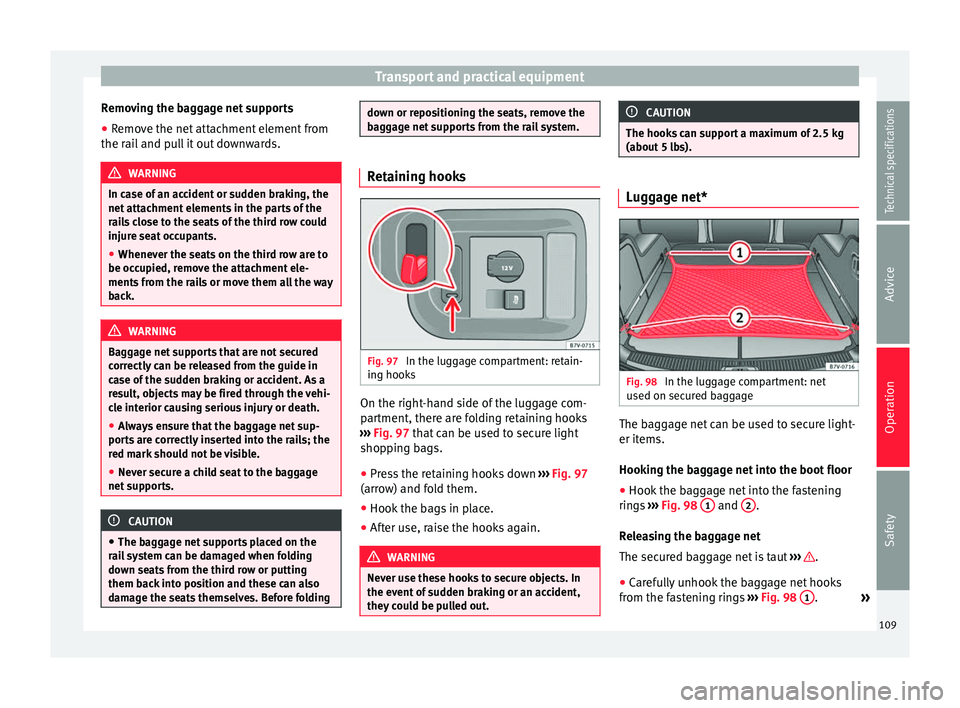
Fig. 97
In the luggage compartment: retain-
ing hooks On the right-hand side of the luggage com-
partment, there are folding retaining hooks
››› Fig. 97 that can be used to secure light
shop pin
g bags.
● Press the retaining hooks down ››› Fig. 97
(arrow) and fold them.
● Hook the bags in place.
● After use, raise the hooks again. WARNING
Never use these hooks to secure objects. In
the event of sudden braking or an accident,
they could be pulled out. CAUTION
The hooks can support a maximum of 2.5 kg
(about 5 lbs). Luggage net*
Fig. 98
In the luggage compartment: net
used on secured baggage The baggage net can be used to secure light-
er items.
Hooking the baggage net into the boot floor
● Hook the baggage net into the fastening
rings ››› Fig. 98 1 and
2 .
Releasing the baggage net
The secured baggage net is taut ››› .
● Carefully unhook the baggage net hooks
from the fastening rings ››› Fig. 98 1 .
»
109
Technical specifications
Advice
Operation
Safety
Page 120 of 305
Operation
Note
The drink holders can be removed for clean-
ing. Drink holders in front centre console
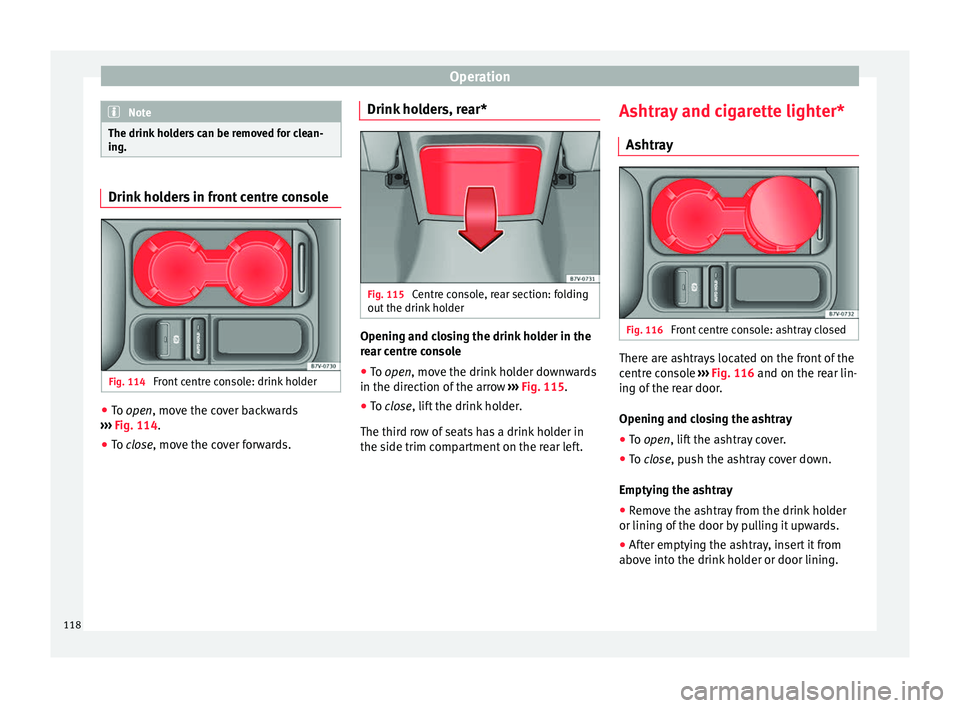
Fig. 114
Front centre console: drink holder ●
To open
, move the cover backwards
›
›› Fig. 114.
● To
close, move the cover forwards. Drink
holders, rear* Fig. 115
Centre console, rear section: folding
out the drink holder Opening and closing the drink holder in the
rear centre console
● To open
, move the drink holder downwards
in the dir
ection of the arrow ››› Fig. 115.
● To
close, lift the drink holder.
The thir
d row of seats has a drink holder in
the side trim compartment on the rear left. Ashtray and cigarette lighter*
Ashtray Fig. 116
Front centre console: ashtray closed There are ashtrays located on the front of the
centre console
››› Fig. 116 and on the rear lin-
in g of
the rear door.
Opening and closing the ashtray
● To open, lift the ashtray cover.
● T
o
close, push the ashtray cover down.
Emptying the ashtray
● Remove the ashtray from the drink holder
or lining of the door by pulling it upwards.
● After emptying the ashtray, insert it from
above into the drink holder or door lining.
118