ECO mode Seat Alhambra 2015 Owner's Guide
[x] Cancel search | Manufacturer: SEAT, Model Year: 2015, Model line: Alhambra, Model: Seat Alhambra 2015Pages: 305, PDF Size: 5.46 MB
Page 202 of 305
Advice
Protection of vehicle undercarriage The vehicle underbody is coated to protect it
from chemical and mechanical damage. The
protective coat on the undercarriage may
wear from use while driving. Therefore, SEAT
recommends that the protective coating on
the undercarriage and on the running gear
should be regularly checked, and repaired if
necessary.
WARNING
Additional underseal or anti-corrosion prod-
ucts could catch fire due to the high tempera-
tures reached by the exhaust gas system and
other engine components.
● Do not apply additional underseal or anti-
corrosion products to the exhaust pipes, cat-
alytic converters, heat shields or other parts
of the vehicle which reach high temperatures. Cleaning the engine compartment
The engine compartment of any motor vehi-
cle is a potentially hazardous area
››› page 214 .
The en gine c
ompartment should only be
cleaned by qualified personnel. If it is not
correctly cleaned, the anti-corrosion coating
and consequently electrical components may
be damaged. Moreover, water may filter di- rectly into the vehicle interior through the wa-
ter chamber
››› .
If the engine compartment is very dirty, al-
ways take the vehicle to a specialised work-
shop for professional cleaning. SEAT recom-
mends taking your car in for technical serv-
ice.
Water box
The water box is in the engine compartment,
between the windscreen and the engine, and
beneath a perforated cover. Air is taken in
through the water box from outside to the ve-
hicle interior via the heating and air condi-
tioner.
Leaves and other loose objects should be
regularly cleaned away from the water box ei-
ther by hand or with a vacuum. WARNING
When working on the engine or in the engine
compartment, there is a risk of injury, burns,
accident or fire.
● Before starting work, please ensure you are
familiar with the required procedure and the
safety precautions ››› page 214.
● SEAT recommends getting a specialised
workshop to do these jobs. CAUTION
If water is manually poured into the water box
(e.g. using a high pressure cleaning appli-
ance), this could cause significant damage to
the vehicle. For the sake of the environment
Only wash the engine compartment in areas
allocated for this purpose, to prevent dirty
water which may be contaminated by oil,
grease or fuel, from entering the drains. In
some places, washing this compartment out-
side the planned areas is even banned. Caring for and cleaning the
vehicle interior
Introduction The dye used in many modern garments, for
example dark jeans, is not always sufficiently
colour-fast. Seat upholstery (material and
leather), especially when light-coloured, may
visibly discolour if the dye comes out of
clothing (even when used correctly). This is
not an upholstery defect but indicates that
the dye in the item of clothing is not suffi-
ciently colour-fast.
The longer stains or dirt remain on the vehi-
cle surfaces, especially the fabrics covering
the padded upholstery, the more difficult it
200
Page 212 of 305
Advice
Petrol types are categorised according to
their octane number (e.g. 91, 95, 98 or 99
RON (RON = “Research Octane Number”).
You may use petrol with a high octane num-
ber than the one recommended for your en-
gine. However, this has no advantage in
terms of fuel consumption and engine power.
SEAT recommends refuelling with a low sul-
phur content or sulphur-free petrol to reduce
fuel consumption for petrol engines.
Petrol additives
The quality of the fuel influences the behav-
iour, power and service life of the engine.
This is why the petrol you use should carry
suitable additives already included by the
petrol industry, free of metals. These addi-
tives will help to prevent corrosion, keep the
fuel system clean and prevent deposits from
building up in the engine.
If good-quality petrol with metal-free addi-
tives is not available or engine problems
arise, the necessary additives must be added
when refuelling ››› .
Not all petrol additives have been shown to
be effective. The use of unsuitable petrol ad-
ditives may cause significant damage to the
engine and the catalytic converter. Metal ad-
ditives should never be used. Metal additives
may also be contained in petrol additives for
improving anti-detonation ratings or octane
ratings ››› . SEAT recommends “genuine Volkswagen
Group Fuel Additives for petrol engines”.
These additives can be bought at SEAT deal-
ers, where information on how to use them
can also be obtained.
CAUTION
● Do not refuel if the filler indicates that the
fuel contains metal. LRP (lead replacement
petrol) fuels contain high concentrations of
metal additives. Using them may damage the
engine!
● Only use fuel with an octane rating that is
in line with the norm EN 228, otherwise sig-
nificant damage could be caused to the en-
gine and fuel system. Furthermore, it could
lead to a loss of performance with the conse-
quent engine fault.
● The use of unsuitable petrol additives could
damage the engine.
● If, in exceptional circumstances, petrol with
a lower octane rating to that recommended is
used, only use moderate engine speeds and a
light throttle. Avoid using full throttle and
overloading the engine. Otherwise you may
damage the engine. Fill up with fuel of a suit-
able octane rating as soon as possible.
● Just one full tank of leaded fuel would seri-
ously impair the efficiency of the catalytic
converter and could damage it. Diesel
Diesel fuel
Diesel fuel must correspond to European
standard EN 590 (In Germany, EN 590 or
DIN 51628).
The use of diesel fuel with a high sulphur
percentage requires shorter service intervals
››› Booklet Maintenance Programme ››› .
Your technical service centre will be able to
tell you which countries have diesel with a
high sulphur content.
Do not mix fuel additives (thinners, or similar
additives) with diesel fuel.
Winter-grade diesel
When using “summer-grade diesel fuel”, dif-
ficulties may be experienced at temperatures
below 0 °C (+32 °F) because the fuel thickens
due to wax separation. For this reason, “win-
ter-grade diesel fuel” is available in Germany,
for example, during the cold months. It can
be used at temperatures as low as -20 °C
(-4 °F).
In countries with different climatic condi-
tions, other types of diesel fuel are available
that are suitable to local temperatures. Tech-
nical service centres and filling stations in
the country concerned will inform you on the
types of diesel fuels available.
210
Page 228 of 305
Advice
It is not always possible to check the level of
the brake fluid, as in some models the en-
gine components make it difficult to see the
brake fluid reservoir. If you cannot read the
exact brake fluid level, consult a specialist.
The brake fluid level drops slightly when the
vehicle is being used due to wear of the
brake pads and the automatic readjustment
of the brake.
Changing the brake fluid
The brake fluid should be changed in accord-
ance with the instructions given in the Main-
tenance Programme. Have the brake fluid
changed by a specialised workshop. SEAT
recommends taking your car in for technical
service. This means that only brake fluid
complying with the required specifications
will be used. WARNING
If the brake fluid level is low or unsuita-
ble/old brake fluid is used, the brake system
may fail or braking power may be reduced.
● Check the brake system and the brake fluid
level regularly!
● The brake fluid should be changed regular-
ly in accordance with the instructions given
in the Maintenance Programme.
● When the brake fluid is used and brakes
are subjected to extreme braking forces, bub-
bles of vapour form in the brake system. These bubbles can significantly reduce brak-
ing power, notably increasing braking dis-
tance, and could result in the total failure of
the brake system.
●
Only used brake fluid that conforms to the
VW 501 14 standard, FMVSS 116 DOT 4
standard or even the DIN ISO 4925 CLASS 4
standard. Other types of brake fluid could af-
fect brake operation and reduce braking pow-
er. Do not use a brake fluid if the container
does not specify compliance with the
VW 501 14, FMVSS 116 DOT 4 or
DIN ISO 4925 CLASS 4 standards.
● The replacement brake fluid must be new.
● Always ensure that you use suitable brake
fluid. Do not use a brake fluid if the container
does not specify compliance with the
VW 501 14, FMVSS 116 DOT 4 or
DIN ISO 4925 CLASS 4 standards. WARNING
Brake fluid is poisonous.
● To reduce the risk of poisoning, do not keep
brake fluid in drinks bottles/containers or
similar. Other people could drink from these
recipients even if the contents are clearly
marked.
● Always keep brake fluid in the original con-
tainer; keep it correctly sealed and out of
reach of children. CAUTION
Brake fluid damages the vehicle paintwork.
Wipe off any brake fluid from the paintwork
immediately. For the sake of the environment
Brake fluid is an environmental pollutant.
Collect any spilt service fluids and allow a
professional to dispose of them. Checking and topping up the
windscreen washer reservoir with
water
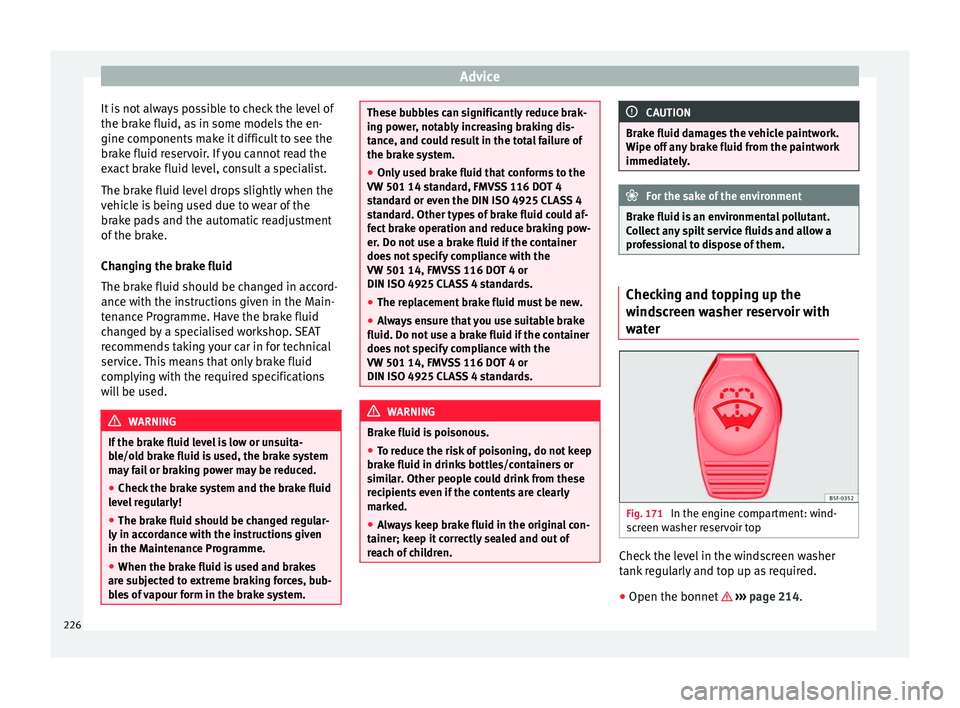
Fig. 171
In the engine compartment: wind-
screen washer reservoir top Check the level in the windscreen washer
tank regularly and top up as required.
● Open the bonnet ››› page 214.
226
Page 235 of 305
Wheels and tyres
time to time according to the system
››› Fig. 174 . The useful life of all the tyres will
then be about the s
ame time.
SEAT recommends you take the vehicle to a
specialised workshop to have the tyres
changed.
Tyres that are over 6 years old
Tyres are subject to an ageing process as a
result of physical and chemical processes.
This may affect their performance. Tyres
which are stored for long periods of time
without being used, harden and become
more fragile than tyres which are in constant
use.
SEAT recommends that tyres over six years
old are replaced with new tyres. This also ap-
plies to tyres which appear to be in perfect
condition on the outside and which have a
tread depth within the values stipulated by
the Law ››› .
The date of manufacture, part of the tyre
identification number (TIN), indicates the age
of the tyre ››› page 238 .
St orin
g tyres
Mark tyres when you remove them to indicate
the direction of rotation (left, right, forwards,
backwards). This ensures you will be able to
mount them correctly when you replace
them. When removed, the wheels and/or
tyres should be stored in a cool, dry and pref- erably dark location. Do
not place tyres
mount
ed on the wheel in a vertical position.
Protect tyres not mounted on wheels from
dirt by storing them in suitable bags and
standing them on the ground on their tread. WARNING
Aggressive fluids or substances could result
in visible or invisible damage with the conse-
quent risks.
● Always ensure that tyres do not come into
contact with chemical products, oil, grease,
fuel, brake fluid or other aggressive substan-
ces. WARNING
Old tyres, even if they have never been used,
may lose air or burst unexpectedly while driv-
ing, resulting in serious accident or damage.
● If tyres are over six years old, they should
only be used in an emergency and with ex-
treme caution. For the sake of the environment
Old tyres must be disposed of by qualified
personnel according to the laws in the coun-
try concerned. Wheel rims
The design of wheel bolts is matched to the
rims. If different rims are fitted, the correct
wheel bolts with the right length and correct-
ly shaped bolt heads must be used. This en-
sures that wheels are fitted securely and that
the brake system functions correctly
››› page 246.
F or t
echnical reasons, it is not generally pos-
sible to use the wheels from other vehicles.
In some cases, this may also be true for the
same model of wheel.
The tyres and rims approved by SEAT are spe-
cially matched to the characteristics of the
vehicle and are critical to good road holding
and safe handling.
Note for Italy: A SEAT Service Centre should
be c on
sulted whether different sized wheels
or tyres to those originally fitted by SEAT may
be fitted, as well as the combinations al-
lowed between the front axle (axle 1) and
back axle (axle 2).
Wheel bolts
Wheel bolts must be tightened to the correct
torque ›››
page 246
.
Beadlock wheel rims
Beadlock wheel rims have various compo-
nents. These are joined together by special
bolts using a special procedure. This ensures »
233
Technical specifications
Advice
Operation
Safety
Page 269 of 305
Fuses and bulbs
WARNING
Failure to replace bulbs correctly may cause
serious accidents.
● Before carrying out any work in the engine
compartment please read and observe the
warnings ››› page 214. In any vehicle, the en-
gine c omp
artment is a hazardous area and
could cause severe injury.
● Discharge lamps work with high-voltage
and can cause serious or fatal injury if han-
dled incorrectly.
● H7 and discharge lamps are highly pressur-
ised and could explode when being changed.
● Only replace the bulbs concerned when
they have cooled.
● Never replace bulbs alone if you are not fa-
miliar with the operations necessary. If you
are not sure about procedures then visit a
specialised workshop to carry out the neces-
sary work.
● Never touch the bulb glass directly. Finger-
prints will be evaporated by the heat of the
operating bulb thus “fogging” up the reflec-
tor.
● The headlamp frameworks in the engine
compartment and the tail lamps contain sharp elements. Always protect your hands
when changing bulbs.
CAUTION
● After changing a bulb, if the rubber covers
are not replaced correctly on the headlamp
framework, the electrical installation may be
damaged, especially if water is allowed to en-
ter.
● Remove the ignition key before working on
the electric system. Otherwise, a short circuit
could occur.
● Switch off the lights and the parking light
before changing a bulb.
● Take good care to avoid damaging any com-
ponents. Control lamp
It
lights upPossible causeSolution
A vehicle exterior
lighting bulb is not
working.Replace the faulty
bulb. Several warning and control lamps light up
for a few seconds when the ignition is switch-
ed on, signalling that the function is being
verified. They will switch off after a few sec-
onds.
Checking the bulbs of a trailer
For vehicles with the factory fitted towing
bracket, certain trailer lights are also control-
led if the power socket is correctly connected.
A fault on a trailer turn signal is indicated on
the instrument panel by the turn signal blink-
ing twice as fast (
or ) ››› page 74.
● General fault of all turn signals on one side.
● Fault in one tail light (on some models, al-
so the registration light).
● Fault in two brake lights. WARNING
Observe the safety warnings ››› in Control
and warning lamps on page 47. Note
A fault in the LED on the tail lights will not be
indicated. However, if the fault affects all the
LEDs then this will be indicated by the control
lamp . 267
Technical specifications
Advice
Operation
Safety
Page 292 of 305
Index
Other storage compartments . . . . . . . . . . . . . . 116
Portable waste bin . . . . . . . . . . . . . . . . . . . . . . 116
Rear footwell . . . . . . . . . . . . . . . . . . . . . . . . . . . 115
Roof console . . . . . . . . . . . . . . . . . . . . . . . . . . . 113
Spectacle case . . . . . . . . . . . . . . . . . . . . . . . . . 112
Compass . . . . . . . . . . . . . . . . . . . . . . . . . . . . . . . . . 43
Components . . . . . . . . . . . . . . . . . . . . . . . . . . . . . 189
Connectors Faults . . . . . . . . . . . . . . . . . . . . . . . . . . . . . . . . . 121
Consumption How it is determined . . . . . . . . . . . . . . . . . . . . 211
Information . . . . . . . . . . . . . . . . . . . . . . . . . . . . 211
Control lamp AdBlue . . . . . . . . . . . . . . . . . . . . . . . . . . . . . . . . 212
Airbag system . . . . . . . . . . . . . . . . . . . . . . . . . . . 25
Brake pad wear indication . . . . . . . . . . . . . . . . 138
Brake system . . . . . . . . . . . . . . . . . . . . . . . . . . 138
Catalytic converter . . . . . . . . . . . . . . . . . . . . . . 151
Changing bulbs . . . . . . . . . . . . . . . . . . . . . . . . 267
Changing gear . . . . . . . . . . . . . . . . . . . . . . . . . 143
Checking the engine oil level . . . . . . . . . . . . . 218
Coolant . . . . . . . . . . . . . . . . . . . . . . . . . . . . . . . 222
Cruise control system (CCS) . . . . . . . . . . . . . . . 170
Diesel particulate filter . . . . . . . . . . . . . . . . . . . 151
Engine management . . . . . . . . . . . . . . . . . . . . 151
Engine oil sensor . . . . . . . . . . . . . . . . . . . . . . . 218
ESC . . . . . . . . . . . . . . . . . . . . . . . . . . . . . . . . . . 138
Exhaust gas purification system . . . . . . . . . . . 151
Filling the tank . . . . . . . . . . . . . . . . . . . . . . . . . 208
Fuel level . . . . . . . . . . . . . . . . . . . . . . . . . . . . . . 208
Lane assist system . . . . . . . . . . . . . . . . . . . . . . 172
Pressing the brake . . . . . . . . . . . . . . . . . . . . . . 138
Steering column lock . . . . . . . . . . . . . . . . . . . . 132
Tyre monitoring indicator . . . . . . . . . . . . . . . . . 178
Tyre monitoring systems . . . . . . . . . . . . . . . . . 178
Windscreen wiper fluid level . . . . . . . . . . . . . . . 82 Control lamps
Lights . . . . . . . . . . . . . . . . . . . . . . . . . . . . . . . . . 75
Controlling function Electric exterior mirrors . . . . . . . . . . . . . . . . . . . 87
Control of function Rain sensor . . . . . . . . . . . . . . . . . . . . . . . . . . . . . 84
Control units . . . . . . . . . . . . . . . . . . . . . . . . . . . . . 192 Reprogramming . . . . . . . . . . . . . . . . . . . . . . . . 192
Convenience closing Electric windows . . . . . . . . . . . . . . . . . . . . . . . . . 71
Panoramic sliding sunroof . . . . . . . . . . . . . . . . . 73
Convenience functions Reprogramming . . . . . . . . . . . . . . . . . . . . . . . . 192
Convenience opening Electric windows . . . . . . . . . . . . . . . . . . . . . . . . . 71
Panoramic sliding sunroof . . . . . . . . . . . . . . . . . 73
Convenient entry function for the third row of seats . . . . . . . . . . . . . . . . . . . . . . . . . . . . . . . . . . 95
Coolant Control lamp . . . . . . . . . . . . . . . . . . . . . . . . . . . 222
See engine coolant . . . . . . . . . . . . . . . . . . . . . . 221
Temperature gauge . . . . . . . . . . . . . . . . . . . . . 222
Warning lamp . . . . . . . . . . . . . . . . . . . . . . . . . . 222
Counter steering assistance system . . . . . . . . . . 133
Crossing a river Salt water . . . . . . . . . . . . . . . . . . . . . . . . . . . . . 153
Cruise control . . . . . . . . . . . . . . . . . . . . . . . . . . . . 169
Cruise control system . . . . . . . . . . . . . . . . . . . . . . 169
Cruise control system (CCS) Control lamp . . . . . . . . . . . . . . . . . . . . . . . . . . . 170
Operations . . . . . . . . . . . . . . . . . . . . . . . . . . . . 171
Warning lamp . . . . . . . . . . . . . . . . . . . . . . . . . . 170
Curb weight . . . . . . . . . . . . . . . . . . . . . . . . . . . . . 275
D Damaged tyres . . . . . . . . . . . . . . . . . . . . . . . . . . . 237
Dangers of not using your seat belt . . . . . . . . . . . 13 Dash panel . . . . . . . . . . . . . . . . . . . . . . . . . . . . . . . 39
Airbag system . . . . . . . . . . . . . . . . . . . . . . 20, 204
Data link connector (DLC) . . . . . . . . . . . . . . . . . . 193
Data plate . . . . . . . . . . . . . . . . . . . . . . . . . . . . . . . 274 Model identification . . . . . . . . . . . . . . . . . . . . . 274
Technical specifications . . . . . . . . . . . . . . . . . . 274
Vehicle chassis number . . . . . . . . . . . . . . . . . . 274
Data registry . . . . . . . . . . . . . . . . . . . . . . . . . . . . . 192
Data storage during the journey . . . . . . . . . . . . . 192
Data stored by the control units . . . . . . . . . . . . . 192
Daytime driving light . . . . . . . . . . . . . . . . . . . . . . . 77
De-icing the door lock cylinder . . . . . . . . . . . . . . 199
De-icing the locks . . . . . . . . . . . . . . . . . . . . . . . . . 199
Deadlock . . . . . . . . . . . . . . . . . . . . . . . . . . . . . . . . . 61
Details Driving with a trailer . . . . . . . . . . . . . . . . . . . . . 185
Device disconnection . . . . . . . . . . . . . . . . . . . . . . 230
Diagnostics connection . . . . . . . . . . . . . . . . . . . . 193
Diesel . . . . . . . . . . . . . . . . . . . . . . . . . . . . . . . . . . 210 Auxiliary heater . . . . . . . . . . . . . . . . . . . . . . . . . 211
Biodiesel . . . . . . . . . . . . . . . . . . . . . . . . . . . . . . 211
Filling the tank . . . . . . . . . . . . . . . . . . . . . . . . . 208
Filter pre-heater . . . . . . . . . . . . . . . . . . . . . . . . 211
Fuel gauge . . . . . . . . . . . . . . . . . . . . . . . . . . . . 208
Winter-grade diesel . . . . . . . . . . . . . . . . . . . . . 210
Diesel particulate filter . . . . . . . . . . . . . . . . . . . . 152 Control lamp . . . . . . . . . . . . . . . . . . . . . . . . . . . 151
Malfunction . . . . . . . . . . . . . . . . . . . . . . . . . . . . 152
Recommended gear . . . . . . . . . . . . . . . . . . . . . 147
Things to note . . . . . . . . . . . . . . . . . . . . . . . . . . 211
Differential lock See "Brake assist systems" . . . . . . . . . . . . . . . 155
Digital clock . . . . . . . . . . . . . . . . . . . . . . . . . . . . . . 40
Dimensions . . . . . . . . . . . . . . . . . . . . . . . . . . . . . . 285
Dipped beam headlight . . . . . . . . . . . . . . . . . . . . . 75
Dipstick . . . . . . . . . . . . . . . . . . . . . . . . . . . . . . . . . 219
Display . . . . . . . . . . . . . . . . . . . . . . . . . . . . . . . 40, 41
290