change wheel Seat Alhambra 2015 Owner's Guide
[x] Cancel search | Manufacturer: SEAT, Model Year: 2015, Model line: Alhambra, Model: Seat Alhambra 2015Pages: 305, PDF Size: 5.46 MB
Page 258 of 305
Advice
the Keyless Access system, the steering
wheel could lock ››› .
WARNING
A vehicle with a flat battery should never be
towed.
● Never remove the key from the ignition
lock. Otherwise, the steering wheel lock
could suddenly lock. The vehicle would not
be controlled and a serious accident could
ensue. WARNING
When towing the vehicle, the handling and
braking efficiency change considerably.
Please observe the following instructions to
minimise the risk of serious accidents and in-
jury:
● As the driver of the vehicle being towed:
– The brake must be depressed must hard-
er as the brake servo does not operate.
Always remain aware to avoid collision
with the towing vehicle.
– More strength is required at the steering
wheel as the power steering does not op-
erate when the engine is switched off.
● As the driver of the towing vehicle:
– Accelerate gently and carefully.
– Avoid sudden braking and manoeuvres.
– Brake well in advance than usual and
brake gently. CAUTION
● Carefully fit and remove the towline anchor-
age and its cover to avoid damage to the ve-
hicle (e.g. paintwork).
● When towing, fuel could enter the catalytic
converter and cause damage! Instructions for tow starting
In general, the vehicle should not be started
by towing. Jump-starting is much more pref-
erable
› › ›
page 253.
For technical reasons, the following vehicles
can
not be tow started:
● Vehicles with an automatic gearbox.
● Vehicles with the Keyless Access locking
and ignition system, since the electronic
steering lock may not unlock.
● Vehicles with an electronic parking brake,
given that it is possible that the brake will
not be disengaged.
● If the vehicle battery is flat, it is possible
that the engine control units do not operate
correctly.
However, if your vehicle must absolutely be
tow-started (manual gearbox):
● Put it into second or third gear.
● Keep the clutch pressed down. ●
Switch on the ignition and the hazard warn-
ing lights.
● Release the clutch when both vehicles are
moving.
● As soon as the engine starts, press the
clutch and move the gear lever into neutral.
This helps to prevent a collision with the tow-
ing vehicle. CAUTION
When tow-starting, fuel could enter the cata-
lytic converter and damage it. Towing instructions
Tow rope or tow bar
When towing, the tow bar is the safest and
vehicle friendly way. You should only use a
tow rope if you do not have a tow bar.
A tow rope should be slightly elastic to avoid
damage to both vehicles. It is advisable to
use a tow rope made of synthetic fibre or sim-
ilarly elastic material.
Only secure the tow rope or tow bar to the
towline anchorage or specially designed fit-
ting.
Vehicles with a
factory fitted towing device ,
can only
be used for towing with a tow bar,
s
pecially designed to fit on a tow hitch ball
››› page 179.
256
Page 260 of 305
Advice
● After towing, remove the towline anchorage
by turning it clockwise and put the cover
b ac
k in place. CAUTION
The towline anchorage must always be com-
pletely and firmly tightened. Otherwise, it
could be released while towing and tow-start-
ing. Fitting the rear towline anchorage
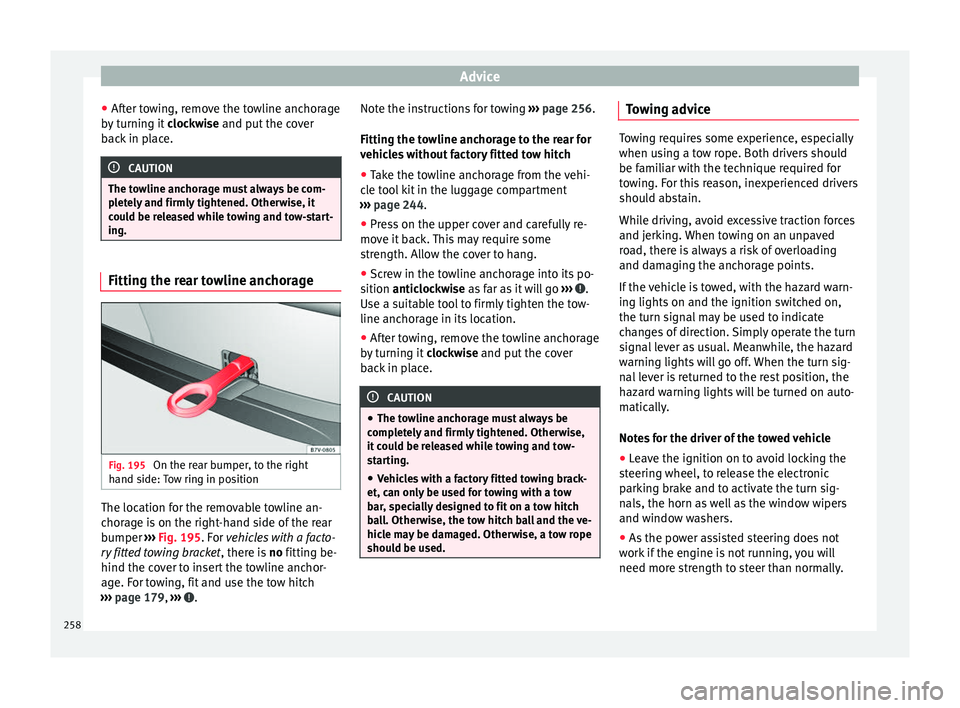
Fig. 195
On the rear bumper, to the right
hand side: Tow ring in position The location for the removable towline an-
chorage is on the right-hand side of the rear
bumper
››› Fig. 195 . For
vehicles with a facto-
ry
fitted towing bracket , there is no fitting be-
hind the cover to insert the towline anchor-
age. For towing, fit and use the tow hitch
››› page 179, ››› . Note the instructions for towing
››› page 256.
Fitting the towline anchorage to the rear for
vehicles without factory fitted tow hitch ● Take the towline anchorage from the vehi-
cle tool kit in the luggage compartment
››› page 244 .
● Pr e
ss on the upper cover and carefully re-
move it back. This may require some
strength. Allow the cover to hang.
● Screw in the towline anchorage into its po-
sition anticlockwise as far as it will go ›
›› .
Use a suitable tool to firmly tighten the tow-
line anchorage in its location.
● After towing, remove the towline anchorage
by turning it clockwise and put the cover
b ac
k in place. CAUTION
● The towline anchorage must always be
completely and firmly tightened. Otherwise,
it could be released while towing and tow-
starting.
● Vehicles with a factory fitted towing brack-
et, can only be used for towing with a tow
bar, specially designed to fit on a tow hitch
ball. Otherwise, the tow hitch ball and the ve-
hicle may be damaged. Otherwise, a tow rope
should be used. Towing advice
Towing requires some experience, especially
when using a tow rope. Both drivers should
be familiar with the technique required for
towing. For this reason, inexperienced drivers
should abstain.
While driving, avoid excessive traction forces
and jerking. When towing on an unpaved
road, there is always a risk of overloading
and damaging the anchorage points.
If the vehicle is towed, with the hazard warn-
ing lights on and the ignition switched on,
the turn signal may be used to indicate
changes of direction. Simply operate the turn
signal lever as usual. Meanwhile, the hazard
warning lights will go off. When the turn sig-
nal lever is returned to the rest position, the
hazard warning lights will be turned on auto-
matically.
Notes for the driver of the towed vehicle
●
Leave the ignition on to avoid locking the
steering wheel, to release the electronic
parking brake and to activate the turn sig-
nals, the horn as well as the window wipers
and window washers.
● As the power assisted steering does not
work if the engine is not running, you will
need more strength to steer than normally.
258
Page 278 of 305
Technical specifications
Towing a trailer Trailer weights Trailer weight
The trailer weights and drawbar loads ap-
proved are selected in intensive trials accord-
ing to precisely defined criteria. The ap-
proved trailer weights are valid for vehicles in
the EU
for maximum speeds of 80 km/h (50
mph) (in c ertain circumstances up to 100
km/h (62 mph)). The figures may be different
in other countries. All data in the official vehi-
cle documentation takes precedence over
these data at all times ››› .
Drawbar loads
The maximum
permitted drawbar load on the
b
all joint of the towing bracket must not ex-
ceed
100 kg.
In the interest of road safety, we recommend
that you always tow approaching the maxi-
mum drawbar load. The response of the trail-
er on the road will be poor, if the drawbar
load is too small.
If the maximum permissible drawbar load
cannot be met (e.g. with small, empty and
light-weight single axle trailers or tandem
axle trailers with a wheelbase of less than 1
metre), a minimum of 4% of the actual trailer
weight is legally required for the drawbar
load. WARNING
● For safety reasons, do not exceed the 80
km/h (50 mph) limit. This is also valid in
countries where higher speeds are permitted.
● Never exceed the maximum trailer weights
or the drawbar load. If the permissible axle
load or the permissible total weight is excee-
ded, the driving characteristics of the vehicle
may change, leading to accidents, injuries
and damage to the vehicle. Wheels
Tyre pressure, snow chains, wheel
bolts Tyre pressures
The sticker with the tyre pressure values can
be found on the inside of the fuel tank flap.
The tyre pressure values given there are for
cold
tyres. The slightly raised pressures of
w arm ty
res must not be reduced. ››› Snow chains
Snow chains may be fitted only to the
front
wheels .
C on
sult the section “wheels” of this manual. Wheel bolts
After the wheels have been changed, the
tightening torque
of the wheel bolts should
be checked as soon as possible with a torque
wrench ››› . The tightening torque for steel
and alloy wheels is 140 Nm. WARNING
● Check the tyre pressure at least once per
month. Checking the tyre pressure is very im-
portant. If the tyre pressure is too high or too
low, there is an increased danger of accidents
- particularly at high speeds.
● If the tightening torque of the wheel bolts
is too low, they could loosen while the vehi-
cle is in motion. Risk of accident! If the tight-
ening torque is too high, the wheel bolts and
threads can be damaged. Note
We recommend that you ask your Technical
Service for information about appropriate
wheel, tyre and snow chain size. 276
Page 287 of 305
Technical specifications
DimensionsLength/Width (mm)4,854/1,904
Height at kerb weight (mm)1,720
Wheelbase (mm)2,919
Turning radius (m)11.9
Front/rear a)
track width (mm)1,557/1,569
1,605/1,617
a) This data will change depending on the type of wheel rim.
Capacities
Capacities
Fuel tank 70 litres. Reserve 8 li-
tres.
Windscreen washer fluid
container/
with headlight washer 3.5 l/ 6 l
Tyre pressure
Summer tyres:
Correct tyre pressure can be seen on the sticker on the
inside of the fuel tank flap.
Winter tyres:
The pressure of these tyres is 0.2 bar higher than that of
summer tyres (2.9 psi / 20 kPa). CAUTION
● Special care should be taken when parking
in areas with high kerbs or fixed barriers. Ob-
jects protruding from the ground may dam-
age the bumper or other parts of the vehicle
during manoeuvres.
● Special attention is required when driving
through entrances, over ramps, kerbs or oth-
er objects. The vehicle underbody, bumpers,
mudguards and running gear, and the engine
and exhaust system could be damaged as
you drive over these objects. 285
Technical specifications
Advice
Operation
Safety
Page 291 of 305
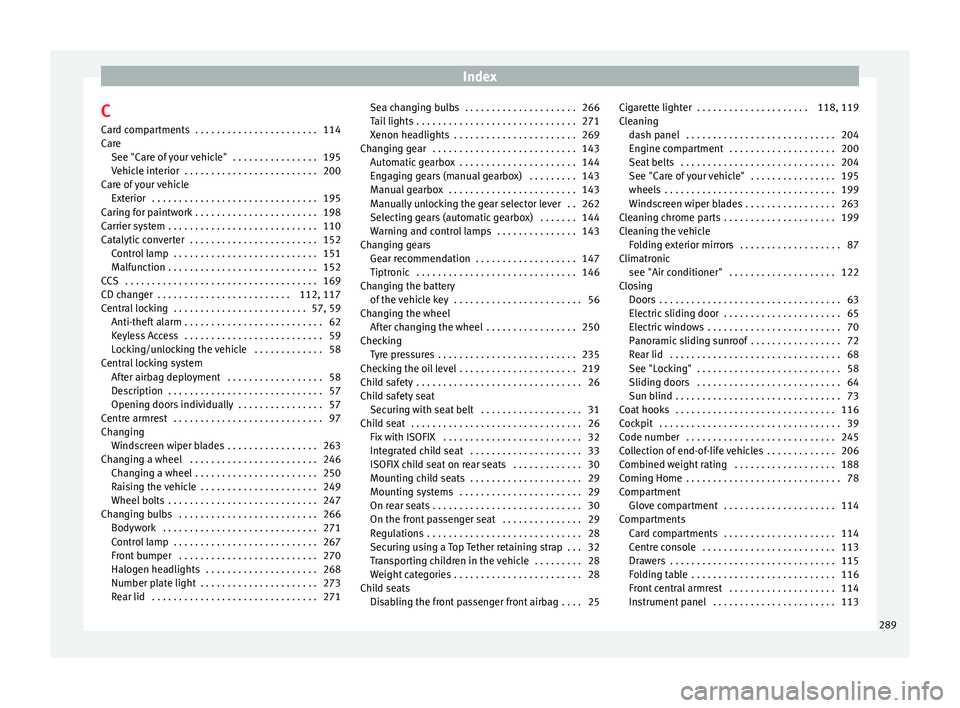
Index
C
Card compartments . . . . . . . . . . . . . . . . . . . . . . . 114
Care See "Care of your vehicle" . . . . . . . . . . . . . . . . 195
Vehicle interior . . . . . . . . . . . . . . . . . . . . . . . . . 200
Care of your vehicle Exterior . . . . . . . . . . . . . . . . . . . . . . . . . . . . . . . 195
Caring for paintwork . . . . . . . . . . . . . . . . . . . . . . . 198
Carrier system . . . . . . . . . . . . . . . . . . . . . . . . . . . . 110
Catalytic converter . . . . . . . . . . . . . . . . . . . . . . . . 152 Control lamp . . . . . . . . . . . . . . . . . . . . . . . . . . . 151
Malfunction . . . . . . . . . . . . . . . . . . . . . . . . . . . . 152
CCS . . . . . . . . . . . . . . . . . . . . . . . . . . . . . . . . . . . . 169
CD changer . . . . . . . . . . . . . . . . . . . . . . . . . 112, 117
Central locking . . . . . . . . . . . . . . . . . . . . . . . . . 57, 59 Anti-theft alarm . . . . . . . . . . . . . . . . . . . . . . . . . . 62
Keyless Access . . . . . . . . . . . . . . . . . . . . . . . . . . 59
Locking/unlocking the vehicle . . . . . . . . . . . . . 58
Central locking system After airbag deployment . . . . . . . . . . . . . . . . . . 58
Description . . . . . . . . . . . . . . . . . . . . . . . . . . . . . 57
Opening doors individually . . . . . . . . . . . . . . . . 57
Centre armrest . . . . . . . . . . . . . . . . . . . . . . . . . . . . 97
Changing Windscreen wiper blades . . . . . . . . . . . . . . . . . 263
Changing a wheel . . . . . . . . . . . . . . . . . . . . . . . . 246 Changing a wheel . . . . . . . . . . . . . . . . . . . . . . . 250
Raising the vehicle . . . . . . . . . . . . . . . . . . . . . . 249
Wheel bolts . . . . . . . . . . . . . . . . . . . . . . . . . . . . 247
Changing bulbs . . . . . . . . . . . . . . . . . . . . . . . . . . 266 Bodywork . . . . . . . . . . . . . . . . . . . . . . . . . . . . . 271
Control lamp . . . . . . . . . . . . . . . . . . . . . . . . . . . 267
Front bumper . . . . . . . . . . . . . . . . . . . . . . . . . . 270
Halogen headlights . . . . . . . . . . . . . . . . . . . . . 268
Number plate light . . . . . . . . . . . . . . . . . . . . . . 273
Rear lid . . . . . . . . . . . . . . . . . . . . . . . . . . . . . . . 271 Sea changing bulbs . . . . . . . . . . . . . . . . . . . . . 266
Tail lights . . . . . . . . . . . . . . . . . . . . . . . . . . . . . . 271
Xenon headlights . . . . . . . . . . . . . . . . . . . . . . . 269
Changing gear . . . . . . . . . . . . . . . . . . . . . . . . . . . 143 Automatic gearbox . . . . . . . . . . . . . . . . . . . . . . 144
Engaging gears (manual gearbox) . . . . . . . . . 143
Manual gearbox . . . . . . . . . . . . . . . . . . . . . . . . 143
Manually unlocking the gear selector lever . . 262
Selecting gears (automatic gearbox) . . . . . . . 144
Warning and control lamps . . . . . . . . . . . . . . . 143
Changing gears Gear recommendation . . . . . . . . . . . . . . . . . . . 147
Tiptronic . . . . . . . . . . . . . . . . . . . . . . . . . . . . . . 146
Changing the battery of the vehicle key . . . . . . . . . . . . . . . . . . . . . . . . 56
Changing the wheel After changing the wheel . . . . . . . . . . . . . . . . . 250
Checking Tyre pressures . . . . . . . . . . . . . . . . . . . . . . . . . . 235
Checking the oil level . . . . . . . . . . . . . . . . . . . . . . 219
Child safety . . . . . . . . . . . . . . . . . . . . . . . . . . . . . . . 26
Child safety seat Securing with seat belt . . . . . . . . . . . . . . . . . . . 31
Child seat . . . . . . . . . . . . . . . . . . . . . . . . . . . . . . . . 26 Fix with ISOFIX . . . . . . . . . . . . . . . . . . . . . . . . . . 32
Integrated child seat . . . . . . . . . . . . . . . . . . . . . 33
ISOFIX child seat on rear seats . . . . . . . . . . . . . 30
Mounting child seats . . . . . . . . . . . . . . . . . . . . . 29
Mounting systems . . . . . . . . . . . . . . . . . . . . . . . 29
On rear seats . . . . . . . . . . . . . . . . . . . . . . . . . . . . 30
On the front passenger seat . . . . . . . . . . . . . . . 29
Regulations . . . . . . . . . . . . . . . . . . . . . . . . . . . . . 28
Securing using a Top Tether retaining strap . . . 32
Transporting children in the vehicle . . . . . . . . . 28
Weight categories . . . . . . . . . . . . . . . . . . . . . . . . 28
Child seats Disabling the front passenger front airbag . . . . 25 Cigarette lighter . . . . . . . . . . . . . . . . . . . . . 118, 119
Cleaning
dash panel . . . . . . . . . . . . . . . . . . . . . . . . . . . . 204
Engine compartment . . . . . . . . . . . . . . . . . . . . 200
Seat belts . . . . . . . . . . . . . . . . . . . . . . . . . . . . . 204
See "Care of your vehicle" . . . . . . . . . . . . . . . . 195
wheels . . . . . . . . . . . . . . . . . . . . . . . . . . . . . . . . 199
Windscreen wiper blades . . . . . . . . . . . . . . . . . 263
Cleaning chrome parts . . . . . . . . . . . . . . . . . . . . . 199
Cleaning the vehicle Folding exterior mirrors . . . . . . . . . . . . . . . . . . . 87
Climatronic see "Air conditioner" . . . . . . . . . . . . . . . . . . . . 122
Closing Doors . . . . . . . . . . . . . . . . . . . . . . . . . . . . . . . . . . 63
Electric sliding door . . . . . . . . . . . . . . . . . . . . . . 65
Electric windows . . . . . . . . . . . . . . . . . . . . . . . . . 70
Panoramic sliding sunroof . . . . . . . . . . . . . . . . . 72
Rear lid . . . . . . . . . . . . . . . . . . . . . . . . . . . . . . . . 68
See "Locking" . . . . . . . . . . . . . . . . . . . . . . . . . . . 58
Sliding doors . . . . . . . . . . . . . . . . . . . . . . . . . . . 64
Sun blind . . . . . . . . . . . . . . . . . . . . . . . . . . . . . . . 73
Coat hooks . . . . . . . . . . . . . . . . . . . . . . . . . . . . . . 116
Cockpit . . . . . . . . . . . . . . . . . . . . . . . . . . . . . . . . . . 39
Code number . . . . . . . . . . . . . . . . . . . . . . . . . . . . 245
Collection of end-of-life vehicles . . . . . . . . . . . . . 206
Combined weight rating . . . . . . . . . . . . . . . . . . . 188
Coming Home . . . . . . . . . . . . . . . . . . . . . . . . . . . . . 78
Compartment Glove compartment . . . . . . . . . . . . . . . . . . . . . 114
Compartments Card compartments . . . . . . . . . . . . . . . . . . . . . 114
Centre console . . . . . . . . . . . . . . . . . . . . . . . . . 113
Drawers . . . . . . . . . . . . . . . . . . . . . . . . . . . . . . . 115
Folding table . . . . . . . . . . . . . . . . . . . . . . . . . . . 116
Front central armrest . . . . . . . . . . . . . . . . . . . . 114
Instrument panel . . . . . . . . . . . . . . . . . . . . . . . 113
289