ABS Seat Alhambra 2017 Owner's Manual
[x] Cancel search | Manufacturer: SEAT, Model Year: 2017, Model line: Alhambra, Model: Seat Alhambra 2017Pages: 320, PDF Size: 6.88 MB
Page 35 of 320
The essentials
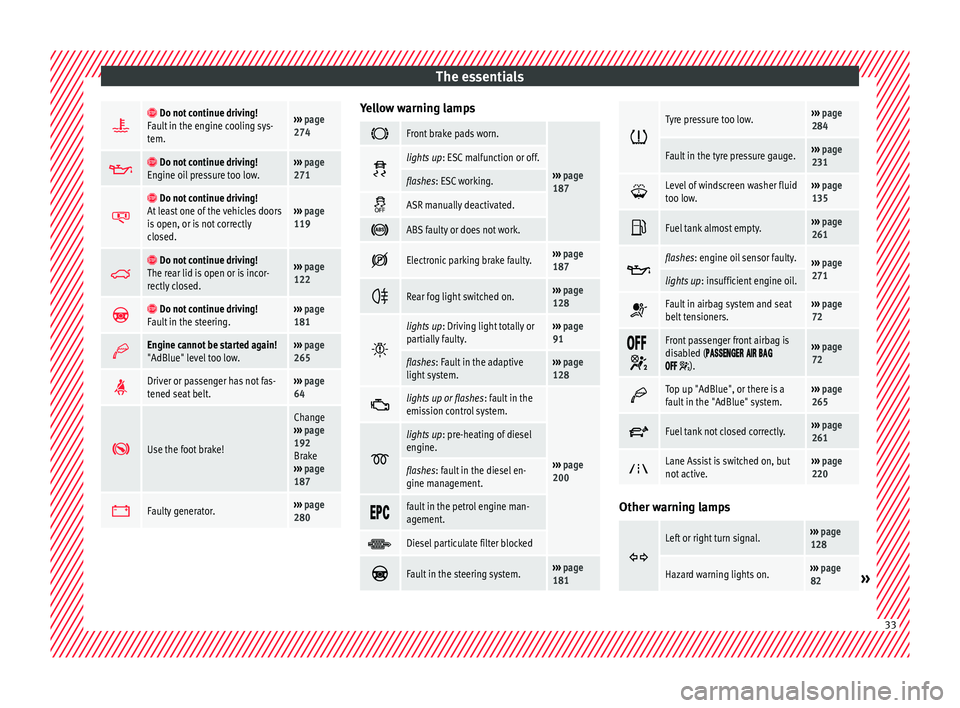
Do not continue driving!
Fault in the engine cooling sys-
tem.››› page
274
Do not continue driving!
Engine oil pressure too low.››› page
271
Do not continue driving!
At least one of the vehicles doors
is open, or is not correctly
closed.››› page
119
Do not continue driving!
The rear lid is open or is incor-
rectly closed.››› page
122
Do not continue driving!
Fault in the steering.››› page
181
Engine cannot be started again!
"AdBlue" level too low.›››
page
265
Driver or passenger has not fas-
tened seat belt.›››
page
64
Use the foot brake!
Change
››› page
192
Brake
››› page
187
Faulty generator.›››
page
280 Yellow warning lamps
Front brake pads worn.
›››
page
187 lights up
: ESC malfunction or off.
flashes: ESC working.
ASR manually deactivated.
ABS faulty or does not work.
Electronic parking brake faulty.›››
page
187
Rear fog light switched on.›››
page
128
lights up
: Driving light totally or
partially faulty.››› page
91
flashes: Fault in the adaptive
light system.››› page
128
lights up or flashes
: fault in the
emission control system.
››› page
200
lights up
: pre-heating of diesel
engine.
flashes: fault in the diesel en-
gine management.
fault in the petrol engine man-
agement.
Diesel particulate filter blocked
Fault in the steering system.›››
page
181
Tyre pressure too low.›››
page
284
Fault in the tyre pressure gauge.››› page
231
Level of windscreen washer fluid
too low.›››
page
135
Fuel tank almost empty.›››
page
261
flashes: engine oil sensor faulty.›››
page
271
lights up : insufficient engine oil.
Fault in airbag system and seat
belt tensioners.›››
page
72
Front passenger front airbag is
disabled (
).
››› page
72
Top up "AdBlue", or there is a
fault in the "AdBlue" system.›››
page
265
Fuel tank not closed correctly.›››
page
261
Lane Assist is switched on, but
not active.›››
page
220 Other warning lamps
Left or right turn signal.›››
page
128
Hazard warning lights on.››› page
82» 33
Page 44 of 320
The essentials
Emergencies F u
se
s
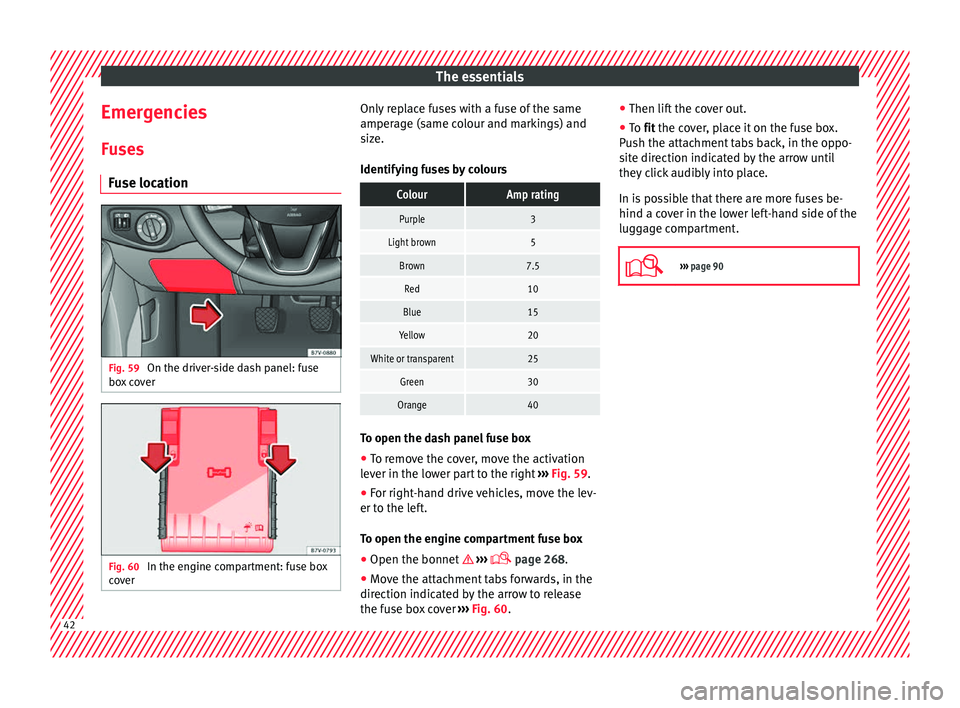
Fuse location Fig. 59
On the driver-side dash panel: fuse
bo x
c
over Fig. 60
In the engine compartment: fuse box
c o v
er Only replace fuses with a fuse of the same
amper
ag
e (s
ame colour and markings) and
size.
Identifying fuses by colours
ColourAmp rating
Purple3
Light brown5
Brown7.5
Red10
Blue15
Yellow20
White or transparent25
Green30
Orange40 To open the dash panel fuse box
●
To remove the cover, move the activation
l ev
er in the lo
wer part to the right ››› Fig. 59.
● For right-hand drive vehicles, move the lev-
er to the lef
t.
To open the engine compartment fuse box
● Open the bonnet ›››
page 268.
● Move the attachment tabs forwards, in the
direction indicat
ed by the arrow to release
the fuse box cover ››› Fig. 60. ●
Then lift the c
over out.
● To fit the cover, place it on the fuse box.
Pu
sh the attachment tabs back, in the oppo-
site direction indicated by the arrow until
they click audibly into place.
In is possible that there are more fuses be-
hind a cover in the lower left-hand side of the
luggage compartment.
››› page 90 42
Page 53 of 320
The essentials
Only secure the tow rope or tow bar to the
t o
wline anc
horage or specially designed fit-
ting.
Vehicles with a factory fitted towing device ,
can only be used for towing with a tow bar,
specially designed to fit on a tow hitch ball
››› page 234.
Towing vehicles with an automatic gearbox
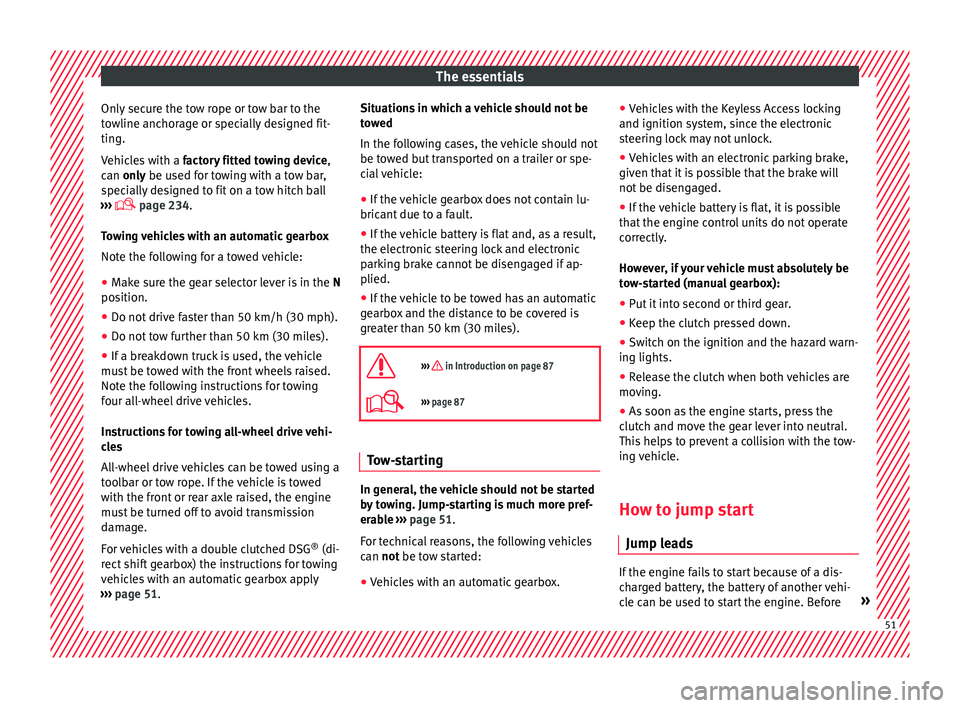
Note the following for a towed vehicle: ● Make sure the gear selector lever is in the N
position.
● Do not
drive faster than 50 km/h (30 mph).
● Do not tow further than 50 km (30 miles).
● If a breakdown truck is used, the vehicle
must
be towed with the front wheels raised.
Note the following instructions for towing
four all-wheel drive vehicles.
Instructions for towing all-wheel drive vehi-
cles
All-wheel drive vehicles can be towed using a
toolbar or tow rope. If the vehicle is towed
with the front or rear axle raised, the engine
must be turned off to avoid transmission
damage.
For vehicles with a double clutched DSG ®
(di-
rect shift gearbox) the instructions for towing
vehicles with an automatic gearbox apply
››› page 51. Situations in which a vehicle should not be
tow
ed
In the following cases, the vehicle should not
be towed but transported on a trailer or spe-
cial vehicle:
● If the vehicle gearbox does not contain lu-
bricant due t
o a fault.
● If the vehicle battery is flat and, as a result,
the electronic
steering lock and electronic
parking brake cannot be disengaged if ap-
plied.
● If the vehicle to be towed has an automatic
gearbo
x and the distance to be covered is
greater than 50 km (30 miles).
››› in Introduction on page 87
››› page 87 Tow-starting
In general, the vehicle should not be started
b
y
t
owing. Jump-starting is much more pref-
erable ›››
page 51.
For technical reasons, the following vehicles
can not be tow started:
● Vehicles with an automatic gearbox. ●
Vehicl
es with the Keyless Access locking
and ignition system, since the electronic
steering lock may not unlock.
● Vehicles with an electronic parking brake,
given that
it is possible that the brake will
not be disengaged.
● If the vehicle battery is flat, it is possible
that the en
gine control units do not operate
correctly.
However, if your vehicle must absolutely be
tow-started (manual gearbox):
● Put it into second or third gear.
● Keep the clutch pressed down.
● Switch on the ignition and the hazard warn-
ing lights.
● Rel
ease the clutch when both vehicles are
movin
g.
● As soon as the engine starts, press the
clutc
h and move the gear lever into neutral.
This helps to prevent a collision with the tow-
ing vehicle.
How to jump start
Jump lea
ds If the engine fails to start because of a dis-
c
h
ar
ged battery, the battery of another vehi-
cle can be used to start the engine. Before » 51
Page 65 of 320

Seat belts
Properly worn seat belts hold the occupants
in the pr oper po
s
ition. They also help prevent
uncontrolled movements that may result in
serious injury and reduce the risk of being
thrown out of the vehicle in case of an acci-
dent.
Vehicle occupants wearing their seat belts
correctly benefit greatly from the ability of the
belts to absorb kinetic energy. In addition,
the front part of your vehicle and other pas-
sive safety features (such as the airbag sys-
tem) are designed to absorb the kinetic ener-
gy released in a collision. Taken together, all
these features reduce the releasing kinetic
energy and consequently, the risk of injury.
This is why it is so important to fasten seat
belts before every trip, even when "just driv-
ing around the corner".
Ensure that your passengers wear their seat
belts as well. Accident statistics have shown
that wearing seat belts is an effective means
of substantially reducing the risk of injury
and improving the chances of survival when
involved in a serious accident. Furthermore,
properly worn seat belts improve the protec-
tion provided by airbags in the event of an
accident. For this reason, wearing a seat belt
is required by law in most countries.
Although your vehicle is equipped with air-
bags, the seat belts must be fastened and
worn. The front airbags, for example, are only
triggered in some cases of head-on collision.
The front airbags will not be triggered during minor frontal or side collisions, rear-end colli-
sions, r
ollovers or accidents in which the air-
bag trigger threshold value in the control unit
is not exceeded.
Therefore, you should always wear your seat
belt and ensure that all vehicle occupants
have fastened their seat belts properly before
you drive off!
Head-on collisions and the laws of
phys
ics Fig. 85
A driver not wearing a seat belt is
thr own f
orward violently Fig. 86
The unbelted rear passenger is
thro wn f
orward violently, hitting the driver
wearing a seat belt It is easy to explain how the laws of physics
w
ork
in the c
ase of a head-on collision: when
a vehicle starts moving, a type of energy
called “kinetic energy” is created both in the
passengers and inside the vehicle.
The amount of “kinetic energy” depends on
the speed of the vehicle and the weight of
the vehicle and its passengers. The higher
the speed and the greater the weight, the
more energy there is to be “absorbed” in an
accident.
The most significant factor, however, is the
speed of the vehicle. If the speed doubles
from 25 km/h (15 mph) to 50 km/h
(30 mph), for example, the corresponding ki-
netic energy is multiplied by four.
Because the vehicle occupants in our exam-
ple are not restrained by seat belts, in the »
63
Technical data
Advice
Operation
Emergencies
Safety
Page 66 of 320
Safety
event of crashing against a wall, all of the oc-
c up
ants' k
inetic energy will be absorbed
solely by said impact.
Even at speeds of 30 km/h (19 mph) to
50 km/h (30 mph), the forces acting on bod-
ies in a collision can easily exceed one tonne
(1000 kg). At greater speed these forces are
even higher.
Vehicle occupants not wearing seat belts are
not “attached” to the vehicle. In a head-on
collision, they will move forward at the same
speed their vehicle was travelling just before
the impact. This example applies not only to
head-on collisions, but to all accidents and
collisions.
Even at low speeds the forces acting on the
body in a collision are so great that it is not
possible to brace oneself with one's hands.
In a frontal collision, unbelted passengers
are thrown forward and will make violent con-
tact with the steering wheel, dash panel,
windscreen or whatever else is in the way
››› Fig. 85.
It is also important for rear passengers to
wear seat belts properly, as they could other-
wise be thrown forward violently through the
vehicle interior in an accident. Passengers in
the rear seats who do not use seat belts en-
danger not only themselves but also the front
occupants ››› Fig. 86. Using seat belts Twisted seat belt
If it
i
s difficult to remove the seat belt from
the guide, the seat belt may have become
twisted inside the side trim after being
wound too quickly on unfastening:
● Pull out the seat belt completely, carefully
pul
ling on the latch plate.
● Untwist the belt and guide it back, assist-
ing it b
y hand.
The seat belt must be fastened even if it is
impossible to untwist it. In this case, the
twisted area must not be in an area in direct
contact with your body. Have the seat belt
untwisted urgently by a specialised work-
shop. WARNING
An improperly handled seat belt increases
the risk of
sustaining severe or fatal injuries.
● Regularly check that the seat belts and
their components
are in perfect condition.
● Always keep your seat belt clean.
● Do not jam or damage the seat belt or rub it
with sharp edg
es.
● Make sure there are no liquids or foreign
bodies on the l
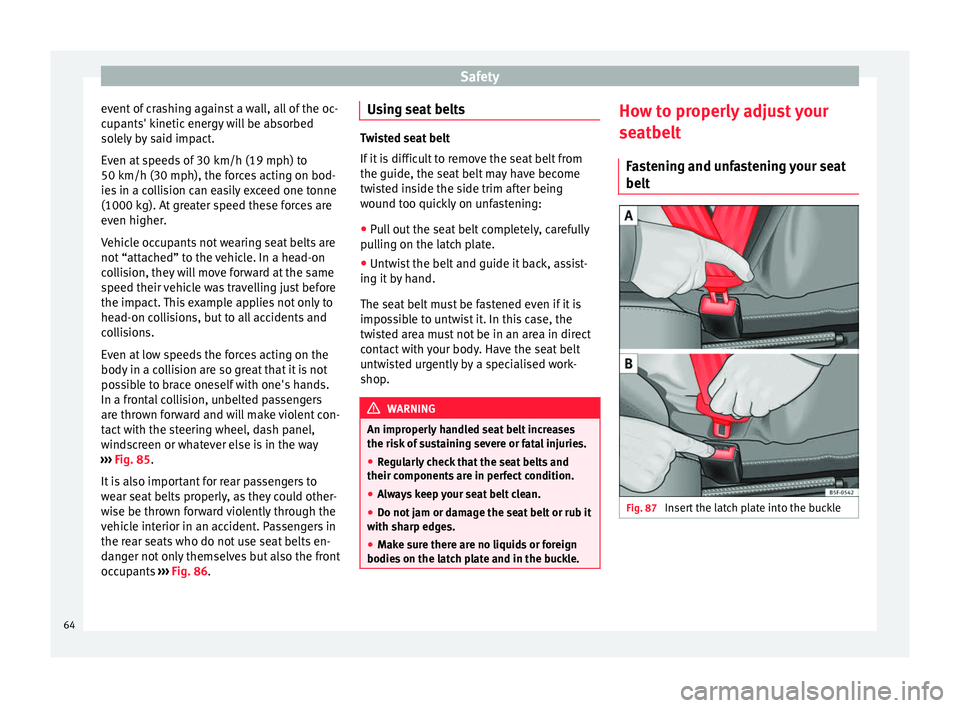
atch plate and in the buckle. How to properly adjust your
se
at
belt
F
astening and unfastening your seat
belt Fig. 87
Insert the latch plate into the buckle64
Page 85 of 320
Self-help
especially in accidents causing serious in-
jury
.
● M
ake sure that the vehicle tools are stored
safely
in the luggage compartment. WARNING
Unsuitable or damaged vehicle tools can
c au se injur
y or accidents.
● Never work with inappropriate or damaged
tool
s. Note
After use, return the jack to its initial position
us in
g the handle in order to securely store it
in the vehicle. Components
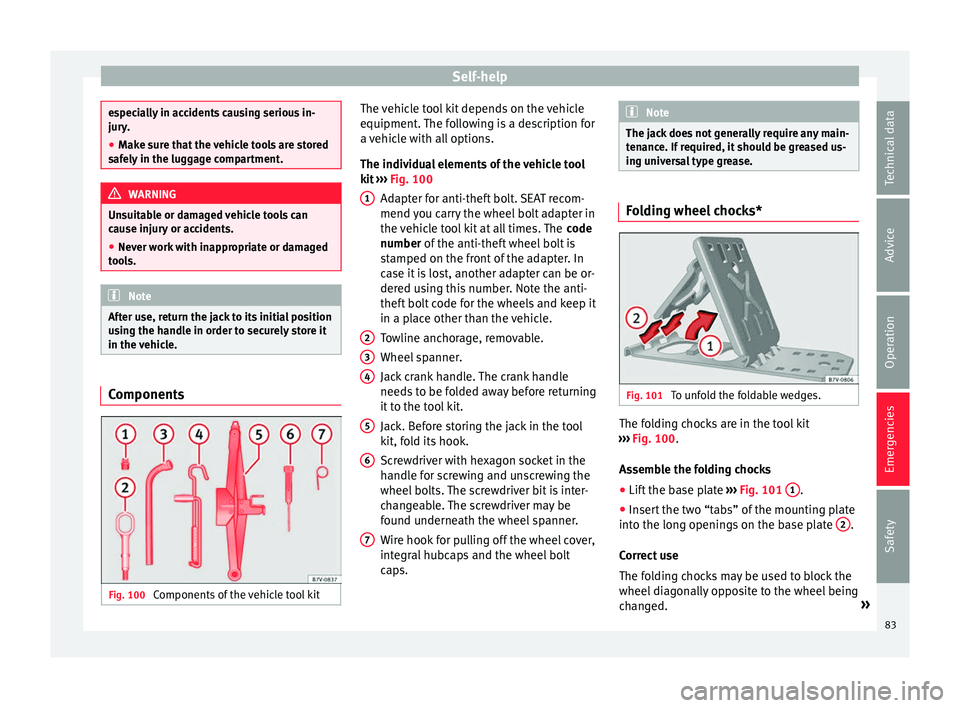
Fig. 100
Components of the vehicle tool kit The vehicle tool kit depends on the vehicle
equipment
.
The f
ollowing is a description for
a vehicle with all options.
The individual elements of the vehicle tool
kit ››› Fig. 100
Adapter for anti-theft bolt. SEAT recom-
mend you carry the wheel bolt adapter in
the vehicle tool kit at all times. The code
number of the anti-theft wheel bolt is
stamped on the front of the adapter. In
case it is lost, another adapter can be or-
dered using this number. Note the anti-
theft bolt code for the wheels and keep it
in a place other than the vehicle.
Towline anchorage, removable.
Wheel spanner.
Jack crank handle. The crank handle
needs to be folded away before returning
it to the tool kit.
Jack. Before storing the jack in the tool
kit, fold its hook.
Screwdriver with hexagon socket in the
handle for screwing and unscrewing the
wheel bolts. The screwdriver bit is inter-
changeable. The screwdriver may be
found underneath the wheel spanner.
Wire hook for pulling off the wheel cover,
integral hubcaps and the wheel bolt
caps.
1
2
3
4
5
6
7 Note
The jack does not generally require any main-
ten anc
e. If required, it should be greased us-
ing universal type grease. Folding wheel chocks*
Fig. 101
To unfold the foldable wedges. The folding chocks are in the tool kit
› ›
›
Fig. 100.
Assemble the folding chocks
● Lift the base plate ›››
Fig. 101 1 .
● Insert the two “tabs” of the mounting plate
int o the lon
g openin
gs on the base plate 2 .
C orr
ect
use
The folding chocks may be used to block the
wheel diagonally opposite to the wheel being
changed. »
83
Technical data
Advice
Operation
Emergencies
Safety
Page 91 of 320
Self-help
Note the instructions for towing
› ›
›
page 50.
Fitting the towline anchorage to the rear for
vehicles without factory fitted tow hitch
● Take the towline anchorage from the vehi-
cle t
ool kit in the luggage compartment
››› page 82.
● Press on the upper cover and carefully re-
move it
back. This may require some
strength. Allow the cover to hang.
● Screw in the towline anchorage into its po-
sition antic
lockwise as far as it will go ››› .
U se a s
uit
able tool to firmly tighten the tow-
line anchorage in its location.
● After towing, remove the towline anchorage
by t
urning it clockwise and put the cover
back in place. CAUTION
● The to wline anc
horage must always be
completely and firmly tightened. Otherwise,
it could be released while towing and tow-
starting.
● Vehicles with a factory fitted towing brack-
et, can only
be used for towing with a tow
bar, specially designed to fit on a tow hitch
ball. Otherwise, the tow hitch ball and the ve-
hicle may be damaged. Otherwise, a tow rope
should be used. Towing advice
Towing requires some expertise and experi-
ence, e
s
pecially when using a tow rope. Both
drivers should be familiar with the technique
required for towing. For this reason, inexper-
ienced drivers should abstain.
While driving, avoid excessive traction forces
and jerking. When towing on an unpaved
road, there is always a risk of overloading
and damaging the anchorage points.
If the vehicle is towed, with the hazard warn-
ing lights on and the ignition switched on,
the turn signal may be used to indicate
changes of direction. Simply operate the turn
signal lever as usual. Meanwhile, the hazard
warning lights will go off. When the turn sig-
nal lever is returned to the rest position, the
hazard warning lights will be turned on auto-
matically.
Notes for the driver of the towed vehicle
● Leave the ignition on to avoid locking the
st eerin
g wheel, to release the electronic
parking brake and to activate the turn sig-
nals, the horn as well as the window wipers
and window washers.
● As the power assisted steering does not
work if
the engine is not running, you will
need more strength to steer than normally. ●
The brake mu
st be depressed must harder
as the brake servo does not operate. Avoid
hitting the towing vehicle.
● Note the instructions and information con-
tained in the Ins
truction Manual for the vehi-
cle to be towed.
Notes for the driver of the towing vehicle
● Accelerate gently and carefully. Avoid sud-
den manoeuvr
es.
● Brake well in advance than usual and brake
gently.
● Not
e the instructions and information con-
tained in the Ins
truction Manual for the vehi-
cle to be towed.
Emergency locking and unlock-
ing
Introduction Read the additional information carefully
› ›
›
page 8,
›››
page 10,
››› page 13
The doors, rear lid and panoramic sliding
sunroof can be locked manually and partially
opened, for example if the key or the central
locking is damaged. »
89
Technical data
Advice
Operation
Emergencies
Safety
Page 97 of 320
Fuses and bulbs
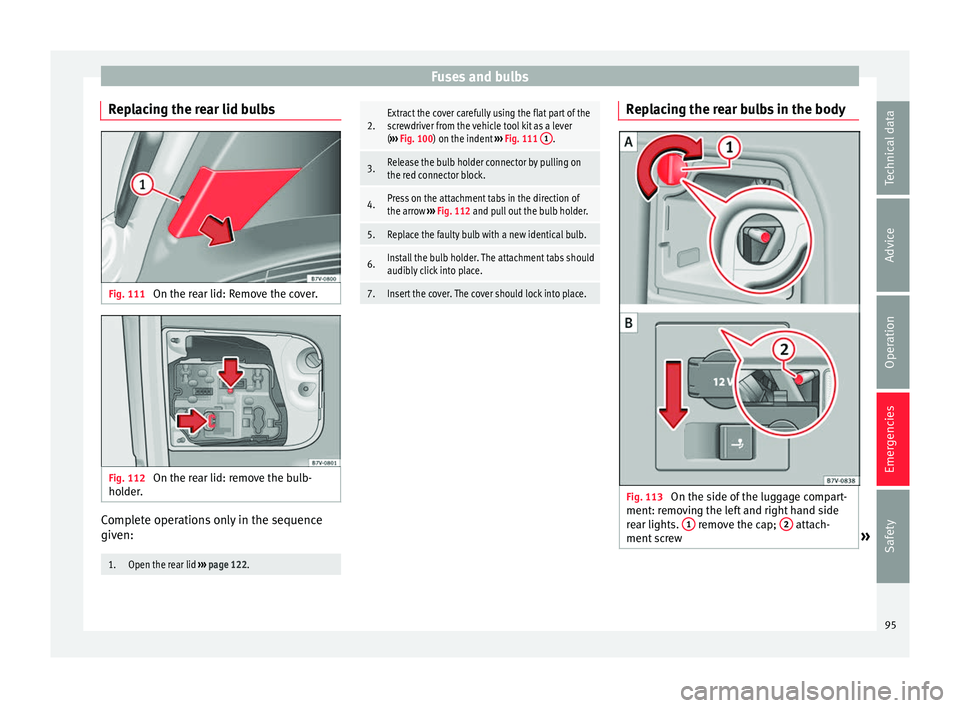
Replacing the rear lid bulbs Fig. 111
On the rear lid: Remove the cover. Fig. 112
On the rear lid: remove the bulb-
ho l
der
. Complete operations only in the sequence
giv
en:
1.Open the rear lid
››› page 122.
2.Extract the cover carefully using the flat part of the
screwdriver from the vehicle tool kit as a lever
(››› Fig. 100) on the indent ››› Fig. 111 1
.
3.Release the bulb holder connector by pulling on
the red connector block.
4.Press on the attachment tabs in the direction of
the arrow
››› Fig. 112 and pull out the bulb holder.
5.Replace the faulty bulb with a new identical bulb.
6.Install the bulb holder. The attachment tabs should
audibly click into place.
7.Insert the cover. The cover should lock into place. Replacing the rear bulbs in the body
Fig. 113
On the side of the luggage compart-
ment: r emo
v
ing the left and right hand side
rear lights. 1 remove the cap;
2 attach-
ment s
c
rew » 95
Technical data
Advice
Operation
Emergencies
Safety
Page 98 of 320
Emergencies
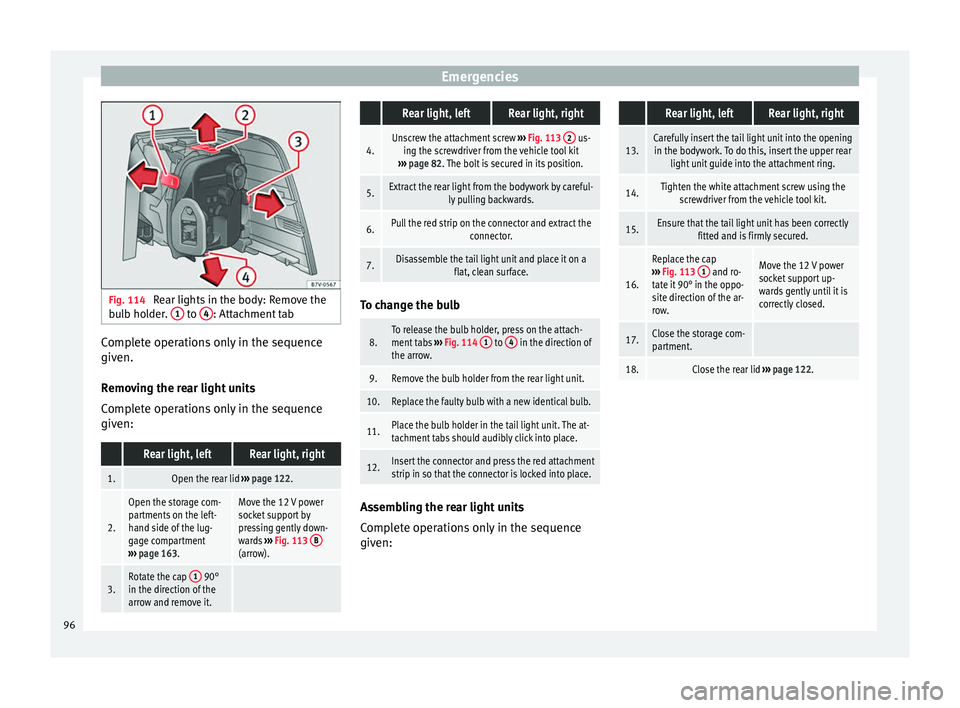
Fig. 114
Rear lights in the body: Remove the
b u
l
b holder. 1 to
4 : Attachment tab
Complete operations only in the sequence
giv
en.
R emo
ving the rear light units
Complete operations only in the sequence
given:
Rear light, leftRear light, right
1.Open the rear lid ››› page 122.
2.
Open the storage com-
partments on the left-
hand side of the lug-
gage compartment
››› page 163.Move the 12 V power
socket support by
pressing gently down-
wards ››› Fig. 113 B
(arrow).
3.Rotate the cap 1 90°
in the direction of the
arrow and remove it.
Rear light, leftRear light, right
4.Unscrew the attachment screw ››› Fig. 113 2 us-
ing the screwdriver from the vehicle tool kit
››› page 82. The bolt is secured in its position.
5.Extract the rear light from the bodywork by careful-
ly pulling backwards.
6.Pull the red strip on the connector and extract the connector.
7.Disassemble the tail light unit and place it on aflat, clean surface. To change the bulb
8.To release the bulb holder, press on the attach-
ment tabs
››› Fig. 114 1 to 4 in the direction of
the arrow.
9.Remove the bulb holder from the rear light unit.
10.Replace the faulty bulb with a new identical bulb.
11.Place the bulb holder in the tail light unit. The at-
tachment tabs should audibly click into place.
12.Insert the connector and press the red attachment
strip in so that the connector is locked into place. Assembling the rear light units
C
omp
l
ete operations only in the sequence
given:
Rear light, leftRear light, right
13.Carefully insert the tail light unit into the opening in the bodywork. To do this, insert the upper rear light unit guide into the attachment ring.
14.Tighten the white attachment screw using the screwdriver from the vehicle tool kit.
15.Ensure that the tail light unit has been correctly fitted and is firmly secured.
16.
Replace the cap
››› Fig. 113 1 and ro-
tate it 90° in the oppo-
site direction of the ar-
row.Move the 12 V power
socket support up-
wards gently until it is
correctly closed.
17.Close the storage com-
partment.
18.Close the rear lid ››› page 122. 96
Page 99 of 320
Fuses and bulbs
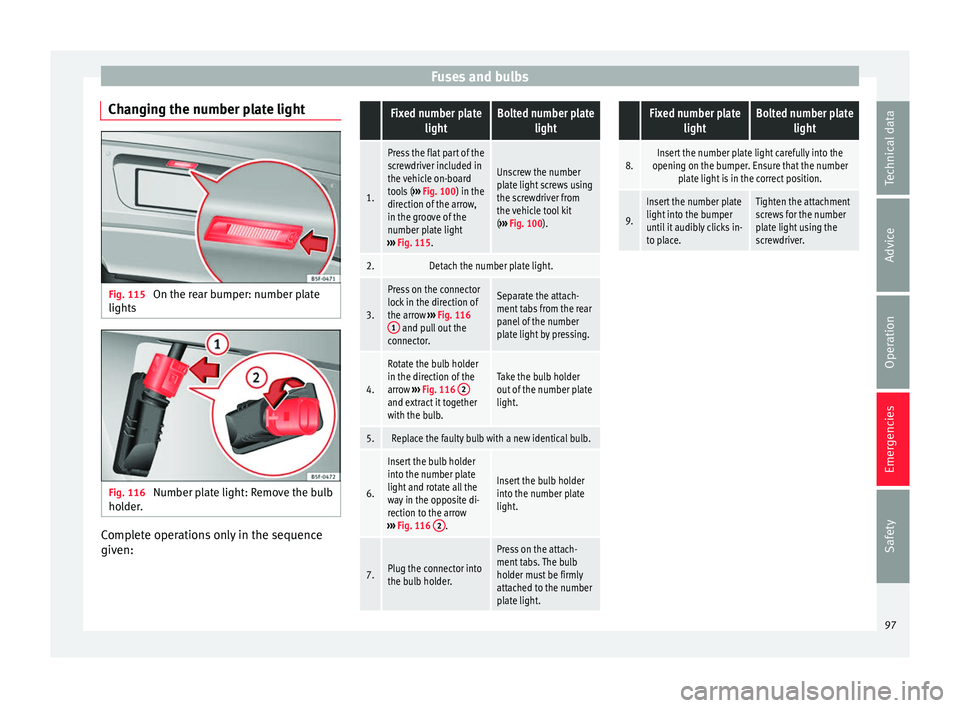
Changing the number plate light Fig. 115
On the rear bumper: number plate
lights Fig. 116
Number plate light: Remove the bulb
ho l
der
. Complete operations only in the sequence
giv
en:
Fixed number plate
lightBolted number plate light
1.
Press the flat part of the
screwdriver included in
the vehicle on-board
tools (››› Fig. 100) in the
direction of the arrow,
in the groove of the
number plate light
››› Fig. 115.
Unscrew the number
plate light screws using
the screwdriver from
the vehicle tool kit
(››› Fig. 100).
2.Detach the number plate light.
3.
Press on the connector
lock in the direction of
the arrow ››› Fig. 116
1
and pull out the
connector.
Separate the attach-
ment tabs from the rear
panel of the number
plate light by pressing.
4.
Rotate the bulb holder
in the direction of the
arrow ››› Fig. 116 2
and extract it together
with the bulb.
Take the bulb holder
out of the number plate
light.
5.Replace the faulty bulb with a new identical bulb.
6.
Insert the bulb holder
into the number plate
light and rotate all the
way in the opposite di-
rection to the arrow
››› Fig. 116 2
.
Insert the bulb holder
into the number plate
light.
7.Plug the connector into
the bulb holder.
Press on the attach-
ment tabs. The bulb
holder must be firmly
attached to the number
plate light.
Fixed number plate
lightBolted number plate light
8.Insert the number plate light carefully into the
opening on the bumper. Ensure that the number plate light is in the correct position.
9.
Insert the number plate
light into the bumper
until it audibly clicks in-
to place.Tighten the attachment
screws for the number
plate light using the
screwdriver. 97
Technical data
Advice
Operation
Emergencies
Safety