maintenance Seat Alhambra 2018 User Guide
[x] Cancel search | Manufacturer: SEAT, Model Year: 2018, Model line: Alhambra, Model: Seat Alhambra 2018Pages: 324, PDF Size: 7.04 MB
Page 255 of 324
Care and maintenance
CAUTION
● Never r ai
se the vehicle at the engine oil
sump, the gearbox or the rear or front axles.
● Always use an intermediate rubber support
to prev
ent damage to the vehicle underbody.
Check that the arms of the lifting platform are
able to move with obstruction.
● The arms should not come into contact with
the side runnin
g boards or other parts of the
vehicle. Caring for and cleaning the ve-
hic
l
e e
xterior
Introduction Regular maintenance and washing help to
m
aint
ain the
value of the vehicle. This may
also be one of the requirements for acknowl-
edging warranty claims in the event of body-
work corrosion or paint defects.
Products suitable for the care of your vehicle
are available at any technical service. WARNING
Car-care products may be toxic and hazard-
ous. If c
ar care products are not suitable or
are used inappropriately, this could result in
accident, serious injury, burns or intoxica-
tion. ●
Car c ar
e products must always be stored in
the original container which should be kept
closed.
● Observe information provided by the manu-
factur
er.
● To prevent confusion, never store car care
products
in empty food cans, bottles or other
containers.
● Keep all care products out of reach of chil-
dren.
● Harmfu
l vapours may be produced when us-
ing car c
are products. Therefore, care prod-
ucts should only be used in well-ventilated
spaces or in the open air.
● Never use fuel, turpentine, engine oil, ace-
tone or any
other volatile liquid to wash,
clean or care for the vehicle. These are toxic
and highly flammable. WARNING
Inappropriate care and cleaning of vehicle
component s
may effect the vehicle safety
equipment, increasing the risk of severe in-
jury.
● Vehicle components should only be
cle
aned and maintained in accordance with
the manufacturer's instructions.
● Only use approved or recommended care
products. CAUTION
Cleaning products which contain solvents will
dam ag
e the material. For the sake of the environment
● Only w
ash the vehicle in areas allocated for
this purpose, to prevent dirty water which
may be contaminated by oil, grease or fuel,
from entering the drains. In some places,
washing it outside the planned areas is even
banned.
● Where possible, always use products which
res
pect the environment.
● The remains of car care products should not
be dispo
sed of with ordinary household
waste. Observe information provided by the
manufacturer. Washing the vehicle
The longer substances such as insects, bird
dr
op
pin
gs, resinous tree sap, road dirt, in-
dustrial deposits, tar, soot or road salt and
other aggressive materials remain on the ve-
hicle, the more damage they do to the paint-
work. High temperatures (for instance due to
strong sunlight) further intensify the corro-
sive effect. The vehicle undercarriage should
also be thoroughly washed at regular inter-
vals. »
253
Technical data
Advice
Operation
Emergencies
Safety
Page 257 of 324
Care and maintenance
Washing the vehicle with a high pres-
s ur
e c
leaner When cleaning the vehicle with a high-pres-
sur
e c
leaner, always follow the operating in-
structions for the equipment. Pay special at-
tention to the required pressure of the jet
and the distance between the jet and the ve-
hicle ››› .
Keep a s uit
able distance from soft materials,
such as rubber hoses or insulating material,
and from the parking distance warning sys-
tem sensors. The parking distance sensors
are fitted in the rear bumpers and, where ap-
plicable, in the front bumpers ››› .
Do not u
se a no
zzle that sprays the water out
in a direct stream or one that has a rotating
jet for forcing off dirt ››› .
WARNING
The incorrect use of high pressure cleaning
equipment c ou
ld result in permanent dam-
age, visible or invisible, to the tyres or other
materials. This could result in a serious acci-
dent.
● Ensure there is a suitable distance between
the nozzl
e and the tyres.
● Never wash tyres with a concentrated jet or
so-cal
led “dirt blasters”. Even at large spray-
ing distances and short cleaning times, you
may damage the tyres. WARNING
After the vehicle has been washed, the brak-
ing eff ect
will be reduced (and the braking
distance increased) due to moisture (and ice
in winter) on the brakes.
● “Dry the brakes and remove ice” by braking
caref
ully. Ensure that you are not endanger-
ing other road-users or breaking traffic regu-
lations in the process. CAUTION
● The wat er t
emperature should not exceed
+60°C (+140°F).
● To avoid damage to the paintwork, do not
wash the
vehicle in full sun.
● The sensors on the bumpers should be kept
cle
an and free of ice at all times to ensure the
parking distance warning system and the
park assist system operate correctly. When
cleaning with pressure hoses and steam
cleaners, the sensors should be sprayed only
briefly. A distance of 10 cm between the sen-
sors and the steam / hose nozzle must be ob-
served.
● Do not use a high pressure cleaner to re-
move ic
e or snow from windows
● Washing the vehicle in low temperatures:
When washin
g the vehicle with a hose, do
not direct water into the lock cylinders or the
gaps around the doors or roof. Locks and
seals could freeze! Factory-fitted adhesive sheets
The following indications should be taken in-
to ac
c
ount to avoid damaging adhesive
sheets:
● Do not use high pressure cleaners.
● Do not use scrapers to remove ice or snow
from the sheets.
● Do not po
lish the adhesive sheets.
● Do not use dirty cloths or sponges.
● It is preferable to wash them with a soft
spon g
e and gentle neutral soap.
Cleaning windows and exterior mir-
rors Cleaning windows and exterior mirrors
S
pr
a
y windows and exterior windows with a
standard window cleaner containing alcohol.
Dry the windows with a clean chamois leath-
er or a lint-free cloth. The chamois leathers
used on painted surfaces are not suitable for
cleaning windows because they are soiled
with wax deposits which could smear the
windows.
Use window cleaner or a silicone remover to
clean rubber, oil, grease and silicone depos-
its off ››› .
»
255
Technical data
Advice
Operation
Emergencies
Safety
Page 259 of 324
Care and maintenance
If the polish does not contain wax, a wax
pr oduct
shou
ld be applied after polishing. CAUTION
● To pr ev
ent damage, car polish or hard wax
should not be used on components painted in
matt paint, plastic components and the glass
headlamp and tail light covers.
● Do not polish the paintwork if it is dirty, ap-
ply po
lish in dusty or sandy zones. Cleaning chrome parts
Clean chrome parts with a damp cloth. SEAT
r
ec
ommend
s the use of a chrome care prod-
uct to clean stains and dirt from chrome sur-
faces. Use a soft dry cloth to polish chrome
parts. CAUTION
To prevent scratching chrome surfaces:
● Do not use abrasive products.
● Do not clean or polish chrome parts in a
sandy or du
sty environment.
● Do not polish dirty surfaces. Caring for and cleaning anodized sur-
f
ac
e
s It is not easy to detect the difference between
aluminium and an anodized s
ur
face, for ex-
ample, a radiator grille. However, anodized
surfaces must not be treated in the same way
as aluminium surfaces. Never use rough
sponges or cloths to wipe away insect re-
mains.
● Use a clean, damp, lint-free cloth to clean
anodized sur
faces.
● If there is a lot of dirt, use a special clean-
ing pr oduct
which does not contain solvents. CAUTION
To prevent damage to the anodized surfaces: ● Do not use products containing solvents.
● Do not use polish or hard wax.
● Do not use abrasive products.
● Do not polish anodized surfaces in sandy or
dus ty
environments.
● Do not polish dirty surfaces. Cleaning wheels
Cleaning steel wheels
U
se an indu s
trial cleaner to remove brake
dust. Therefore, clean wheels regularly with a
separate sponge. Any damage to the paint on steel wheels
should be t
ouched up before the metal starts
to rust.
Caring for and cleaning alloy wheels
Remove road salt and brake dust by washing
the wheels approximately once a fortnight.
Use an acid free detergent to clean the wheel
rims. SEAT recommends treating the wheels
thoroughly with a wax compound about once
every three months.
It is important to remove road salt and brake
dust by washing the wheels at regular inter-
vals, otherwise the finish will be impaired.
Always use an acid-free detergent for alloy
wheel rims. Car polish or other abrasive
agents should not be used for maintaining
the rims.
If the protective coating on the paint has
been damaged (e.g. hit by a stone), it should
be repaired immediately.
Caring for rubber seals The rubber seals on doors, windows, etc., re-
m
ain fl
e
xible, provide a better seal and last
longer if they are regularly treated with a
product specifically designed for use on rub-
ber. »
257
Technical data
Advice
Operation
Emergencies
Safety
Page 261 of 324
Care and maintenance
Caring for and cleaning the ve-
hic l
e int
erior
Introduction The dye used in many modern garments, for
ex
amp
le dark jeans, is not always sufficiently
colour-fast. Seat upholstery (material and
leather), especially when light-coloured, may
visibly discolour if the dye comes out of
clothing (even when used correctly). This is
not an upholstery defect but indicates that
the dye in the item of clothing is not suffi-
ciently colour-fast.
The longer stains or dirt remain on the vehi-
cle surfaces, especially the fabrics covering
the padded upholstery, the more difficult it
becomes to clean and maintain them. If
stains and dirt are left for a long time, it may
be that they are impossible to remove. WARNING
Car-care products may be toxic and hazard-
ous. U s
ing unsuitable car-care products or,
using them in the wrong way, may cause acci-
dents, serious injury, burns or intoxication.
● Keep your car-care products in their origi-
nal
containers.
● Read the instructions.
● Never keep car-care products in empty food
container
s, bottles or other similar contain-
ers. Other people may confuse them. ●
Keep a l
l car-care products out of the reach
of children.
● Some products may give off harmful va-
pours durin
g use. Therefore, they should be
used outdoors in well-ventilated places.
● Never use fuel, turpentine, engine oil, nail-
varnish r
emover or any other volatile product
for washing, maintenance or cleaning. These
are toxic and highly flammable. WARNING
Unsuitable maintenance and cleaning of vehi-
c le c
omponents may impair proper operation
of safety equipment and cause serious injury.
● Maintain and clean vehicle components ac-
cordin
g to the manufacturer's instructions.
● Only use approved or recommended clean-
ing product
s. CAUTION
● Cle
aning products which contain solvents
have a corrosive effect and may damage the
material irreparably.
● Stains and dirt containing aggressive sub-
stanc
es or solvents attack the material and
may damage it irreparably, even when they
are cleaned quickly.
● Dirt and stains should not be allowed to dry
and should be c
leaned as quickly as possible.
● In the case of stubborn stains, take the ve-
hicle t
o a specialised workshop to avoid dam-
age. How to care for the upholstery
To treat and maintain your seat upholstery,
keep the f
o
llowing in mind ››› :
● Before entering the vehicle, close any Vel-
cr o f
asteners that might snag on the uphols-
tery or trim fabric. Any open Velcro fasteners
may damage the trim or upholstery fabrics.
● To prevent damage, avoid direct contact
between sharp dec
orative objects and the
upholstery and trim fabrics. Decorative ob-
jects include zips, rivets and rhinestones on
clothing and belts.
● From time to time, clean the dust that gath-
ers in the per
forations, folds and seams so
that the surfaces of the seats are not dam-
aged by its abrasive effect.
● Make sure clothes are colour-fast to avoid
them running and s
taining the upholstery.
This is especially important if the upholstery
is light in colour. CAUTION
If you ignore this advice, which is important
for m aint
aining your seat upholstery, the fab-
ric may be damaged or stained. Note
SEAT recommends you take the vehicle to a
spec i
alised workshop to treat any stains on
the upholstery caused by the discolouration
of clothing. 259
Technical data
Advice
Operation
Emergencies
Safety
Page 263 of 324
Care and maintenance
CAUTION
● Brushe s
should only be used to clean the
carpet and floor mats! Other fabrics may be
damaged if cleaned with a brush.
● If cream detergents or detergents for deli-
cate g
arments are applied with a damp cloth
or sponge, they may, for example, leave rings
when dry because of the surfactant compo-
nents they contain. Generally, such rings are
very difficult or almost impossible to remove. CAUTION
● Do not l et
water soak into Alcantara ®
under
any circumstances.
● Do not use leather cleaning products, sol-
vents, w
ax polish, shoe cream, stain remov-
ers or similar products on Alcantara ®
.
● Never use brushes for cleaning damp mate-
rial
as they could damage the surface. Cleaning and maintenance of natural
l
e
ather upho
lsteryConsult a professional cleaning workshop if
y
ou h
av
e any doubts on cleaning and main-
taining the leather equipment in your vehicle.
Maintenance and treatment
Nappa natural leather is delicate because it
has no additional protective layer. ●
After c
leaning, regularly apply a condition-
er with sun-screen and impregnating action.
These products nourish the leather, soften it
and make it more breathable, as well as re-
hydrating it. They also provide it with a pro-
tective film.
● Clean the leather every 2 or 3 months and
remov
e stains as they appear.
● Treat the leather every 6 months with a
suitab
le maintenance product.
● Apply as few cleaning and maintenance
products a
s possible, always using a dry, lint-
free cotton or woollen cloth. Do not apply
cleaning and maintenance products directly
to the leather.
● Remove recent ball-point pen and ink
stain
s, lipstick, shoe cream and similar
stains as soon as possible.
● Maintain the colour of the leather. To do
this, use a s
pecial cream especially coloured
for leather to achieve the same overall colour,
if necessary.
● Afterwards, go over it with a soft cloth.
Cle
aning the vehicle
SEAT recommends using a slightly damp cot-
ton or woollen cloth for general cleaning pur-
poses.
Generally, the leather should never be
soaked at any point, nor should water pene-
trate the seams. Before cleaning the leather upho
lstery, bear
in mind the following recommendations
››› page 260, Cleaning the upholstery on
heated seats and electrically operated seats
or seats with airbag components . CAUTION
● On no acc ou
nt use solvents, wax polish,
shoe cream, stain removers or similar materi-
als on leather.
● If the stain remains on the leather for long,
it wi
ll soak in and be impossible to remove.
● In the event of spilt liquids, dry immediate-
ly with an ab
sorbent cloth to prevent the liq-
uid penetrating through the leather or seams.
● If the vehicle is left standing in the sun for
long periods, the l
eather should be protected
against direct sunlight to prevent it from fad-
ing. Note
The leather will usually change colour slight-
ly w ith u
se. Cleaning synthetic leather upholstery
Before cleaning synthetic leather upholstery,
be
ar in mind the f
o
llowing recommendations
››› page 260, Cleaning the upholstery on
heated seats and electrically operated seats
or seats with airbag components »
261
Technical data
Advice
Operation
Emergencies
Safety
Page 265 of 324
Care and maintenance
vehicle in question by SEAT. Seat belts which
hav
e been w
orn in an accident and stretched
must be replaced by a specialised workshop.
Renewal may be necessary even if there is no
apparent damage. The belt anchorage should
also be checked. Notes for the user
Labels and p
latesSome parts in the engine compartment come
fr
om the f
act
ory with certificates of safety, la-
bels or plates containing important informa-
tion regarding the operation of the vehicle,
for example, on the fuel tank flap, on the pas-
senger's sun visor, on the driver door strut, or
on the floor of the boot.
● Never remove these certificates of safety,
labels
or plates, and ensure they are kept in
good condition and are legible.
● If a vehicle part, bearing a certificate of
safety
, label or plate, is replaced, the special-
ised workshop should attach the information
back in the same place.
Certificate of safety
A certificate of safety on the door strut states
that all the safety standards and regulations
established by the national traffic authorities
responsible for road safety were met at the time of manufacture. It may also give the
month and ye
ar of manufacture, together
with the chassis number.
Warning of high voltage label*
There is a label close to the bonnet lock
which warns of high voltage in the vehicle's
electrical system. The vehicle ignition system
complies with several standards, including
the Canadian standard, ICES-002.
Using your vehicle in other countries
and continents The vehicle is manufactured at the factory for
u
se in a p
ar
ticular country in accordance with
the national legislation in force at the time of
manufacture.
If the vehicle is sold in another country or
used in another country for an extended peri-
od of time, the applicable legislation of that
country should be observed.
It may be necessary to fit or remove certain
pieces of equipment or to deactivate certain
functions. Service work may also be affected.
This is particularly true if the vehicle is used
in a different climate for an extended period
of time.
As there are different types of frequency
bands around the world, you may find that the radio or navigation system supplied at
the factor
y does not work in another country. CAUTION
● SEA T doe
s not accept liability for any dam-
age to the vehicle due to the use of a lower
quality fuel, an inadequate service or the
non-availability of genuine spare parts.
● SEAT does not accept liability if the vehicle
does not
comply in part or in full with the le-
gal requirements of other countries or conti-
nents. Radio and antenna reception
The aerial of radio and navigation systems
fitt
ed at
the f
actory may be mounted in differ-
ent parts of the vehicle:
● On the inside of the rear window, next to
the rear w
indow heating,
● on the inside of the rear side windows,
● on the inside of the windscreen,
● on the roof of the vehicle.
Aerials
mounted on the inside of a window
can be recognised by the fine wires. CAUTION
Aerials on the inside of windows may be dam-
aged if knoc
ked or if cleaned with corrosive or
acid cleaning products. Do not stick adhesive » 263
Technical data
Advice
Operation
Emergencies
Safety
Page 270 of 324
Advice
CAUTION
● Do not r ef
uel if the filler indicates that the
fuel contains metal. LRP ( lead replacement
petrol) fuels contain high concentrations of
metal additives. Using them may damage the
engine!
● Never refuel with fuels containing a large
proportion of
ethanol (for example, E50, E85).
This could damage the fuel system.
● Just filling one full tank of leaded fuel or
fuel c
ontaining other metal additives would
seriously impair the efficiency of the catalytic
converter.
● Only use fuel additives that have been ap-
prov
ed by SEAT. Octane boosting or anti-
knock additives may contain metal additives
that could seriously damage the engine or
the catalytic converter. These additives must
not be used.
● High engine speed and full throttle can
damag
e the engine when using petrol with an
octane rating lower than the correct grade for
the engine. Note
● You m a
y use petrol with a high octane num-
ber than the one recommended for your en-
gine.
● In those countries where unleaded petrol is
not avai
lable, you may refuel with a fuel with
a low lead content. Diesel fuel
Please note the information on the inside of
the fuel
t
ank flap.
We recommend the use of diesel fuel which
complies to European standard EN 590. If
diesel fuel which meets European standard
EN 590 is not available, the Cetane number
(CZ) must, at minimum, be 51. If the engine
is equipped with a particulate filter, the sul-
phur content of the fuel must be below 50
parts per million.
Winter-grade diesel
Summer fuel becomes thicker in winter and it
is more difficult to start the engine. For this
reason, petrol stations in some countries al-
so offer winter diesel with improved fluidity
when cold (winter-grade diesel). CAUTION
● The v ehic
le is not designed for the use of
FAME fuel (biodiesel). The fuel system would
be damaged if you used biodiesel.
● Do not mix fuel additives, the so-called
“thinners”, petro
l or similar additives with
diesel fuel.
● If poor-quality diesel fuel is used, it may be
neces
sary to drain the fuel filter more fre-
quently than is specified in the Maintenance
Programme. We recommend having this done
by a specialised workshop. If water is allowed to collect in the filter, this can cause engine
perf
orm
ance problems. Selective catalytic reduction*
(AdBlue)
Introduction In vehicles with “Selective Catalytic Reduc-
tion”, a spec
i
al urea solution (AdBlue) is in-
jected into the exhaust gas system in front of
the catalytic converter to reduce nitrogen ox-
ide emissions.
The consumption of AdBlue depends on indi-
vidual driving style, the temperature at which
the system operates and the outside temper-
ature where the vehicle is driven.
AdBlue is kept in an independent tank in the
vehicle and should be refilled at an official
supplier. The AdBlue tank holds approxi-
mately 17 litres.
The AdBlue fill level must be checked when
the vehicle is being serviced. WARNING
If the AdBlue fill level is too low, the vehicle
ma y
not restart after switching the ignition
off. The emergency start or jump start will not
be possible either! 268
Page 279 of 324
Checking and refilling levels
●
When refi l
ling or changing service liquids,
ensure that you put the liquids into the right
tank. Making a mistake when refilling could
cause serious malfunctions and damage the
engine! For the sake of the environment
The oil level must never be above area
› ››
Fig. 242 A . Otherwise oil can be drawn in
through the c r
ankcase breather and escape
into the atmosphere via the exhaust system. Engine oil consumption
The consumption of engine oil can be differ-
ent
fr
om one en
gine to another and can vary
during the useful life of the engine.
Depending on driving style and the condi-
tions of use, the consumption of engine oil
can reach 1 litre every 2,000 km (one quarter
of a gallon every 1,200 miles); for new vehi-
cles, this could be higher for the first
5,000 km (3,000 miles). For this reason the
engine oil level must be checked at regular
intervals, preferably when filling the tank and
before a journey.
Topping up engine oil Read the additional information carefully
› ›
›
page 40 The engine oil must be changed regularly ac-
cordin
g to the specifications of the Mainte-
nance Programme.
Due to the problems linked with disposing of
used oil and the need for suitable tools and
special knowledge, always visit a specialised
workshop to have the engine oil and filter
changed. SEAT recommends taking your car
in for technical service.
Detailed information on the service intervals
is shown in the Maintenance Programme. WARNING
If, in exceptional circumstances, you must
ch an
ge the engine oil yourself, please note
the following:
● Wear eye protection.
● Always wait until the engine has complete-
ly coo
led to avoid being burned.
● Always keep your arms horizontal when un-
scr
ewing the oil drainage bolt so that it does
not run down your arms.
● Use a suitable container large enough to
col
lect all of the used oil in the engine.
● Never collect engine oil in empty food con-
tainers, c
ans, bottles or other containers as
not all people are able to identify engine oil.
● Oil is toxic and must be kept out of the
reac
h of children. CAUTION
No additives should be used with engine oil.
This c
ould result in engine damage. Any dam-
age caused by the use of such additives
would not be covered by the factory warranty. For the sake of the environment
● Bef or
e changing the engine oil, find a suita-
ble location or service for proper disposal.
● Always dispose of engine oil with the ut-
most
respect for the environment. Never dis-
pose of used engine oil in places such as a
garden, woods, drains, roads, paths, rivers
and drainage systems. Engine coolant
Intr oduction WARNING
Engine coolant is toxic!
● Only keep engine coolant in its original
cont ainer
, tightly shut and in a safe place.
● Never store engine coolant in empty food
container
s or bottles as other people may ac-
cidentally drink it.
● Always keep engine coolant out of reach of
chil
dren. » 277
Technical data
Advice
Operation
Emergencies
Safety
Page 284 of 324
Advice
Brake fluid level
The l ev
el
of the brake fluid reservoir should
always be between the and marks, or
above the mark ››› .
It i
s
not always possible to check the level of
the brake fluid, as in some models the en-
gine components make it difficult to see the
brake fluid reservoir. If you cannot read the
exact brake fluid level, consult a specialist.
The brake fluid level drops slightly when the
vehicle is being used due to wear of the
brake pads and the automatic readjustment
of the brake.
Changing the brake fluid
The brake fluid should be changed in accord-
ance with the instructions given in the Main-
tenance Programme. Have the brake fluid
changed by a specialised workshop. SEAT
recommends taking your car in for technical
service. This means that only brake fluid
complying with the required specifications
will be used. WARNING
If the brake fluid level is low or unsuita-
bl e/o
ld brake fluid is used, the brake system
may fail or braking power may be reduced.
● Check the brake system and the brake fluid
level
regularly! ●
The brak e fluid shou
ld be changed regular-
ly in accordance with the instructions given
in the Maintenance Programme.
● When the brake fluid is used and brakes
are sub
jected to extreme braking forces, bub-
bles of vapour form in the brake system.
These bubbles can significantly reduce brak-
ing power, notably increasing braking dis-
tance, and could result in the total failure of
the brake system.
● Only used brake fluid that conforms to the
VW 501 14 stand
ard, FMVSS 116 DOT 4
standard or even the DIN ISO 4925 CLASS 4
standard. Other types of brake fluid could af-
fect brake operation and reduce braking pow-
er. Do not use a brake fluid if the container
does not specify compliance with the
VW 501 14, FMVSS 116 DOT 4 or
DIN ISO 4925 CLASS 4 standards.
● The replacement brake fluid must be new.
● Always ensure that you use suitable brake
fluid. Do not use a br
ake fluid if the container
does not specify compliance with the
VW 501 14, FMVSS 116 DOT 4 or
DIN ISO 4925 CLASS 4 standards. WARNING
Brake fluid is poisonous.
● To reduce the risk of poisoning, do not keep
brak e fluid in drink
s bottles/containers or
similar. Other people could drink from these
recipients even if the contents are clearly
marked. ●
Alw a
ys keep brake fluid in the original con-
tainer; keep it correctly sealed and out of
reach of children. CAUTION
Brake fluid damages the vehicle paintwork.
W ipe off an
y brake fluid from the paintwork
immediately. For the sake of the environment
Brake fluid is an environmental pollutant.
Co l
lect any spilt service fluids and allow a
professional to dispose of them. 282
Page 287 of 324
Checking and refilling levels
Checking the electrolyte level of the
v ehic
l
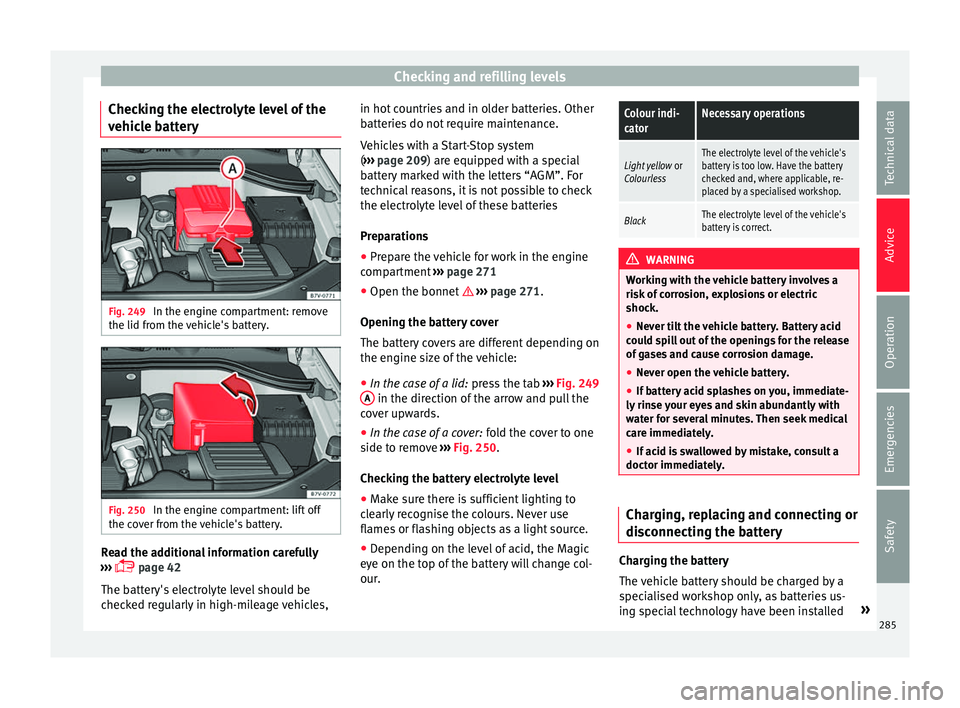
e battery Fig. 249
In the engine compartment: remove
the lid fr om the
v
ehicle's battery. Fig. 250
In the engine compartment: lift off
the c o
v
er from the vehicle's battery. Read the additional information carefully
› ›
›
page 42
The battery's electrolyte level should be
checked regularly in high-mileage vehicles, in hot countries and in older batteries. Other
batterie
s do not require maintenance.
Vehicles with a Start-Stop system
( ››› page 209) are equipped with a special
battery marked with the letters “AGM”. For
technical reasons, it is not possible to check
the electrolyte level of these batteries
Preparations
● Prepare the vehicle for work in the engine
compar
tment ››› page 271
● Open the bonnet ›››
page 271.
Opening the battery cover
The battery covers are different depending on
the engine size of the vehicle:
● In the case of a lid: pres
s the tab ››› Fig. 249
A in the direction of the arrow and pull the
c o
v
er upwards.
● In the case of a cover: fol
d the cover to one
side to remove ››› Fig. 250.
Checking the battery electrolyte level
● Make sure there is sufficient lighting to
cle
arly recognise the colours. Never use
flames or flashing objects as a light source.
● Depending on the level of acid, the Magic
eye on the top of
the battery will change col-
our.
Colour indi-
catorNecessary operations
Light yellow or
ColourlessThe electrolyte level of the vehicle's
battery is too low. Have the battery
checked and, where applicable, re-
placed by a specialised workshop.
BlackThe electrolyte level of the vehicle's
battery is correct. WARNING
Working with the vehicle battery involves a
risk of
corrosion, explosions or electric
shock.
● Never tilt the vehicle battery. Battery acid
coul
d spill out of the openings for the release
of gases and cause corrosion damage.
● Never open the vehicle battery.
● If battery acid splashes on you, immediate-
ly rinse
your eyes and skin abundantly with
water for several minutes. Then seek medical
care immediately.
● If acid is swallowed by mistake, consult a
doctor immediat
ely. Charging, replacing and connecting or
di
s
c
onnecting the battery Charging the battery
The
vehic
le battery should be charged by a
specialised workshop only, as batteries us-
ing special technology have been installed »
285
Technical data
Advice
Operation
Emergencies
Safety