ECO mode Seat Altea 2015 User Guide
[x] Cancel search | Manufacturer: SEAT, Model Year: 2015, Model line: Altea, Model: Seat Altea 2015Pages: 236, PDF Size: 4.23 MB
Page 71 of 236

Opening and closing
● The turn signal light will flash once on clos-
ing and activating the alarm.
When does the system trigger an alarm?
The system triggers an alarm if the following
unauthorised actions are carried out when
the vehicle is locked:
● Opening the vehicle mechanically using
the key and with the ignition off.
● A door is opened.
● Opening the bonnet.
● The rear lid is opened.
● Ignition switched on with a non-validated
key.
● Movements in the driving compartment
(vehicles with interior monitoring).
● Undue manipulation of the alarm.
● Battery handling.
The acoustic signals sound and the turn sig-
nals flash for approx. 30 seconds. This cycle
may be repeated up to 10 times depending
on the country.
Opening the doors mechanically (emergency
opening)
If the radio frequency remote control function
fails, you will have to use the key to unlock
the vehicle. This is done as follows: ●
Use the lock on the driver door to unlock
the vehicle. The anti-theft alarm system re-
mains active, but an alarm is not triggered
immediately.
● Switch on the ignition within 15 seconds.
When the ignition is switched on, the elec-
tronic immobiliser recognises a valid vehicle
key and deactivates the anti-theft alarm sys-
tem. If you do not switch on the ignition with-
in 15 seconds, the alarm is triggered (in cer-
tain markets, such as the Netherlands, there
is no 15-second waiting time and the alarm
is activated immediately after opening the
door).
Opening all the doors in manual mode
In vehicles without an alarm, when opening
the driver door manually, all doors are
opened.
How to switch the alarm off
When the vehicle is unlocked via the unlock-
ing button of the radio frequency remote con-
trol or when the key is inserted in the ignition
lock. Note
● After 28 days, the indicator light will be
switched off to prevent the battery from
draining if the vehicle has been left parked
for a long period of time. The alarm system
remains activated. ●
If, after the audible warning turns off, an-
other monitored area is accessed (e.g. the
boot hatch is opened after a door has been
opened), the alarm is triggered again.
● The anti-theft alarm is not activated when
the vehicle is locked from within using the
central locking button .
● If the vehicle battery is run down or flat
then the anti-theft alarm will not operate cor-
rectly.
● Vehicle monitoring remains active even if
the battery is disconnected or not working for
any reason.
● The alarm is triggered immediately if one of
the battery cables is disconnected while the
alarm system is active. Interior monitoring*
This is a monitoring or control function incor-
porated in the anti-theft alarm* which de-
tects unauthorized vehicle entry by means of
ultrasound.
The system consists of 3 sensors, 2 emitters
and a receptor.
Activation
– It is automatically turned on with the anti-
theft alarm, when the vehicle is locked me-
chanically with the key and when the but-
ton on the remote control is used.
»
69Technical specifications
Advice
Operation
Safety
Page 80 of 236
Operation
panel. The control lamp
flashes when the
t urn s
ignals are operated, provided a trailer is
correctly attached and connected to the vehi-
cle. If a turn signal bulb is defective, the con-
trol lamp flashes at double speed. If the trail-
er turn signal bulbs are defective, the control
lamp does not light up. Change the bulb.
● The main beam headlights can only be
sw
itched on if the dipped beam headlights
are already on. The warning lamp then
comes on in the instrument panel.
● The headlight flasher come
s on for as long
as you pull the lever – even if no other lights
are switched on. The warning lamp then
comes on in the instrument panel.
● When the parking lights are switched on,
the he
adlight and the tail light on the corre-
sponding side of the vehicle light up. The
parking lights will only work if the key is re-
moved from the ignition. If said light is on, an
audible warning will be emitted while the
driver door is open.
● If the turn signal lever is left on after the
key has been taken out of the ignition lock,
an acoustic signal sounds when the driver
door is opened. This is intended as a remind-
er to switch off the turn signal, unless you
wish to leave the parking light on. Daytime driving lights*
Daytime running lights are signalling devices
for improving road safety. The lights are built into the headlights and come on each time
the ignition is turned on if the light switch is
in position
0 or
. It is automatically
sw
itched off when the side lights are turned
on.
Automatic control of the dipped beam in
combination with the daytime running lights
If the dipped beam control and the daytime
running lights
are activated at the same
time, the dipped beams and the instrument
panel lighting will automatically come on as
required (e.g. when entering a tunnel) and
the daytime running lights will switch off.
When the automatic dipped beam control
switches off the dipped beams (e.g. when
coming out of a tunnel), the daytime running
lights come back on. WARNING
The side lights or daytime driving lights are
not bright enough to illuminate the road
ahead and to ensure that other road users are
able to see you.
● Always use your dipped beam head lights if
it is raining or if visibility is poor.
● The rear lights do not come on with the
daytime driving light. A vehicle which does
not have the rear lights on may not be visible
to other drivers in the darkness, if it is rain-
ing or in conditions of poor visibility. Note
Please observe any relevant legal require-
ments which may apply in your country. Nordic country solution
3 Only available in certain countries or as an
option
al
extra
The so-called “Nordic country solution” is an
alternative solution to daytime running lights
in vehicles without this function. It consists
of simultaneously connecting the dimmed
dipped beams, the sidelights and the licence
plate lights.
The aforementioned lights are switched on
each time the ignition is turned on if the light
switch is in position 0 or . Depending
upon the model, the control lamp on the
light control switch or the instrument panel
lighting will indicate that the lights are on.
Activation of the Nordic country solution
● Remove the key from the ignition, move the
turn signal lever upward (right turn signal),
press it back to flash position and hold it
there.
● Insert the key and switch on the ignition,
holding it in this position for 3 seconds.
Then, switch off the ignition. The Nordic
country solution is now activated and the cor-
responding lights can come on.
78
Page 83 of 236
Lights and visibility
correct use of lights in all situations. “Auto-
matic headlight control” is merely a system
to support the driver. Where necessary,
switch on the lights manually using the light
switch.
Fog lights with cornering function*
3 Applies to the model: ALTEA / ALTEA XL
When the t urn s
ignal is switched on to turn or
on very tight bends, the right or left fog light
automatically comes on to function as a cor-
nering light. The cornering light only oper-
at e
s if the dipped beam lights are on. WARNING
Read and observe the relevant warnings ››› in Adaptive headlights* (for driving round
bends) on page 80 Hazard warning lights
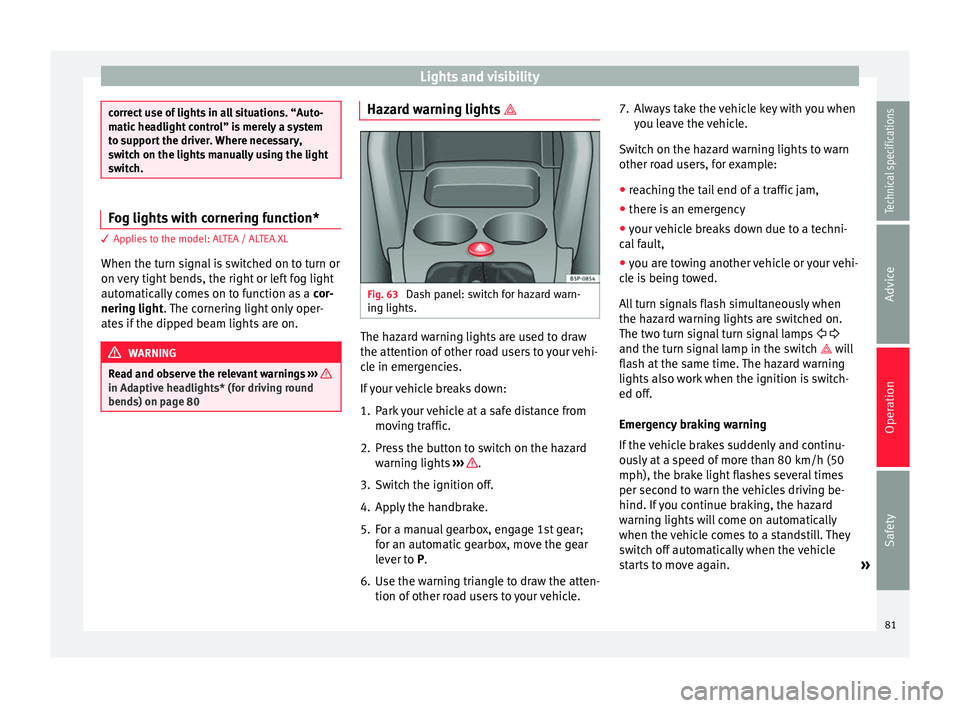
Fig. 63
Dash panel: switch for hazard warn-
ing lights. The hazard warning lights are used to draw
the attention of other road users to your vehi-
cle in emergencies.
If your vehicle breaks down:
1. Park your vehicle at a safe distance from
moving traffic.
2. Press the button to switch on the hazard warning lights ››› .
3. Switch the ignition off.
4. Apply the handbrake.
5. For a manual gearbox, engage 1st gear; for an automatic gearbox, move the gear
lever to P
.
6.
Use the warning triangle to draw the atten-
tion of other road users to your vehicle. 7. Always take the vehicle key with you when
you leave the vehicle.
Switch on the hazard warning lights to warn
other road users, for example:
● reaching the tail end of a traffic jam,
● there is an emergency
● your vehicle breaks down due to a techni-
cal fault,
● you are towing another vehicle or your vehi-
cle is being towed.
All turn signals flash simultaneously when
the hazard warning lights are switched on.
The two turn signal turn signal lamps
and the turn signal lamp in the switch will
flash at the same time. The hazard warning
lights also work when the ignition is switch-
ed off.
Emergency braking warning
If the vehicle brakes suddenly and continu-
ously at a speed of more than 80 km/h (50
mph), the brake light flashes several times
per second to warn the vehicles driving be-
hind. If you continue braking, the hazard
warning lights will come on automatically
when the vehicle comes to a standstill. They
switch off automatically when the vehicle
starts to move again. »
81
Technical specifications
Advice
Operation
Safety
Page 85 of 236
Lights and visibility
Rear interior lights and reading
lights* Fig. 66
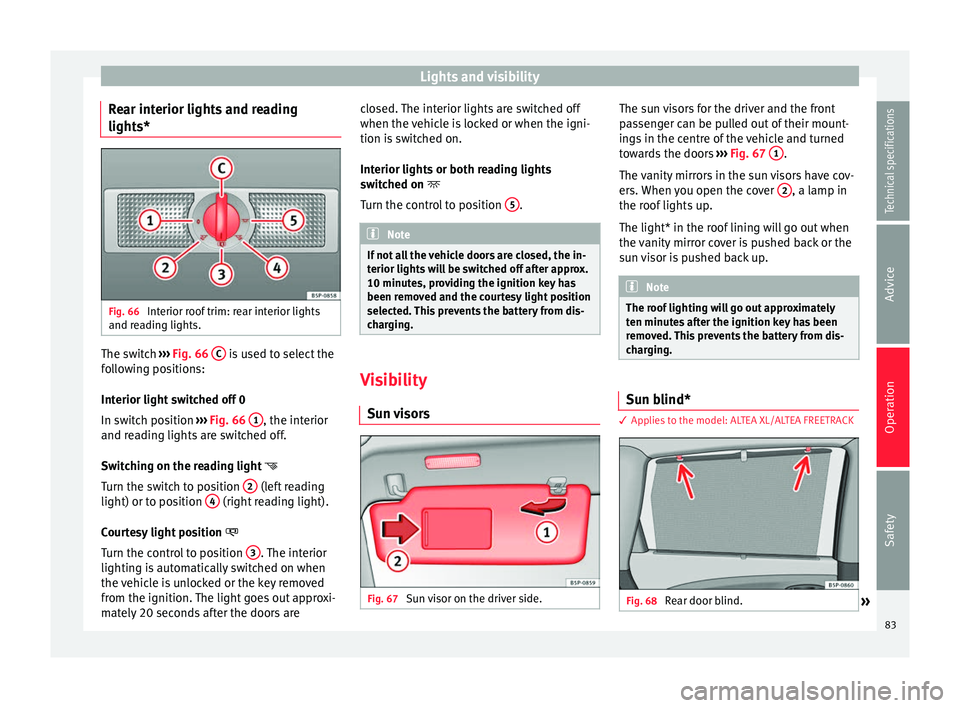
Interior roof trim: rear interior lights
and reading lights. The switch
››› Fig. 66 C is used to select the
following positions:
Interior light switched off 0
In switch position ››› Fig. 66 1 , the interior
and reading lights are switched off.
Switching on the reading light
Turn the switch to position 2 (left reading
light) or to position 4 (right reading light).
Courtesy light position
Turn the control to position 3 . The interior
lighting is automatically switched on when
the vehicle is unlocked or the key removed
from the ignition. The light goes out approxi-
mately 20 seconds after the doors are closed. The interior lights are switched off
when the vehicle is locked or when the igni-
tion is switched on.
Interior lights or both reading lights
switched on
T urn the c
ontrol to position 5 .
Note
If not all the vehicle doors are closed, the in-
terior lights will be switched off after approx.
10 minutes, providing the ignition key has
been removed and the courtesy light position
selected. This prevents the battery from dis-
charging. Visibility
Sun visors Fig. 67
Sun visor on the driver side. The sun visors for the driver and the front
passenger can be pulled out of their mount-
ings in the centre of the vehicle and turned
towards the doors
››› Fig. 67 1 .
The vanity mirrors in the sun visors have cov-
ers. When you open the cover 2 , a lamp in
the roof lights up.
The light* in the roof lining will go out when
the vanity mirror cover is pushed back or the
sun visor is pushed back up. Note
The roof lighting will go out approximately
ten minutes after the ignition key has been
removed. This prevents the battery from dis-
charging. Sun blind*
3 Applies to the model: ALTEA XL/ALTEA FREETRACK
Fig. 68
Rear door blind.
» 83
Technical specifications
Advice
Operation
Safety
Page 107 of 236
Transport and practical equipment
distributed evenly along the entire length.
However, the maximum load permitted for
the entire roof (including the support system)
of 75 kg must not be exceeded nor the total
weight recommended for the entire vehicle.
See the “Technical Data” ››› page 207 sec-
tion.
● When transporting heavy or large objects
on the roof, any change in the normal vehicle
behaviour due to a change in the centre of
gravity or an increased wind resistance must
be taken into account. For this reason, a suit-
able speed and driving style must be used.
● On vehicles fitted with a sliding/tilting sun-
roof*, make sure it does not hit the load on
the roof upon opening. Attachment points
Fig. 112
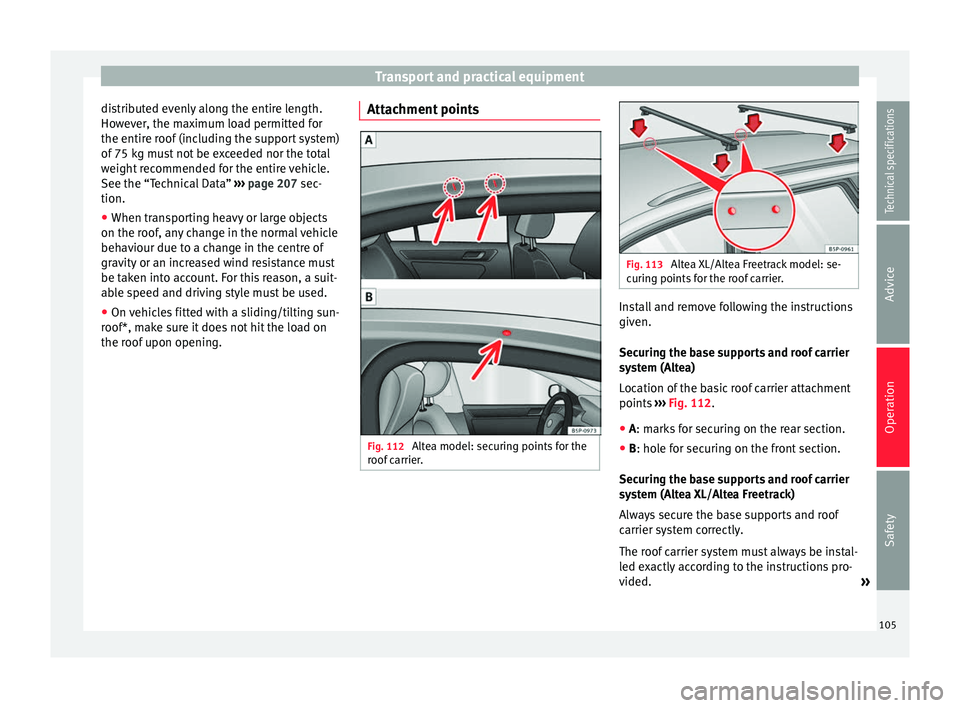
Altea model: securing points for the
roof carrier. Fig. 113
Altea XL/Altea Freetrack model: se-
curing points for the roof carrier. Install and remove following the instructions
given.
Securing the base supports and roof carrier
system (Altea)
Location of the basic roof carrier attachment
points
››› Fig. 112 .
● A: marks for securing on the rear section.
● B: hole for securing on the front section.
Sec uring the base supports and roof carrier
system (Altea XL/Altea Freetrack)
Always secure the base supports and roof
carrier system correctly.
The roof carrier system must always be instal-
led exactly according to the instructions pro-
vided. »
105
Technical specifications
Advice
Operation
Safety
Page 116 of 236
Operation
A pleasant temperature is quickly reached in
automatic mode at a temperature of +22 °C
(+72 °F). Therefore, we recommend you not
to change this adjustment, except as neces-
sary to suit individual preferences or particu-
lar circumstances. It is possible to select inte-
rior temperatures from +18 °C (+64 °F) to
+26 °C (+80 °F). These are approximate tem-
peratures and the actual temperature may be
slightly higher or lower depending on out-
side ambient conditions.
Climatronic maintains a constant tempera-
ture. The temperature of the air supplied to the interior, the blower speed and the air dis-
tribution are regulated automatically. The
system also considers the sunlight radiation,
so there is no need for manual readjustment.
Therefore,
automatic mode
almo
s t always
provides the best comfort for the vehicle oc-
cupants throughout the year.
Automatic mode is switched off whenever an
adjustment is made using the buttons for the
air distribution, fan or or the air recircula-
tion button . The temperature will continue
to be regulated within the parameters man-
ually selected by the user. Note
There are two automatic modes:
● Automatic mode LO: this calculates the air
flow for two people.
● Automatic mode HI: this calculates the air
flow for more than two people. Manual mode
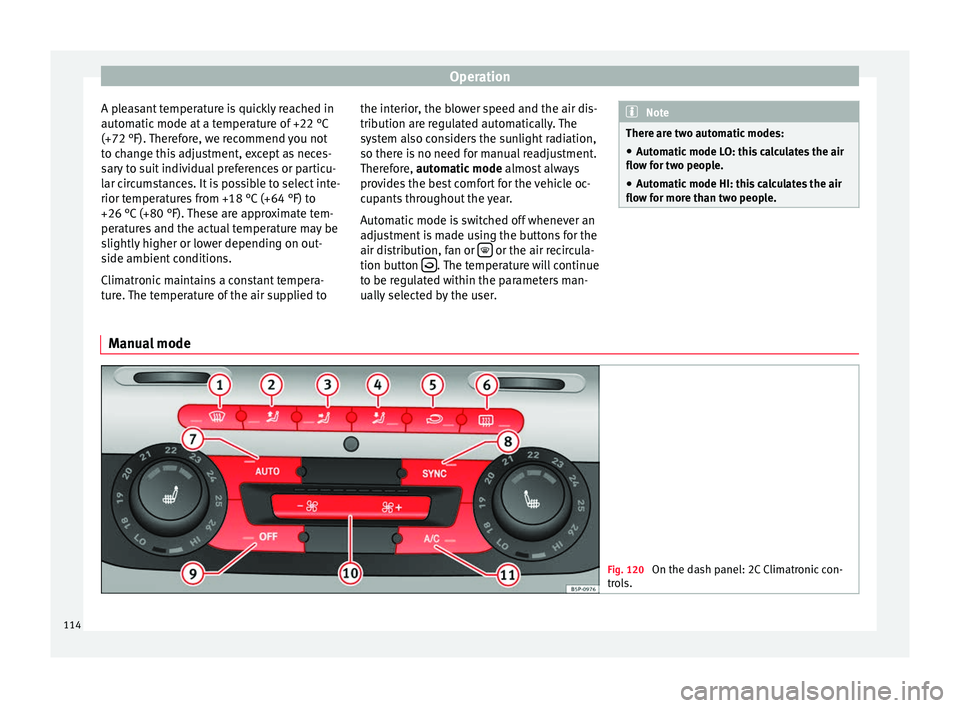
Fig. 120
On the dash panel: 2C Climatronic con-
trols. 114
Page 118 of 236
Operation
If the windscreen air output is on and air re-
circulation mode is pressed, this remains ac-
tive. When the recirculation mode is on, if the
air distribution towards the windscreen mode
is selected, the recirculation mode is deacti-
vated. For safety reasons, the air recirculation
mode should not be connected. WARNING
In air recirculation mode, no cold air from the
outside enters the vehicle interior. If the air
conditioning system is switched off, the win-
dows can quickly mist over. Therefore, never
leave the air recirculation mode switched on
for a long time (risk of accident). General notes
Pollution filter
The pollution filter (a combined particulate
filter and active carbon filter) serves as a bar-
rier against impurities in the outside air, in-
cluding dust and pollen.
For the climate control system to work with
maximum efficiency, the pollution filter must
be replaced at the specified intervals in the
Maintenance Programme.
If the filter loses efficiency prematurely due
to use in areas reaching very high pollution
levels, the pollen filter must be changed
more frequently than stated in the Service
Schedule. Air conditioner
When the air conditioning system is switched
on, not only the temperature, but also the air
humidity in the vehicle interior is reduced.
This improves comfort for the vehicle occu-
pants and prevents misting of the windows
when the ambient air humidity is high.
If the air conditioning system cannot be
switched on this may be caused by the fol-
lowing reasons:
● The engine is not running.
● The A/C button is switched off.
● The outside temperature is lower than ap-
proximately +3 °C (+37 °F).
● The air conditioning system compressor
has been temporarily switched off because
the engine coolant temperature is too high.
● The air conditioner fuse is faulty.
● Another fault in the vehicle. Have the air
conditioner checked by a specialised work-
shop. CAUTION
● If you suspect that the air conditioner is
damaged, switch it off with the A/C button to
prevent further damage and have it checked
by a specialised workshop.
● Repairs to the air conditioner require spe-
cialist knowledge and special tools. There-
fore, we recommend you to take the vehicle
to a specialised workshop. Note
● If the humidity and temperature outside the
vehicle are high, condensation can drip off
the evaporator in the cooling system and
form a pool underneath the vehicle. This is
normal and does not indicate a leak.
● Keep the air intake slots in front of the
windscreen free of snow, ice and leaves to en-
sure heating and cooling are not impaired,
and to prevent the windows from misting
over.
● The air from the vents flows through the ve-
hicle interior and is extracted by slots de-
signed for this purpose. Therefore, do not
cover these slots with items of clothing or
other objects.
● The air conditioner operates most effective-
ly with the windows and the sliding/tilting
sunroof* closed. However, if the temperature
inside the vehicle is excessive because of the
sun, the air inside can be cooled faster by
opening the windows for a short time.
● Do not smoke while air recirculation mode
is on, as smoke drawn into the air condition-
ing system leaves residue on the evaporator,
producing a permanent unpleasant odour.
● It is advisable to turn on the air condition-
ing at least once a month, to lubricate the
system gaskets and prevent leaks. If a de-
crease in the cooling capacity is detected, a
Technical Service should be consulted to
check the system. 116
Page 119 of 236
Driving
Driving Power steering (servotronic*) Power steering assists the driver by reducing
the force needed to turn the steering wheel.
In cars equipped with servotronic* power
steering the degree of power assistance is
regulated electronically
according to road
s
peed.
The power steering will keep on working even
if
the servotronic* device fails. The degree of
po w
er assistance will, however, no longer
adapt to different speeds. If the electronic
regulating system is not working properly,
this is most noticeable when turning the
steering wheel at low speeds (for instance
when parking), as more effort will be required
than usual. The fault should be corrected by
a specialised workshop as soon as possible.
Power steering does not work if the engine is
off. In this case the steering wheel requires
much more force to turn.
Turning the steering to its limit when the ve-
hicle is stationary will place an excessive
load on the power steering system. Turning
the steering wheel to its limit places a load
on the system, which causes noise. It will al-
so reduce the idling speed of the engine. CAUTION
When the engine is running, do not turn the
steering wheel to its limit for more than 15
seconds. Otherwise, there is a risk of damag-
ing the power steering. Note
● If the power steering should fail at any time
or the engine is switched off (for instance
when being towed), the vehicle can still be
steered. However, more effort will be required
to turn the steering wheel.
● If the system is leaking or malfunctioning,
please take the car to a specialised workshop
immediately.
● The power steering system requires a spe-
cial hydraulic fluid. The container is located
in the engine compartment (front left). The
correct fluid level in the reservoir is impor-
tant for the power steering to function prop-
erly. The hydraulic fluid level is checked at
the Inspection Service. All-wheel drive*
On all-wheel drive models, the engine power
is distributed to all four wheels
General notes
The all-wheel drive system operates com-
pletely automatically. The propulsion force is
distributed among the four wheels and adap-ted to the driving style and the road condi-
tions.
The all-wheel drive is specially designed to
complement the superior engine power. This
combination gives the vehicle exceptional
handling and performance capabilities, both
on normal roads and in more difficult condi-
tions, such as snow and ice.
Winter tyres
Thanks to its all-wheel drive, your vehicle will
have plenty of traction in winter conditions,
even with the standard tyres. Nevertheless,
we still recommend that winter tyres or all-
season tyres should be fitted on all four
wheels when winter road conditions are ex-
pected, mainly because this will give a better
braking response.
Snow chains
On roads where snow chains are mandatory,
this also applies to cars with all-wheel drive.
Changing tyres
On vehicles with all-wheel drive, all four tyres
must have the same rolling circumference
››› page 179 . WARNING
● Even with all-wheel drive, you should al-
ways adjust your speed to suit the condi-
tions. Do not let the extra safety features » 117
Technical specifications
Advice
Operation
Safety
Page 120 of 236
Operation
tempt you into taking any risks when driving.
Failure to follow this instruction could result
in an accident.
●
The braking capability of your vehicle is
limited by the tyres' grip. Vehicle behaviour
is no different from a vehicle without four-
wheel drive. So do not be tempted to drive
too fast on icy or slippery roads just because
the vehicle still has good acceleration in
these conditions. Failure to do so could result
in an accident.
● On wet roads bear in mind that the front
wheels may lose contact with the road and
start to float (aquaplaning) if the vehicle is
driven too fast. If this should happen, there
will be no sudden increase in engine speed
when aquaplaning begins to warn the driver,
as with a front-wheel drive vehicle. For this
reason and for that mentioned above, always
choose a driving speed suitable for the road
conditions. Failure to follow this instruction
could result in an accident. Driving with LPG*
3 Applies to the model: ALTEA / ALTEA XL
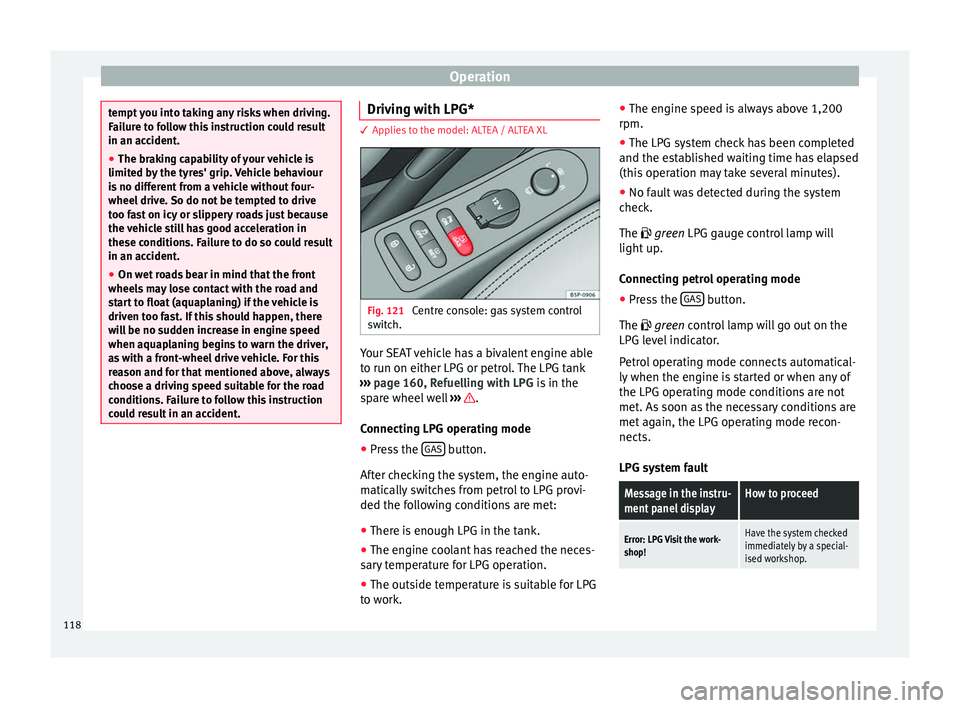
Fig. 121
Centre console: gas system control
switch. Your SEAT vehicle has a bivalent engine able
to run on either LPG or petrol. The LPG tank
››› page 160, Refuelling with LPG is in the
spare wheel well ››› .
Connecting LPG operating mode
● Press the GAS button.
After checking the system, the engine auto-
matically switches from petrol to LPG provi-
ded the following conditions are met:
● There is enough LPG in the tank.
● The engine coolant has reached the neces-
sary temperature for LPG operation.
● The outside temperature is suitable for LPG
to work. ●
The engine speed is always above 1,200
rpm.
● The LPG system check has been completed
and the established waiting time has elapsed
(this operation may take several minutes).
● No fault was detected during the system
check.
The
green LPG gauge control lamp will
light up.
Connecting petrol operating mode
● Press the GAS button.
The green
control lamp will go out on the
LPG l
evel indicator.
Petrol operating mode connects automatical-
ly when the engine is started or when any of
the LPG operating mode conditions are not
met. As soon as the necessary conditions are
met again, the LPG operating mode recon-
nects.
LPG system fault
Message in the instru-
ment panel displayHow to proceed
Error: LPG Visit the work-
shop!Have the system checked
immediately by a special-
ised workshop. 118
Page 129 of 236
Driving
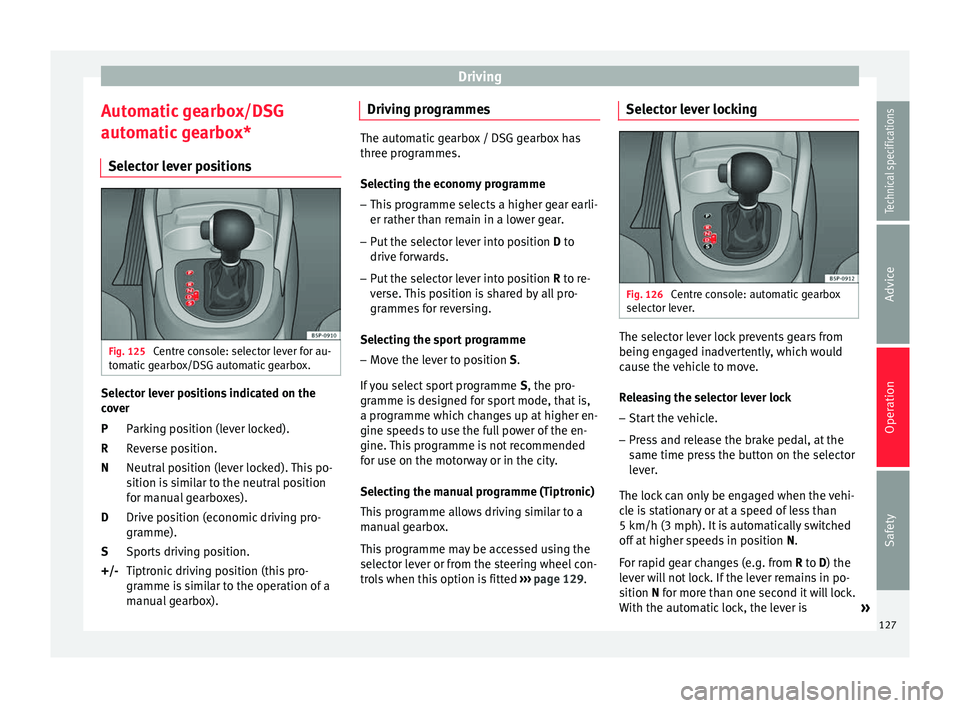
Automatic gearbox/DSG
automatic gearbox* Selector lever positions Fig. 125
Centre console: selector lever for au-
tomatic gearbox/DSG automatic gearbox. Selector lever positions indicated on the
cover
Parking position (lever locked).
Reverse position.
Neutral position (lever locked). This po-
sition is similar to the neutral position
for manual gearboxes).
Drive position (economic driving pro-
gramme).
Sports driving position.
Tiptronic driving position (this pro-
gramme is similar to the operation of a
manual gearbox).
P
R
N
D
S
+/- Driving programmes The automatic gearbox / DSG gearbox has
three programmes.
Selecting the economy programme
– This programme selects a higher gear earli-
er rather than remain in a lower gear.
– Put the selector lever into position D to
driv e f
orwards.
– Put the selector lever into position R to re-
ver
se. This position is shared by all pro-
grammes for reversing.
Selecting the sport programme – Move the lever to position S.
If you select sport programme S, the pro-
gr amme i
s designed for sport mode, that is,
a programme which changes up at higher en-
gine speeds to use the full power of the en-
gine. This programme is not recommended
for use on the motorway or in the city.
Selecting the manual programme (Tiptronic)
This programme allows driving similar to a
manual gearbox.
This programme may be accessed using the
selector lever or from the steering wheel con-
trols when this option is fitted ›››
page 129. Selector lever locking
Fig. 126
Centre console: automatic gearbox
selector lever. The selector lever lock prevents gears from
being engaged inadvertently, which would
cause the vehicle to move.
Releasing the selector lever lock
– Start the vehicle.
– Press and release the brake pedal, at the
same time press the button on the selector
lever.
The lock can only be engaged when the vehi-
cle is stationary or at a speed of less than
5 km/h (3 mph). It is automatically switched
off at higher speeds in position N.
F or r
apid gear changes (e.g. from R
to D) the
lever will not lock. If the lever remains in po-
sition
N for more than one second it will lock.
With the automatic lock, the lever is »
127
Technical specifications
Advice
Operation
Safety