ECO mode Seat Altea 2015 Owner's Guide
[x] Cancel search | Manufacturer: SEAT, Model Year: 2015, Model line: Altea, Model: Seat Altea 2015Pages: 236, PDF Size: 4.23 MB
Page 132 of 236
Operation
– Lightly press the selector lever forward
››› Fig. 128 + to change up to a higher
gear.
– Lightly press the selector lever backward
››› Fig. 128 - to change down to a lower
gear.
Changing gear with the steering wheel
paddle levers* – Press the right paddle lever + towards the
steering wheel to change up ››› Fig. 129 .
– Pr e
ss the left paddle – towards the steer-
ing wheel to change down ››› Fig. 129 .
U s
ing the paddle levers on the steering
wheel, you can access manual driving mode
regardless of the pre-selected driving mode.
General information about driving in
tiptronic mode
When accelerating, the automatic gearbox /
DSG automatic gearbox goes into a higher
gear a little before the engine reaches its
maximum permitted revolutions.
If a lower gear is selected, the automatic
gearbox / DSG automatic gearbox will only
change down when the engine cannot go
over its maximum permitted revolutions.
If “tiptronic” is selected whilst the vehicle is
in motion and the automatic gearbox / DSG
automatic gearbox is in third gear and selec- tor lever position D, “tiptronic” mode will
then also be in third gear.
Changing gears in the normal or sport
programme using the steering wheel paddle
levers
If the paddle levers
››› Fig. 129 are used in
the normal
or sport programme, the system
switches temporarily to “tiptronic” mode. To
exit “Tiptronic” mode again, press the right
paddle shifter +OFF toward the steering
wheel for approximately one second. You will
also leave “Tiptronic” mode if the paddle lev-
ers are not moved for a certain time. Note
● The gearbox controls on the steering wheel
can operate with the selector lever in any po-
sition and with the vehicle in motion. Kick-down feature
This feature allows maximum acceleration.
If you press the accelerator down thoroughly,
the gearbox automatically changes down, de-
pending on speed and engine speed, into a
lower gear to take full advantage of give the
vehicle maximum acceleration.
The gearbox does not change gear until the
engine reaches the maximum determined en-
gine speed for the gear. WARNING
You could lose control of the vehicle if you ac-
celerate on slippery road surfaces. Risk of se-
rious injury.
● Be particularly careful when using the kick-
down features on slippery road surfaces. With
a fast acceleration, the vehicle could lose
traction and skid.
● You should use the kick-down feature only
when traffic and weather conditions allow it
to be used safely. Run-in and economical driving
Running in a new engine The engine needs to be run in over the first
1,500 km.
Up to 1,000 kilometres
– Do not drive at speeds of more than 2/3
the maximum speed.
– Do not accelerate hard.
– Avoid high engine revolutions.
– Do not tow a trailer.
130
Page 135 of 236
Driving
Some tips on how to help you reduce pollu-
tion while saving money are listed below.
Drive anticipating the traffic situation
A vehicle uses most fuel when accelerating.
When you anticipate situations, you have to
brake less often and, thus, accelerate less. If
it is possible, let the vehicle roll with a gear
engaged , for example, if you see a red light
ahe a
d. The braking effect achieved in this
way helps to reduce the wear of brakes and
tyres; emissions and fuel consumption are
reduced to zero (disconnection due to iner-
tia).
Change gear early to save energy
An effective way of saving fuel is to change
up
quickly through the gears. Running the
engine at high rpm in the lower gears uses
an unnecessary amount of fuel.
Manual gearbox: shift up from first to second
gear as soon as possible. We recommend
that, whenever possible, you change to a
higher gear upon reaching 2000 rpm. Follow
the “recommended gear” indication that ap-
pears on the instrument panel ››› page 47.
Avoid driving at high speed
We advise you not to drive at the top speed
permitted by the vehicle. Fuel consumption,
exhaust emissions and noise levels all in- crease very rapidly at higher speeds. Driving
at moderate speeds will help to save fuel.
Avoid idling
It is worthwhile switching off the engine
when waiting in a traffic jam, at level cross-
ings or at traffic lights with a long red phase.
The fuel saved after only 30 - 40 seconds is
greater than the amount of fuel needed to re-
start the engine.
The engine takes a long time to warm up
when it is idling. Mechanical wear and pollu-
tant emissions are also especially high dur-
ing this initial warm-up phase. It is therefore
best to drive off immediately after starting
the engine. Avoid running the engine at high
speed.
Periodic maintenance
Periodic maintenance work guarantees that,
before beginning a journey, you will not con-
sume more than the required amount of fuel.
A well-serviced engine gives you the benefit
of
improved fuel efficiency as well as maxi-
mum reliability and an enhanced resale val-
ue.
A badly serviced engine can consume up to
10% more fuel than necessary.
Avoid short journeys
To reduce the consumption and emission of
polluting exhaust gases, the engine and the exhaust gas filtration systems should reach
the optimum operating temperature.
With the en
gine cold, fuel consumption is
proportionally higher. The engine does not
warm up and fuel consumption does not nor-
malise until having driven approximately four
kilometres. This is why we recommend avoid-
ing short trips whenever possible.
Maintain the correct tyre pressures
Bear in mind that keeping the tyres at an ad-
equate pressure saves fuel. If the tyre pres-
sure is just one bar (14.5 psi / 100 kPa) too
low, fuel consumption can increase by as
much as 5%. Due to the greater rolling resist-
ance, under-inflation also increases tyre wear
and impairs handling.
The tyre pressures should always be checked
when the tyres are cold.
Do not u
se winter tyres
all year round as they
increase fuel consumption by up to 10%.
Avoid unnecessary weight
Given that every kilo of extra weight
will in-
crease the fuel consumption, it is advisable
to always check the luggage compartment to
make sure that no unnecessary loads are be-
ing transported.
A roof rack is often left in place for the sake
of convenience, even when it is no longer
needed. At a speed of 100 km/h (62 mph) »
133
Technical specifications
Advice
Operation
Safety
Page 143 of 236

Driver assistance systems
SEAT Parking System Plus*:
description The Parking System Plus is an acoustic and
optical parking aid.
Sensors are located in the front and rear
bumpers. When the sensors detect an obsta-
cle, you are alerted by audible and optical
warnings. The measuring range of the sen-
sors starts at approximately:FrontSide0.90
Centre1.20
RearSide0.60
Centre1.60
The audible warnings sound with increasing
frequency as you approach the obstacle.
When the vehicle is less than 0.30 m away
from the obstacle, the warning tone will
sound continuously. Stop moving immediate-
ly!
The volume of the warning beeps will gradu-
ally decrease after about 4 seconds if the ve-
hicle remains at a constant distance from a
detected obstacle (it does not affect the per-
manent acoustic signal). Activating/deactivating
Fig. 134
Centre console: Switch for parking
aid. Activate
– Connects the radio navigator.
– Press the switch on the centre console
››› Fig. 134 or on the gear indicator. You will
he ar a brief
confirmation tone and the LED
on the switch will light up.
Deactivating – Drive forward faster than 10 km/h (6 mph),
or
– Press the switch or
– Switch the ignition off.
Segments in the optical display
Some colour segments in front and behind
and an audible warning enable the driver to
assess the distance with respect to an obsta- cle. The amber colour segments combined
with a discontinuous beep indicate the pres-
ence of an obstacle. As the vehicle gets clos-
er to the obstacle, the colour of the segment
changes to red and the acoustic signal beeps
continuously. When the penultimate segment
is displayed, this means that the vehicle has
reached the collision zone. Stop moving im-
mediately!
››› in SEAT Parking System: de-
scription on page 140. Note
● Please refer to the notes on towing
››› page 141.
● Ther e i
s a slight delay in the picture dis-
play. Towing bracket
In towing mode, the rear parking aid sensors
are not enabled when you select reverse gear
or press the switch
. This function may not
be guaranteed on towing brackets that are
not factory fitted. This results in the following
restrictions:
SEAT Parking System*
No warning is given.
SEAT Parking System Plus*
There is no rear distance warning. The system
will still give a warning when obstacles are »
141
Technical specifications
Advice
Operation
Safety
Page 144 of 236
Operation
detected while driving forward. The optical
display changes to towing mode.
Fault messages If you hear a long beep for a few seconds and
the LED on the switch
* starts flashing
when
you switch on the parking aid, a system
fault has occurred. Contact a SEAT official
service or specialised workshop. Note
If the fault is not corrected before you switch
off the ignition, it will only be indicated by
the flashing LED on the switch the next
time y
ou switch on the parking aid. Cruise speed* (cruise control
system - CCS)
Description The CCS is able to maintain the set speed in
the range from approx. 30 km/h (19 mph) to
180 km/h (112 mph).
Once the speed setting has been saved, you
may take your foot off the accelerator. WARNING
It could be dangerous to use the cruise con-
trol system if it is not possible to drive at con-
stant speed.
● Do not use the cruise control system when
driving in dense traffic, on roads with lots of
bends or on roads with poor conditions (with
ice, slippery surfaces, loose grit or gravel), as
this could cause an accident.
● Always switch the cruise control system off
after using it in order to avoid involuntary
use.
● It is dangerous to use a set speed which is
too high for the current road, traffic or weath-
er conditions. Risk of accident. Note
The cruise control cannot maintain a constant
speed when descending downhill. It will in-
crease due to its own weight. Use the foot
brake to slow the vehicle. Switching the cruise control system
on and off
Fig. 135
Turn signal and main beam head-
light lever: switch and rocker switch for the
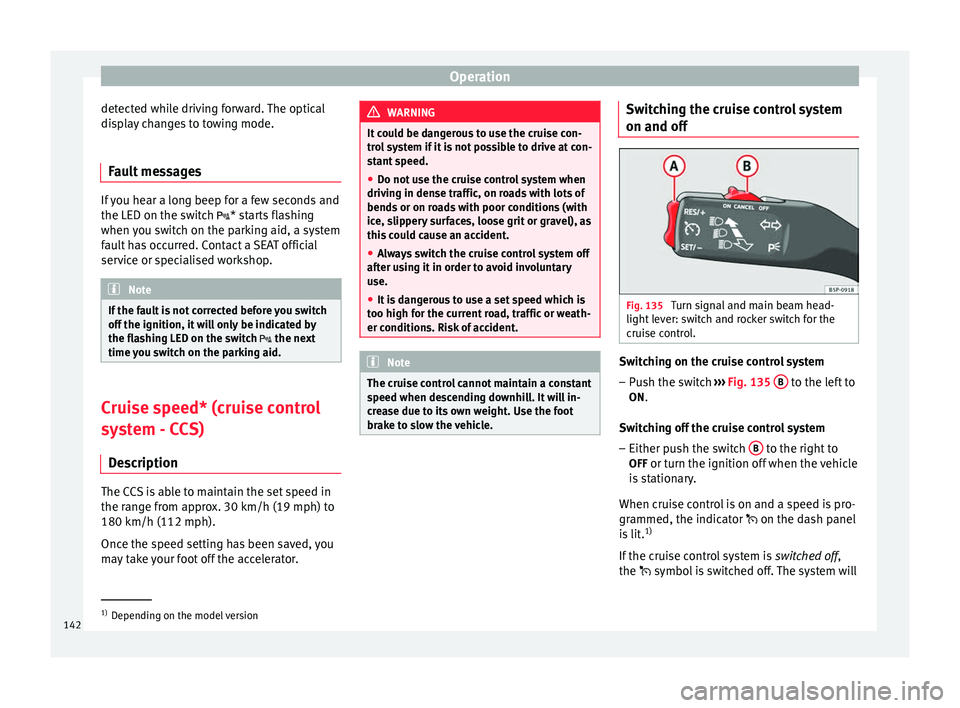
cruise control. Switching on the cruise control system
– Push the switch ››› Fig. 135 B to the left to
ON.
Switching off the cruise control system
– Either push the switch B to the right to
OFF or turn the ignition off when the vehicle
is stationary.
When cruise control is on and a speed is pro-
grammed, the indicator on the dash panel
is lit. 1)
If the cruise control system is switched off,
the symbo l
is switched off. The system will 1)
Depending on the model version
142
Page 147 of 236
Towing bracket device
Tyre pressure
Set tyre pressure to the maximum permissi-
ble pressure shown on the sticker on the in-
side of the fuel tank flap. Set the tyre pres-
sure of the trailer tyres in accordance with the
trailer manufacturer's recommendations.
Exterior mirrors
Check whether you can see enough of the
road behind the trailer with the standard rear
vision mirrors. If this is not the case, you
should have additional exterior mirrors fitted.
Both exterior mirrors should be mounted on
hinged extension brackets. Adjust the mirrors
to give sufficient vision to the rear. WARNING
Never transport people in a trailer. This could
result in fatal accidents. Note
● Towing a trailer places additional demands
on the vehicle. We recommend additional
services between the normal inspection inter-
vals if the vehicle is used frequently for tow-
ing a trailer.
● Find out whether special regulations apply
to towing a trailer in your country. Ball coupling of towing bracket*
Depending on the model version, the spheri-
cal head on the trailer hook may be stored in
the tool box.
The ball coupling is provided with instruc-
tions on fitting and removing the ball cou-
pling of the towing bracket.
WARNING
The towing bracket ball coupling must be
stored securely in the luggage compartment
to prevent them being flung through the vehi-
cle and causing injury. Note
● By law, the ball coupling must be removed
if a trailer is not being towed if it obscures
the number plate. Driving tips
Driving with a trailer always requires extra
care.
Weight distribution
The weight distribution of a loaded trailer
with an unladen vehicle is very unfavourable.
However, if this cannot be avoided, drive ex-
tra slowly to allow for the unbalanced weight
distribution.Speed
The stability of the vehicle and trailer is re-
duced with increasing speed. For this reason,
it is advisable not to drive at the maximum
permissible speed in an unfavourable road,
weather or wind conditions. This applies es-
pecially when driving downhill.
You should always reduce speed immediately
if the trailer shows the slightest sign of
snak-
ing . Never try to stop the “snaking” by in-
c r
easing speed.
Always brake in due course. If the trailer has
an
overrun brake, apply the brakes gently at
first and then, firmly. This will prevent the
jerking that can be caused by locking of trail-
er wheels. Select a low gear in due course
before going down a steep downhill. This en-
ables you to use the engine braking to slow
down the vehicle.
Reheating
At very high temperatures and during pro-
longed slopes, driving in a low gear and high
engine speed, always monitor the coolant
temperature gauge ››› page 31.
Electronic Stability Control*
The ESC* system helps to stabilise the trailer
in case of skidding or rocking.
145
Technical specifications
Advice
Operation
Safety
Page 148 of 236
Operation
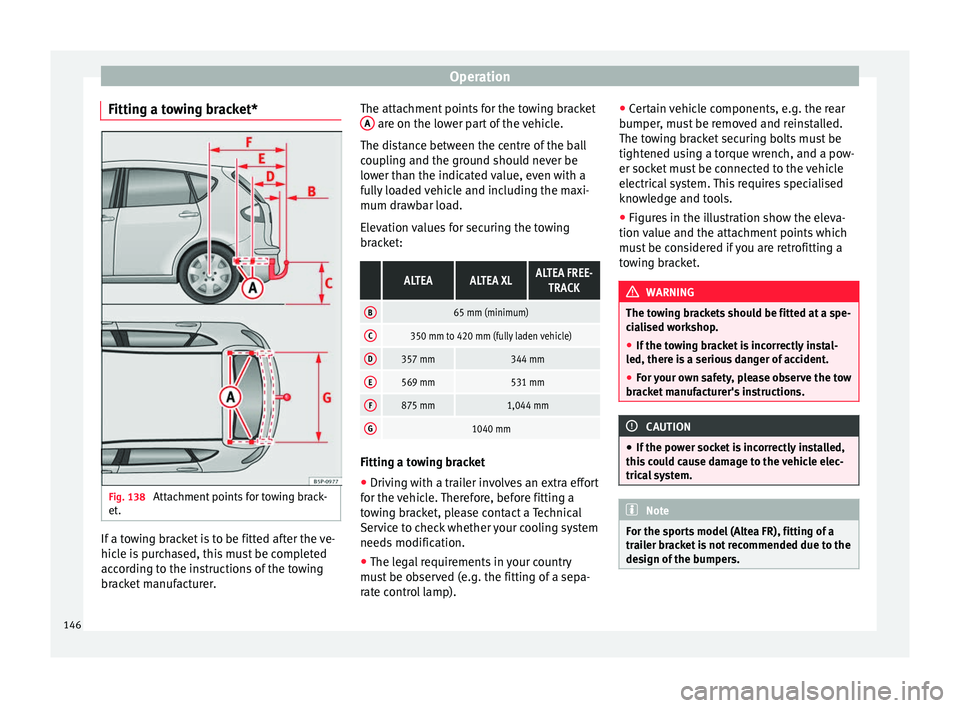
Fitting a towing bracket* Fig. 138
Attachment points for towing brack-
et. If a towing bracket is to be fitted after the ve-
hicle is purchased, this must be completed
according to the instructions of the towing
bracket manufacturer. The attachment points for the towing bracket
A are on the lower part of the vehicle.
The distance between the centre of the ball
coupling and the ground should never be
lower than the indicated value, even with a
fully loaded vehicle and including the maxi-
mum drawbar load.
Elevation values for securing the towing
bracket: ALTEAALTEA XLALTEA FREE- TRACK
B65 mm (minimum)
C350 mm to 420 mm (fully laden vehicle)
D357 mm344 mm
E569 mm531 mm
F875 mm1,044 mm
G1040 mm Fitting a towing bracket
●
Driving with a trailer involves an extra effort
for the vehicle. Therefore, before fitting a
towing bracket, please contact a Technical
Service to check whether your cooling system
needs modification.
● The legal requirements in your country
must be observed (e.g. the fitting of a sepa-
rate control lamp). ●
Certain vehicle components, e.g. the rear
bumper, must be removed and reinstalled.
The towing bracket securing bolts must be
tightened using a torque wrench, and a pow-
er socket must be connected to the vehicle
electrical system. This requires specialised
knowledge and tools.
● Figures in the illustration show the eleva-
tion value and the attachment points which
must be considered if you are retrofitting a
towing bracket. WARNING
The towing brackets should be fitted at a spe-
cialised workshop.
● If the towing bracket is incorrectly instal-
led, there is a serious danger of accident.
● For your own safety, please observe the tow
bracket manufacturer's instructions. CAUTION
● If the power socket is incorrectly installed,
this could cause damage to the vehicle elec-
trical system. Note
For the sports model (Altea FR), fitting of a
trailer bracket is not recommended due to the
design of the bumpers. 146
Page 155 of 236
Care and maintenance
running gear, and retouch it if necessary,
before and after the winter season.
We recommend that you go to your Technical
Service to carry out repair work and addition-
al anti-corrosion work. WARNING
Do not apply underseal or anti-corrosion
coatings to the exhaust pipes, catalytic con-
verter or the heat shields on the exhaust sys-
tem. The heat of the exhaust system or the
engine could cause them to ignite. Risk of
fire. Cleaning the engine compartment
Take special care when cleaning the engine
compartment.
Anti-corrosion treatment
The engine compartment and the surface of
the power unit are given anti-corrosion treat-
ment at the factory.
Good corrosion protection is particularly im-
portant in winter when the vehicle is fre-
quently driven on salted roads. To prevent
the salt corroding the vehicle, the entire en-
gine compartment should be thoroughly
cleaned before and after winter.
Technical Services
have the proper products
for cleaning and preservation as well as the necessary workshop equipment. For this rea-
son, we recommend having this work per-
formed by them.
The anti-corrosion protection is usually re-
moved if the engine compartment is cleaned
with grease removing solutions, or if you
have the engine cleaned. On commissioning
this work, ensure that all surfaces, seams,
joints and components in the engine com-
partment are given anti-corrosion treatment.
WARNING
● When working in the engine compartment,
always observe the safety warnings
››› page 163.
● Bef
ore opening the bonnet, switch the en-
gine off, apply the handbrake firmly and al-
ways remove the key from the ignition.
● Allow the engine to cool before you clean
the engine compartment.
● Do not clean, for example, the vehicle un-
derbody, wheel arches or wheel trims without
protecting your hands and arms. You may cut
yourself on sharp-edged metal parts. Failure
to comply could result in injury.
● Moisture, ice and salt on the brake system
may affect braking effectiveness. Risk of acci-
dent. Directly after washing, avoid sudden
and sharp braking.
● Never touch the radiator fan. It is tempera-
ture-controlled and could start automatically,
even when the key is removed from the igni-
tion! For the sake of the environment
Fuel, grease and oil deposits can be removed
when the engine is washed. The polluted wa-
ter must be cleaned in an oil separator. For
this reason, engine washing should be car-
ried out only by a specialised workshop or a
petrol station. Caring for the vehicle interior
Introduction The dye used in many modern garments, for
example dark jeans, is not always sufficiently
colour-fast. Seat upholstery (material and
leather), especially when light-coloured, may
visibly discolour if the dye comes out of
clothing (even when used correctly). This is
not an upholstery defect but indicates that
the dye in the item of clothing is not suffi-
ciently colour-fast.
The longer stains or dirt remain on the vehi-
cle surfaces, especially the fabrics covering
the padded upholstery, the more difficult it
becomes to clean and maintain them. If
stains and dirt are left for a long time, it may
be that they are impossible to remove.
WARNING
Car-care products may be toxic and hazard-
ous. Using unsuitable car-care products or, » 153
Technical specifications
Advice
Operation
Safety
Page 181 of 236
Wheels
the vehicle is impaired and there is a risk of
accident.
Note
● The run-flat tyres do not “deflate” on losing
pressure because they are supported on the
reinforced sides. Therefore defects in the tyre
cannot be detected with a visual inspection.
● Snow chains must not be used on front
tyres used in emergency conditions. New tyres and wheels
New tyres and wheels have to be run in.
The tyres and wheel rims are an essential
part of the vehicle's design. Those approved
by SEAT are specially matched to the charac-
teristics of the vehicle and make a major con-
tribution to good road-holding and safe han-
dling
››› .
Note for Italy: A SEAT Service Centre should
be c on
sulted whether different sized wheels
or tyres to those originally fitted by SEAT may
be fitted, as well as the combinations al-
lowed between the front axle (axle 1) and
back axle (axle 2).
Tyres should be replaced at least in pairs and
not individually (i.e. both front tyres or both
rear tyres together). A knowledge of tyre des-
ignations makes it easier to choose the cor- rect tyres. Radial tyres have the tyre designa-
tions marked on the sidewall, for example:
195/65 R15 91T
This contains the following information:
Tyre width in mm
Height/width ratio in %
Tyre construction: Radial
Rim di
ameter in inches
Load rating code
Speed rating
The tyres could also have the following infor-
mation:
● A direction of rotation symbol
● “Reinforced” denotes heavy-duty tyres.
The manufacturing date is also indicated on
the tyre sidewall (possibly only on the inner
side of the wheel).
“DOT... 1103...” means, for example, that the
tyre was produced in the 11th week of 2003.
We recommend that work on tyres and
wheels be carried out by a Technical Service.
They are familiar with the procedure and
have the necessary special tools and spare
parts as well as the proper facilities for dis-
posing of the old tyres. 195
65
R
15
91
T Any technical service has full information on
the technical requirements when installing or
changing tyres, wheels or wheel trims.
On vehicles with
all-wheel drive, all four tyres
must always be fitted with tyres of the same
type, make and tread pattern, as otherwise
the driveline can be damaged by continuous
differences in the wheel speeds. For this rea-
son, the spare wheel should have the same
wheel dimensions as the normal wheels so
that it will fit if there is a puncture. You may
also use the factory-supplied compact tem-
porary spare wheel. WARNING
● We recommend that you use only wheels
and tyres which have been approved by SEAT
for your model. Failure to do so could impair
vehicle handling. Risk of accident.
● Avoid running the vehicle on tyres that are
more than 6 years old. If you have no alterna-
tive, you should drive slowly and with extra
care at all times.
● Never use old tyres or those with an un-
known “history of use”.
● If wheel trims are retrofitted, you must en-
sure that the flow of air to the brakes is not
restricted. This could cause the brake system
to overheat.
● All four wheels must be fitted with radial
tyres of the same type, size (rolling circumfer-
ence) and the same tread pattern. » 179
Technical specifications
Advice
Operation
Safety
Page 182 of 236
Advice
For the sake of the environment
Old tyres must be disposed of according to
the laws in the country concerned. Note
● For technical reasons, it is not generally
possible to use the wheels from other vehi-
cles. This can also apply to wheels of the
same model. The use of wheels or tyres
which have not been approved by SEAT for
use with your model may invalidate the vehi-
cle's type approval for use on public roads.
● If the spare tyre is not the same as the
tyres that are mounted on the vehicle (e.g.
winter tyres) you should only use the spare
tyre for a short period of time and drive with
extra care. Refit the normal road wheel as
soon as possible. Wheel bolts
The design of wheel bolts is matched to the
rims. If different wheel rims are fitted, the
correct wheel bolts with the right length and
correctly shaped bolt heads must be used.
This ensures that wheels are fitted securely
and that the brake system functions correctly.
In certain circumstances, you should not use
wheel bolts from a different vehicle, even if it
is the same model
›››
page 147. After the wheels have been changed, the
tightening torque of the wheel bolts should
be checked as soon as possible with a torque
wrench
››› . The tightening torque for steel
and alloy wheels is 120 Nm. WARNING
If the wheel bolts are not tightened correctly,
the wheel could become loose while driving.
Risk of accident.
● The wheel bolts must be clean and turn
easily. Never apply grease or oil to them.
● Use only wheel bolts which belong to the
wheel.
● If the tightening torque of the wheel bolts
is too low, they could loosen whilst the vehi-
cle is in motion. Risk of accident! If the tight-
ening torque is too high, the wheel bolts and
threads can be damaged. CAUTION
The prescribed tightening torque for wheel
bolts for steel and alloy wheels is 120 Nm. Winter service
Winter tyres In winter conditions winter tyres will consid-
erably improve the vehicle's handling. Sum-mer tyres (width, rubber compound, tread
pattern) provide less grip on ice and snow.
Winter tyres must be inflated to a
pressure of
0.2 bar (2.9 psi/20 kPa) higher than the pres-
sures specified for summer tyres (see sticker
on fuel tank flap).
Winter tyres must be fitted on all four wheels.
Information on permitted winter tyre sizes
can be found in the vehicle's registration
documentation. Use only radial winter tyres.
All tyre sizes listed in the vehicle documenta-
tion also apply to winter tyres.
Winter tyres lose their effectiveness when the
tread is worn down to a depth of 4 mm.
The speed rating code ››› page 179, New
tyres and wheels determines the following
speed limits for winter tyres:
›
› › max. 160 km/h
max. 180 km/h
max. 190 km/h
max. 210 km/h
In some countries, vehicles which can exceed
the speed rating of the fitted tyre must have
an appropriate sticker in the driver's field of
view. These stickers are available from your
technical service. The legal requirements of
each country must be followed.
Do not have winter tyres fitted for unnecessa-
rily long periods. Vehicles with summer tyres Q
S
T
H
180
Page 183 of 236
Emergencies
handle better when the roads are free of
snow and ice.
If you have a flat tyre, please refer to the
notes on the spare wheel ››› page 179, New
tyres and wheels .WARNING
The maximum speed for the winter tyres must
not be exceeded. Otherwise, this could lead
to damage and risk of accident. For the sake of the environment
Fit your summer tyres again as soon as possi-
ble. They are quieter, do not wear so quickly
and reduce fuel consumption. Snow chains
Snow chains are only permitted on front
wheels and only for tyres 195/65R15 and
205/55R16. These tyres may only be fitted
with fine-pitch link chains which do not pro-
trude more than 15 mm
›››
page 210.
Other tyres may use fine-pitch links which do
not protrude more than 9 mm, including ten-
sion device.
Remove wheel hub covers and trim rings be-
fore fitting snow chains. For safety reasons,
cover caps, available at any technical service,
must then be fitted over the wheel bolts. All-wheel drive
: where snow chains are com-
pulsory, this normally also applies to all-
wheel drive vehicles. Snow chains may only
be fitted to the front
wheels (also on vehicles
w
ith all-wheel drive). WARNING
Snow chains should be correctly tightened in
accordance with the manufacturer's instruc-
tions. This will prevent the chains coming in-
to contact with the wheel housing. CAUTION
Remove the snow chains to drive on roads
without snow. Otherwise they will impair
handling, damage the tyres and wear out very
quickly. Note
● In some countries, the maximum permitted
speed with snow chains is 50 km/h (31 mph).
The legal requirements of each country must
be followed.
● We recommend that you ask your technical
service for information about appropriate
wheel, tyre and snow chain size. Emergencies
Vehicle tools, spare wheel Vehicle Tools The vehicle tools are located under the floor
panel in the luggage compartment.
– Lift the cover of the luggage compartment,
by pulling it up with a finger in the fitting.
– Take the vehicle tools out of the vehicle.
The vehicle tool kit includes:
● Jack.*
● Hook for removing wheel covers* or wheel
trims*
● Box spanner for wheel bolts.*
● Towing ring.
● Adapter for the anti-theft wheel bolts*
Some of the items listed are only provided in
certain model versions, or are optional ex-
tras. WARNING
● The factory-supplied jack is only designed
for changing wheels on this model. On no ac-
count attempt to use it for lifting heavier ve-
hicles or other loads. Risk of injury.
● Use the jack only on a firm, level ground.
» 181
Technical specifications
Advice
Operation
Safety