brakes Seat Altea 2015 User Guide
[x] Cancel search | Manufacturer: SEAT, Model Year: 2015, Model line: Altea, Model: Seat Altea 2015Pages: 236, PDF Size: 4.23 MB
Page 151 of 236
Care and maintenance
For the sake of the environment
● When purchasing products for your vehicle
maintenance, select the ones which are not
harmful to the environment.
● The waste from car-care products should
not be disposed of with ordinary household
waste. Observe the disposal information on
the package. Care of the vehicle exterior
Automatic car wash tunnel The vehicle paintwork is so durable that the
vehicle can normally be washed without
problems in an automatic car wash tunnel.
However, the paintwork wear depends to a
large extent on the kind of the car wash tun-
nel, the brushes used, its water filtering and
the type of cleaning and preservative prod-
ucts.
Before going through a vehicle wash, be sure
to take the usual precautions such as closing
the windows and sunroof.
If the vehicle has special accessories such as
spoilers or a roof rack or two-way radio aerial,
etc., it is advisable to consult the car wash
tunnel operator.
After washing,
the brakes
could take some
time t
o respond as the brake discs and pads could be wet, or even frozen in winter. “Dry”
the brakes by braking several times. WARNING
Water, ice and salt on the brake system can
reduce braking effectiveness. Risk of acci-
dent. CAUTION
Before putting the vehicle through the car
wash, do not tighten the aerial if it is folded
because it can be damaged. Washing by hand
Vehicle washing
– First soften the dirt and rinse it off with wa-
ter.
– Clean your vehicle from top to bottom with
a soft sponge, a glove or a brush. Use very
light pressure.
– Rinse the sponge or glove often with clean
water.
– Special car shampoo should only be used
for very stubborn dirt.
– Leave the wheels, sill panels etc. until last,
using a different sponge or glove.
– Rinse the vehicle thoroughly with water. –
Dry the vehicle surface gently with a cha-
mois leather.
– In cold temperature
, dry the rubber seals
and their s
urfaces to prevent them from
freezing. Apply silicone spray to the rubber
seals.
After washing the vehicle – After washing, avoid sudden and sharp
braking. “Dry” the brakes by braking sever-
al times ››› page 123, Braking capacity and
distance. WARNING
● Wash your vehicle with the ignition switch-
ed off.
● Protect your hands and arms from cuts on
sharp metal edges when cleaning the under-
body, the inside of the wheel housings etc.
Risk of injury.
● Water, ice and salt on the brake system can
reduce braking effectiveness. Risk of acci-
dent. CAUTION
● Never remove dirt, mud or dust if the vehi-
cle surface is dry. Never use a dry cloth or
sponge for cleaning purposes. This could
scratch the paintwork or glass on your vehi-
cle. » 149
Technical specifications
Advice
Operation
Safety
Page 152 of 236
Advice
●
Washing the vehicle in low temperatures:
when washing the vehicle with a hose, do not
direct water into the lock cylinders or the
gaps around the doors, rear lid, or sunroof.
Risk of freezing. For the sake of the environment
To protect the environment, the vehicle
should be washed only in specially provided
wash bays, to prevent toxic, oil-laden waste
water from entering the sewer system. In
some places, washing vehicles outside wash
bays is prohibited. Note
Do not wash the vehicle in direct sunlight. Washing the vehicle with a high
pressure cleaner
Be particularly careful when using a high
pressure cleaner!
– Always observe the instructions for the
high-pressure cleaner, particularly those
concerning the pressure and the spraying
di s
tance.
– Increase the spraying distance for soft ma-
terials and painted bumpers. –
Do not use a high pressure cleaner to re-
move ice or snow from windows
››› page 151.
– Never u
se concentrated jet nozzles (“rotat-
ing jets”) ››› .
– After washing, avoid sudden and sharp
braking. “Dry” the brakes by braking sever-
al times ››› page 123 . WARNING
● Never wash tyres with a concentrated jet
(“rotating nozzle”). Even at large spraying
distances and short cleaning times, damage
can occur to the tyres. This may cause an ac-
cident.
● Water, ice and salt on the brake system can
reduce braking effectiveness. Risk of acci-
dent. CAUTION
● Do not use water hotter than +60 °C
(+140 °F). This could damage the vehicle.
● To avoid damage to the vehicle, keep a suf-
ficient distance from sensitive materials such
as flexible hoses, plastic, soundproofing ma-
terial, etc. This also applies to bumpers pain-
ted in the colour of the bodywork. The closer
the nozzle is to the surface, the greater the
wear on the material. Vehicle paint maintenance
Regular waxing protects the paintwork.
You need to apply wax to your vehicle if water
does not form small drops and run off the
paintwork when it is
clean.
Good quality har
d wax products are available
at your Technical Service.
Regular wax applications help to protects the
paintwork from environmental contaminants.
››› page 148. It also protects against minor
sc
ratches.
Even if a wax solution is used regularly in the
vehicle washing tunnel, it is advisable to pro-
tect the paint with a hard wax coating at least
twice a year.
Polishing the paintwork Polishing is only necessary if the paint has
lost its shine, and the gloss cannot be
brought back by applying wax. Polishing
products can be purchased in your Technical
Service.
The vehicle must be waxed after polishing if
the polish used does not contain wax com-
pounds to seal the paint
›››
page 150, Vehicle
paint maintenance .
150
Page 154 of 236
Advice
Caring for rubber seals will also prevent pre-
mature ageing and leaks. The doors will be
easier to open. If rubber seals are well looked
after, they will not freeze so quickly in winter.
Door lock cylinder The door lock cylinders can freeze up in win-
ter.
To de-ice the lock cylinders you should only
use spray with lubricating and anti-corrosive
properties.
Cleaning chrome parts 1. Clean chrome parts with a damp cloth.
2. Polish chrome parts with a soft, dry cloth.
If this does not provide satisfying results, use
a specialist
chrome cleaning product.
Chrome cleaning products will remove stains
from the surface. CAUTION
To prevent scratching chrome surfaces:
● Never use an abrasive cleaning product on
chrome.
● Do not clean or polish chrome parts in a
sandy or dusty environment. Steel wheel rims
–
Clean steel wheel rims regularly using a
separate sponge.
Use an industrial cleaner to remove brake
dust. Any damage to the paint on steel wheel
rims should be repaired before starting to
rust. WARNING
● Never wash tyres with a cylindrical jet. Even
at large spraying distances and short clean-
ing times, damage can occur to the tyres.
This may cause an accident.
● Water, ice and salt on the brake system can
reduce braking effectiveness. Risk of acci-
dent. Directly after washing, avoid sudden
and sharp braking. “Dry” the brakes by brak-
ing several times ››› page 123. Alloy wheel rims
Every two weeks
– Wash salt and brake dust from alloy
wheels.
– Use an acid free detergent to clean the
wheel rims.
Every 3 months
– Apply a hard wax compound to the wheels. Alloy wheels require regular attention to pre-
serve their appearance. If road salt and brake
dust are not often removed, the aluminium
finish will be impaired.
Always use an acid-free detergent for alloy
wheel rims.
Car polish or other abrasive agents should
not be used for maintaining the rims. If the
protective coating is damaged, e.g. by flying
stones, the damaged area should be re-
paired immediately.
WARNING
● Never wash tyres with a cylindrical jet. Even
at large spraying distances and short clean-
ing times, damage can occur to the tyres.
This may cause an accident.
● Water, ice and salt on the brake system can
reduce braking effectiveness. Risk of acci-
dent. Directly after washing, avoid sudden
and sharp braking. “Dry” the brakes by brak-
ing several times ››› page 123. Underbody protection
The vehicle underbody is coated to protect it
from chemical and mechanical damage.
The protective coating can be damaged when
driving. We recommend that you check the
protective coating under the body and on the
152
Page 174 of 236
Advice
Brake fluid Checking the brake fluid level Fig. 151
Engine compartment: brake fluid
reservoir cap –
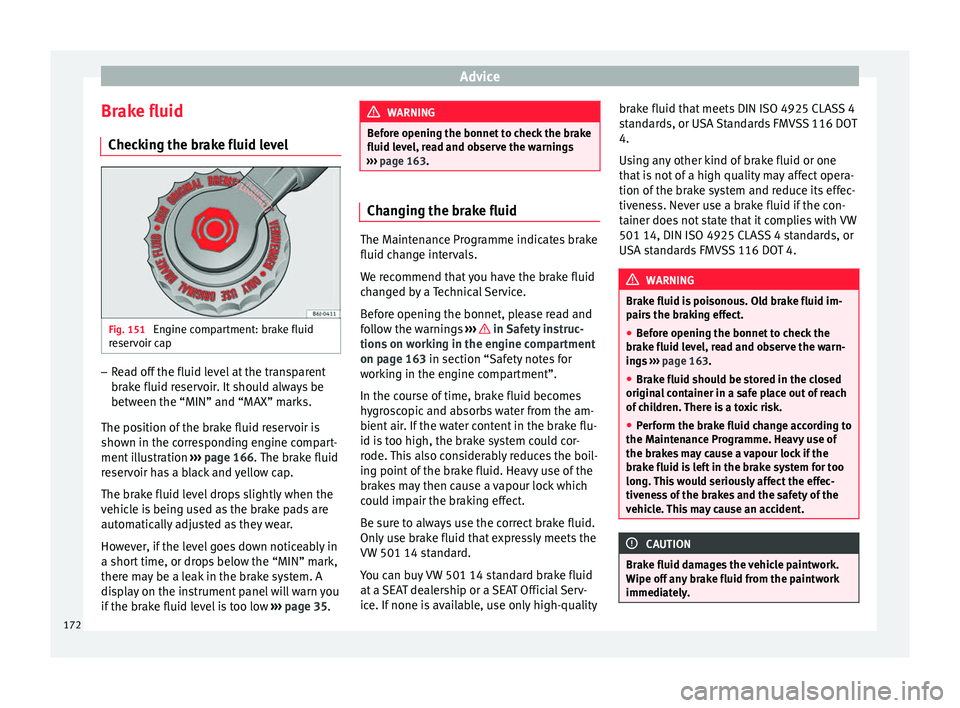
Read off the fluid level at the transparent
brake fluid reservoir. It should always be
between the “MIN” and “MAX” marks.
The position of the brake fluid reservoir is
shown in the corresponding engine compart-
ment illustration ››› page 166. The brake fluid
reservoir has a black and yellow cap.
The brake fluid level drops slightly when the
vehicle is being used as the brake pads are
automatically adjusted as they wear.
However, if the level goes down noticeably in
a short time, or drops below the “MIN” mark,
there may be a leak in the brake system. A
display on the instrument panel will warn you
if the brake fluid level is too low ››› page 35. WARNING
Before opening the bonnet to check the brake
fluid level, read and observe the warnings
››› page 163. Changing the brake fluid
The Maintenance Programme indicates brake
fluid change intervals.
We recommend that you have the brake fluid
changed by a Technical Service.
Before opening the bonnet, please read and
follow the warnings
››› in Safety instruc-
tions on working in the engine compartment
on page 163 in section “Safety notes for
w ork
ing in the engine compartment”.
In the course of time, brake fluid becomes
hygroscopic and absorbs water from the am-
bient air. If the water content in the brake flu-
id is too high, the brake system could cor-
rode. This also considerably reduces the boil-
ing point of the brake fluid. Heavy use of the
brakes may then cause a vapour lock which
could impair the braking effect.
Be sure to always use the correct brake fluid.
Only use brake fluid that expressly meets the
VW 501 14 standard.
You can buy VW 501 14 standard brake fluid
at a SEAT dealership or a SEAT Official Serv-
ice. If none is available, use only high-quality brake fluid that meets DIN ISO 4925 CLASS 4
standards, or USA Standards FMVSS 116 DOT
4.
Using any other kind of brake fluid or one
that is not of a high quality may affect opera-
tion of the brake system and reduce its effec-
tiveness. Never use a brake fluid if the con-
tainer does not state that it complies with VW
501 14, DIN ISO 4925 CLASS 4 standards, or
USA standards FMVSS 116 DOT 4.
WARNING
Brake fluid is poisonous. Old brake fluid im-
pairs the braking effect.
● Before opening the bonnet to check the
brake fluid level, read and observe the warn-
ings ››› page 163.
● Br ak
e fluid should be stored in the closed
original container in a safe place out of reach
of children. There is a toxic risk.
● Perform the brake fluid change according to
the Maintenance Programme. Heavy use of
the brakes may cause a vapour lock if the
brake fluid is left in the brake system for too
long. This would seriously affect the effec-
tiveness of the brakes and the safety of the
vehicle. This may cause an accident. CAUTION
Brake fluid damages the vehicle paintwork.
Wipe off any brake fluid from the paintwork
immediately. 172
Page 181 of 236
Wheels
the vehicle is impaired and there is a risk of
accident.
Note
● The run-flat tyres do not “deflate” on losing
pressure because they are supported on the
reinforced sides. Therefore defects in the tyre
cannot be detected with a visual inspection.
● Snow chains must not be used on front
tyres used in emergency conditions. New tyres and wheels
New tyres and wheels have to be run in.
The tyres and wheel rims are an essential
part of the vehicle's design. Those approved
by SEAT are specially matched to the charac-
teristics of the vehicle and make a major con-
tribution to good road-holding and safe han-
dling
››› .
Note for Italy: A SEAT Service Centre should
be c on
sulted whether different sized wheels
or tyres to those originally fitted by SEAT may
be fitted, as well as the combinations al-
lowed between the front axle (axle 1) and
back axle (axle 2).
Tyres should be replaced at least in pairs and
not individually (i.e. both front tyres or both
rear tyres together). A knowledge of tyre des-
ignations makes it easier to choose the cor- rect tyres. Radial tyres have the tyre designa-
tions marked on the sidewall, for example:
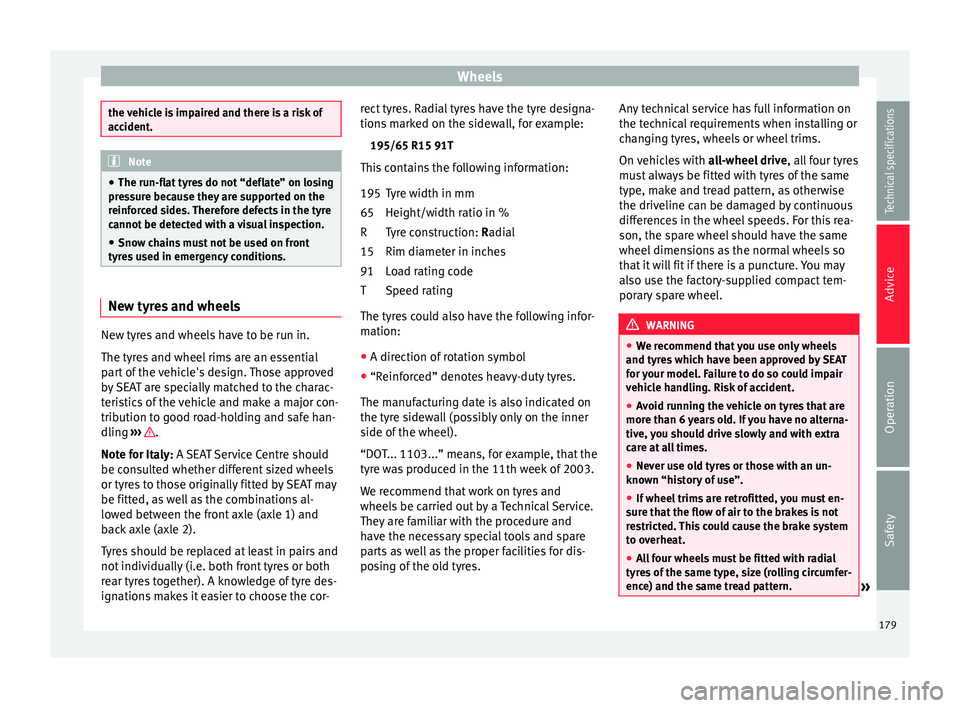
195/65 R15 91T
This contains the following information:
Tyre width in mm
Height/width ratio in %
Tyre construction: Radial
Rim di
ameter in inches
Load rating code
Speed rating
The tyres could also have the following infor-
mation:
● A direction of rotation symbol
● “Reinforced” denotes heavy-duty tyres.
The manufacturing date is also indicated on
the tyre sidewall (possibly only on the inner
side of the wheel).
“DOT... 1103...” means, for example, that the
tyre was produced in the 11th week of 2003.
We recommend that work on tyres and
wheels be carried out by a Technical Service.
They are familiar with the procedure and
have the necessary special tools and spare
parts as well as the proper facilities for dis-
posing of the old tyres. 195
65
R
15
91
T Any technical service has full information on
the technical requirements when installing or
changing tyres, wheels or wheel trims.
On vehicles with
all-wheel drive, all four tyres
must always be fitted with tyres of the same
type, make and tread pattern, as otherwise
the driveline can be damaged by continuous
differences in the wheel speeds. For this rea-
son, the spare wheel should have the same
wheel dimensions as the normal wheels so
that it will fit if there is a puncture. You may
also use the factory-supplied compact tem-
porary spare wheel. WARNING
● We recommend that you use only wheels
and tyres which have been approved by SEAT
for your model. Failure to do so could impair
vehicle handling. Risk of accident.
● Avoid running the vehicle on tyres that are
more than 6 years old. If you have no alterna-
tive, you should drive slowly and with extra
care at all times.
● Never use old tyres or those with an un-
known “history of use”.
● If wheel trims are retrofitted, you must en-
sure that the flow of air to the brakes is not
restricted. This could cause the brake system
to overheat.
● All four wheels must be fitted with radial
tyres of the same type, size (rolling circumfer-
ence) and the same tread pattern. » 179
Technical specifications
Advice
Operation
Safety
Page 213 of 236
Technical features
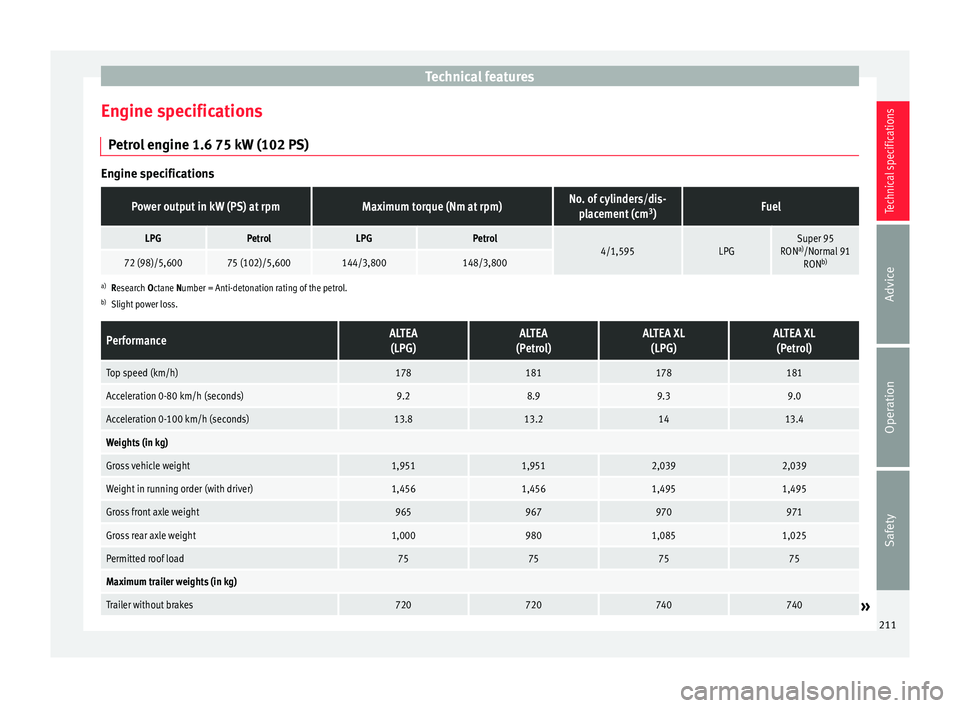
Engine specifications Petrol engine 1.6 75 kW (102 PS) Engine specificationsPower output in kW (PS) at rpmMaximum torque (Nm at rpm)No. of cylinders/dis-
placement (cm 3
)Fuel
LPGPetrolLPGPetrol4/1,595LPGSuper 95
RON a)
/Normal 91
RON b)
72 (98)/5,60075 (102)/5,600144/3,800148/3,800
a)
Research Octane Number = Anti-detonation rating of the petrol.
b) Slight power loss.
PerformanceALTEA
(LPG)ALTEA
(Petrol)ALTEA XL (LPG)ALTEA XL(Petrol)
Top speed (km/h)178181178181
Acceleration 0-80 km/h (seconds)9.28.99.39.0
Acceleration 0-100 km/h (seconds)13.813.21413.4
Weights (in kg)
Gross vehicle weight1,9511,9512,0392,039
Weight in running order (with driver)1,4561,4561,4951,495
Gross front axle weight965967970971
Gross rear axle weight1,0009801,0851,025
Permitted roof load75757575
Maximum trailer weights (in kg)
Trailer without brakes720720740740» 211
Technical specifications
Advice
Operation
Safety
Page 214 of 236
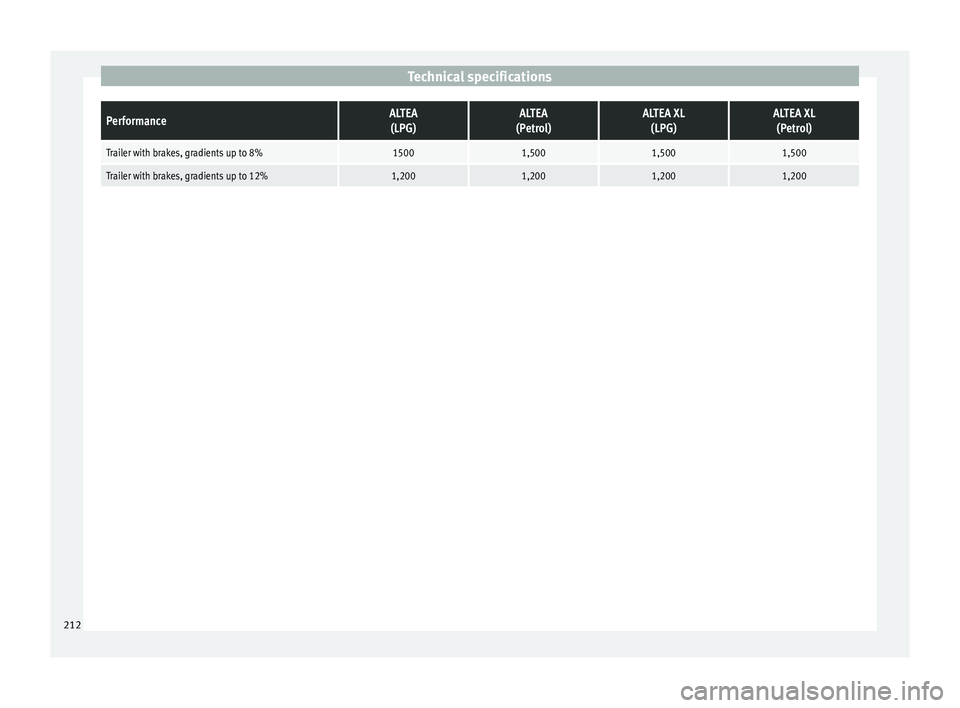
Technical specificationsPerformanceALTEA
(LPG)ALTEA
(Petrol)ALTEA XL (LPG)ALTEA XL(Petrol)
Trailer with brakes, gradients up to 8%15001,5001,5001,500
Trailer with brakes, gradients up to 12%1,2001,2001,2001,200 212
Page 215 of 236
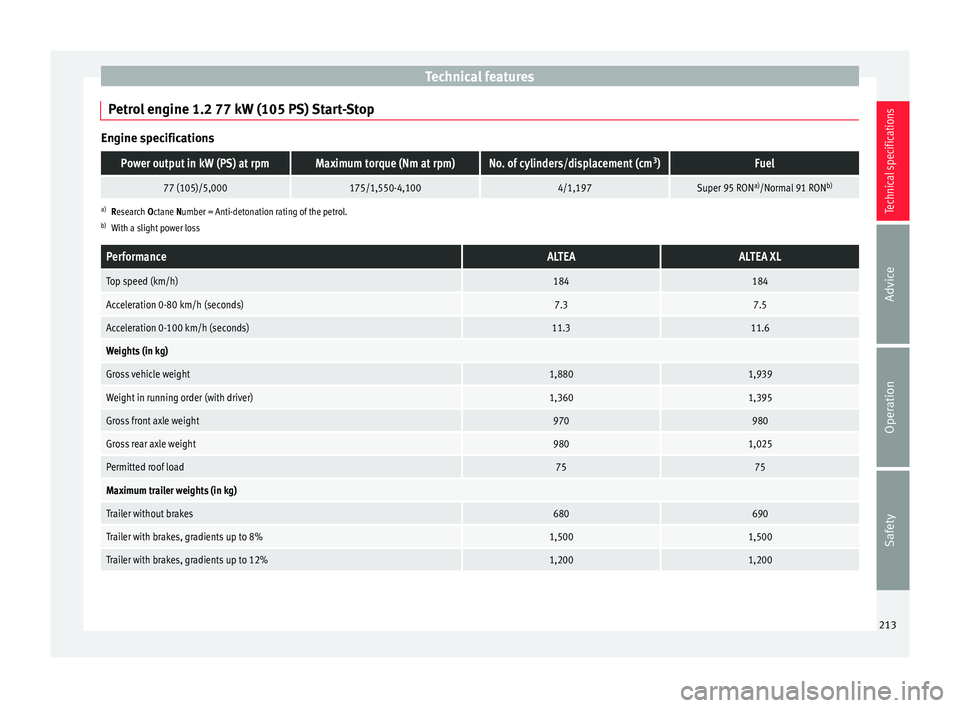
Technical features
Petrol engine 1.2 77 kW (105 PS) Start-Stop Engine specificationsPower output in kW (PS) at rpmMaximum torque (Nm at rpm)No. of cylinders/displacement (cm
3
)Fuel
77 (105)/5,000175/1,550-4,1004/1,197Super 95 RON a)
/Normal 91 RON b)
a)
Research Octane Number = Anti-detonation rating of the petrol.
b) With a slight power loss
PerformanceALTEAALTEA XL
Top speed (km/h)184184
Acceleration 0-80 km/h (seconds)7.37.5
Acceleration 0-100 km/h (seconds)11.311.6
Weights (in kg)
Gross vehicle weight1,8801,939
Weight in running order (with driver)1,3601,395
Gross front axle weight970980
Gross rear axle weight9801,025
Permitted roof load7575
Maximum trailer weights (in kg)
Trailer without brakes680690
Trailer with brakes, gradients up to 8%1,5001,500
Trailer with brakes, gradients up to 12%1,2001,200 213
Technical specifications
Advice
Operation
Safety
Page 216 of 236
Technical specifications
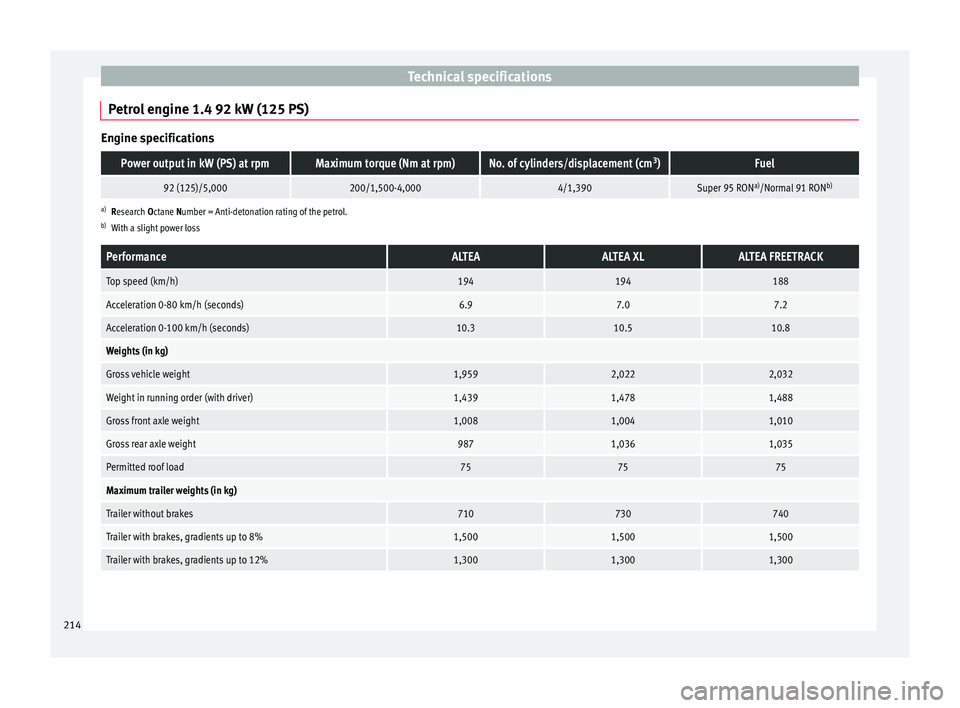
Petrol engine 1.4 92 kW (125 PS) Engine specificationsPower output in kW (PS) at rpmMaximum torque (Nm at rpm)No. of cylinders/displacement (cm
3
)Fuel
92 (125)/5,000200/1,500-4,0004/1,390Super 95 RON a)
/Normal 91 RON b)
a)
Research Octane Number = Anti-detonation rating of the petrol.
b) With a slight power loss
PerformanceALTEAALTEA XLALTEA FREETRACK
Top speed (km/h)194194188
Acceleration 0-80 km/h (seconds)6.97.07.2
Acceleration 0-100 km/h (seconds)10.310.510.8
Weights (in kg)
Gross vehicle weight1,9592,0222,032
Weight in running order (with driver)1,4391,4781,488
Gross front axle weight1,0081,0041,010
Gross rear axle weight9871,0361,035
Permitted roof load757575
Maximum trailer weights (in kg)
Trailer without brakes710730740
Trailer with brakes, gradients up to 8%1,5001,5001,500
Trailer with brakes, gradients up to 12%1,3001,3001,300 214
Page 217 of 236
Technical features
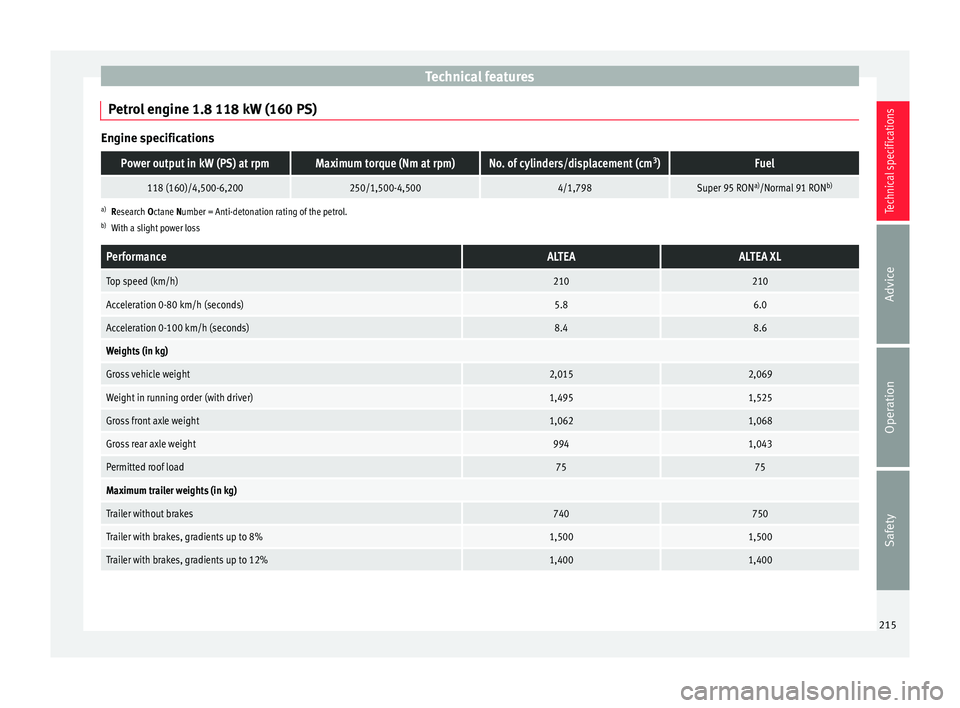
Petrol engine 1.8 118 kW (160 PS) Engine specificationsPower output in kW (PS) at rpmMaximum torque (Nm at rpm)No. of cylinders/displacement (cm
3
)Fuel
118 (160)/4,500-6,200250/1,500-4,5004/1,798Super 95 RON a)
/Normal 91 RON b)
a)
Research Octane Number = Anti-detonation rating of the petrol.
b) With a slight power loss
PerformanceALTEAALTEA XL
Top speed (km/h)210210
Acceleration 0-80 km/h (seconds)5.86.0
Acceleration 0-100 km/h (seconds)8.48.6
Weights (in kg)
Gross vehicle weight2,0152,069
Weight in running order (with driver)1,4951,525
Gross front axle weight1,0621,068
Gross rear axle weight9941,043
Permitted roof load7575
Maximum trailer weights (in kg)
Trailer without brakes740750
Trailer with brakes, gradients up to 8%1,5001,500
Trailer with brakes, gradients up to 12%1,4001,400 215
Technical specifications
Advice
Operation
Safety