fuel consumption Seat Altea 2015 User Guide
[x] Cancel search | Manufacturer: SEAT, Model Year: 2015, Model line: Altea, Model: Seat Altea 2015Pages: 236, PDF Size: 4.23 MB
Page 136 of 236
Operation
and 120 km/h (75 mph) your vehicle will use
about 12% more fuel as a result of the extra
wind resistance caused by the roof rack even
when it is not in use.
Save electricity
The engine activates the alternator, which
produces electricity. With the need for elec-
tricity, fuel consumption is also increased.
Because of this, always turn off electrical de-
vices when you do not need them. Examples
of devices that use a lot of electricity are: the
fan at high speeds, the rear window heating
or the seat heaters*. Note
● If you vehicle has Start-Stop, it is not rec-
ommended t o sw
itch this function off.
● It is recommended to close the windows
when driving at more than 60 km/h
● Do not drive with your foot resting on the
clutch pedal,, as the pressure can make the
pl
ate spin, more fuel will be used and it can
burn the clutch plate lining, causing a serious
fault.
● Do not hold the vehicle on a hill with the
clutch, use the foot brake or hand brake, us-
ing the latter to start. The fuel consumption
will be lower and you will prevent the clutch
plate from being damaged.
● On descents, use the engine brake, chang-
ing to the gear that is more suitable for the slope. Fuel consumption will be “zero” and
the brakes will not suffer.
Driver assistance systems
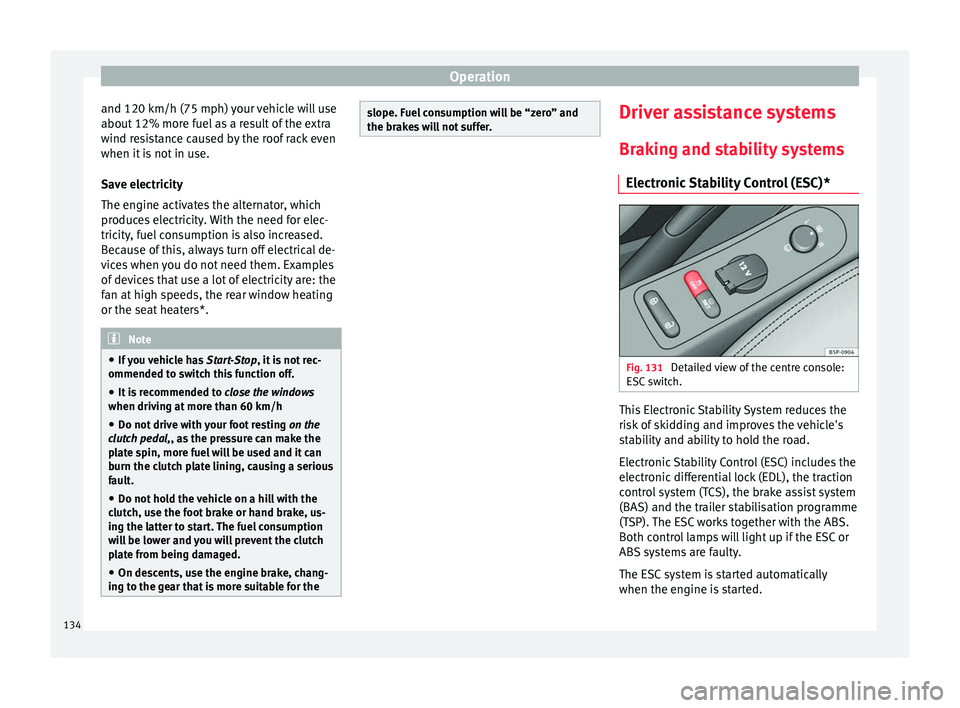
Braking and stability systems Electronic Stability Control (ESC)* Fig. 131
Detailed view of the centre console:
ESC switch. This Electronic Stability System reduces the
risk of skidding and improves the vehicle's
stability and ability to hold the road.
Electronic Stability Control (ESC) includes the
electronic differential lock (EDL), the traction
control system (TCS), the brake assist system
(BAS) and the trailer stabilisation programme
(TSP). The ESC works together with the ABS.
Both control lamps will light up if the ESC or
ABS systems are faulty.
The ESC system is started automatically
when the engine is started.
134
Page 161 of 236
Checking and refilling levels
●
When filling the fuel tank after having run it
completely dry on a vehicle with a diesel en-
gine the ignition must be switched on for at
least 30 seconds before starting the engine.
Subsequently, when you start the engine it
may take longer than normal to start firing
(up to one minute). This is due to the fact that
the fuel system has to purge itself of air be-
fore starting. For the sake of the environment
Do not try to put in more fuel after the auto-
matic filler nozzle has switched off; this may
cause the fuel to overflow if it becomes warm. Petrol
Petrol types The recommended fuel types are listed on a
sticker inside the fuel tank flap.
Only
unleaded petrol conforming to standard
DIN EN 228 may be used for vehicles with
c at
alytic converters (EN = “European Stand-
ard”).
Petrol types are categorised according to
their
octane number, e.g. 91, 95, 98 RON
(RON = “research octane number”). You may
use petrol with a higher octane number than
the one recommended for your engine. How- ever, this has no advantage in terms of fuel
consumption and engine power. CAUTION
● Petrol with standard EN 228 may be mixed
with small quantities of ethanol. However,
the so-called “bioethanol fuels” available at
commercial establishments with reference
E50 or E85, which contain a high percentage
of ethanol, may not be used, as they will
damage the fuel system.
● Even one tankful of leaded fuel would per-
manently impair the efficiency of the catalyt-
ic converter.
● High engine speed and full throttle can
damage the engine when using petrol with an
octane rating lower than the correct grade for
the engine. For the sake of the environment
Just one full tank of leaded fuel would seri-
ously impair the efficiency of the catalytic
converter. Petrol additives
The quality of the fuel influences the behav-
iour, power and service life of the engine.
This is why the petrol you use should carry
suitable additives already included by the
petrol industry, free of metals. These addi-
tives will help to prevent corrosion, keep thefuel system clean and prevent deposits from
building up in the engine.
If good-quality petrol with metal-free addi-
tives is not available or engine problems
arise, the necessary additives must be added
when refuelling.
Not all petrol additives have been shown to
be effective. The use of unsuitable petrol ad-
ditives may cause significant damage to the
engine and the catalytic converter. Metal ad-
ditives should never be used. Metal additives
may also be contained in petrol additives for
improving anti-detonation ratings or octane
ratings.
SEAT recommends “genuine Volkswagen
Group fuel additives for petrol engines”.
These additives can be bought at SEAT Au-
thorised Services, where information on how
to use them can also be obtained.
CAUTION
Do not refuel if the filler indicates that the
fuel contains metal. LRP (lead replacement
petrol) fuels contain high concentrations of
metal additives. Using them may damage the
engine! 159
Technical specifications
Advice
Operation
Safety
Page 178 of 236

Advice
●
At continuously high speeds, a tyre with in-
sufficient pressure flexes more. In this way it
becomes too hot, and this can cause tread
separation and tyre blow-out. Always observe
the recommended tyre pressures.
● If the tyre pressure is too low or too high,
the tyres will wear prematurely and the vehi-
cle will not handle well. Risk of accident! For the sake of the environment
Under-inflated tyres will increase fuel con-
sumption. Tyre pressure monitoring
The tyre pressure monitoring system con-
stantly checks the pressure of the tyres.
The system uses the speed sensors of the
ABS wheels. It operates by analysing the
speed and frequency spectrum of each
wheel.
For optimum performance, use genuine SEAT
tyres. In addition, check and adjust tyre pres-
sures regularly.
Whenever the tyre pressure is are changed or
one or more tyres are changed, the system
should be reset by pressing the SET button
on the centre console.
The system warns the driver in the event of a
loss of pressure by means of symbols and messages in the instrument panel display.
The system operates via the ESC
››› page 134.
Note that tyre pressure also depends on tyre
temperature. Said pressure increases around
0.1 bar (2.9 psi/10 kPa) for each +10 °C
(+50 °F) in tyre temperature increase. The tyre
heats up while the vehicle is being driven
and the tyre pressure will rise accordingly.
Therefore, you should only adjust the tyre
pressure when they are cold (i.e. approxi-
mately at ambient temperature).
To ensure that the tyre pressure monitoring
system works reliably, you should check and,
if necessary, adjust the tyre pressures at reg-
ular intervals and store the correct pressures
(reference values) in the system.
A tyre pressure information label is attached
to the inside of the fuel tank flap. WARNING
● Never adjust tyre pressure when the tyres
are hot. This may damage or even burst the
tyres. Risk of accident!
● An insufficiently inflated tyre flexes a lot
more at high speeds and causes significant
heating of the tyre. Under these conditions,
the tyre bead may be released or the tyre may
burst. Risk of accident! For the sake of the environment
Under-inflated tyres lead to increased fuel
consumption and tyre wear. Significant tyre pressure loss
The tyre symbol
is displayed and indicates
th at
the tyre pressure of at least one tyre is
insufficient.
– Stop the vehicle.
– Switch the ignition off.
– Check the tyre(s).
– Change the wheel if necessary.
176
Page 183 of 236
Emergencies
handle better when the roads are free of
snow and ice.
If you have a flat tyre, please refer to the
notes on the spare wheel ››› page 179, New
tyres and wheels .WARNING
The maximum speed for the winter tyres must
not be exceeded. Otherwise, this could lead
to damage and risk of accident. For the sake of the environment
Fit your summer tyres again as soon as possi-
ble. They are quieter, do not wear so quickly
and reduce fuel consumption. Snow chains
Snow chains are only permitted on front
wheels and only for tyres 195/65R15 and
205/55R16. These tyres may only be fitted
with fine-pitch link chains which do not pro-
trude more than 15 mm
›››
page 210.
Other tyres may use fine-pitch links which do
not protrude more than 9 mm, including ten-
sion device.
Remove wheel hub covers and trim rings be-
fore fitting snow chains. For safety reasons,
cover caps, available at any technical service,
must then be fitted over the wheel bolts. All-wheel drive
: where snow chains are com-
pulsory, this normally also applies to all-
wheel drive vehicles. Snow chains may only
be fitted to the front
wheels (also on vehicles
w
ith all-wheel drive). WARNING
Snow chains should be correctly tightened in
accordance with the manufacturer's instruc-
tions. This will prevent the chains coming in-
to contact with the wheel housing. CAUTION
Remove the snow chains to drive on roads
without snow. Otherwise they will impair
handling, damage the tyres and wear out very
quickly. Note
● In some countries, the maximum permitted
speed with snow chains is 50 km/h (31 mph).
The legal requirements of each country must
be followed.
● We recommend that you ask your technical
service for information about appropriate
wheel, tyre and snow chain size. Emergencies
Vehicle tools, spare wheel Vehicle Tools The vehicle tools are located under the floor
panel in the luggage compartment.
– Lift the cover of the luggage compartment,
by pulling it up with a finger in the fitting.
– Take the vehicle tools out of the vehicle.
The vehicle tool kit includes:
● Jack.*
● Hook for removing wheel covers* or wheel
trims*
● Box spanner for wheel bolts.*
● Towing ring.
● Adapter for the anti-theft wheel bolts*
Some of the items listed are only provided in
certain model versions, or are optional ex-
tras. WARNING
● The factory-supplied jack is only designed
for changing wheels on this model. On no ac-
count attempt to use it for lifting heavier ve-
hicles or other loads. Risk of injury.
● Use the jack only on a firm, level ground.
» 181
Technical specifications
Advice
Operation
Safety
Page 209 of 236
Technical features
Technical specifications
Technical features
Important information Important The information in the vehicle documentation
always takes precedence over the informa-
tion in this Instruction Manual.
All technical specifications provided in this
documentation are valid for the standard
model in Spain. The vehicle data card inclu-
ded in the Maintenance Programme or the
vehicle registration documents shows which
engine is installed in the vehicle.
The figures may be different depending
whether additional equipment is fitted, for
different models, for special vehicles and for
other countries.
Abbreviations used in the Technical
Specifications sectionAb-
brevia- tionMeaning
kWKilowatt, engine power measurement.
PSPferdestärke (horsepower), formerly used to
denote engine power.
Ab-
brevia- tionMeaning
rpmRevolutions per minute - engine speed.
NmNewton metres, unit of engine torque.
litresper
100 kmFuel consumption in litres per 100 km (70
miles).
g/kmCarbon dioxide emissions in grams per km
(mile) travelled.
CO 2Carbon dioxide
CNCetane number, indication of the diesel com-
bustion power.
RONResearch octane number, indication of the
knock resistance of petrol. 207
Technical specifications
Advice
Operation
Safety
Page 210 of 236
Technical specifications
Vehicle identification data Fig. 202
Vehicle data sticker (boot). Fig. 203
Chassis number. Vehicles for certain export countries do not
have an identification plate.
Identification plate
The identification plate is located on the left
rib inside the engine compartment.
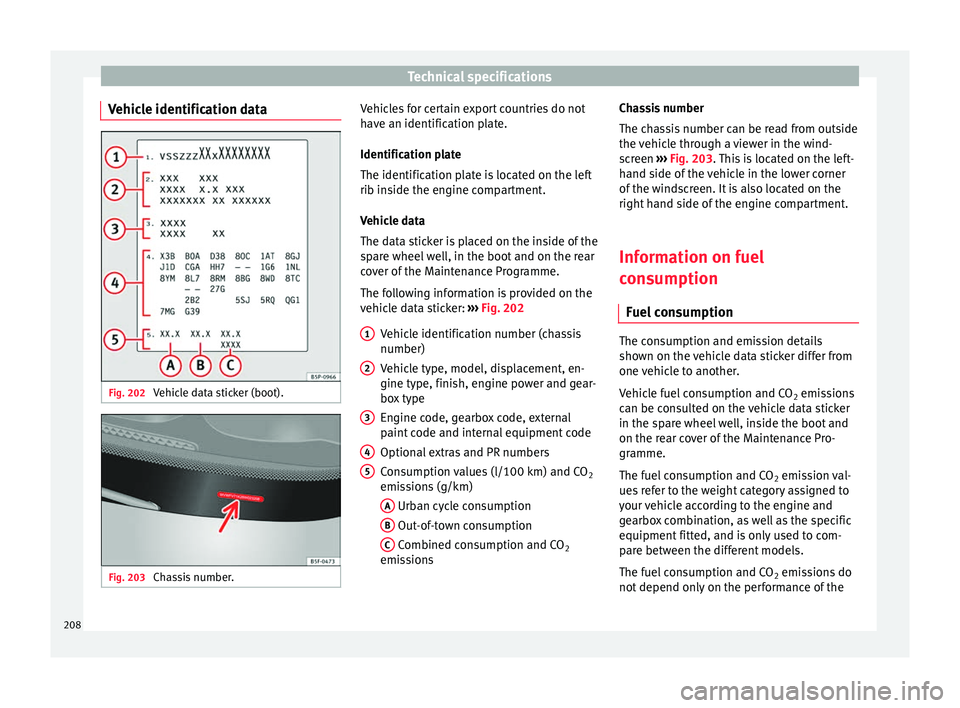
Vehicle data
The data sticker is placed on the inside of the
spare wheel well, in the boot and on the rear
cover of the Maintenance Programme.
The following information is provided on the
vehicle data sticker:
››› Fig. 202
Vehicle identification number (chassis
number)
Vehicle type, model, displacement, en-
gine type, finish, engine power and gear-
box type
Engine code, gearbox code, external
paint code and internal equipment code
Optional extras and PR numbers
Consumption values (l/100 km) and CO 2
emissions (g/km)
A Urban cycle consumption
B Out-of-town consumption
C Combined consumption and CO
2
emissions
1 2
3
4
5 Chassis number
The chassis number can be read from outside
the vehicle through a viewer in the wind-
screen
››› Fig. 203 . This is located on the left-
h and s
ide of the vehicle in the lower corner
of the windscreen. It is also located on the
right hand side of the engine compartment.
Information on fuel
consumption
Fuel consumption The consumption and emission details
shown on the vehicle data sticker differ from
one vehicle to another.
Vehicle fuel consumption and CO
2 emissions
can be consulted on the vehicle data sticker
in the spare wheel well, inside the boot and
on the rear cover of the Maintenance Pro-
gramme.
The fuel consumption and CO 2 emission val-
ues refer to the weight category assigned to
your vehicle according to the engine and
gearbox combination, as well as the specific
equipment fitted, and is only used to com-
pare between the different models.
The fuel consumption and CO 2 emissions do
not depend only on the performance of the
208
Page 211 of 236
Technical features
vehicle, they can also differ from the estab-
lished values depending on other factors
such as driving style, road conditions, traffic
conditions, environmental conditions, load
and number of passengers.
Calculation of fuel consumption
The consumption values have been calcula-
ted based on measurements performed or
supervised by certified CE laboratories ac-
cording to the latest version of directives
715/2007/EC and 80/1268/CEE (for more in-
formation consult the European Union Publi-
cations Office at EUR-Lex: © European Union,
http://eur-lex.europa.eu/en/index.htm) and
are valid for the kerb weight indicated for the
vehicle. Note
In practice, and considering all the factors
mentioned here, consumption values can dif-
fer from those calculated in the current Euro-
pean regulations. Weights
Kerb weight refers to the basic model with a
fuel tank filled to 90% capacity and without
optional extras. The figure quoted includes
75 kg to allow for the weight of the driver. For special versions and optional equipment
fittings or for the addition of accessories, the
weight of the vehicle will increase
››› .
WARNING
● Please note that the centre of gravity may
shift when transporting heavy objects; this
may affect vehicle handling and lead to an ac-
cident. Always adjust your speed and driving
style to suit road conditions and require-
ments.
● Never exceed the gross axle weight rating
or the gross vehicle weight rating. If the per-
missible axle load or the permissible total
weight is exceeded, the driving characteris-
tics of the vehicle may change, leading to ac-
cidents, injuries and damage to the vehicle. Towing a trailer
Trailer weights Trailer weight
The trailer weights and drawbar loads ap-
proved are selected in intensive trials accord-
ing to precisely defined criteria. The ap-
proved trailer weights are valid for vehicles in
the
EU
and generally, for maximum speeds of
80 km/h (50 mph) (in c ertain circumstances
up to 100 km/h (62 mph)). The figures may
be different in other countries. All data in the official vehicle documentation takes prece-
dence over these data at all times
››› .
Drawbar loads
The maximum
permitted drawbar load on the
b
all joint of the towing bracket must not ex-
ceed
75 kg.
In the interest of road safety, we recommend
that you always tow approaching the maxi-
mum drawbar load. The response of the trail-
er on the road will be poor if the drawbar load
is too small.
If the maximum permissible drawbar load
cannot be met (e.g. with small, empty and
light-weight single axle trailers or tandem
axle trailers with a wheelbase of less than 1
metre), a minimum of 4% of the actual trailer
weight is legally required for the drawbar
load. WARNING
● For safety reasons, you should not drive at
speeds above 80 km/h (50 mph) when towing
a trailer. This also applies in countries where
higher speeds are permitted.
● Never exceed the maximum trailer weights
or the drawbar load. If the permissible axle
load or the permissible total weight is excee-
ded, the driving characteristics of the vehicle
may change, leading to accidents, injuries
and damage to the vehicle. 209Technical specifications
Advice
Operation
Safety
Page 228 of 236
Index
Front drinks holders . . . . . . . . . . . . . . . . . . . . . . . . 95
Front interior light Switch off light . . . . . . . . . . . . . . . . . . . . . . . . . . 82
Switch on light . . . . . . . . . . . . . . . . . . . . . . . . . . 82
Front passenger airbag deactivation . . . . . . . . . . 23
Front reading lights . . . . . . . . . . . . . . . . . . . . . . . . 82
Front seat adjustment Lumbar support adjustment . . . . . . . . . . . . . . . 89
Fuel Diesel . . . . . . . . . . . . . . . . . . . . . . . . . . . . . . . . 160
Petrol . . . . . . . . . . . . . . . . . . . . . . . . . . . . . . . . . 159
Fuel consumption . . . . . . . . . . . . . . . . . . . . 132, 208
Fuel level Indicator . . . . . . . . . . . . . . . . . . . . . . . . . . . . . . . 33
Fuel reserve . . . . . . . . . . . . . . . . . . . . . . . . . . . . . . 40 Warning message . . . . . . . . . . . . . . . . . . . . . . . . 49
Fuel tank see Fuel reserve . . . . . . . . . . . . . . . . . . . . . . . . . 40
F uel
Tank
Opening the fuel tank flap . . . . . . . . . . . . . . . . 158
Fuel: saving . . . . . . . . . . . . . . . . . . . . . . . . . . . . . . 132
Fuses . . . . . . . . . . . . . . . . . . . . . . . . . . . . . . . . . . . 196 Fuse box . . . . . . . . . . . . . . . . . . . . . . . . . . . . . . 197
Identifying blown fuses . . . . . . . . . . . . . . . . . . 198
Identifying by colours . . . . . . . . . . . . . . . . . . . . 197
Preparation before replacing . . . . . . . . . . . . . . 198
Replacement . . . . . . . . . . . . . . . . . . . . . . . . . . . 198
G Gear shift pattern . . . . . . . . . . . . . . . . . . . . . . . . . 126
General overview of the engine compartment . . 166
Glove compartment . . . . . . . . . . . . . . . . . . . . . . . . 93
Glow plug system . . . . . . . . . . . . . . . . . . . . . . . . . 122 Control lamp . . . . . . . . . . . . . . . . . . . . . . . . . . . . 41 H
Handbrake . . . . . . . . . . . . . . . . . . . . . . . . . . . . . . 124
Control lamp . . . . . . . . . . . . . . . . . . . . . . . . . . . . 44
warning lamp . . . . . . . . . . . . . . . . . . . . . . . . . . 124
Hazard warning lights . . . . . . . . . . . . . . . . . . . . . . 81
HBA . . . . . . . . . . . . . . . . . . . . . . . . . . . . . . . . . . . . 136
Head-on collisions and the laws of physics . . . . . 13
Head-protection airbags . . . . . . . . . . . . . . . . . . . . 22 safety instructions . . . . . . . . . . . . . . . . . . . . . . . 22
Headlight flashers . . . . . . . . . . . . . . . . . . . . . . . . . 77
Headlight range control . . . . . . . . . . . . . . . . . . . . . 79
Headlights Driving abroad . . . . . . . . . . . . . . . . . . . . . . . . . 120
fog lights . . . . . . . . . . . . . . . . . . . . . . . . . . . . . . . 76
Headlight washer . . . . . . . . . . . . . . . . . . . . . . . . 86
Head restraints Adjusting . . . . . . . . . . . . . . . . . . . . . . . . . . . . . . . 90
Adjustment of the head restraint angle . . . . . . 90
Correct adjustment . . . . . . . . . . . . . . . . . . . . . . . 90
Removing . . . . . . . . . . . . . . . . . . . . . . . . . . . . . . 90
Heated front seats . . . . . . . . . . . . . . . . . . . . . . . . . 91
Heated rear window 2C-Climatronic . . . . . . . . . . . . . . . . . . . . . . . . . 113
heating element wires . . . . . . . . . . . . . . . . . . . 151
Heating . . . . . . . . . . . . . . . . . . . . . . . . . . . . . . . . . 107
High pressure cleaners . . . . . . . . . . . . . . . . . . . . 150
Hill driving assistant . . . . . . . . . . . . . . . . . . . . . . 125
Horn . . . . . . . . . . . . . . . . . . . . . . . . . . . . . . . . . . . . 31
How to jump start description . . . . . . . . . . . . . . . 190
Hydraulic Brake Assist . . . . . . . . . . . . . . . . . . . . . 136
I Identification number . . . . . . . . . . . . . . . . . . . . . 208
Identification plate . . . . . . . . . . . . . . . . . . . . . . . . 208
Ignition . . . . . . . . . . . . . . . . . . . . . . . . . . . . . . . . . 120
Ignition lock . . . . . . . . . . . . . . . . . . . . . . . . . . . . . 120
Information messages in the display . . . . . . . . . . 49 Information on the multi-function display
On-screen display . . . . . . . . . . . . . . . . . . . . . . . . 52
Instrument and switch lighting . . . . . . . . . . . . . . . 79
Instrument lighting . . . . . . . . . . . . . . . . . . . . . . . . 31
Instrument panel menu Lights and visibility menu . . . . . . . . . . . . . . . . . 56
Instrument panel menus Configuration menu . . . . . . . . . . . . . . . . . . . . . . 54
Example of menu use . . . . . . . . . . . . . . . . . . . . . 50
Main menu . . . . . . . . . . . . . . . . . . . . . . . . . . . . . 50
Vehicle status menu . . . . . . . . . . . . . . . . . . . . . . 54
Instruments . . . . . . . . . . . . . . . . . . . . . . . . . . . . . . 32
Interior lights . . . . . . . . . . . . . . . . . . . . . . . . . . . . . 82
Interior monitoring . . . . . . . . . . . . . . . . . . . . . . . . . 70 Activation . . . . . . . . . . . . . . . . . . . . . . . . . . . . . . 69
Deactivation . . . . . . . . . . . . . . . . . . . . . . . . . . . . 69
Interior rear vision mirror . . . . . . . . . . . . . . . . . . . . 86
Intermittent windscreen wipe . . . . . . . . . . . . . . . . 84
ISOFIX system . . . . . . . . . . . . . . . . . . . . . . . . . . . . . 27
J Jack position points Sill panel trim . . . . . . . . . . . . . . . . . . . . . . . . . . 185
Journeys abroad . . . . . . . . . . . . . . . . . . . . . . . . . . 120
Jump-starting . . . . . . . . . . . . . . . . . . . . . . . . . . . . 189
Jump leads . . . . . . . . . . . . . . . . . . . . . . . . . . . . . . 189
K
Keys . . . . . . . . . . . . . . . . . . . . . . . . . . . . . . . . . . . . . 66
L
Lifting the seat backrest . . . . . . . . . . . . . . . . . . . . 92
Lifting the vehicle . . . . . . . . . . . . . . . . . . . . . . . . . 185
Lights . . . . . . . . . . . . . . . . . . . . . . . . . . . . . . . . . . . 75 general remarks . . . . . . . . . . . . . . . . . . . . . . . . 198
Load compartment in the luggage compartment see Loading the luggage compartment . . . . . 101
226