roof Seat Altea 2015 Owner's Guide
[x] Cancel search | Manufacturer: SEAT, Model Year: 2015, Model line: Altea, Model: Seat Altea 2015Pages: 236, PDF Size: 4.23 MB
Page 150 of 236
Advice
To return to working position
Continue in the reverse order to the previous
instruction. CAUTION
If an automatic car wash tunnel is used, be-
fore entering the tunnel, put the aerial down
parallel to the roof and do not tighten to
avoid damage. Mobile phones and two-way radios
First consult your Technical Service if you
wish to use a mobile telephone or a two-way
radio with a transmitting power output in ex-
cess of 10 watts. Here you will receive infor-
mation concerning the technical possibilities
for retrofitting this equipment.
Mobile telephones and two-way radios
should be only fitted by a specialised work-
shop, for example a SEAT dealership.
WARNING
● Always concentrate primarily on driving. If
you are distracted while driving you could
have an accident.
● Never attach the telephone mountings to
the surfaces covering the airbag units or
within the range of the airbags. There is a
high danger of injury if the airbag is trig-
gered. Note
Please observe the operating instructions of
your mobile telephone/two-way radio. Care and cleaning
General information Vehicle maintenance
Regular care and washing help to maintain
the value
of the vehicle. This may also be one
of the requirements for acknowledging war-
ranty claims in the event of bodywork corro-
sion or paint defects.
The best way to protect your vehicle against
the harmful effects of the environment is
through correct maintenance and frequent
washing. The longer substances such as in-
sect remains, bird droppings, resinous tree
sap, road dirt, industrial deposits, tar, soot or
road salt and other aggressive materials re-
main on the vehicle, the more damage they
do to the paintwork. High temperatures, for
instance in strong sunlight, further intensify
the corrosive effect.
After winter, a period when salt is put on the
roads, it is important to have the underside
of the vehicle washed thoroughly. Products for vehicle maintenance
Car-care products are available in your Tech-
nical Services. Keep the product instructions
until you have used them up. WARNING
● Car-care products can be toxic. Because of
this, they must always be kept closed in their
original container. Keep them out of the reach
of children. Failure to comply could result in
poisoning.
● Always read and observe the instructions
and warnings on the package before using
car-care products. Improper use could cause
health problems or damage the vehicle. The
use of certain products may produce noxious
vapours; they should be used in well ventila-
ted areas.
● Never use fuel, turpentine, engine oil, nail
varnish remover or other volatile fluids.
These are toxic and highly flammable. Risk of
fire and explosion.
● Before washing your vehicle, or carrying
out any maintenance, switch the engine off,
apply the handbrake firmly and remove the
key from the ignition. CAUTION
Never attempt to remove dirt, mud or dust if
the surface of the vehicle is dry. Never use a
dry cloth or sponge for cleaning purposes.
This could damage the paintwork or the win-
dows of your vehicle. Soak dirt, mud or dust
with plenty of water. 148
Page 151 of 236
Care and maintenance
For the sake of the environment
● When purchasing products for your vehicle
maintenance, select the ones which are not
harmful to the environment.
● The waste from car-care products should
not be disposed of with ordinary household
waste. Observe the disposal information on
the package. Care of the vehicle exterior
Automatic car wash tunnel The vehicle paintwork is so durable that the
vehicle can normally be washed without
problems in an automatic car wash tunnel.
However, the paintwork wear depends to a
large extent on the kind of the car wash tun-
nel, the brushes used, its water filtering and
the type of cleaning and preservative prod-
ucts.
Before going through a vehicle wash, be sure
to take the usual precautions such as closing
the windows and sunroof.
If the vehicle has special accessories such as
spoilers or a roof rack or two-way radio aerial,
etc., it is advisable to consult the car wash
tunnel operator.
After washing,
the brakes
could take some
time t
o respond as the brake discs and pads could be wet, or even frozen in winter. “Dry”
the brakes by braking several times. WARNING
Water, ice and salt on the brake system can
reduce braking effectiveness. Risk of acci-
dent. CAUTION
Before putting the vehicle through the car
wash, do not tighten the aerial if it is folded
because it can be damaged. Washing by hand
Vehicle washing
– First soften the dirt and rinse it off with wa-
ter.
– Clean your vehicle from top to bottom with
a soft sponge, a glove or a brush. Use very
light pressure.
– Rinse the sponge or glove often with clean
water.
– Special car shampoo should only be used
for very stubborn dirt.
– Leave the wheels, sill panels etc. until last,
using a different sponge or glove.
– Rinse the vehicle thoroughly with water. –
Dry the vehicle surface gently with a cha-
mois leather.
– In cold temperature
, dry the rubber seals
and their s
urfaces to prevent them from
freezing. Apply silicone spray to the rubber
seals.
After washing the vehicle – After washing, avoid sudden and sharp
braking. “Dry” the brakes by braking sever-
al times ››› page 123, Braking capacity and
distance. WARNING
● Wash your vehicle with the ignition switch-
ed off.
● Protect your hands and arms from cuts on
sharp metal edges when cleaning the under-
body, the inside of the wheel housings etc.
Risk of injury.
● Water, ice and salt on the brake system can
reduce braking effectiveness. Risk of acci-
dent. CAUTION
● Never remove dirt, mud or dust if the vehi-
cle surface is dry. Never use a dry cloth or
sponge for cleaning purposes. This could
scratch the paintwork or glass on your vehi-
cle. » 149
Technical specifications
Advice
Operation
Safety
Page 152 of 236
Advice
●
Washing the vehicle in low temperatures:
when washing the vehicle with a hose, do not
direct water into the lock cylinders or the
gaps around the doors, rear lid, or sunroof.
Risk of freezing. For the sake of the environment
To protect the environment, the vehicle
should be washed only in specially provided
wash bays, to prevent toxic, oil-laden waste
water from entering the sewer system. In
some places, washing vehicles outside wash
bays is prohibited. Note
Do not wash the vehicle in direct sunlight. Washing the vehicle with a high
pressure cleaner
Be particularly careful when using a high
pressure cleaner!
– Always observe the instructions for the
high-pressure cleaner, particularly those
concerning the pressure and the spraying
di s
tance.
– Increase the spraying distance for soft ma-
terials and painted bumpers. –
Do not use a high pressure cleaner to re-
move ice or snow from windows
››› page 151.
– Never u
se concentrated jet nozzles (“rotat-
ing jets”) ››› .
– After washing, avoid sudden and sharp
braking. “Dry” the brakes by braking sever-
al times ››› page 123 . WARNING
● Never wash tyres with a concentrated jet
(“rotating nozzle”). Even at large spraying
distances and short cleaning times, damage
can occur to the tyres. This may cause an ac-
cident.
● Water, ice and salt on the brake system can
reduce braking effectiveness. Risk of acci-
dent. CAUTION
● Do not use water hotter than +60 °C
(+140 °F). This could damage the vehicle.
● To avoid damage to the vehicle, keep a suf-
ficient distance from sensitive materials such
as flexible hoses, plastic, soundproofing ma-
terial, etc. This also applies to bumpers pain-
ted in the colour of the bodywork. The closer
the nozzle is to the surface, the greater the
wear on the material. Vehicle paint maintenance
Regular waxing protects the paintwork.
You need to apply wax to your vehicle if water
does not form small drops and run off the
paintwork when it is
clean.
Good quality har
d wax products are available
at your Technical Service.
Regular wax applications help to protects the
paintwork from environmental contaminants.
››› page 148. It also protects against minor
sc
ratches.
Even if a wax solution is used regularly in the
vehicle washing tunnel, it is advisable to pro-
tect the paint with a hard wax coating at least
twice a year.
Polishing the paintwork Polishing is only necessary if the paint has
lost its shine, and the gloss cannot be
brought back by applying wax. Polishing
products can be purchased in your Technical
Service.
The vehicle must be waxed after polishing if
the polish used does not contain wax com-
pounds to seal the paint
›››
page 150, Vehicle
paint maintenance .
150
Page 176 of 236
Advice
Checking the electrolyte level The electrolyte level should be checked regu-
larly in high-mileage vehicles, in hot coun-
tries and in older batteries.
– Open the bonnet and open the battery cov-
er at the front ››› in Safety instructions
on working in the engine compartment on
page 164 ››› in Warnings on handling
the battery on page 173.
– Check the colour display in the "magic eye"
on the top of the battery.
– If there are air bubbles in the window, tap
the window gently until they disperse.
The position of the battery is shown in the
corresponding engine compartment diagram
››› page 166 .
The “m agic
eye” indicator, located on the top
of the battery changes colour, depending on
the charge state and electrolyte level of the
battery.
There are two different colours:
● Black: correct charge status.
● Transparent/clear yellow: the battery must
be replaced. Contact a specialised workshop. Charging and changing the vehicle
battery The battery is maintenance-free and is
checked during the inspection service. All
work on the vehicle battery requires special-
ist knowledge.
If you often drive short distances or if the ve-
hicle is not driven for long periods, the bat-
tery should be checked by a specialised
workshop between the scheduled services.
If the battery has discharged and you have
problems starting the vehicle, the battery
might be damaged. If this happens, we rec-
ommend you have the vehicle battery
checked by a Technical Service where it will
be re-charged or replaced.
Charging the battery
The vehicle battery should be charged by a
specialised workshop only, as batteries us-
ing special technology have been installed
and they must be charged in a controlled en-
vironment.
Replacing a vehicle battery
The battery has been developed to suit the
conditions of its location and has special
safety features.
Genuine SEAT batteries meet the mainte-
nance, performance and safety specifications
of your vehicle. WARNING
● We recommend you use only maintenance-
free or cycle free leak-proof batteries which
comply with standards T 825 06 and
VW 7 50 73. This standard applies as of
2001.
● Before starting any work on the batteries,
you must read and observe the warnings
››› in Warnings on handling the battery on
page 173. For the sake of the environment
Batteries contain toxic substances such as
sulphuric acid and lead. They must be dis-
posed of appropriately and must not be dis-
posed of with ordinary household waste. 174
Page 195 of 236
Emergencies
– Bolt the anchorage to its limit to the left, in
the dir ection of
the arrow ››› Fig. 165.
Re
ar towline anchorage
– Take the towline anchorage from the on-
board tool set.
– Remove the cover by pressing down on its
right-hand side.
– Bolt the anchorage to its limit to the left
, in
the direction of the arrow ››› Fig. 166.
Aft
er use, unscrew the towline anchorage
and put it back in the vehicle tool kit. Replace
the cover on the bumper. The towline anchor-
age should always be kept in the vehicle. Emergency locking and
unlocking
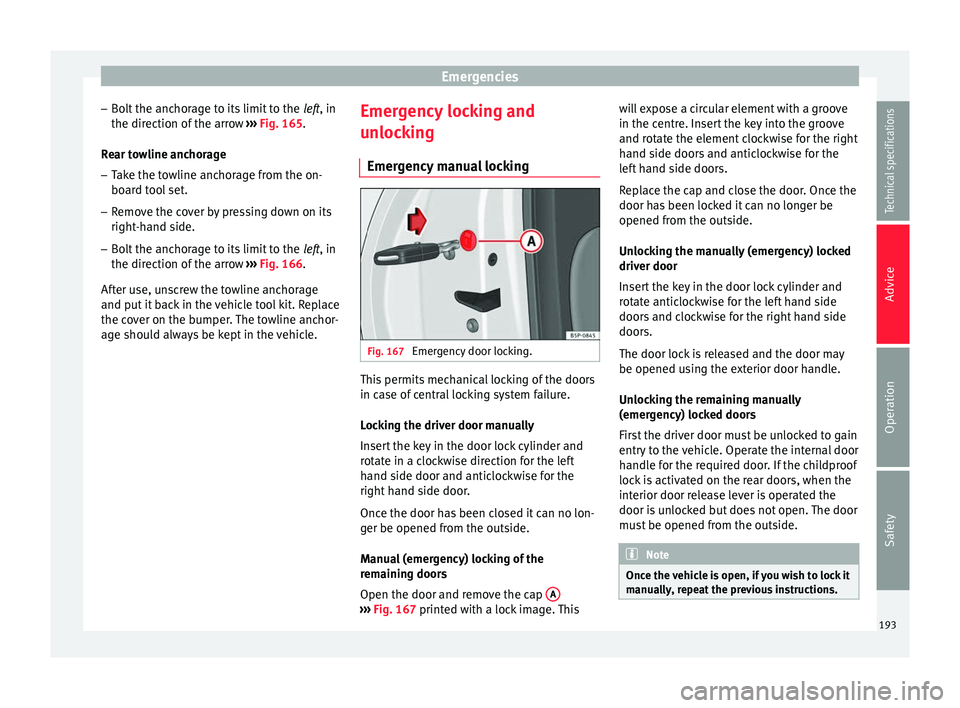
Emergency manual locking Fig. 167
Emergency door locking. This permits mechanical locking of the doors
in case of central locking system failure.
Locking the driver door manually
Insert the key in the door lock cylinder and
rotate in a clockwise direction for the left
hand side door and anticlockwise for the
right hand side door.
Once the door has been closed it can no lon-
ger be opened from the outside.
Manual (emergency) locking of the
remaining doors
Open the door and remove the cap
A ›››
Fig. 167 printed with a lock image. This w
i
ll expose a circular element with a groove
in the centre. Insert the key into the groove
and rotate the element clockwise for the right
hand side doors and anticlockwise for the
left hand side doors.
Replace the cap and close the door. Once the
door has been locked it can no longer be
opened from the outside.
Unlocking the manually (emergency) locked
driver door
Insert the key in the door lock cylinder and
rotate anticlockwise for the left hand side
doors and clockwise for the right hand side
doors.
The door lock is released and the door may
be opened using the exterior door handle.
Unlocking the remaining manually
(emergency) locked doors
First the driver door must be unlocked to gain
entry to the vehicle. Operate the internal door
handle for the required door. If the childproof
lock is activated on the rear doors, when the
interior door release lever is operated the
door is unlocked but does not open. The door
must be opened from the outside. Note
Once the vehicle is open, if you wish to lock it
manually, repeat the previous instructions. 193
Technical specifications
Advice
Operation
Safety
Page 213 of 236
Technical features
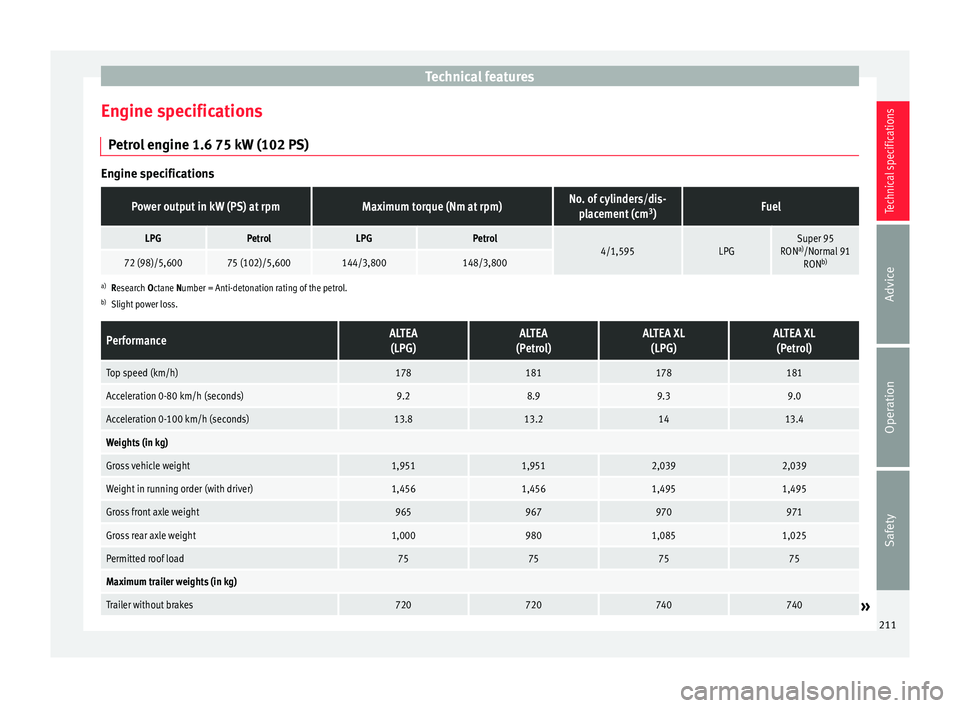
Engine specifications Petrol engine 1.6 75 kW (102 PS) Engine specificationsPower output in kW (PS) at rpmMaximum torque (Nm at rpm)No. of cylinders/dis-
placement (cm 3
)Fuel
LPGPetrolLPGPetrol4/1,595LPGSuper 95
RON a)
/Normal 91
RON b)
72 (98)/5,60075 (102)/5,600144/3,800148/3,800
a)
Research Octane Number = Anti-detonation rating of the petrol.
b) Slight power loss.
PerformanceALTEA
(LPG)ALTEA
(Petrol)ALTEA XL (LPG)ALTEA XL(Petrol)
Top speed (km/h)178181178181
Acceleration 0-80 km/h (seconds)9.28.99.39.0
Acceleration 0-100 km/h (seconds)13.813.21413.4
Weights (in kg)
Gross vehicle weight1,9511,9512,0392,039
Weight in running order (with driver)1,4561,4561,4951,495
Gross front axle weight965967970971
Gross rear axle weight1,0009801,0851,025
Permitted roof load75757575
Maximum trailer weights (in kg)
Trailer without brakes720720740740» 211
Technical specifications
Advice
Operation
Safety
Page 215 of 236
Technical features
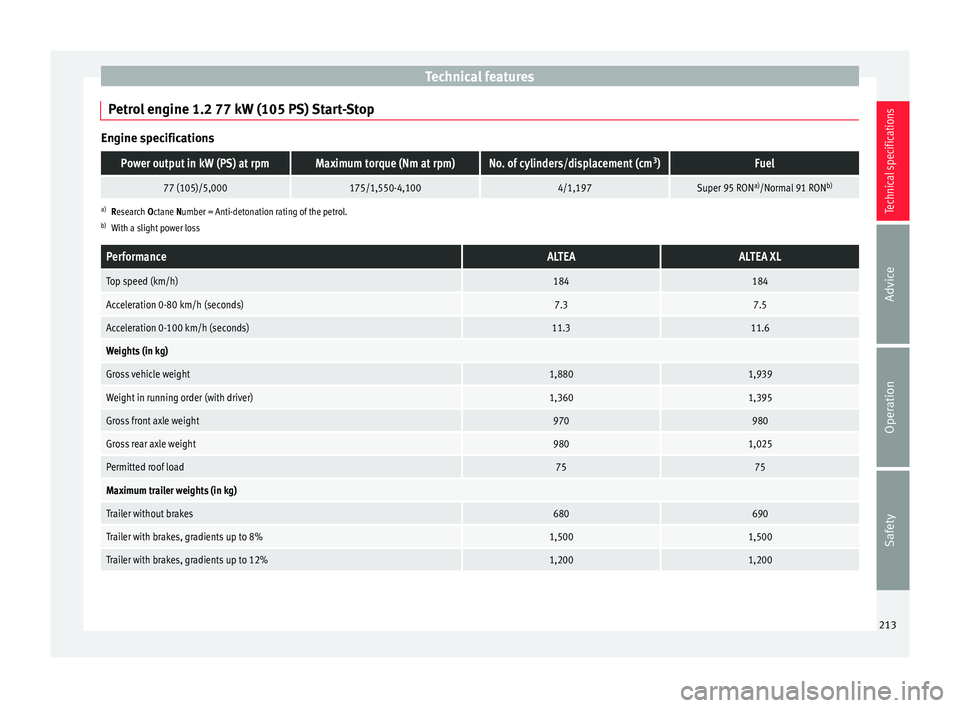
Petrol engine 1.2 77 kW (105 PS) Start-Stop Engine specificationsPower output in kW (PS) at rpmMaximum torque (Nm at rpm)No. of cylinders/displacement (cm
3
)Fuel
77 (105)/5,000175/1,550-4,1004/1,197Super 95 RON a)
/Normal 91 RON b)
a)
Research Octane Number = Anti-detonation rating of the petrol.
b) With a slight power loss
PerformanceALTEAALTEA XL
Top speed (km/h)184184
Acceleration 0-80 km/h (seconds)7.37.5
Acceleration 0-100 km/h (seconds)11.311.6
Weights (in kg)
Gross vehicle weight1,8801,939
Weight in running order (with driver)1,3601,395
Gross front axle weight970980
Gross rear axle weight9801,025
Permitted roof load7575
Maximum trailer weights (in kg)
Trailer without brakes680690
Trailer with brakes, gradients up to 8%1,5001,500
Trailer with brakes, gradients up to 12%1,2001,200 213
Technical specifications
Advice
Operation
Safety
Page 216 of 236
Technical specifications
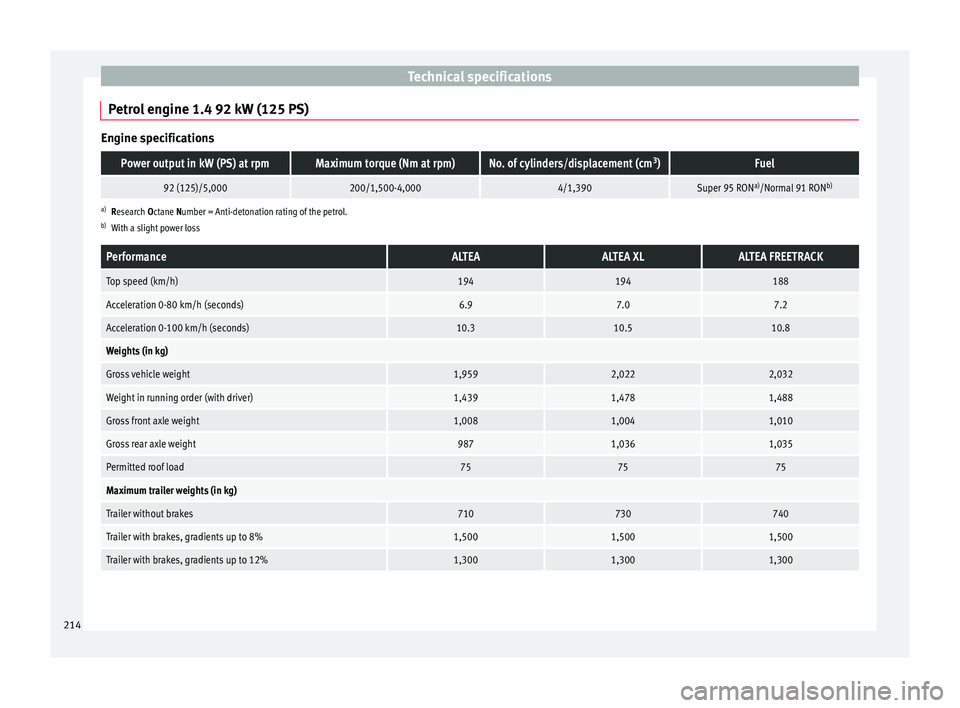
Petrol engine 1.4 92 kW (125 PS) Engine specificationsPower output in kW (PS) at rpmMaximum torque (Nm at rpm)No. of cylinders/displacement (cm
3
)Fuel
92 (125)/5,000200/1,500-4,0004/1,390Super 95 RON a)
/Normal 91 RON b)
a)
Research Octane Number = Anti-detonation rating of the petrol.
b) With a slight power loss
PerformanceALTEAALTEA XLALTEA FREETRACK
Top speed (km/h)194194188
Acceleration 0-80 km/h (seconds)6.97.07.2
Acceleration 0-100 km/h (seconds)10.310.510.8
Weights (in kg)
Gross vehicle weight1,9592,0222,032
Weight in running order (with driver)1,4391,4781,488
Gross front axle weight1,0081,0041,010
Gross rear axle weight9871,0361,035
Permitted roof load757575
Maximum trailer weights (in kg)
Trailer without brakes710730740
Trailer with brakes, gradients up to 8%1,5001,5001,500
Trailer with brakes, gradients up to 12%1,3001,3001,300 214
Page 217 of 236
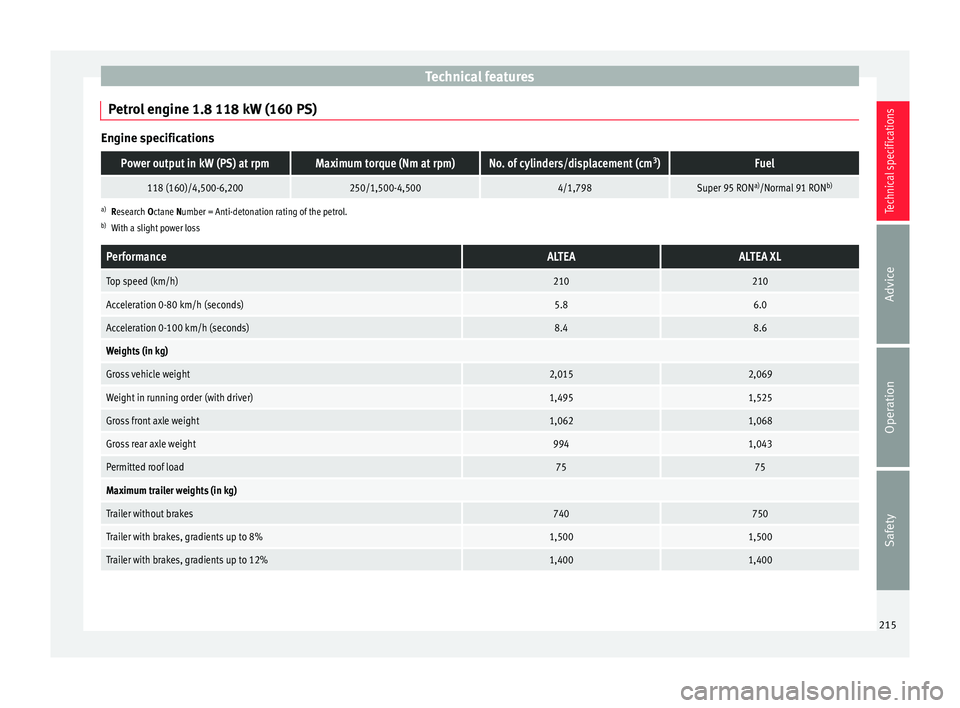
Technical features
Petrol engine 1.8 118 kW (160 PS) Engine specificationsPower output in kW (PS) at rpmMaximum torque (Nm at rpm)No. of cylinders/displacement (cm
3
)Fuel
118 (160)/4,500-6,200250/1,500-4,5004/1,798Super 95 RON a)
/Normal 91 RON b)
a)
Research Octane Number = Anti-detonation rating of the petrol.
b) With a slight power loss
PerformanceALTEAALTEA XL
Top speed (km/h)210210
Acceleration 0-80 km/h (seconds)5.86.0
Acceleration 0-100 km/h (seconds)8.48.6
Weights (in kg)
Gross vehicle weight2,0152,069
Weight in running order (with driver)1,4951,525
Gross front axle weight1,0621,068
Gross rear axle weight9941,043
Permitted roof load7575
Maximum trailer weights (in kg)
Trailer without brakes740750
Trailer with brakes, gradients up to 8%1,5001,500
Trailer with brakes, gradients up to 12%1,4001,400 215
Technical specifications
Advice
Operation
Safety
Page 218 of 236
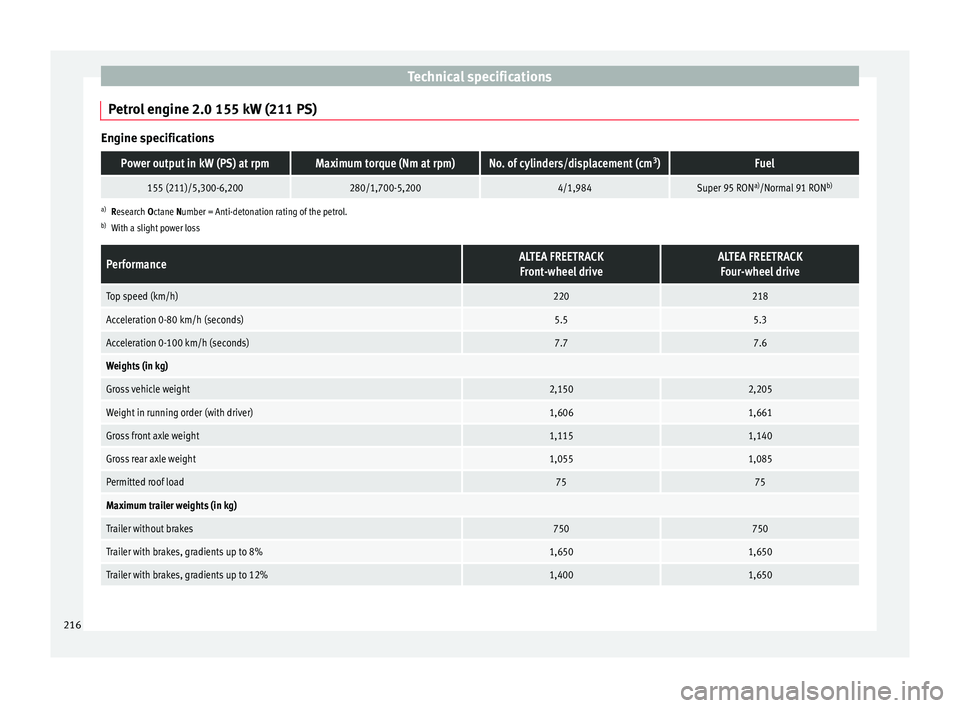
Technical specifications
Petrol engine 2.0 155 kW (211 PS) Engine specificationsPower output in kW (PS) at rpmMaximum torque (Nm at rpm)No. of cylinders/displacement (cm
3
)Fuel
155 (211)/5,300-6,200280/1,700-5,2004/1,984Super 95 RON a)
/Normal 91 RON b)
a)
Research Octane Number = Anti-detonation rating of the petrol.
b) With a slight power loss
PerformanceALTEA FREETRACK
Front-wheel driveALTEA FREETRACK Four-wheel drive
Top speed (km/h)220218
Acceleration 0-80 km/h (seconds)5.55.3
Acceleration 0-100 km/h (seconds)7.77.6
Weights (in kg)
Gross vehicle weight2,1502,205
Weight in running order (with driver)1,6061,661
Gross front axle weight1,1151,140
Gross rear axle weight1,0551,085
Permitted roof load7575
Maximum trailer weights (in kg)
Trailer without brakes750750
Trailer with brakes, gradients up to 8%1,6501,650
Trailer with brakes, gradients up to 12%1,4001,650 216