light Seat Altea 2015 Manual Online
[x] Cancel search | Manufacturer: SEAT, Model Year: 2015, Model line: Altea, Model: Seat Altea 2015Pages: 236, PDF Size: 4.23 MB
Page 151 of 236
Care and maintenance
For the sake of the environment
● When purchasing products for your vehicle
maintenance, select the ones which are not
harmful to the environment.
● The waste from car-care products should
not be disposed of with ordinary household
waste. Observe the disposal information on
the package. Care of the vehicle exterior
Automatic car wash tunnel The vehicle paintwork is so durable that the
vehicle can normally be washed without
problems in an automatic car wash tunnel.
However, the paintwork wear depends to a
large extent on the kind of the car wash tun-
nel, the brushes used, its water filtering and
the type of cleaning and preservative prod-
ucts.
Before going through a vehicle wash, be sure
to take the usual precautions such as closing
the windows and sunroof.
If the vehicle has special accessories such as
spoilers or a roof rack or two-way radio aerial,
etc., it is advisable to consult the car wash
tunnel operator.
After washing,
the brakes
could take some
time t
o respond as the brake discs and pads could be wet, or even frozen in winter. “Dry”
the brakes by braking several times. WARNING
Water, ice and salt on the brake system can
reduce braking effectiveness. Risk of acci-
dent. CAUTION
Before putting the vehicle through the car
wash, do not tighten the aerial if it is folded
because it can be damaged. Washing by hand
Vehicle washing
– First soften the dirt and rinse it off with wa-
ter.
– Clean your vehicle from top to bottom with
a soft sponge, a glove or a brush. Use very
light pressure.
– Rinse the sponge or glove often with clean
water.
– Special car shampoo should only be used
for very stubborn dirt.
– Leave the wheels, sill panels etc. until last,
using a different sponge or glove.
– Rinse the vehicle thoroughly with water. –
Dry the vehicle surface gently with a cha-
mois leather.
– In cold temperature
, dry the rubber seals
and their s
urfaces to prevent them from
freezing. Apply silicone spray to the rubber
seals.
After washing the vehicle – After washing, avoid sudden and sharp
braking. “Dry” the brakes by braking sever-
al times ››› page 123, Braking capacity and
distance. WARNING
● Wash your vehicle with the ignition switch-
ed off.
● Protect your hands and arms from cuts on
sharp metal edges when cleaning the under-
body, the inside of the wheel housings etc.
Risk of injury.
● Water, ice and salt on the brake system can
reduce braking effectiveness. Risk of acci-
dent. CAUTION
● Never remove dirt, mud or dust if the vehi-
cle surface is dry. Never use a dry cloth or
sponge for cleaning purposes. This could
scratch the paintwork or glass on your vehi-
cle. » 149
Technical specifications
Advice
Operation
Safety
Page 152 of 236
Advice
●
Washing the vehicle in low temperatures:
when washing the vehicle with a hose, do not
direct water into the lock cylinders or the
gaps around the doors, rear lid, or sunroof.
Risk of freezing. For the sake of the environment
To protect the environment, the vehicle
should be washed only in specially provided
wash bays, to prevent toxic, oil-laden waste
water from entering the sewer system. In
some places, washing vehicles outside wash
bays is prohibited. Note
Do not wash the vehicle in direct sunlight. Washing the vehicle with a high
pressure cleaner
Be particularly careful when using a high
pressure cleaner!
– Always observe the instructions for the
high-pressure cleaner, particularly those
concerning the pressure and the spraying
di s
tance.
– Increase the spraying distance for soft ma-
terials and painted bumpers. –
Do not use a high pressure cleaner to re-
move ice or snow from windows
››› page 151.
– Never u
se concentrated jet nozzles (“rotat-
ing jets”) ››› .
– After washing, avoid sudden and sharp
braking. “Dry” the brakes by braking sever-
al times ››› page 123 . WARNING
● Never wash tyres with a concentrated jet
(“rotating nozzle”). Even at large spraying
distances and short cleaning times, damage
can occur to the tyres. This may cause an ac-
cident.
● Water, ice and salt on the brake system can
reduce braking effectiveness. Risk of acci-
dent. CAUTION
● Do not use water hotter than +60 °C
(+140 °F). This could damage the vehicle.
● To avoid damage to the vehicle, keep a suf-
ficient distance from sensitive materials such
as flexible hoses, plastic, soundproofing ma-
terial, etc. This also applies to bumpers pain-
ted in the colour of the bodywork. The closer
the nozzle is to the surface, the greater the
wear on the material. Vehicle paint maintenance
Regular waxing protects the paintwork.
You need to apply wax to your vehicle if water
does not form small drops and run off the
paintwork when it is
clean.
Good quality har
d wax products are available
at your Technical Service.
Regular wax applications help to protects the
paintwork from environmental contaminants.
››› page 148. It also protects against minor
sc
ratches.
Even if a wax solution is used regularly in the
vehicle washing tunnel, it is advisable to pro-
tect the paint with a hard wax coating at least
twice a year.
Polishing the paintwork Polishing is only necessary if the paint has
lost its shine, and the gloss cannot be
brought back by applying wax. Polishing
products can be purchased in your Technical
Service.
The vehicle must be waxed after polishing if
the polish used does not contain wax com-
pounds to seal the paint
›››
page 150, Vehicle
paint maintenance .
150
Page 155 of 236
Care and maintenance
running gear, and retouch it if necessary,
before and after the winter season.
We recommend that you go to your Technical
Service to carry out repair work and addition-
al anti-corrosion work. WARNING
Do not apply underseal or anti-corrosion
coatings to the exhaust pipes, catalytic con-
verter or the heat shields on the exhaust sys-
tem. The heat of the exhaust system or the
engine could cause them to ignite. Risk of
fire. Cleaning the engine compartment
Take special care when cleaning the engine
compartment.
Anti-corrosion treatment
The engine compartment and the surface of
the power unit are given anti-corrosion treat-
ment at the factory.
Good corrosion protection is particularly im-
portant in winter when the vehicle is fre-
quently driven on salted roads. To prevent
the salt corroding the vehicle, the entire en-
gine compartment should be thoroughly
cleaned before and after winter.
Technical Services
have the proper products
for cleaning and preservation as well as the necessary workshop equipment. For this rea-
son, we recommend having this work per-
formed by them.
The anti-corrosion protection is usually re-
moved if the engine compartment is cleaned
with grease removing solutions, or if you
have the engine cleaned. On commissioning
this work, ensure that all surfaces, seams,
joints and components in the engine com-
partment are given anti-corrosion treatment.
WARNING
● When working in the engine compartment,
always observe the safety warnings
››› page 163.
● Bef
ore opening the bonnet, switch the en-
gine off, apply the handbrake firmly and al-
ways remove the key from the ignition.
● Allow the engine to cool before you clean
the engine compartment.
● Do not clean, for example, the vehicle un-
derbody, wheel arches or wheel trims without
protecting your hands and arms. You may cut
yourself on sharp-edged metal parts. Failure
to comply could result in injury.
● Moisture, ice and salt on the brake system
may affect braking effectiveness. Risk of acci-
dent. Directly after washing, avoid sudden
and sharp braking.
● Never touch the radiator fan. It is tempera-
ture-controlled and could start automatically,
even when the key is removed from the igni-
tion! For the sake of the environment
Fuel, grease and oil deposits can be removed
when the engine is washed. The polluted wa-
ter must be cleaned in an oil separator. For
this reason, engine washing should be car-
ried out only by a specialised workshop or a
petrol station. Caring for the vehicle interior
Introduction The dye used in many modern garments, for
example dark jeans, is not always sufficiently
colour-fast. Seat upholstery (material and
leather), especially when light-coloured, may
visibly discolour if the dye comes out of
clothing (even when used correctly). This is
not an upholstery defect but indicates that
the dye in the item of clothing is not suffi-
ciently colour-fast.
The longer stains or dirt remain on the vehi-
cle surfaces, especially the fabrics covering
the padded upholstery, the more difficult it
becomes to clean and maintain them. If
stains and dirt are left for a long time, it may
be that they are impossible to remove.
WARNING
Car-care products may be toxic and hazard-
ous. Using unsuitable car-care products or, » 153
Technical specifications
Advice
Operation
Safety
Page 156 of 236
Advice
using them in the wrong way, may cause acci-
dents, serious injury, burns or intoxication.
●
Keep your car-care products in their origi-
nal containers.
● Read the instructions.
● Never keep car-care products in empty food
containers, bottles or other similar contain-
ers. Other people may confuse them.
● Keep all car-care products out of the reach
of children.
● Some products may give off harmful va-
pours during use. Therefore, they should be
used outdoors in well-ventilated places.
● Never use fuel, turpentine, engine oil, nail-
varnish remover or any other volatile product
for washing, maintenance or cleaning. These
are toxic and highly flammable. WARNING
Unsuitable maintenance and cleaning of vehi-
cle components may impair proper operation
of safety equipment and cause serious injury.
● Maintain and clean vehicle components ac-
cording to the manufacturer's instructions.
● Only use approved or recommended clean-
ing products. CAUTION
● Cleaning products which contain solvents
have a corrosive effect and may damage the
material irreparably. ●
Stains and dirt containing aggressive sub-
stances or solvents attack the material and
may damage it irreparably, even when they
are cleaned quickly.
● Dirt and stains should not be allowed to dry
and should be cleaned as quickly as possible.
● In the case of stubborn stains, take the ve-
hicle to a specialised workshop to avoid dam-
age. Treating your upholstery
To treat and maintain your seat upholstery,
keep the following in mind
››› :
Before entering the vehicle, close any Velcro
fasteners that might snag on the upholstery
or trim fabric. Any open Velcro fasteners may
damage the trim or upholstery fabrics.
To prevent damage, avoid direct contact be-
tween sharp decorative objects and the up-
holstery and trim fabrics. Decorative objects
include zips, rivets and rhinestones on cloth-
ing and belts.
From time to time, clean the dust that gath-
ers in the perforations, folds and seams so
that the surfaces of the seats are not dam-
aged by its abrasive effect.
Make sure clothes are colour-fast to avoid
them running and staining the upholstery.
This is especially important if the upholstery
is light in colour. CAUTION
If you ignore this checklist, which is impor-
tant for maintaining your seat upholstery, the
fabric may be damaged or stained.
● Consult the checklist and carry out the op-
erations it describes. Note
SEAT recommends you take the vehicle to a
specialised workshop to treat any stains on
the upholstery caused by the discolouration
of clothing. How to clean the upholstery, trim
fabrics and Alcantara
® Cleaning the fabric on heated seats and
electrically adjustable seats or seats with
airbag components
There may be important airbag components
and electrical connections inside the driver
seat, passenger seat and possibly the outer
rear seats. If these seats and seat backrests
are damaged, or are cleaned and are treated
incorrectly, or if they get wet, the vehicle
electric system may be destroyed and the air-
bag system damaged
››› .
Electric and heated seats contain compo-
nents and electrical connections that may be
damaged if the seats are cleaned or incor-
rectly treated ››› . Similarly, damage may be
154
Page 157 of 236
Care and maintenance
caused at other points in the vehicle's electri-
cal system.
For this reason, bear the following indica-
tions in mind for cleaning:
● Do not use high-pressure or steam cleaning
equipment or cold aerosols.
● Do not use cream detergents or detergent-
based solutions for delicate garments.
● Prevent the fabric from getting wet at all
times.
● Only use cleaning products approved by
SEAT.
● If in doubt, take the vehicle to a professio-
nal cleaning company.
Cleaning the fabric on unheated seats, non-
electrically adjustable seats and seats
without airbag components
● Before using any cleaning products, con-
sult and keep in mind the instructions of use,
indications and warnings on the container.
● Use a vacuum cleaner (with the brush at-
tachment) on the trim and seat fabrics, the
Alcantara ®
upholstery of the seats and the
carpet.
● Do not use high-pressure or steam cleaning
equipment or cold aerosols.
● For general cleaning, use a soft sponge or
an ordinary lint-free microfibre cloth ››› .●
Clean Alcantara ®
surfaces with a slightly
damp cotton or woollen cloth, or a standard
lint-free microfibre cloth ››› .
If the dirt on the trim and upholstery fabrics
is only superficial, you can use a standard
foam cleaner.
If the upholstery and trim are very dirty, be-
fore cleaning them we recommend you find
out about the most suitable cleaning options
from a professional cleaning company. If nec-
essary, cleaning should be done by a special-
ised firm.
Stain removal
When removing stains, it may be necessary
to clean the whole surface and not just the
stain itself. Especially if the surface has been
dirtied through normal use. If you only clean
the stained area, that part may then look
lighter than the rest. If in doubt, take the ve-
hicle to a professional cleaning company. WARNING
If there is a fault in the airbag system, it is
likely that the airbag will not deploy correct-
ly, not deploy at all, or do so unexpectedly,
which could cause serious or fatal injuries.
● Have the system checked immediately by a
specialised workshop. CAUTION
If the upholstery on electrically operated
seats or seats with airbag components gets
soaked, the vehicle's electric system and cer-
tain other components may be damaged.
● If the seat gets soaked, take the vehicle im-
mediately to a specialised workshop to be
dried and for the system components to be
inspected.
● Do not use steam cleaning equipment as
the dirt becomes more encrusted and fixed in
the material.
● High-pressure cleaning equipment and cold
aerosols may damage the upholstery. CAUTION
● Brushes should only be used to clean the
mats and floor mat! Other fabrics may be
damaged if cleaned with a brush.
● If cream detergents or detergents for deli-
cate garments are applied with a damp cloth
or sponge, they may, for example, leave rings
when dry because of the surfactant compo-
nents they contain. Generally, such rings are
very difficult or almost impossible to remove. CAUTION
● Do not let water soak into Alcantara ®
car-
pet under any circumstances.
● Do not use leather cleaning products, sol-
vents, wax polish, shoe cream, stain remov-
ers or similar products on Alcantara ®
. » 155Technical specifications
Advice
Operation
Safety
Page 158 of 236
Advice
●
Never use brushes for cleaning damp mate-
rial as they could damage the surface. Cleaning and maintenance of natural
leather upholstery
Consult a professional cleaning workshop if
you have any doubts on cleaning and main-
taining the leather equipment in your vehicle.
Maintenance and treatment
Nappa natural leather is delicate because it
has no additional protective layer.
● After cleaning, regularly apply a condition-
er with sun-screen and impregnating action.
These products nourish the leather, soften it
and make it more breathable, as well as re-
hydrating it. They also provide it with a pro-
tective film.
● Clean the leather every two or three months
and remove stains as they appear.
● Treat the leather regularly (about twice a
year) with a suitable maintenance product.
● Apply as few cleaning and maintenance
products as possible, always using a dry, lint-
free cotton or woollen cloth. Do not apply
cleaning and maintenance products directly
to the leather. ●
Remove recent ball-point pen and ink
stains, lipstick, shoe cream and similar
stains as soon as possible.
● Maintain the colour of the leather. To do
this, use a special cream especially coloured
for leather to achieve the same overall colour,
if necessary.
● Afterwards, go over it with a soft cloth.
Cleaning the vehicle
SEAT recommends using a slightly damp cot-
ton or woollen cloth for general cleaning pur-
poses.
Generally, the leather should never be
soaked at any point, nor should water pene-
trate the seams.
Before cleaning the leather upholstery, bear
in mind the f o
llowing recommendations
››› page 154, Cleaning the fabric on heated
seats and electrically adjustable seats or
seats with airbag components . CAUTION
● On no account use solvents, wax polish,
shoe cream, stain removers or similar materi-
als on leather.
● If the stain remains on the leather for long,
it will soak in and be impossible to remove.
● In the event of spilt liquids, dry immediate-
ly with an absorbent cloth to prevent the liq-
uid penetrating through the leather or seams. ●
If the vehicle is left standing in the sun for
long periods, the leather should be protected
against direct sunlight to prevent it from fad-
ing. Note
The leather will usually change colour slight-
ly with use. Cleaning synthetic leather upholstery
Before cleaning synthetic leather upholstery,
bear in mind the following recommendations
››› page 154, Cleaning the fabric on heated
seats and electrically adjustable seats or
seats with airbag components
Only use water and neutral cleaning products
to clean synthetic leather upholstery. CAUTION
Do not use solvents, floor wax, shoe cream,
stain removers or similar products on syn-
thetic leather. These will stiffen the material,
causing it to crack prematurely. Cleaning plastic parts and the
instrument panel
–
Use a clean, damp cloth to clean plastic
parts and the dash panel.
156
Page 167 of 236
Checking and refilling levels
For the sake of the environment
Service fluids leaks are harmful to the envi-
ronment. For this reason you should make
regular checks on the ground underneath
your vehicle. If you find spots of oil or other
fluids, have your vehicle inspected in a speci-
alised workshop. Opening the bonnet
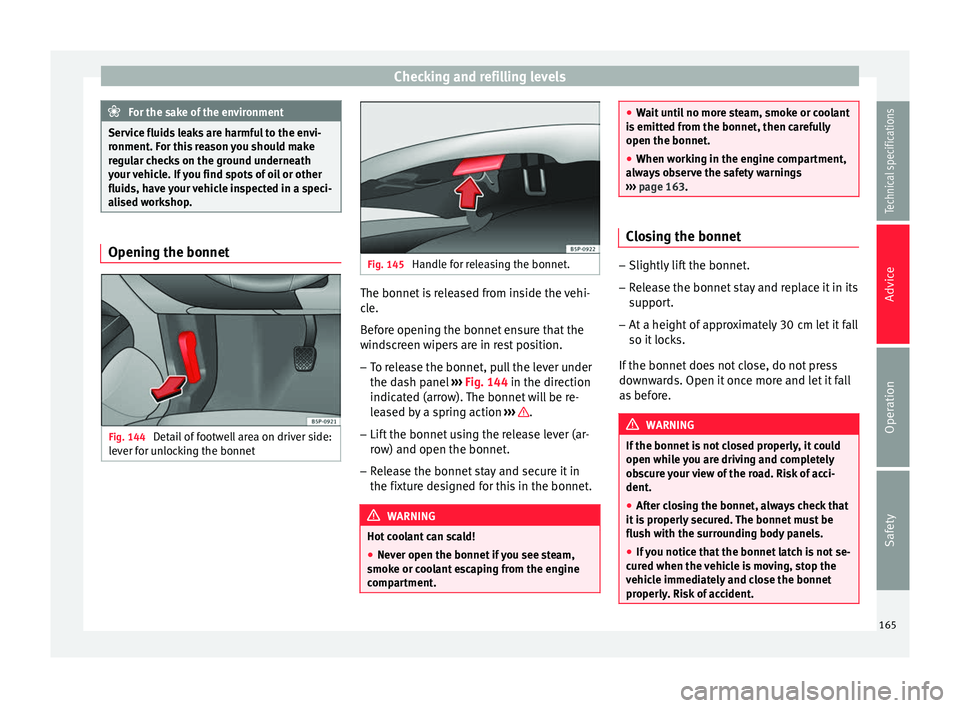
Fig. 144
Detail of footwell area on driver side:
lever for unlocking the bonnet Fig. 145
Handle for releasing the bonnet. The bonnet is released from inside the vehi-
cle.
Before opening the bonnet ensure that the
windscreen wipers are in rest position.
– To release the bonnet, pull the lever under
the dash panel ››› Fig. 144 in the direction
indic at
ed (arrow). The bonnet will be re-
leased by a spring action ››› .
– Lift the bonnet using the release lever (ar-
row) and open the bonnet.
– Release the bonnet stay and secure it in
the fixture designed for this in the bonnet. WARNING
Hot coolant can scald!
● Never open the bonnet if you see steam,
smoke or coolant escaping from the engine
compartment. ●
Wait until no more steam, smoke or coolant
is emitted from the bonnet, then carefully
open the bonnet.
● When working in the engine compartment,
always observe the safety warnings
››› page 163. Closing the bonnet
–
Slightly lift the bonnet.
– Release the bonnet stay and replace it in its
support.
– At a height of approximately 30 cm let it fall
so it locks.
If the bonnet does not close, do not press
downwards. Open it once more and let it fall
as before. WARNING
If the bonnet is not closed properly, it could
open while you are driving and completely
obscure your view of the road. Risk of acci-
dent.
● After closing the bonnet, always check that
it is properly secured. The bonnet must be
flush with the surrounding body panels.
● If you notice that the bonnet latch is not se-
cured when the vehicle is moving, stop the
vehicle immediately and close the bonnet
properly. Risk of accident. 165
Technical specifications
Advice
Operation
Safety
Page 171 of 236
Checking and refilling levels
Changing engine oil The engine oil must be changed at the inter-
vals given in the service schedule.
We recommend that you have the engine oil
changed by a Technical Service.
The oil change intervals are shown in the
Maintenance Programme.
WARNING
Only change the engine oil yourself if you
have the specialist knowledge required!
● Before opening the bonnet, read and ob-
serve the warnings ››› page 163, Safety in-
structions on working in the engine compart-
ment.
● Wait
for the engine to cool down. Hot oil
may cause burn injuries.
● Wear eye protection to avoid injuries, such
as acid burns, caused by splashes of oil.
● When removing the oil drain plug with your
fingers, keep your arm horizontal to help pre-
vent oil from running down your arm.
● Wash your skin thoroughly if it comes into
contact with engine oil.
● Engine oil is poisonous! Used oil must be
stored in a safe place out of the reach of chil-
dren. CAUTION
No additives should be used with engine oil.
This could result in engine damage. Any dam-
age caused by the use of such additives
would not be covered by the factory warranty. For the sake of the environment
● Because of disposal problems and the spe-
cial tools and specialist knowledge required,
we recommend that you have the engine oil
and filter changed by a Technical Service.
● Never pour oil down drains or into the
ground.
● Use a suitable container when draining the
used oil. It must be large enough to hold all
the engine oil. Cooling system
Engine coolant specifications The engine cooling system is supplied from
the factory with a specially treated mixture of
water and, at least, 40 % of the additive
G 13
(TLVW 774 J). The engine coolant additive is
recognisable by its purple colour. This mix-
ture of water and additive gives the necessa-
ry frost protection down to -25°C (-13 F) and
protects the light alloy parts of the cooling
system against corrosion. It also prevents scaling and considerably raises the boiling
point of the coolant.
To protect the engine cooling system, the
percentage of additive must
always be at
l e
ast 40 %, even in warm climates where an-
ti-freeze protection is not required.
If greater frost protection is required in very
cold climates, the proportion of additive can
be increased. However, the percentage of ad-
ditive should not exceed 60%, as this would
reduce frost protection and, in turn, decrease
cooling capacity.
When the coolant is topped up, use a mixture
of distilled water and, at least, 40 % of the G
13 or G 12 plu
s-plus (TL-VW 774 G) additive
(both are purple) to obtain an optimum anti-
corrosion protection ››› . The mixture of G
13 with G 12 plus (TL-VW 774 F), G 12 (red) or
G 11 (green-blue) engine coolants will signifi-
cantly reduce the anticorrosion protection
and should, therefore be avoided ››› .
WARNING
If there is not enough anti-freeze in the cool-
ant system, the engine may fail leading to se-
rious damage.
● Please make sure that the percentage of
additive is correct with respect to the lowest
expected ambient temperature in the zone
where the vehicle is to be used.
● When the outside temperature is very low,
the coolant could freeze and the vehicle » 169
Technical specifications
Advice
Operation
Safety
Page 173 of 236
Checking and refilling levels
WARNING
Any work carried out in the engine compart-
ment or on the engine must be carried out
cautiously.
● When working in the engine compartment,
always observe the safety warnings
››› page 163.
● When the engine is warm or hot, the cool-
ing system is pressurised! Do not unscrew
the cap on the coolant expansion tank when
the engine is hot. This is a burn injury risk. CAUTION
● When mixed with other additives the colour
of G12 will change to brown. If this occurs
you should have the coolant changed imme-
diately. Failure to do so will result in engine
damage!
● If a lot of coolant fluid has been lost, wait
for the engine to cool. This avoids damaging
the en gine. Lar
ge coolant losses are an indi-
cation of leaks in the cooling system. See a
specialised workshop immediately and have
the cooling system checked. Otherwise, there
is a risk of engine damage. Windscreen washer reservoir
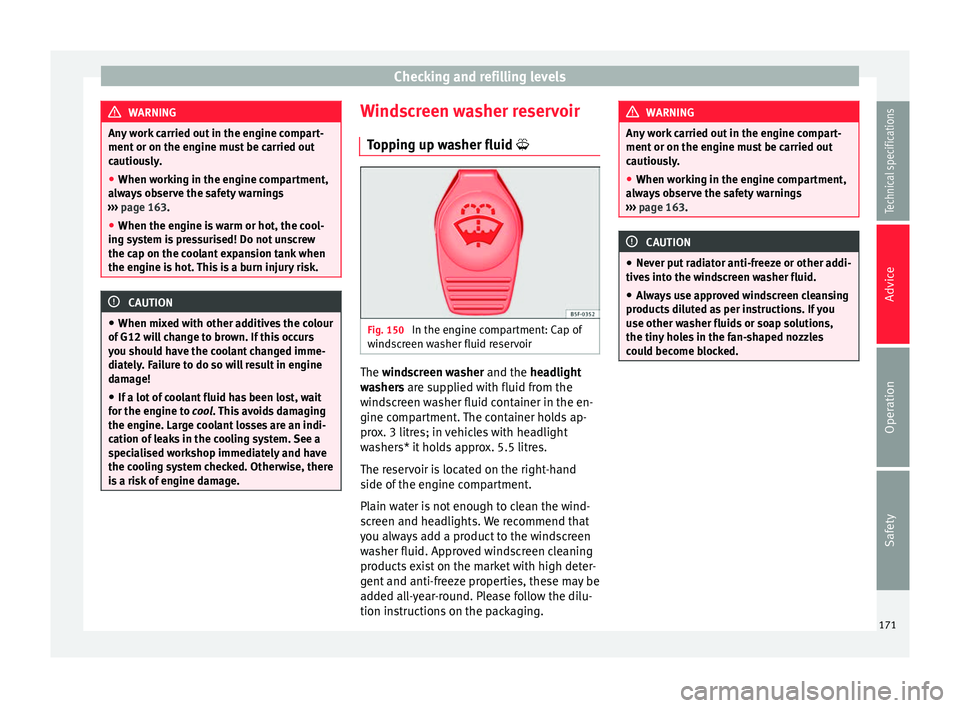
Topping up washer fluid Fig. 150
In the engine compartment: Cap of
windscreen washer fluid reservoir The
windscreen washer
and the
headlight
washers are supplied with fluid from the
windscreen washer fluid container in the en-
gine compartment. The container holds ap-
prox. 3 litres; in vehicles with headlight
washers* it holds approx. 5.5 litres.
The reservoir is located on the right-hand
side of the engine compartment.
Plain water is not enough to clean the wind-
screen and headlights. We recommend that
you always add a product to the windscreen
washer fluid. Approved windscreen cleaning
products exist on the market with high deter-
gent and anti-freeze properties, these may be
added all-year-round. Please follow the dilu-
tion instructions on the packaging. WARNING
Any work carried out in the engine compart-
ment or on the engine must be carried out
cautiously.
● When working in the engine compartment,
always observe the safety warnings
››› page 163. CAUTION
● Never put radiator anti-freeze or other addi-
tives into the windscreen washer fluid.
● Always use approved windscreen cleansing
products diluted as per instructions. If you
use other washer fluids or soap solutions,
the tiny holes in the fan-shaped nozzles
could become blocked. 171
Technical specifications
Advice
Operation
Safety
Page 174 of 236
Advice
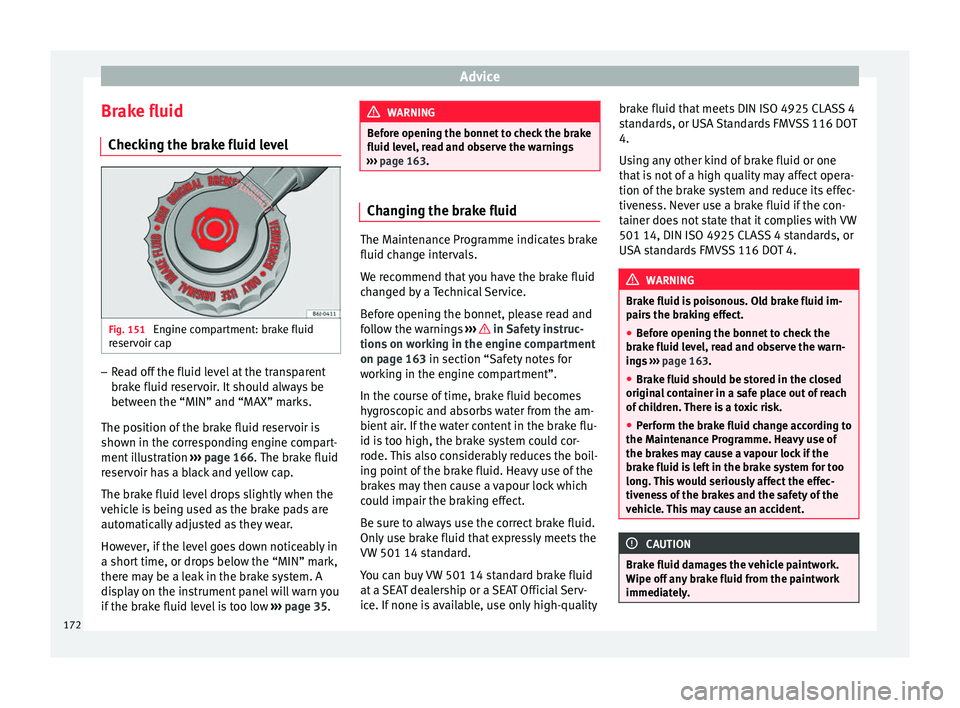
Brake fluid Checking the brake fluid level Fig. 151
Engine compartment: brake fluid
reservoir cap –
Read off the fluid level at the transparent
brake fluid reservoir. It should always be
between the “MIN” and “MAX” marks.
The position of the brake fluid reservoir is
shown in the corresponding engine compart-
ment illustration ››› page 166. The brake fluid
reservoir has a black and yellow cap.
The brake fluid level drops slightly when the
vehicle is being used as the brake pads are
automatically adjusted as they wear.
However, if the level goes down noticeably in
a short time, or drops below the “MIN” mark,
there may be a leak in the brake system. A
display on the instrument panel will warn you
if the brake fluid level is too low ››› page 35. WARNING
Before opening the bonnet to check the brake
fluid level, read and observe the warnings
››› page 163. Changing the brake fluid
The Maintenance Programme indicates brake
fluid change intervals.
We recommend that you have the brake fluid
changed by a Technical Service.
Before opening the bonnet, please read and
follow the warnings
››› in Safety instruc-
tions on working in the engine compartment
on page 163 in section “Safety notes for
w ork
ing in the engine compartment”.
In the course of time, brake fluid becomes
hygroscopic and absorbs water from the am-
bient air. If the water content in the brake flu-
id is too high, the brake system could cor-
rode. This also considerably reduces the boil-
ing point of the brake fluid. Heavy use of the
brakes may then cause a vapour lock which
could impair the braking effect.
Be sure to always use the correct brake fluid.
Only use brake fluid that expressly meets the
VW 501 14 standard.
You can buy VW 501 14 standard brake fluid
at a SEAT dealership or a SEAT Official Serv-
ice. If none is available, use only high-quality brake fluid that meets DIN ISO 4925 CLASS 4
standards, or USA Standards FMVSS 116 DOT
4.
Using any other kind of brake fluid or one
that is not of a high quality may affect opera-
tion of the brake system and reduce its effec-
tiveness. Never use a brake fluid if the con-
tainer does not state that it complies with VW
501 14, DIN ISO 4925 CLASS 4 standards, or
USA standards FMVSS 116 DOT 4.
WARNING
Brake fluid is poisonous. Old brake fluid im-
pairs the braking effect.
● Before opening the bonnet to check the
brake fluid level, read and observe the warn-
ings ››› page 163.
● Br ak
e fluid should be stored in the closed
original container in a safe place out of reach
of children. There is a toxic risk.
● Perform the brake fluid change according to
the Maintenance Programme. Heavy use of
the brakes may cause a vapour lock if the
brake fluid is left in the brake system for too
long. This would seriously affect the effec-
tiveness of the brakes and the safety of the
vehicle. This may cause an accident. CAUTION
Brake fluid damages the vehicle paintwork.
Wipe off any brake fluid from the paintwork
immediately. 172