ECU Seat Altea XL 2015 Owner's Guide
[x] Cancel search | Manufacturer: SEAT, Model Year: 2015, Model line: Altea XL, Model: Seat Altea XL 2015Pages: 236, PDF Size: 4.23 MB
Page 105 of 236
Transport and practical equipment
Fastening rings* There can be four fastening rings in the lug-
gage compartment for fastening luggage and
other objects.
–
Always use suitable and undamaged straps
to secure luggage and other objects to the fastening rings ››› in Loading the lug-
gage compartment on page 101.
– Pull up the fastening rings to attach the
straps.
During a collision or an accident, even small
and light objects can build up so much ener-
gy that they can cause very severe injuries.
The amount of “energy” depends on the
speed of the vehicle and the weight of the
object. The most significant factor, however,
is the speed of the vehicle.
Example: An object weighing 4.5 kg is lying
unsecured in the vehicle. During a frontal col-
lision at a speed of 50 km/h (30 mph), this
object generates a force corresponding to 20
times its weight. This means that the effec-
tive weight of the object increases to about
90 kg. Imagine the injuries that may result
from said “object” if it hits any passenger
when flying through the passenger compart-
ment. This increased risk of injury will be fur-
ther increased if a loose object is struck by
an inflating airbag. WARNING
● If pieces of baggage or other objects are se-
cured to the fastening rings with inappropri-
ate or damaged retaining cords, injuries
could result in the event of braking manoeu-
vres or accidents.
● Never secure a child seat on the fastening
rings. Cargo separation net*
3 Applies to the model: ALTEA XL/ALTEA FREETRACK
Fig. 107
Separation net. Fig. 108
Fastening rings for the separation
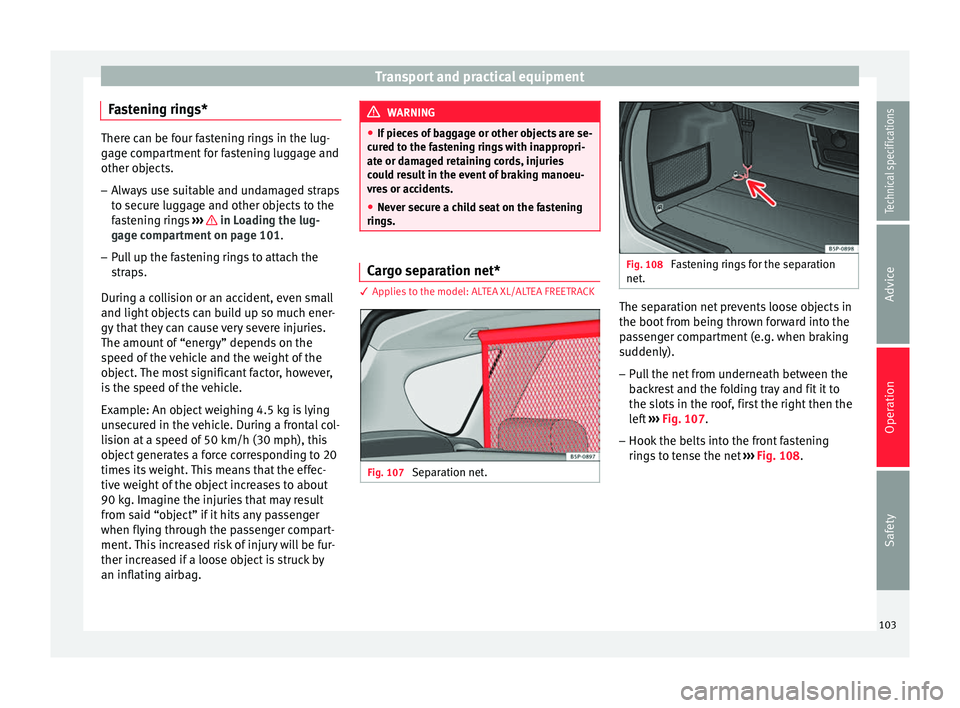
net. The separation net prevents loose objects in
the boot from being thrown forward into the
passenger compartment (e.g. when braking
suddenly).
– Pull the net from underneath between the
backrest and the folding tray and fit it to
the slots in the roof, first the right then the
left ››› Fig. 107 .
– Hook the belts
into the front fastening
rings to tense the net ››› Fig. 108
.
103
Technical specifications
Advice
Operation
Safety
Page 106 of 236
Operation
Storage in the boot floor* Fig. 109
Variable storage in the boot floor. Fig. 110
Boot floor partition. There is a variable storage compartment* in
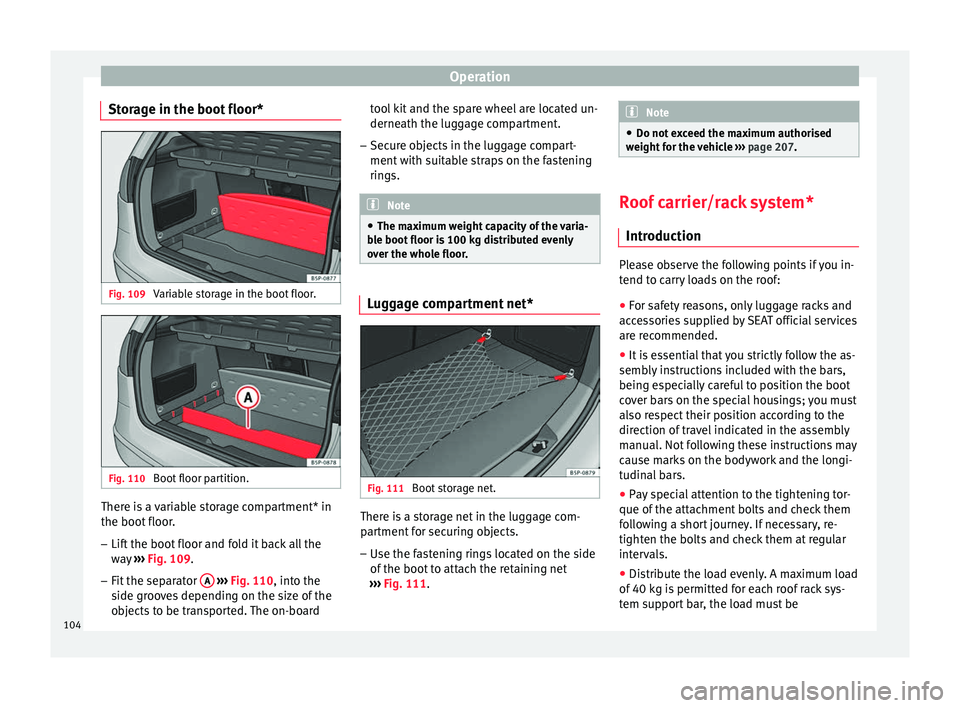
the boot floor.
–
Lift the boot floor and fold it back all the
way ››› Fig. 109 .
– Fit the sep
arator A
››› Fig. 110
, into the
s ide gr
ooves depending on the size of the
objects to be transported. The on-board tool kit and the spare wheel are located un-
derneath the luggage compartment.
– Secure objects in the luggage compart-
ment with suitable straps on the fastening
rings. Note
● The maximum weight capacity of the varia-
ble boot floor is 100 kg distributed evenly
over the whole floor. Luggage compartment net*
Fig. 111
Boot storage net. There is a storage net in the luggage com-
partment for securing objects.
– Use the fastening rings located on the side
of the boot to attach the retaining net
››› Fig. 111 . Note
● Do not exceed the maximum authorised
weight for the vehicle ››› page 207. Roof carrier/rack system*
Introduction Please observe the following points if you in-
tend to carry loads on the roof:
● For safety reasons, only luggage racks and
accessories supplied by SEAT official services
are recommended.
● It is essential that you strictly follow the as-
sembly instructions included with the bars,
being especially careful to position the boot
cover bars on the special housings; you must
also respect their position according to the
direction of travel indicated in the assembly
manual. Not following these instructions may
cause marks on the bodywork and the longi-
tudinal bars.
● Pay special attention to the tightening tor-
que of the attachment bolts and check them
following a short journey. If necessary, re-
tighten the bolts and check them at regular
intervals.
● Distribute the load evenly. A maximum load
of 40 kg is permitted for each roof rack sys-
tem support bar, the load must be
104
Page 107 of 236
Transport and practical equipment
distributed evenly along the entire length.
However, the maximum load permitted for
the entire roof (including the support system)
of 75 kg must not be exceeded nor the total
weight recommended for the entire vehicle.
See the “Technical Data” ››› page 207 sec-
tion.
● When transporting heavy or large objects
on the roof, any change in the normal vehicle
behaviour due to a change in the centre of
gravity or an increased wind resistance must
be taken into account. For this reason, a suit-
able speed and driving style must be used.
● On vehicles fitted with a sliding/tilting sun-
roof*, make sure it does not hit the load on
the roof upon opening. Attachment points
Fig. 112
Altea model: securing points for the
roof carrier. Fig. 113
Altea XL/Altea Freetrack model: se-
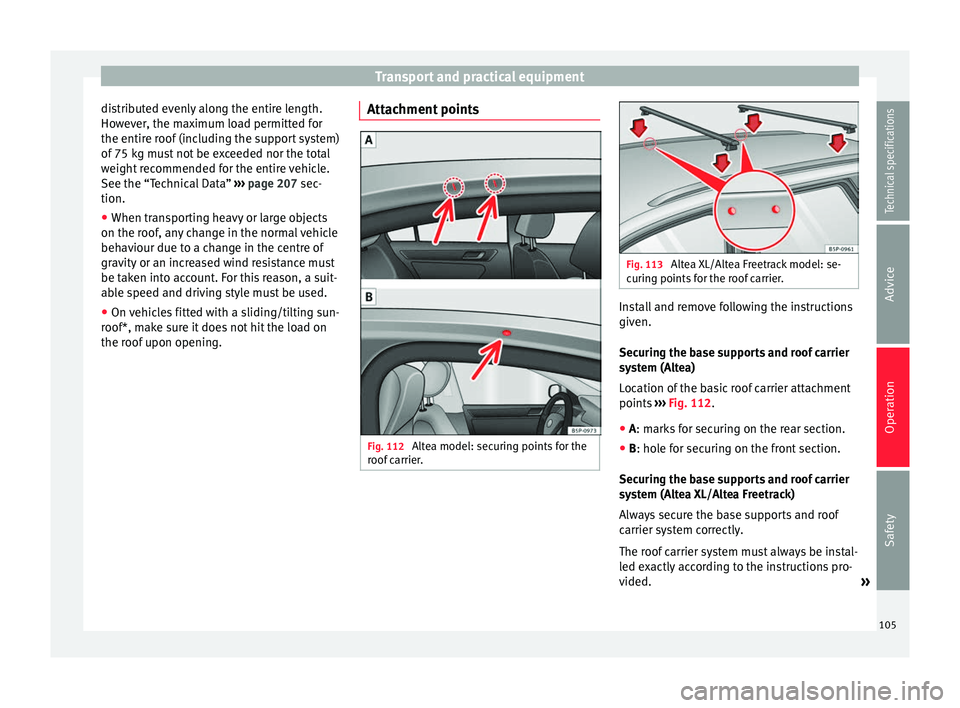
curing points for the roof carrier. Install and remove following the instructions
given.
Securing the base supports and roof carrier
system (Altea)
Location of the basic roof carrier attachment
points
››› Fig. 112 .
● A: marks for securing on the rear section.
● B: hole for securing on the front section.
Sec uring the base supports and roof carrier
system (Altea XL/Altea Freetrack)
Always secure the base supports and roof
carrier system correctly.
The roof carrier system must always be instal-
led exactly according to the instructions pro-
vided. »
105
Technical specifications
Advice
Operation
Safety
Page 127 of 236
Driving
●
If the handbrake is only partially released,
this will cause the rear brakes to overheat,
which can impair the function of the brake
system and could lead to an accident. This al-
so causes premature wear on the rear brake
pads. CAUTION
Always apply the handbrake before you leave
the vehicle. Put it in 1st gear as well. Parking
The handbrake should always be firmly ap-
plied when the vehicle is parked.
Always note the following points when park-
ing the vehicle:
– Use the brake pedal to stop the vehicle.
– Apply the handbrake.
– Put it in 1st gear.
– Switch the engine off and remove the key
from the ignition. Turn the steering wheel
slightly to engage the steering lock.
– Always take you keys with you when you
leave the vehicle ››› .Additional notes on parking the vehicle on
gradients:
Turn the steering wheel so that the vehicle
rolls against the kerb if it started to roll.
●
If the vehicle is parked facing downhill,
turn the front wheels so that they point to-
wards the kerb .
● If the vehicle is parked facing uphill, turn
the fr ont
wheels so that they point away from
the kerb
.
● Secure the vehicle as usual by applying the
handbrake firmly and putting it in 1st gear. WARNING
● Take measures to reduce the risk of injury
when you leave your vehicle unattended.
● Never park where the hot exhaust system
could ignite inflammable materials, such as
dry grass, low bushes, spilt fuel etc.
● Never allow vehicle occupants to remain in
the vehicle when it is locked. They would be
unable to open the vehicle from the inside,
and could become trapped in the vehicle in
an emergency. In the event of an emergency,
locked doors will delay assistance to vehicle
occupants.
● Never leave children alone in the vehicle.
They could set the vehicle in motion, for ex-
ample, by releasing the handbrake or the
gearbox lever. ●
Depending on weather conditions, it may
become extremely hot or cold inside the vehi-
cle. This can be fatal. Hill driving assistant*
This function is only included in vehicles with
ESC.
The hill driving assistant helps the driver to
move off and upward on a hill without rolling
backward.
The system maintains brake pressure for ap-
proximately 2 seconds after the driver takes
his foot off the brake pedal to prevent the ve-
hicle from rolling backward when starting off.
During these 2 seconds, the driver has
enough time to release the clutch pedal and
accelerate without the vehicle moving and
without having to use the handbrake, making
starting off easier, more comfortable and saf-
er.
These are the basic operation conditions:
● being on a ramp or hill/slope,
● closed doors,
● vehicle completely stationary,
● engine running and foot on the brake,
● besides having a gear engaged or being in
neutral for manual gear change and with the
selector lever at position S,
D
or R for an au-
tomatic gearbox. »
125
Technical specifications
Advice
Operation
Safety
Page 146 of 236
Operation
once on the upper part of the rocker switch RES/+ ››› Fig. 137 A .
Complete system deactivation* Vehicles with a manual gearbox
The system is completely turned off
by mov-
ing the control B
››› Fig. 137 all the way to
the right (OFF
engaged), or when the vehicle
is stationary, by switching off the ignition.
Vehicles with automatic gearbox/DSG
automatic gearbox
To completely disengage the system, the se-
lector lever must be placed in one of the fol-
lowing positions: P ,
N, R or 1 or with the vehi-
cle stopped and the ignition turned off. Towing bracket device
Trailer towing Instructions to follow Your vehicle may be used to tow a trailer
when fitted with the correct equipment.
If the car is supplied with a
factory-fitted tow-
in g br
acket it will already have the necessary
technical modifications and meet the statuto-
ry requirements for towing a trailer. If you
wish to retrofit a towing bracket, consult
›
›› page 146.
Connect
ors
Your vehicle is fitted with a 12-pin connector
for the electrical connection between the
trailer and the vehicle.
If the trailer has a 7-pin plug you will need to
use an a
dapter cable. It is available at any
Technical Service.
Trailer weight/drawbar load
Never exceed the authorised trailer weight. If
you do not load the trailer up to the maxi-
mum permitted trailer weight, you can then
climb correspondingly steeper slopes.
The maximum trailer weights listed are only applicable for altitudes up to 1000 m above
sea l
evel. With increasing altitude the engine power and therefore the vehicle climbing
ability are impaired because of the reduced
air density. The maximum trailer weight has
to be reduced accordingly. The weight of the
vehicle and trailer combination must be re-
duced by 10% for every further 1000 m (or
part thereof). The gross combination weight
is the actual weight of the laden vehicle plus
the actual weight of the laden trailer. When
possible, operate the trailer with the maxi-
mum permitted drawbar load on the ball joint
of the t
owing bracket, but do not exceed the
specified limit.
The figures for trailer weights
and drawbar
loads that are given on the data plate of the
towing bracket are for certification purposes
only. The correct figures for your specific
model, which may be lower than these fig-
ures for the towing bracket, are given in the
vehicle documentation or in ››› chapter Tech-
nical Data .
Distributing the load
Distribute loads in the trailer so that heavy
objects are as near to the axle as possible.
Loads carried in the trailer must be secured
to prevent them moving.
144
Page 147 of 236
Towing bracket device
Tyre pressure
Set tyre pressure to the maximum permissi-
ble pressure shown on the sticker on the in-
side of the fuel tank flap. Set the tyre pres-
sure of the trailer tyres in accordance with the
trailer manufacturer's recommendations.
Exterior mirrors
Check whether you can see enough of the
road behind the trailer with the standard rear
vision mirrors. If this is not the case, you
should have additional exterior mirrors fitted.
Both exterior mirrors should be mounted on
hinged extension brackets. Adjust the mirrors
to give sufficient vision to the rear. WARNING
Never transport people in a trailer. This could
result in fatal accidents. Note
● Towing a trailer places additional demands
on the vehicle. We recommend additional
services between the normal inspection inter-
vals if the vehicle is used frequently for tow-
ing a trailer.
● Find out whether special regulations apply
to towing a trailer in your country. Ball coupling of towing bracket*
Depending on the model version, the spheri-
cal head on the trailer hook may be stored in
the tool box.
The ball coupling is provided with instruc-
tions on fitting and removing the ball cou-
pling of the towing bracket.
WARNING
The towing bracket ball coupling must be
stored securely in the luggage compartment
to prevent them being flung through the vehi-
cle and causing injury. Note
● By law, the ball coupling must be removed
if a trailer is not being towed if it obscures
the number plate. Driving tips
Driving with a trailer always requires extra
care.
Weight distribution
The weight distribution of a loaded trailer
with an unladen vehicle is very unfavourable.
However, if this cannot be avoided, drive ex-
tra slowly to allow for the unbalanced weight
distribution.Speed
The stability of the vehicle and trailer is re-
duced with increasing speed. For this reason,
it is advisable not to drive at the maximum
permissible speed in an unfavourable road,
weather or wind conditions. This applies es-
pecially when driving downhill.
You should always reduce speed immediately
if the trailer shows the slightest sign of
snak-
ing . Never try to stop the “snaking” by in-
c r
easing speed.
Always brake in due course. If the trailer has
an
overrun brake, apply the brakes gently at
first and then, firmly. This will prevent the
jerking that can be caused by locking of trail-
er wheels. Select a low gear in due course
before going down a steep downhill. This en-
ables you to use the engine braking to slow
down the vehicle.
Reheating
At very high temperatures and during pro-
longed slopes, driving in a low gear and high
engine speed, always monitor the coolant
temperature gauge ››› page 31.
Electronic Stability Control*
The ESC* system helps to stabilise the trailer
in case of skidding or rocking.
145
Technical specifications
Advice
Operation
Safety
Page 148 of 236
Operation
Fitting a towing bracket* Fig. 138
Attachment points for towing brack-
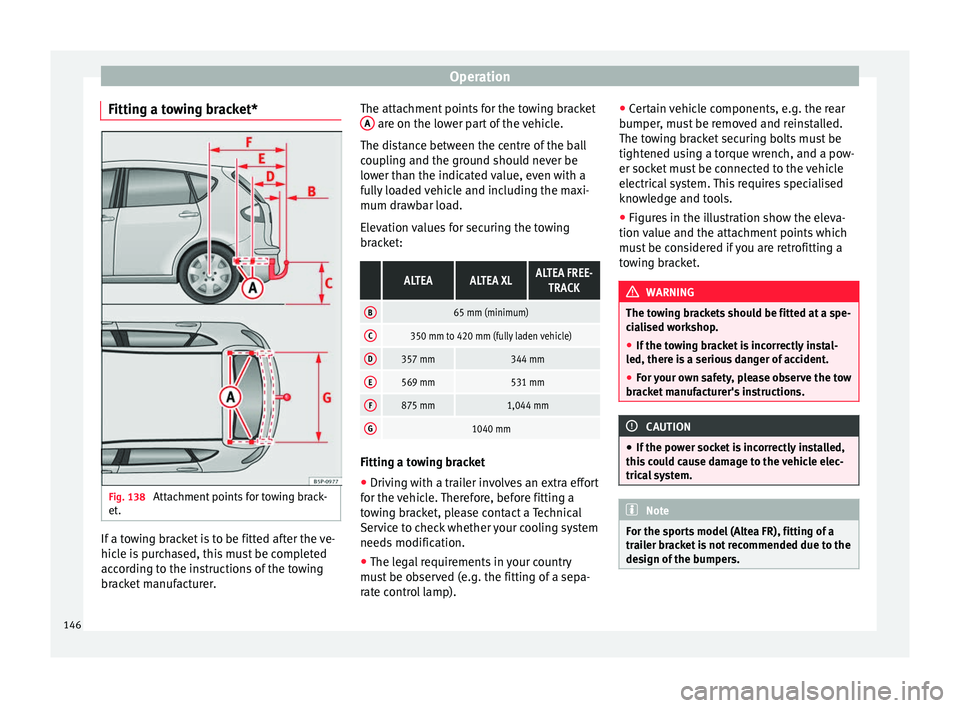
et. If a towing bracket is to be fitted after the ve-
hicle is purchased, this must be completed
according to the instructions of the towing
bracket manufacturer. The attachment points for the towing bracket
A are on the lower part of the vehicle.
The distance between the centre of the ball
coupling and the ground should never be
lower than the indicated value, even with a
fully loaded vehicle and including the maxi-
mum drawbar load.
Elevation values for securing the towing
bracket: ALTEAALTEA XLALTEA FREE- TRACK
B65 mm (minimum)
C350 mm to 420 mm (fully laden vehicle)
D357 mm344 mm
E569 mm531 mm
F875 mm1,044 mm
G1040 mm Fitting a towing bracket
●
Driving with a trailer involves an extra effort
for the vehicle. Therefore, before fitting a
towing bracket, please contact a Technical
Service to check whether your cooling system
needs modification.
● The legal requirements in your country
must be observed (e.g. the fitting of a sepa-
rate control lamp). ●
Certain vehicle components, e.g. the rear
bumper, must be removed and reinstalled.
The towing bracket securing bolts must be
tightened using a torque wrench, and a pow-
er socket must be connected to the vehicle
electrical system. This requires specialised
knowledge and tools.
● Figures in the illustration show the eleva-
tion value and the attachment points which
must be considered if you are retrofitting a
towing bracket. WARNING
The towing brackets should be fitted at a spe-
cialised workshop.
● If the towing bracket is incorrectly instal-
led, there is a serious danger of accident.
● For your own safety, please observe the tow
bracket manufacturer's instructions. CAUTION
● If the power socket is incorrectly installed,
this could cause damage to the vehicle elec-
trical system. Note
For the sports model (Altea FR), fitting of a
trailer bracket is not recommended due to the
design of the bumpers. 146
Page 160 of 236
Advice
Checking and refilling levels
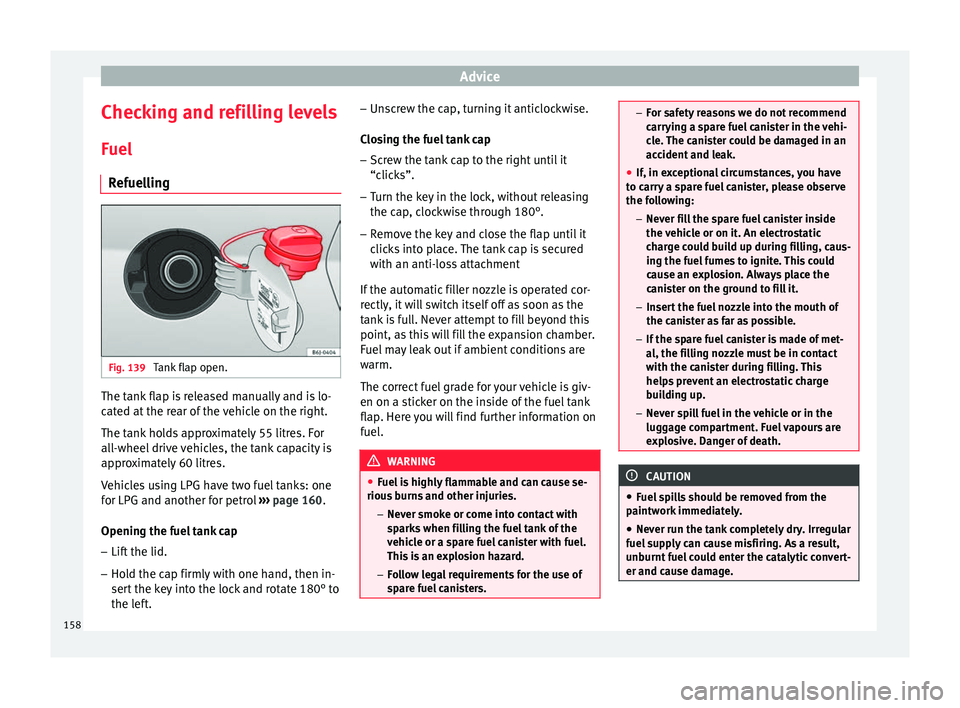
Fuel Refuelling Fig. 139
Tank flap open. The tank flap is released manually and is lo-
cated at the rear of the vehicle on the right.
The tank holds approximately 55 litres. For
all-wheel drive vehicles, the tank capacity is
approximately 60 litres.
Vehicles using LPG have two fuel tanks: one
for LPG and another for petrol
››› page 160.
Opening the fuel tank cap
– Lift the lid.
– Hold the cap firmly with one hand, then in-
sert the key into the lock and rotate 180° to
the left. –
Unscrew the cap, turning it anticlockwise.
Closing the fuel tank cap
– Screw the tank cap to the right until it
“clicks”.
– Turn the key in the lock, without releasing
the cap, clockwise through 180°.
– Remove the key and close the flap until it
clicks into place. The tank cap is secured
with an anti-loss attachment
If the automatic filler nozzle is operated cor-
rectly, it will switch itself off as soon as the
tank is full. Never attempt to fill beyond this
point, as this will fill the expansion chamber.
Fuel may leak out if ambient conditions are
warm.
The correct fuel grade for your vehicle is giv-
en on a sticker on the inside of the fuel tank
flap. Here you will find further information on
fuel. WARNING
● Fuel is highly flammable and can cause se-
rious burns and other injuries.
–Never smoke or come into contact with
sparks when filling the fuel tank of the
vehicle or a spare fuel canister with fuel.
This is an explosion hazard.
– Follow legal requirements for the use of
spare fuel canisters. –
For safety reasons we do not recommend
carrying a spare fuel canister in the vehi-
cle. The canister could be damaged in an
accident and leak.
● If, in exceptional circumstances, you have
to carry a spare fuel canister, please observe
the following:
–Never fill the spare fuel canister inside
the vehicle or on it. An electrostatic
charge could build up during filling, caus-
ing the fuel fumes to ignite. This could
cause an explosion. Always place the
canister on the ground to fill it.
– Insert the fuel nozzle into the mouth of
the canister as far as possible.
– If the spare fuel canister is made of met-
al, the filling nozzle must be in contact
with the canister during filling. This
helps prevent an electrostatic charge
building up.
– Never spill fuel in the vehicle or in the
luggage compartment. Fuel vapours are
explosive. Danger of death. CAUTION
● Fuel spills should be removed from the
paintwork immediately.
● Never run the tank completely dry. Irregular
fuel supply can cause misfiring. As a result,
unburnt fuel could enter the catalytic convert-
er and cause damage. 158
Page 167 of 236
Checking and refilling levels
For the sake of the environment
Service fluids leaks are harmful to the envi-
ronment. For this reason you should make
regular checks on the ground underneath
your vehicle. If you find spots of oil or other
fluids, have your vehicle inspected in a speci-
alised workshop. Opening the bonnet
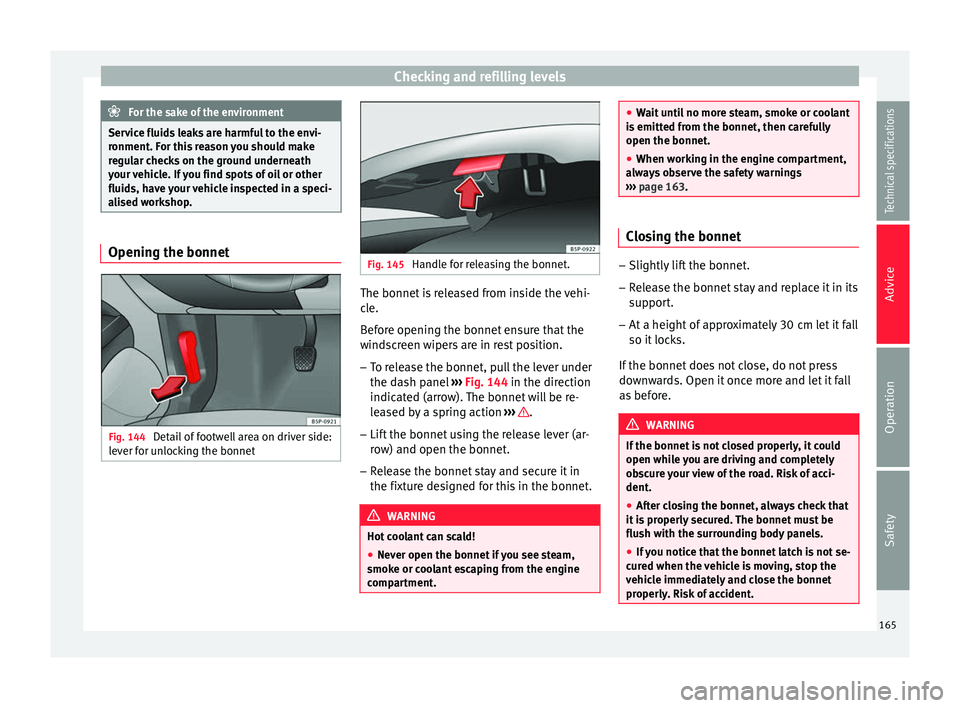
Fig. 144
Detail of footwell area on driver side:
lever for unlocking the bonnet Fig. 145
Handle for releasing the bonnet. The bonnet is released from inside the vehi-
cle.
Before opening the bonnet ensure that the
windscreen wipers are in rest position.
– To release the bonnet, pull the lever under
the dash panel ››› Fig. 144 in the direction
indic at
ed (arrow). The bonnet will be re-
leased by a spring action ››› .
– Lift the bonnet using the release lever (ar-
row) and open the bonnet.
– Release the bonnet stay and secure it in
the fixture designed for this in the bonnet. WARNING
Hot coolant can scald!
● Never open the bonnet if you see steam,
smoke or coolant escaping from the engine
compartment. ●
Wait until no more steam, smoke or coolant
is emitted from the bonnet, then carefully
open the bonnet.
● When working in the engine compartment,
always observe the safety warnings
››› page 163. Closing the bonnet
–
Slightly lift the bonnet.
– Release the bonnet stay and replace it in its
support.
– At a height of approximately 30 cm let it fall
so it locks.
If the bonnet does not close, do not press
downwards. Open it once more and let it fall
as before. WARNING
If the bonnet is not closed properly, it could
open while you are driving and completely
obscure your view of the road. Risk of acci-
dent.
● After closing the bonnet, always check that
it is properly secured. The bonnet must be
flush with the surrounding body panels.
● If you notice that the bonnet latch is not se-
cured when the vehicle is moving, stop the
vehicle immediately and close the bonnet
properly. Risk of accident. 165
Technical specifications
Advice
Operation
Safety
Page 182 of 236
Advice
For the sake of the environment
Old tyres must be disposed of according to
the laws in the country concerned. Note
● For technical reasons, it is not generally
possible to use the wheels from other vehi-
cles. This can also apply to wheels of the
same model. The use of wheels or tyres
which have not been approved by SEAT for
use with your model may invalidate the vehi-
cle's type approval for use on public roads.
● If the spare tyre is not the same as the
tyres that are mounted on the vehicle (e.g.
winter tyres) you should only use the spare
tyre for a short period of time and drive with
extra care. Refit the normal road wheel as
soon as possible. Wheel bolts
The design of wheel bolts is matched to the
rims. If different wheel rims are fitted, the
correct wheel bolts with the right length and
correctly shaped bolt heads must be used.
This ensures that wheels are fitted securely
and that the brake system functions correctly.
In certain circumstances, you should not use
wheel bolts from a different vehicle, even if it
is the same model
›››
page 147. After the wheels have been changed, the
tightening torque of the wheel bolts should
be checked as soon as possible with a torque
wrench
››› . The tightening torque for steel
and alloy wheels is 120 Nm. WARNING
If the wheel bolts are not tightened correctly,
the wheel could become loose while driving.
Risk of accident.
● The wheel bolts must be clean and turn
easily. Never apply grease or oil to them.
● Use only wheel bolts which belong to the
wheel.
● If the tightening torque of the wheel bolts
is too low, they could loosen whilst the vehi-
cle is in motion. Risk of accident! If the tight-
ening torque is too high, the wheel bolts and
threads can be damaged. CAUTION
The prescribed tightening torque for wheel
bolts for steel and alloy wheels is 120 Nm. Winter service
Winter tyres In winter conditions winter tyres will consid-
erably improve the vehicle's handling. Sum-mer tyres (width, rubber compound, tread
pattern) provide less grip on ice and snow.
Winter tyres must be inflated to a
pressure of
0.2 bar (2.9 psi/20 kPa) higher than the pres-
sures specified for summer tyres (see sticker
on fuel tank flap).
Winter tyres must be fitted on all four wheels.
Information on permitted winter tyre sizes
can be found in the vehicle's registration
documentation. Use only radial winter tyres.
All tyre sizes listed in the vehicle documenta-
tion also apply to winter tyres.
Winter tyres lose their effectiveness when the
tread is worn down to a depth of 4 mm.
The speed rating code ››› page 179, New
tyres and wheels determines the following
speed limits for winter tyres:
›
› › max. 160 km/h
max. 180 km/h
max. 190 km/h
max. 210 km/h
In some countries, vehicles which can exceed
the speed rating of the fitted tyre must have
an appropriate sticker in the driver's field of
view. These stickers are available from your
technical service. The legal requirements of
each country must be followed.
Do not have winter tyres fitted for unnecessa-
rily long periods. Vehicles with summer tyres Q
S
T
H
180