brake pads Seat Arona 2017 Owner's Manual
[x] Cancel search | Manufacturer: SEAT, Model Year: 2017, Model line: Arona, Model: Seat Arona 2017Pages: 308, PDF Size: 6.66 MB
Page 47 of 308
The essentials
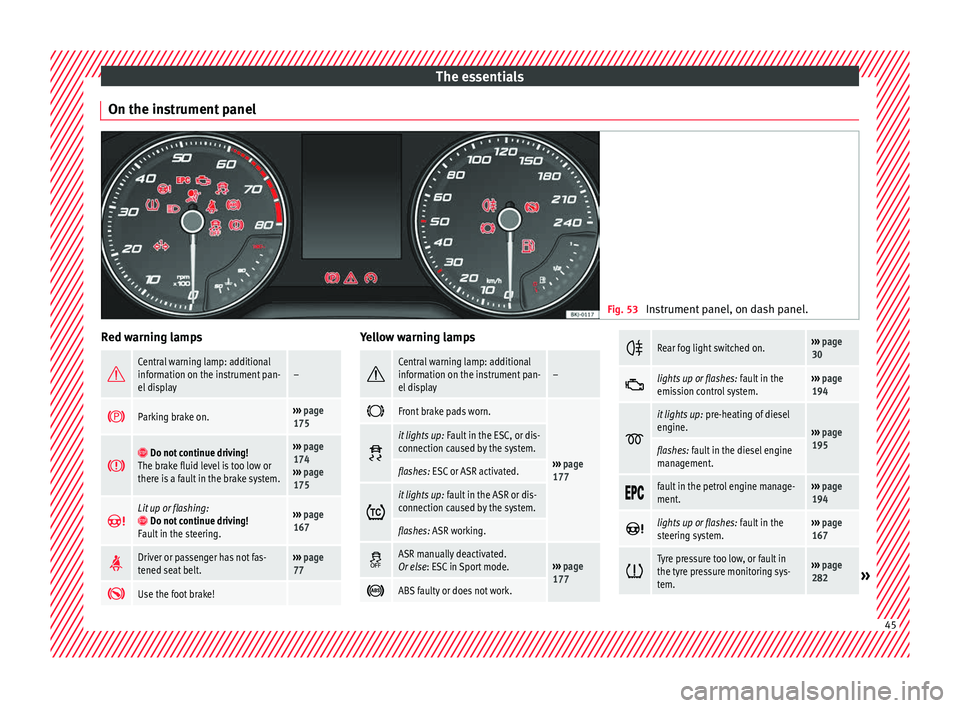
On the instrument panel Fig. 53
Instrument panel, on dash panel. Red warning lamps
Central warning lamp: additional
information on the instrument pan-
el display–
Parking brake on.›››
page
175
Do not continue driving!
The brake fluid level is too low or
there is a fault in the brake system.››› page
174
››› page
175
Lit up or flashing: Do not continue driving!
Fault in the steering.››› page
167
Driver or passenger has not fas-
tened seat belt.›››
page
77
Use the foot brake! Yellow warning lamps
Central warning lamp: additional
information on the instrument pan-
el display–
Front brake pads worn.
›››
page
177
it lights up:
Fault in the ESC, or dis-
connection caused by the system.
flashes: ESC or ASR activated.
it lights up:
fault in the ASR or dis-
connection caused by the system.
flashes: ASR working.
ASR manually deactivated.
Or else
: ESC in Sport mode.››› page
177
ABS faulty or does not work.
Rear fog light switched on.›››
page
30
lights up or flashes:
fault in the
emission control system.››› page
194
it lights up:
pre-heating of diesel
engine.
››› page
195
flashes: fault in the diesel engine
management.
fault in the petrol engine manage-
ment.›››
page
194
lights up or flashes:
fault in the
steering system.››› page
167
Tyre pressure too low, or fault in
the tyre pressure monitoring sys-
tem.›››
page
282» 45
Page 177 of 308
Driving
a great extent on the conditions under which
the v
ehic
le is operated and the way the vehi-
cle is driven. If you often drive in town, drive
short distances or have a sporty driving style,
we recommend that you have the thickness
of your brake pads checked by technical serv-
ices more frequently than recommended in
the Maintenance Programme.
If you drive with wet brakes, for example, af-
ter crossing areas of water, on days of heavy
rainfall or even after washing the car, the ef-
fect of the brakes is reduced as the brake
discs are wet or even frozen (in winter): in
this case, the brakes should be “dried” by
pressing the brake pedal several times. WARNING
Longer braking distances and faults in the
brak e sy
stem increase the risk of accidents.
● New brake pads must be run in and do not
have the c
orrect friction during the first
200 km. This reduced braking capacity may
be compensated for by pressing on the brake
pedal a little harder, which also applies when
the brake pads have to be changed further
on.
● If brakes are wet or frozen, or if you are
driving on r
oads which have been salted,
braking power may be lower than normal.
● On steep slopes, if brakes are excessively
used, they w
ill overheat. Before driving down
a long steep slope, it is advisable to reduce
speed and change down into a lower gear or range (depending on the type of transmis-
sion).
Thu
s, make use of engine braking and
relieve the brakes.
● Never let the brakes “drag” by applying
light pre
ssure. Continuous braking will cause
the brakes to overheat and the braking dis-
tance will increase. Apply and then release
the brakes alternately.
● Never let the vehicle run with the engine
switc
hed off. The braking distance is in-
creased considerably when the brake servo is
not active.
● If the brake fluid loses its viscosity and is
subj
ected to heavy use, vapour bubbles can
form in the brake system. This reduces the ef-
ficiency of the brakes.
● Non-standard or damaged front spoilers
coul
d restrict the airflow to the brakes and
cause them to overheat. Before purchasing
accessories please observe the relevant in-
structions ››› page 255, Modifications.
● If a brake system circuit fails, the braking
dist
ance will be increased considerably. Con-
tact a specialised workshop immediately and
avoid unnecessary journeys. Control lamp
Situations in which the warning lamp lights
up *
●
the brake fluid level is too low
› ›
›
page 275. ●
there is
a fault in the brake system.
This warning lamp can light up together with
the ABS system warning lamp. WARNING
● If the br ak
e warning lamp does not go out
or if it lights up when driving, the brake fluid
level in the reservoir is too low so there is a
risk of an accident ››› page 275, Brake fluid.
Stop the vehicle and do not drive on. Obtain
technical assistance.
● If the brake warning lamp lights up to-
gether w
ith the ABS lamp this could be
due to an ABS fault. This could cause the rear
wheels to lock quickly when you brake. This
could cause the rear to break away. Risk of
skidding. Stop the vehicle and seek technical
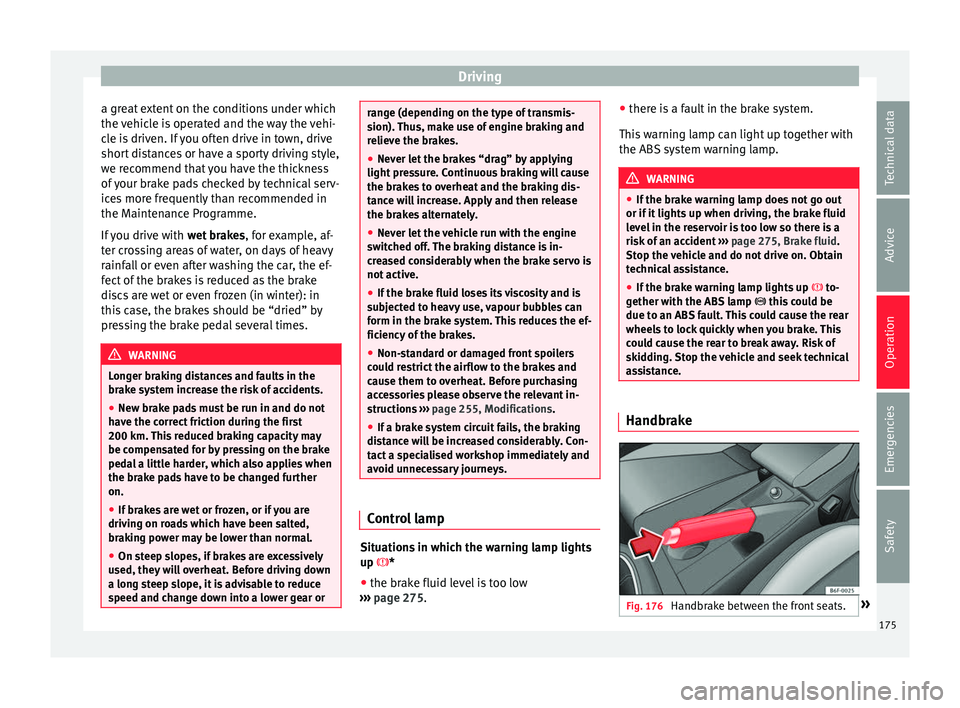
assistance. Handbrake
Fig. 176
Handbrake between the front seats. » 175
Technical data
Advice
Operation
Emergencies
Safety
Page 193 of 308
Driving
Run-in and economical driving R u
nnin
g in a new engine The engine needs to be run-in over the first
1500 km (900 mil
e
s).
For the first 1,000 kilometres (600 miles)
– Do not drive at speeds of more than 2/3
the maximum s
peed.
– Do not accelerate hard.
– Avoid high engine revolutions.
– Do not tow a trailer.
From 1,000 k i
lometres (600 miles) to 1,500
kilometres (900 miles)
– Speeds can be gradual
ly increased to the
maximum road speed or maximum permis-
sible engine speed (rpm).
During its first few hours of running, the in-
ternal friction in the engine is greater than
later on, when all the moving parts have bed-
ded in. For the sake of the environment
If the engine is run in gently, its life will be in-
cr e
ased and its oil consumption reduced. Tyre and brake pad run-in
New tyres should be run in carefully for the
firs
t
500 km (300 miles) and new brake pads
should be run in carefully for the first 200 km
(125 miles).
During the first 200 km (125 miles) you have
to compensate for the reduced braking effect
by applying more pressure to the brake ped-
al. In case of a sharp braking, the braking
distance will be longer with new brake pads
than with brake pads which have been run-
in. WARNING
● At fir s
t, new tyres do not give maximum
grip, and require running-in. This may cause
an accident. Drive particularly carefully in the
first 500 km (300 miles).
● New brake pads must be “run in” and do
not hav
e the correct friction properties during
the first 200 km (125 miles). However, the re-
duced braking capacity may be compensated
by pressing on the brake pedal a little harder. Environmental compatibility
Environmental protection is a top priority in
the de
s
ign, c
hoice of materials and manufac-
ture of your new SEAT. Constructive measures to encourage recy-
cling
● Joints
and connections designed for easy
dismantlin
g.
● Modular construction to facilitate disman-
tling.
● Incr
eased use of single-grade materials.
● Plastic parts and elastomers are marked in
accor
dance with ISO 1043, ISO 11469 and
ISO 1629.
Choice of materials
● Use of recycled materials.
● Use of compatible plastics in the same part
if its c
omponents are not easily separated.
● Use of recycled materials and/or materials
originating fr
om renewable sources.
● Reduction of volatile components, includ-
ing odour, in p
lastic materials.
● Use of CFC-free coolants.
Ban on heavy
metals, with the exceptions
dictated by law (Annex II of ELV Directive
2000/53/EC): cadmium, lead, mercury, hexa-
valent chromium.
Manufacturing methods
● Reduction of the quantity of thinner in the
protectiv
e wax for cavities.
● Use of plastic film as protection during ve-
hicle tr
ansport. »
191
Technical data
Advice
Operation
Emergencies
Safety
Page 197 of 308
Driving
Engine pre-heating/fault system* The warning lamp lights up to show that the
glow p
lug
s are preheating the diesel engine.
The control lamp lights up
If the control lamp lights up when the en-
gine is started it means that the glow plugs
are preheating. The engine can be started
straight away when the lamp switches off.
Control lamp flashes
If a fault develops in the engine management
system while you are driving, the glow plug
system lamp will flash . Take the vehicle to
a specialised workshop as soon as possible
and have the engine checked.
Driving tips Drivin g abr
oadTo drive abroad, the following must be taken
int
o c
on
sideration:
● For vehicles fitted with a catalytic converter
ensur
e that unleaded petrol is available for
the journey. See the chapter “Refuelling”. Au-
tomobile organisations will have information
about service station networks selling unlea-
ded fuel. ●
In some countrie
s, it is possible that your
car model is not sold, and therefore some
spare parts are not available or the technical
services may only be able to carry out limited
repairs.
SEAT importers and distributors will gladly
provide information about the technical prep-
aration that your vehicle requires and also
about necessary maintenance and repair
possibilities.
Adhesive strips for headlights
In countries where vehicles drive on the other
side of the road to your home country, the
asymmetric dipped beam may dazzle drivers
of oncoming vehicles.
To prevent dazzling, you must apply stickers
to certain parts of the headlight lenses. Fur-
ther information is available at any Technical
Service.
Driving on flooded roads To prevent damage to the vehicle when driv-
in
g thr
ough w
ater, for example, along a floo-
ded road, please observe the following:
● The water should never come above the
lower edg
e of the bodywork.
● Drive at pedestrian speed. WARNING
After driving through water, mud, sludge,
etc ., the br
aking effect can be delayed slight-
ly due to moisture build-up on the discs and
brake pads. Applying the brakes carefully
several times will remove the moisture and
restore the full braking effect. CAUTION
● Drivin g thr
ough flooded areas may severely
damage vehicle components such as the en-
gine, transmission, running gear or electrical
system.
● Whenever driving through water, the Start-
Stop sys
tem* must be switched off
››› page 196. Note
● Check the depth of
the water before enter-
ing the flooded zone.
● Do not stop in the water, drive in reverse, or
stop the en
gine in any situation.
● Note that vehicles travelling in the opposite
direction ma
y splash water that could exceed
the maximum permitted water height for your
vehicle.
● Avoid driving through salt water (corro-
sion). 195
Technical data
Advice
Operation
Emergencies
Safety
Page 259 of 308
Care and maintenance
WARNING
● Car -c
are products can be toxic. Because of
this, they must always be kept closed in their
original container. Keep them out of the reach
of children. Failure to comply could result in
poisoning.
● Always read and observe the instructions
and warning
s on the package before using
car-care products. Improper use could cause
health problems or damage the vehicle. The
use of certain products may produce noxious
vapours; they should be used in well ventila-
ted areas.
● Never use fuel, turpentine, engine oil, nail
varnish r
emover or other volatile fluids.
These are toxic and highly flammable. Risk of
fire and explosion.
● Before washing your vehicle, or carrying
out any
maintenance, switch the engine off,
apply the handbrake firmly and remove the
key from the ignition. CAUTION
Never attempt to remove dirt, mud or dust if
the sur f
ace of the vehicle is dry. Never use a
dry cloth or sponge for cleaning purposes.
This could damage the paintwork or the win-
dows of your vehicle. Soak dirt, mud or dust
with plenty of water. For the sake of the environment
● When pur c
hasing car care products, try to
select ones that are not harmful to the envi-
ronment.
● The waste from car-care products should
not be dis
posed of with ordinary household
waste. Observe the disposal information on
the package. Care of the vehicle exterior
Autom atic
car wash tunnel The vehicle paintwork is so durable that the
v
ehic
l
e can normally be washed without
problems in an automatic car wash tunnel.
However, the paintwork wear depends to a
large extent on the kind of the car wash tun-
nel, the brushes used, its water filtering and
the type of cleaning and preservative prod-
ucts.
Before going through a car wash, be sure to
take the usual precautions such as closing
the windows. There is nothing to note apart
from that.
If the vehicle has special accessories such as
spoilers or a roof rack or two-way radio aerial,
etc., it is advisable to consult the car wash
tunnel operator first. After washing, the brake
s could take some
time to respond as the brake discs and pads
could be wet, or even frozen in winter. “Dry”
the brakes by braking several times. WARNING
Water, ice and salt on the brake system can
reduc e br
aking effectiveness. Risk of acci-
dent. Hand-washing
Vehicle washing
– First soften the dirt and rinse it off with wa-
ter
.
– C
lean your vehicle from top to bottom with
a soft s
ponge, a glove or a brush. Use very
light pressure.
– Rinse the sponge or glove often with clean
water
.
– Special car shampoo should only be used
for v
ery stubborn dirt.
– Leave the wheels, sill panels etc. until last,
usin
g a different sponge or glove.
– Rinse the vehicle thoroughly with water.
– Dry the vehicle surface gently with a cha-
mois l
eather.
– In cold temperature, dry the rubber seals
and their sur
faces to prevent them from »
257
Technical data
Advice
Operation
Emergencies
Safety
Page 277 of 308
Checking and refilling levels
CAUTION
The original additives should never be mixed
with c oo
lants which are not approved by
SEAT. Otherwise, you run the risk of causing
severe damage to the engine and the engine
cooling system.
● If the fluid in the expansion tank is not pur-
ple b
ut is, for example, brown, this indicates
that the G13 additive has been mixed with an
inadequate coolant. The coolant must be
changed as soon as possible if this is the
case! This could result in serious faults and
engine damage. For the sake of the environment
Coolants and additives can contaminate the
env ir
onment. If any fluids are spilled, they
should be collected and correctly disposed
of, with respect to the environment. Brake fluid
Chec k
in
g the brake fluid levelRead the additional information carefully
› ›
›
page 57
The position of the brake fluid reservoir is
shown in the corresponding engine compart-
ment image ›››
page 270. The brake fluid res-
ervoir has a black and yellow cap. The brake fluid level drops slightly when the
vehicl
e is being used as the brake pads are
automatically adjusted as they wear.
However, if the level goes down noticeably in
a short time, or drops below the “MIN” mark,
there may be a leak in the brake system. A
display on the instrument panel will warn you
if the brake fluid level is too low ››› page 117. WARNING
Before opening the bonnet to check the brake
fluid lev el, r
ead and observe the warnings
››› page 267. Changing the brake fluid
The Maintenance Programme indicates brake
fluid c
h
an
ge intervals.
We recommend that you have the brake fluid
changed by a Technical Service.
Before opening the bonnet, please read and
follow the warnings ››› in safety notes for
w ork
in the en
gine compartment on
page 267 in section “Safety notes for work-
ing in the engine compartment”.
In the course of time, brake fluid becomes
hygroscopic and absorbs water from the am-
bient air. If the water content in the brake flu-
id is too high, the brake system could cor-
rode. This also considerably reduces the boil-
ing point of the brake fluid. Heavy use of the brakes may then cause a vapour lock which
coul
d impair the braking effect.
Be sure to always use the correct brake fluid.
Only use brake fluid that expressly meets the
VW 501 14 standard.
You can buy VW 501 14 standard brake fluid
in a SEAT dealership or a SEAT Official Serv-
ice. If none is available, use only high-quality
brake fluid that meets DIN ISO 4925 CLASS 4
standards, or USA Standards FMVSS 116 DOT
4.
Using any other kind of brake fluid or one
that is not of a high quality may affect opera-
tion of the brake system and reduce its effec-
tiveness. Never use a brake fluid if the con-
tainer does not state that it complies with VW
501 14, DIN ISO 4925 CLASS 4 standards, or
USA standards FMVSS 116 DOT 4. WARNING
Brake fluid is poisonous. Old brake fluid im-
pair s
the braking effect.
● Before opening the bonnet to check the
brake fluid l
evel, read and observe the warn-
ings ››› page 267.
● Brake fluid should be stored in the closed
original
container in a safe place out of reach
of children. There is a toxic risk.
● Perform the brake fluid change according to
the Mainten
ance Programme. Heavy use of
the brakes may cause a vapour lock if the
brake fluid is left in the brake system for too » 275
Technical data
Advice
Operation
Emergencies
Safety
Page 278 of 308
Advice
long. This would seriously affect the effec-
tivene
s
s of the brakes and the safety of the
vehicle. This may cause an accident. CAUTION
Brake fluid damages the vehicle paintwork.
W ipe off an
y brake fluid from the paintwork
immediately. For the sake of the environment
The brake pads and brake fluid must be col-
lect ed and di
sposed of according the applica-
ble regulations. The SEAT Technical Service
network has the necessary equipment and
qualified personnel for collecting and dispos-
ing of this waste material. Windscreen washer reservoir
Chec k
in
g and topping up the wind-
screen washer reservoir water Read the additional information carefully
› ›
›
page 57
The windscreen washer is supplied with liq-
uid from the windscreen washer reservoir in
the engine compartment. It has a capacity of
approximately 3 litres.
The tank is in the engine compartment. Plain water is not enough to clean the wind-
scr
een and headlights. We recommend that
you always add a product to the windscreen
washer fluid. Approved windscreen cleaning
products exist on the market with high deter-
gent and anti-freeze properties, these may be
added all-year-round. Please follow the dilu-
tion instructions on the packaging. WARNING
Any work carried out in the engine compart-
ment or on the en gine mu
st be carried out
cautiously.
● When working in the engine compartment,
alwa
ys observe the safety warnings
››› page 267. CAUTION
● Never p ut
radiator anti-freeze or other addi-
tives into the windscreen washer fluid.
● Always use approved windscreen cleansing
products
diluted as per instructions. If you
use other washer fluids or soap solutions,
the tiny holes in the fan-shaped nozzles
could become blocked. Vehicle battery
S ymbo
l
s and warnings on handling
the battery Read the additional information carefully
›› ›
page 57
Wear eye protection
Battery acid is extremely corrosive. Wear protec-
tive gloves and eye protection!
Fires, sparks, open flames and smoking are pro-
hibited!
A highly explosive mixture of gases is released
when the battery is under charge.
Keep children away from acid and batteries!
WARNING
Always be aware of the danger of injury and
chemic a
l burns as well as the risk of accident
or fire when working on the battery and the
electrical system:
● Wear eye protection. Protect your eyes,
skin and clothin
g from acid and particles con-
taining lead.
● Battery acid is extremely corrosive. Wear
protectiv
e gloves and eye protection. Do not
tilt the batteries. This could spill acid through
the vents.
● Rinse battery acid from eyes immediately
for sever
al minutes with clear water. Then276
Page 296 of 308
Index
B
B ac
k
seat
folding down and raising the back seat back- rest . . . . . . . . . . . . . . . . . . . . . . . . . . . . . . . . . 149
Battery . . . . . . . . . . . . . . . . . . . . . . . . . . . . . . . . . . 125
Before setting off . . . . . . . . . . . . . . . . . . . . . . . . . . 71
Belt pretensioners . . . . . . . . . . . . . . . . . . . . . . . . . 81
Biodiesel . . . . . . . . . . . . . . . . . . . . . . . . . . . . . . . . 266
Blind spot detector (BSD) . . . . . . . . . . . . . . . . . . 220 control lamps . . . . . . . . . . . . . . . . . . . . . . . . . . 220
driving situations . . . . . . . . . . . . . . . . . . . . . . . 223
indication in the external rear view mirror . . . 221
malfunction . . . . . . . . . . . . . . . . . . . . . . . . . . . . 220
operating . . . . . . . . . . . . . . . . . . . . . . . . . . . . . . 221
towing . . . . . . . . . . . . . . . . . . . . . . . . . . . . . . . . 225
Bonnet . . . . . . . . . . . . . . . . . . . . . . . . . 17, 267, 270 closing . . . . . . . . . . . . . . . . . . . . . . . . . . . . . . . . 269
opening . . . . . . . . . . . . . . . . . . . . . . . . . . . . . . . 268
Boot hatch . . . . . . . . . . . . . . . . . . . . . . . . . . . . . . 135
Boot lid . . . . . . . . . . . . . . . . . . . . . . . . . . . . . . . . . 135
Brake assist . . . . . . . . . . . . . . . . . . . . . . . . . . . . . 177
Brake fluid . . . . . . . . . . . . . . . . . . . . . . . . . . 57, 275 changing . . . . . . . . . . . . . . . . . . . . . . . . . . . . . . 275
Brake pads . . . . . . . . . . . . . . . . . . . . . . . . . 174, 191
Brakes brake fluid . . . . . . . . . . . . . . . . . . . . . . . . . . . . . 275
new brake pads . . . . . . . . . . . . . . . . . . . . . . . . 174
warning lamp . . . . . . . . . . . . . . . . . . . . . . . . . . 175
Brake servo . . . . . . . . . . . . . . . . . . . . . . . . . 174, 182
Brake system . . . . . . . . . . . . . . . . . . . . . . . . . . . . 275
Braking brake assist . . . . . . . . . . . . . . . . . . . . . . . . . . . . 177
Braking distance . . . . . . . . . . . . . . . . . . . . . . . . . 174
BSD see Blind spot detector (BSD) . . . . . . . . . . . . . 220
Bulbs changing the bulbs . . . . . . . . . . . . . . . . . . . . . 102 Buzzer . . . . . . . . . . . . . . . . . . . . . . . . . . . . . . . . . . 139
C Capac
ities . . . . . . . . . . . . . . . . . . . . . . . . . . . . . . . . 54
fuel tank . . . . . . . . . . . . . . . . . . . . . . . . . . . . . . 117
Car care exterior . . . . . . . . . . . . . . . . . . . . . . . . . . . . . . . 257
Catalytic converter . . . . . . . . . . . . . . . . . . . . . . . . 193 malfunction . . . . . . . . . . . . . . . . . . . . . . . . . . . . 193
CCS . . . . . . . . . . . . . . . . . . . . . . . . . . . . . . . . . . . . . 42
Central locking system . . . . . . . . . . . . . . . . . . . . . 126 anti-theft alarm . . . . . . . . . . . . . . . . . . . . . . . . . 132
automatic speed-dependent locking . . . . . . . 128
central locking button . . . . . . . . . . . . . . . . . . . 128
electric windows . . . . . . . . . . . . . . . . . . . . . . . . 136
emergency locking . . . . . . . . . . . . . . . . . . . . . . . 16
key by remote control . . . . . . . . . . . . . . . . . . . . 124
Keyless Access . . . . . . . . . . . . . . . . . . . . . . . . . 129
safe security system . . . . . . . . . . . . . . . . . . . . . 126
selective unlocking system . . . . . . . . . . . . . . . 127
self-locking system to prevent involuntary un-locking . . . . . . . . . . . . . . . . . . . . . . . . . . . . . . 128
unlocking system . . . . . . . . . . . . . . . . . . . . . . . 128
Central wheel trim . . . . . . . . . . . . . . . . . . . . . . 61, 62
Centre console . . . . . . . . . . . . . . . . . . . . . . . . . . . . 11
Cetane number (diesel fuel) . . . . . . . . . . . . . . . . 266
Changing a bulb additional brake light . . . . . . . . . . . . . . . . . . . . 107
dipped beam . . . . . . . . . . . . . . . . . . . . . . . . . . 104
DRL (daytime running light) . . . . . . . . . . . . . . . 104
fog light . . . . . . . . . . . . . . . . . . . . . . . . . . . . . . . 105
general notes . . . . . . . . . . . . . . . . . . . . . . . . . . 102
interior light and reading light . . . . . . . . . . . . 107
luggage compartment light . . . . . . . . . . . . . . . 108
main beam headlight . . . . . . . . . . . . . . . . . . . . 103
number plate light . . . . . . . . . . . . . . . . . . . . . . 106
rear bulb in the side panel . . . . . . . . . . . . . . . . 105 rear light in the rear lid . . . . . . . . . . . . . . . . . . . 106
turn sign
al light . . . . . . . . . . . . . . . . . . . . . . . . 104
Changing a wheel . . . . . . . . . . . . . . . . . . . . . . . . . 61 subsequent work . . . . . . . . . . . . . . . . . . . . . . . . 65
wheel bolts . . . . . . . . . . . . . . . . . . . . . . . . . . . . . 63
Changing settings CAR menu . . . . . . . . . . . . . . . . . . . . . . . . . . . . . . 33
Changing the blades . . . . . . . . . . . . . . . . . . . . . . . 96
Charging the battery . . . . . . . . . . . . . . . . . . . . . . . 67
Checking levels engine compartment . . . . . . . . . . . . . . . . . . . . 270
Child-proof locking electric windows . . . . . . . . . . . . . . . . . . . . . . . . 135
Child seats . . . . . . . . . . . . . . . . . . . . . . . . . . . . 23, 89 categorisation in groups . . . . . . . . . . . . . . . . . . 90
ISOFIX system . . . . . . . . . . . . . . . . . . . . . . . . . . . 26
safety instructions . . . . . . . . . . . . . . . . . . . . 23, 88
securing with seat belt . . . . . . . . . . . . . . . . . . . . 24
Top Tether system . . . . . . . . . . . . . . . . . . . . . 26, 29
Chrome parts cleaning . . . . . . . . . . . . . . . . . . . . . . . . . . . . . . 260
Cigarette lighter . . . . . . . . . . . . . . . . . . . . . . . . . . 152
City Emergency braking function . . . . . . . . . . . . . 207
Cleaning . . . . . . . . . . . . . . . . . . . . . . . . . . . . . . . . 256 adhesive sheets . . . . . . . . . . . . . . . . . . . . . . . . 258
alcantara . . . . . . . . . . . . . . . . . . . . . . . . . . . . . . 264
alloy wheel rims . . . . . . . . . . . . . . . . . . . . . . . . 261
chrome parts . . . . . . . . . . . . . . . . . . . . . . . . . . . 260
Easy Connect control panel . . . . . . . . . . . . . . . 262
engine compartment . . . . . . . . . . . . . . . . . . . . 261
fabrics . . . . . . . . . . . . . . . . . . . . . . . . . . . . . . . . 262
high pressure cleaners . . . . . . . . . . . . . . . . . . . 258
leather . . . . . . . . . . . . . . . . . . . . . . . . . . . . . . . . 263
plastic parts . . . . . . . . . . . . . . . . . . . . . . 259, 262
radio display . . . . . . . . . . . . . . . . . . . . . . . . . . . 262
rubber seals . . . . . . . . . . . . . . . . . . . . . . . . . . . 260
seat belts . . . . . . . . . . . . . . . . . . . . . . . . . . . . . 264
294
Page 303 of 308
Index
Rear window wiper blade ch
an
ging . . . . . . . . . . . . . . . . . . . . . . . . . . . . . . . 70
cleaning . . . . . . . . . . . . . . . . . . . . . . . . . . . . . . . 70
Refuelling . . . . . . . . . . . . . . . . . . . . . . . . . . . . . . . 265 opening fuel tank flap . . . . . . . . . . . . . . . . . . . 265
Remote control . . . . . . . . . . . . . . . . . . . . . . . . . . . 124
Removing and attaching head restraints . . . . . . 147
Repair work . . . . . . . . . . . . . . . . . . . . . . . . . . . . . . 255
Replacement parts . . . . . . . . . . . . . . . . . . . . . . . . . . . . . . . . . 255
Replacement keys . . . . . . . . . . . . . . . . . . . . . . . . 124
Replacement parts . . . . . . . . . . . . . . . . . . . . . . . . 255
Replacing the battery of the vehicle key . . . . . . . . . . . . . . . . . . . . . . . 125
Reset the trip recorder . . . . . . . . . . . . . . . . . . . . . 116
Rev counter . . . . . . . . . . . . . . . . . . . . . . . . . 113, 115
Reverse gear (automatic gearbox) . . . . . . . . . . . 183
Rims changing a wheel . . . . . . . . . . . . . . . . . . . . . . . . 61
Roll-back function windows . . . . . . . . . . . . . . . . . . . . . . . . . . . . . . 136
Roof carrier . . . . . . . . . . . . . . . . . . . . . . . . . . . . . . 156
Roof carrier system . . . . . . . . . . . . . . . . . . . . . . . . 156
Roof load . . . . . . . . . . . . . . . . . . . . . . . . . . . . . . . . 157 technical data . . . . . . . . . . . . . . . . . . . . . . . . . . 157
Roof luggage rack attach the cross bars . . . . . . . . . . . . . . . . . . . . 156
Roof rack . . . . . . . . . . . . . . . . . . . . . . . . . . . . . . . . 156
Rubber seals care . . . . . . . . . . . . . . . . . . . . . . . . . . . . . . . . . . 260
Run-in brake pads . . . . . . . . . . . . . . . . . . . . . . . . . . . . 191
engine . . . . . . . . . . . . . . . . . . . . . . . . . . . . . . . . 191
tyres . . . . . . . . . . . . . . . . . . . . . . . . . . . . . . . . . . 191
S Safe . . . . . . . . . . . . . . . . . . . . . . . . . . . . . . . . . . . . 127 Safe driving . . . . . . . . . . . . . . . . . . . . . . . . . . . . . . 71
Safe Sec
urity system . . . . . . . . . . . . . . . . . . . . . . 127
Safety . . . . . . . . . . . . . . . . . . . . . . . . . . . . . . . . . . . 71 child safety . . . . . . . . . . . . . . . . . . . . . . . . . . . . . 88
child seats . . . . . . . . . . . . . . . . . . . . . . . . . . . . . . 88
deactivating the front passenger airbag . . . . . . 21
safe driving . . . . . . . . . . . . . . . . . . . . . . . . . . . . . 71
Safety equipment . . . . . . . . . . . . . . . . . . . . . . . . . . 71
Safety instructions coolant temperature . . . . . . . . . . . . . . . . . . . . . 274
front airbags . . . . . . . . . . . . . . . . . . . . . . . . . . . . 84
head-protection airbags . . . . . . . . . . . . . . . . . . 22
seat belt tensioners . . . . . . . . . . . . . . . . . . . . . . 81
side airbags . . . . . . . . . . . . . . . . . . . . . . . . . . . . 85
using child seats . . . . . . . . . . . . . . . . . . . . . 23, 88
using seat belts . . . . . . . . . . . . . . . . . . . . . . . . . 78
Saving fuel inertia mode . . . . . . . . . . . . . . . . . . . . . . . . . . . 189
Saving tips (efficiency programme) . . . . . . . . . . . 40
Seat heating . . . . . . . . . . . . . . . . . . . . . . . . . . . . . . . 148
Seat belt position . . . . . . . . . . . . . . . . . . . . . . . . . . 19 for pregnant women . . . . . . . . . . . . . . . . . . . . . . 19
Seat belts . . . . . . . . . . . . . . . . . . . . . . . . . . . . . . . . 77 adjustment . . . . . . . . . . . . . . . . . . . . . . . . . . 19, 80
control lamp . . . . . . . . . . . . . . . . . . . . . . . . . . . . 77
protective function . . . . . . . . . . . . . . . . . . . . . . . 78
purpose . . . . . . . . . . . . . . . . . . . . . . . . . . . . . 77, 82
safety notes . . . . . . . . . . . . . . . . . . . . . . . . . . . . 78
unfastened . . . . . . . . . . . . . . . . . . . . . . . . . . . . . 79
Seat belt tensioners . . . . . . . . . . . . . . . . . . . . . . . . 20 control lamp . . . . . . . . . . . . . . . . . . . . . . . . . . . . 84
SEAT Drive Profile . . . . . . . . . . . . . . . . . . . . . . . . . 225
Seat heating . . . . . . . . . . . . . . . . . . . . . . . . . . . . . 148
Selective opening . . . . . . . . . . . . . . . . . . . . . . . . 127
Selector lever lock . . . . . . . . . . . . . . . . . . . . . . . . 184 Selector lever (automatic gearbox)
malfu nction . . . . . . . . . . . . . . . . . . . . . . . . . . . . 184
manual release . . . . . . . . . . . . . . . . . . . . . . . . . . 48
positions . . . . . . . . . . . . . . . . . . . . . . . . . . . . . . 183
Service intervals . . . . . . . . . . . . . . . . . . . . . . . . . . . 41
Service notification: read . . . . . . . . . . . . . . . . . . . . 42
Side airbags description . . . . . . . . . . . . . . . . . . . . . . . . . . . . . 22
safety instructions . . . . . . . . . . . . . . . . . . . . . . . 85
Signal lever . . . . . . . . . . . . . . . . . . . . . . . . . . . . . . . 31
Sitting position driver . . . . . . . . . . . . . . . . . . . . . . . . . . . . . . . . . . 72
Snow chains . . . . . . . . . . . . . . . . . . . . . . . . . . . . . . 66
Spanner symbol . . . . . . . . . . . . . . . . . . . . . . . . . . . 41
Spare wheel . . . . . . . . . . . . . . . . . . . . . . . . . . . . . 283
Special characteristics tow-starting . . . . . . . . . . . . . . . . . . . . . . . . . . . . . 97
Speed limiter . . . . . . . . . . . . . . . . . . . . . . . 198, 200 control lamp . . . . . . . . . . . . . . . . . . . . . . . . . . . 200
display message . . . . . . . . . . . . . . . . . . . . . . . . 200
operate . . . . . . . . . . . . . . . . . . . . . . . . . . . . . . . 201
warning lamp . . . . . . . . . . . . . . . . . . . . . . . . . . 200
Speed warning . . . . . . . . . . . . . . . . . . . . . . . . . . . . 40
Speed warning device . . . . . . . . . . . . . . . . . . . . . . 40
Sport Mode . . . . . . . . . . . . . . . . . . . . . . . . . . . . . . 179
Start-Stop . . . . . . . . . . . . . . . . . . . . . . . . . . . . . . . 196
Start-Stop system driver messages . . . . . . . . . . . . . . . . . . . . . . . . 198
lamps . . . . . . . . . . . . . . . . . . . . . . . . . . . . . . . . 196
operation . . . . . . . . . . . . . . . . . . . . . . . . . . . . . . 196
stopping and starting the engine . . . . . . . . . . 196
switching off and on . . . . . . . . . . . . . . . . . . . . . 198
the engine does not switch off . . . . . . . . . . . . 197
the engine starts by itself . . . . . . . . . . . . . . . . 197
Starter button . . . . . . . . . . . . . . . . . . . . . . . . . . . . 171
301