light Seat Ateca 2017 Owner's Manual
[x] Cancel search | Manufacturer: SEAT, Model Year: 2017, Model line: Ateca, Model: Seat Ateca 2017Pages: 328, PDF Size: 6.36 MB
Page 282 of 328
Advice
together with
It lights up red
Unable to start
the engine! There
is a fault in the
AdBlue ®
system.Visit a specialised workshop with-
out switching the ignition off and
on, and have the system checked.
together with
It lights up yellow
The AdBlue
®
system
is malfunctioning or
has been filled with
AdBlue ®
that does
not meet the prescri-
bed standard.
Immediately consult a special-
ised workshop and have the
system checked. Some warning and control lamps will light up
briefly
when the ignition i
s switched on to
check certain functions. They will switch off
after a few seconds. WARNING
Observe the safety warnings ››
› in Warning
and c ontr
ol lamps on page 107. Information on AdBlue
®The consumption of AdBlue
®
depend s
on
your personal driving style, the temperature of the system and on the outdoor tempera-
tur
e when the vehicle is used.
AdBlue ®
freezes at temperatures of -11°C
(+13°F). The system has heating elements
that guarantee its operation even at low tem-
peratures.
The AdBlue ®
tank level capacity is approxi-
mately 12 litres.
The minimum amount to be poured in (as-
suming the tank is empty) is indicated on the
AdBlue ®
sticker located on the floor of the
luggage compartment.
The AdBlue ®
tank should never be empty.
When the distance to empty drops below
2400 km, a warning to refill the AdBlue ®
tank
will appear on the dash panel display
››› page 280. If this information is ignored, it
will later no longer be possible to re-start the
engine ››› in Introduction on page 279. If
thi s
warning does not appear, it is not neces-
sary to refill the AdBlue ®
tank.
AdBlue ®
is a registered brand of the German
Association of the Automotive Industry (VDA)
and is also known as AUS32 or DEF (Diesel
Exhaust Fluid). CAUTION
Filling the AdBlue ®
tank
excessively can
cause damage to the tank.
● SEAT recommends refilling the AdBlue ®
tank
at a specialised workshop. Refilling AdBlue
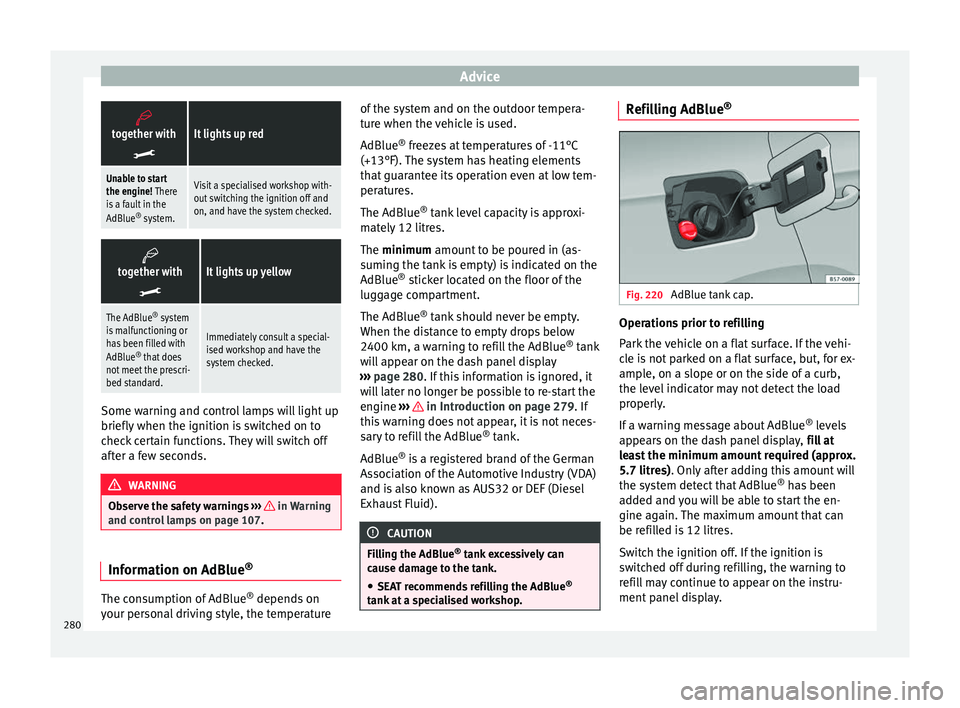
® Fig. 220
AdBlue tank cap. Operations prior to refilling
P
ark
the vehicle on a flat surface. If the vehi-
cle is not parked on a flat surface, but, for ex-
ample, on a slope or on the side of a curb,
the level indicator may not detect the load
properly.
If a warning message about AdBlue ®
levels
appears on the dash panel display, fill at
least the minimum amount required (approx.
5.7 litres). Only after adding this amount will
the system detect that AdBlue ®
has been
added and you will be able to start the en-
gine again. The maximum amount that can
be refilled is 12 litres.
Switch the ignition off. If the ignition is
switched off during refilling, the warning to
refill may continue to appear on the instru-
ment panel display.
280
Page 285 of 328
Checking and refilling levels
WARNING
● Sw it
ch the engine off, remove the key from
the ignition and apply the hand brake. If the
vehicle has a manual gearbox, place the lever
in neutral; if it has an automatic gearbox,
place the selector lever in position P. Wait for
the engine to cool down.
● Keep children away from the engine com-
par
tment.
● Never spill liquids used for vehicle opera-
tion on the engine c
ompartment, as these
may catch fire (e.g. the antifreeze in coolant).
● Take care not to cause short circuits in the
electric
al system, especially when working
on the battery.
● If working inside the engine compartment,
remember th
at, even when the ignition is
switched off, the radiator fan may start up au-
tomatically, and therefore there is a risk of in-
jury.
● Never cover the engine with additional in-
su
lating materials such as a blanket. Risk of
fire!
● Do not unscrew the cap on the coolant ex-
pan
sion tank when the engine is hot. The
cooling system is under pressure.
● Protect face, hands and arms by covering
the cap w
ith a large, thick rag to protect
against escaping coolant and steam.
● If it is necessary to work in the engine com-
par
tment while the engine is running, the ro-
tating components (for example, poly-V belt, alternator, radiator fan) and the high voltage
ignition sy
s
tem are an additional hazard.
● Observe the following additional warnings
if w
ork on the fuel system or the electrical
system is necessary:
– Always disconnect the battery from the
on-board network.
– Do not smoke.
– Never work near naked flames.
– Always keep an approved fire extinguish-
er immediately available. CAUTION
When topping up fluids make sure the correct
fluid i s
put into the correct filler opening, oth-
erwise this can cause serious malfunctions or
engine damage. For the sake of the environment
Inspect the ground underneath your vehicle
r e
gularly so that any leaks are detected at an
early stage. If you find spots of oil or other
fluids in the area where it was parked, have
your vehicle inspected at the workshop. Note
In right-hand drive vehicles* some brake flu-
id r e
servoirs are on the other side of the en-
gine compartment ››› Fig. 221. Opening the bonnet
Read the additional information carefully
› ›
› page 11
The bonnet is released from inside the vehi-
cle.
Check that the windscreen wiper arms are
not unfolded. Otherwise the paint may be
damaged.
The bonnet can only be unlocked when the
driver door is open. WARNING
Never open the bonnet if you see steam or
drip s
of coolant being released from the en-
gine compartment. Failure to comply could
result in burns. Wait until no steam or coolant
can be seen before opening the bonnet. Closing the bonnet
–
Slightly lift the bonnet.
– Release the bonnet stay before pressing it
bac
k into its support.
– Carefully close the bonnet.
– Press the bonnet down until it locks into
pl
ace.
– Make sure that the bonnet catches onto its
cl
asp. Do not press down too hard ››› .
»
283
Technical data
Advice
Operation
Emergencies
Safety
Page 288 of 328
Advice
WARNING
Oil is highly inflammable! Ensure that no oil
c ome
s into contact with hot engine compo-
nents when topping up. CAUTION
If the oil level is above the area A do not
s t
art the engine. This could result in damage
to the engine and catalytic converter. Contact
a specialised workshop. For the sake of the environment
The oil level must never be above area A .
Other w
ise oil can be drawn in through the
crankcase breather and escape into the at-
mosphere via the exhaust system. Note
Before a long trip, we recommend finding an
en gine oi
l that conforms to the correspond-
ing VW specifications and recommend keep-
ing it in the vehicle. This way, the correct en-
gine oil will always be available for a top-up if
needed. Changing engine oil
Read the additional information carefully
› ›
› page 48.
The engine oil must be changed at the inter-
vals given in the service schedule. We recommend that you have the engine oil
ch
anged by a Technical Service.
The oil change intervals are shown in the
Maintenance Programme. WARNING
Only change the engine oil yourself if you
h av
e the specialist knowledge required!
● Before opening the bonnet, read and ob-
serv
e the warnings ››› page 282.
● Wait for the engine to cool down. Hot oil
ma
y cause burn injuries.
● Wear eye protection to avoid injuries, such
as
acid burns, caused by splashes of oil.
● When removing the oil drain plug with your
fing
ers, keep your arm horizontal to help pre-
vent oil from running down your arm.
● Wash your skin thoroughly if it comes into
cont
act with engine oil.
● Engine oil is poisonous! Used oil must be
st
ored in a safe place out of the reach of chil-
dren. CAUTION
No additives should be used with engine oil.
Thi s
could result in engine damage. Any dam-
age caused by the use of such additives
would not be covered by the factory warranty. For the sake of the environment
● Bec
ause of disposal problems and the spe-
cial tools and specialist knowledge required,
we recommend that you have the engine oil
and filter changed by a Technical Service.
● Never pour oil down drains or into the
grou
nd.
● Use a suitable container when draining the
used oi
l. It must be large enough to hold all
the engine oil. Cooling system
Top
ping up coolant Read the additional information carefully
› ›
› page 49
Top up coolant when the level is below the
MIN (minimum) mark.
Checking coolant level
– Park the vehicle in a horizontal position.
– Switch the ignition off.
– Read off the coolant level on coolant ex-
pan
sion tank. When the engine is cold, the
coolant level should be between the marks.
When the engine is hot, it may be slightly
above the upper mark.
286
Page 290 of 328
Advice
However, if the brake fluid level goes down
notic e
ably in a short time, or drops below the
MIN mark, there may be a leak in the brake
system. Seek specialist assistance. A warn-
ing light on the instrument panel display
monitors the brake fluid level ››› page 106.
In right-hand drive vehicles the brake fluid
reservoir is on the other side of the engine
compartment.
Changing brake fluid
The regular intervals at which the brake fluid
should be replaced are listed in the Mainte-
nance Programme. We recommend you have
it replaced at a SEAT Official Service, during
an Inspection Service. WARNING
● Br ak
e fluid should be stored in the closed
original container in a safe place out of reach
of children. Risk of poisoning!
● If the brake fluid is left in the system for
too lon
g and the brakes are subjected to
heavy use, vapour bubbles may form in the
brake system. This would seriously affect the
efficiency of the brakes and the safety of the
vehicle. This may cause an accident. CAUTION
Brake fluid should not come into contact with
the v
ehicle paintwork, as it is abrasive. Windscreen washer reservoir
Chec k
ing and topping up the wind-
screen washer reservoir Read the additional information carefully
› ›
› page 50
Check the water level in the windscreen
washer reservoir regularly and top up as re-
quired.
The container for the windscreen washer con-
tains the cleaning fluid for the windscreen,
the rear window and the headlight washer
system*.
● Open the bonnet ›
›
›
page 282.
● The windscreen washer reservoir is marked
with the symbo
l on the cap.
● Check there is enough windscreen water in
the re
servoir.
Recommended windscreen wipers
● For the hottest seasons we recommend
summer G 052 184 A1 f
or clear glass. Propor-
tions of the mixture in the washer fluid tank:
1:100 (1 part concentrate per 100 parts wa-
ter).
● All year round, G 052 164 A2 for clear
gla
ss. Approximate proportion of the winter
mixture, up to -18°C (0°F): 1:2 (1 part con-
centrate per 2 parts water); otherwise, a 1:4 proportion of mixture in the washer fluid
tank.
C
apacity
The reservoir holds approximately 3 litres in
versions without headlight washer and 5 li-
tres in versions with headlight washer. WARNING
If the water from the windscreen washer does
not c
ontain enough anti-freeze, it may freeze
on the windscreen and rear window, reducing
forward and rear visibility.
● In winter, ensure the windscreen washer
cont
ains enough anti-freeze.
● In cold conditions, you should not use the
wind
screen wiper system unless you have
warmed the windscreen with the ventilation
system. The antifreeze could freeze on the
windscreen and reduce visibility. WARNING
Never mix an unsuitable antifreeze or other
s imi
lar additives with the windscreen washer
water. A greasy layer may be formed on the
windscreen which will impair visibility.
● Use clean water with a window cleaner rec-
ommended by
SEAT.
● If necessary, add a suitable antifreeze to
the wat
er in the reservoir.288
Page 291 of 328
Checking and refilling levels
CAUTION
● Do not mi
x cleaning products recommen-
ded by SEAT with other products. This could
lead to flocculation and may block the wind-
screen washer jets.
● When topping up service fluids, make abso-
lutely
certain that you fill the fluids into the
correct reservoirs. Using the wrong fluids
could cause serious malfunctions and engine
damage!
● Not having windscreen wiper fluid reduces
vi
sibility through the windscreen, and leads
to loss of visibility in headlights in models
with headlight washer. Battery
Gener a
l information Read the additional information carefully
› ›
› page 50.
The battery is located in the engine compart-
ment and is almost maintenance-free. It is
checked as part of the Inspection Service.
Nevertheless, check the terminals are clean
and have the correct tightening torque, espe-
cially in summer and winter.
Disconnecting the battery
The battery should only be disconnected in
exceptional cases. When the battery is dis- connected, some of the vehicle's functions
are “lo
st” (››› table on page 289). These
functions will require resetting after the bat-
tery is reconnected.
Deactivate the anti-theft alarm* before you
disconnect the battery Otherwise the alarm
will be triggered.
FunctionReprogramming
One-touch function of
the electric windows››› page 128, One-touch
opening and closing.
Remote control key
If the vehicle does not re-
spond to the key, they
should be synchronised
››› page 120.
Digital clock››› page 104.
ESC warning lampAfter driving for a few me-
tres, the warning lamp goes
out again. If the vehicle is not used for long periods
The
v
ehicle has a system for monitoring the
current consumption when the engine is left
unused for long periods of time ››› page 274.
Some functions, such as the interior lights, or
the remote door opening, may be temporarily
disabled to prevent the battery from running
flat. These functions will come back on as
soon as the ignition is switched on and the
engine started. Winter conditions
Durin
g the winter, the starting power may be
reduced, and if necessary, the battery should
be charged ››› in Important safety warn-
in g
s for handling a vehicle battery on
page 290
Important safety warnings for han-
dling a
vehicle battery All work on batteries requires specialist
kno
wl
edge. Please refer to a SEAT Official
Service or a workshop specialising in batter-
ies: risk of burns or exploding battery!
The battery must not be opened. Never try to
change the fluid level of the battery. Other-
wise explosive gas is released from the bat-
tery that could cause an explosion.
Wear eye protection.
Battery acid is very corrosive and caustic. Wear
protective gloves and eye protection. In the event
of electrolyte splashes, rinse off with plenty of
water.
Fires, sparks, open flames and smoking are pro-
hibited.
The battery should only be charged in a well-ven-
tilated zone. Risk of explosion!
Keep children away from acid and batteries!»
289
Technical data
Advice
Operation
Emergencies
Safety
Page 294 of 328
Advice
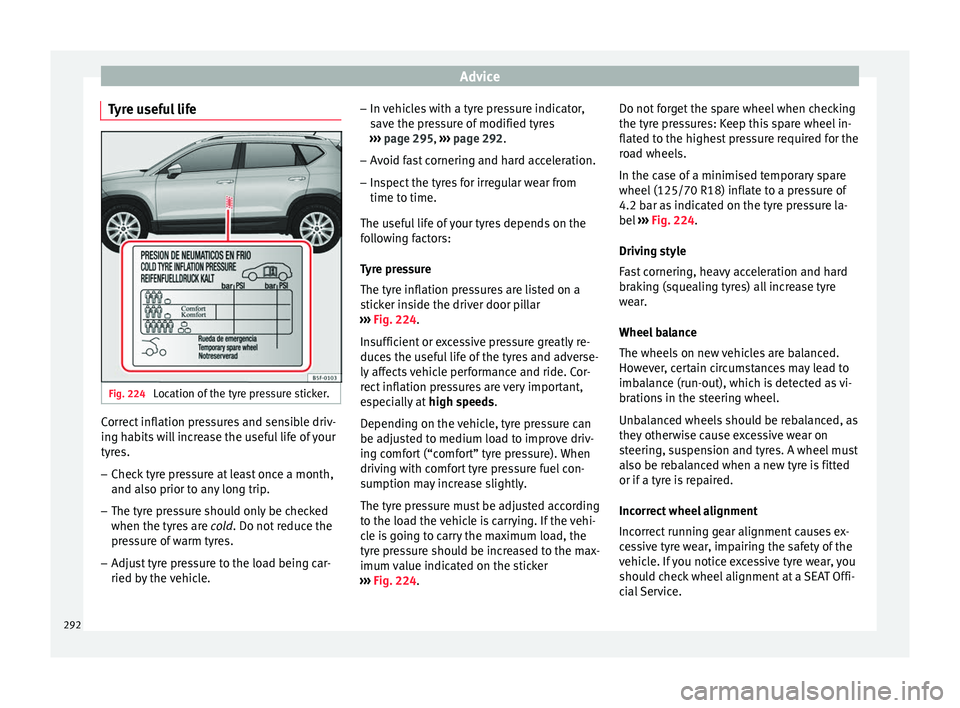
Tyre useful life Fig. 224
Location of the tyre pressure sticker. Correct inflation pressures and sensible driv-
in
g h
abits will increase the useful life of your
tyres.
– Check tyre pressure at least once a month,
and also prior t
o any long trip.
– The tyre pressure should only be checked
when the tyr
es are cold. Do not reduce the
pressure of warm tyres.
– Adjust tyre pressure to the load being car-
ried by
the vehicle. –
In v
ehicles with a tyre pressure indicator,
save the pressure of modified tyres
››› page 295, ››› page 292.
– Avoid fast cornering and hard acceleration.
– Inspect the tyres for irregular wear from
time to time.
The u
seful life of your tyres depends on the
following factors:
Tyre pressure
The tyre inflation pressures are listed on a
sticker inside the driver door pillar
››› Fig. 224.
Insufficient or excessive pressure greatly re-
duces the useful life of the tyres and adverse-
ly affects vehicle performance and ride. Cor-
rect inflation pressures are very important,
especially at high speeds.
Depending on the vehicle, tyre pressure can
be adjusted to medium load to improve driv-
ing comfort (“comfort” tyre pressure). When
driving with comfort tyre pressure fuel con-
sumption may increase slightly.
The tyre pressure must be adjusted according
to the load the vehicle is carrying. If the vehi-
cle is going to carry the maximum load, the
tyre pressure should be increased to the max-
imum value indicated on the sticker
››› Fig. 224. Do not forget the spare wheel when checking
the tyr
e pressures: Keep this spare wheel in-
flated to the highest pressure required for the
road wheels.
In the case of a minimised temporary spare
wheel (125/70 R18) inflate to a pressure of
4.2 bar as indicated on the tyre pressure la-
bel ››› Fig. 224.
Driving style
Fast cornering, heavy acceleration and hard
braking (squealing tyres) all increase tyre
wear.
Wheel balance
The wheels on new vehicles are balanced.
However, certain circumstances may lead to
imbalance (run-out), which is detected as vi-
brations in the steering wheel.
Unbalanced wheels should be rebalanced, as
they otherwise cause excessive wear on
steering, suspension and tyres. A wheel must
also be rebalanced when a new tyre is fitted
or if a tyre is repaired.
Incorrect wheel alignment
Incorrect running gear alignment causes ex-
cessive tyre wear, impairing the safety of the
vehicle. If you notice excessive tyre wear, you
should check wheel alignment at a SEAT Offi-
cial Service.
292
Page 297 of 328
Wheels
●
Av
oid running the vehicle on tyres that are
more than 6 years old. If you have no alterna-
tive, you should drive slowly and with extra
care at all times.
● If wheel trims are fitted after the car is pur-
ch
ased, ensure that there is an adequate flow
of air for cooling the brake system. For the sake of the environment
Old tyres must be disposed of according to
the l a
ws in the country concerned. Note
● A S
EAT Service Centre should be consulted
to find out whether wheels or tyres of differ-
ent sizes to those originally fitted by SEAT
can be fitted, and to find out about the com-
binations allowed between the front axle
(axle 1) and the rear axle (axle 2).
● Never mount used tyres if you are not sure
of their
“previous history”.
● For technical reasons, it is not generally
pos
sible to use the wheels from other vehi-
cles. In some cases, this may also be true for
the same model of wheel. Wheel bolts
The wheel
bolts
ar
e matched to the rims.
When installing different wheels (for instance
alloy wheels or wheels with winter tyres) it is
important to use the correct wheel bolts with the right length and correctly shaped bolt
hea
ds. This ensures that wheels are fitted se-
curely and that the brake system functions
correctly.
The wheel bolts must be clean and turn easi-
ly.
A special adapter is required to turn the anti-
theft wheel bolts* ›››
page 54.
Tyre monitoring systems Introduction WARNING
Unsuitable handling of the wheels and tyres
m a
y lead to sudden tyre pressure losses, to
tread separation or even to a blow-out.
● Check tyre pressures regularly and ensure
they ar
e maintained at the pressures indica-
ted. Tyre pressure that is too low could cause
overheating, resulting in tread detachment or
even burst tyres.
● Tyre pressure should be that indicated on
the label
when the tyres are cold at all times
››› page 303.
● Regularly check the cold inflation pressure
of the ty
res. If necessary, change the tyre
pressure of the vehicle tyres while they are
cold. ●
Re
gularly check your tyres for damage and
wear.
● Never exceed the maximum permitted
speed or lo
ads specified for the type of tyre
fitted on your vehicle. For the sake of the environment
Under-inflated tyres lead to increased fuel
c on
sumption and tyre wear. Note
● Driv in
g for the first time with new tyres at a
high speed can cause them to slightly ex-
pand, which could then produce an air pres-
sure warning.
● Only replace used tyres with those author-
ised b
y SEAT for the corresponding type vehi-
cle.
● Do not only rely on the tyre monitoring sys-
tem. R
egularly check your tyres to ensure
that the tyre pressure is correct and that the
tyres are not damaged due to puncture, cuts,
tears and impacts/dents. Remove objects
from the tyres only when they have not
pierced the tyres. 295
Technical data
Advice
Operation
Emergencies
Safety
Page 298 of 328
Advice
Tyre monitoring indicator If a light appears
The pressure in one or more tyres has
clearly reduced in comparison to the
tyre pressure set by the driver or the
tyre has structural damage.
Additionally, an audible warning can be heard and a text
message can be seen on the instrument panel display.
Stop! Reduce speed immediately! Stop the vehicle
safely as soon as possible. Avoid sudden manoeuvres
and braking! Check all tyres and pressures. Replace any
damaged tyres. If flashing
System malfunction
The control lamp flashes for approximately one minute
and then lights up permanently.
If tyre pressure is correct, switch the ignition off and on
again. If the control lamp remains lit up, the tyre moni-
toring indicator can be calibrated. Have the system
checked by a specialised workshop.
Several warning and control lamps light up
f
or a f
ew seconds when the ignition is switch-
ed on while the function is verified. They will
switch off after a few seconds. WARNING
When the tyres are inflated at different pres-
s ur
es or at a pressure that is too low then a
tyre may be damaged resulting in a loss of control of the vehicle and a serious or fatal
ac
c
ident.
● If the warning lamp lights
up, stop im-
mediately and check the tyres.
● If the tyres are inflated at different pres-
sur
es or if a tyre pressure is too low, this will
increase tyre wear, negatively affecting vehi-
cle stability and increasing braking distan-
ces.
● If tyres are inflated at different pressures or
a tyr
e pressure is too low, a tyre may be dam-
aged and burst resulting in a loss of control
of the vehicle.
● The driver is responsible for ensuring that
al
l of the vehicle tyres are correctly inflated
to the right pressure. The recommended tyre
pressure is indicated on the label
››› page 303.
● The tyre monitoring system can only oper-
ate c
orrectly if all of the tyres are inflated to
the correct pressure when cold.
● Driving with tyres at the wrong pressure
can d
amage them and result in an accident.
Ensure that the tyre pressures of all the tyres
correspond to the vehicle load.
● Before starting a journey, always inflate
tyr
es to the correct pressure.
● Tyres with insufficient pressure are subjec-
ted t
o more flexing. Due to this, the tyre
could become excessively hot, causing tread
separation and also tyre blow-out.
● With an overloaded vehicle at high speed,
the tyr
es can overheat and burst resulting in
a loss of vehicle control. ●
Ty
re pressures which are too high or too
low reduce the useful life of the tyre, affect-
ing vehicle performance.
● If a tyre has not been punctured and it does
not h
ave to be changed immediately, drive to
the nearest specialised workshop at a moder-
ate speed and have the tyre checked and in-
flated to the correct pressure. WARNING
Observe the safety warnings ›
›
› in Warning
and c ontr
ol lamps on page 107. Note
● If e
xcessively low tyre pressure is detected
with the ignition on, an audible warning will
sound. In the event that there is a fault in the
system, an audible warning will sound.
● Driving on dirt tracks for a long period of
time or drivin
g in a sporty style can tempora-
rily deactivate the TPMS. The control lamp
shows a fault, but disappears when road con-
ditions or the driving style change. 296
Page 299 of 328
Wheels
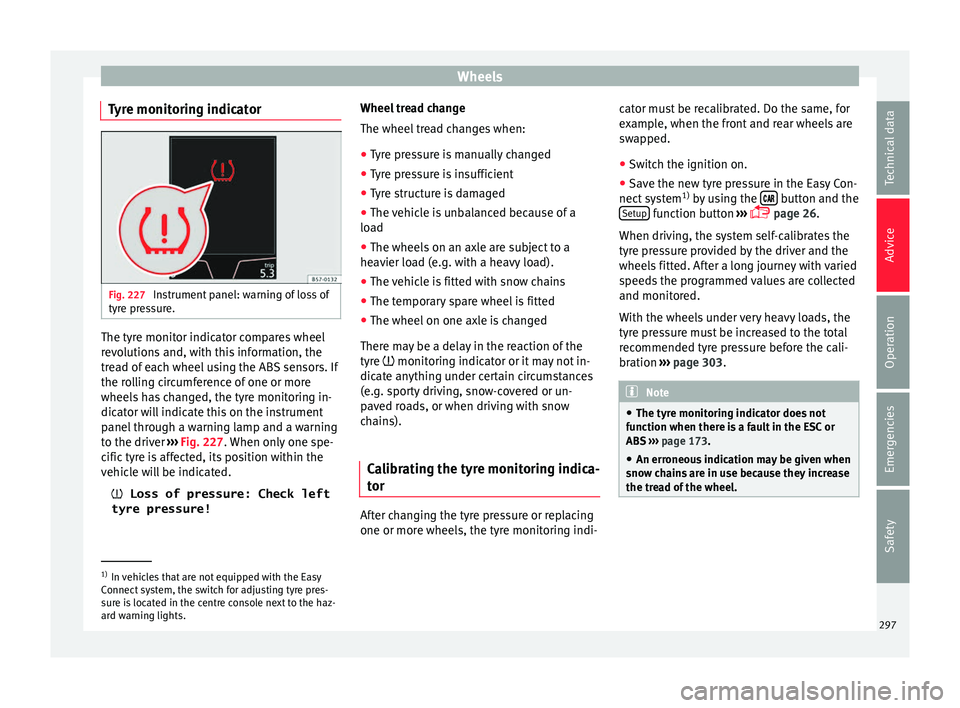
Tyre monitoring indicator Fig. 227
Instrument panel: warning of loss of
ty r
e pressure. The tyre monitor indicator compares wheel
r
ev
olutions and, with this information, the
tread of each wheel using the ABS sensors. If
the rolling circumference of one or more
wheels has changed, the tyre monitoring in-
dicator will indicate this on the instrument
panel through a warning lamp and a warning
to the driver ››› Fig. 227. When only one spe-
cific tyre is affected, its position within the
vehicle will be indicated.
Loss of pressure: Check left
tyre pressure! Wheel tread change
The wheel tr
ead changes when:
● Tyre pressure is manually changed
● Tyre pressure is insufficient
● Tyre structure is damaged
● The vehicle is unbalanced because of a
loa
d
● The wheels on an axle are subject to a
heav
ier load (e.g. with a heavy load).
● The vehicle is fitted with snow chains
● The temporary spare wheel is fitted
● The wheel on one axle is changed
There m
ay be a delay in the reaction of the
tyre monitoring indicator or it may not in-
dicate anything under certain circumstances
(e.g. sporty driving, snow-covered or un-
paved roads, or when driving with snow
chains).
Calibrating the tyre monitoring indica-
tor After changing the tyre pressure or replacing
one or mor
e wheel
s, the tyre monitoring indi- cator must be recalibrated. Do the same, for
ex
ample, when the front and rear wheels are
swapped.
● Switch the ignition on.
● Save the new tyre pressure in the Easy Con-
nect sy
stem1)
by using the button and the
Set up function button
››
›
page 26.
When driving, the system self-calibrates the
tyre pressure provided by the driver and the
wheels fitted. After a long journey with varied
speeds the programmed values are collected
and monitored.
With the wheels under very heavy loads, the
tyre pressure must be increased to the total
recommended tyre pressure before the cali-
bration ››› page 303. Note
● The ty r
e monitoring indicator does not
function when there is a fault in the ESC or
ABS ››› page 173.
● An erroneous indication may be given when
sno
w chains are in use because they increase
the tread of the wheel. 1)
In vehicles that are not equipped with the Easy
C onnect
system, the switch for adjusting tyre pres-
sure is located in the centre console next to the haz-
ard warning lights. 297
Technical data
Advice
Operation
Emergencies
Safety
Page 305 of 328
Technical specifications
Trailer mode Tr
ailer weights Trailer weight
The tr
ai
ler weights and drawbar loads ap-
proved are selected in intensive trials accord-
ing to precisely defined criteria. The ap-
proved trailer weights are valid for vehicles in
the EU for maximum speeds of 80 km/h (50
mph) (in certain circumstances up to 100
km/h (62 mph)). The figures may be different
in other countries. All data in the official vehi-
cle documentation takes precedence over
these data at all times ››› .
Dr a
wbar loads
The maximum permitted drawbar load on the
ball joint of the towing bracket must not ex-
ceed 80 kg.
In the interest of road safety, we recommend
that you always tow approaching the maxi-
mum drawbar load. The response of the trail-
er on the road will be poor, if the drawbar
load is too small.
If the maximum permissible drawbar load
cannot be met (e.g. with small, empty and
light-weight single axle trailers or tandem
axle trailers with a wheelbase of less than 1
metre), a minimum of 4% of the actual trailer
weight is legally required for the drawbar
load. WARNING
● For s
afety reasons, you should not drive at
speeds above 80 km/h (50 mph) when towing
a trailer. This also applies in countries where
higher speeds are permitted.
● Never exceed the maximum trailer weights
or the dra
wbar load. If the permissible axle
load or the permissible total weight is excee-
ded, the driving characteristics of the vehicle
may change, leading to accidents, injuries
and damage to the vehicle. Wheels
Ty
re pressure, snow chains, wheel
bolts Tyre pressures
The s
tic
ker with the tyre pressure values can
be found on the inside of the fuel tank flap.
The tyre pressure values given there are for
cold tyres. The slightly raised pressures of
warm tyres must not be reduced. ››› The pressure for win
t
er tyres is 0.2 bar
(2.9 psi / 20 kPa) higher than that of summer
tyres.
Snow chains
Snow chains may be fitted only to the front
wheels, and only for the following tyres:
215/60 R16Chains with links of maximum 15 mm
215/55 R17Chains with links of maximum 15 mm
215/50 R18Chains with links of maximum 15 mm
Other dimensions do not allow chains Wheel bolts
Af
t
er the wheels have been changed, the
tightening torque of the wheel bolts should
be checked as soon as possible with a torque
wrench ››› . The tightening torque for steel
and al lo
y wheels is 140 Nm. WARNING
● Chec k
the tyre pressure at least once per
month. Checking the tyre pressure is very im-
portant. If the tyre pressure is too high or too
low, there is an increased danger of accidents
- particularly at high speeds.
● If the tightening torque of the wheel bolts
is
too low, they could loosen while the vehi-
cle is in motion. Risk of accident! If the tight-
ening torque is too high, the wheel bolts and
threads can be damaged. Note
We recommend that you ask your Technical
Ser v
ice for information about appropriate
wheel, tyre and snow chain size. 303
Technical data
Advice
Operation
Emergencies
Safety