ECU Seat Ateca 2017 User Guide
[x] Cancel search | Manufacturer: SEAT, Model Year: 2017, Model line: Ateca, Model: Seat Ateca 2017Pages: 328, PDF Size: 6.36 MB
Page 69 of 328

Safe driving
Rear head restraints – The rear head restraints have 2 positions:
use
and non-use.
– One position for use
(head restraint raised)
››› Fig. 84. In this position, the head re-
straints are used normally, protecting pas-
sengers along with the rear seat belts.
– And one position for non-use
(head re-
straint lowered).
– To fit the head restraints in position for use,
pu
ll on the edges with both hands in the
direction of the arrow. WARNING
● Under no c ir
cumstances should the rear
passengers travel while the head restraints
are in the non-use position. See the warning
label located on the rear side fixed window
››› Fig. 85.
● Do not swap the centre rear head restraint
with either of
the outer seat rear head re-
straints. Risk of injury in case of an accident! CAUTION
Note the instructions on the adjustment of
the he a
d restraints ››› page 143. Pedal area
P ed
als –
Ensure that you can always press the accel-
er at
or, brake and clutch pedals unimpaired
to the floor.
– Ensure that the pedals can return unim-
pair
ed to their initial positions.
– Ensure that the floor mats are securely fas-
tened durin
g the trip and do not obstruct
the pedals ››› .
On ly
use floor mats which leave the pedals
clear and which are secured to prevent them
from slipping. You can obtain suitable floor
mats from a specialised dealership. Fasten-
ers* for floor mats are fitted in the footwells.
If a brake circuit fails, the brake pedal must
be pressed down thoroughly in order to stop
the vehicle.
Wear suitable footwear
Always wear shoes which support your feet
properly and give you a good feeling for the
pedals. WARNING
● Re
stricting pedal operation can lead to crit-
ical situations while driving. ●
Nev er l
ay or fit floor mats or other floor cov-
erings over the original floor mats. This
would reduce the pedal area and could ob-
struct the pedals. Risk of accident.
● Never place objects in the driver footwell.
An ob
ject could move into the pedal area and
impair pedal operation. In the event of a sud-
den driving or braking manoeuvre, you will
not be able to operate the brake, clutch or ac-
celerator pedal. Risk of accident! 67Technical data
Advice
Operation
Emergencies
Safety
Page 70 of 328
Safety
Seat belts
Wh y
wear a seat belt?
Number of seats Your vehicle has
five
seats, two in the front
and three in the rear. Each seat is equipped
with a three-point seat belt.
In some versions, your vehicle is approved
only for four seats. Two front seats and two
rear seats. WARNING
● Nev er tr
ansport more than the permitted
amount of people in your vehicle.
● Every vehicle occupant must properly fas-
ten and w
ear the seat belt belonging to his or
her seat. Children must be protected with an
appropriate child restraint system. Seat belt lamp*
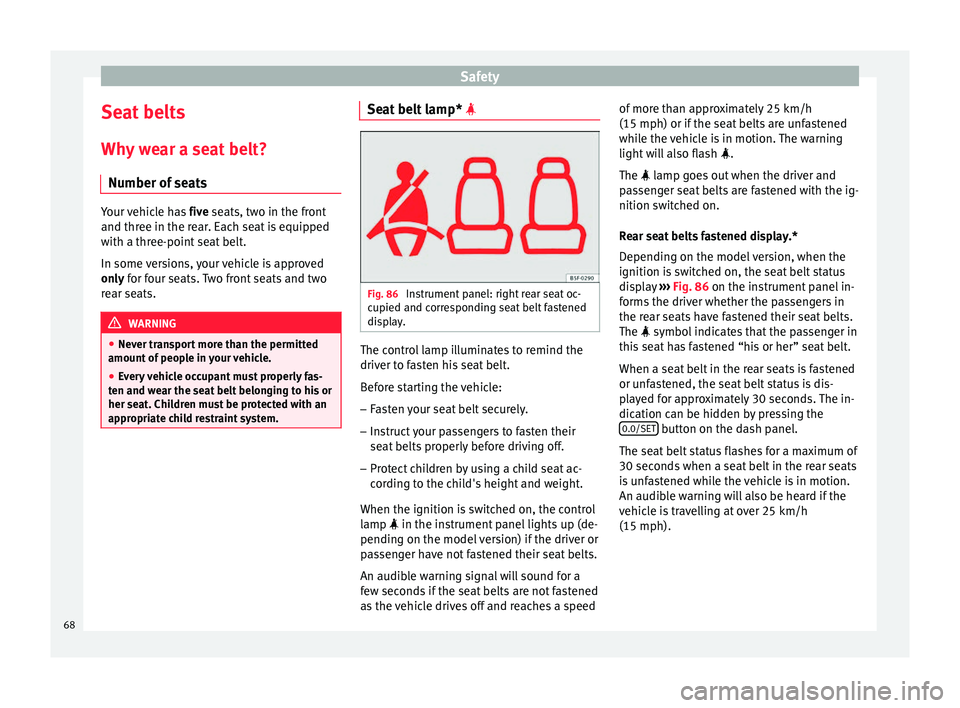
Fig. 86
Instrument panel: right rear seat oc-
c upied and c
orresponding seat belt fastened
display. The control lamp illuminates to remind the
driv
er t
o fasten his seat belt.
Before starting the vehicle: – Fasten your seat belt securely.
– Instruct your passengers to fasten their
seat
belts properly before driving off.
– Protect children by using a child seat ac-
cor
ding to the child's height and weight.
When the ignition is switched on, the control
lamp in the instrument panel lights up (de-
pending on the model version) if the driver or
passenger have not fastened their seat belts.
An audible warning signal will sound for a
few seconds if the seat belts are not fastened
as the vehicle drives off and reaches a speed of more than approximately 25 km/h
(15 mph) or if the se
at belts are unfastened
while the vehicle is in motion. The warning
light will also flash .
The lamp goes out when the driver and
passenger seat belts are fastened with the ig-
nition switched on.
Rear seat belts fastened display.*
Depending on the model version, when the
ignition is switched on, the seat belt status
display ››› Fig. 86 on the instrument panel in-
forms the driver whether the passengers in
the rear seats have fastened their seat belts.
The symbol indicates that the passenger in
this seat has fastened “his or her” seat belt.
When a seat belt in the rear seats is fastened
or unfastened, the seat belt status is dis-
played for approximately 30 seconds. The in-
dication can be hidden by pressing the 0.0/SET button on the dash panel.
The se at
belt status flashes for a maximum of
30 seconds when a seat belt in the rear seats
is unfastened while the vehicle is in motion.
An audible warning will also be heard if the
vehicle is travelling at over 25 km/h
(15 mph).
68
Page 73 of 328
Seat belts
possible to brace oneself with one's hands.
In a fr ont
al collision, unbelted passengers
are thrown forward and will make violent con-
tact with the steering wheel, dash panel,
windscreen or whatever else is in the way
››› Fig. 88.
It is also important for rear passengers to
wear seat belts properly, as they could other-
wise be thrown forward violently through the
vehicle interior in an accident. Passengers in
the rear seats who do not use seat belts en-
danger not only themselves but also the front
occupants ››› Fig. 89. How to properly adjust your
seat
belt
Fastening and unfastening the seat
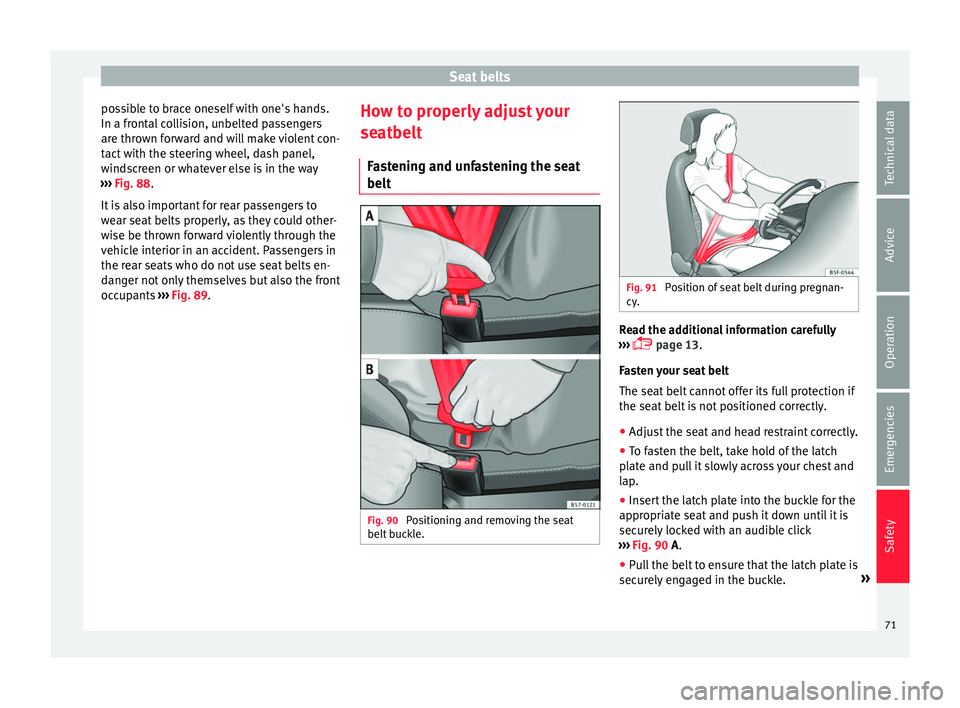
belt Fig. 90
Positioning and removing the seat
belt b
uckle. Fig. 91
Position of seat belt during pregnan-
cy . Read the additional information carefully
› ›
› page 13.
Fasten your seat belt
The seat belt cannot offer its full protection if
the seat belt is not positioned correctly.
● Adjust the seat and head restraint correctly.
● To fasten the belt, take hold of the latch
pl
ate and pull it slowly across your chest and
lap.
● Insert the latch plate into the buckle for the
appr
opriate seat and push it down until it is
securely locked with an audible click
››› Fig. 90 A.
● Pull the belt to ensure that the latch plate is
secur
ely engaged in the buckle. »
71
Technical data
Advice
Operation
Emergencies
Safety
Page 81 of 328
Transporting children safely
light up, with the word
in the centre part of the dash panel.
– The warning lamp is
illuminated for
60 seconds in the centre part of the dash
panel.
Control lamp with the word
(front passenger airbag disabled)
If the front passenger front airbag is disa-
bled, after switching on the ignition, the con-
trol lamp will light up for several seconds,
then it will switch off for about 1 s and then
switch on again.
If the control lamp is flashing, there is a fault
in the disabling of the airbag system ››› .
Pl e
ase go immediately to an Official Service. WARNING
● The driv er of
the vehicle is responsible for
disabling or switching on the airbag.
● Always switch off the ignition before disa-
blin
g the front passenger airbag! Failure to do
so could result in a fault in the airbag deacti-
vation system.
● Never leave the key in the airbag disabling
swit
ch as it could get damaged or enable or
disable the airbag during driving.
● If the (airbag di
sabled) control lamp
flashes, the front passenger front airbag will
not trigger in the event of an accident! Have
the system immediately checked by an Offi-
cial Service. Transporting children safely
Saf ety
for children
Introduction For safety reasons, as we have learned from
ac
c
ident statistics, we recommend that chil-
dren under 12 years of age travel in the rear
seats. Depending on their age, height and
weight, children travelling in rear seats must
use a child seat or a seat belt. For safety rea-
sons, the child seat should be installed in the
rear seat, behind the front passenger seat or
in the centre back seat.
The physical laws involved and the forces
acting in a collision apply also to children
››› page 70. But unlike adults, children do not
have fully developed muscle and bone struc-
tures. This means that children are subject to
a greater risk of injury.
To reduce the risk of injuries, children must
always use special child restraint systems
when travelling in the vehicle.
We recommend the use of child safety prod-
ucts from the SEAT Original Accessories Pro-
gramme, which includes systems for all ages
made by “Peke” (not for all countries) (see
www.seat.com). These systems have been especially de-
s
igned and ap
proved, complying with the
ECE-R44. regulation.
SEAT recommends securing the child seats
shown on the website as described below:
● Child seats in the opposite direction of
trav
el (group 0+): ISOFIX and support bracket
(Peke G0 Plus + ISOFIX Base (RWF)).
● Child seats in the direction of travel (group
1): ISOFIX and
Top Tether (Peke G1 ISOFIX
DUO Plus).
● Child seats in the direction of travel (group
2): seat
belt and ISOFIX (Peke G3 KIDFIX).
● Child seats in the direction of travel (group
3): with se
at belt (Peke G3 KIDFIX).
Follow the manufacturer's instructions and
observe any statutory requirements when in-
stalling and using child seats. Always read
and note ››› page 79.
We recommend you always carry the manu-
facturer's Child Seat Instruction Manual to-
gether with the on-board documentation.
Important information regarding the
front
passenger's airbag Read the additional information carefully
› ›
› page 17. »
79
Technical data
Advice
Operation
Emergencies
Safety
Page 82 of 328
Safety
Read and always observe the safety informa-
tion inc luded in the f
ollowing chapters:
● Safety distance with respect to the passen-
ger airb
ag ››› page 73.
● Objects between the passenger and the
pa
ssenger side airbag ››› in Front airbags
on p ag
e 75.
The passenger side front airbag, when ena-
bled, is a serious risk for a child that is facing
backward since the airbag can strike the seat
with such force that it can cause serious or
fatal injuries. Children up to 12 years old
should always travel on the rear seat.
Therefore we strongly recommend you to
transport children on the rear seats. This is
the safest location in the vehicle. Alternative-
ly, the front passenger airbag can be disa-
bled with a key-operated switch ››› page 78.
When transporting children, use a child seat
suitable for the age and size of each child
››› page 81. WARNING
● If a c
hild seat is secured to the front pas-
senger seat, the risk to the child of sustain-
ing critical or fatal injuries in the event of an
accident increases.
● An inflating front passenger airbag can
strik
e the rear-facing child seat and project it
with great force against the door, the roof or
the backrest. ●
Nev er in
stall a child seat facing backwards
on the front passenger seat unless the front
passenger front airbag has been disabled.
Risk of potentially fatal injuries to the child!
However, if it is necessary, in exceptional ca-
ses, to transport a child in the front passen-
ger seat, the front passenger front airbag
must always be disabled ››› page 77. If the
passenger seat has a height adjustment op-
tion, move it to the highest, most upright po-
sition. If you have a fixed seat, do not install
any child restraint system in this location.
● For those vehicles that do not include a key
lock
switch to deactivate the airbag, the vehi-
cle must be taken to a technical service. Do
not forget to reconnect the airbag when an
adult wants to sit in the front passenger seat.
● All vehicle occupants, especially children,
mus
t assume the proper sitting position and
be properly belted in while travelling.
● Never hold children or babies on your lap,
this
can result in potentially fatal injuries to
the child!
● Never allow a child to be transported in a
vehic
le without being properly secured, or to
stand up or kneel on a seat while travelling.
In an accident, the child could be flung
through the vehicle, causing possibly fatal in-
juries to themselves and to the other vehicle
occupants.
● If children assume an improper sitting posi-
tion when the v
ehicle is moving, they expose
themselves to greater risk of injury in the
event of a sudden braking manoeuvre or in an
accident. This is particularly important if the child is travelling on the front passenger seat
and the airb
ag sy
stem is triggered in an acci-
dent; as this could cause serious injury or
even death.
● A suitable child seat can protect your child!
● Never leave a child alone in the child seat
or ins
ide the vehicle because depending on
the season, very high temperatures may be
reached inside a parked vehicle, which could
be fatal.
● Children who are less than 1.5 metres tall
mus
t not wear a normal seat belt without a
child seat, as this could cause injuries to the
abdominal and neck areas during a sudden
braking manoeuvre or in an accident.
● Do not allow the seat belt to become twis-
ted and the se
at belt should be properly in
place ››› page 68.
● Only one child may occupy a child seat
››
› page 80, Child seats.
● When a child seat is mounted in the rear
seat
s, the door child-proof lock should be ac-
tivated ››› page 120. Child seats
Saf ety
instructions Read the additional information carefully
› ›
› page 17.
80
Page 83 of 328
Transporting children safely
WARNING
When travelling, children must be secured in
the v
ehicle with a restraint system suitable
for age, weight and size.
● Read and always observe information and
warnin
gs concerning the use of child seats
››› page 79. WARNING
The retaining rings are designed only for use
w ith “ISOFIX” and T
op Tether* system child
seats.
● Never secure other child seats that do not
hav
e the “ISOFIX” or Top Tether* system, or
retaining belts or objects to the fastening
rings - this can result in potentially fatal inju-
ries to the child.
● Ensure that the child seat is secured cor-
rectly
using the “ISOFIX” and Top Tether* se-
curing rings. WARNING
An undue installation of the safety seat will
inc r
ease the risk of injury in the event of a
crash.
● Never tie the retainer strap to a hook in the
lugg
age compartment.
● Never secure or tie luggage or other items
to the lo
wer anchorages (ISOFIX) or the upper
ones (Top Tether). Categorisation of child seats into
gr
oup
s Use only child seats that are officially ap-
pr
o
ved and suitable for the child.
These seats are subject to the ECE-R 44 or
ECE-R 129 standard. ECE-R stands for: Eco-
nomic Commission for Europe Regulation.
The child seats are grouped into 5 catego-
ries:
Group 0: Up to 10 kg (up to around 9
months)
Group 0+: Up to 13 kg (up to around 18
months)
Group 1: from 9 to 18 kg (up to approx. 4
years old)
Group 2: from 15 to 25 kg (up to approx. 7
years old)
Group 3: From 22 to 36 kg (over around 7
years old)
Child seats that have been tested and ap-
proved under the ECE-R 44 or ECE-R 129
standard bear the test mark ECE-R 44 or ECE-
R 129 on the seat (the letter E in a circle with
the test number below it).
Follow the manufacturer's instructions and
observe any statutory requirements when in-
stalling and using child seats. We recommend you to always include the
m
anuf
acturer's Child Seat Instruction Manual
together with the on-board documentation.
SEAT recommends you use child seats from
the Original Accessories Catalogue . These
child seats have been designed and tested
for use in SEAT vehicles. You can find the
right child seat for your model and age group
at SEAT dealers.
Child seats by approval category
Child seats may have the approval category
of universal, semi-universal, vehicle specific
(all according to the ECE-R 44 standard) or i-
Size (according to the ECE-R 129 standard).
● Universal: Chil
d seats with universal appro-
val can be installed in all vehicles. There is
no need to consult any list of models. In the
case of universal approval for ISOFIX, the
child seat is additionally provided with a Top
Tether belt.
● Semi-universal: semi-univ
ersal approval, in
addition to the standard requirements of uni-
versal approval, requires safety devices to
lock the child seat, which require additional
testing. Child seats with semi-universal ap-
proval include a list of vehicle models for
which they can be installed.
● Vehicle-specific: v
ehicle-specific approval
requires a dynamic test of the child seat for
each vehicle model separately. Child seats
with vehicle-specific approval also include a »
81
Technical data
Advice
Operation
Emergencies
Safety
Page 91 of 328
Self-help
● Sc r
ew the towing eye in the housing by
turning it to the maximum anticlock-
wise ››› . Use a suitable object that can
c omp
letely and securely tighten the towing
eye in its housing.
● After towing, unscrew the towing eye cloc
k-
wise with a suitable object.
● Insert the side tab of the lid into the open-
ing of
the bumper and press until the tab is
properly clipped into the bumper.
● Clean the towing eye if necessary and then
st
ore it in the luggage compartment along
with the other vehicle tools. CAUTION
The towing eye must always be completely
and firm ly
tightened. Otherwise, it could be
released while towing and tow-starting. Fitting the rear towing eye
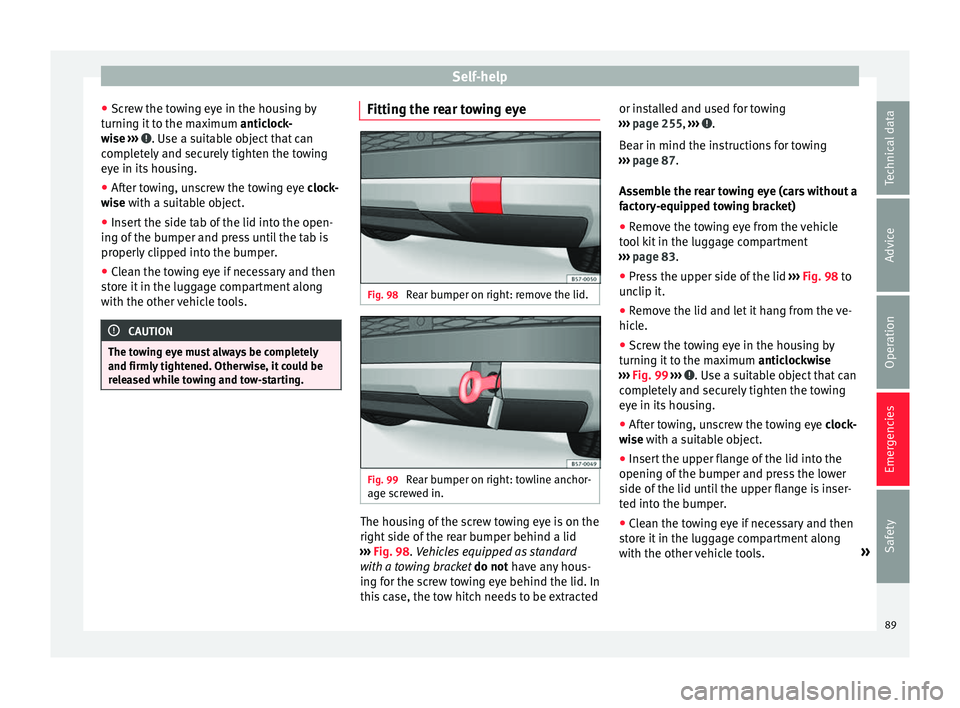
Fig. 98
Rear bumper on right: remove the lid. Fig. 99
Rear bumper on right: towline anchor-
ag e s
crewed in. The housing of the screw towing eye is on the
right
s
ide of the rear bumper behind a lid
››› Fig. 98. Vehicles equipped as standard
with a towing bracket do not have any hous-
ing for the screw towing eye behind the lid. In
this case, the tow hitch needs to be extracted or installed and used for towing
››
› page 255, ››› .
B e
ar in mind the instructions for towing
››› page 87.
Assemble the rear towing eye (cars without a
factory-equipped towing bracket)
● Remove the towing eye from the vehicle
too
l kit in the luggage compartment
››› page 83.
● Press the upper side of the lid ››
› Fig. 98 to
unclip it.
● Remove the lid and let it hang from the ve-
hicl
e.
● Screw the towing eye in the housing by
turnin
g it to the maximum anticlockwise
››› Fig. 99 ››› . Use a suitable object that can
c omp
letely and securely tighten the towing
eye in its housing.
● After towing, unscrew the towing eye cloc
k-
wise with a suitable object.
● Insert the upper flange of the lid into the
opening of
the bumper and press the lower
side of the lid until the upper flange is inser-
ted into the bumper.
● Clean the towing eye if necessary and then
st
ore it in the luggage compartment along
with the other vehicle tools. »
89
Technical data
Advice
Operation
Emergencies
Safety
Page 98 of 328
Emergencies
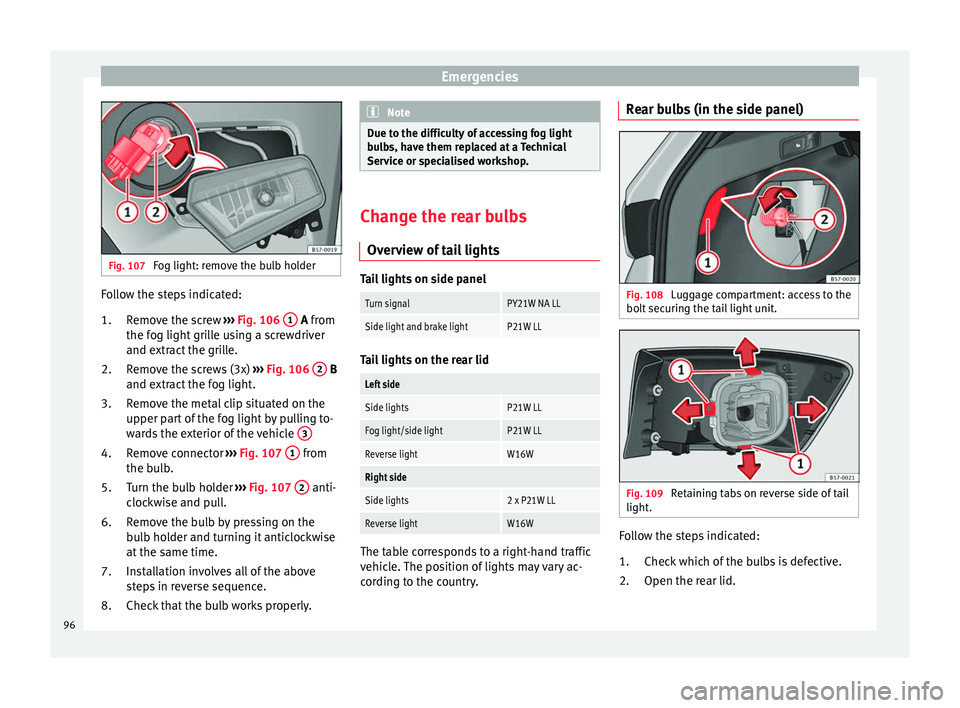
Fig. 107
Fog light: remove the bulb holder Follow the steps indicated:
Remo
ve the screw ››› Fig. 106 1 A fr
om
the f
og light grille using a screwdriver
and extract the grille.
Remove the screws (3x) ››› Fig. 106 2 B
and e xtr
act the fog light.
Remove the metal clip situated on the
upper part of the fog light by pulling to-
wards the exterior of the vehicle 3Remove connector
››
›
Fig. 107 1 from
the b u
lb.
Turn the bulb holder ›››
Fig. 107 2 anti-
c loc
kwise and pull.
Remove the bulb by pressing on the
bulb holder and turning it anticlockwise
at the same time.
Installation involves all of the above
steps in reverse sequence.
Check that the bulb works properly.
1.
2.
3.
4.
5.
6.
7.
8. Note
Due to the difficulty of accessing fog light
b u
lbs, have them replaced at a Technical
Service or specialised workshop. Change the rear bulbs
Ov er
view of tail lights Tail lights on side panel
Turn signalPY21W NA LL
Side light and brake lightP21W LL
Tail lights on the rear lid
Left side
Side lightsP21W LL
Fog light/side lightP21W LL
Reverse lightW16W
Right side
Side lights2 x P21W LL
Reverse lightW16W
The table corresponds to a right-hand traffic
v
ehic
le. The position of lights may vary ac-
cording to the country. Rear bulbs (in the side panel)
Fig. 108
Luggage compartment: access to the
bo lt
securing the tail light unit. Fig. 109
Retaining tabs on reverse side of tail
light . Follow the steps indicated:
Chec k
which of the bulbs is defective.
Open the rear lid.
1.
2.
96
Page 99 of 328
Fuses and bulbs
Remove the lid, levering it with the flat
s ide of
a screwdriver into the recess
››› Fig. 108 1 .
R emo
ve the bulb connector.
Unscrew the light securing bolt by hand
or using a screwdriver ››› Fig. 108 2 .
R emo
ve the light from the body, gently
pulling it toward you, and place on a
clean, smooth surface.
Disassemble the bulb holder unlocking
the securing tabs ››› Fig. 109 1 .
Ch an
ge the damaged bulb.
To refit follow the steps in reverse order,
taking special care when fitting the bulb
holder. The securing tabs must click into
place. CAUTION
Take care when removing the rear light unit to
m ak
e sure there is no damage to the paint-
work or any of its components. Note
● Mak
e sure you have a soft cloth ready to
place under the glass on the rear light unit, to
avoid any scratches.
● In the case of LED lights, change only the
turn s
ignal bulb. 3.
4.
5.
6.
7.
8.
9.
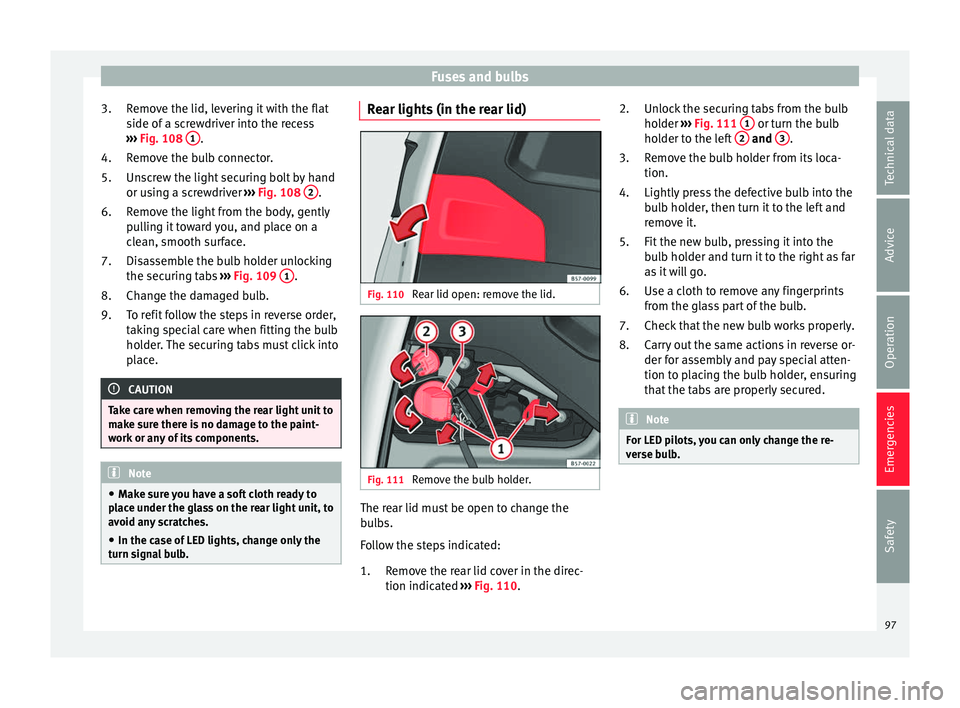
Rear lights (in the rear lid) Fig. 110
Rear lid open: remove the lid. Fig. 111
Remove the bulb holder. The rear lid must be open to change the
b
u
lbs.
Follow the steps indicated:
Remove the rear lid cover in the direc-
tion indicated ››› Fig. 110.
1. Unlock the securing tabs from the bulb
hol
der ››› Fig. 111 1 or turn the bulb
ho l
der to the left 2 and
3 .
R emo
ve the bulb holder from its loca-
tion.
Lightly press the defective bulb into the
bulb holder, then turn it to the left and
remove it.
Fit the new bulb, pressing it into the
bulb holder and turn it to the right as far
as it will go.
Use a cloth to remove any fingerprints
from the glass part of the bulb.
Check that the new bulb works properly.
Carry out the same actions in reverse or-
der for assembly and pay special atten-
tion to placing the bulb holder, ensuring
that the tabs are properly secured. Note
For LED pilots, you can only change the re-
v er
se bulb. 2.
3.
4.
5.
6.
7.
8.
97
Technical data
Advice
Operation
Emergencies
Safety
Page 114 of 328
Operation
Opening and closing C entr
al locking system
Description Read the additional information carefully
› ›
› page 9
The vehicle can be locked and unlocked via
the central locking system. There are several
methods, depending on the vehicle equip-
ment:
● key with remote control ›
›
›
page 114 ,
● lock on driver door (emergency opening
››
› page 9) or
● interior central locking switch ››
›
page 115.
Unlocking one side of the vehicle only
When you lock the vehicle with the key, the
doors and the rear lid are locked. When you
open the door, you can either unlock only the
driver door, or all the vehicle doors. To select
the required option, use Easy Connect*
››› page 115.
Automatic locking (Auto Lock)*
The Auto Lock function locks the doors and
the rear lid when the vehicle exceeds a speed
of about 15 km/h (9 mph). The vehicle is unlocked again when the igni-
tion key
is removed. Alternatively, the vehicle
can also be unlocked via the central locking
switch or by pulling one of the inside door
handles. The Auto Lock function can be
switched on and off on the sound system or
on the Easy Connect* system ››› page 115.
In the event of an accident in which the air-
bags inflate, the doors will be automatically
unlocked to facilitate access and assistance.
Anti-theft alarm system*
If the anti-theft alarm system senses interfer-
ence with the vehicle it triggers an audible
and visible alarm.
The anti-theft alarm system is automatically
switched on when locking the vehicle. It
switches off when the vehicle is unlocked
from a distance.
When the driver door is unlocked with the
key, you should switch on the ignition within
15 seconds. Otherwise the alarm will be trig-
gered. On some export versions, the alarm is
triggered immediately when you open a door.
To deactivate the alarm, press the button on the remote control key, or switch on the
ignition. Af
t
er a certain time, the alarm will
automatically switch off.
Switch off the vehicle interior monitoring and
tow-away protection if you wish to prevent the alarm from being triggered accidentally
››
› page 123.
Turn signals
The turn signals will flash twice when the ve-
hicle is unlocked and once when the vehicle
is locked.
If it does not flash, this indicates that one of
the doors, the rear lid or the bonnet is not
closed correctly.
Accidental lock-out
The central locking system prevents you from
being locked out of the vehicle in the follow-
ing situations: ● If the driver door is open, the vehicle can-
not be loc
ked with the central locking switch
››› page 115.
Lock the vehicle with the remote control key,
when all the doors and the rear lid have been
closed. This prevents the accidental locking
of the vehicle. WARNING
Do not leave anyone (especially children) in
the v
ehicle if it is locked from the outside and
the anti-theft security system* is enabled, as
the doors and windows cannot then be
opened from the inside. Locked doors could
delay assistance in an emergency, potentially
putting lives at risk. 112