change time Seat Ateca 2017 Service Manual
[x] Cancel search | Manufacturer: SEAT, Model Year: 2017, Model line: Ateca, Model: Seat Ateca 2017Pages: 328, PDF Size: 6.36 MB
Page 293 of 328
Wheels
CAUTION
● Some v
ehicles, for example those with the
Start-Stop system* are fitted with a special
battery (AGM-type or EFB-type battery). If any
other type of battery is fitted, the Start-Stop
function may be considerably reduced and
the vehicle may not stop on repeated occa-
sions.
● Make sure that the vent hose is always at-
tac
hed to the original opening on the side of
the battery. Gases or battery acid can other-
wise escape and possibly cause damage.
● The battery holder and clamps must always
be corr
ectly secured.
● Before starting any work on the battery, al-
wa
ys observe the warnings listed under
››› page 289, Important safety warnings for
handling a vehicle battery .
● Do not forget to replace the battery cover-
ing
s, where applicable. It is a protection for
high temperatures. This in turn extends the
vehicle service life. For the sake of the environment
B atteries contain toxic substances includ-
in
g sulphuric acid and lead. They must be
disposed of appropriately and must not be
disposed of with ordinary household waste.
Make sure disconnected batteries cannot tip
over. Sulphuric acid could be spilt! Wheels
Wheel s
and tyres
General notes –
When driving with new ty r
es, be especially
careful during the first 500 km (300 miles).
– If you have to drive over a kerb or similar
ob
stacle, drive very slowly and as near as
possible at a right angle to the obstacle.
– Check from time to time if the tyres are
dam
aged (punctures, cuts, cracks or
dents). Remove any foreign objects embed-
ded in the treads.
– Damaged wheels and tyres must be re-
pl
aced immediately.
– Keep grease, oil and fuel off the tyres.
– Replace any missing valve caps as soon as
pos
sible.
– Mark the wheels before taking them off so
that
they rotate in the same direction when
put back.
– When removed, the wheels or tyres should
be st
ored in a cool, dry and preferably dark
place.
New tyres
New tyres do not give maximum grip straight
away and should therefore be “run in” by driving carefully and at moderate speeds for
about the fir
st 500 km (300 miles). This will
also increase the useful life of the tyres.
The tread depth of new tyres may vary, ac-
cording to the type and make of tyre and the
tread pattern.
Concealed damage
Damage to tyres and rims is often not readily
visible. If you notice unusual vibration or the
car pulling to one side, this may indicate that
one of the tyres is damaged. Reduce speed
immediately if there is any reason to suspect
that damage may have occurred. Inspect the
tyres for damage. If no external damage is
visible, drive slowly and carefully to the near-
est specialised workshop and have the car
inspected.
Tyres with directional tread pattern
An arrow on the tyre sidewall indicates the di-
rection of rotation on single drive tyres. Al-
ways note the direction of rotation indicated
when mounting the wheel. This guarantees
optimum grip and helps to avoid aquaplan-
ing, excessive noise and wear.
Retrofitting accessories
If you wish to change or fit wheels, rims or
wheel trims, we recommend that you consult
with a SEAT Official Service centre for advice
regarding current techniques.
291
Technical data
Advice
Operation
Emergencies
Safety
Page 295 of 328
Wheels
WARNING
● Alw
ays adapt the tyre pressure accordingly
when the vehicle load changes.
● A tyre with low air pressure has to flex a lot
more when the
vehicle is heavily loaded or at
high speeds, therefore causing overheating
to occur. Under these conditions, the tyre
bead may be released or the tyre may burst.
Risk of accident! For the sake of the environment
Under-inflated tyres will increase fuel con-
s umption. Wear indicators
Fig. 225
Tyre tread: tread wear indicators Tread wear indicators indicate if a tyre is
w
orn. The origin
al tyres on your vehicle have
1.6 mm high “tre
ad wear indicators” running
across the tread. Depending on the manufac-
turer, there will be 6 to 8 of them spaced at
equal distances around the tyre. Markings on
the tyre sidewall (for instance the letters
“TWI” or a triangle) indicate the positions of
the tread wear indicators.
The minimum tread depth required by law is
1.6 mm (measured in the tread grooves next
to the tread wear indicators). (Different fig-
ures may apply in other countries.) WARNING
The tyres must be replaced at the latest when
the tr e
ad is worn down to the tread wear indi-
cators. Failure to follow this instruction could
result in an accident.
● Especially in difficult driving conditions
suc
h as wet or icy roads. It is important that
the tyre tread be as deep as possible and be
approximately the same on the tyres of both
the front and the rear axles.
● The scant driving safety due to insufficient
tre
ad depth is particularly evident in vehicle
handling, when there is a risk of “aquaplan-
ing” in deep puddles of water and when driv-
ing through corners, and braking is also ad-
versely affected.
● The speed has to be adapted accordingly,
otherw
ise there is a risk of losing control over
the vehicle. Changing wheels
Fig. 226
Interchanging tyres. To ensure that the wear is equal on all tyres
the wheel
s
should be changed round from
time to time according to the system
››› Fig. 226. The useful life of all the tyres will
then be about the same time.
New tyres or new wheels –
All four wheels must be fitted with tyres of
the s ame type, s
ize (rolling circumference)
and preferably the same tread pattern.
– Tyres should be replaced at least in pairs
and not indiv
idually (i.e. both front tyres or
both rear tyres together).
– Do not use tyres whose effective size ex-
ceed
s the dimensions of the factory-ap-
proved makes of tyre. »
293
Technical data
Advice
Operation
Emergencies
Safety
Page 297 of 328
Wheels
●
Av
oid running the vehicle on tyres that are
more than 6 years old. If you have no alterna-
tive, you should drive slowly and with extra
care at all times.
● If wheel trims are fitted after the car is pur-
ch
ased, ensure that there is an adequate flow
of air for cooling the brake system. For the sake of the environment
Old tyres must be disposed of according to
the l a
ws in the country concerned. Note
● A S
EAT Service Centre should be consulted
to find out whether wheels or tyres of differ-
ent sizes to those originally fitted by SEAT
can be fitted, and to find out about the com-
binations allowed between the front axle
(axle 1) and the rear axle (axle 2).
● Never mount used tyres if you are not sure
of their
“previous history”.
● For technical reasons, it is not generally
pos
sible to use the wheels from other vehi-
cles. In some cases, this may also be true for
the same model of wheel. Wheel bolts
The wheel
bolts
ar
e matched to the rims.
When installing different wheels (for instance
alloy wheels or wheels with winter tyres) it is
important to use the correct wheel bolts with the right length and correctly shaped bolt
hea
ds. This ensures that wheels are fitted se-
curely and that the brake system functions
correctly.
The wheel bolts must be clean and turn easi-
ly.
A special adapter is required to turn the anti-
theft wheel bolts* ›››
page 54.
Tyre monitoring systems Introduction WARNING
Unsuitable handling of the wheels and tyres
m a
y lead to sudden tyre pressure losses, to
tread separation or even to a blow-out.
● Check tyre pressures regularly and ensure
they ar
e maintained at the pressures indica-
ted. Tyre pressure that is too low could cause
overheating, resulting in tread detachment or
even burst tyres.
● Tyre pressure should be that indicated on
the label
when the tyres are cold at all times
››› page 303.
● Regularly check the cold inflation pressure
of the ty
res. If necessary, change the tyre
pressure of the vehicle tyres while they are
cold. ●
Re
gularly check your tyres for damage and
wear.
● Never exceed the maximum permitted
speed or lo
ads specified for the type of tyre
fitted on your vehicle. For the sake of the environment
Under-inflated tyres lead to increased fuel
c on
sumption and tyre wear. Note
● Driv in
g for the first time with new tyres at a
high speed can cause them to slightly ex-
pand, which could then produce an air pres-
sure warning.
● Only replace used tyres with those author-
ised b
y SEAT for the corresponding type vehi-
cle.
● Do not only rely on the tyre monitoring sys-
tem. R
egularly check your tyres to ensure
that the tyre pressure is correct and that the
tyres are not damaged due to puncture, cuts,
tears and impacts/dents. Remove objects
from the tyres only when they have not
pierced the tyres. 295
Technical data
Advice
Operation
Emergencies
Safety
Page 298 of 328
Advice
Tyre monitoring indicator If a light appears
The pressure in one or more tyres has
clearly reduced in comparison to the
tyre pressure set by the driver or the
tyre has structural damage.
Additionally, an audible warning can be heard and a text
message can be seen on the instrument panel display.
Stop! Reduce speed immediately! Stop the vehicle
safely as soon as possible. Avoid sudden manoeuvres
and braking! Check all tyres and pressures. Replace any
damaged tyres. If flashing
System malfunction
The control lamp flashes for approximately one minute
and then lights up permanently.
If tyre pressure is correct, switch the ignition off and on
again. If the control lamp remains lit up, the tyre moni-
toring indicator can be calibrated. Have the system
checked by a specialised workshop.
Several warning and control lamps light up
f
or a f
ew seconds when the ignition is switch-
ed on while the function is verified. They will
switch off after a few seconds. WARNING
When the tyres are inflated at different pres-
s ur
es or at a pressure that is too low then a
tyre may be damaged resulting in a loss of control of the vehicle and a serious or fatal
ac
c
ident.
● If the warning lamp lights
up, stop im-
mediately and check the tyres.
● If the tyres are inflated at different pres-
sur
es or if a tyre pressure is too low, this will
increase tyre wear, negatively affecting vehi-
cle stability and increasing braking distan-
ces.
● If tyres are inflated at different pressures or
a tyr
e pressure is too low, a tyre may be dam-
aged and burst resulting in a loss of control
of the vehicle.
● The driver is responsible for ensuring that
al
l of the vehicle tyres are correctly inflated
to the right pressure. The recommended tyre
pressure is indicated on the label
››› page 303.
● The tyre monitoring system can only oper-
ate c
orrectly if all of the tyres are inflated to
the correct pressure when cold.
● Driving with tyres at the wrong pressure
can d
amage them and result in an accident.
Ensure that the tyre pressures of all the tyres
correspond to the vehicle load.
● Before starting a journey, always inflate
tyr
es to the correct pressure.
● Tyres with insufficient pressure are subjec-
ted t
o more flexing. Due to this, the tyre
could become excessively hot, causing tread
separation and also tyre blow-out.
● With an overloaded vehicle at high speed,
the tyr
es can overheat and burst resulting in
a loss of vehicle control. ●
Ty
re pressures which are too high or too
low reduce the useful life of the tyre, affect-
ing vehicle performance.
● If a tyre has not been punctured and it does
not h
ave to be changed immediately, drive to
the nearest specialised workshop at a moder-
ate speed and have the tyre checked and in-
flated to the correct pressure. WARNING
Observe the safety warnings ›
›
› in Warning
and c ontr
ol lamps on page 107. Note
● If e
xcessively low tyre pressure is detected
with the ignition on, an audible warning will
sound. In the event that there is a fault in the
system, an audible warning will sound.
● Driving on dirt tracks for a long period of
time or drivin
g in a sporty style can tempora-
rily deactivate the TPMS. The control lamp
shows a fault, but disappears when road con-
ditions or the driving style change. 296
Page 304 of 328
Technical data
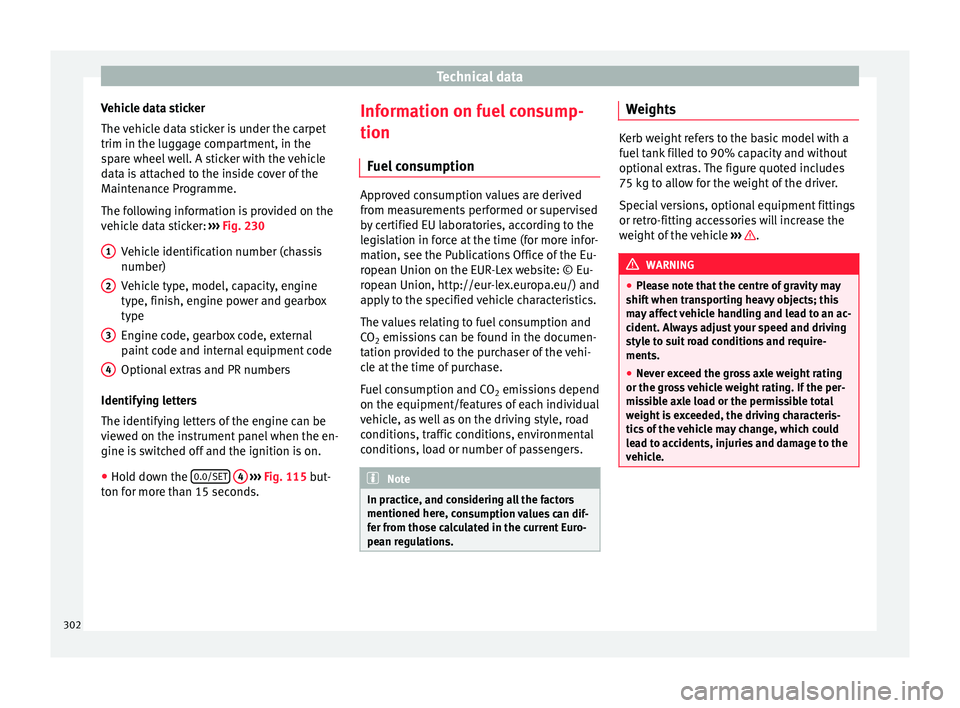
Vehicle data sticker
The v
ehicle data sticker is under the carpet
trim in the luggage compartment, in the
spare wheel well. A sticker with the vehicle
data is attached to the inside cover of the
Maintenance Programme.
The following information is provided on the
vehicle data sticker: ››› Fig. 230
Vehicle identification number (chassis
number)
Vehicle type, model, capacity, engine
type, finish, engine power and gearbox
type
Engine code, gearbox code, external
paint code and internal equipment code
Optional extras and PR numbers
Identifying letters
The identifying letters of the engine can be
viewed on the instrument panel when the en-
gine is switched off and the ignition is on.
● Hold down the 0.0/SET
4
› ›
›
Fig. 115 but-
ton for more than 15 seconds. 1 2
3
4 Information on fuel consump-
tion
Fuel
consumption Approved consumption values are derived
fr
om me
asurements performed or supervised
by certified EU laboratories, according to the
legislation in force at the time (for more infor-
mation, see the Publications Office of the Eu-
ropean Union on the EUR-Lex website: © Eu-
ropean Union, http://eur-lex.europa.eu/) and
apply to the specified vehicle characteristics.
The values relating to fuel consumption and
CO 2 emissions can be found in the documen-
tation provided to the purchaser of the vehi-
cle at the time of purchase.
Fuel consumption and CO 2 emissions depend
on the equipment/features of each individual
vehicle, as well as on the driving style, road
conditions, traffic conditions, environmental
conditions, load or number of passengers. Note
In practice, and considering all the factors
mentioned her e, c
onsumption values can dif-
fer from those calculated in the current Euro-
pean regulations. Weights
Kerb weight refers to the basic model with a
f
uel
tank filled to 90% capacity and without
optional extras. The figure quoted includes
75 kg to allow for the weight of the driver.
Special versions, optional equipment fittings
or retro-fitting accessories will increase the
weight of the vehicle ››› .
WARNING
● Ple
ase note that the centre of gravity may
shift when transporting heavy objects; this
may affect vehicle handling and lead to an ac-
cident. Always adjust your speed and driving
style to suit road conditions and require-
ments.
● Never exceed the gross axle weight rating
or the gro
ss vehicle weight rating. If the per-
missible axle load or the permissible total
weight is exceeded, the driving characteris-
tics of the vehicle may change, which could
lead to accidents, injuries and damage to the
vehicle. 302
Page 305 of 328
Technical specifications
Trailer mode Tr
ailer weights Trailer weight
The tr
ai
ler weights and drawbar loads ap-
proved are selected in intensive trials accord-
ing to precisely defined criteria. The ap-
proved trailer weights are valid for vehicles in
the EU for maximum speeds of 80 km/h (50
mph) (in certain circumstances up to 100
km/h (62 mph)). The figures may be different
in other countries. All data in the official vehi-
cle documentation takes precedence over
these data at all times ››› .
Dr a
wbar loads
The maximum permitted drawbar load on the
ball joint of the towing bracket must not ex-
ceed 80 kg.
In the interest of road safety, we recommend
that you always tow approaching the maxi-
mum drawbar load. The response of the trail-
er on the road will be poor, if the drawbar
load is too small.
If the maximum permissible drawbar load
cannot be met (e.g. with small, empty and
light-weight single axle trailers or tandem
axle trailers with a wheelbase of less than 1
metre), a minimum of 4% of the actual trailer
weight is legally required for the drawbar
load. WARNING
● For s
afety reasons, you should not drive at
speeds above 80 km/h (50 mph) when towing
a trailer. This also applies in countries where
higher speeds are permitted.
● Never exceed the maximum trailer weights
or the dra
wbar load. If the permissible axle
load or the permissible total weight is excee-
ded, the driving characteristics of the vehicle
may change, leading to accidents, injuries
and damage to the vehicle. Wheels
Ty
re pressure, snow chains, wheel
bolts Tyre pressures
The s
tic
ker with the tyre pressure values can
be found on the inside of the fuel tank flap.
The tyre pressure values given there are for
cold tyres. The slightly raised pressures of
warm tyres must not be reduced. ››› The pressure for win
t
er tyres is 0.2 bar
(2.9 psi / 20 kPa) higher than that of summer
tyres.
Snow chains
Snow chains may be fitted only to the front
wheels, and only for the following tyres:
215/60 R16Chains with links of maximum 15 mm
215/55 R17Chains with links of maximum 15 mm
215/50 R18Chains with links of maximum 15 mm
Other dimensions do not allow chains Wheel bolts
Af
t
er the wheels have been changed, the
tightening torque of the wheel bolts should
be checked as soon as possible with a torque
wrench ››› . The tightening torque for steel
and al lo
y wheels is 140 Nm. WARNING
● Chec k
the tyre pressure at least once per
month. Checking the tyre pressure is very im-
portant. If the tyre pressure is too high or too
low, there is an increased danger of accidents
- particularly at high speeds.
● If the tightening torque of the wheel bolts
is
too low, they could loosen while the vehi-
cle is in motion. Risk of accident! If the tight-
ening torque is too high, the wheel bolts and
threads can be damaged. Note
We recommend that you ask your Technical
Ser v
ice for information about appropriate
wheel, tyre and snow chain size. 303
Technical data
Advice
Operation
Emergencies
Safety
Page 316 of 328
Index
Fuel tank flap openin g and c
losing . . . . . . . . . . . . . . . . . . . . . 48
Full-LED Headlights . . . . . . . . . . . . . . . . . . . . . . . . 93
Function Coming Home . . . . . . . . . . . . . . . . . . . . 134
Function Leaving Home . . . . . . . . . . . . . . . . . . . . 135
Fuses . . . . . . . . . . . . . . . . . . . . . . . . . . . . . . . . . 51, 90 fuse box . . . . . . . . . . . . . . . . . . . . . . . . . . . . . . . . 91
identifying blown fuses . . . . . . . . . . . . . . . . . . . 51
Identifying by colours . . . . . . . . . . . . . . . . . . . . . 51
Preparation before replacing . . . . . . . . . . . . . . . 51
replacing . . . . . . . . . . . . . . . . . . . . . . . . . . . . . . . 51
G Gear-change indicator . . . . . . . . . . . . . . . . . . . . . . 31
Gearbox DSG see Automatic gearbox . . . . . . . . . . . . . . . . . . . 177
Gearbox lever . . . . . . . . . . . . . . . . . . . . . . . . . . . . . 40
Gear change . . . . . . . . . . . . . . . . . . . . . . . . . . . . . . 40 automatic . . . . . . . . . . . . . . . . . . . . . . . . . . . . . . 41
Kick-down . . . . . . . . . . . . . . . . . . . . . . . . . . . . . 227
manual gearbox . . . . . . . . . . . . . . . . . . . . . . . . 176
Manual gear change . . . . . . . . . . . . . . . . . . . . . . 40
Gear engaged . . . . . . . . . . . . . . . . . . . . . . . . . . . . . 40
Gear recommendation . . . . . . . . . . . . . . . . . . . . . . 31
Gearshift paddles (automatic gearbox) . . . . . . . 179
General instrument panel Control lamps . . . . . . . . . . . . . . . . . . . . . . . . . . . 38
controls and displays . . . . . . . . . . . . . . . . . . . . 101
Engine compartment . . . . . . . . . . . . . . . . . . . . 282
Warning lamps . . . . . . . . . . . . . . . . . . . . . . . . . . 38
Glove compartment . . . . . . . . . . . . . . . . . . . . . . . 148
H
Hand brake See Parking brake . . . . . . . . . . . . . . . . . . . . . . 170
Hazard warning lights . . . . . . . . . . . . . . . . . 24, 135 HDC
se e Hill Descent Control . . . . . . . . . . . . . . . . . . 190
Head-on collisions and the laws of physics . . . . . 70
Head-protection airbags description . . . . . . . . . . . . . . . . . . . . . . . . . . . . . 17
safety instructions . . . . . . . . . . . . . . . . . . . . . . . 76
Headlight range control . . . . . . . . . . . . . . . . . . . . 137
Headlights driving abroad . . . . . . . . . . . . . . . . . . . . . . . . . 136
Headlight washers . . . . . . . . . . . . . . . . . . . . . . 139
Head restraints . . . . . . . . . . . . . . . . . . . . . . . . . . . . 13 adjustment . . . . . . . . . . . . . . . . . . . . . . . . . . . . 143
front head restraints . . . . . . . . . . . . . . . . . . . . . . 66
rear head restraints . . . . . . . . . . . . . . . . . . . . . . 66
Headrests . . . . . . . . . . . . . . . . . . . . . . . . . . . . . . . . 13 adjustment . . . . . . . . . . . . . . . . . . . . . . . . . . . . 143
front . . . . . . . . . . . . . . . . . . . . . . . . . . . . . . . . . . . 66
Heated rear window . . . . . . . . . . . . . . . . . . . . . 43, 45
Heating and fresh air . . . . . . . . . . . . . . . . . . . . . . . 46
Hill Descent Control control lamp . . . . . . . . . . . . . . . . . . . . . . . . . . . 190
Horn . . . . . . . . . . . . . . . . . . . . . . . . . . . . . . . . . . . 101
How to jump start . . . . . . . . . . . . . . . . . . . . . . . . . . 58 description . . . . . . . . . . . . . . . . . . . . . . . . . . . . . 59
I
Identifying letters on engine . . . . . . . . . . . . . . . . 301
Ignition . . . . . . . . . . . . . . . . . . . . . . . . . . . . . 23, 165
Ignition lock . . . . . . . . . . . . . . . . . . . . . . . . . 23, 165 see Starter button . . . . . . . . . . . . . . . . . . . . . . . 167
Incorrect sitting position . . . . . . . . . . . . . . . . . . . . 65
Indications on display traffic signs . . . . . . . . . . . . . . . . . . . . . . . . . . . . 229
Indications on the ACT . . . . . . . . . . . . . . . . . . . . . . . . . . . . . . . . . . 185 Indications on the display . . . . . . . . . . . . . . . . . . 103
ad aptive cruise control . . . . . . . . . . . . . . . . . . . 199
assist systems submenu . . . . . . . . . . . . . . . . . . 32
compass . . . . . . . . . . . . . . . . . . . . . . . . . . . . . . 104
distance travelled . . . . . . . . . . . . . . . . . . . . . . . 104
doors, bonnet and rear lid open . . . . . . . . . . . . 32
Driver information system . . . . . . . . . . . . . . . . . 29
driving data . . . . . . . . . . . . . . . . . . . . . . . . . . . . . 33
ECO . . . . . . . . . . . . . . . . . . . . . . . . . . . . . . . . . . 104
engine oil . . . . . . . . . . . . . . . . . . . . . . . . . . . . . . 34
MKB . . . . . . . . . . . . . . . . . . . . . . . . . . . . . . . . . . 105
outside temperature . . . . . . . . . . . . . . . . . . . . . . 31
recommended gear . . . . . . . . . . . . . . . . . . . . . 104
second speed display . . . . . . . . . . . . . . . . . . . 104
selector lever positions . . . . . . . . . . . . . 104, 177
service intervals . . . . . . . . . . . . . . . . . . . . . . . . . 35
speed warning . . . . . . . . . . . . . . . . . . . . . . . . . 104
Start-Stop . . . . . . . . . . . . . . . . . . . . . . . . . . . . . 104
time . . . . . . . . . . . . . . . . . . . . . . . . . . . . . . . . . . 104
tyre monitoring . . . . . . . . . . . . . . . . . . . . . . . . . 297
warning and control lamps . . . . . . . . . . . . . . . 199
warning and information messages . . . . . . . . . 32
Indications on the screen SEAT Drive Profile . . . . . . . . . . . . . . . . . . . . . . . 225
Inertia mode . . . . . . . . . . . . . . . . . . . . . . . . . . . . . 182
Infotainment system . . . . . . . . . . . . . . . . . . . . . . . 26
Inspection . . . . . . . . . . . . . . . . . . . . . . . . . . . . . . . 284
Inspection service . . . . . . . . . . . . . . . . . . . . . . . . 284
Instrument cluster . . . . . . . . . . . . . . . . . . . . . . . . 102
Instrument panel . . . . . . . . . . . . . . . . . . . . . . . . . 102 display . . . . . . . . . . . . . . . . . . . . . . . . . . . 102, 103
instruments . . . . . . . . . . . . . . . . . . . . . . . . . . . . 102
menus . . . . . . . . . . . . . . . . . . . . . . . . . . . . . . . . . 29
odometer . . . . . . . . . . . . . . . . . . . . . . . . . . . . . . 105
service interval indication . . . . . . . . . . . . . . . . . 35
warning and control lamps . . . . . . . . . . . . . . . 106
Interior lights . . . . . . . . . . . . . . . . . . . . . . . . . . . . . 24
314
Page 317 of 328
Index
Interior view lef
t guide . . . . . . . . . . . . . . . . . . . . . . . . . . . . . . . . 7
right-hand drive . . . . . . . . . . . . . . . . . . . . . . . . . . 8
ISOFIX . . . . . . . . . . . . . . . . . . . . . . . . . . . . . . . . 19, 21
ISOFIX system . . . . . . . . . . . . . . . . . . . . . . . . . . . . . 19
ISOFIX System . . . . . . . . . . . . . . . . . . . . . . . . . . . . . 21
J Jack . . . . . . . . . . . . . . . . . . . . . . . . . . . . . . . . . . 54, 83 mounting points . . . . . . . . . . . . . . . . . . . . . . . . . 55
Jump leads . . . . . . . . . . . . . . . . . . . . . . . . . . . . . . . 58
K
Key-operated switch . . . . . . . . . . . . . . . . . . . . . . . . 77
Keyless-Entry see Keyless Access . . . . . . . . . . . . . . . . . . . . . . 116
Keyless-Exit see Keyless Access . . . . . . . . . . . . . . . . . . . . . . 116
Keyless Access Easy Open . . . . . . . . . . . . . . . . . . . . . . . . . . . . . 116
Keyless-Entry . . . . . . . . . . . . . . . . . . . . . . . . . . 116
Keyless-Exit . . . . . . . . . . . . . . . . . . . . . . . . . . . . 116
Press & Drive . . . . . . . . . . . . . . . . . . . . . . . . . . . 167
special characteristics . . . . . . . . . . . . . . . . . . . 119
starting the engine . . . . . . . . . . . . . . . . . . . . . . 168
unlocking and locking the vehicle . . . . . . . . . . 116
Keyless Access locking and ignition system see Keyless Access . . . . . . . . . . . . . . . . . . . . . . 116
Keys assign key . . . . . . . . . . . . . . . . . . . . . . . . . . . . . 113
car key . . . . . . . . . . . . . . . . . . . . . . . . . . . . . . . . 113
driver messages (mechanical contact) . . . . . . 165
remote control . . . . . . . . . . . . . . . . . . . . . . . . . 113
replacing the battery . . . . . . . . . . . . . . . . . . . . 120
spare key . . . . . . . . . . . . . . . . . . . . . . . . . . . . . . 113
Synchronising . . . . . . . . . . . . . . . . . . . . . . . . . . 120
unlocking and locking . . . . . . . . . . . . . . . . . 9, 114 Kick-down
autom atic gearbox . . . . . . . . . . . . . . . . . . . . . . 181
manual gear change . . . . . . . . . . . . . . . . . . . . . 227
Knee airbags safety information . . . . . . . . . . . . . . . . . . . . . . . 16
L
Lane Assist . . . . . . . . . . . . . . . . . . . . . . . . . . . . . . 213 cleaning the camera area . . . . . . . . . . . . . . . . . 268
Lane Assist system see Lane Assist . . . . . . . . . . . . . . . . . . . . . . . . . 213
Launch control programme (automatic gearbox) 181
Leather: care . . . . . . . . . . . . . . . . . . . . . . . . . . . . . 271
Leaving Home . . . . . . . . . . . . . . . . . . . . . . . . . . . . 135
Lifting the vehicle . . . . . . . . . . . . . . . . . . . . . . . . . . 55
Light Assist . . . . . . . . . . . . . . . . . . . . . . . . . . . . . . 132
Lighting of the instrument panel . . . . . . . . . . . . . 137
Lights . . . . . . . . . . . . . . . . . . . . . . . . . . . . . . 23, 131 audible signals . . . . . . . . . . . . . . . . . . . . . . . . . 131
AUTO . . . . . . . . . . . . . . . . . . . . . . . . . . . . . . . . . 132
changing a bulb . . . . . . . . . . . . . . . . . . . . . . . . . 93
coming home . . . . . . . . . . . . . . . . . . . . . . . . . . 134
cornering lights . . . . . . . . . . . . . . . . . . . . . . . . 134
Daytime running lights . . . . . . . . . . . . . . . . . . . 131
dipped beam headlight . . . . . . . . . . . . . . . . . . 131
Fog light . . . . . . . . . . . . . . . . . . . . . . . . . . . . . . 134
Hazard warning lights . . . . . . . . . . . . . . . . . . . . 24
headlight range control . . . . . . . . . . . . . . . . . . 137
interior lights . . . . . . . . . . . . . . . . . . . . . . . . . . 138
leaving home . . . . . . . . . . . . . . . . . . . . . . . . . . 135
light control . . . . . . . . . . . . . . . . . . . . . . . . . . . 131
lighting of the instruments . . . . . . . . . . . . . . . 137
lighting of the switches . . . . . . . . . . . . . . . . . . 137
main beam lever . . . . . . . . . . . . . . . . . . . . . . . . 131
main beam lights . . . . . . . . . . . . . . . . . . . . . . . 131
main beams . . . . . . . . . . . . . . . . . . . . . . . . . . . . 24
motorway light . . . . . . . . . . . . . . . . . . . . . . . . . 136 parking lights . . . . . . . . . . . . . . . . . . . . . . . . . . 136
re
ading lights . . . . . . . . . . . . . . . . . . . . . . . . . . 138
side lights . . . . . . . . . . . . . . . . . . . . . . . . . . . . . 131
switch . . . . . . . . . . . . . . . . . . . . . . . . . . . . . . . . . 23
turn signal lever . . . . . . . . . . . . . . . . . . . . . . . . 131
Load compartment in the luggage compartment see Loading the luggage compartment . . . . . 149
Loading the luggage compartment . . . . . . . . . . . 149
Loading the vehicle fastening rings . . . . . . . . . . . . . . . . . . . . . . . . . 151
luggage compartment . . . . . . . . . . . . . . . . . . . . 10
roof carrier system . . . . . . . . . . . . . . . . . . . . . . 156
tailboard for transporting long items . . . . . . . 151
trailer . . . . . . . . . . . . . . . . . . . . . . . . . . . . . . . . . 261
Locking and unlocking in the door cylinder . . . . . . . . . . . . . . . . . . . . . . . 9
with the central locking switch . . . . . . . . . . . . 115
Luggage . . . . . . . . . . . . . . . . . . . . . . . . . . . . . . . . 149
Luggage compartment . . . . . . . . . . . . . . . . . . . . . . 10 automatic lock . . . . . . . . . . . . . . . . . . . . . . . . . 125
electric opening and closing . . . . . . . . . . . . . . 123
luggage compartment lighting . . . . . . . . . . . . 138
luggage compartment variable floor . . . . . . . . 153
net bag . . . . . . . . . . . . . . . . . . . . . . . . . . . . . . . 152
rear shelf . . . . . . . . . . . . . . . . . . . . . . . . . . . . . . 150
special characteristics of the electric rear lid . 124
storing the rear shelf . . . . . . . . . . . . . . . . . . . . 150
Unlocking manually . . . . . . . . . . . . . . . . . . . . . . 11
see also Loading the luggage compartment . 149
Luggage compartment floor . . . . . . . . . . . . . . . . 153
Luggage compartment variable floor . . . . . . . . . 153
Luggage net luggage compartment . . . . . . . . . . . . . . . . . . . 152
Lumbar support . . . . . . . . . . . . . . . . . . . . . . . . . . 143
M Main beam assist . . . . . . . . . . . . . . . . . . . . . . . . . 132
315
Page 318 of 328
Index
Main beam lever . . . . . . . . . . . . . . . . . . . . . . . . . . 131
M ain p
anel
turn signal and main beam lever . . . . . . . . . . . 131
Maintenance intervals . . . . . . . . . . . . . . . . . . . . . 284
malfunction catalytic converter . . . . . . . . . . . . . . . . . . . . . . 186
Front Assist . . . . . . . . . . . . . . . . . . . . . . . . . . . . 208
Malfunction Adaptive cruise control . . . . . . . . . . . . . . . . . . 198
clutch . . . . . . . . . . . . . . . . . . . . . . . . . . . . . . . . . 183
diesel particulate filter . . . . . . . . . . . . . . . . . . . 186
front assist monitoring system . . . . . . . . . . . . 208
gearbox . . . . . . . . . . . . . . . . . . . . . . . . . . . . . . . 183
towing bracket . . . . . . . . . . . . . . . . . . . . . . . . . 260
Manual air conditioning . . . . . . . . . . . . . . . . . . . . 44
Manual gearbox . . . . . . . . . . . . . . . . . . . . . . . . . . 176 towing . . . . . . . . . . . . . . . . . . . . . . . . . . . . . . . . . 87
Manual unlocking and locking . . . . . . . . . . . . . . . 85
Maximum trailer weight loading the trailer . . . . . . . . . . . . . . . . . . . . . . . 261
Mirror . . . . . . . . . . . . . . . . . . . . . . . . . . . . . . . . . . 141
Mobile . . . . . . . . . . . . . . . . . . . . . . . . . . . . . . . . . . 265
Mobile telephones . . . . . . . . . . . . . . . . . . . . . . . . 265
Model plate . . . . . . . . . . . . . . . . . . . . . . . . . . . . . . 301
Modifications . . . . . . . . . . . . . . . . . . . . . . . . . . . . 265
Multi-collision Brake . . . . . . . . . . . . . . . . . . . . . . 174
Multimedia . . . . . . . . . . . . . . . . . . . . . . . . . . . . . . 111
My Beat . . . . . . . . . . . . . . . . . . . . . . . . . . . . . . . . . 169
N Natural leather cleaning . . . . . . . . . . . . . . . . . . . . . . . . . . . . . . 271
Navigation system CD-ROM player . . . . . . . . . . . . . . . . . . . . . . . . . 148
Net bag luggage compartment . . . . . . . . . . . . . . . . . . . 152 Noises
Adaptiv e cruise control . . . . . . . . . . . . . . . . . . 198
auxiliary heater . . . . . . . . . . . . . . . . . . . . . . . . . 164
brakes . . . . . . . . . . . . . . . . . . . . . . . . . . . . . . . . 172
ESC . . . . . . . . . . . . . . . . . . . . . . . . . . . . . . . . . . 174
parking brake . . . . . . . . . . . . . . . . . . . . . . . . . . 171
tyres . . . . . . . . . . . . . . . . . . . . . . . . . . . . . . 56, 291
Number of seats . . . . . . . . . . . . . . . . . . . . . . . . . . . 68
O
Octane rating (petrol) . . . . . . . . . . . . . . . . . . . . . . 277
Odometer . . . . . . . . . . . . . . . . . . . . . . . . . . . . . . . 105 partial . . . . . . . . . . . . . . . . . . . . . . . . . . . . . . . . 102
reset button . . . . . . . . . . . . . . . . . . . . . . . . . . . 105
total . . . . . . . . . . . . . . . . . . . . . . . . . . . . . . . . . . 102
Oil change . . . . . . . . . . . . . . . . . . . . . . . . . . . . . . . 286
Oil properties . . . . . . . . . . . . . . . . . . . . . . . . . . . . . 49
On-screen messages Front Assist monitoring system . . . . . . . . . . . . 208
One-touch opening and closing Electric windows . . . . . . . . . . . . . . . . . . . . . . . . 128
Open and close . . . . . . . . . . . . . . . . . . . . . . . . . . 112 rear lid with electric opening and closing . . . . 123
windows . . . . . . . . . . . . . . . . . . . . . . . . . . . . . . 126
Opening . . . . . . . . . . . . . . . . . . . . . . . . . . . . . . . . 112 bonnet . . . . . . . . . . . . . . . . . . . . . . . . . . . . . . . . 283
fuel tank flap . . . . . . . . . . . . . . . . . . . . . . . . . . . 276
rear lid . . . . . . . . . . . . . . . . . . . . . . . . . . . . . . . . 123
sun blind (sunroof) . . . . . . . . . . . . . . . . . . . . . . 129
sunroof . . . . . . . . . . . . . . . . . . . . . . . . . . . . . . . 129
windows . . . . . . . . . . . . . . . . . . . . . . . . . . . . . . 126
Opening and closing . . . . . . . . . . . . . . . . . . . . . . . . 9 bonnet . . . . . . . . . . . . . . . . . . . . . . . . . . . . . . . . 283
by remote control . . . . . . . . . . . . . . . . . . . . . . . 114
fuel tank flap . . . . . . . . . . . . . . . . . . . . . . . . . . . 276
in the door cylinder . . . . . . . . . . . . . . . . . . . . . . . 9
rear lid of the luggage compartment . . . . . . . . 10 sunroof . . . . . . . . . . . . . . . . . . . . . . . . . . . . . . . 129
with the c
entral locking switch . . . . . . . . . . . . 115
Opening manually rear lid . . . . . . . . . . . . . . . . . . . . . . . . . . . . . . . . . 11
Operating malfunction Park Assist . . . . . . . . . . . . . . . . . . . . . . . . . . . . 232
sunroof . . . . . . . . . . . . . . . . . . . . . . . . . . . . . . . 128
Outside temperature . . . . . . . . . . . . . . . . . . . . . . . 31
P Paint . . . . . . . . . . . . . . . . . . . . . . . . . . . . . . . . . . . 268 care . . . . . . . . . . . . . . . . . . . . . . . . . . . . . . . . . . 268
damage . . . . . . . . . . . . . . . . . . . . . . . . . . . . . . . 269
Paintwork code . . . . . . . . . . . . . . . . . . . . . . . . . . . . . . . . . . 301
Panoramic sliding sunroof convenience opening and closing . . . . . . . . . 127
see also Sunroof . . . . . . . . . . . . . . . . . . . . . . . . 128
Park Assist . . . . . . . . . . . . . . . . . . . . . . . . . . . . . . 232 automatic braking intervention . . . . . . . . . . . . 239
automatic interruption . . . . . . . . . . . . . . . . . . . 233
conditions for exiting a parking space . . . . . . 238
driving with a trailer . . . . . . . . . . . . . . . . . . . . . 244
exiting a parking space (only for parallelspaces) . . . . . . . . . . . . . . . . . . . . . . . . . . . . . 238
operating malfunction . . . . . . . . . . . . . . . . . . . 232
parallel parking . . . . . . . . . . . . . . . . . . . . . . . . 236
parking conditions . . . . . . . . . . . . . . . . . . . . . . 236
perpendicular parking . . . . . . . . . . . . . . . . . . . 236
see Park Assist . . . . . . . . . . . . . . . . . . . . . . . . . 232
stopping prematurely . . . . . . . . . . . . . . . . . . . . 233
Parking . . . . . . . . . . . . . . . . . . . . . . . . . . . . 171, 180 with Park Assist . . . . . . . . . . . . . . . . . . . . . . . . 236
Parking aid Rear parking aid . . . . . . . . . . . . . . . . . . . . . . . . 244
316
Page 327 of 328

SEAT S.A. is permanently concerned about continuous development of its t\�ypes and models. For this reason we ask you to under-
stand, that at any given time, changes regarding shape, equipment and te\�chnique may take place on the car delivered. For this reason
no right at all may derive based on the data, drawings and descriptions \�in this current handbook.
All texts, illustrations and standards in this handbook are based on the\� status of information at the time of printing. Except for error
or omission, the information included in the current handbook is valid a\�s of the date of closing print.
Re-printing, copying or translating, whether total or partial is not all\�owed unless SEAT allows it in written form.
SEAT reserves all rights in accordance with the “Copyright” Act.
All rights on changes are reserved.
❀This paper has been manufactured using bleached non-chlorine cellulose.
© SEAT S.A. - Reprint: 15.05.16
About this manual
This manual contains a description of the
equipment supplied with the vehicle at the
time this manual was published. Some of the
units described herein will not be available
until a later date or are only available in cer -
tain markets.
Because this is a general manual for the
ATECA range, some of the equipment and
functions that are described in this manual
are not included in all types or variants of the
model; they may vary or be modified depend -
ing on the technical requirements and on the
market; this is in no way deceptive advertis-
ing.
The illustrations are intended as a general
guide and may vary from the equipment fitted
in your vehicle in some details.
The steering indications (left, right, forward,
reverse) appearing in this manual refer to the
normal driving movements of the vehicle ex -
cept when otherwise indicated.
The audiovisual material only is intended to
help users to understand certain car function -
alities better. It does not replace the instruc -
tion manual. Please use the instruction manu-
al to obtain more comprehensive information
and indications.
The equipment marked with an aster -
isk* is fitted as standard only in certain
versions, and is only supplied as op -
tional extras for some versions, or are
only offered in certain countries.
® All registered marks are indicated with
®. Although the copyright symbol does
not appear, it is a copyrighted mark.
>> The section is continued on the follow-
ing page.
Important warnings on a given page
Detailed contents on a given page
General information on a given page
Emergency information on a given page
Audiovisual material on a given page
WARNING
Texts preceded by this symbol contain infor -
mation on safety. They warn you about possi -
ble dangers of accident or injury.
CAUTION
Texts with this symbol draw your attention to
potential sources of damage to your vehicle.
For the sake of the environment
Texts preceded by this symbol contain rele-
vant information concerning environmental
protection.
Note
Texts preceded by this symbol contain additio -
nal information.
This manual is divided into six large parts,
which are:
1. The essentials
2. Safety
3. Emergencies
4. Operation
5. Tips
6. Technical data
At the end of this manual, there is a detailed
alphabetical index that will help you quickly
find the information you require.