ignition Seat Exeo 2009 Service Manual
[x] Cancel search | Manufacturer: SEAT, Model Year: 2009, Model line: Exeo, Model: Seat Exeo 2009Pages: 310, PDF Size: 8.54 MB
Page 114 of 310
Unlocking and locking
112
– With the control in position 0, press the control briefly to make
the roof tilt open all the way.
– To open the roof as far as an intermediate setting, press and hold
the control until the roof has moved to the desired position.When you release the switch it will automatically spring back from position
to position .
The sliding sun blind in the headliner automatically opens when the sunroof
is slid open. If required, it can be closed by hand when the sunroof is closed.
It is advisable to close the sun blind when the vehicle is left standing in the
sun. It is important to remember to close the sunroof when parking the
vehicle or if it suddenly starts raining – especially when the sun blind is
extended.
For further information on the automatic close function, see ⇒page 112.ClosingClosing
– Turn the control to position ⇒page 111, fig. 81 to close the
sunroof ⇒.
Closing the sunroof from the tilt position
– Pull the specially formed rear end of the control and hold it until
the sunroof has moved down to the desired position.
– Pull the switch briefly to lower the sunroof automatically to the
fully closed position. If required, the sunroof can be stopped in
any position by briefly pulling the control again ⇒.
WARNING
Take care when closing the sliding/tilting roof. There is a risk of suffering
injury. For this reason, always take out the ignition key when leaving the
vehicle.Automatic close function
The sun roof can also be closed from outside the vehicle.– Turn the key in the lock on the driver's door and hold it in the lock
position or press the lock button on the remote control until the
roof has closed all the way ⇒.
WARNING
Take care when closing the sunroof. There is a risk of suffering injury.Sunroof / deflector*The solar cells in the roof power the climate control fan.
The solar roof is operated in the same way as the normal sliding/tilting sun
roof.
The interior trim is fixed to the solar roof and cannot be opened and closed
separately.
A2
A1
A0
Exeo_EN.book Seite 112 Freitag, 28. August 2009 10:14 10
Page 115 of 310
Unlocking and locking113
Safety First
Controls and equipment
Practical tips
Technical Data
Closing the sunroof by overriding the safety cut-out
It is possible to override the safety cut-out to close the
sunroof.The sliding sunroof mechanism is equipped with a safety cut-out. If
the roof should fail to close normally, it can be closed by overriding
the safety cut-out.
– Turn the control to position ⇒page 111, fig. 81 .
– Pull on the control switch until the roof closes.
WARNING
Take care when closing the sunroof. There is a risk of suffering injury. For
this reason, always take out the ignition key when leaving the vehicle.
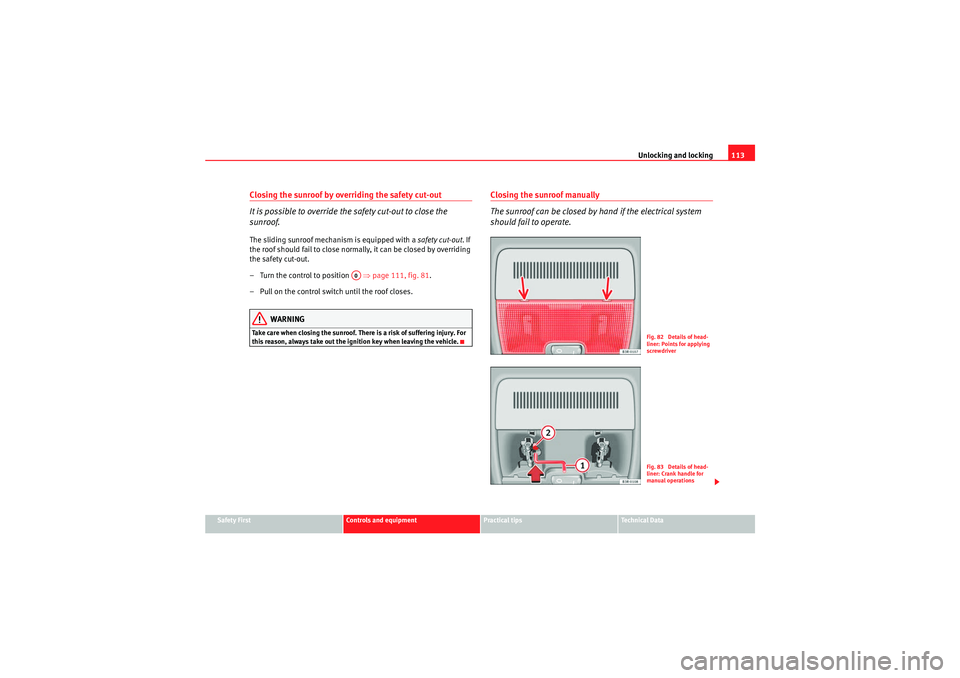
Closing the sunroof manually
The sunroof can be closed by hand if the electrical system
should fail to operate.
A0
Fig. 82 Details of head-
liner: Points for applying
screwdriverFig. 83 Details of head-
liner: Crank handle for
manual operations
Exeo_EN.book Seite 113 Freitag, 28. August 2009 10:14 10
Page 117 of 310
Lights and visibility115
Safety First
Controls and equipment
Practical tips
Technical Data
Lights and visibilityLightsLights: switching on and off
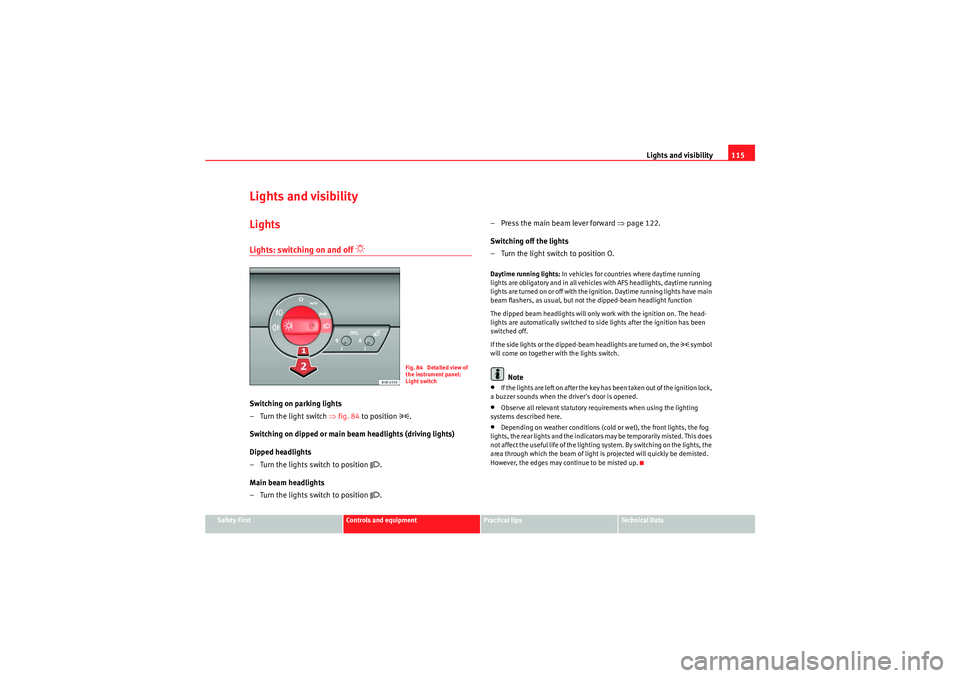
Switching on parking lights
– Turn the light switch ⇒fig. 84 to position
.
Switching on dipped or main beam headlights (driving lights)
Dipped headlights
– Turn the lights switch to position
.
Main beam headlights
– Turn the lights switch to position . – Press the main beam lever forward
⇒page 122.
Switching off the lights
– Turn the light switch to position O.
Daytime running lights: In vehicles for countries where daytime running
lights are obligatory and in all vehicles with AFS headlights, daytime running
lights are turned on or off with the ignition. Daytime running lights have main
beam flashers, as usual, but not the dipped-beam headlight function
The dipped beam headlights will only work with the ignition on. The head-
lights are automatically switched to side lights after the ignition has been
switched off.
If the side lights or the dipped-beam headlights are turned on, the
symbol
will come on together with the lights switch.
Note
•If the lights are left on after the key has been taken out of the ignition lock,
a buzzer sounds when the driver's door is opened.•Observe all relevant statutory requirements when using the lighting
systems described here.•Depending on weather conditions (cold or wet), the front lights, the fog
lights, the rear lights and the indicators may be temporarily misted. This does
not affect the useful life of the lighting system. By switching on the lights, the
area through which the beam of light is projected will quickly be demisted.
However, the edges may continue to be misted up.
Fig. 84 Detailed view of
the instrument panel:
Light switch
Exeo_EN.book Seite 115 Freitag, 28. August 2009 10:14 10
Page 118 of 310
Lights and visibility
116Automatic headlight switch* (sensor-controlled)
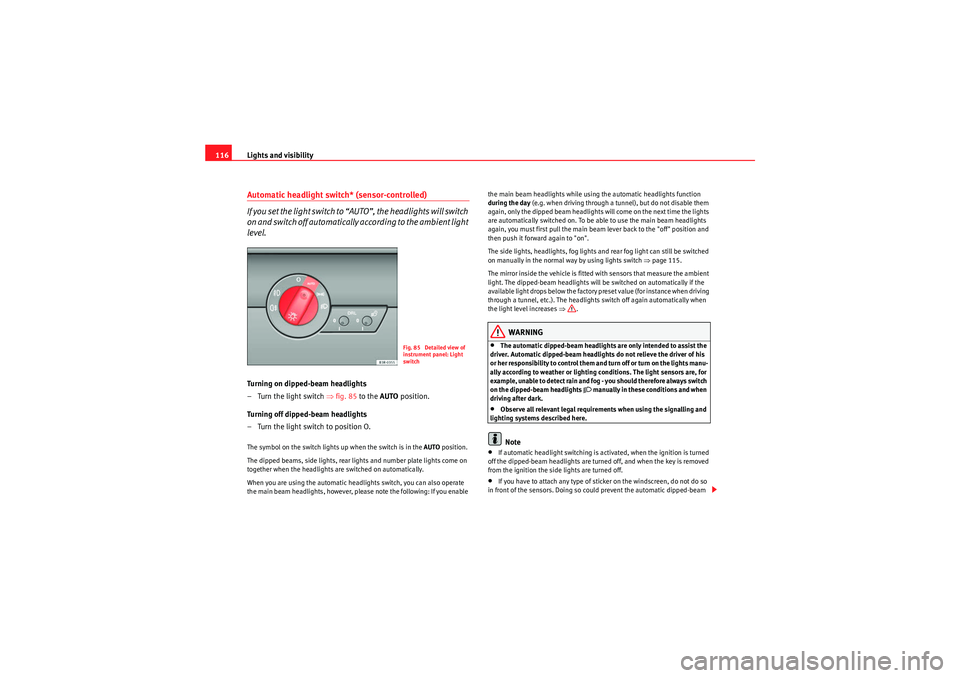
If you set the light switch to “AUTO”, the headlights will switch
on and switch off automatically according to the ambient light
level.Turning on dipped-beam headlights
–Turn the light switch ⇒ fig. 85 to the AUTO position.
Turning off dipped-beam headlights
– Turn the light switch to position O.The symbol on the switch lights up when the switch is in the AUTO position.
The dipped beams, side lights, rear lights and number plate lights come on
together when the headlights are switched on automatically.
When you are using the automatic headlights switch, you can also operate
the main beam headlights, however, please note the following: If you enable the main beam headlights while using the automatic headlights function
during the day
(e.g. when driving through a tunnel), but do not disable them
again, only the dipped beam headlights will come on the next time the lights
are automatically switched on. To be able to use the main beam headlights
again, you must first pull the main beam lever back to the "off" position and
then push it forward again to "on".
The side lights, headlights, fog lights and rear fog light can still be switched
on manually in the normal way by using lights switch ⇒page 115.
The mirror inside the vehicle is fitted with sensors that measure the ambient
light. The dipped-beam headlights will be switched on automatically if the
available light drops below the factory preset value (for instance when driving
through a tunnel, etc.). The headlights switch off again automatically when
the light level increases ⇒.
WARNING
•The automatic dipped-beam headlights are only intended to assist the
driver. Automatic dipped-beam headlights do not relieve the driver of his
or her responsibility to control them and turn off or turn on the lights manu-
ally according to weather or lighting conditions. The light sensors are, for
example, unable to detect rain and fog - you should therefore always switch
on the dipped-beam headlights
manually in these conditions and when
driving after dark.
•Observe all relevant legal requirements when using the signalling and
lighting systems described here.Note
•If automatic headlight switching is activated, when the ignition is turned
off the dipped-beam headlights are turned off, and when the key is removed
from the ignition the side lights are turned off.•If you have to attach any type of sticker on the windscreen, do not do so
in front of the sensors. Doing so could prevent the automatic dipped-beam
Fig. 85 Detailed view of
instrument panel: Light
switch
Exeo_EN.book Seite 116 Freitag, 28. August 2009 10:14 10
Page 120 of 310
Lights and visibility
118Coming home and leaving home functions*
The coming home and leaving home functions are used to
light up the surroundings in the dark. The front fog lights, the
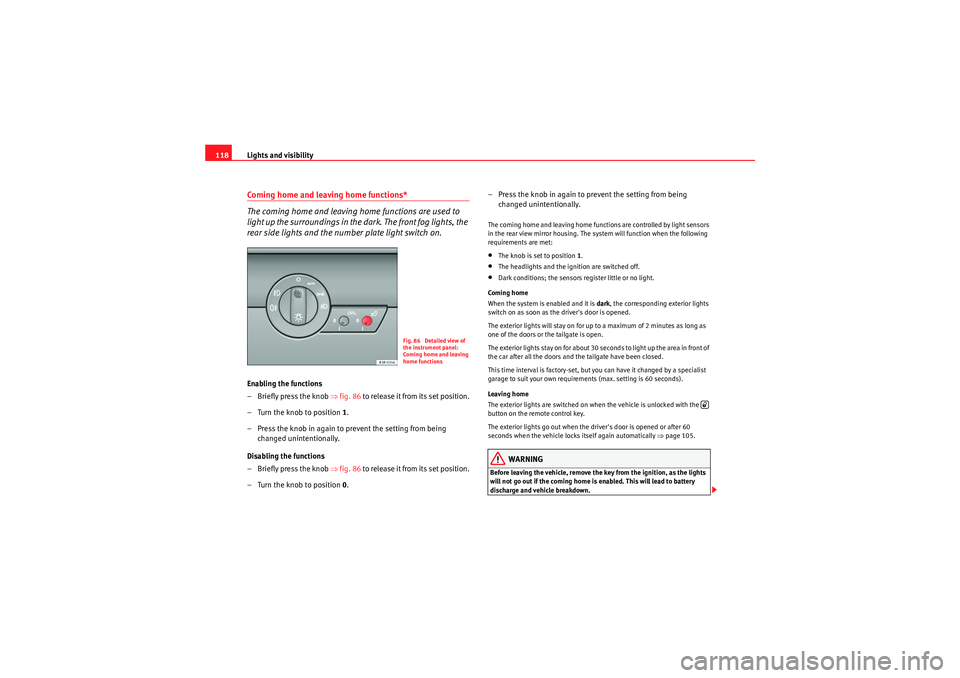
rear side lights and the number plate light switch on.Enabling the functions
– Briefly press the knob ⇒fig. 86 to release it from its set position.
– Turn the knob to position 1.
– Press the knob in again to prevent the setting from being changed unintentionally.
Disabling the functions
– Briefly press the knob ⇒fig. 86 to release it from its set position.
– Turn the knob to position 0. – Press the knob in again to prevent the setting from being
changed unintentionally.
The coming home and leaving home functions are controlled by light sensors
in the rear view mirror housing. The system will function when the following
requirements are met:•The knob is set to position 1.•The headlights and the ignition are switched off.•Dark conditions; the sensors register little or no light.
Coming home
When the system is enabled and it is dark, the corresponding exterior lights
switch on as soon as the driver's door is opened.
The exterior lights will stay on for up to a maximum of 2 minutes as long as
one of the doors or the tailgate is open.
The exterior lights stay on for about 30 seconds to light up the area in front of
the car after all the doors and the tailgate have been closed.
This time interval is factory-set, but you can have it changed by a specialist
garage to suit your own requirements (max. setting is 60 seconds).
Leaving home
The exterior lights are switched on when the vehicle is unlocked with the
button on the remote control key.
The exterior lights go out when the driver's door is opened or after 60
seconds when the vehicle locks itself again automatically ⇒page 105.WARNING
Before leaving the vehicle, remove the key from the ignition, as the lights
will not go out if the coming home is enabled. This will lead to battery
discharge and vehicle breakdown.
Fig. 86 Detailed view of
the instrument panel:
Coming home and leaving
home functions
Exeo_EN.book Seite 118 Freitag, 28. August 2009 10:14 10
Page 121 of 310
Lights and visibility119
Safety First
Controls and equipment
Practical tips
Technical Data
Note
•If you always wish to use the coming home and leaving home functions,
you can leave them permanently switched on. As the system is controlled via
a light sensor, it will only work in dark conditions.•Permanent use of the coming home and leaving home functions, particu-
larly on short journeys, will increase the load on the battery. To make sure the
battery is always sufficiently charged, occasionally drive longer distances.•If the fog lights have been switched on by the coming home and leaving
home functions, they will always be switched off when you switch on the igni-
tion.•Observe all relevant legal requirements when using the signalling and
lighting systems described here.Instrument lighting
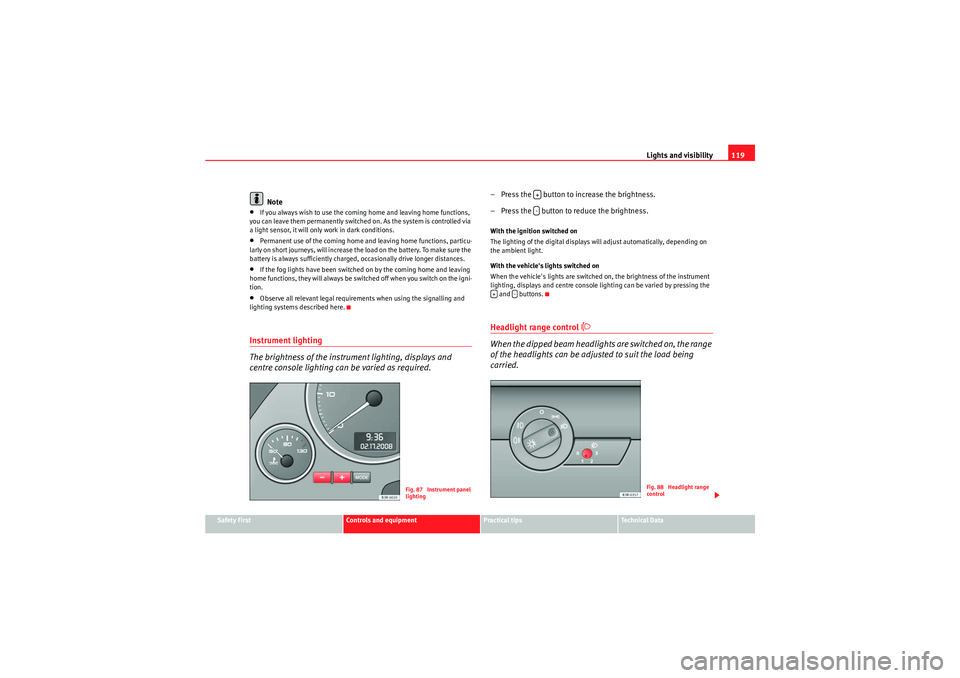
The brightness of the instrument lighting, displays and
centre console lighting can be varied as required.
– Press the button to increase the brightness.
– Press the button to reduce the brightness.With the ignition switched on
The lighting of the digital displays will adjust automatically, depending on
the ambient light.
With the vehicle's lights switched on
When the vehicle's lights are switched on, the brightness of the instrument
lighting, displays and centre console lighting can be varied by pressing the and buttons.Headlight range control
When the dipped beam headlights are switched on, the range
of the headlights can be adjusted to suit the load being
carried.
Fig. 87 Instrument panel
lighting
+-
+
-
Fig. 88 Headlight range
control
Exeo_EN.book Seite 119 Freitag, 28. August 2009 10:14 10
Page 122 of 310
Lights and visibility
120
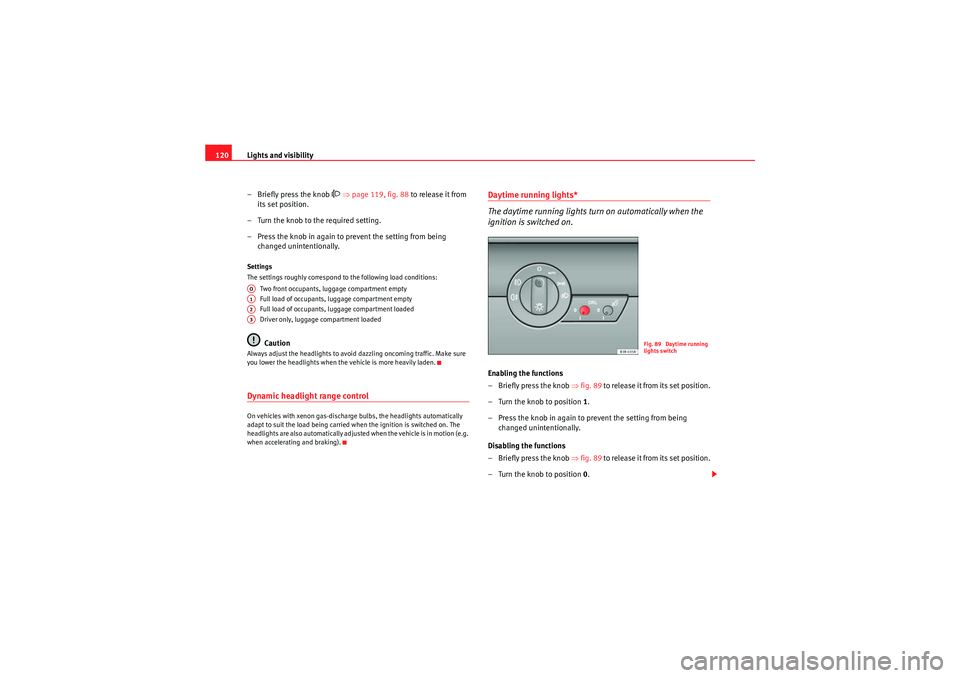
– Briefly press the knob
⇒ page 119, fig. 88 to release it from
its set position.
– Turn the knob to the required setting.
– Press the knob in again to prevent the setting from being changed unintentionally.
Settings
The settings roughly correspond to the following load conditions:
Two front occupants, luggage compartment empty
Full load of occupants, luggage compartment empty
Full load of occupants, luggage compartment loaded
Driver only, luggage compartment loaded
Caution
Always adjust the headlights to avoid dazzling oncoming traffic. Make sure
you lower the headlights when the vehicle is more heavily laden.Dynamic headlight range controlOn vehicles with xenon gas-discharge bulbs, the headlights automatically
adapt to suit the load being carried when the ignition is switched on. The
headlights are also automatically adjusted when the vehicle is in motion (e.g.
when accelerating and braking).
Daytime running lights*
The daytime running lights turn on automatically when the
ignition is switched on.Enabling the functions
– Briefly press the knob ⇒fig. 89 to release it from its set position.
– Turn the knob to position 1.
– Press the knob in again to prevent the setting from being changed unintentionally.
Disabling the functions
– Briefly press the knob ⇒fig. 89 to release it from its set position.
– Turn the knob to position 0.
AOA1A2A3
Fig. 89 Daytime running
lights switch
Exeo_EN.book Seite 120 Freitag, 28. August 2009 10:14 10
Page 123 of 310
Lights and visibility121
Safety First
Controls and equipment
Practical tips
Technical Data
– Press the knob in again to prevent the setting from being
changed unintentionally.This button activates or deactivates the daytime running lights function. With
the function activated, when the ignition is switched on the daytime running
lights are turned on automatically.
Note
Please observe any relevant legal requirements which may apply in your
country.Adaptive headlights* (for cornering)
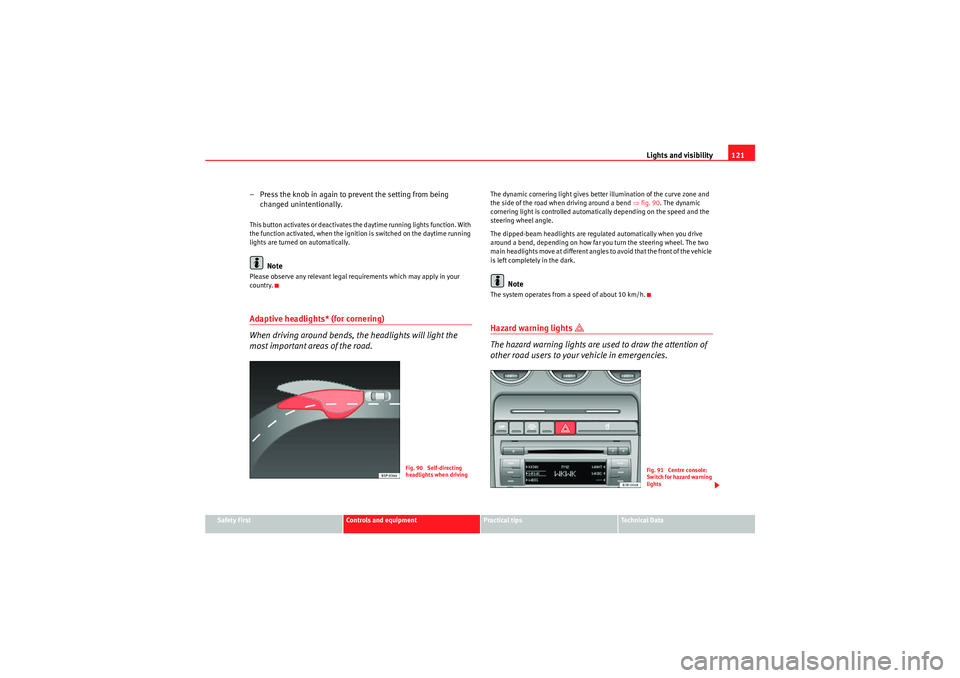
When driving around bends, the headlights will light the
most important areas of the road.
The dynamic cornering light gives better illumination of the curve zone and
the side of the road when driving around a bend ⇒fig. 90 . The dynamic
cornering light is controlled automatically depending on the speed and the
steering wheel angle.
The dipped-beam headlights are regulated automatically when you drive
around a bend, depending on how far you turn the steering wheel. The two
main headlights move at different angles to avoid that the front of the vehicle
is left completely in the dark.
Note
The system operates from a speed of about 10 km/h.Hazard warning lights
The hazard warning lights are used to draw the attention of
other road users to your vehicle in emergencies.
Fig. 90 Self-directing
headlights when driving
Fig. 91 Centre console:
Switch for hazard warning
lights
Exeo_EN.book Seite 121 Freitag, 28. August 2009 10:14 10
Page 124 of 310
Lights and visibility
122
–Press the switch
⇒ page 121, fig. 91 to switch the hazard
warning lights on or off.
All four indicators flash simultaneously when the hazard warning lights are
switched on. The hazard warning light indication lamps
and the turn
signal indication lamp itself
flash at the same time. The hazard warning
lights also work when the ignition is switched off.
In an accident in which the airbags are triggered, the hazard warning lights
are switched on automatically.
Note
You should switch on the hazard warning lights to warn other road users, e.g.•When reaching the tail end of a traffic jam•If your vehicle breaks down or there is an emergency•If your vehicle is being towed away or if you are towing another vehicle
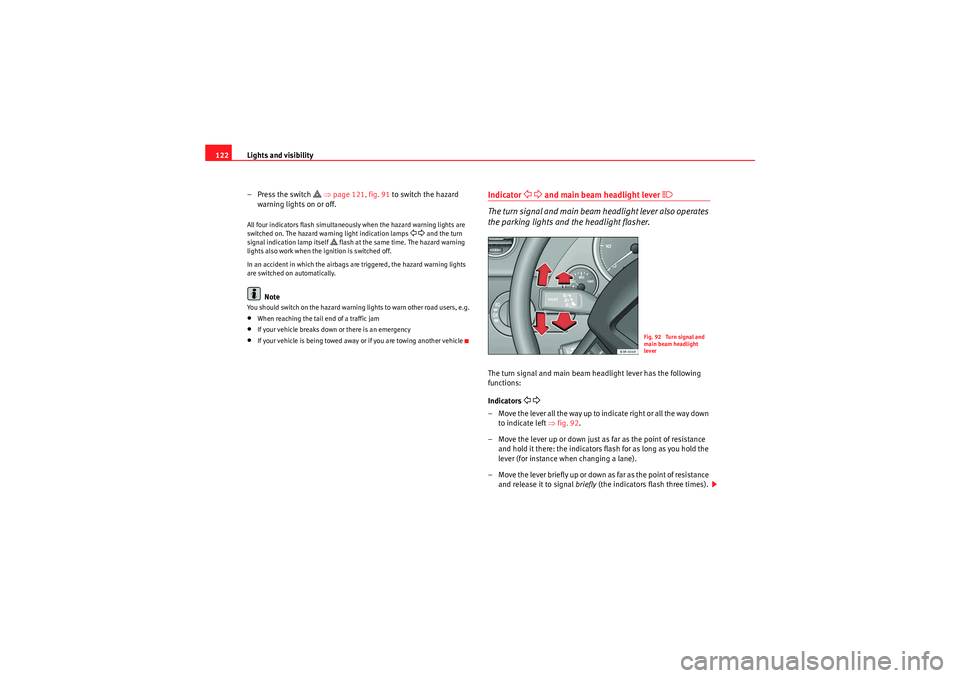
Indicator
and main beam headlight lever
The turn signal and main beam headlight lever also operates
the parking lights and the headlight flasher.The turn signal and main beam headlight lever has the following
functions:
Indicators
– Move the lever all the way up to indicate right or all the way down to indicate left ⇒fig. 92 .
– Move the lever up or down just as far as the point of resistance and hold it there: the indicators flash for as long as you hold the
lever (for instance when changing a lane).
– Move the lever briefly up or down as far as the point of resistance and release it to signal briefly (the indicators flash three times).
Fig. 92 Turn signal and
main beam headlight
lever
Exeo_EN.book Seite 122 Freitag, 28. August 2009 10:14 10
Page 125 of 310
Lights and visibility123
Safety First
Controls and equipment
Practical tips
Technical Data
Main beam headlights
– Press the lever forward to switch on the main beams.
– Pull the lever back towards you to switch the main beam head-
lights off again.
Headlight flasher
– Pull the lever towards the steering wheel to operate the flasher.
Parking light
– Switch the ignition off.
– Move the lever up or down to turn on the right or left-hand
parking lights respectively.Notes on these functions•The indicators only work when the ignition is switched on. The indicator
lamp or flashes in the instrument panel when the turns signals
⇒ page 65 are working.
•The indicators are cancelled automatically when the steering wheel is
returned to the straight-ahead position.•The main beam headlights can only be switched on if the dipped beam
headlights are already on. The main beam headlight indicator lamp
then
comes on in the instrument panel.
•The headlight flasher co m es on for as lo ng as yo u pull th e le ve r, e ve n if no
other lights are switched on. The main beam headlight indicator lamp
then comes on in the instrument panel.
•When the parking lights are switched on, the headlight and the rear light
on one side of the car light up with re duced intensity. The parking lights will
only work with the ignition off.
Caution
Never use the main beam headlights or the headlight flasher if this would
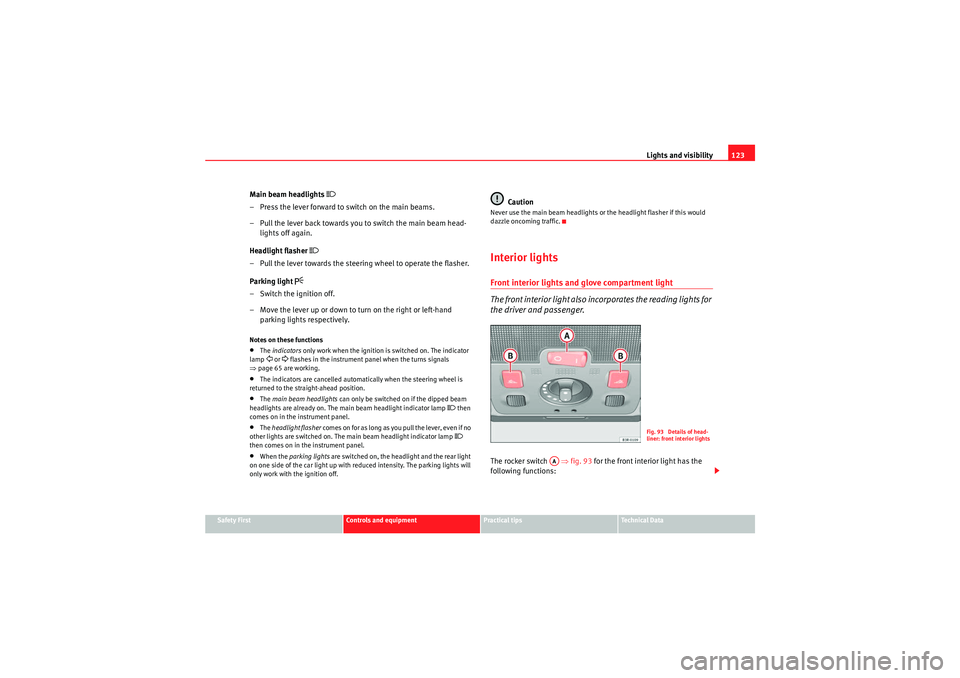
dazzle oncoming traffic.Interior lightsFront interior lights and glove compartment light
The front interior light also incorporates the reading lights for
the driver and passenger.The rocker switch ⇒fig. 93 for the front interior light has the
following functions:
Fig. 93 Details of head-
liner: front interior lights
AA
Exeo_EN.book Seite 123 Freitag, 28. August 2009 10:14 10