child lock Seat Ibiza 5D 2008 Owner's manual
[x] Cancel search | Manufacturer: SEAT, Model Year: 2008, Model line: Ibiza 5D, Model: Seat Ibiza 5D 2008Pages: 260, PDF Size: 8.11 MB
Page 5 of 260
Contents3
ContentsManual structure
. . . . . . . . . . . . . . . . . . . .
Content
. . . . . . . . . . . . . . . . . . . . . . . . . . . . . . . .
Safety First
. . . . . . . . . . . . . . . . . . . . . . . . . . .
Safe driving
. . . . . . . . . . . . . . . . . . . . . . . . . . . . . .
Brief introduction . . . . . . . . . . . . . . . . . . . . . . . .
Proper sitting position for occupants . . . . . . . . .
Pedal area . . . . . . . . . . . . . . . . . . . . . . . . . . . . . .
Stowing luggage . . . . . . . . . . . . . . . . . . . . . . . . .
Seat belts
. . . . . . . . . . . . . . . . . . . . . . . . . . . . . . . .
Brief Introduction . . . . . . . . . . . . . . . . . . . . . . . .
Why wear seat belts? . . . . . . . . . . . . . . . . . . . . . .
Seat belts . . . . . . . . . . . . . . . . . . . . . . . . . . . . . . .
Belt tension devices* . . . . . . . . . . . . . . . . . . . . .
Airbag system
. . . . . . . . . . . . . . . . . . . . . . . . . . . .
Brief introduction . . . . . . . . . . . . . . . . . . . . . . . .
Front airbags . . . . . . . . . . . . . . . . . . . . . . . . . . . .
Side airbags . . . . . . . . . . . . . . . . . . . . . . . . . . . . .
Curtain airbags . . . . . . . . . . . . . . . . . . . . . . . . . .
Deactivating airbags* . . . . . . . . . . . . . . . . . . . . .
Child safety
. . . . . . . . . . . . . . . . . . . . . . . . . . . . . .
Brief introduction . . . . . . . . . . . . . . . . . . . . . . . .
Child seats . . . . . . . . . . . . . . . . . . . . . . . . . . . . . .
Securing child seats . . . . . . . . . . . . . . . . . . . . . .
Operating instructions
. . . . . . . . . . . .
Cockpit
. . . . . . . . . . . . . . . . . . . . . . . . . . . . . . . . . . .
Overview . . . . . . . . . . . . . . . . . . . . . . . . . . . . . . .
Instruments . . . . . . . . . . . . . . . . . . . . . . . . . . . . .
Digital display in the instrument panel . . . . . . .
Warning lamps . . . . . . . . . . . . . . . . . . . . . . . . . . .
Steering column controls*
. . . . . . . . . . . . . . . .
General information . . . . . . . . . . . . . . . . . . . . . .
Audio Control . . . . . . . . . . . . . . . . . . . . . . . . . . . .
Audio + Telephone Control . . . . . . . . . . . . . . . . .
Unlocking and locking
. . . . . . . . . . . . . . . . . . . .
Central locking . . . . . . . . . . . . . . . . . . . . . . . . . . .
Keys . . . . . . . . . . . . . . . . . . . . . . . . . . . . . . . . . . .
Radio frequency remote control . . . . . . . . . . . . .
Anti-theft alarm system* . . . . . . . . . . . . . . . . . . .
Tailgate . . . . . . . . . . . . . . . . . . . . . . . . . . . . . . . . .
Windows . . . . . . . . . . . . . . . . . . . . . . . . . . . . . . .
Panoramic tilting roof* . . . . . . . . . . . . . . . . . . . .
Lights and visibility
. . . . . . . . . . . . . . . . . . . . . . .
Lights . . . . . . . . . . . . . . . . . . . . . . . . . . . . . . . . . .
Interior lights . . . . . . . . . . . . . . . . . . . . . . . . . . . .
Visibility . . . . . . . . . . . . . . . . . . . . . . . . . . . . . . . .
Windscreen washers . . . . . . . . . . . . . . . . . . . . . .
Rearview mirrors . . . . . . . . . . . . . . . . . . . . . . . . .
Seats and stowage
. . . . . . . . . . . . . . . . . . . . . . .
The importance of correct seat adjustment . . . .
Head restraints . . . . . . . . . . . . . . . . . . . . . . . . . .
Front seats . . . . . . . . . . . . . . . . . . . . . . . . . . . . . .
Rear seat bench . . . . . . . . . . . . . . . . . . . . . . . . . .
Stowage compartments . . . . . . . . . . . . . . . . . . .
Ashtrays, cigarette lighter and power point . . . First-aid kit, warning triangle, fire extinguisher*
Boot . . . . . . . . . . . . . . . . . . . . . . . . . . . . . . . . . . .
Heating, Ventilation and Air conditioning
. .
Heating . . . . . . . . . . . . . . . . . . . . . . . . . . . . . . . . .
Air conditioning* . . . . . . . . . . . . . . . . . . . . . . . . .
Climatronic . . . . . . . . . . . . . . . . . . . . . . . . . . . . . .
General notes . . . . . . . . . . . . . . . . . . . . . . . . . . .
Driving
. . . . . . . . . . . . . . . . . . . . . . . . . . . . . . . . . . .
Address . . . . . . . . . . . . . . . . . . . . . . . . . . . . . . . .
Safety . . . . . . . . . . . . . . . . . . . . . . . . . . . . . . . . . .
Ignition lock . . . . . . . . . . . . . . . . . . . . . . . . . . . . .
Starting and stopping the engine . . . . . . . . . . .
Manual gearbox . . . . . . . . . . . . . . . . . . . . . . . . . .
Automatic gearbox* . . . . . . . . . . . . . . . . . . . . . .
Handbrake . . . . . . . . . . . . . . . . . . . . . . . . . . . . . .
Acoustic parking aid system* . . . . . . . . . . . . . . .
Cruise control system (CCS)* . . . . . . . . . . . . . . .
Practical tips
. . . . . . . . . . . . . . . . . . . . . . . . .
Intelligent technology
. . . . . . . . . . . . . . . . . . . . .
Brakes . . . . . . . . . . . . . . . . . . . . . . . . . . . . . . . . .
Anti-lock brake system and traction control ABS
Electronic stabilisation programme (ESP)* . . . .
Driving and the environment
. . . . . . . . . . . . . .
Running-in . . . . . . . . . . . . . . . . . . . . . . . . . . . . . .
Exhaust gas purification system . . . . . . . . . . . . .
Economical and environmentally-friendly driving
Driving abroad . . . . . . . . . . . . . . . . . . . . . . . . . . .
Trailer towing . . . . . . . . . . . . . . . . . . . . . . . . . . . .
5
6
7
7
7
9
14
15
16
16
18
21
25
26
26
29
31
35
38
40
40
42
45 49
49
49
51
52
57
68
68
68
70
72
72
77
78
79
82
84
87
89
89
95
96
97
100
103
103
104
106
108
109
113 115
115
118
118
121
124
127
129
129
130
131
132
134
135
142
144
145
149
149
149
150
151
153
153
154
155
157
161
Ibiza250_angles Seite 3 Dienstag, 5. August 2008 1:11 13
Page 17 of 260

Safe driving15
Safety First
Operating instructions
Practical tips
Te c h n i c a l D a t a
WARNING
•
If the pedals are obstructed, an accide nt may occur. Risk of serious inju-
ries.
•
Ensure that the floor mats are always securely attached.
•
Never lay or fit floor mats or other floor coverings over the original floor
mats. This would reduce the pedal area and could obstruct the pedals. Risk
of accident.
Stowing luggageLoading the boot
All luggage and other loose object s must be safely secured in
the luggage compartment.Unsecured objects which shift back and forth could affect safety or
driving characteristics of the vehicle by shifting the centre of gravity.
– Distribute the load evenly in the luggage compartment.
– Lay and stow heavy luggage as far forward as possible in the luggage compartment.
– Stow heavy luggage as low as possible in the luggage compart- ment.
WARNING
•
Loose luggage and other objects in the boot could cause serious inju-
ries.
•
Always put objects in the luggage compartment.
•
During sudden manoeuvres or accidents, loose objects can be thrown
forward, injuring vehicle occupants or even third parties. This increased
risk of injury will be further increased if a loose object is struck by an
inflating airbag. If this happens, objects can be transformed into
“missiles”. Risk of fatal injury.
•
Please note that the centre of gravity may shift when transporting
heavy objects; this may affect the vehicle's handling and lead to an acci-
dent. Therefore, it is essential to adjust your speed and driving style
accordingly, to avoid accidents.
•
Never exceed the allowed axle loads or allowed maximum weight. If the
allowed axle load or the allowed total weight is exceeded, the driving char-
acteristics of the vehicle may change, leading to accidents, injuries and
damage to the vehicle.
•
Never leave your vehicle unattended, especially when the tailgate is
open. Children could climb into the luggage compartment closing the door
behind them; they will remain trapped without help and there is a mortal
risk.
•
Never allow children to play in or around the vehicle. Close and lock
both the tailgate and all the doors when you leave the vehicle. Before you
lock the vehicle, make sure that ther e are no adults or children in the
vehicle.
•
Never transport passengers in the luggage compartment. Every
passenger must be properly belted in ⇒ page 16.Note
•
Air circulation in the vehicle helps reduce fogging of the windows. Used
air escapes through ventilation slits in the side trim of the luggage compart-
ment. Ensure that the ventil ation slits are never covered.WARNING (continued)
Ibiza250_angles Seite 15 Dienstag, 5. August 2008 1:11 13
Page 23 of 260

Seat belts21
Safety First
Operating instructions
Practical tips
Te c h n i c a l D a t a
•
Fasten your seat belt before every trip - even when driving in town. The
other passengers must also wear the seat belt, otherwise they may be
danger of injury!
•
The seat belt cannot offer its full protection if the belt web is not posi-
tioned correctly.
•
Never allow two passengers (even children) to share the same seat belt.
•
Keep both feet in the foot-well in front of your seat as long as the
vehicle is in motion.
•
Never unbuckle a seat belt while the vehicle is in motion. Risk of fatal
injury.
•
The belt webbing must never be twisted while it is being worn.
•
The belt webbing should never lie on hard or fragile objects (such as
glasses or pens, etc.) because this can cause injuries.
•
Do not allow the seat belt to be damaged or jammed, or to rub on any
sharp edges.
•
Never wear the seat belt under the arm or in any other incorrect posi-
tion.
•
Loose, bulky clothing (such as an overcoat over a jacket) impairs the
proper fit and function of the belts, reducing their capacity to protect.
•
The slot in the seat belt buckle must not be blocked with paper or other
objects, as this can prevent the latch plate from engaging securely.
•
Never use seat belt clips, retaining rings or similar instruments to alter
the position of the belt webbing.
•
Frayed or torn seat belts or damage to the connections, belt retractors
or parts of the buckle could cause severe injuries in the event of an acci-
dent. Therefore, you must check the co ndition of all seat belts at regular
intervals.
•
Seat belts which have been worn in an accident and stretched must be
replaced by a qualified workshop. Renewal may be necessary even if there
is no apparent damage. The belt anchorage should also be checked.
•
Do not attempt to repair a damaged se at belt yourself. The seat belts
must not be removed or modified in any way.
•
The belts must be kept clean, ot herwise the retractors may not work
properly.
Seat beltsSeat belt adjustment
The seat belts for the front and rear occupants are locked into
position by a latch.The seat belt cannot offer its full protection if the belt web is not
positioned correctly.
WARNING (continued)
WARNING (continued)
Fig. 11 Belt buckle and
latch plate of seat belt
Ibiza250_angles Seite 21 Dienstag, 5. August 2008 1:11 13
Page 25 of 260
Seat belts23
Safety First
Operating instructions
Practical tips
Te c h n i c a l D a t a
WARNING
•
An incorrectly worn seat belt web can cause severe injuries in the event
of an accident.
•
The shoulder belt must be posi tioned around the middle of the
shoulder. The seat belt must l ie flat and snugly on the torso ⇒page 22,
fig. 12 .
•
The lap part of the seat belt must l ie across the pelvis, never across the
stomach. The seat belt must lie flat and snugly on the pelvis ⇒page 22,
fig. 13 . Pull the belt tight if necessary to take up any slack.
•
Read and observe the warnings ⇒page 20.
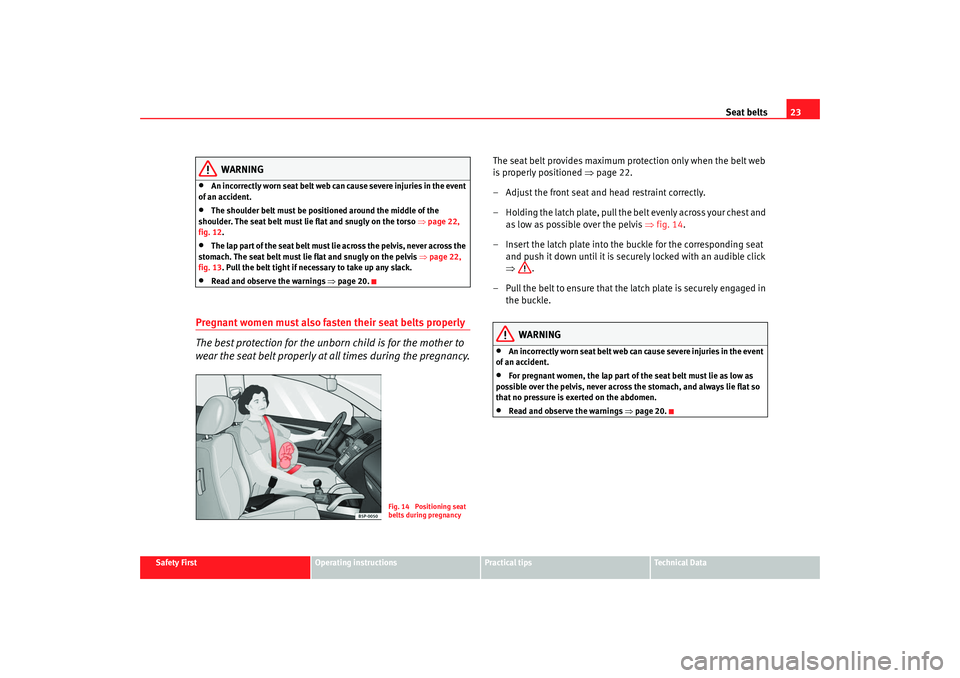
Pregnant women must also fasten their seat belts properly
The best protection for the unborn child is for the mother to
wear the seat belt properly at all times during the pregnancy.
The seat belt provides maximum protection only when the belt web
is properly positioned ⇒page 22.
– Adjust the front seat and head restraint correctly.
– Holding the latch plate, pull the belt evenly across your chest and as low as possible over the pelvis ⇒ fig. 14.
– Insert the latch plate into the buckle for the corresponding seat and push it down until it is securely locked with an audible click
⇒ .
– Pull the belt to ensure that the latch plate is securely engaged in the buckle.
WARNING
•
An incorrectly worn seat belt web can cause severe injuries in the event
of an accident.
•
For pregnant women, the lap part of the seat belt must lie as low as
possible over the pelvis, never across the stomach, and always lie flat so
that no pressure is exerted on the abdomen.
•
Read and observe the warnings ⇒ page 20.
Fig. 14 Positioning seat
belts during pregnancy
Ibiza250_angles Seite 23 Dienstag, 5. August 2008 1:11 13
Page 29 of 260
Airbag system27
Safety First
Operating instructions
Practical tips
Te c h n i c a l D a t a
•
Always properly adjust the front seats.
The danger of fitting a child seat on the front passenger seat
Rear-facing child seats must never be used on the front
passenger seat when the front passenger airbag is enabled.An enabled front airbag on the front passenger side is potentially a major
danger to a child. The front passenger seat is life threatening to a child if
he/she is transported in a rear-facing child seat. You should always transport
all children up to 12 years of age on the rear seat.
If a rear-facing child seat is secured to the front passenger seat, an inflating
airbag can strike it with such great force that critical or fatal injuries may
result.
Therefore we strongly recommend you to transport children on the rear seats.
That is the safest place for children in the vehicle. Alternatively, the front
passenger airbag can be disabled with a key-operated switch ⇒page 38.
When transporting children, use a child seat appropriate to the age and size
of each child.
For those vehicles that do not include a key lock switch to turn the airbag off,
an Authorised Service Centre must be consulted.
WARNING
•
If a child seat is secured to the front passenger seat, the risk to the child
of sustaining critical or fatal injuries in the event of an accident increases.
•
Never secure a rear-facing child seat to the front passenger seat if the
front passenger airbag is enabled. The child can suffer critical or fatal inju-
ries when the front passenger airbag is triggered.
•
An inflating front passenger airbag can strike the rear-facing child seat
and hurl it with great force against the door, the roof or the backrest.
•
If, under special circumstances, it is necessary to transport a child in a
rear-facing child seat on the front passenger seat, it is absolutely essential
that you observe the following safety measures:
−Disable the front passenger airbag ⇒page 38, “Deactivating
airbags*”.
− The child seat must be approved by the child seat manufacturer for
use on a front passenger seat with front or side airbag.
− Follow the installation instructio ns of the child seat manufacturer
and absolutely observe all warnings.
− Before properly installing the child seat, push the front passenger
seat completely backwards so that the greatest possible distance to
the front passenger airbag is ensured.
− Ensure that no objects prevent the front passenger seat from being
pushed completely back.
− The backrest of the front passenger seat must be in an upright
position.
Warning lamp for airbag and belt tension device system
This warning lamp monitors the airbag and belt tension
device system.The warning lamp monitors all airbags and belt tension devices in the
vehicle, including control units and wiring connections.
WARNING (continued)
WARNING (continued)
Ibiza250_angles Seite 27 Dienstag, 5. August 2008 1:11 13
Page 43 of 260
Child safety41
Safety First
Operating instructions
Practical tips
Te c h n i c a l D a t a
Safety notes on using child seats
Proper use of child seats substantially reduces the risk of
injury in an accident!As the driver, you are responsible for any children you transport in
your vehicle.
– Protect your children by properly using appropriate child seats
⇒page 42.
– Always ensure that the belt webbing is properly positioned according to the instructions prov ided by the manufacturer of the
child seat.
– When travelling, do not allow children to distract you from traffic.
– Take breaks regularly during long trips. Take a break at least every two hours.
WARNING
•
Never install a child seat facing backwards (or rear-facing) on the front
passenger seat unless the front passenger airbag has been disabled. This
could lead to a risk of pote ntially fatal injuries to the child! However, if it is
necessary, in exceptional cases, to transport a child in the front passenger
seat, the front passenger airbag must always be disabled ⇒page 38,
“Deactivating airbags*”. If the passe nger seat has a height adjustment
option, move it to the highest position.
•
For those vehicles that do not include a key lock switch to turn the
airbag off, an Authorised Service Centre must be consulted.
•
All passengers, especially children, must assume the proper sitting
position and be properly belted in while travelling.
•
Never hold children or babies on your lap, this can result in potentially
fatal injuries to the child!
•
Never allow a child to be transported in a vehicle without being properly
secured, or to stand up or kneel on a seat while travelling. In an accident,
the child could be flung through the vehicle, causing possibly fatal injuries
to themselves and to the other passengers.
•
If children assume an improper sitting position when the car is moving,
they expose themselves to greater risk of injury in the event of sudden
braking manoeuvre or in an accident. Th is is particularly important if the
child is travelling on the front passenger seat and the airbag system is trig-
gered in an accident; this could cause serious injury or even death.
•
A suitable child seat can protect your child!
•
Never leave an unsupervised child alone on a child seat or in the
vehicle.
•
Depending on weather conditions, it may become extremely hot or cold
inside the vehicle. This can be fatal.
•
Children who are less than 1.5 metres tall must not wear a normal seat
belt without a child restraint system, as this could cause injuries to the
abdominal and neck areas during a sudden braking manoeuvre or in an
accident.
•
Do not allow the belt webbing to become twisted or jammed, or to rub
on any sharp edges.
•
Incorrectly worn seat belts can cause injuries even in a minor collision
or in sudden braking manoeuvres.
•
The seat belt provides maximum protection only when the belt web is
properly positioned ⇒page 21, “Seat belts”.
•
Only one child at a time may occupy a child seat ⇒page 42, “Child
seats”.WARNING (continued)
Ibiza250_angles Seite 41 Dienstag, 5. August 2008 1:11 13
Page 74 of 260
Unlocking and locking
72Unlocking and lockingCentral locking Description
The central locking system enables you to lock and unlock all
doors with just pushing on the keybutton.Central locking can be activated by using any of the following options:•
the key , by inserting it into the driver's door cylinder and rotating it manu-
ally,
•
the interior central locking button ⇒page 75.
•
the radio frequency remote control, using the buttons on the key
⇒ page 78.
Various functions are available to improve the vehicle safety:
- Locking system “Safe”
- Selective unlocking system*
- Self-locking system to prevent involuntary unlocking
- Automatic speed-dependent locking and unlocking system*
- Emergency unlocking system
WARNING
•
Locking from the outside without seeing may cause bruising to other
people, particularly tochildren.
•
When locking a vehicle, never leave children unaccompanied inside, as
from the outside it will be difficu lt to provide assistance if required.
•
Having the doors locked prevents an intrusion from getting in, for
example when stopped at a traffic light.
Note
For anti-theft security, only the driver's door is fitted with a lock cylinder.Safety system “Safe*”
This is an anti-theft device which consists of a double lock for
the door locks and a deactivation function for the boot in
order to prevent a forced entry.Activation
The “safe” system is activated when the vehicle is locked using the key or the
remote control.
To activate it with the key, rotate once it is inserted in the door lock cylinder
in the locking direction.
To activate the system using the remote control, press the lock button once on the remote.
Once this system is activated, opening doors from the outside and the inside
is not possible. The tailgate can not be opened. The central locking button
does not work.
Deactivation
Rotate the key inserted in the lock cylinder twice towards the locking direc-
tion.
To activate the system using the remote control, press the lock button on the
remote twice in less than five seconds.
Ibiza250_angles Seite 72 Dienstag, 5. August 2008 1:11 13
Page 77 of 260
Unlocking and locking75
Safety First
Operating instructions
Practical tips
Te c h n i c a l D a t a
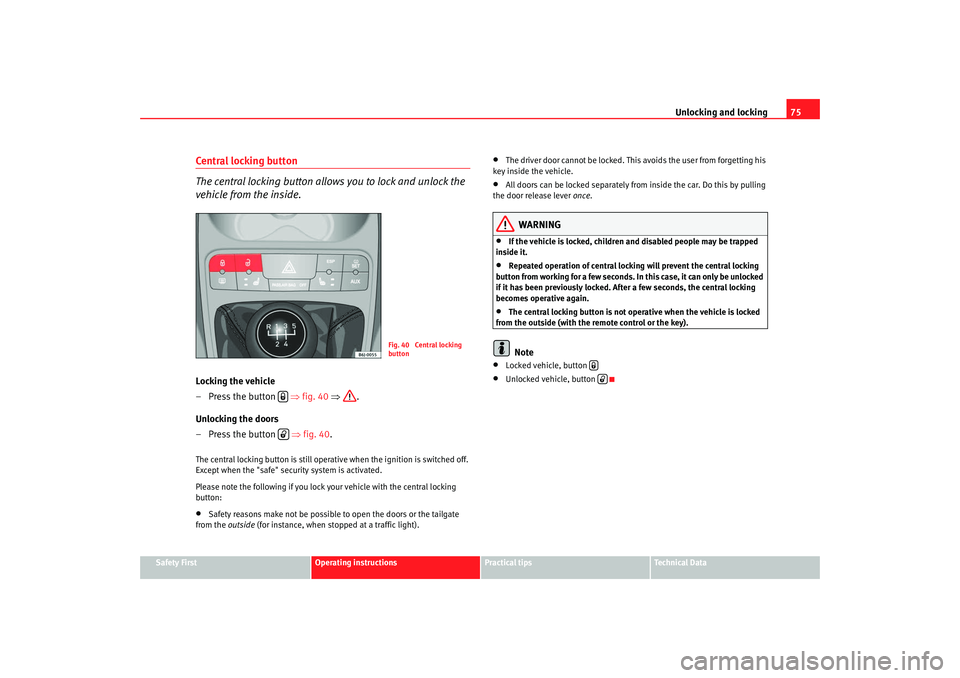
Central locking button
The central locking button allows you to lock and unlock the
vehicle from the inside.Locking the vehicle
– Press the button ⇒fig. 40 ⇒ .
Unlocking the doors
– Press the button ⇒ fig. 40.The central locking button is still operative when the ignition is switched off.
Except when the "safe" security system is activated.
Please note the following if you lock your vehicle with the central locking
button:•
Safety reasons make not be possible to open the doors or the tailgate
from the outside (for instance, when stopped at a traffic light).
•
The driver door cannot be locked. This avoids the user from forgetting his
key inside the vehicle.
•
All doors can be locked separately from inside the car. Do this by pulling
the door release lever once.
WARNING
•
If the vehicle is locked, children and disabled people may be trapped
inside it.
•
Repeated operation of central locking will prevent the central locking
button from working for a few seconds. In this case, it can only be unlocked
if it has been previously locked. Afte r a few seconds, the central locking
becomes operative again.
•
The central locking button is not op erative when the vehicle is locked
from the outside (with the remote control or the key).Note
•
Locked vehicle, button
•
Unlocked vehicle, button
Fig. 40 Central locking
button
Ibiza250_angles Seite 75 Dienstag, 5. August 2008 1:11 13
Page 78 of 260
Unlocking and locking
76Childproof lock
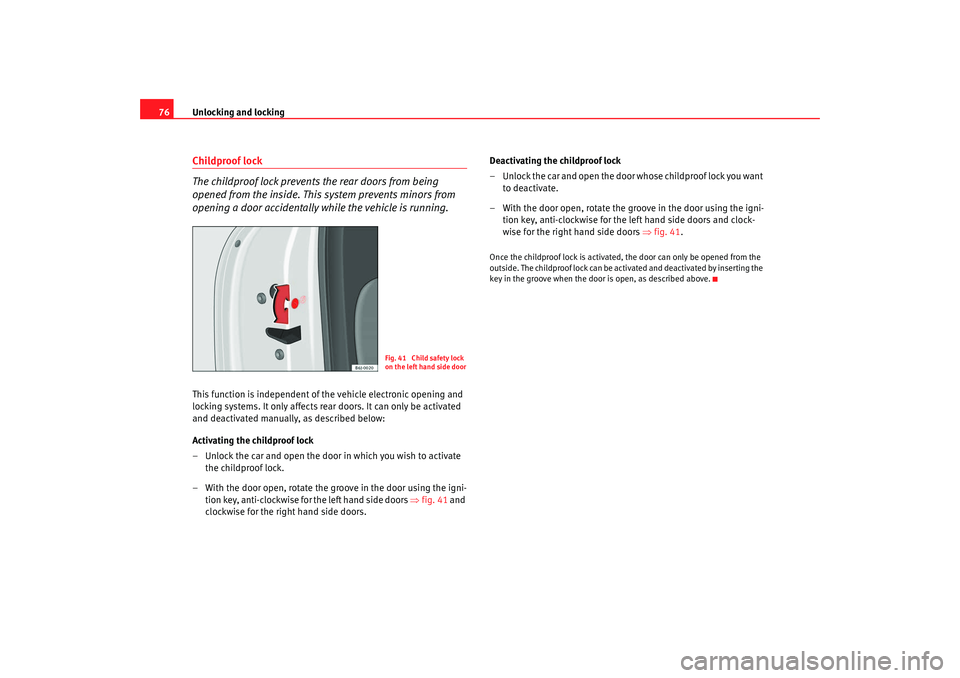
The childproof lock prevents the rear doors from being
opened from the inside. This system prevents minors from
opening a door accidentally while the vehicle is running.This function is independent of the vehicle electronic opening and
locking systems. It only affects rear doors. It can only be activated
and deactivated manually, as described below:
Activating the childproof lock
– Unlock the car and open the door in which you wish to activate
the childproof lock.
– With the door open, rotate the groove in the door using the igni- tion key, anti-clockwise for the left hand side doors ⇒fig. 41 and
clockwise for the right hand side doors. Deactivating the childproof lock
– Unlock the car and open the door whose childproof lock you want
to deactivate.
– With the door open, rotate the groove in the door using the igni- tion key, anti-clockwise for the left hand side doors and clock-
wise for the right hand side doors ⇒fig. 41 .
Once the childproof lock is activated, the door can only be opened from the
outside. The childproof lock can be activated and deactivated by inserting the
key in the groove when the door is open, as described above.
Fig. 41 Child safety lock
on the left hand side door
Ibiza250_angles Seite 76 Dienstag, 5. August 2008 1:11 13
Page 79 of 260
Unlocking and locking77
Safety First
Operating instructions
Practical tips
Te c h n i c a l D a t a
KeysSet of keys
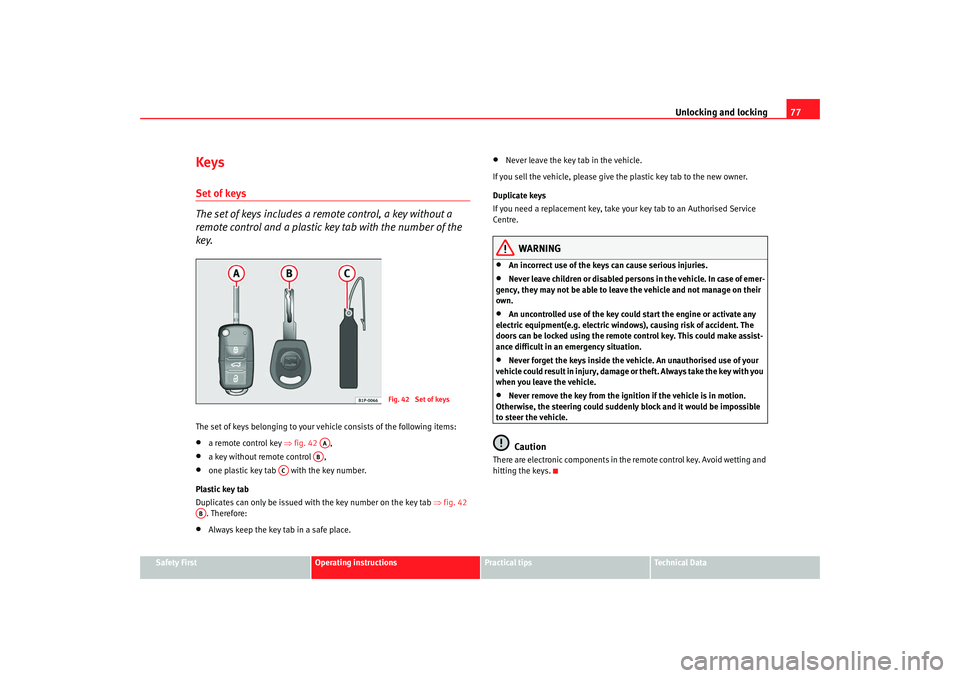
The set of keys includes a remote control, a key without a
remote control and a plastic key tab with the number of the
key.The set of keys belonging to your vehicle consists of the following items:•
a remote control key ⇒fig. 42 ,
•
a key without remote control ,
•
one plastic key tab with the key number.
Plastic key tab
Duplicates can only be issued with the key number on the key tab ⇒fig. 42
. Therefore:
•
Always keep the key tab in a safe place.
•
Never leave the key tab in the vehicle.
If you sell the vehicle, please give the plastic key tab to the new owner.
Duplicate keys
If you need a replacement key, take y our key tab to an Authorised Service
Centre.
WARNING
•
An incorrect use of the keys can cause serious injuries.
•
Never leave children or disabled persons in the vehicle. In case of emer-
gency, they may not be able to leave the vehicle and not manage on their
own.
•
An uncontrolled use of the key could start the engine or activate any
electric equipment(e.g. electric wind ows), causing risk of accident. The
doors can be locked using the remote control key. This could make assist-
ance difficult in an emergency situation.
•
Never forget the keys inside the vehicle. An unauthorised use of your
vehicle could result in injury, damage or theft. Always take the key with you
when you leave the vehicle.
•
Never remove the key from the ignition if the vehicle is in motion.
Otherwise, the steering could suddenly block and it would be impossible
to steer the vehicle.Caution
There are electronic components in the remote control key. Avoid wetting and
hitting the keys.
Fig. 42 Set of keys
AAAB
AC
AB
Ibiza250_angles Seite 77 Dienstag, 5. August 2008 1:11 13