service interval Seat Ibiza SC 2009 Owner's manual
[x] Cancel search | Manufacturer: SEAT, Model Year: 2009, Model line: Ibiza SC, Model: Seat Ibiza SC 2009Pages: 257, PDF Size: 6.61 MB
Page 52 of 257
Cockpit
50Rev counter
The rev. counter displays the engine speed in revolutions per
minute.The start of the red zone ⇒ page 49, fig. 30 indicates the maximum
engine speed operating at service temperature. However, it is advisable to
change up a into a higher gear, move the selector lever to D or lift your foot
off the accelerator before the needle reaches the red zone.
Caution
The rev counter needle must never enter the red zone on the scale. Risk of
engine damage.
For the sake of the environment
Changing up into higher gears early will help you to save fuel and minimise
engine noise.SpeedometerThe speedometer is equipped with a digital odometer and a trip counter, in
addition to a service intervals display.
During the running-in period, the instructions shown on ⇒page 152 should
be followed.
Digital display in the instrument panelFuel gauge
and reserve indicator
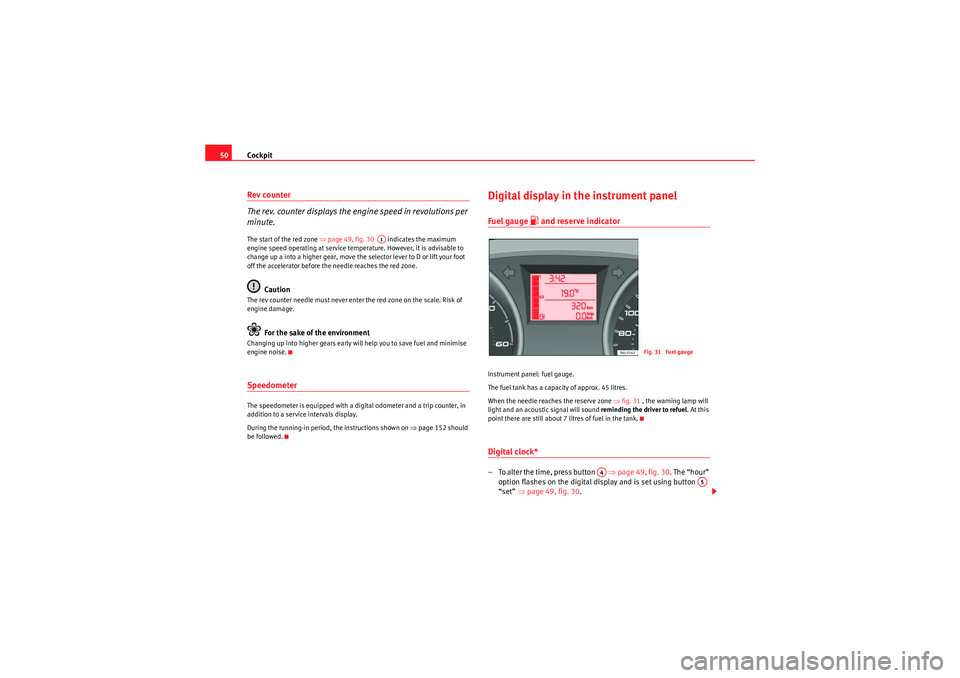
Instrument panel: fuel gauge.
The fuel tank has a capacity of approx. 45 litres.
When the needle reaches the reserve zone ⇒fig. 31 , the warning lamp will
light and an acoustic signal will sound reminding the driver to refuel. At this
point there are still about 7 litres of fuel in the tank.Digital clock* – To alter the time, press button ⇒page 49, fig. 30 . The “hour”
option flashes on the digital display and is set using button
“set” ⇒page 49, fig. 30 .
A1
Fig. 31 Fuel gauge
A4
A5
IbizaSC_EN.book Seite 50 Mittwoch, 16. September 2009 12:11 12
Page 56 of 257
Cockpit
54
WARNING
There could be black ice on the road surface even if the “snowflake symbol”
is not shown. You should, for this reason, not rely exclusively on this
display - Risk of accident!
Note
When the vehicle is stationary or travelling at very low speeds, the tempera-
ture displayed may be slightly higher than the actual ambient temperature as
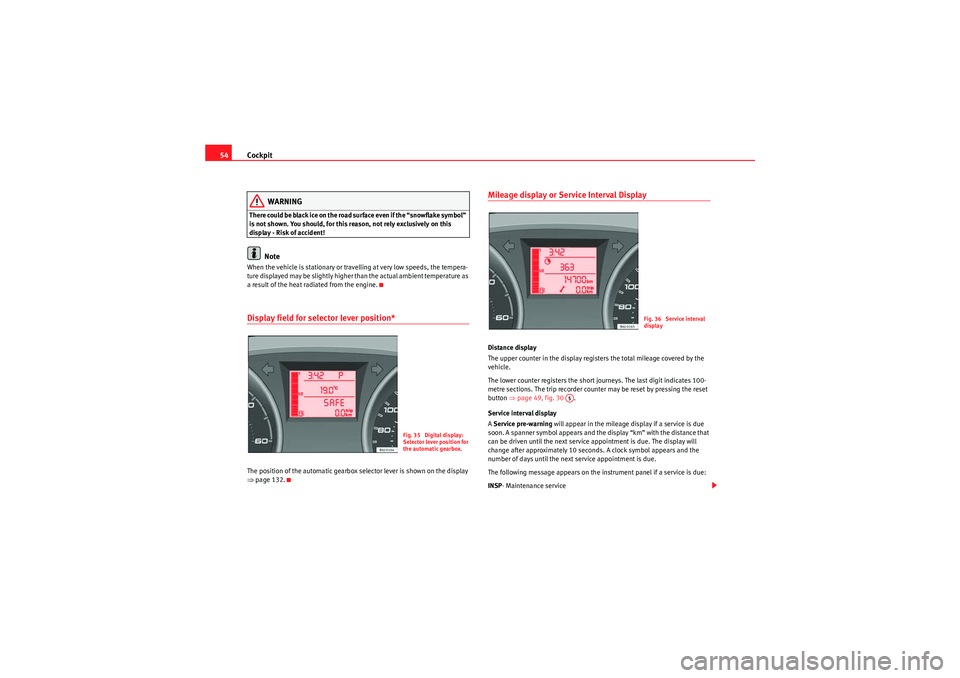
a result of the heat radiated from the engine.Display field for selector lever position*The position of the automatic gearbox selector lever is shown on the display
⇒ page 132.
Mileage display or Service Interval DisplayDistance display
The upper counter in the display registers the total mileage covered by the
vehicle.
The lower counter registers the short journeys. The last digit indicates 100-
metre sections. The trip recorder counter may be reset by pressing the reset
button ⇒page 49, fig. 30 .
Service interval display
A Service pre-warning will appear in the mileage display if a service is due
soon. A spanner symbol appears and the display “km” with the distance that
can be driven until the next service appointment is due. The display will
change after approximately 10 seconds. A clock symbol appears and the
number of days until the next service appointment is due.
The following message appears on the instrument panel if a service is due:
INSP - Maintenance service
Fig. 35 Digital display:
Selector lever position for
the automatic gearbox.
Fig. 36 Service interval
display
A5
IbizaSC_EN.book Seite 54 Mittwoch, 16. September 2009 12:11 12
Page 57 of 257
Cockpit55
Safety First
Controls and equipment
Practical tips
Technical Data
The service message will disappear approximately 20 seconds after the igni-
tion is switched on or the engine is running. This may also be turned off
pressing the short journey counter reset button for more than 0.5 seconds.
4)
The Service Centre which carries out the maintenance service will reset the
maintenance interval display once the service is finished.
We recommend you to carry out the repair and maintenance work only in the
Authorised Service Centres.
If you wish to find out how long before the inspection, press button
⇒
page 49, fig. 30, and select the relevant option from the menu.4)With “Ignition OFF” the maintenance display remains visible.
A4
IbizaSC_EN.book Seite 55 Mittwoch, 16. September 2009 12:11 12
Page 126 of 257
Heating, Ventilation and Air conditioning
124When the outside temperature is low, air recirculation mode improves
heating performance by heating air from the interior instead of cold air from
the outside.
When the outside temperature is high, air recirculation mode improves
cooling performance by cooling air from the interior instead of warm air from
outside.
For safety reasons, it is not recommended to switch air recirculation on when
the air distribution control is being adjusted to the windscreen setting
.
WARNING
In air recirculation mode, no cold air from the outside enters the vehicle
interior. If the air conditioning system is switched off, the windows can
quickly mist over. Therefore, never leave the air recirculation mode
switched on for a long time (risk of accident).
Note
When engaging reverse gear, the air reci rculation is connected automatically
to prevent the entrance of exhaust fumes in the vehicle on travelling back-
wards. In this case the symbol for air recirculation is not displayed.General notesThe impurity filter
The impurity filter (a combined particle filter and active carbon filter) serves
as a barrier against impurities in the ambient air, including dust and pollen.
For the air conditioning system to work with maximum efficiency, the pollen
filter must be replaced at the specified intervals in the Maintenance Program. If the filter loses efficiency prematurely due to use in areas reaching very high
pollution levels, the pollen filter must be changed more frequently than
stated in the Service Schedule.
Caution
•If you suspect that the air conditioning is damaged, switch it off with
button to prevent further damage and have it checked by a qualified
workshop.•Repairs to the air conditioning system require specialist knowledge and
special tools. Therefore, we recommend you to take the vehicle to a qualified
workshop.Note
•If the humidity and temperature outside the vehicle are high, condensa-
tion can drip off the evaporator in the cooling system and so forming a puddle
underneath the vehicle. This is completely normal and there is no need to
suspect a leak.•Keep the air intake slots in front of the windscreen free of snow, ice and
leaves to ensure heating and cooling are not impaired, and to prevent the
windows from misting over.•The air from the vents flows through the vehicle interior and is extracted
by slots designed for this purpose. Therefore, do not cover these slots with
items of clothing or other objects.•The air conditioning system operates most effectively with the windows
and the sliding/tilting roof* closed. However, if the vehicle has been over-
heated by sun, the air inside can be cooled quicklier by opening the windows
for a short time.•Do not smoke while air recirculation mode is on, as smoke drawn into the
air conditioning system leaves a residue on the evaporator, producing a
permanent unpleasant odour.•At low outside temperatures the compressor switches off automatically.
The button cannot be switched on either.
ACAUTO
IbizaSC_EN.book Seite 124 Mittwoch, 16. September 2009 12:11 12
Page 159 of 257
Driving and the environment157
Safety First
Controls and equipment
Practical tips
Technical Data
If the trailer has a 7-pin plug
you will need to use an adapter cable. This is
available in any SEAT dealer.
Trailer weight / draw bar loading
Never exceed the authorised towing limit. If you do not load the trailer up to
the maximum permitted trailer weight, you can then climb correspondingly
steeper slopes.
The maximum trailer weights listed are only applicable for altitudes up to
1,000 m above sea level. With increasing altitude the engine power and
therefore the vehicle's climbing ability are impaired because of the reduced
air density. The maximum trailer weight has to be reduced accordingly. The
weight of the vehicle and trailer combination must be reduced by 10% for
every further 1,000 m (or part thereof). The gross combination weight is the
actual weight of the laden vehicle plus the actual weight of the laden trailer.
When possible, operate the trailer with the maximum permitted draw bar
weight on the ball joint of the towing bracket, but do not exceed the specified
limit.
The figures for trailer weights and draw bar weights that are given on the
data plate of the towing bracket are for certification purposes only. The
correct figures for your specific model, which may be lower than these figures
for the towing bracket, are given in the registration documents ⇒Section
“Technical data”.
Distributing the load
Distribute loads in the trailer so that heavy objects are as near to the axle as
possible. Loads carried in the trailer must be secured to prevent them
moving.
Tyre pressure
Set tyre pressure to the maximum permissible pressure shown on the sticker
on the inside of the fuel tank flap. Set the tyre pressure of the trailer tyres in
accordance with the trailer manufacturer's recommendations. Exterior mirrors
Check whether you can see enough of the road behind the trailer with the
standard mirrors. If this is not the case, you should have additional mirrors
fitted. Both exterior mirrors should be mounted on hinged extension
brackets. Adjust the mirrors to give sufficient vision to the rear.
WARNING
Never transport people in a trailer. This could result in fatal accidents.
Note
•Towing a trailer places additional demands on the vehicle. We recom-
mend additional services between the normal inspection intervals if the
vehicle is used frequently for towing a trailer.•Find out whether special regulations apply to towing a trailer in your
country.Ball coupling of towing bracket*The ball coupling is provided with instructions on fitting and removing the
ball coupling of the towing bracket.
WARNING
The towing bracket ball coupling must be stored securely in the luggage
compartment to prevent them being flung through the vehicle and causing
injury.
IbizaSC_EN.book Seite 157 Mittwoch, 16. September 2009 12:11 12
Page 183 of 257
Checking and refilling levels181
Safety First
Controls and equipment
Practical tips
Technical Data
Checking oil level
– Park the vehicle in a horizontal position.
– Briefly run the engine at idle speed until the service temperature
is reached then stop.
– Wait two minutes.
– Pull out the dipstick. Wipe the dipstick with a clean cloth and insert it again, pushing it in as far as it will go.
– Then pull it out once more and check the oil level ⇒ page 180,
fig. 114. Top up with engine oil if necessary.Oil level in area
–Do not add oil.
Oil level in area
–Oil can be topped up. The indicated oil level should afterwards be in
zone .
Oil level in area
–Oil must be topped up. The indicated oil level should afterwards be in
zone .
Depending on how you drive and the conditions in which the car is used, oil
consumption can be up to 0.5 l/1,000 km. Oil consumption is likely to be
higher for the first 5,000 km. For this reason the engine oil level must be
checked at regular intervals, preferably when filling the tank and before a
journey.
WARNING
Any work carried out in the engine compartment or on the engine must be
carried out cautiously.
•When working in the engine compartment, always observe the safety
warnings ⇒page 176.Caution
If the oil level is above the area do not start the engine. This could result
in damage to the engine and catalytic converter. Contact an Authorised
Service Centre.Topping up engine oil
Top up gradually with small quantities of oil.
Before opening the bonnet, read and observe the warnings ⇒ in
“Safety instructions on working in the engine compartment” on
page 176.
AAAB
AA
AC
AA
WARNING (continued)
AA
Fig. 115 In the engine
compartment: Engine oil
filler cap
IbizaSC_EN.book Seite 181 Mittwoch, 16. September 2009 12:11 12
Page 184 of 257
Checking and refilling levels
182
– Unscrew cap from oil filler opening ⇒fig. 115 .
– Top-up oil in small amounts, using the correct oil.
– To avoid over-filling with engine oil, you should top-up using small quantities, wait a while and check the oil level before
adding any more oil.
– As soon as the oil level is in area , carefully close the cap.The position of the oil filler opening is shown in the corresponding engine
compartment illustration ⇒page 230.
Engine oil specification ⇒page 179.
WARNING
Oil is highly inflammable! Ensure that no oil comes into contact with hot
engine components when topping up.
Caution
If the oil level is above the area do not start the engine. This could result
in damage to the engine and catalytic converter. Contact a qualified work-
shop.
For the sake of the environment
The oil level must never be above area . Otherwise oil can be drawn in
through the crankcase breather and escape into the atmosphere via the
exhaust system.
Changing engine oil
The engine oil must be changed at the intervals given in the
service schedule.We recommend that you have the engine oil changed by an Authorised
Service Centre.
The oil change intervals are shown in the Maintenance Programme.
WARNING
Only change the oil yourself if you have the specialist knowledge required!•Before opening the bonnet, read and observe the warnings
⇒ page 176, “Safety instructions on working in the engine compartment”.•Wait for the engine to cool down. Hot oil may cause burn injuries.•Wear eye protection to avoid injuries caused by splashes of oil.•When removing the oil drain plug with your fingers, keep your arm hori-
zontal to help prevent oil from running down your arm.•Wash your skin thoroughly if it comes into contact with engine oil.•Engine oil is poisonous! Used oil must be stored in a safe place out of
the reach of children until it is disposed of.Caution
No additives should be used with engine oil. This could result in engine
damage. Any damage caused by the use of such additives would not be
covered by the factory warranty.
For the sake of the environment
•Because of the disposal problems, the necessary special tools and
specialist knowledge required, we recommend that you have the engine oil
and filter changed by an Authorised Service Centre.
AB
AA
AA
IbizaSC_EN.book Seite 182 Mittwoch, 16. September 2009 12:11 12
Page 190 of 257
Checking and refilling levels
188Brake fluidChecking the brake fluid level
The brake fluid is checked at the intervals given in the service
schedule.– Read off the fluid level at the transparent brake fluid reservoir. It
should always be between the “MIN” and “MAX” marks.The position of the brake fluid reservoir is shown in the corresponding engine
compartment illustration ⇒page 230. The brake fluid reservoir has a black
and yellow cap.
The brake fluid level drops slightly when the vehicle is being used as the
brake pads are automatically adjusted as they wear. However, if the level goes down noticeably in a short time, or drops below the
“MIN” mark, there may be a leak in the brake system. A display on the instru-
ment panel will warn you if the brake fluid level is too low
⇒page 56.
WARNING
Before opening the bonnet to check the brake fluid level, read and observe
the warnings ⇒page 176.Changing the brake fluid
The Maintenance Program indicates the brake fluid change
intervals.We recommend that you have the brake fluid changed by an Authorised
Service Centre.
Before opening the bonnet, please read and follow the warnings ⇒ in
“Safety instructions on working in the engine compartment” on page 176 in
section “Safety notes for working in the engine compartment”.
Brake fluid absorbs moisture. In the course of time, it will absorb water from
the ambient air. If the water content in the brake fluid is too high, the brake
system could corrode. This also considerably reduces the boiling point of the
brake fluid. Heavy use of the brakes may then cause a vapour lock which
could impair the braking effect.
It is important that you use only brake fluid compliant with US standard
FMVSS 116 DOT 4. We recommend the use of Genuine SEAT brake fluid.
WARNING
Brake fluid is poisonous. Old brake fluid impairs the braking effect.
Fig. 120 In the engine
compartment: Brake fluid
reservoir cover
IbizaSC_EN.book Seite 188 Mittwoch, 16. September 2009 12:11 12
Page 249 of 257
Index247
Index
AABS . . . . . . . . . . . . . . . . . . . . . . . . . . . . . . . . . . . 148
Warning lamp . . . . . . . . . . . . . . . . . . . . . . . . . 59
Accessories . . . . . . . . . . . . . . . . . . . . . . . . . . . . 168
Acoustic signal . . . . . . . . . . . . . . . . . . . . . . . . . . 17
Acoustic warning . . . . . . . . . . . . . . . . . . . . . . . . 128
Adaptive headlights . . . . . . . . . . . . . . . . . . . . . . 88
Adjustable service interval display . . . . . . . . . . 54
Air conditioning system Climatronic . . . . . . . . . . . . . . . . . . . . . . . . . . 121
General notes . . . . . . . . . . . . . . . . . . . . . . . . 124
Air conditioning* . . . . . . . . . . . . . . . . . . . . . . . . 118
Air outlets . . . . . . . . . . . . . . . . . . . . . . . . . . . . . . 117
Air recirculation Semi-automatic air conditioning . . . . . . . . 120
Air recirculation mode Climatronic . . . . . . . . . . . . . . . . . . . . . . . . . . 123
Airbag system . . . . . . . . . . . . . . . . . . . . . . . . . . . 25 Curtain airbags . . . . . . . . . . . . . . . . . . . . . . . 34
Front airbags . . . . . . . . . . . . . . . . . . . . . . . . . 28
Side airbags . . . . . . . . . . . . . . . . . . . . . . . . . . 30
Warning lamp . . . . . . . . . . . . . . . . . . . . . . . . . 26
Alarm system Switching off . . . . . . . . . . . . . . . . . . . . . . . . . 77
Alternator Warning lamp . . . . . . . . . . . . . . . . . . . . . . . . . 64
Ambient temperature display . . . . . . . . . . . . 51, 53 Anti-freeze . . . . . . . . . . . . . . . . . . . . . . . . . . . . . 183
Anti-lock brake system . . . . . . . . . . . . . . . . . . . 148
Warning lamp . . . . . . . . . . . . . . . . . . . . . . . . . 59
Anti-theft alarm system . . . . . . . . . . . . . . . . . . . . 77 Switching off . . . . . . . . . . . . . . . . . . . . . . . . . 77
Anti-theft wheel bolts . . . . . . . . . . . . . . . . . . . . 200
Aquaplaning . . . . . . . . . . . . . . . . . . . . . . . . . . . 194
Automatic anti-dazzle interior mirror* Activating the anti-dazzle function . . . . . . . 97
Deactivating anti-dazzle function . . . . . . . . . 97
Automatic car washing tunnel . . . . . . . . . . . . . 160
Automatic gearbox . . . . . . . . . . . . . . . . . . . . . . 132 Kick-down feature . . . . . . . . . . . . . . . . . . . . 139
Selector lever positions . . . . . . . . . . . . . . . . 137
Automatic wiper/wash function for the rear window 96
AUX input connection/USB* . . . . . . . . . . . . . . . 112
Auxiliary audio input connection: AUX . . . . . . . 111
BBall coupling . . . . . . . . . . . . . . . . . . . . . . . . . . . 157
Battery Changing . . . . . . . . . . . . . . . . . . . . . . . . . . . 191
Charging . . . . . . . . . . . . . . . . . . . . . . . . . . . . 191
Winter conditions . . . . . . . . . . . . . . . . . . . . 189
Belt tension device Disposal . . . . . . . . . . . . . . . . . . . . . . . . . . . . . 24
Warning lamp . . . . . . . . . . . . . . . . . . . . . . . . . 26 Belt tension devices . . . . . . . . . . . . . . . . . . . . . . 24
Biodiesel . . . . . . . . . . . . . . . . . . . . . . . . . . . . . . 175
Biodiesel fuel . . . . . . . . . . . . . . . . . . . . . . . . . . . 175
Bonnet . . . . . . . . . . . . . . . . . . . . . . . . . . . . . . . . 178
Boot . . . . . . . . . . . . . . . . . . . . . . . . . . . . . . . . . . 112
Boot* . . . . . . . . . . . . . . . . . . . . . . . . . . . . . . 93, 218
Brake fluid . . . . . . . . . . . . . . . . . . . . . . . . . . . . . 188
Changing . . . . . . . . . . . . . . . . . . . . . . . . . . . 188
Brake pads . . . . . . . . . . . . . . . . . . . . . . . . . . . . . 152
Brake servo . . . . . . . . . . . . . . . . . . . . . . . 147, 152
Brake system . . . . . . . . . . . . . . . . . . . . . . . . . . . 188 Warning lamp . . . . . . . . . . . . . . . . . . . . . . . . 61
Brakes . . . . . . . . . . . . . . . . . . . . . . . . . . . . . . . . 152
Braking distance . . . . . . . . . . . . . . . . . . . . . . . . 152
Bulb changes general notes . . . . . . . . . . . . . . . . . . . . . . . . 209
Bulb defect Indicator . . . . . . . . . . . . . . . . . . . . . . . . . . . . . 59
Buzzer . . . . . . . . . . . . . . . . . . . . . . . . . . . . . . 91, 128
CCar phone . . . . . . . . . . . . . . . . . . . . . . . . . . . . . . 169
Catalytic converter . . . . . . . . . . . . . . . . . . . . . . . 153
Central locking . . . . . . . . . . . . . . . . . . . . . . . . . . . 70 Automatic speed dependent locking and un-locking system* . . . . . . . . . . . . . . . . . . . . . 72
Locking system for involuntary unlocking . . 72
IbizaSC_EN.book Seite 247 Mittwoch, 16. September 2009 12:11 12