light Seat Ibiza ST 2016 Repair Manual
[x] Cancel search | Manufacturer: SEAT, Model Year: 2016, Model line: Ibiza ST, Model: Seat Ibiza ST 2016Pages: 252, PDF Size: 5.56 MB
Page 126 of 252
Operation
turned off. For this reason, ensure that the
r e
ar lid i s
always closed.
Glove compartment light
When opening the glove compartment on the
passenger side, the glove compartment light
will automatically turn on and will turn off
upon closure.
Ambient light*
››› table on page 2
The ambient lighting lights up the central
console area and the footwell area.
They will switch on fully when the doors are
opened and will decrease in intensity while
driving when the dipped beam headlight is
on.
The intensity of the ambient light* can be ad-
justed using the Easy Connect menu (see
Adjusting Lights > Interior light-
ing ›››
page 24). Note
If not all the vehicle doors are closed, the in-
terior lights w
ill be switched off after approx.
10 minutes, providing the ignition key has
been removed and the courtesy light position
selected. This prevents the battery from dis-
charging. Visibility
He at
ed r e
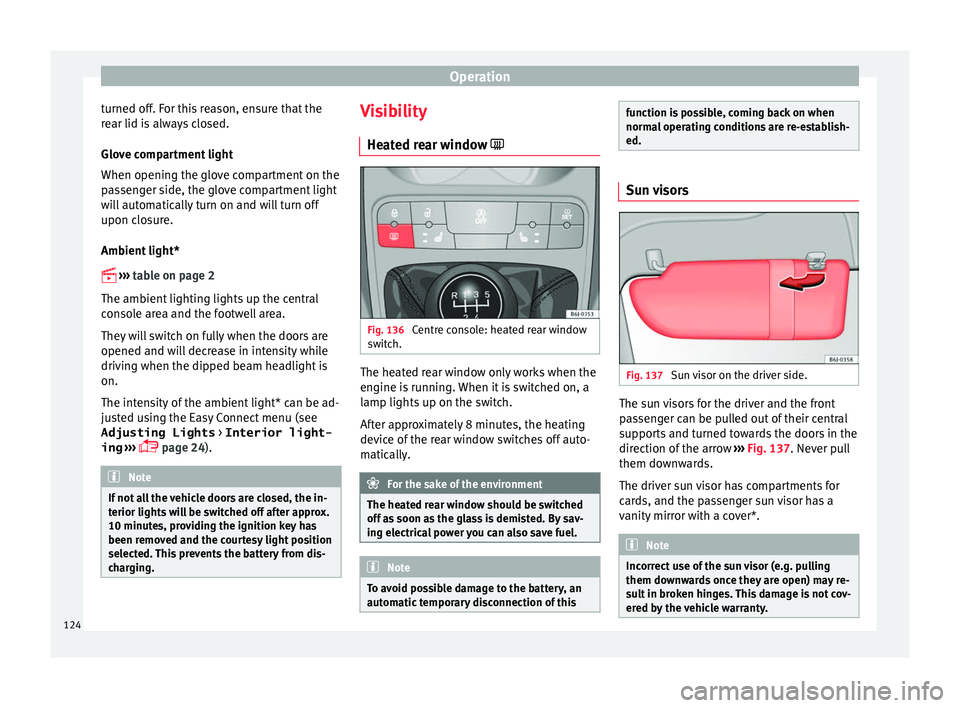
ar window Fig. 136
Centre console: heated rear window
sw it
ch. The heated rear window only works when the
en
gine i
s ru
nning. When it is switched on, a
lamp lights up on the switch.
After approximately 8 minutes, the heating
device of the rear window switches off auto-
matically. For the sake of the environment
The heated rear window should be switched
off as soon a
s the glass is demisted. By sav-
ing electrical power you can also save fuel. Note
To avoid possible damage to the battery, an
automatic t
emporary disconnection of this function is possible, coming back on when
normal
oper
ating conditions are re-establish-
ed. Sun visors
Fig. 137
Sun visor on the driver side. The sun visors for the driver and the front
p
a
ssen
ger can be pulled out of their central
supports and turned towards the doors in the
direction of the arrow ››› Fig. 137. Never pull
them downwards.
The driver sun visor has compartments for
cards, and the passenger sun visor has a
vanity mirror with a cover*. Note
Incorrect use of the sun visor (e.g. pulling
them downw ar
ds once they are open) may re-
sult in broken hinges. This damage is not cov-
ered by the vehicle warranty. 124
Page 127 of 252
Lights and visibility
Windscreen wiper and rear win-
do w w
iper sy s
tems
Control lamp*
It lights up
Windscreen wiper fluid level too low
This serves as a reminder to fill up the reser-
voir at the e
arlie
st opportunity ››› page 210.
Windscreen wipers Read the additional information carefully
› ›
›
p
age 23 WARNING
● Worn and dirty w
iper blades reduce visibili-
ty and safety levels while driving.
● In cold conditions you should not use the
wash/wipe sy
stem unless you have warmed
the windscreen with the heating and ventila-
tion system. The windscreen washer fluid
could otherwise freeze on the windscreen and
obscure your view of the road.
● Always note the corresponding warnings
››› p
age 54. WARNING
The rain sensor* may not detect enough rain
to swit c
h on the wipers.
● If necessary, switch on the wipers manually
when water on the wind
screen obstructs visi-
bility. CAUTION
In icy conditions, always check that the wiper
bla de
s are not frozen to the glass before us-
ing the wipers for the first time. If you switch
on the windscreen wipers when the wiper
blades are frozen to the windscreen, you
could damage both the wiper blades and the
wiper motor. Note
● The winds c
reen wipers will only work when
the ignition is switched on.
● The heat output of the heated jets* is con-
troll
ed automatically when the ignition is
switched on, depending upon the outside
temperature.
● In certain versions of vehicles with alarms,
the windsc
reen wiper will only work in inter-
val/rain sensor mode when the ignition is on
and the bonnet closed.
● When the interval wipe function is on, the
interva
ls are directly proportional to the
speed. This way, the higher the vehicle speed
the shorter the intervals. ●
If y ou s
top the vehicle with the windscreen
wiper in position 1 or 2, it will automatically
change to a lower position speed. The set
speed will be resumed when the vehicle pulls
away.
● The windscreen will be wiped again after
approx
imately five seconds once the “auto-
matic wash/wipe system” has been activa-
ted, provided the vehicle is moving (drip func-
tion). If you activate the wipers less than 3
seconds after the drip function, a new wash
sequence will begin without performing the
last wipe. For the “drip” function to work
again, you have to turn the ignition off and
then on again.
● Do not put stickers on the windscreen in
front of the
rain sensor*. This may cause sen-
sor disruption or faults. Rear window wiper
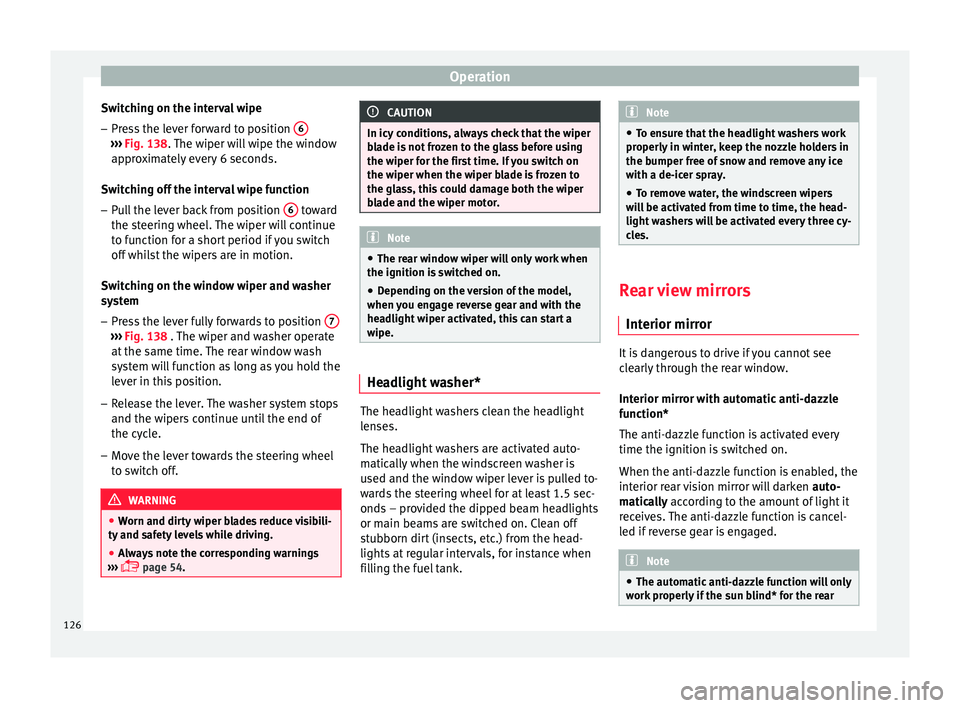
Fig. 138
Windscreen wiper lever: rear window
w iper
. » 125
Technical data
Advice
Operation
Emergencies
Safety
Page 128 of 252
Operation
Switching on the interval wipe – Press the lever forward to position 6›››
Fig. 138. The w
iper w i
ll wipe the window
approximately every 6 seconds.
Switching off the interval wipe function
– Pull the lever back from position 6 toward
the s t
eerin g wheel
. The wiper will continue
to function for a short period if you switch
off whilst the wipers are in motion.
Switching on the window wiper and washer
system – Press the lever fully forwards to position 7›››
Fig. 138 . The wiper and w a
sher operate
at the same time. The rear window wash
system will function as long as you hold the
lever in this position.
– Release the lever. The washer system stops
and the wipers c
ontinue until the end of
the cycle.
– Move the lever towards the steering wheel
to switc
h off. WARNING
● Worn and dirty w
iper blades reduce visibili-
ty and safety levels while driving.
● Always note the corresponding warnings
››› p
age 54. CAUTION
In icy conditions, always check that the wiper
bla de i
s not frozen to the glass before using
the wiper for the first time. If you switch on
the wiper when the wiper blade is frozen to
the glass, this could damage both the wiper
blade and the wiper motor. Note
● The rear w indo
w wiper will only work when
the ignition is switched on.
● Depending on the version of the model,
when you eng
age reverse gear and with the
headlight wiper activated, this can start a
wipe. Headlight washer*
The headlight washers clean the headlight
l
en
ses.
The he
adlight washers are activated auto-
matically when the windscreen washer is
used and the window wiper lever is pulled to-
wards the steering wheel for at least 1.5 sec-
onds – provided the dipped beam headlights
or main beams are switched on. Clean off
stubborn dirt (insects, etc.) from the head-
lights at regular intervals, for instance when
filling the fuel tank. Note
● To ens ur
e that the headlight washers work
properly in winter, keep the nozzle holders in
the bumper free of snow and remove any ice
with a de-icer spray.
● To remove water, the windscreen wipers
will
be activated from time to time, the head-
light washers will be activated every three cy-
cles. Rear view mirrors
Int erior mirr
or It is dangerous to drive if you cannot see
c
l
e arly
through the rear window.
Interior mirror with automatic anti-dazzle
function*
The anti-dazzle function is activated every
time the ignition is switched on.
When the anti-dazzle function is enabled, the
interior rear vision mirror will darken auto-
matically according to the amount of light it
receives. The anti-dazzle function is cancel-
led if reverse gear is engaged. Note
● The automatic anti-d
azzle function will only
work properly if the sun blind* for the rear 126
Page 129 of 252
Lights and visibility
window is retracted and there are no other
obj
ect
s preventing light from reaching the in-
terior rear vision mirror.
● If you have to stick any type of sticker on
the windsc
reen, do not do so in front of the
sensors. Doing so could prevent the anti-daz-
zle function from working well or even from
working at all. Folding in the exterior mirrors man-
ually
The exterior mirrors of the vehicle may be fol-
ded in. F
or thi
s, pre
ss the mirror housing to-
wards the vehicle. Note
Before washing the vehicle with an automatic
car wa sh, f
old in the exterior mirrors to avoid
damage. Electric exterior mirrors*
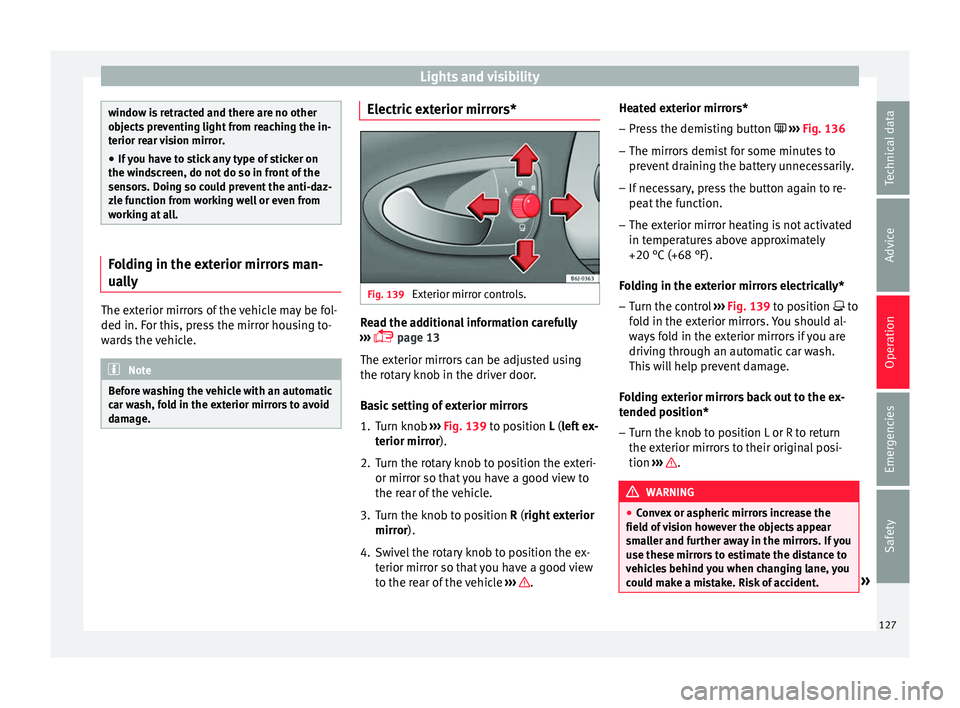
Fig. 139
Exterior mirror controls. Read the additional information carefully
› ›
›
p
age 13
The exterior mirrors can be adjusted using
the rotary knob in the driver door.
Basic setting of exterior mirrors
1. Turn knob ››› Fig. 139 t
o position L (left ex-
terior mirror).
2. Turn the rotary knob to position the exteri- or mirror so that
you have a good view to
the rear of the vehicle.
3. Turn the knob to position R (right exterior mirr
or).
4. Swivel the rotary knob to position the ex- terior mirror so that
you have a good view
to the rear of the vehicle ››› .Heated exterior mirrors*
– Press the demisting button › ›
›
Fig. 136
– The mirr
ors demist for some minutes to
prevent dr
aining the battery unnecessarily.
– If necessary, press the button again to re-
peat the fu
nction.
– The exterior mirror heating is not activated
in temperatur
es above approximately
+20 °C (+68 °F).
Folding in the exterior mirrors electrically* – Turn the control ››› Fig. 139
to position to
fold in the exterior mirrors. You should al-
ways fold in the exterior mirrors if you are
driving through an automatic car wash.
This will help prevent damage.
Folding exterior mirrors back out to the ex-
tended position* – Turn the knob to position L or R to return
the exterior mirror
s to their original posi-
tion ››› .
WARNING
● Conv e
x or aspheric mirrors increase the
field of vision however the objects appear
smaller and further away in the mirrors. If you
use these mirrors to estimate the distance to
vehicles behind you when changing lane, you
could make a mistake. Risk of accident. » 127
Technical data
Advice
Operation
Emergencies
Safety
Page 130 of 252
Operation
●
If pos s
ible, use the rear vision mirror to es-
timate distances to vehicles behind you.
● Make sure that you do not get your finger
trapped between the mirr
or and the mirror
base when folding back the mirrors. Risk of
injury! For the sake of the environment
The exterior mirror heating should be switch-
ed off when it i s
no longer needed. Other-
wise, it is an unnecessary fuel waste. Note
● If the electric a
l adjustment ever fails to op-
erate, the mirrors can be adjusted by hand by
lightly pressing the edge of the mirror glass.
● In vehicles with electric exterior mirrors,
the follo
wing points should be observed: if,
due to an external force (e.g. being knocked
while manoeuvring), the adjustment of the
mirror housing is altered, the mirror will have
to be fully folded electrically. Do not readjust
the rear vision mirror housing by hand, as
this will interfere with the mirror adjuster
function.
● The rear vision mirrors can be adjusted sep-
arately or s
imultaneously, as described
above.
● The fold-in function on the exterior mirrors
will
not activate at speeds over 40 km/h
(25 mph). Seats and head restraints
Adju
s
tin g the se
at and head re-
straints
Adjusting the front seats Read the additional information carefully
›››
p
age 12 WARNING
The safe driving chapter contains important
information, tip s, s
uggestions and warnings
that you should read and observe for your
own safety and the safety of your passengers
››› page 56. WARNING
● Never adju s
t the driver or front passenger
seat while the vehicle is in motion. While ad-
justing your seat, you will assume an incor-
rect sitting position. Risk of accidents. Adjust
the driver or front passenger seat only when
the vehicle is stationary.
● To reduce the risk of injury to the driver and
front pa
ssenger in case of a sudden braking
or an accident, never drive with the backrest
tilted towards the rear. The maximum protec-
tion of the seat belt can be achieved only
when the backrests are in an upright position
and the driver and front passenger have prop-
erly adjusted their seat belts. The further the backrests are tilted to the rear, the greater
the risk of
injur
y due to improper positioning
of the belt web!
● Exercise caution when securing the seat
height into for
wards/backwards position. In-
juries can be caused if the seat height is ad-
justed without due care and attention.
● To move the seat forwards and backwards,
pull
upwards and not sideways on the lever,
as the force exerted on it in that direction
could damage it. Folding and lifting the backrest of the
fr
ont
seat
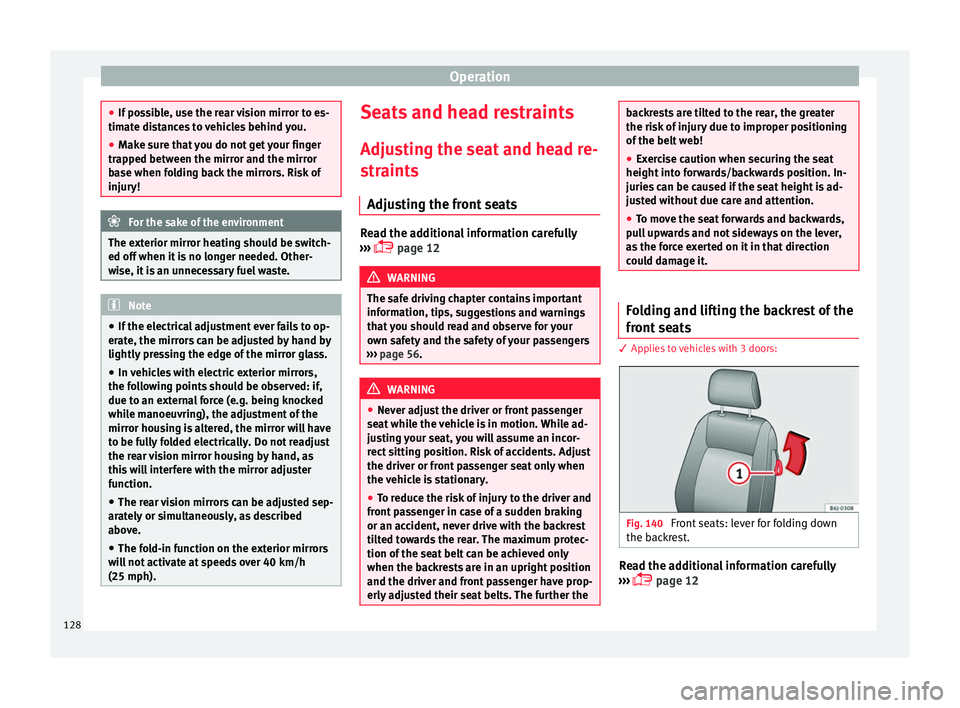
s 3 Applies to vehicles with 3 doors:
Fig. 140
Front seats: lever for folding down
the b ac
kr
est. Read the additional information carefully
› ›
›
p
age 12
128
Page 132 of 252
Operation
Note
● To fit and r emo
ve the rear head restraints,
gently tilt the seat backrest forwards.
● When fitting the head restraints again, in-
sert the tube
s as far as possible into the
guides without pressing the button. Seat functions
Heated se at
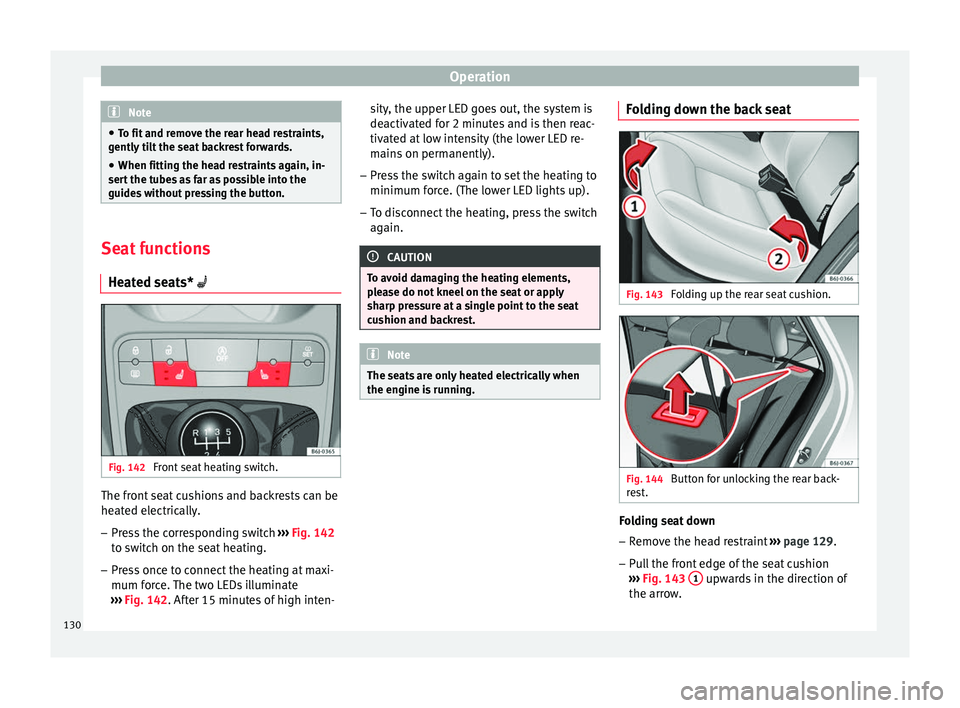
s* Fig. 142
Front seat heating switch. The front seat cushions and backrests can be
he
at
ed el ectric
ally.
– Press the corresponding switch ››› Fig. 142
t
o switch on the seat heating.
– Press once to connect the heating at maxi-
mum force.
The two LEDs illuminate
››› Fig. 142. After 15 minutes of high inten- sity, the upper LED goes out, the system is
deactivated f
or 2 minutes and is then reac-
tivated at low intensity (the lower LED re-
mains on permanently).
– Press the switch again to set the heating to
minimum force. (The lo
wer LED lights up).
– To disconnect the heating, press the switch
again. CAUTION
To avoid damaging the heating elements,
ple a
se do not kneel on the seat or apply
sharp pressure at a single point to the seat
cushion and backrest. Note
The seats are only heated electrically when
the engine is ru
nning. Folding down the back seat
Fig. 143
Folding up the rear seat cushion. Fig. 144
Button for unlocking the rear back-
r e
st
. Folding seat down
– Remove the head restraint ››
›
p
age 129.
– Pull the front edge of the seat cushion
››› Fig. 143
1 upwards in the direction of
the arr o
w .
130
Page 136 of 252
Operation
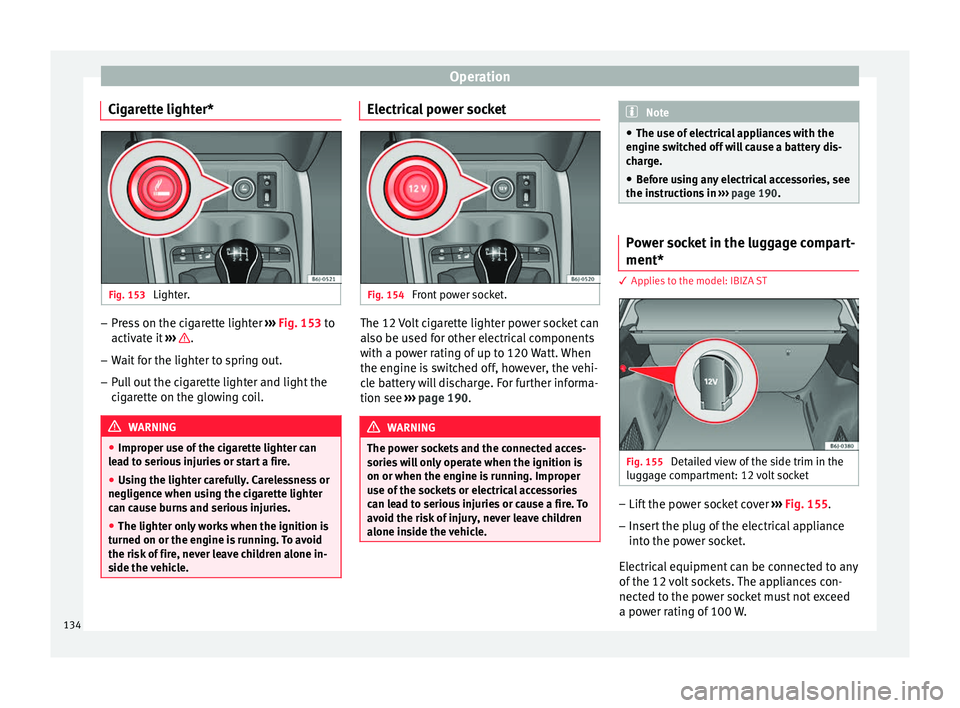
Cigarette lighter* Fig. 153
Lighter. –
Press on the cigarette lighter ››
›
Fig. 153 to
activate it ››› .
– Wait for the lighter to spring out.
– Pull out the cigarette lighter and light the
cig
ar ett
e on the glowing coil. WARNING
● Improper use of the c
igarette lighter can
lead to serious injuries or start a fire.
● Using the lighter carefully. Carelessness or
negligence when u
sing the cigarette lighter
can cause burns and serious injuries.
● The lighter only works when the ignition is
turned on or the engine is
running. To avoid
the risk of fire, never leave children alone in-
side the vehicle. Electrical power socket
Fig. 154
Front power socket. The 12 Volt cigarette lighter power socket can
al
so be u
sed for other el
ectrical components
with a power rating of up to 120 Watt. When
the engine is switched off, however, the vehi-
cle battery will discharge. For further informa-
tion see ››› page 190. WARNING
The power sockets and the connected acces-
sories w i
ll only operate when the ignition is
on or when the engine is running. Improper
use of the sockets or electrical accessories
can lead to serious injuries or cause a fire. To
avoid the risk of injury, never leave children
alone inside the vehicle. Note
● The use of el ectric
al appliances with the
engine switched off will cause a battery dis-
charge.
● Before using any electrical accessories, see
the instructions
in ››› page 190. Power socket in the luggage compart-
ment*
3 Applies to the model: IBIZA ST
Fig. 155
Detailed view of the side trim in the
lug g
ag e c
ompartment: 12 volt socket –
Lift the power socket cover ››
›
Fig. 155
.
– Insert the plug of the electrical appliance
into the power soc
ket.
Electrical equipment can be connected to any
of the 12 volt sockets. The appliances con-
nected to the power socket must not exceed
a power rating of 100 W.
134
Page 138 of 252
Operation
Note
● The tyre pr e
ssure must be adjusted accord-
ing to the load. When necessary check the
tyre pressures on the label located on the in-
side fuel tank flap ››› page 213.
● Air circulation in the vehicle helps reduce
fogging of
the windows. Used air escapes
through ventilation slits in the side trim of
the luggage compartment. Ensure that the
ventilation slots are never covered.
● Straps for securing the load to the fasten-
ing rings* ar
e commercially available from ac-
cessory shops. Fastening rings*
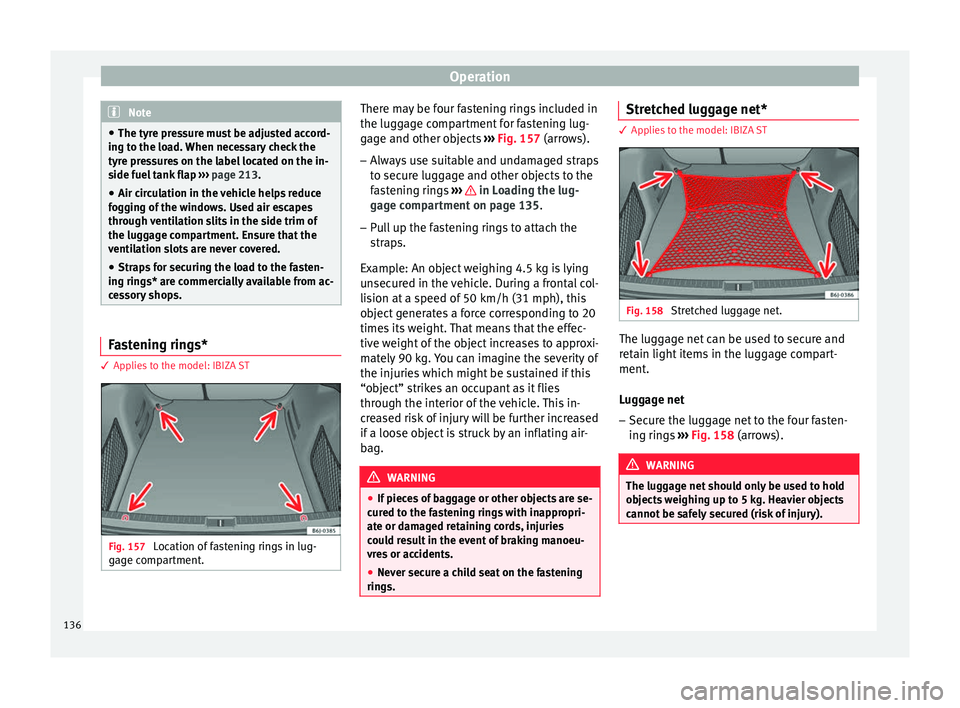
3 Applies to the model: IBIZA ST
Fig. 157
Location of fastening rings in lug-
g ag
e c omp
artment. There may be four fastening rings included in
the lug
g
ag e c
ompartment for fastening lug-
gage and other objects ››› Fig. 157 (arrows).
– Always use suitable and undamaged straps
to secure lug
gage and other objects to the
fastening rings ››› in Loading the lug-
g ag
e c omp
artment on page 135.
– Pull up the fastening rings to attach the
straps.
Ex
ample: An object weighing 4.5 kg is lying
unsecured in the vehicle. During a frontal col-
lision at a speed of 50 km/h (31 mph), this
object generates a force corresponding to 20
times its weight. That means that the effec-
tive weight of the object increases to approxi-
mately 90 kg. You can imagine the severity of
the injuries which might be sustained if this
“object” strikes an occupant as it flies
through the interior of the vehicle. This in-
creased risk of injury will be further increased
if a loose object is struck by an inflating air-
bag. WARNING
● If piece s
of baggage or other objects are se-
cured to the fastening rings with inappropri-
ate or damaged retaining cords, injuries
could result in the event of braking manoeu-
vres or accidents.
● Never secure a child seat on the fastening
rings. Stretched luggage net*
3 Applies to the model: IBIZA ST
Fig. 158
Stretched luggage net. The luggage net can be used to secure and
r
et
ain light it
ems in the luggage compart-
ment.
Luggage net
– Secure the luggage net to the four fasten-
ing rings
››› Fig. 158 (arrows). WARNING
The luggage net should only be used to hold
obj ect
s weighing up to 5 kg. Heavier objects
cannot be safely secured (risk of injury). 136
Page 140 of 252
Operation
●
If the lugg ag
e compartment is overloaded,
remove the tray.
● The load in the storage compartment
should not e
xceed 3 kg. Note
● En sur e th
at, when placing items of clothing
on the luggage compartment cover, rear visi-
bility is not reduced.
● If your vehicle has a storage compartment*,
only pl
ace light objects inside. Roof rack/roof luggage rack*
Intr oduction Please observe the following points if you in-
t
end t
o carr
y loads on the roof:
● For safety reasons, only luggage racks and
acces
sories supplied by SEAT Official Serv-
ices are recommended.
● It is essential that you follow the assembly
instructions
included with the bars exactly,
being especially careful to position front and
rear luggage compartment cover bars on the
special housings in the longitudinal bars.
You must also respect their position accord-
ing to the direction of travel indicated in the
assembly manual. Not following these in-
structions may damage the bodywork. ●
Pay s
pecial attention to the tightening tor-
que of the attachment bolts and check them
following a short journey. If necessary, re-
tighten the bolts and check them at regular
intervals.
● Distribute the load evenly. A maximum load
of 40 kg i
s permitted for each roof rack sys-
tem support bar, the load must be distrib-
uted evenly along the entire length. However,
the maximum load permitted for the entire
roof (including the support system) of 75 kg
must not be exceeded nor the total weight
recommended for the entire vehicle. See the
“Technical Data” section.
● When transporting heavy or large objects
on the roof, any
change in the normal vehicle
behaviour due to a change in the centre of
gravity or an increased wind resistance must
be taken into account. For this reason, a suit-
able speed and driving style must be used.
● On vehicles fitted with a sliding/tilting sun-
roof*, make s
ure it does not hit the load on
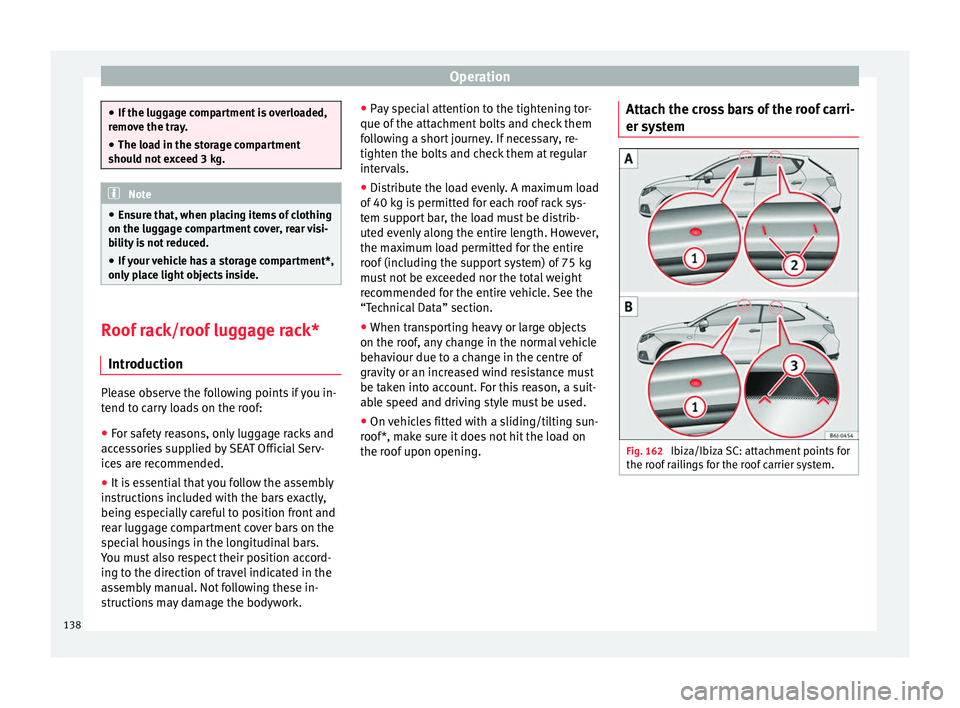
the roof upon opening. Attach the cross bars of the roof carri-
er system
Fig. 162
Ibiza/Ibiza SC: attachment points for
the r oof
rai
lings for the roof carrier system. 138
Page 144 of 252
Operation
Air distributionSymbol ››› page 142
CMain air output through out-
lets
1, 2
5
1, 2, 5
3, 4
Outlets
3 and
4 can be closed or opened
separat ely
using the slats and the air flow di-
rected as required.
Heating and fresh air
Contro l
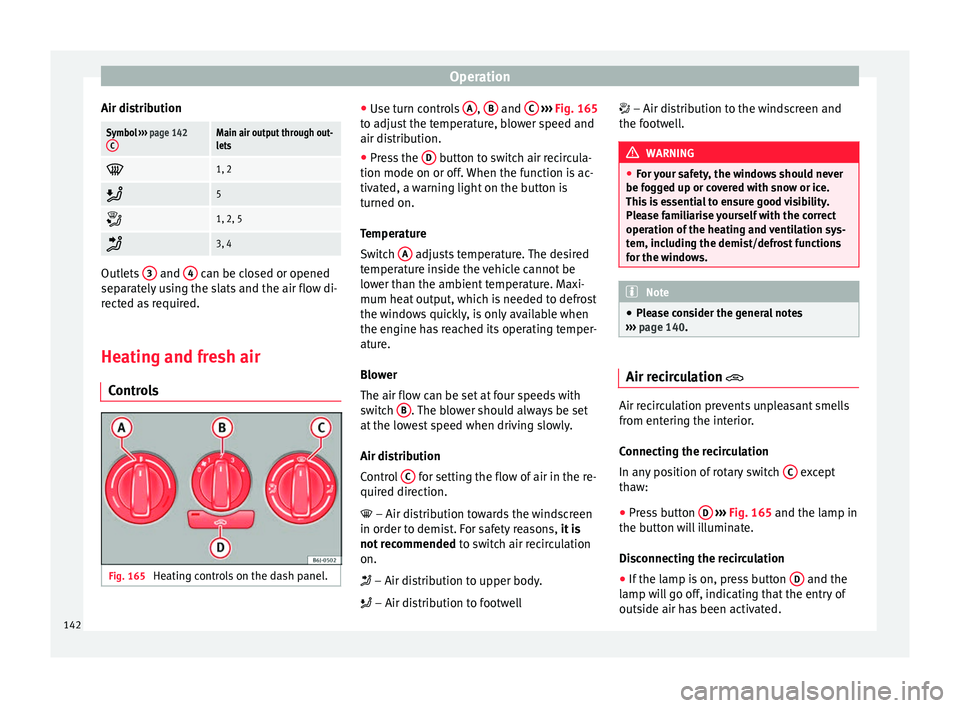
s Fig. 165
Heating controls on the dash panel. ●
Use t
urn c ontr
ols A ,
B and
C
› ››
Fig. 165
t o a dju
st the temperature, blower speed and
air distribution.
● Press the D button to switch air recircula-
tion mode on or off .
When the f u
nction is ac-
tivated, a warning light on the button is
turned on.
Temperature
Switch A adjusts temperature. The desired
t emper
atur
e inside the vehicle cannot be
lower than the ambient temperature. Maxi-
mum heat output, which is needed to defrost
the windows quickly, is only available when
the engine has reached its operating temper-
ature.
Blower
The air flow can be set at four speeds with
switch B . The blower should always be set
at the lo
we
st speed when driving slowly.
Air distribution
Control C for setting the flow of air in the re-
quir ed dir
ection.
– Air di
stribution towards the windscreen
in order to demist. For safety reasons, it is
not recommended to switch air recirculation
on.
– Air distribution to upper body.
– Air distribution to footwell – Air distribution to the windscreen and
the footwel
l. WARNING
● For y our s
afety, the windows should never
be fogged up or covered with snow or ice.
This is essential to ensure good visibility.
Please familiarise yourself with the correct
operation of the heating and ventilation sys-
tem, including the demist/defrost functions
for the windows. Note
● Plea se c
onsider the general notes
››› page 140. Air recirculation
Air recirculation prevents unpleasant smells
fr
om ent
ering the int
erior.
Connecting the recirculation
In any position of rotary switch C except
th a
w:
● Pr e
ss button D
› ›
›
Fig. 165
and the lamp in
the button will illuminate.
Disconnecting the recirculation
● If the lamp is on, press button D and the
l amp w
il
l go off, indicating that the entry of
outside air has been activated.
142