brake pads Seat Leon 5D 2012 Owner's manual
[x] Cancel search | Manufacturer: SEAT, Model Year: 2012, Model line: Leon 5D, Model: Seat Leon 5D 2012Pages: 289, PDF Size: 3.81 MB
Page 71 of 289
70Instruments and warning/control lamps
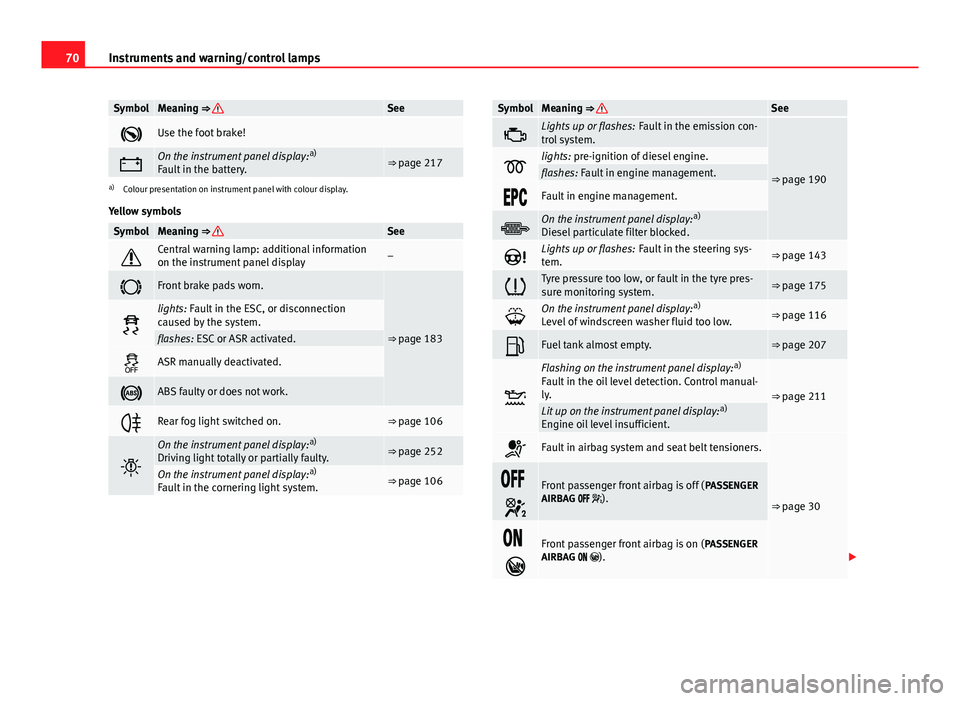
SymbolMeaning ⇒ See
Use the foot brake!
On the instrument panel display: a)
Fault in the battery.⇒ page 217
a) Colour presentation on instrument panel with colour display.
Yellow symbols
SymbolMeaning ⇒ See
Central warning lamp: additional information
on the instrument panel display–
Front brake pads worn.
⇒ page 183
lights: Fault in the ESC, or disconnection
caused by the system.
flashes: ESC or ASR activated.
ASR manually deactivated.
ABS faulty or does not work.
Rear fog light switched on.⇒ page 106
On the instrument panel display: a)
Driving light totally or partially faulty.⇒ page 252
On the instrument panel display: a)
Fault in the cornering light system.⇒ page 106
SymbolMeaning ⇒ See
Lights up or flashes: Fault in the emission con-
trol system.
⇒ page 190lights: pre-ignition of diesel engine.flashes: Fault in engine management.
Fault in engine management.
On the instrument panel display: a)
Diesel particulate filter blocked.
Lights up or flashes: Fault in the steering sys-
tem.⇒ page 143
Tyre pressure too low, or fault in the tyre pres-
sure monitoring system.⇒ page 175
On the instrument panel display: a)
Level of windscreen washer fluid too low.⇒ page 116
Fuel tank almost empty.⇒ page 207
Flashing on the instrument panel display: a)
Fault in the oil level detection. Control manual-
ly.
⇒ page 211Lit up on the instrument panel display: a)
Engine oil level insufficient.
Fault in airbag system and seat belt tensioners.
⇒ page 30
Front passenger front airbag is off ( PASSENGER
AIRBAG ).
Front passenger front airbag is on ( PASSENGER
AIRBAG ).
Page 148 of 289
147
Driving
Handbrake Using the handbrake
The handbrake should be applied firmly to prevent the vehi-
cle from accidentally rolling away.
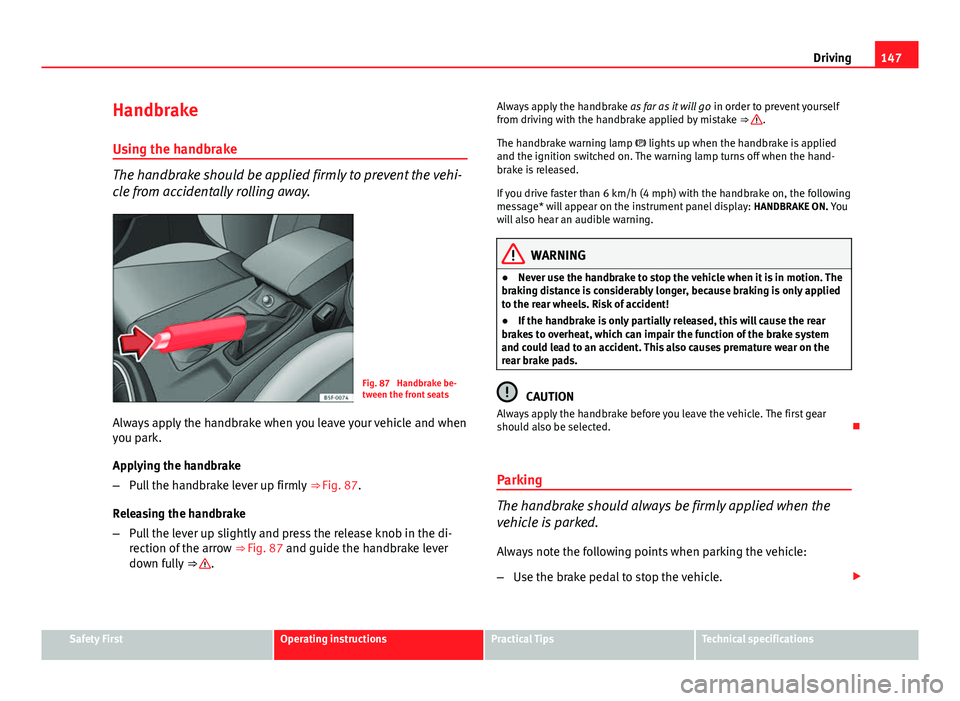
Fig. 87 Handbrake be-
tween the front seats
Always apply the handbrake when you leave your vehicle and when
you park.
Applying the handbrake
– Pull the handbrake lever up firmly ⇒ Fig. 87.
Releasing the handbrake
– Pull the lever up slightly and press the release knob in the di-
rection of the arrow ⇒ Fig. 87 and guide the handbrake lever
down fully ⇒
. Always apply the handbrake
as far as it will go in order to prevent yourself
from driving with the handbrake applied by mistake ⇒
.
The handbrake warning lamp lights up when the handbrake is applied
and the ignition switched on. The warning lamp turns off when the hand-
brake is released.
If you drive faster than 6 km/h (4 mph) with the handbrake on, the following
message* will appear on the instrument panel display: HANDBRAKE ON. You
will also hear an audible warning.
WARNING
● Never use the handbrake to stop the vehicle when it is in motion. The
braking distance is considerably longer, because braking is only applied
to the rear wheels. Risk of accident!
● If the handbrake is only partially released, this will cause the rear
brakes to overheat, which can impair the function of the brake system
and could lead to an accident. This also causes premature wear on the
rear brake pads.
CAUTION
Always apply the handbrake before you leave the vehicle. The first gear
should also be selected.
Parking
The handbrake should always be firmly applied when the
vehicle is parked.
Always note the following points when parking the vehicle:
– Use the brake pedal to stop the vehicle.
Safety FirstOperating instructionsPractical TipsTechnical specifications
Page 186 of 289
185
Intelligent technology
Disable ASR
ASR can be disabled through the Easy Connect system ⇒ page 79 or by
pressing the OFF
button. The traction control system will be disabled.
The control lamp will light up. For vehicles with a driver information sys-
tem* the driver will be informed that ASR is disabled.
In the following exceptional circumstances enabling the ESC Sport mode to
improve the traction of the wheels is tenable:
● when rocking the vehicle backwards and forwards to free it.
● Driving in deep snow or on loose surfaces.
Activate ASR
ASR can be switched on through the Easy Connect system ⇒ page 79 or by
pressing the OFF
button. The traction control system will be enabled.
The control lamp switches off. For vehicles with a driver information sys-
tem* the driver will be informed that ASR is enabled.
WARNING
You should switch on the ESC Sport mode only if the traffic conditions
and your driving ability allow you to do so safely: risk of skidding!
● With ESC in Sport mode, the stabilising function will be limited to al-
low for a sportier drive. The driving wheels could spin and the vehicle
could skid.
Note
● ESC Sport mode cannot be activated if the cruise control* actively inter-
venes. Brakes
New brake pads
For the first 400 km (250 miles), new brake pads have not yet reached their
maximum braking capacity, and need to be “run in” first. However, you can
compensate for the slightly reduced braking effect by applying more pres-
sure on the brake pedal. Avoid overloading the brakes while running them
in.
Wear
The rate of wear on the
brake pads depends a great deal on how you drive
and the conditions in which the vehicle is operated. This is a particular
problem in urban traffic and short stretches, or with very sporty driving.
Depending on the speed, the braking force, and the environmental condi-
tions (for example, the temperature, air humidity, etc.) noises may be pro-
duced on braking.
Wet roads or road salt
In certain situations (for example, on driving through flooded areas, in se-
vere downpours or after washing the vehicle) the braking action could be
delayed if the discs and pads are damp, or frozen in winter. In this case the
brakes should be dried by pressing the brake pedal several times.
At high speed and with the windscreen wipers activated, the brake pads will
briefly touch the brake discs. This takes place, although unnoticeable to the
driver, at regular intervals to improve the response time of the brakes when
they are wet.
The effectiveness of the brakes can also be temporarily reduced if the vehi-
cle is driven for some distance without using the brakes when there is a lot
of salt on the road in winter. The layer of salt that accumulates on the discs
and pads can be removed by gently applying the brakes a few times.
Safety FirstOperating instructionsPractical TipsTechnical specifications
Page 187 of 289
186Intelligent technology
Corrosion
There may be a tendency for corrosion to form on the discs and dirt to build
up on the brake pads if the vehicle is used infrequently or the brakes are
not used very often.
If the brakes are not used frequently, or if rust has formed on the disks, it is
advisable to clean off the pads and disks by braking firmly a few times at a
moderately high speed ⇒
.
Fault in the brake system
If the brake pedal travel should ever increase suddenly, this may mean that
one of the two brake circuits has failed. Drive immediately to the nearest
specialised workshop and have the fault repaired. Drive there slowly and re-
member that you will have to apply more pressure on the brake pedal and
allow for longer stopping distances.
Low brake fluid level
Malfunctions can occur in the brake system if the brake fluid level is too
low. The brake fluid level is monitored electronically.
Brake servo
The brake servo increases the pressure you apply to the brake pedal. It
works only when the engine is running.
WARNING
● Apply the brakes heavily to clean the brake system only in a suitable
traffic situation. Do not put other road users in danger: risk of causing an
accident.
● Ensure the vehicle does not move while in neutral, when the engine is
stopped. Failure to do so could result in an accident.
CAUTION
● Never let the brakes “drag” by leaving your foot on the pedal when it is
not necessary to brake. This overheats the brakes, resulting in longer stop-
ping distances and greater wear.
● Before driving down a long, steep gradient, it is advisable to reduce
speed and select a lower gear. This makes use of engine braking and re-
lieves the brakes. If you still have to use the brakes, it is better to brake
firmly at intervals than to apply the brakes continuously.
Note
● If the brake servo is out of action due to a malfunction, or if the car has
to be towed, you will have to press the brake pedal considerably harder to
make up for the lack of servo assistance.
● If you wish to equip the vehicle with accessories such as a front spoiler
or wheel covers, it is important that the flow of air to the front wheels is not
obstructed, otherwise the brakes can overheat.
Electro-mechanical steering
Electro-mechanical power steering assists the driver when
steering.
Electro-mechanical power steering adapts electronically to the speed of the
car, torque and turning angle.
If the power steering should fail at any time or the engine is switched off (for
instance when being towed), the car can still be steered. However, more ef-
fort than normal will be required to turn the steering wheel.
Driver warning lamps and messages
(in red) Faulty steering! To park the vehicle
Page 191 of 289
190Driving and the environment
Driving and the environment
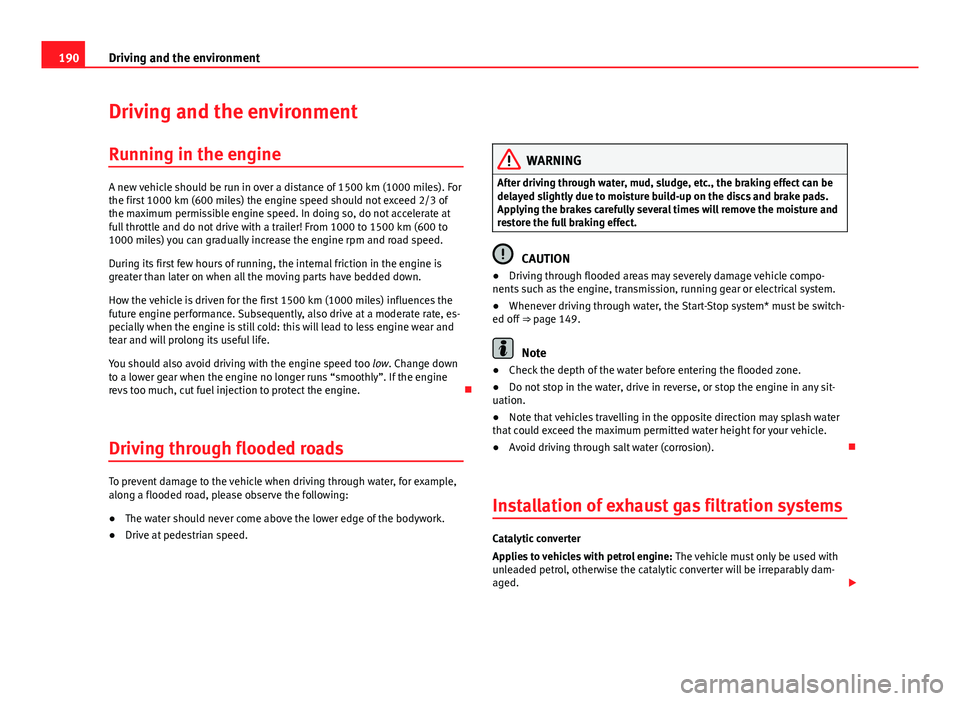
Running in the engine
A new vehicle should be run in over a distance of 1500 km (1000 miles). For
the first 1000 km (600 miles) the engine speed should not exceed 2/3 of
the maximum permissible engine speed. In doing so, do not accelerate at
full throttle and do not drive with a trailer! From 1000 to 1500 km (600 to
1000 miles) you can gradually increase the engine rpm and road speed.
During its first few hours of running, the internal friction in the engine is
greater than later on when all the moving parts have bedded down.
How the vehicle is driven for the first 1500 km (1000 miles) influences the
future engine performance. Subsequently, also drive at a moderate rate, es-
pecially when the engine is still cold: this will lead to less engine wear and
tear and will prolong its useful life.
You should also avoid driving with the engine speed too low. Change down
to a lower gear when the engine no longer runs “smoothly”. If the engine
revs too much, cut fuel injection to protect the engine.
Driving through flooded roads
To prevent damage to the vehicle when driving through water, for example,
along a flooded road, please observe the following:
● The water should never come above the lower edge of the bodywork.
● Drive at pedestrian speed.
WARNING
After driving through water, mud, sludge, etc., the braking effect can be
delayed slightly due to moisture build-up on the discs and brake pads.
Applying the brakes carefully several times will remove the moisture and
restore the full braking effect.
CAUTION
● Driving through flooded areas may severely damage vehicle compo-
nents such as the engine, transmission, running gear or electrical system.
● Whenever driving through water, the Start-Stop system* must be switch-
ed off ⇒ page 149.
Note
● Check the depth of the water before entering the flooded zone.
● Do not stop in the water, drive in reverse, or stop the engine in any sit-
uation.
● Note that vehicles travelling in the opposite direction may splash water
that could exceed the maximum permitted water height for your vehicle.
● Avoid driving through salt water (corrosion).
Installation of exhaust gas filtration systems
Catalytic converter
Applies to vehicles with petrol engine: The vehicle must only be used with
unleaded petrol, otherwise the catalytic converter will be irreparably dam-
aged.
Page 279 of 289
Brakes . . . . . . . . . . . . . . . . . . . . . . . . . . . . . . . . 185Brake fluid . . . . . . . . . . . . . . . . . . . . . . . . . 217
Brake servo . . . . . . . . . . . . . . . . . . . . . . . . . 185
New brake pads . . . . . . . . . . . . . . . . . . . . . 185
Braking Brake assist system . . . . . . . . . . . . . . . . . . 183
Moving off on a hill . . . . . . . . . . . . . . . . . . 148
C
Carbon components: Cleaning . . . . . . . . . . . . 200
Care . . . . . . . . . . . . . . . . . . . . . . . . . . . . . . . . . . 198
Care of vehicle . . . . . . . . . . . . . . . . . . . . . . . . . 198
Care (paint care) . . . . . . . . . . . . . . . . . . . . . . . . 200
Catalytic converter . . . . . . . . . . . . . . . . . . . . . . 190
CD-ROM reader (navigation) . . . . . . . . . . . . . . 130
Central locking Anti-theft alarm . . . . . . . . . . . . . . . . . . . . . . 93
Central locking switch . . . . . . . . . . . . . . . . . 93
Electric windows . . . . . . . . . . . . . . . . . . . . . 101
Programming . . . . . . . . . . . . . . . . . . . . . . . . 92
Remote control key . . . . . . . . . . . . . . . . . . . . 91
Selective unlocking system . . . . . . . . . . . . . 91
Sliding/tilting sunroof . . . . . . . . . . . . . . . . 101
Central locking system . . . . . . . . . . . . . . . . . . . . 86 Manual locking in an emergency . . . . . . . . 97
Rear lid . . . . . . . . . . . . . . . . . . . . . . . . . . . . . 98
Cetane number (Diesel fuel) . . . . . . . . . . . . . . 207
Changing Windscreen and rear window wiper blades . .221
Changing a bulb . . . . . . . . . . . . . . . . . . . . . . . . 252 Bulb sizes . . . . . . . . . . . . . . . . . . . . . . . . . . 252 Changing gear
Engaging gears (manual gearbox) . . . . . . 152
Manual gearbox . . . . . . . . . . . . . . . . . . . . . 152
Changing main headlight main beam . . . . . . . . . . . . . . . . . . . . . . . . . 255
turn signal . . . . . . . . . . . . . . . . . . . . . . . . . . 255
Changing main headlight bulbs daylight bulb . . . . . . . . . . . . . . . . . . . . . . . 254
Dipped beam . . . . . . . . . . . . . . . . . . . . . . . 254
Changing the battery of the vehicle key . . . . . . . . . . . . . . . . . . . . . 90
Chassis number . . . . . . . . . . . . . . . . . . . . . . . . 264
Child-proof lock Electric windows . . . . . . . . . . . . . . . . . . . . . 100
Child safety . . . . . . . . . . . . . . . . . . . . . . . . . . . . . 47
Child seat Categorisation in groups . . . . . . . . . . . . . . . 49
Group 1 . . . . . . . . . . . . . . . . . . . . . . . . . . . . . 50
Group 2 . . . . . . . . . . . . . . . . . . . . . . . . . . . . . 50
Group 3 . . . . . . . . . . . . . . . . . . . . . . . . . . . . . 50
Groups 0 and 0+ . . . . . . . . . . . . . . . . . . . . . . 49
Safety notes . . . . . . . . . . . . . . . . . . . . . . . . . 47
Securing . . . . . . . . . . . . . . . . . . . . . . . . . . . . 52
Child seats . . . . . . . . . . . . . . . . . . . . . . . . . . . . . 49 ISOFIX system . . . . . . . . . . . . . . . . . . . . . . . . 54
on the front passenger seat . . . . . . . . . . . . . 31
Top Tether system . . . . . . . . . . . . . . . . . 54, 55
Cleaning . . . . . . . . . . . . . . . . . . . . . . . . . . . . . . 198 Alcantara . . . . . . . . . . . . . . . . . . . . . . . . . . . 204
Carbon components . . . . . . . . . . . . . . . . . . 200
Display/Easy Connect control panel . . . . . 202
Exhaust pipe . . . . . . . . . . . . . . . . . . . . . . . . 201 Leather . . . . . . . . . . . . . . . . . . . . . . . . . . . . 203
Plastic parts . . . . . . . . . . . . . . . . . . . . 200, 202
Radio display . . . . . . . . . . . . . . . . . . . . . . . 202
Rims . . . . . . . . . . . . . . . . . . . . . . . . . . . . . . 201
Seat belts . . . . . . . . . . . . . . . . . . . . . . . . . . 205
Trim parts . . . . . . . . . . . . . . . . . . . . . . . . . . 202
Trims . . . . . . . . . . . . . . . . . . . . . . . . . . . . . . 200
Washing the vehicle . . . . . . . . . . . . . . . . . . 198
Windows . . . . . . . . . . . . . . . . . . . . . . . . . . . 201
Windscreen and rear window wiper blades . .221
Cleaning/De-icing the windows . . . . . . . . . . . 201
Cleaning the rims . . . . . . . . . . . . . . . . . . . . . . . 201
Cleaning the upholstery Natural leather . . . . . . . . . . . . . . . . . . . . . . 203
Closing Bonnet . . . . . . . . . . . . . . . . . . . . . . . . . . . . 210
Panoramic sliding sunroof . . . . . . . . . . . . . 103
Panoramic sunroof . . . . . . . . . . . . . . . . . . . 103
Windows . . . . . . . . . . . . . . . . . . . . . . . . . . . 100
Clutch (warning lamp) . . . . . . . . . . . . . . . . . . . 162
Coming Home . . . . . . . . . . . . . . . . . . . . . . . . . . 113
Compartments . . . . . . . . . . . . . . . . . . . . . . . . . 129
Consumption (fuel) . . . . . . . . . . . . . . . . . . . . . 264
Control lamp Airbag system . . . . . . . . . . . . . . . . . . . . . . . . 33
Cruise control . . . . . . . . . . . . . . . . . . . . . . . 164
Tyre monitor indicator warning lamp . . . . 175
Tyre monitoring systems . . . . . . . . . . . . . . 175
Windscreen wiper fluid level . . . . . . . . . . . 117
Control lamps Lights . . . . . . . . . . . . . . . . . . . . . . . . . . . . . 106
Control of function Rain sensor . . . . . . . . . . . . . . . . . . . . . . . . . 120
278 Index
Page 284 of 289
Outside temperature . . . . . . . . . . . . . . . . . . . . . 64
Outside temperature display . . . . . . . . . . . . . . . 73
OverviewTurn signal and main beam lever . . . . . . . 107
Overview (controls and displays) . . . . . . . . . . . 59
P Paint code . . . . . . . . . . . . . . . . . . . . . . . . . . . . . 264
Paint damage . . . . . . . . . . . . . . . . . . . . . . . . . . 200
Panoramic sliding sunroof . . . . . . . . . . . . . . . . 103 Closing . . . . . . . . . . . . . . . . . . . . . . . . . . . . 103
Convenience closing . . . . . . . . . . . . . . . . . 104
Convenience opening . . . . . . . . . . . . . . . . 104
Fault . . . . . . . . . . . . . . . . . . . . . . . . . . . . . . 103
Opening . . . . . . . . . . . . . . . . . . . . . . . . . . . 103
Roll-back function . . . . . . . . . . . . . . . . . . . 104
Parking . . . . . . . . . . . . . . . . . . . . . . . . . . . . . . . 147
Parking aid Adjusting the display/audible warnings . 181
Environment warning . . . . . . . . . . . . . . . . . 179
Fault . . . . . . . . . . . . . . . . . . . . . . . . . . . . . . 181
Plus parking aid . . . . . . . . . . . . . . . . . . . . . 179
Rear parking aid . . . . . . . . . . . . . . . . . . . . . 179
Sensors/Camera: cleaning . . . . . . . . . . . . 199
Towing bracket . . . . . . . . . . . . . . . . . . . . . . 182
Parking aid system see Parking aid . . . . . . . . . . . . . . . . . . . . . . 179
Parking light . . . . . . . . . . . . . . . . . . . . . . . . . . . 109
Parking (automatic gearbox) . . . . . . . . . . 156, 157
Particulate filter (Diesel) . . . . . . . . . . . . . . . . . 190 Passenger
see Correct sitting position . . . . . . . 11, 12, 13
Pedals . . . . . . . . . . . . . . . . . . . . . . . . . . . . . . . . . 16
Physical principles of a frontal collision . . . . . . 21
Plastic parts: Cleaning . . . . . . . . . . . . . . . 200, 202
Polishing . . . . . . . . . . . . . . . . . . . . . . . . . . . . . . 200
Power Management . . . . . . . . . . . . . . . . . . . . . 187
Power socket . . . . . . . . . . . . . . . . . . . . . . . . . . 129
Preheating . . . . . . . . . . . . . . . . . . . . . . . . . . . . 144
Pressure (tyres) . . . . . . . . . . . . . . . . . . . . . . . . . 223
R Racks . . . . . . . . . . . . . . . . . . . . . . . . . . . . . . . . . 130
Radio display: cleaning . . . . . . . . . . . . . . . . . . 202
Radio transmitters . . . . . . . . . . . . . . . . . . . . . . 230
Rain sensor . . . . . . . . . . . . . . . . . . . . . . . . . . . . 120 Control of function . . . . . . . . . . . . . . . . . . . 120
Rear lid automatic locking . . . . . . . . . . . . . . . . . . . . . 99
Central locking system . . . . . . . . . . . . . . . . . 98
Manual release in an emergency . . . . . . . . 99
Rear lights Changing a bulb . . . . . . . . . . . . . . . . . . . . . 252
Rear vision mirror . . . . . . . . . . . . . . . . . . . . . . . 122
Rear vision mirrors Adjusting the exterior mirrors . . . . . . . . . . 122
see also Rear vision mirrors . . . . . . . . . . . . 123
Reflective vests . . . . . . . . . . . . . . . . . . . . . . . . . 232
Remote control See "Keys" . . . . . . . . . . . . . . . . . . . . . . . . . . 88 Remote control key
Unlocking/Locking . . . . . . . . . . . . . . . . . . . . 91
Remove the wheel cover . . . . . . . . . . . . . . . . . 236
Removing the head restraint . . . . . . . . . . . . . . . . . . . . . . . . . . . . . . . . . . . 128
Repairs . . . . . . . . . . . . . . . . . . . . . . . . . . . . . . . 230 Airbags . . . . . . . . . . . . . . . . . . . . . . . . . . . . . 34
Replacement parts . . . . . . . . . . . . . . . . . . . . . . 230
Reservoir capacity Windscreen washer water reservoir . . . . . 122
Reset button (trip recorder) . . . . . . . . . . . . . . . . 67
Reset the trip recorder to zero . . . . . . . . . . . . . . 67
Retrofitting a towing bracket . . . . . . . . . . . . . . 196
Rev counter . . . . . . . . . . . . . . . . . . . . . . . . . . 61, 66
Reverse gear (automatic gearbox) . . . . . . . . . 154
Rims Cleaning . . . . . . . . . . . . . . . . . . . . . . . . . . . 201
RME (fuel) . . . . . . . . . . . . . . . . . . . . . . . . . . . . . 207
Roll-back function Panoramic sliding sunroof . . . . . . . . . . . . . 104
Windows . . . . . . . . . . . . . . . . . . . . . . . . . . . 102
Roof carrier (roof load) . . . . . . . . . . . . . . . . . . . 131
Running in New brake pads . . . . . . . . . . . . . . . . . . . . . 185
New engine . . . . . . . . . . . . . . . . . . . . . . . . . 190
New tyres . . . . . . . . . . . . . . . . . . . . . . . . . . 223
S Safe driving . . . . . . . . . . . . . . . . . . . . . . . . . . . . . 7
Safelock see Anti-theft security system . . . . . . . . . . . 86
283
Index