radio Seat Leon 5D 2014 User Guide
[x] Cancel search | Manufacturer: SEAT, Model Year: 2014, Model line: Leon 5D, Model: Seat Leon 5D 2014Pages: 284, PDF Size: 5.85 MB
Page 99 of 284
Lights and visibility
● When the drivers of other oncoming vehi-
cles (such as a truck) can see over a guard
rail in the centre of the road.
● If the camera is damaged or the power sup-
ply is cut off.
● In fog, snow and heavy rain.
● With dust and sand turbulence.
● With loose gravel in the field of vision of
the camera.
● When the field of vision of the camera is
misted up, dirty or covered by stickers, snow,
ice, etc. WARNING
The convenience features of the main beam
assist should not encourage the taking of
risks. The system is not a replacement for
driver concentration.
● You are always in control of the main beam
and adapting it to the light, visibility and traf-
fic conditions.
● It is possible that the main beam headlight
control does not recognise all driving situa-
tions and is limited under certain circumstan-
ces.
● When the field of vision of the camera is
dirty, covered or damaged, operation of the
main beam control may be affected. This also
applies when changes are made to the vehi- cle lighting system, for example, if additional
headlights are installed.
CAUTION
To avoid affecting the operation of the sys-
tem, take the following points into considera-
tion:
● Clean the field of vision of the camera regu-
larly and make sure it is free of snow and ice.
● Do not cover the field of vision of the cam-
era.
● Check that the windscreen is not damaged
in the area of the field of vision of the camera. Note
Main beam and headlight flasher can be
turned on and off manually at any time with
the turn signal and main beam lever
››› page 95. Fog lights
The warning lamps
or also show, on the
light switch or instrument panel, when the
fog lights are on. ●
Switching on front fog lights* : pull the
light switch to the first point 1 , from posi-
tions ,
or .
● Switching on the rear fog light
: com-
pletely pull the light switch 2 from position
,
or .
● To switch off the fog lights, press the light
switch or turn it to position
.
Cornering lights* 1) When turning slowly or on very tight bends,
the cornering lights are activated automati-
cally. The cornering lights may be integrated
in the fog lights and are switched on only at
speeds of less than 40 km/h (25 mph).
When reverse gear is engaged, the cornering
lights on both sides of the vehicle switch on,
in order to better illuminate the area for park-
ing.
Coming home “function” This function may be connected/disconnec-
ted through the radio menu. The “Coming
Home” and/or “Leaving Home” delay time
may also be set (default: 30 sec).
»1)
This function is not available on vehicles equipped
with full-LED headlights. 97
Technical specifications
Advice
Operation
Safety
The essentials
Page 100 of 284
OperationVehicle with
halogen
headlightsIn the “Coming Home” function, the day-
time running lights (DRL), the rear side
lights and the licence plate lights are
turned on.
Vehicle with
full-LED
headlightsIn the “Coming Home” function, the dip-
ped beams and the daytime running
lights (DRL), the rear side lights and the
licence plate lights are switched on.
Automatic* activation of “Coming Home”
For vehicles with a light and rain sensor (rota-
ry light switch in position
).
● Sw it
ch off the engine and remove the key
from the ignition with the rotary light switch
in position ›››
page 15.
● The automatic “Coming Home” function is
only active when the light sensor detects
darkness.
● When the car door is opened, the “Coming
Home” lighting comes on.
Manual “Coming Home” activation
For vehicles with a light and rain sensor (rota-
ry light switch without position ).
● Switch off the engine and remove the key
from the ignition.
● Activate the headlight flashers for approxi-
mately 1 second.
● Activated for any position of the rotary light
switch. ●
When the car door is opened, the “Coming
Home” lighting comes on. The headlights are
turned off 60 seconds after the vehicle door
is opened.
Deactivation
● If no door has been closed, they go out au-
tomatically after 60 seconds.
● After the last door has been closed, the
headlights will be switched off after the
“Coming Home” delay (as established in the
radio menu) has elapsed.
● On turning the light switch to position
››› page 15.
● When the ignition i s
switched on (when
starting the engine).
“Leaving Home” function The “Leaving Home” function is only availa-
ble for vehicles with a light and rain sensor
(rotary light switch in position
).
This function may be connected/disconnec-
ted through the radio menu. The “Leaving
Home” function switch-off delay may also be
set (default: 30 sec).
Vehicle with
halogen
headlightsIn the “Leaving Home” function, the day-
time running lights (DRL), the rear side
lights and the licence plate lights are
switched on.
Vehicle with
full-LED
headlightsIn the “Leaving Home” function, the dip-
ped beams, the daytime running lights
(DRL), the rear side lights and the li-
cence plate lights are switched on. Activation
● When the vehicle is unlocked using the re-
mote control.
● The “Leaving Home” function is only activa-
ted when the rotary light switch is in position
and the light sensor detects darkness.
Deactivation
● When the “Leaving Home” delay period
ends (default: 30 sec).
● When the vehicle is locked using the re-
mote control.
● When the light control is switched into a
position other than .
● With the ignition is switched on.
98
Page 103 of 284
Lights and visibility
Dynamic headlight range control
The control is not mounted in vehicles with
dynamic headlight range control. The head-
light range is automatically adjusted accord-
ing to the vehicle load status when they are
switched on.
Instrument panel lighting
With the ignition on and without light activa-
tion, the instrument panel lighting remains
activated in daytime light conditions. The
lighting is reduced as the exterior light di-
minishes. In some cases, e.g. when driving
through a tunnel without the function
active, the instrument panel lighting may
even switch off. The objective of this function
is to provide the driver with a visual indica-
tion that he or she should activate the dip-
ped beam. WARNING
Heavy objects in the vehicle may mean that
the headlights dazzle and distract other driv-
ers. This could result in a serious accident.
● Adjust the light beam to the vehicle load
status so that it does not blind other drivers. Interior and reading lights
1) Read the additional information carefully
››› page 16
Glove compartment and luggage
compartment lighting*
When opening and closing the glove com-
partment on the front passenger side and the
rear lid, the respective light will automatically
switch on and off.
Footwell lighting*
The lights in the footwell area below the dash
(driver and front passenger sides) will switch
on when the doors are opened and will de-
crease in intensity while driving. The intensity
of these lights can be adjusted using the ra-
dio menu (see Easy Connect > Adjusting Light-
ing > Interior lighting ›››
page 17).
Ambient light*
The ambient light in the door panel changes
colour (white or red) depending on the driv-
ing mode. The intensity of these lights can be
adjusted using the radio menu (see Easy Con-
nect > Adjusting Lights > Interior lighting
››› page 17
). Note
The reading lights switch off when the vehi-
cle is locked using a key or after several mi-
nutes if the key is removed from the ignition.
This prevents the battery from discharging. Visibility
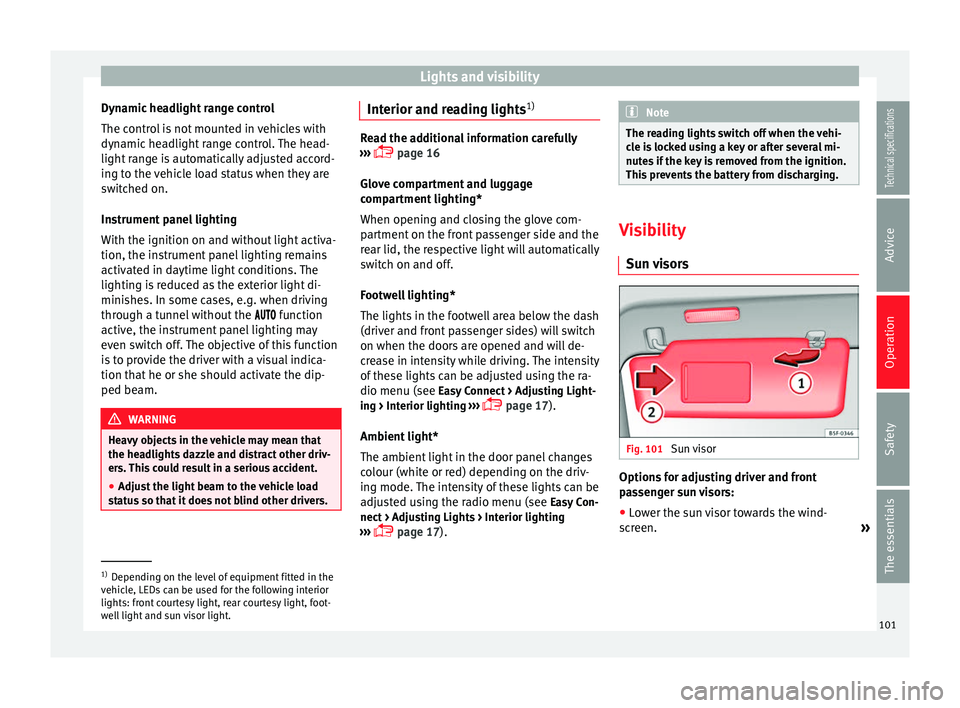
Sun visors Fig. 101
Sun visor Options for adjusting driver and front
passenger sun visors:
● Lower the sun visor towards the wind-
screen. »1)
Depending on the level of equipment fitted in the
vehicle, LEDs can be used for the following interior
lights: front courtesy light, rear courtesy light, foot-
well light and sun visor light. 101Technical specifications
Advice
Operation
Safety
The essentials
Page 128 of 284

OperationFunc-
tion
buttonFunction
OFFSwitch off and switch on the Climatronic.
SETTINGS
The air conditioning settings submenu is
opened. It is possible to make the following
adjustments:
Function button Air conditioning profile.
: to ad-
just the level of the fan in AUTO mode. You
can choose between low, medium and
high.
Function button Automatic air recirculation
to
switch on and off automatic air recircula-
tion ››› page 128.
BACK
function button to close the sub-
menu. Adjust using the Easy Connect
system*
3 Applies to vehicles with a Media System Plus/Navi
System.
In the Easy Connect system it is also possible
to perform various adjustments to the Clima-
tronic.
Open the air conditioner
menu
● Press the Setup button.
On the top of the screen you can see and
change the current settings, such as, for ex-
ample, the temperature set for the driver side
and for that of passenger. Temperatures up to +22°C (+72°F) are shown with blue arrows,
and temperatures over +22°C (+72°F) with
red arrows.
To switch a function on or off, or to select a
submenu, you must press the corresponding
function button.
Function
buttonFunction
Air condi-
tioning pro- fileAdjust the fan level in AUTO mode. You
can choose between low, medium and
high.
OFFClimatronic is switched off.
ONClimatronic is switched on.
SETTINGS
The air conditioning settings submenu
is opened. It is possible to make the fol-
lowing adjustments:
Function button Air conditioning profile.
: to
adjust the level of the fan in AUTO
mode. You can choose between low, me-
dium and high.
Function button Automatic air recirculation
to switch on and off automatic air recir-
culation
››› page 128.
BACK
function button to close the
submenu.
Automatic
supplemen-
tary heating
Activate/deactivate the automatic acti-
vation of the supplementary heating for
colder countries (only for engines with
supplementary heating). With the option
deactivated, depending on the outside
temperature the heating may need more
time than normal to reach a comfortable
temperature. Instructions for use of the air
conditioner
The interior cooling system only works when
the engine is running and fan is switched on.
The air conditioner operates most effectively
with the windows and the panoramic sliding
sunroof closed. However, if the vehicle has
heated up after standing in the sun for some
time, the air inside can be cooled more quick-
ly by opening the windows and the panoram-
ic sliding sunroof briefly.
Climatronic: change the temperature unit on
the screen of the radio or on the factory-
fitted navigation system
Changing the temperature display from Cel-
sius to Fahrenheit on radio or on the factory-
fitted navigation system is done using the
menu on the instrument panel
›››
page 72.
The cooling system cannot be activated
If the air conditioning system cannot be
switched on, this may be caused by the fol-
lowing:
● The engine is not running.
● The fan is switched off.
● The air conditioner fuse has blown.
● The outside temperature is lower than ap-
proximately +3°C (+38°F).
126
Page 184 of 284
Advice
Advice
Care and maintenance
Accessories and modifications to the vehicle
Accessories, replacement parts and
repairs Always ask your dealer or specialist retailer
for advice before purchasing accessories and
replacement parts.
Your vehicle is designed to offer a high
standard of active and passive safety. For this
reason, we recommend that you ask a SEAT
Official Service for advice before fitting ac-
cessories or replacement parts. Your SEAT Of-
ficial Service has the latest information from
the manufacturer and can recommend acces-
sories and replacement parts which are suita-
ble for your requirements. They can also an-
swer any questions you might have regarding
official regulations.
We recommend you to use only
SEAT acces-
sories and
Genuine SEAT parts ®
. SEAT has
tested these parts and accessories for suita-
bility, reliability and safety. SEAT Official
Services have the necessary experience and
facilities to ensure that the parts are installed
correctly and professionally. Any
retro-fitted equipment which has a direct
effect on the vehicle and/or the way it is driv-
en, such as a cruise control system or elec-
tronically-controlled suspension, must be
approved for use in your vehicle and bear the
e mark (the European Union's authorisation
symbol).
If
any additional electrical devices are fitted
which do not serve to control the vehicle it-
self (for instance a refrigerator box, laptop or
ventilator fan, etc.), they must bear the
sign (manufacturer conformity declaration in
the European Union). WARNING
Accessories, for example telephone holders
or cup holders, should never be fitted on the
covers, or within the working range of the air-
bags. Otherwise, there is a danger of injury if
the airbag is triggered in an accident. Technical modifications
Modifications must always be carried out ac-
cording to our specifications.
Unauthorised modifications to the electronic
components, software, wiring or data transfer
in the vehicle may cause malfunctioning. Due
to the way the electronic components are
linked together in networks, other indirect
systems may be affected by the faults. This
can seriously impair safety, lead to excessivewear of components, and also invalidate your
vehicle registration documents.
You will appreciate that your SEAT dealership
cannot be held liable for any damage caused
by modifications and/or work performed in-
correctly.
We therefore recommend that all work should
be performed by a SEAT Official Service using
genuine SEAT parts
®
. WARNING
Incorrectly performed modifications or other
work on your vehicle can lead to malfunctions
and cause accidents. Two-way radios and office equipment
Radio transmitters (fixed installation)
Any retrofit installations of radio transmitters
in the vehicle require prior approval. SEAT
generally authorises in-vehicle installations
of approved types of radio transmitters provi-
ded that:
●
The aerial is installed correctly.
● The aerial is installed on the exterior of the
vehicle (and shielded cables are used togeth-
er with non-reflective aerial trimming).
● The effective transmitting power does not
exceed 10 Watts at the aerial base.
182
Page 185 of 284

Care and maintenance
A SEAT Official Service and specialised work-
shop will be able to inform you about options
for installing and operating radio transmitters
with a higher
transmitting power.
Mo
bile radio transmitters
Commercial mobile telephones or radio
equipment might interfere with the electron-
ics of your vehicle and cause malfunctions.
This may be due to:
● No external aerial.
● External aerial incorrectly installed.
● Transmitting power more than 10 W.
You must, therefore, do not operate portable
mobile telephones or radio equipment inside
the vehicle without a properly installed exter-
nal aerial ››› .
Please note also that the maximum range of
the equipment can only be achieved with an
external aerial.
B u
siness equipment
Retrofit installation of business or private
equipment in the vehicle is permitted, provi-
ded the equipment cannot interfere with the
driver's immediate control of the vehicle and
that any such equipment carries the mark.
Any retrofit equipment that could influence
the driver's control of the vehicle must have a
type approval for your vehicle and must carry
the e mark. WARNING
Mobile telephones or radio equipment which
is operated inside the vehicle without a prop-
erly installed external aerial can create exces-
sive magnetic fields that could cause a health
hazard. Note
● The posterior fitting of electric and elec-
tronic equipment in this vehicle affects its li-
cence and could lead to the withdrawal of the
vehicle registration document under certain
circumstances.
● Please use the mobile telephone/radio op-
erating instructions. Care and cleaning
General information Regular and careful care helps to
maintain
the value of the vehicle. This may also be one
of the requirements for upholding any war-
ranty claims in the event of corrosion or paint
defects.
SEAT Official Services and specialist retailers
carry stocks of suitable car care materials.
Please follow the instructions for use on the
packaging. WARNING
● Cleaning products and other materials used
for car care can be damaging to your health if
misused.
● Always keep care products in a safe place,
out of the reach of children. Failure to comply
could result in poisoning. For the sake of the environment
● If possible, use environmentally friendly
products.
● The remains of car care products should not
be disposed of with ordinary household
waste. Vehicle exterior care
Washing the vehicle The longer substances such as insects, bird
droppings, resinous tree sap, road dirt, in-
dustrial deposits, tar, soot or road salt and
other aggressive materials remain on the ve-
hicle, the more damage they do to the paint-
work. High temperatures (for instance due to
strong sunlight) further intensify the corro-
sive effect.
After the period when salt is put on the roads
it is important to have the underside of the
vehicle washed thoroughly.
»
183
Technical specifications
Advice
Operation
Safety
The essentials
Page 186 of 284

Advice
Automatic car washes
Before going through a car wash, be sure to
take the usual precautions such as closing
the windows and roof. If the vehicle has spe-
cial accessories such as spoilers or a roof
rack or two-way radio aerial, etc., it is advisa-
ble to consult the car wash tunnel operator.
It is best to use a car wash without revolving
bristles if possible.
Washing the vehicle with a high pressure
cleaner
When washing the vehicle with a high-pres-
sure cleaner, always follow the operating in-
structions for the equipment. This applies
particularly to the operating pressure and the
spraying distance . Do not hold the nozzle too
c lo
se to soft materials such as rubber hoses
or seals. The same applies to the parking aid
sensors*, which are located in the rear bump-
er.
Do not use a nozzle that sprays the water out
in a
direct stream or one that has a rotating
jet for forcing off dirt.
Washing the car by hand
When washing the car by hand, use plenty of
water to soften the dirt first, and rinse off as
well as possible.
Then clean the vehicle with a soft sponge,
glove
or brush using only slight pressure.
You should start on the roof and work down. Special car
soap
should only be used for very
persistent dirt.
Rinse the sponge or glove thoroughly and of-
ten.
Wheels, sills and similar should be cleaned
last. Use a second sponge for this. WARNING
● The vehicle should only be washed with the
ignition switched off. Failure to follow this in-
struction could result in an accident.
● Do not clean the underside of chassis, the
inside of wheel arches or wheel trims without
protecting your hands and arms. You may cut
yourself on sharp-edged metal parts. Other-
wise, there is a risk of sustaining cuts.
● When washing the car during the winter
season: water and ice in the brake system
can reduce braking effectiveness: risk of acci-
dent! CAUTION
● Do not wash the vehicle in direct sunlight –
otherwise the paint can be damaged.
● Do not use sponges, abrasive household
sponges or similar to clean insect remains.
This could damage the surface.
● Clean off stubborn dirt (insects, etc.) from
the headlights at regular intervals, for in-
stance when filling the fuel tank. The head-
lights should only be washed with water, do not wipe them with a dry cloth or sponge. It
is best to use soapy water.
● Never wash tyres with a jet that sprays the
water out in a direct stream. This could dam-
age the tyres even if the spray is kept at a
distance and only used for a very short time.
● Before washing the vehicle in an automatic
car wash, please make sure to retract the ex-
terior mirrors to prevent them from being
damaged. Electrically retractable exterior
mirrors must not be folded in or out by hand,
always use the electrical power control. CAUTION
● Before washing the vehicle in an automatic
car wash, please proceed as follows to lock
the wiper arms so that they are not moved to-
wards the top of the windscreen:
–the bonnet must be closed.
– switch the ignition on and off.
– press the windscreen wiper lever forward
briefly (windscreen washer function).
This will lock the wiper arms. For the sake of the environment
The car should only be washed in special
wash bays. These areas are prepared to pre-
vent oily water from getting into the public
drains. In some places, washing vehicles out-
side the areas intended for this purpose is
prohibited. 184
Page 189 of 284

Care and maintenance
intervals, otherwise the exhaust tail pipe ma-
terial could be damaged. To remove impuri-
ties, do not use rim, paint or chrome cleaners
or other abrasive products. Clean the exhaust
tail pipes with cleaning products that are
suitable for stainless steel.
SEAT Official Services carry stocks of cleaning
products that have been tested and ap-
proved for use on your vehicle.
Care of the vehicle interior
Radio display/Easy Connect* and
control panel* The display can be cleaned with a soft cloth
and a professionally available “LCD cleaner”.
Moisten the cloth with a small amount of the
cleaning fluid.
The Easy Connect control panel* should first
be cleaned with a brush so that no dirt goes
into the device or between the keys and
housing. Next, we recommend cleaning the
Easy Connect control panel* using a cloth
dampened with water and washing-up liquid.
CAUTION
● To avoid scratching the screen, do not wipe
the display with a dry cloth.
● To avoid damage, ensure that no liquid
goes into the Easy Connect control panel*. Plastic and leatherette parts
Plastic parts and leatherette can be cleaned
with a damp cloth. If this is not sufficient,
plastic parts and leatherette should only be
treated with a special solvent-free plastic
c l
eaner.
Te
xtile covers and trim parts Textile covers and trim parts (e.g. seats, door
trim) should be cleaned regularly with a vac-
uum cleaner. This will remove surface dirt
which could otherwise be rubbed into the
textile material during use. Do not use steam
cleaners, as the steam could carry the dirt
deeper into the textile material.
Normal cleaning
We recommend that you use a soft sponge or
a commercially available lint-free, micro-fibre
cloth for normal cleaning. Only use brushes
on floor coverings and mats, as other textile
surfaces could become damaged.
In the case of normal surface dirt you can use
a foam cleaner. Use a sponge to spread the
foam on the textile surface and to work it into
the material lightly. However, make sure that
the textile material does not become soaking
wet. Then dab off the foam with a dry and ab-
sorbent cloth (e.g. a micro-fibre cloth) andvacuum off any residue once the surface is
completely dry.
Cleaning stains
Treat drink stains (such as coffee or fruit
juice, etc.) with a cleaning solution for deli-
cate fabrics. This solution should be applied
with a sponge. If the stains are difficult to re-
move, a washing paste can be applied direct-
ly onto the stain and worked into the fabric.
The surface will then have to be wiped with
clear water to remove any residue left by the
paste. To do so, use a damp cloth or sponge
and then dab the stain with an absorbent
cloth.
Remove chocolate or make-up stains with a
cleaning paste (for e.g., soft soap). Then re-
move the soap with water (wet sponge).
A spirit-based cleaner can be used to remove
grease, oil, lipstick or ball point pen. Then
dab the dissolved grease or colour particles
off with an absorbent cloth or similar. You
may also have to treat the stain once more
using washing paste and water.
If the covers or textile trim panels are badly
soiled we recommend that you have them
cleaned by a professional cleaning company
with a shampoo and spray.
»
187Technical specifications
Advice
Operation
Safety
The essentials
Page 222 of 284
Advice
the wheel condition and hub mounting surfa-
ces. These surfaces must be clean before fit-
ting the wheel. CAUTION
When removing/fitting the wheel, the rim
may hit and damage the brake disc. For this
reason, please take care and get a second
person to assist you. Tyres with compulsory direction of
rotation
A directional tread pattern can be identified
by arrows on the sidewall that point in the di-
rection of rotation. Always observe the direc-
tion of rotation indicated when mounting the
wheel. This is important so that these tyres
can give maximum grip and avoid excessive
noise, tread wear and aquaplaning.
If, exceptionally, it is necessary to mount the
spare wheel* in the opposite direction of ro-
tation, please drive carefully, as in this case
the tyre does not have optimum conditions of
use. This is particularly important when driv-
ing on wet roads.
To benefit from the advantages of tyres with
this type of tread pattern, the defective tyre
should be replaced as soon as possible so
that all tyres again rotate in the correct direc-
tion. After changing a wheel –
On alloy wheels: replace the wheel bolt
caps.
– On plate wheels: replace the wheel hubcap
››› page 217.
– Put the tools and jack back in the luggage
compartment.
– If the replaced wheel does not fit in the
spare wheel housing, store it safely in the
luggage compartment ››› page 114.
– Check the tyre pressure of the newly moun-
ted tyre as soon as possible.
– In vehicles fitted with a tyre pressure indi-
cator, adjust the pressure and store the
reading in the radio/ Easy Connect system*
››› page 212.
– The wheel bolts should be tightened to 120
Nm. Check the torque as soon as possible
with a torque wrench. Meanwhile, drive
carefully.
– Have the flat tyre replaced as quickly as
possible. Tyre repair
Tools, anti-puncture kit* The tools and anti-puncture kit* are stored
under the floor panel in the luggage compart-
ment.
To access the vehicle tools:
– Lift up the floor surface by the plastic han-
dle until it is fastened to the tabs on both
sides.
Depending on the vehicle equipment, the
tyre repair kit* is located under the floor pan-
el in the luggage compartment.
The tool kit includes: ● Jack*
● Wire hook for pulling off the wheel cov-
er* /wheel bolt cap clip.
● Box spanner for wheel bolts*
● Towline anchorage
● Adapter for the anti-theft wheel bolts*
Some of the items listed are only provided in
certain model versions, or are optional ex-
tras. Note
The jack does not generally require any main-
tenance. If required, it should be greased us-
ing universal type grease. 220
Page 272 of 284

Index
Before starting the vehicle . . . . . . . . . . . . . . . . . . 37
Belt tightening . . . . . . . . . . . . . . . . . . . . . . . . . . . . 47
Bench seat . . . . . . . . . . . . . . . . . . . . . . . . . . . . . . 110
Biodiesel . . . . . . . . . . . . . . . . . . . . . . . . . . . . . . . . 196
Bonnet . . . . . . . . . . . . . . . . . . . . . . . . . . . . . 10, 198
Brake fluid . . . . . . . . . . . . . . . . . . . . . . . . . . . . . . . 32
Brakes . . . . . . . . . . . . . . . . . . . . . . . . . . . . . . . . . . 146 Brake fluid . . . . . . . . . . . . . . . . . . . . . . . . . . . . . 204
Brake servo . . . . . . . . . . . . . . . . . . . . . . . . . . . . 146
New brake pads . . . . . . . . . . . . . . . . . . . . . . . . 146
Braking Brake assist system . . . . . . . . . . . . . . . . . . . . . 143
Moving off on hills . . . . . . . . . . . . . . . . . . . . . . 147
C Carbon components: Cleaning . . . . . . . . . . . . . . 186
Care . . . . . . . . . . . . . . . . . . . . . . . . . . . . . . . . . . . . 183
Care of vehicle . . . . . . . . . . . . . . . . . . . . . . . . . . . 183
Care (paint care) . . . . . . . . . . . . . . . . . . . . . . . . . . 185
CAR menu Setup . . . . . . . . . . . . . . . . . . . . . . . . . . . 17
Catalytic converter . . . . . . . . . . . . . . . . . . . . . . . . 141
CCS . . . . . . . . . . . . . . . . . . . . . . . . . . . . . . . . . . . . . 21
CD-ROM player (navigation) . . . . . . . . . . . . . . . . 112
Central locking Anti-theft alarm . . . . . . . . . . . . . . . . . . . . . . . . . . 87
Central locking switch . . . . . . . . . . . . . . . . . . . . 85
Electric windows . . . . . . . . . . . . . . . . . . . . . . . . . 91
Manual locking . . . . . . . . . . . . . . . . . . . . . . . . . 228
Programming . . . . . . . . . . . . . . . . . . . . . . . . . . . 85
Rear lid . . . . . . . . . . . . . . . . . . . . . . . . . . . . . . . . 89
Remote control key . . . . . . . . . . . . . . . . . . . . . . . 84
Selective unlocking system . . . . . . . . . . . . . . . . 84
Sliding/tilting sunroof . . . . . . . . . . . . . . . . . . . . 91
Central locking system . . . . . . . . . . . . . . . . . . . . . . 82
Cetane number (diesel fuel) . . . . . . . . . . . . . . . . 196 Changing
of windscreen wiper and window washerblades . . . . . . . . . . . . . . . . . . . . . . . . . . . . . . 230
Changing a bulb . . . . . . . . . . . . . . . . . . . . . . . . . . 233 Bulb sizes . . . . . . . . . . . . . . . . . . . . . . . . . . . . . 233
Changing gear Engaging gears (manual gearbox) . . . . . . . . . 132
Manual gearbox . . . . . . . . . . . . . . . . . . . . . . . . 132
Changing main headlight turn signal . . . . . . . . . . . . . . . . . . . . . . . . . . . . . 235
Changing the battery of the vehicle key . . . . . . . . . . . . . . . . . . . . . . . . 86
Changing the main beam headlight bulb main beam headlight . . . . . . . . . . . . . . . . . . . . 236
Changing the main headlight bulb day light . . . . . . . . . . . . . . . . . . . . . . . . . . . . . . 235
dipped light . . . . . . . . . . . . . . . . . . . . . . . . . . . 235
Chassis number . . . . . . . . . . . . . . . . . . . . . . . . . . 241
Child-proof lock Electric windows . . . . . . . . . . . . . . . . . . . . . . . . . 90
Child safety . . . . . . . . . . . . . . . . . . . . . . . . . . . . . . . 56
Child seat Categorisation in groups . . . . . . . . . . . . . . . . . . 58
Child seats . . . . . . . . . . . . . . . . . . . . . . . . . . . . . . . 58 ISOFIX system . . . . . . . . . . . . . . . . . . . . . . . . . . . 59
safety instructions . . . . . . . . . . . . . . . . . . . . . . . 57
Top Tether system . . . . . . . . . . . . . . . . . . . . . 59, 61
City Emergency braking function . . . . . . . . . . . . . 165
Cleaning . . . . . . . . . . . . . . . . . . . . . . . . . . . . . . . . 183 Alcantara . . . . . . . . . . . . . . . . . . . . . . . . . . . . . . 189
Carbon components . . . . . . . . . . . . . . . . . . . . . 186
Display/Easy Connect control panel . . . . . . . . 187
Exhaust pipe . . . . . . . . . . . . . . . . . . . . . . . . . . . 186
Leather . . . . . . . . . . . . . . . . . . . . . . . . . . . . . . . 188
of Changing windscreen wiper and windowwasher blades . . . . . . . . . . . . . . . . . . . . . . . . 230
Plastic parts . . . . . . . . . . . . . . . . . . . . . . 185, 187
Radio display . . . . . . . . . . . . . . . . . . . . . . . . . . 187 Seat belts . . . . . . . . . . . . . . . . . . . . . . . . . . . . . 189
Trim parts . . . . . . . . . . . . . . . . . . . . . . . . . . . . . 187
Trims . . . . . . . . . . . . . . . . . . . . . . . . . . . . . . . . . 185
Washing the vehicle . . . . . . . . . . . . . . . . . . . . . 183
Wheels . . . . . . . . . . . . . . . . . . . . . . . . . . . . . . . 186
Windows . . . . . . . . . . . . . . . . . . . . . . . . . . . . . . 186
Cleaning/De-icing the windows . . . . . . . . . . . . . 186
Cleaning the upholstery Natural leather . . . . . . . . . . . . . . . . . . . . . . . . . 188
Climatronic . . . . . . . . . . . . . . . . . . . . . . . . . . . . . . . 26
Close . . . . . . . . . . . . . . . . . . . . . . . . . . . . . . . . . . . . 82 Panoramic sunroof . . . . . . . . . . . . . . . . . . . . . . . 92
Windows . . . . . . . . . . . . . . . . . . . . . . . . . . . . . . . 90
Closing . . . . . . . . . . . . . . . . . . . . . . . . . . . . . . . . . . 82 Bonnet . . . . . . . . . . . . . . . . . . . . . . . . . . . . . . . . 199
Panoramic sliding sunroof . . . . . . . . . . . . . . . . . 92
Panoramic sunroof . . . . . . . . . . . . . . . . . . . . . . . 92
Windows . . . . . . . . . . . . . . . . . . . . . . . . . . . . . . . 90
Clutch (warning lamp) . . . . . . . . . . . . . . . . . . . . . 139
Coming Home . . . . . . . . . . . . . . . . . . . . . . . . . . . . . 97
Control lamp Cruise control . . . . . . . . . . . . . . . . . . . . . . . . . . 150
Tyre monitor indicator warning lamp . . . . . . . 212
Tyre monitoring systems . . . . . . . . . . . . . . . . . 212
Control lamps Adaptive cruise control . . . . . . . . . . . . . . . . . . 152
Control of function Rain sensor . . . . . . . . . . . . . . . . . . . . . . . . . . . . 104
Controls and displays (overview) . . . . . . . . . . . . . 65
Convenience closing Panoramic sliding sunroof . . . . . . . . . . . . . . . . . 93
Convenience opening Panoramic sliding sunroof . . . . . . . . . . . . . . . . . 93
Convenience opening/closing . . . . . . . . . . . . . . . 91
Coolant . . . . . . . . . . . . . . . . . . . . . . . . . . . . . . . . . . 32
270