instrument panel Seat Leon 5D 2014 Workshop Manual
[x] Cancel search | Manufacturer: SEAT, Model Year: 2014, Model line: Leon 5D, Model: Seat Leon 5D 2014Pages: 284, PDF Size: 5.85 MB
Page 174 of 284
Operation
WARNING
Please note that if the road surface is slip-
pery or wet, the kick-down feature could
cause the driving wheels to spin, which could
result in skidding. Tiredness detection (break
recommendation)*
Introduction The Tiredness detection informs the driver
when their driving behaviour shows signs of
fatigue.
WARNING
Do not let the comfort afforded by the Tired-
ness detection system tempt you into taking
any risks when driving. Take regular breaks,
sufficient in length when making long jour-
neys.
● The driver always assumes the responsibil-
ity of driving to their full capacity.
● Never drive if you are tired.
● The system does not detect the tiredness of
the driver in all circumstances. Consult the in-
formation in the section ››› page 172, System
limitations.
● In some s it
uations, the system may incor-
rectly interpret an intended driving manoeu-
vre as driver tiredness. ●
No warning is given in the event of the ef-
fect called microsleep!
● Please observe the indications on the in-
strument panel and act as is necessary. Note
● Tiredness detection has been developed for
driving on motorways and well paved roads
only.
● If there is a fault in the system, have it
checked by a specialised workshop. Function and operation
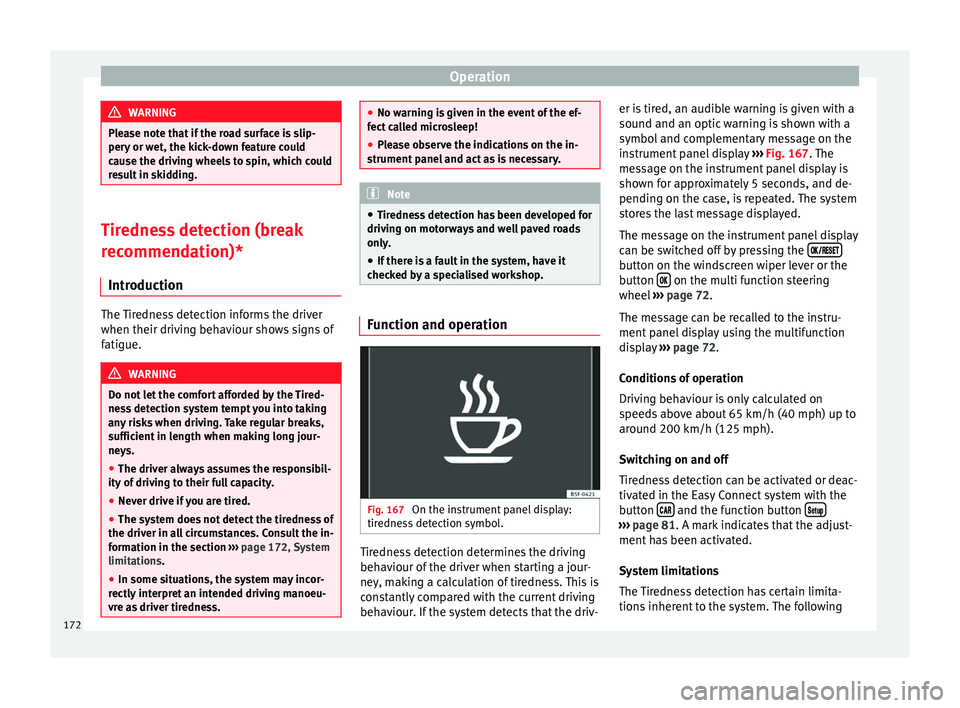
Fig. 167
On the instrument panel display:
tiredness detection symbol. Tiredness detection determines the driving
behaviour of the driver when starting a jour-
ney, making a calculation of tiredness. This is
constantly compared with the current driving
behaviour. If the system detects that the driv-er is tired, an audible warning is given with a
sound and an optic warning is shown with a
symbol and complementary message on the
instrument panel display
››› Fig. 167 . The
me s
sage on the instrument panel display is
shown for approximately 5 seconds, and de-
pending on the case, is repeated. The system
stores the last message displayed.
The message on the instrument panel display
can be switched off by pressing the button on the windscreen wiper lever or the
button
on the multi function steering
wheel ››› page 72 .
The me s
sage can be recalled to the instru-
ment panel display using the multifunction
display ››› page 72.
Condition
s of operation
Driving behaviour is only calculated on
speeds above about 65 km/h (40 mph) up to
around 200 km/h (125 mph).
Switching on and off
Tiredness detection can be activated or deac-
tivated in the Easy Connect system with the
button and the function button
›››
page 81 . A mark indicates that the adjust-
ment h
as been activated.
System limitations
The Tiredness detection has certain limita-
tions inherent to the system. The following
172
Page 198 of 284
Advice
SEAT recommends “genuine Volkswagen
Group Fuel Additives for petrol engines”.
These additives can be bought at SEAT deal-
ers, where information on how to use them
can also be obtained. CAUTION
● Do not refuel if the filler indicates that the
fuel contains metal. LRP ( lead replacement
petrol) fuels contain high concentrations of
met a
l additives. Using them may damage the
engine!
● Never refuel with fuels containing a large
proportion of ethanol (for example, E50, E85).
This could damage the fuel system.
● Just filling one full tank of leaded fuel or
fuel containing other metal additives would
seriously impair the efficiency of the catalytic
converter.
● Only use fuel additives that have been ap-
proved by SEAT. Octane boosting or anti-
knock additives may contain metal additives
that could seriously damage the engine or
the catalytic converter. These additives must
not be used.
● High engine speed and full throttle can
damage the engine when using petrol with an
octane rating lower than the correct grade for
the engine. Note
● You may use petrol with a high octane num-
ber than the one recommended for your en-
gine.
● In those countries where unleaded petrol is
not available, you may refuel with a fuel with
a low lead content. Diesel Fuel
Please note the information on the inside of
the fuel tank flap.
We recommend the use of
diesel fuel which
c omp
lies to European standard EN 590. If
diesel fuel which meets European standard
EN 590 is not available, the Cetane number
(CZ) must, at minimum, be 51. If the engine
is equipped with a particulate filter, the sul-
phur content of the fuel must be below 50
parts per million.
Winter-grade diesel
Summer fuel becomes thicker in winter and it
is more difficult to start the engine. For this
reason, petrol stations in some countries al-
so offer winter diesel with improved fluidity
when cold (winter-grade diesel). Water in the fuel filter
1)
If your vehicle has a diesel engine and is
equipped with a
fuel filter with a water sepa-
rator, the instrument panel may display the
following warning: Water in the fuel filter.
If thi
s is the case, take the vehicle to a speci-
alised workshop so that they can drain the
fuel filter. CAUTION
● The vehicle is not designed for the use of
FAME fuel (biodiesel). The fuel system would
be damaged if you used biodiesel.
● Do not mix fuel additives, the so-called
“thinners”, petrol or similar additives with
diesel fuel.
● If poor-quality diesel fuel is used, it may be
necessary to drain the fuel filter more fre-
quently than is specified in the Maintenance
Programme. We recommend having this done
by a specialised workshop. If water is allowed
to collect in the filter, this can cause engine
performance problems. Natural gas
Natural gas
Natural gas can be compressed or in liquid
form, addition to others.
1)
Valid for the market: Algeria.
196
Page 199 of 284

Checking and refilling levels
Liquefied natural gas (LNG) is the result of
heavy cooling of natural gas. Therefore its
volume is considerably reduced compared
with compressed natural gas (CNG). In vehi-
cles with a natural gas engine, liquefied nat-
ural gas cannot be directly refilled, as the gas
would expand excessively in the vehicle gas
tank.
Therefore, vehicles with a natural gas engine
must only be refuelled using compressed
natural gas ››› .
Natural gas quality and consumption
Natural gas is divided into the groups H and
L depending on its quality.
Gas type H has a superior heating power and
inferior nitrogen and carbon dioxide content
than type L. The higher the heating power of
the natural gas, the lower the consumption
will be.
However, the heating power and the propor-
tion of nitrogen and carbon dioxide can fluc-
tuate within the quality groups. Therefore, ve-
hicle consumption can also vary when using
a single type of gas only.
The engine management automatically
adapts to the natural gas used according to
its quality. Therefore, different quality gases
can be mixed in the tank, without the need
for comprehensive draining before applying a
different quality gas. Updated information relating to natural gas
quality is displayed on the instrument panel
››› page 72 .
Nat ur
al gas and safety
If you can smell gas or suspect that there is a
leak ››› :
● Stop the vehicle immediately.
● Switch the ignition off.
● Open the doors to appropriately ventilate
the vehicle.
● Extinguish cigarettes immediately.
● Move away from the vehicle or switch off
objects that may cause sparks or a fire.
● If you continue to smell gas, do not contin-
ue driving!
● Seek specialist assistance. Have the fault
repaired. WARNING
Failure to act when you can smell gas in the
vehicle or when refuelling can cause serious
injuries.
● Carry out the necessary operations.
● Leave the danger zone.
● If necessary, warn the emergency services. WARNING
The vehicle is not prepared to use liquefied
natural gas (LNG) and this fuel must not be
added under any circumstances. Liquefied
natural gas can cause the natural gas tank to
explode, resulting in serious injury. Note
Have the natural gas system checked regular-
ly by a specialised workshop, according to
the Maintenance Programme. 197
Technical specifications
Advice
Operation
Safety
The essentials
Page 206 of 284

Advice
could damage the engine
. If there is no
c
oolant in the expansion tank, do not con-
tinue driving. You should obtain professio-
nal assistance ››› .
– If there is still some coolant in the expan-
sion tank, top up to the upper mark.
– Top up with coolant until the level becomes
stable.
– Screw the cap back on correctly.
Any loss of coolant fluid normally indicates a
leak in the cooling system. Take the vehicle
straight to a specialised workshop to have
the cooling system examined. If there are no
leaks in the engine cooling system, a loss of
coolant can only occur if the coolant boils
and is forced out of the system as a result of
overheating. WARNING
● The cooling system is under pressure. Do
not unscrew the cap on the coolant expan-
sion tank when the engine is hot: risk of
burns!
● The antifreeze and coolant fluid can be a
health hazard. Therefore, the antifreeze
should be stored in the original container in a
safe place out of reach of children. Failure to
comply could result in poisoning.
● If working inside the engine compartment,
remember that, even when the ignition is
switched off, the radiator fan may start up au- tomatically, and therefore there is a risk of in-
jury.
CAUTION
Do not top up the expansion tank with cool-
ant fluid if it is empty! Air could enter the
cooling system. In this case, stop driving.
Seek specialist assistance. Otherwise, there
is a risk of engine damage. Brake fluid
Topping up the brake fluid Read the additional information carefully
››› page 32
Checking the brake fluid level
The brake fluid level must be between the
MIN and MAX markings.
However, if the brake fluid level goes down
noticeably in a short time, or drops below the
MIN mark, there may be a leak in the brake
system. Seek specialist assistance. A warn-
ing light on the instrument panel display
monitors the brake fluid level ››› page 71.
In right-hand drive vehicles the brake fluid
reservoir is on the other side of the engine
compartment. Changing brake fluid
The regular intervals at which the brake fluid
should be replaced are listed in the Mainte-
nance Programme. We recommend you have
it replaced at a SEAT Official Service, during
an Inspection Service.
WARNING
● Brake fluid should be stored in the closed
original container in a safe place out of reach
of children. Risk of poisoning!
● If the brake fluid is left in the system for
too long and the brakes are subjected to
heavy use, vapour bubbles may form in the
brake system. This would seriously affect the
efficiency of the brakes and the safety of the
vehicle. This may cause an accident. CAUTION
Brake fluid should not come into contact with
the vehicle paintwork, as it is abrasive. Windscreen washer reservoir
Checking and topping up the
windscreen washer reservoir with
water Read the additional information carefully
››› page 32
204
Page 214 of 284
Advice
securely and that the brake system functions
correctly.
The wheel bolts must be clean and turn easi-
ly.
A special adapter is required to turn the anti-
theft wheel bolts* ››› page 218.
Tyre monitoring systems Introduction WARNING
Unsuitable handling of the wheels and tyres
may lead to sudden tyre pressure losses, to
tread separation or even to a blow-out.
● Check tyre pressures regularly and ensure
they are maintained at the pressures indica-
ted. Tyre pressure that is too low could cause
overheating, resulting in tread detachment or
even burst tyres.
● Tyre pressure should be that indicated on
the label when the tyres are cold at all times
››› page 243.
● Re
gularly check the cold inflation pressure
of the tyres. If necessary, change the tyre
pressure of the vehicle tyres while they are
cold.
● Regularly check your tyres for damage and
wear. ●
Never exceed the maximum permitted
speed or loads specified for the type of tyre
fitted on your vehicle. For the sake of the environment
Under-inflated tyres lead to increased fuel
consumption and tyre wear. Note
● Driving for the first time with new tyres at a
high speed can cause them to slightly ex-
pand, which could then produce an air pres-
sure warning.
● Only replace used tyres with those author-
ised by SEAT for the corresponding type vehi-
cle.
● Do not only rely on the tyre monitoring sys-
tem. Regularly check your tyres to ensure
that the tyre pressure is correct and that the
tyres are not damaged due to puncture, cuts,
tears and impacts/dents. Remove objects
from the tyres only when they have not
pierced the tyres. Tyre monitor indicator warning lamp
If a light appears
The pressure in one or more tyres has
clearly reduced in comparison to the
tyre pressure set by the driver or the
tyre has structural damage.
Additionally, an audible warning can be heard and a text
message can be seen on the instrument panel display.
Stop the vehicle!
Reduce speed immediately! Stop
the vehicle safely as soon as possible. Avoid sudden
manoeuvres and braking! Check all tyres and pressures.
Replace any damaged tyres. If flashing
System malfunction
The control lamp flashes for approximately one minute
and then lights up permanently.
If tyre pressure is correct, switch the ignition off and on
again. If the control lamp remains lit up, the tyre moni-
toring indicator can be calibrated. Have the system
checked by a specialised workshop.
Several warning and control lamps light up
for a few seconds when the ignition is switch-
ed on while the function is verified. They will
switch off after a few seconds.
WARNING
When the tyres are inflated at different pres-
sures or at a pressure that is too low then a
tyre may be damaged resulting in a loss of 212
Page 215 of 284

Wheels
control of the vehicle and a serious or fatal
accident.
●
If the warning lamp lights up, stop im-
mediately and check the tyres.
● If the tyres are inflated at different pres-
sures or if a tyre pressure is too low, this will
increase tyre wear, negatively affecting vehi-
cle stability and increasing braking distan-
ces.
● If tyres are inflated at different pressures or
a tyre pressure is too low, a tyre may be dam-
aged and burst resulting in a loss of control
of the vehicle.
● The driver is responsible for ensuring that
all of the vehicle tyres are correctly inflated
to the right pressure. The recommended tyre
pressure is indicated on the label
››› page 243.
● The ty r
e monitoring system can only oper-
ate correctly if all of the tyres are inflated to
the correct pressure when cold.
● Driving with tyres at the wrong pressure
can damage them and result in an accident.
Ensure that the tyre pressures of all the tyres
correspond to the vehicle load.
● Before starting a journey, always inflate
tyres to the correct pressure.
● Tyres with insufficient pressure are subjec-
ted to more flexing. Due to this, the tyre
could become excessively hot, causing tread
separation and also tyre blow-out.
● With an overloaded vehicle at high speed,
the tyres can overheat and burst resulting in
a loss of vehicle control. ●
Tyre pressures which are too high or too
low reduce the useful life of the tyre, affect-
ing vehicle performance.
● If a tyre has not been punctured and it does
not have to be changed immediately, drive to
the nearest specialised workshop at a moder-
ate speed and have the tyre checked and in-
flated to the correct pressure. WARNING
Observe the safety warnings ››› in Control
and warning lamps on page 71. Note
● If excessively low tyre pressure is detected
with the ignition on, an audible warning will
sound. In the event that there is a fault in the
system, an audible warning will sound.
● Driving on dirt tracks for a long period of
time or driving in a sporty style can tempora-
rily deactivate the TPMS. The control lamp
shows a fault, but disappears when road con-
ditions or the driving style change. Tyre monitoring indicator
Fig. 179
Instrument panel: warning of loss of
tyre pressure. The tyre monitor indicator compares wheel
revolutions and, with this information, the
tread of each wheel using the ABS sensors. If
the rolling circumference of one or more
wheels has changed, the tyre monitoring in-
dicator will indicate this on the instrument
panel through a warning lamp and a warning
to the driver
››› Fig. 179 . When only one spe-
c ific
tyre is affected, its position within the
vehicle will be indicated.
Loss of pressure: Check left tyre pressure!
Wheel tread change
The wheel tread changes when: ● Tyre pressure is manually changed
● Tyre pressure is insufficient
● Tyre structure is damaged »
213
Technical specifications
Advice
Operation
Safety
The essentials
Page 244 of 284
Technical specifications
VIN in the Easy Connect – Select: Function button CAR > control but-
ton (Car)* Systems > Service & Control >
Ch a
ssis number .
Chassis number
The VIN is located in the Easy Connect, on the
vehicle data sticker and under the wind-
screen, on the driver side ››› Fig. 226. Addi-
tional
ly, the chassis number is located in the
engine compartment, on the right-hand side.
The number is engraved on the top side rail,
and is partially covered.
Type plate
The type plate is located on the right side
door pillar. Vehicles for certain export coun-
tries do not have a type plate.
Vehicle data sticker
The vehicle data sticker is under the carpet
trim in the luggage compartment, in the
spare wheel well. A sticker with the vehicle
data is attached to the inside cover of the
Maintenance Programme.
The following information is provided on the
vehicle data sticker: ››› Fig. 225
Vehicle identification number (chassis
number)
1 Vehicle type, model, capacity, engine
type, finish, engine power and gearbox
type
Engine code, gearbox code, external
paint code and internal equipment code
Optional extras and PR numbers
Consumption values (l/100 km) and CO
2
emissions (g/km)
A Urban cycle consumption
B Out-of-town consumption
C Combined consumption and CO
2
emissions
Identifying letters
The identifying letters of the engine can be
viewed on the instrument panel when the en-
gine is switched off and the ignition is on.
● Hold down the 0.0/SET
4
››› Fig. 82 button
for more than 15 seconds.
Information on fuel
consumption
Fuel consumption The consumption and emission details
shown on the vehicle data sticker differ from
one vehicle to another.2 3
4
5 Vehicle fuel consumption and CO
2 emissions
appear on the vehicle data sticker in the
spare wheel well, inside the boot and on the
rear cover of the Maintenance Programme.
The fuel consumption and CO 2 emission val-
ues refer to the weight category assigned to
your vehicle according to the engine and
gearbox combination, as well as the specific
equipment fitted, and is only used to com-
pare between the different models.
The fuel consumption and CO 2 emissions do
not depend only on the performance of the
vehicle, they can also differ from the estab-
lished values depending on other factors
such as driving style, road conditions, traffic
conditions, environmental conditions, load
and number of passengers.
Calculation of fuel consumption
The consumption values have been calcula-
ted based on measurements performed or
supervised by certified CE laboratories ac-
cording to the latest version of directives
715/2007/EC and 80/1268/CEE (for more in-
formation consult the European Union Publi-
cations Office at EUR-Lex: © European Union,
http://eur-lex.europa.eu/en/index.htm) and
are valid for the kerb weight indicated for the
vehicle.
242
Page 273 of 284

Index
Cooling system Checking the coolant . . . . . . . . . . . . . . . . . . . . 203
Coolant temperature gauge . . . . . . . . . . . . . . . . 69
Topping up coolant . . . . . . . . . . . . . . . . . . . . . . 203
Cornering lights . . . . . . . . . . . . . . . . . . . . . . . . . . . 97
Correct adjustment of front head restraints . . . . . 41
Correct adjustment of rear head restraints In-use and non-use positions of rear head re-straints . . . . . . . . . . . . . . . . . . . . . . . . . . . . . . 41
Correct sitting position front passenger . . . . . . . . . . . . . . . . . . . . . . . . . 39
Incorrect sitting position . . . . . . . . . . . . . . . . . . 40
passenger . . . . . . . . . . . . . . . . . . . . . . . . . . . . . . 40
Cruise control . . . . . . . . . . . . . . . . . . . . . . . . 21, 150 Control lamp . . . . . . . . . . . . . . . . . . . . . . . . . . . 150
Operation . . . . . . . . . . . . . . . . . . . . . . . . . . . . . 151
Warning lamp . . . . . . . . . . . . . . . . . . . . . . . . . . 150
Cruise control system . . . . . . . . . . . . . . . . . . . . . . 150
D Dangers in not using the seat belt . . . . . . . . . . . . 45
Daytime driving light . . . . . . . . . . . . . . . . . . . . . . . 95
Deactivating the front passenger front airbag . . . 11
DEF (instrument panel) . . . . . . . . . . . . . . . . . . . . . 69
Diesel Diesel particulate filter . . . . . . . . . . . . . . . . . . . 141
Engine oil . . . . . . . . . . . . . . . . . . . . . . . . . . . . . 200
Pre-heating . . . . . . . . . . . . . . . . . . . . . . . . . . . . 129
Digital clock . . . . . . . . . . . . . . . . . . . . . . . . . . . . . . 66
Dimensions . . . . . . . . . . . . . . . . . . . . . . . . . . . . . . 267
Dipped beam headlight . . . . . . . . . . . . . . . . . . . . . 94
Direction of rotation (tyres) . . . . . . . . . . . . . . . . . 220
Disabling the front airbag . . . . . . . . . . . . . . . . . . . 54
Display . . . . . . . . . . . . . . . . . . . . . . . . . . . . . . . 66, 67
Display/Easy Connect control panel: cleaning . . 187
Disposal Seat belt tensioners . . . . . . . . . . . . . . . . . . . . . . 47 Distance control
see Adaptive cruise control . . . . . . . . . . . . . . . 151
Door/r e
ar lid warning . . . . . . . . . . . . . . . . . . . . . . . 72
Door cylinder . . . . . . . . . . . . . . . . . . . . . . . . . . . . 227
Door handle . . . . . . . . . . . . . . . . . . . . . . . . . . . . . 227
Door lock . . . . . . . . . . . . . . . . . . . . . . . . . . . . . . . . 227
Doors Childproof locks . . . . . . . . . . . . . . . . . . . . . . . . . 87
Opening and closing . . . . . . . . . . . . . . . . . . . . . . 9
Downhill speed control . . . . . . . . . . . . . . . . . . . . 138
Drawer . . . . . . . . . . . . . . . . . . . . . . . . . . . . . . . . . . 111
Drink holders . . . . . . . . . . . . . . . . . . . . . . . . . . . . 112
Driver see
Correct sitting position . . . . . . . . . 38, 39, 40
Driver information system . . . . . . . . . . . . . . . . . . . 19 CD/radio display . . . . . . . . . . . . . . . . . . . . . . . . . 72
Control . . . . . . . . . . . . . . . . . . . . . . . . . . . . . . . . . 19
Door/rear lid warning . . . . . . . . . . . . . . . . . . . . . 72
Engine oil temperature display . . . . . . . . . . . . . 77
Menu . . . . . . . . . . . . . . . . . . . . . . . . . . . . . . . . . . 20
Operation via the windscreen wiper lever . . . . . 72
Outside temperature display . . . . . . . . . . . . . . . 72
Driving With a trailer . . . . . . . . . . . . . . . . . . . . . . 177, 179
Driving abroad Headlights . . . . . . . . . . . . . . . . . . . . . . . . . . . . 100
Driving mode . . . . . . . . . . . . . . . . . . . . . . . 170, 171
Driving profile . . . . . . . . . . . . . . . . . . . . . . . 170, 171
Driving safety . . . . . . . . . . . . . . . . . . . . . . . . . . . . . 37
Driving through water . . . . . . . . . . . . . . . . . . . . . 141
Dynamic headlight range control . . . . . . . . . . . . 100
E
E10 see Ethanol (fuel) . . . . . . . . . . . . . . . . . . . . . . . 195
E a
sy Connect . . . . . . . . . . . . . . . . . . . . . . . . . . 17, 81
Economic driving . . . . . . . . . . . . . . . . . . . . . . . . . 142 EDL
see Electronic differential lock . . . . . . . . . . . . . 143
Effic iency
programme
Additional electrical appliances . . . . . . . . . . . . 77
Saving tips . . . . . . . . . . . . . . . . . . . . . . . . . . . . . 78
Electric Windows . . . . . . . . . . . . . . . . . . . . . . . . . . . . . . . 90
Electrical accessories see
Power socket . . . . . . . . . . . . . . . . . . . . . . . 113
Electrical sockets trailer . . . . . . . . . . . . . . . . . . . . . . . . . . . . . . . . . 179
Electric seat Adjustment . . . . . . . . . . . . . . . . . . . . . . . . . . . . . 12
Electric windows . . . . . . . . . . . . . . . . . . . . . . . . 10, 90 Convenience opening/closing . . . . . . . . . . . . . . 91
Electro-mechanical steering . . . . . . . . . . . . . . . . 190 Warning lamp . . . . . . . . . . . . . . . . . . . . . . . . . . 190
Electronic differential lock . . . . . . . . . . . . . . . . . . 143
Electronic self-locking . . . . . . . . . . . . . . . . . . . . . 143
Electronic Stability Control (ESC) . . . . . . . . . . . . 143
Emergencies . . . . . . . . . . . . . . . . . . . . . . . . . . . . . 217 Automatic gearbox Backup programme . . . . . 139
Replacing the battery . . . . . . . . . . . . . . . . . . . . 207
Emergency braking warning . . . . . . . . . . . . . . . . . 99
Emergency locking and unlocking . . . . . . . . . . . 227
Emergency towing . . . . . . . . . . . . . . . . . . . . . . . . . 35
Engine Assisted starting . . . . . . . . . . . . . . . . . . . . . . . . 223
Pre-heating . . . . . . . . . . . . . . . . . . . . . . . . . . . . 129
Start-Stop system . . . . . . . . . . . . . . . . . . . . . . . 148
Starting . . . . . . . . . . . . . . . . . . . . . . . . . . . . . . . 129
Starting up (driver messages with the me-chanical contact) . . . . . . . . . . . . . . . . . . . . . 129
Switching off (engine) . . . . . . . . . . . . . . . . . . . 130
Engine compartment . . . . . . . . . . . . . . . . . . 10, 198 Closing the bonnet . . . . . . . . . . . . . . . . . . . . . . 199
Opening the bonnet . . . . . . . . . . . . . . . . . . . . . 199
Safety notes . . . . . . . . . . . . . . . . . . . . . . . . . . . 198 271
Page 275 of 284

Index
G
Gas Pre-heating . . . . . . . . . . . . . . . . . . . . . . . . . . . . 129
Gas filtration system Diesel particulate filter . . . . . . . . . . . . . . . . . . . 141
Gear-change indicator . . . . . . . . . . . . . . . . . . . . . . 74
Gearbox DSG see Automatic gearbox . . . . . . . . . . . . . . . . . . . 132
Ge arbo
x lever . . . . . . . . . . . . . . . . . . . . . . . . . . . . . 24
Gear change . . . . . . . . . . . . . . . . . . . . . . . . . . . . . . 24
Gear engaged . . . . . . . . . . . . . . . . . . . . . . . . . . . . . 24
Gear recommendation . . . . . . . . . . . . . . . . . . . . . . 74
Gearshift paddles (automatic gearbox) . . . . . . . 135
General overview of the engine compartment . . 198
Glass Cleaning/De-icing . . . . . . . . . . . . . . . . . . . . . . 186
Glove box . . . . . . . . . . . . . . . . . . . . . . . . . . . . . . . 112
Glove compartment lighting . . . . . . . . . . . . . . . . 101
Glow plug system control lamp . . . . . . . . . . . . . . . . . . . . . . . . . . . . 71
H Handbrake . . . . . . . . . . . . . . . . . . . . . . . . . . . . . . 131 warning lamp . . . . . . . . . . . . . . . . . . . . . . . . . . 131
Hazard warning lights . . . . . . . . . . . . . . . . . . . 15, 99
Head-on collisions and the laws of physics . . . . . 45
Head-protection airbags . . . . . . . . . . . . . . . . . . . . 53 description . . . . . . . . . . . . . . . . . . . . . . . . . . . . . 53
safety instructions . . . . . . . . . . . . . . . . . . . . . . . 53
Headlight range control . . . . . . . . . . . . . . . . . . . . 100
Headlights Changing a bulb . . . . . . . . . . . . . . . . . . . . . . . . 233
Driving abroad . . . . . . . . . . . . . . . . . . . . . . . . . 100
Headlight washers . . . . . . . . . . . . . . . . . . . . . . 103
Head restraints . . . . . . . . . . . . . . . . . . . . . . . . . . . . 12 Adjustment . . . . . . . . . . . . . . . . . . . . . . . . . . . . 107 Headrests . . . . . . . . . . . . . . . . . . . . . . . . . . . . . . . . 12
Adjustment . . . . . . . . . . . . . . . . . . . . . . . . . . . . 107
Heated exterior mirrors . . . . . . . . . . . . . . . . . . . . . . . . . 104
Heated rear window . . . . . . . . . . . . . . . . . . . . . 27, 29
Heating and fresh air . . . . . . . . . . . . . . . . . . . . . . . 29
Hill driving assistant . . . . . . . . . . . . . . . . . . . . . . 147
Horn . . . . . . . . . . . . . . . . . . . . . . . . . . . . . . . . . . . . 65
How to jump start description . . . . . . . . . . . . . . . 223
I Identification plate . . . . . . . . . . . . . . . . . . . . . . . . 241
Identifying letters of engine . . . . . . . . . . . . . . . . 241
Ignition . . . . . . . . . . . . . . . . . . . . . . . . . . . . . 14, 129
Ignition lock . . . . . . . . . . . . . . . . . . . . . . . . . 14, 129
Importance of the correct adjustment of head re- straints . . . . . . . . . . . . . . . . . . . . . . . . . . . . . . . . 41
Inertia mode . . . . . . . . . . . . . . . . . . . . . . . . . . . . . 138
Information on emissions . . . . . . . . . . . . . . . . . . 241
Inspection service . . . . . . . . . . . . . . . . . . . . . . . . 200
Instrument cluster . . . . . . . . . . . . . . . . . . . . . . . . . 66
Instrument panel . . . . . . . . . . . . . . . . . . . . . . . 22, 66 Display . . . . . . . . . . . . . . . . . . . . . . . . . . . . . 66, 67
Instruments . . . . . . . . . . . . . . . . . . . . . . . . . . . . . 66
Lamps . . . . . . . . . . . . . . . . . . . . . . . . . . . . . . . . . 71
Service interval display . . . . . . . . . . . . . . . . . . . 80
Instrument panel lighting . . . . . . . . . . . . . . . . . . 100
Instrument panel on-screen messages Front Assist monitoring system . . . . . . . . . . . . 162
Interior lights . . . . . . . . . . . . . . . . . . . . . . . . . . . . . 16
Interior monitoring . . . . . . . . . . . . . . . . . . . . . . . . . 89
Interior view . . . . . . . . . . . . . . . . . . . . . . . . . . . . . . . 7
ISOFIX . . . . . . . . . . . . . . . . . . . . . . . . . . . . . . . . 59, 61
ISOFIX system . . . . . . . . . . . . . . . . . . . . . . . . . . . . . 59 J
Jack . . . . . . . . . . . . . . . . . . . . . . . . . . . . . . . . . . . . 220 Mounting points . . . . . . . . . . . . . . . . . . . . . . . . 219
Jump leads . . . . . . . . . . . . . . . . . . . . . . . . . . . . . . 223
Jump starting . . . . . . . . . . . . . . . . . . . . . . . . . . . . 223
K
Key Driver messages (mechanical contact) . . . . . . 129
Unlock/Lock . . . . . . . . . . . . . . . . . . . . . . . . . . . . 84
Keys Assign key . . . . . . . . . . . . . . . . . . . . . . . . . . . . . . 83
Car key . . . . . . . . . . . . . . . . . . . . . . . . . . . . . . . . . 83
Changing the battery (vehicle key) . . . . . . . . . . 86
Locking/Unlocking . . . . . . . . . . . . . . . . . . . . . . 227
Remote control . . . . . . . . . . . . . . . . . . . . . . . . . . 83
Spare key . . . . . . . . . . . . . . . . . . . . . . . . . . . . . . 83
Kick-down Manual gearbox . . . . . . . . . . . . . . . . . . . . . . . . 171
Kick-down feature Automatic gearbox . . . . . . . . . . . . . . . . . . . . . . 137
Knee airbag see Airbag system . . . . . . . . . . . . . . . . . . . . . . . 52
L
Lamps Audib
le warnings . . . . . . . . . . . . . . . . . . . . . . . . 71
Control lamps . . . . . . . . . . . . . . . . . . . . . . . . . . . 71
Warning lamps . . . . . . . . . . . . . . . . . . . . . . . . . . 71
Lane Assist . . . . . . . . . . . . . . . . . . . . . . . . . . . . . . 166 Cleaning the camera area . . . . . . . . . . . . . . . . 185
Lane Assist system see Lane Assist . . . . . . . . . . . . . . . . . . . . . . . . . 166
Lau nc
h Control Programme (automatic gearbox) 137
Leather Care Natural leather . . . . . . . . . . . . . . . . . . . . . . . . . 188
273
Page 276 of 284

Index
Leather: Care . . . . . . . . . . . . . . . . . . . . . . . . . . . . 188
Leaving Home . . . . . . . . . . . . . . . . . . . . . . . . . . . . . 98
Level control . . . . . . . . . . . . . . . . . . . . . . . . . . . . . . 31
Lifting the vehicle . . . . . . . . . . . . . . . . . . . . . . . . . 219
Lighting Changing a bulb . . . . . . . . . . . . . . . . . . . . . . . . 233
Lights . . . . . . . . . . . . . . . . . . . . . . . . . . . . . . . . 15, 94 Audible warnings . . . . . . . . . . . . . . . . . . . . . . . . 94
AUTO . . . . . . . . . . . . . . . . . . . . . . . . . . . . . . . . . . 96
Changing a bulb . . . . . . . . . . . . . . . . . . . . . . . . 233
Coming home . . . . . . . . . . . . . . . . . . . . . . . . . . . 97
Controls lighting . . . . . . . . . . . . . . . . . . . . . . . . 100
Cornering lights . . . . . . . . . . . . . . . . . . . . . . . . . 97
Daytime driving light . . . . . . . . . . . . . . . . . . . . . 95
Dipped beam headlight . . . . . . . . . . . . . . . . . . . 94
Fog light . . . . . . . . . . . . . . . . . . . . . . . . . . . . . . . 97
Headlight range control . . . . . . . . . . . . . . . . . . 100
Instrument lighting . . . . . . . . . . . . . . . . . . . . . . 100
Interior lights . . . . . . . . . . . . . . . . . . . . . . . . . . 101
Leaving home . . . . . . . . . . . . . . . . . . . . . . . . . . . 98
Light switch . . . . . . . . . . . . . . . . . . . . . . . . . . . . . 94
Main beam lever . . . . . . . . . . . . . . . . . . . . . . . . . 95
Motorway lights . . . . . . . . . . . . . . . . . . . . . . . . 100
Parking light . . . . . . . . . . . . . . . . . . . . . . . . . . . . 99
Reading lights . . . . . . . . . . . . . . . . . . . . . . . . . . 101
Side light . . . . . . . . . . . . . . . . . . . . . . . . . . . . . . . 94
Turn signal lever . . . . . . . . . . . . . . . . . . . . . . . . . 95
Light switch . . . . . . . . . . . . . . . . . . . . . . . . . . . . . . 15
Load compartment in the luggage compartment see Loading the luggage compartment . . . . . 114
L o
ading the luggage compartment . . . . . . . . . . . 114
Loading the vehicle fastening rings . . . . . . . . . . . . . . . . . . . . . . . . . 119
luggage compartment . . . . . . . . . . . . . . . . . . . . . 9
roof carrier system . . . . . . . . . . . . . . . . . . . . . . 124
tailboard for transporting long items . . . . . . . 118 Locking/Unlocking
In the lock cylinder . . . . . . . . . . . . . . . . . . . . . . 227
With the central locking switch . . . . . . . . . . . . . 85
Longlife inspection service . . . . . . . . . . . . . . . . . 200
Luggage compartment . . . . . . . . . . . . . . . . . . . . 9, 89 automatic lock . . . . . . . . . . . . . . . . . . . . . . . . . . 90
Central locking . . . . . . . . . . . . . . . . . . . . . . . . . . 89
Cover . . . . . . . . . . . . . . . . . . . . . . . . . . . . . . . . . 114
Luggage compartment lighting . . . . . . . . . . . . 101
luggage compartment variable floor . . . . . . . . 121
Manual release . . . . . . . . . . . . . . . . . . . . . . . . . 228
net bag . . . . . . . . . . . . . . . . . . . . . . . . . . . . . . . 120
net partition . . . . . . . . . . . . . . . . . . . . . . 116, 117
retractable rear shelf . . . . . . . . . . . . . . . . . . . . 115
storing the rear shelf . . . . . . . . . . . . . . . . . . . . 116
see also
Loading the luggage compartment . 114
Luggage compartment floor . . . . . . . . . . . . . . . . 121
Luggage compartment variable floor . . . . . . . . . 121
Luggage net luggage compartment . . . . . . . . . . . . . . . . . . . 120
Lumbar support . . . . . . . . . . . . . . . . . . . . . . . . . . 106
M Main beam . . . . . . . . . . . . . . . . . . . . . . . . . . . . . . . 15
Main beam assist . . . . . . . . . . . . . . . . . . . . . . . . . . 96
Main beam headlight . . . . . . . . . . . . . . . . . . . . . . . 94
Main beam lever . . . . . . . . . . . . . . . . . . . . . . . . . . . 95
Main panel Turn signal and main beam lever . . . . . . . . . . . 95
malfunction Front Assist . . . . . . . . . . . . . . . . . . . . . . . . . . . . 162
Malfunction Adaptive cruise control . . . . . . . . . . . . . . . . . . 152
front assist monitoring system . . . . . . . . . . . . 162
Manual action Passenger door . . . . . . . . . . . . . . . . . . . . . . . . . 228
Rear lid . . . . . . . . . . . . . . . . . . . . . . . . . . 228, 229 Manual gearbox . . . . . . . . . . . . . . . . . . . . . . . . . . 132
Kick-down . . . . . . . . . . . . . . . . . . . . . . . . . . . . . 171
Manual gear change . . . . . . . . . . . . . . . . . . . . . . . 24
Manual operation Selector lever . . . . . . . . . . . . . . . . . . . . . . . . . . 229
Messages on the instrument panel display Adaptive cruise control . . . . . . . . . . . . . . . . . . 152
Mobile phone . . . . . . . . . . . . . . . . . . . . . . . . . . . . 182
Mobile phones . . . . . . . . . . . . . . . . . . . . . . . . . . . 182
Modifications (technical) . . . . . . . . . . . . . . . . . . . 182
Monitoring systems Front Assist monitoring system . . . . . . . . . . . . 161
Motorway lights . . . . . . . . . . . . . . . . . . . . . . . . . . 100
Mounting pin (tyre change) . . . . . . . . . . . . . . . . . 220
Mounting points (jack) . . . . . . . . . . . . . . . . . . . . . 219
Move off Hill driving assistant . . . . . . . . . . . . . . . . . . . . . 147
Multi-collision Brake . . . . . . . . . . . . . . . . . . . . . . 144
N
Natural gas . . . . . . . . . . . . . . . . . . . . . . . . . . . . . . 196 Fuel tank cap . . . . . . . . . . . . . . . . . . . . . . . . . . . 194
LNG . . . . . . . . . . . . . . . . . . . . . . . . . . . . . . . . . . 195
refuelling . . . . . . . . . . . . . . . . . . . . . . . . . . . . . . 194
smell . . . . . . . . . . . . . . . . . . . . . . . . . . . . . . . . . 197
things to note . . . . . . . . . . . . . . . . . . . . . . . . . . 194
Natural gas quality . . . . . . . . . . . . . . . . . . . . . . . . 197
Navigation system CD-ROM player . . . . . . . . . . . . . . . . . . . . . . . . . 112
Net bag luggage compartment . . . . . . . . . . . . . . . . . . . 120
Net partition . . . . . . . . . . . . . . . . . . . . . . . . 116, 117
Noises Adaptive cruise control . . . . . . . . . . . . . . . . . . 152
refuelling natural gas . . . . . . . . . . . . . . . . . . . . 195
Number of colour . . . . . . . . . . . . . . . . . . . . . . . . . 241
Number of seats . . . . . . . . . . . . . . . . . . . . . . . . . . . 43
274