ignition Seat Mii 2013 Owner's Guide
[x] Cancel search | Manufacturer: SEAT, Model Year: 2013, Model line: Mii, Model: Seat Mii 2013Pages: 306, PDF Size: 4.3 MB
Page 87 of 306
85
Lights and visibility
WARNING
The side lights or daytime driving lights are not bright enough to illumi-
nate the road ahead and to ensure that other road users are able to see
you.
● Always use your dipped beam head lights if it is raining or if visibility
is poor.
Lights and visibility: functions
Parking light remains on both sides
If when switching off the ignition, the light control remains in the posi-
tion and the vehicle is closed from outside, both headlights, in addition
to the side lights and the rear lights will light up.
Daytime driving light
The daytime driving light consists of individual lights in the front head-
lamps.
When the daytime driving light is switched on, only the individual lights
come on ⇒
.
The daytime lights are switched on each time the ignition is turned on if the
light switch is in position .
Switching the daytime driving light on and off
To switch the daytime driving light on or off, it is necessary to fit or remove
the corresponding fuse. Ask for professional assistance for this.
WARNING
If the road is not well-lit and the vehicle is not clearly visible to other
drivers, there is a risk of accident.
● Never use the daytime driving light if the road is not well-lit as a re-
sult of the weather conditions and poor visibility. The daytime driving
lights are not bright enough to illuminate the road ahead and to ensure
that other road users are able to see you.
● The rear lights do not come on with the daytime driving light. A vehi-
cle which does not have the rear lights on may not be visible to other
drivers in the darkness, if it is raining or in conditions of poor visibility.
Note
The headlights, rear lights and turn signals may mist up temporarily on the
inside in cool or damp weather. This is normal and in no way effects the
useful life of the vehicle lighting system.
Adjusting the headlights
In those countries where vehicles drive on the other side of the road to the
home country, the asymmetric dipped beam may dazzle drivers of oncom-
ing vehicles.
For this reason, stickers may need to be used to cover the headlights when
driving abroad. For further information, please refer to a specialised work-
shop. SEAT recommends visiting a Technical Service.
Note
The use of stickers to cover headlights is only permitted over a short period.
To modify the direction of the headlamps more permanently, please take
the vehicle to a specialised workshop. SEAT recommends visiting a Techni-
cal Service.
Vehicle diagramPrior to a journey...While drivingCare, cleaning and mainte-
nanceIf and whenTechnical specifications
Page 88 of 306
86Lights and visibility
Headlight range control, lighting of instruments and
controls
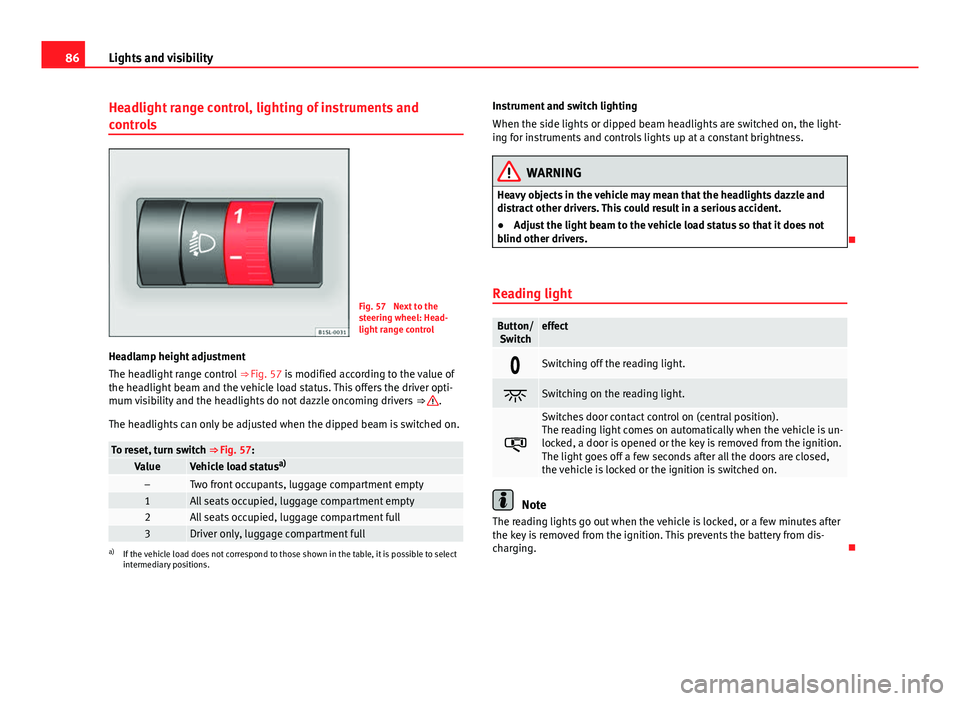
Fig. 57 Next to the
steering wheel: Head-
light range control
Headlamp height adjustment
The headlight range control ⇒ Fig. 57 is modified according to the value of
the headlight beam and the vehicle load status. This offers the driver opti-
mum visibility and the headlights do not dazzle oncoming drivers ⇒
.
The headlights can only be adjusted when the dipped beam is switched on.
To reset, turn switch ⇒ Fig. 57:ValueVehicle load status a)–Two front occupants, luggage compartment empty1All seats occupied, luggage compartment empty2All seats occupied, luggage compartment full3Driver only, luggage compartment fulla)
If the vehicle load does not correspond to those shown in the table, it is possible to select
intermediary positions. Instrument and switch lighting
When the side lights or dipped beam headlights are switched on, the light-
ing for instruments and controls lights up at a constant brightness.
WARNING
Heavy objects in the vehicle may mean that the headlights dazzle and
distract other drivers. This could result in a serious accident.
● Adjust the light beam to the vehicle load status so that it does not
blind other drivers.
Reading light
Button/ Switcheffect
Switching off the reading light.
Switching on the reading light.
Switches door contact control on (central position).
The reading light comes on automatically when the vehicle is un-
locked, a door is opened or the key is removed from the ignition.
The light goes off a few seconds after all the doors are closed,
the vehicle is locked or the ignition is switched on.
Note
The reading lights go out when the vehicle is locked, or a few minutes after
the key is removed from the ignition. This prevents the battery from dis-
charging.
Page 92 of 306
90Lights and visibility
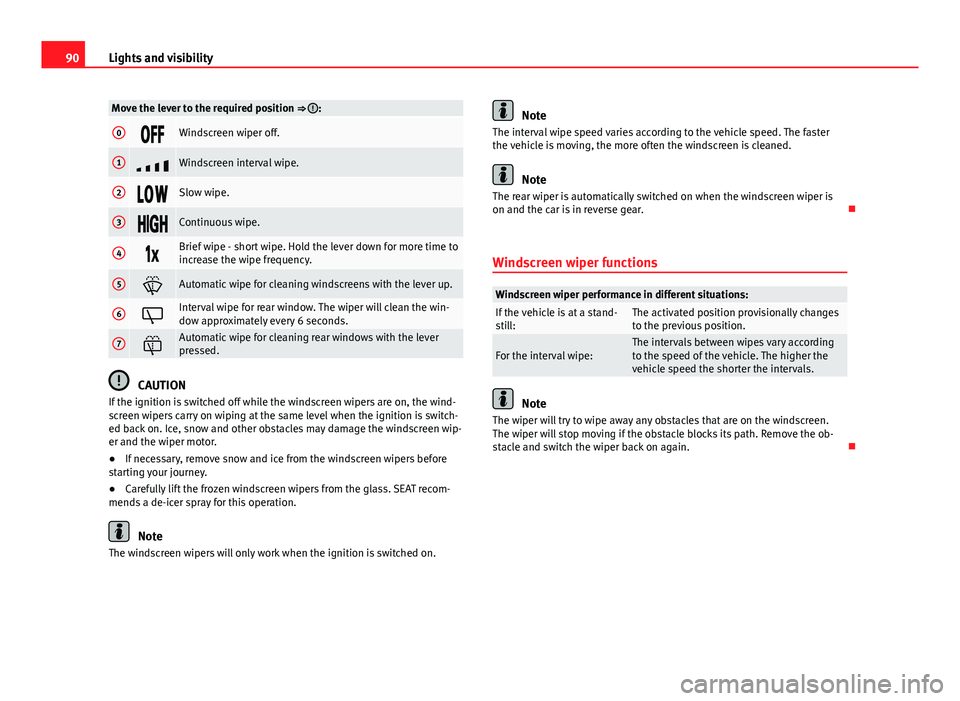
Move the lever to the required position ⇒ :
0Windscreen wiper off.
1Windscreen interval wipe.
2Slow wipe.
3Continuous wipe.
4Brief wipe - short wipe. Hold the lever down for more time to
increase the wipe frequency.
5Automatic wipe for cleaning windscreens with the lever up.
6Interval wipe for rear window. The wiper will clean the win-
dow approximately every 6 seconds.
7Automatic wipe for cleaning rear windows with the lever
pressed.
CAUTION
If the ignition is switched off while the windscreen wipers are on, the wind-
screen wipers carry on wiping at the same level when the ignition is switch-
ed back on. Ice, snow and other obstacles may damage the windscreen wip-
er and the wiper motor.
● If necessary, remove snow and ice from the windscreen wipers before
starting your journey.
● Carefully lift the frozen windscreen wipers from the glass. SEAT recom-
mends a de-icer spray for this operation.
Note
The windscreen wipers will only work when the ignition is switched on.
Note
The interval wipe speed varies according to the vehicle speed. The faster
the vehicle is moving, the more often the windscreen is cleaned.
Note
The rear wiper is automatically switched on when the windscreen wiper is
on and the car is in reverse gear.
Windscreen wiper functions
Windscreen wiper performance in different situations:If the vehicle is at a stand-
still:The activated position provisionally changes
to the previous position.
For the interval wipe:The intervals between wipes vary according
to the speed of the vehicle. The higher the
vehicle speed the shorter the intervals.
Note
The wiper will try to wipe away any obstacles that are on the windscreen.
The wiper will stop moving if the obstacle blocks its path. Remove the ob-
stacle and switch the wiper back on again.
Page 93 of 306
91
Lights and visibility
Windscreen wiper service position
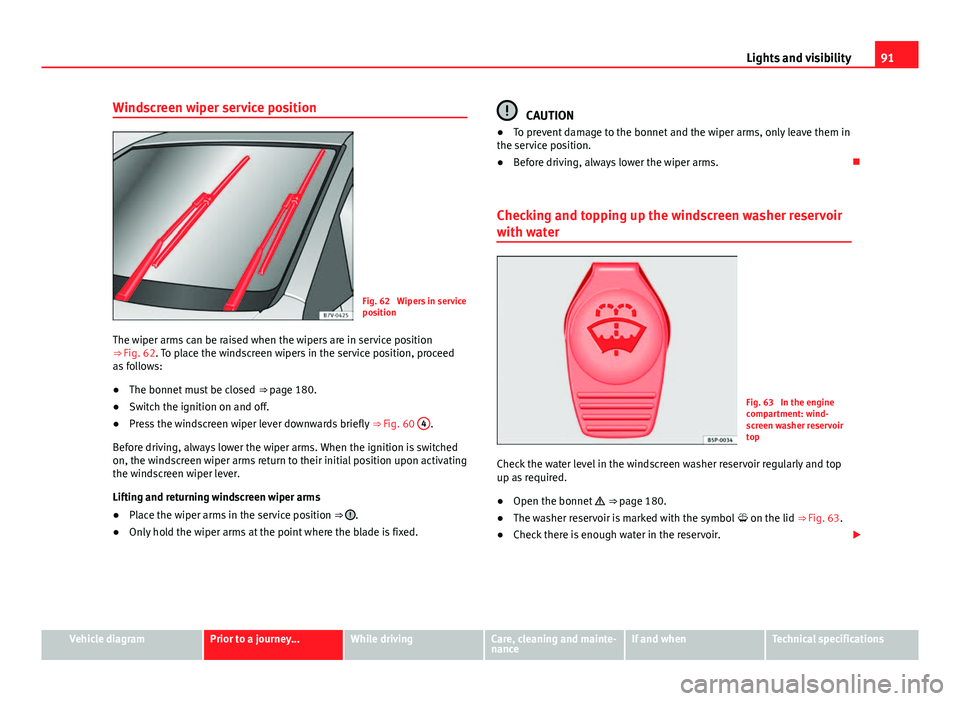
Fig. 62 Wipers in service
position
The wiper arms can be raised when the wipers are in service position
⇒ Fig. 62. To place the windscreen wipers in the service position, proceed
as follows:
● The bonnet must be closed
⇒ page 180.
● Switch the ignition on and off.
● Press the windscreen wiper lever downwards briefly
⇒ Fig. 60 4
.
Before driving, always lower the wiper arms. When the ignition is switched
on, the windscreen wiper arms return to their initial position upon activating
the windscreen wiper lever.
Lifting and returning windscreen wiper arms
● Place the wiper arms in the service position
⇒
.
● Only hold the wiper arms at the point where the blade is fixed.
CAUTION
● To prevent damage to the bonnet and the wiper arms, only leave them in
the service position.
● Before driving, always lower the wiper arms.
Checking and topping up the windscreen washer reservoir
with water
Fig. 63 In the engine
compartment: wind-
screen washer reservoir
top
Check the water level in the windscreen washer reservoir regularly and top
up as required.
● Open the bonnet ⇒ page 180.
● The washer reservoir is marked with the symbol on the lid ⇒ Fig. 63.
● Check there is enough water in the reservoir.
Vehicle diagramPrior to a journey...While drivingCare, cleaning and mainte-
nanceIf and whenTechnical specifications
Page 117 of 306
115
Practical equipment
Ashtray and Lighter
Introduction
Additional information and warnings:
● Power socket ⇒ page 117
● Accessories, parts replacement, repairs and modifications ⇒ page 222
WARNING
Undue use of the ashtray and cigarette lighter may cause a fire or burns
and other serious injuries.
● Never put paper or other flammable objects in the ashtray.
Ashtray*
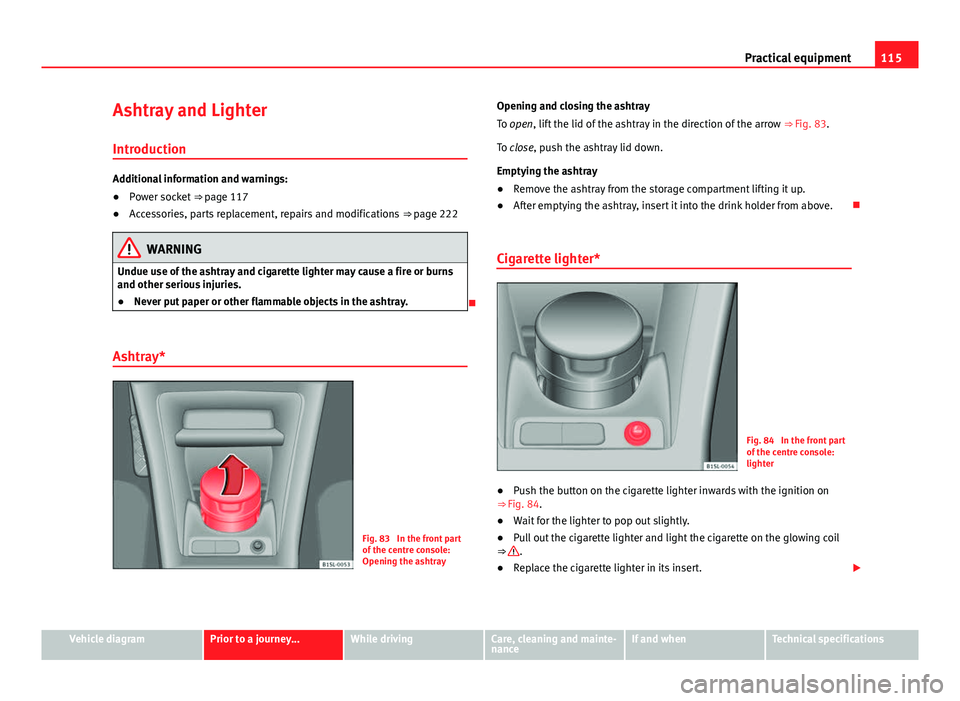
Fig. 83 In the front part
of the centre console:
Opening the ashtray Opening and closing the ashtray
To open, lift the lid of the ashtray in the direction of the arrow
⇒ Fig. 83.
To close, push the ashtray lid down.
Emptying the ashtray
● Remove the ashtray from the storage compartment lifting it up.
● After emptying the ashtray, insert it into the drink holder from above.
Cigarette lighter*
Fig. 84 In the front part
of the centre console:
lighter
● Push the button on the cigarette lighter inwards with the ignition on
⇒ Fig. 84.
● Wait for the lighter to pop out slightly.
● Pull out the cigarette lighter and light the cigarette on the glowing coil
⇒
.
● Replace the cigarette lighter in its insert.
Vehicle diagramPrior to a journey...While drivingCare, cleaning and mainte-
nanceIf and whenTechnical specifications
Page 118 of 306
116Practical equipment
WARNING
Undue use of the cigarette lighter may cause a fire or burns and other se-
rious injuries.
● The cigarette lighter must only be used to light cigarettes or similar.
● Never leave children unsupervised in the vehicle. The cigarette lighter
can be used when the ignition is switched on.
Note
The cigarette lighter can also be used with the 12 Volt socket.
Page 119 of 306
117
Practical equipment
Electrical power socket* Introduction
Electrical equipment can be connected to the socket in the vehicle.
All connected appliances should be in perfect working order without any
faults.
Additional information and warnings:
● Cigarette lighter ⇒ page 115
● Accessories, parts replacement, repairs and modifications ⇒ page 222
WARNING
Improper use of the socket or electrical devices could lead to a fire and
cause serious injuries.
● Never leave children unsupervised in the vehicle. The socket and
equipment connected to it can be used when the ignition is switched on.
● Should a connected electrical device overheat, switch it off and un-
plug it immediately.
CAUTION
● To avoid damage to the vehicle's electrical system, never connect equip-
ment that generates electrical current, such as solar panels or battery charg-
ers, to the 12 Volt power sockets in order to charge the vehicle's battery.
● Only use accessories with approved electromagnetic compatibility ac-
cording to current regulations. ●
To avoid damage due to voltage variations, switch off all appliances con-
nected to the 12 V socket before switching the ignition on or off and before
starting the engine.
● Never connect an appliance to the 12 Volt power socket that consumes
more than the power indicated in watts. Exceeding the maximum power ab-
sorption could damage the vehicle's electrical system.
For the sake of the environment
Do not leave the engine running when the vehicle is at a standstill.
Note
Using electrical appliances with the engine stopped and the ignition switch-
ed on will drain the battery.
Note
Unshielded equipment can cause interference on the radio equipment and
the vehicle's electrical system.
Note
If electrical equipment is used near an aerial, you may observe interference
in the reception of AM stations.
Vehicle diagramPrior to a journey...While drivingCare, cleaning and mainte-
nanceIf and whenTechnical specifications
Page 120 of 306
118Practical equipment
Vehicle socket
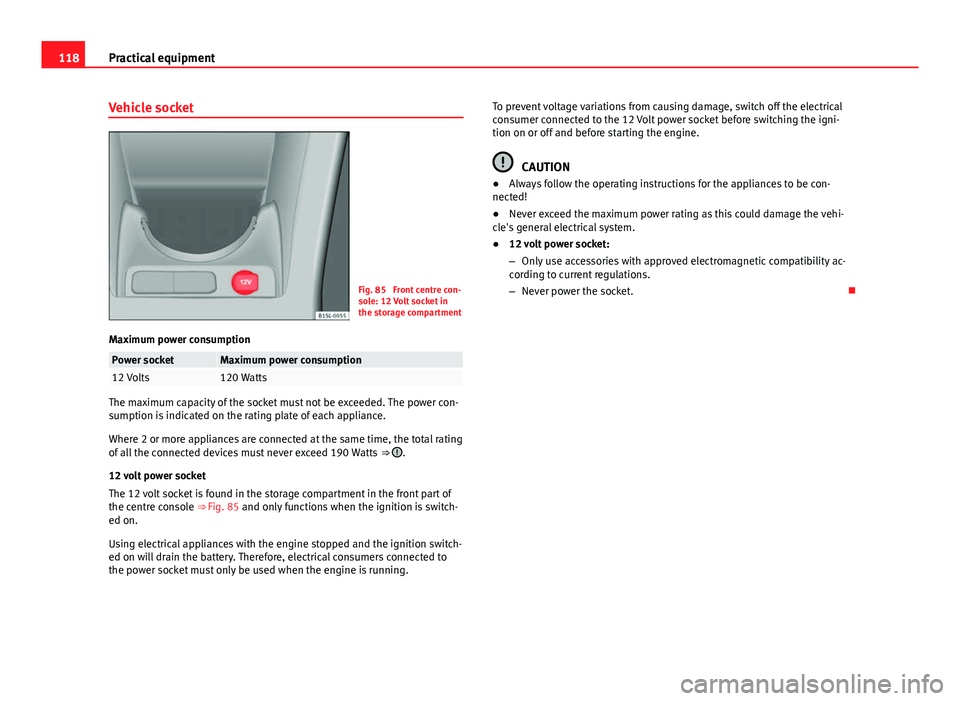
Fig. 85 Front centre con-
sole: 12 Volt socket in
the storage compartment
Maximum power consumption
Power socketMaximum power consumption12 Volts120 Watts
The maximum capacity of the socket must not be exceeded. The power con-
sumption is indicated on the rating plate of each appliance.
Where 2 or more appliances are connected at the same time, the total rating
of all the connected devices must never exceed 190 Watts ⇒
.
12 volt power socket
The 12 volt socket is found in the storage compartment in the front part of
the centre console ⇒ Fig. 85 and only functions when the ignition is switch-
ed on.
Using electrical appliances with the engine stopped and the ignition switch-
ed on will drain the battery. Therefore, electrical consumers connected to
the power socket must only be used when the engine is running. To prevent voltage variations from causing damage, switch off the electrical
consumer connected to the 12 Volt power socket before switching the igni-
tion on or off and before starting the engine.
CAUTION
● Always follow the operating instructions for the appliances to be con-
nected!
● Never exceed the maximum power rating as this could damage the vehi-
cle's general electrical system.
● 12 volt power socket:
– Only use accessories with approved electromagnetic compatibility ac-
cording to current regulations.
– Never power the socket.
Page 122 of 306
120Starting, changing gears, parking
WARNING
The components of the exhaust system reach very high temperatures.
This could cause a fire and considerable damage.
● Always park your vehicle so that no part of the exhaust system can
come in contact with flammable materials (such as wood, leaves, spilled
fuel, dried grass, etc).
● Never apply additional underseal or anti-corrosion coatings to the ex-
haust pipes, catalytic converter or the heat shields on the exhaust sys-
tem.
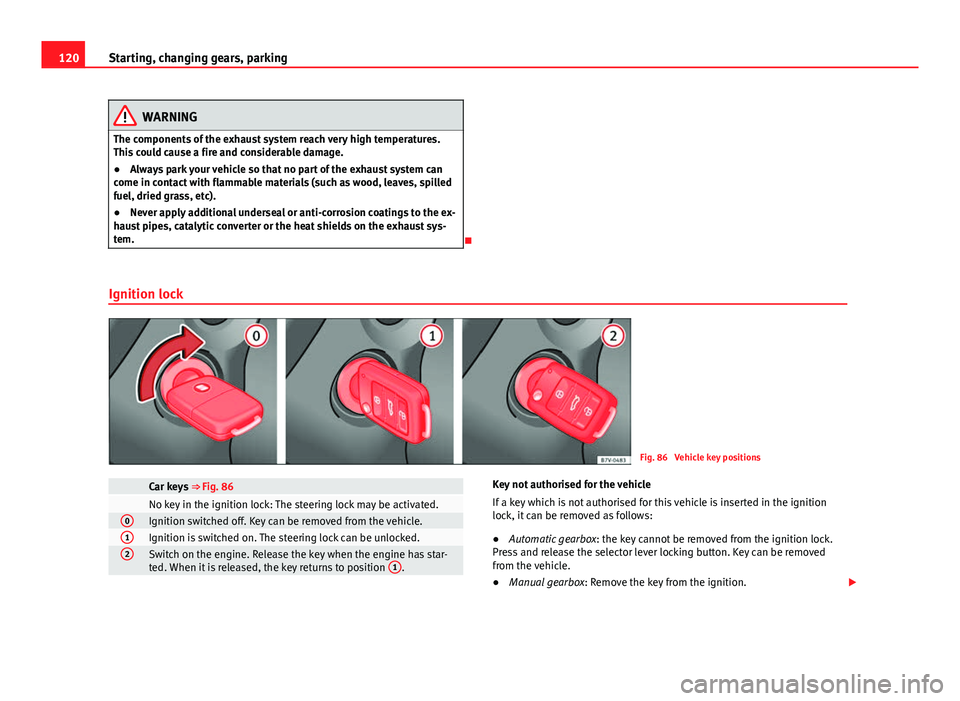
Ignition lock
Fig. 86 Vehicle key positions
Car keys ⇒ Fig. 86 No key in the ignition lock: The steering lock may be activated.0Ignition switched off. Key can be removed from the vehicle.1Ignition is switched on. The steering lock can be unlocked.2Switch on the engine. Release the key when the engine has star-
ted. When it is released, the key returns to position 1.
Key not authorised for the vehicle
If a key which is not authorised for this vehicle is inserted in the ignition
lock, it can be removed as follows:
●
Automatic gearbox : the key cannot be removed from the ignition lock.
Press and release the selector lever locking button. Key can be removed
from the vehicle.
● Manual gearbox: Remove the key from the ignition.
Page 123 of 306

121
Starting, changing gears, parking
WARNING
Unsuitable or careless use of the vehicle key could result in serious in-
jury.
● Always take all the keys with you whenever you leave the vehicle. The
engine could accidentally be started and electrical equipment such as
the windows could accidentally be operated resulting in serious injury.
● Never leave children or disabled people alone in the car. They could
be trapped in the car in an emergency and will not be able to get them-
selves to safety. For example, depending on the time of the year, temper-
atures inside a locked and closed vehicle can be extremely high or ex-
tremely low resulting in serious injuries and illness or even death, partic-
ularly for young children.
● Never remove the key from the ignition if the vehicle is in motion. The
steering may lock and it will not be possible to turn the steering wheel.
Note
● If the key is left in the ignition lock with the engine off for long periods,
the vehicle battery will run flat.
● In vehicles with automatic gearbox the ignition key can only be with-
drawn with the selector lever in position P. In this case, press and release
the selector lever locking button.
Starting the engine
Complete operations only in the sequence given.
1.Press the brake pedal and keep pressed until step 5 has been completed.
1 a.In vehicles with a manual gearbox: Press the clutch pedal all
the way and keep pressed until the engine starts.
Complete operations only in the sequence given.
2.Put the gearbox lever in neutral or the selector lever in posi- tion P or N.
3.Turn the key in the ignition lock to position ⇒ Fig. 86 2; do
not press the accelerator.
4.When the engine has started, release the key in the ignition lock.
5.If the engine does not start, stop the process and try again af-ter one minute.
6.Release the handbrake when you want to begin driving⇒ page 134.
WARNING
Never leave the vehicle unattended if the engine is running. The vehicle
could move off suddenly, especially if it is in gear, resulting in an acci-
dent and serious injury.
WARNING
Cold start sprays could explode or cause a sudden increase in the engine
speed.
● Never use start boosters.
CAUTION
● An attempt to start the engine while driving or starting the engine imme-
diately after turning it off can cause damage to the engine or starter motor.
● When the engine is cold, avoid high revs and heavy acceleration and do
not make the engine work hard.
● Do not push or tow start the engine. Unburnt fuel could damage the cat-
alytic converter.
Vehicle diagramPrior to a journey...While drivingCare, cleaning and mainte-
nanceIf and whenTechnical specifications