fuel Seat Mii 2014 Service Manual
[x] Cancel search | Manufacturer: SEAT, Model Year: 2014, Model line: Mii, Model: Seat Mii 2014Pages: 219, PDF Size: 4.19 MB
Page 185 of 219

Emergencies
Connect the battery clamps so they have
good metal-to-metal contact with the battery
terminals.
If the engine fails to start, switch off the start-
er after about 10 seconds and try again after
about 1 minute. WARNING
● Please note the safety warnings referring to
working in the engine compartment
››› page 143.
● The b att
ery providing assistance must have
the same voltage as the flat battery (12V) and
approximately the same capacity (see imprint
on battery). Failure to comply could result in
an explosion.
● Never use jump leads when one of the bat-
teries is frozen. Danger of explosion! Even af-
ter the battery has thawed, battery acid could
leak and cause chemical burns. If a battery
freezes, it should be replaced.
● Keep sparks, flames and lighted cigarettes
away from batteries, danger of explosion.
Failure to comply could result in an explo-
sion.
● Observe the instructions provided by the
manufacturer of the jump leads.
● Do not connect the negative cable from the
other vehicle directly to the negative terminal
of the flat battery. The gas emitted from the
battery could be ignited by sparks. Danger of
explosion. ●
Do not attach the negative cable from the
other vehicle to parts of the fuel system or to
the brake line.
● The non-insulated parts of the battery
clamps must not be allowed to touch. The
jump lead attached to the positive battery
terminal must not touch metal parts of the ve-
hicle, this can cause a short circuit.
● Position the leads in such a way that they
cannot come into contact with any moving
parts in the engine compartment.
● Do not lean on the batteries. This could re-
sult in chemical burns. Note
The vehicles must not touch each other, oth-
erwise electricity could flow as soon as the
positive terminals are connected. Towing and tow starting
Introduction When towing or tow starting, respect the le-
gal requirements.
For technical reasons, it is not possible to
tow a vehicle if the battery is flat. WARNING
A vehicle with a flat battery should never be
towed.
● Never remove the key from the ignition
lock. Otherwise, the steering wheel lock
could suddenly lock. The vehicle would not
be controlled and a serious accident could
ensue. WARNING
When towing the vehicle, the handling and
braking efficiency change considerably.
Please observe the following instructions to
minimise the risk of serious accidents and in-
jury:
● As the driver of the vehicle being towed:
– The brake must be depressed must hard-
er as the brake servo does not operate.
Always remain aware to avoid collision
with the towing vehicle.
– More strength is required at the steering
wheel as the power steering does not op-
erate when the engine is switched off.
● As the driver of the towing vehicle:
– Accelerate gently and carefully.
– Avoid sudden braking and manoeuvres.
– Brake well in advance than usual and
brake gently.
» 183
Technical specifications
Advice
Operation
Safety
Page 186 of 219
Advice
CAUTION
● Carefully fit and remove the towline anchor-
age and its cover to avoid damage to the ve-
hicle (e.g. paintwork).
● When towing, fuel could enter the catalytic
converter and cause damage! Note
Fitting a towline anchorage to the rear bump-
er is not possible. The vehicle is not suitable
for towing other vehicles. Instructions for tow starting
In general, the vehicle should not be started
by towing. Jump-starting is much more pref-
erable
›
› ›
page 181.
For technical reasons, the following vehicles
can
not be tow started:
● Vehicles with an automatic gearbox.
● If the vehicle battery is flat, it is possible
that the engine control unit does not operate
correctly.
However, if your vehicle must absolutely be
tow-started (manual gearbox):
● Put it into second or third gear.
● Keep the clutch pressed down. ●
Switch on the ignition and the hazard warn-
ing lights.
● Release the clutch when both vehicles are
moving.
● As soon as the engine starts, press the
clutch and move the gear lever into neutral.
This helps to prevent a collision with the tow-
ing vehicle. CAUTION
When tow-starting, fuel could enter the cata-
lytic converter and damage it. Notes on towing
Tow rope or tow bar
When towing, the tow bar is the safest and
vehicle friendly way. You should only use a
tow rope if you do not have a tow bar.
A tow rope should be slightly elastic to avoid
damage to both vehicles. It is advisable to
use a tow rope made of synthetic fibre or sim-
ilarly elastic material.
Only secure the tow rope or tow bar to the
towline anchorage or specially designed fit-
ting.
Towing vehicles with an automatic gearbox
Note the following for a towed vehicle:●
Make sure the gear selector lever is in the N
position.
● Do not drive faster than 50 km/h (30 mph)
when towing a vehicle.
● Do not tow further than 50 km (30 miles).
● If a breakdown truck is used, the vehicle
must be towed with the front wheels raised.
Situations in which the vehicle should not be
towed
In the following cases, the vehicle should not
be towed but transported on a trailer or spe-
cial vehicle:
● If the vehicle gearbox does not contain lu-
bricant due to a fault.
● If the battery is flat and the steering cannot
be unlocked as a result, the electronic steer-
ing lock and electronic parking brake cannot
be disengaged.
● If the vehicle to be towed has an automatic
gearbox and the distance to be covered is
greater than 50 km (30 miles). Note
The vehicle can only be towed if the steering
lock electronic gearbox lock is deactivated. If
the vehicle has no power supply or there is
an electric system fault, the engine must be
started using jump leads to deactivate the
steering column electronic gearbox lock. 184
Page 191 of 219
Fuses and bulbs
CAUTION
● Damaged or dirty windscreen wipers could
scratch the glass.
● If products containing solvents, rough
sponges or sharp objects are used to clean
the blades, the graphite layer will be dam-
aged.
● Never use fuel, nail varnish remover, paint
thinner or similar products to clean the win-
dows. Note
If wax deposits, other cleaning products from
the automatic car wash, or other care prod-
ucts, are left on the windscreen and the rear
window, the blades can scratch the glass. Re-
move wax deposits with a special product or
cleaning cloths. Fuses and bulbs
Fuses Introduction Due to the constant updating of vehicles,
fuse assignments based on equipment and
the use of the same fuse for various electrical
components, it is not possible to provide an
up-to-date summary of the fuse positions for
the electrical components at the time of
printing this manual. For detailed information
about the fuse positions, please consult a
technical service.
In general, a fuse can be assigned to various
electrical components. Likewise, an electrical
component can be protected by several
fuses.
Only replace fuses when the cause of the
problem has been solved. If a newly inserted
fuse blows after a short time, you must have
the electrical system checked by a special-
ised workshop as soon as possible.
WARNING
The high voltages in the electrical system can
give serious electrical shocks, causing burns
and even death!
● Never touch the electrical wiring of the igni-
tion system. ●
Take care not to cause short circuits in the
electrical system. WARNING
Using unsuitable fuses, repairing fuses or
bridging a current circuit without fuses can
cause a fire and serious injury.
● Never use a fuse with a higher value. Only
replace fuses with a fuse of the same amper-
age (same colour and markings) and size.
● Never repair a fuse.
● Never replace a fuse by a metal strip, staple
or similar. CAUTION
● To prevent damage to the vehicle's electric
system, before replacing a fuse always turn
off the ignition, the lights and all electrical
elements and remove the key from the igni-
tion.
● If you replace a fuse with higher-rating
fuse, you could cause damage to another part
of the electrical system.
● Protect the fuse boxes when open to pre-
vent the entry of dust or humidity as they can
damage the electrical system. Note
One component may have more than one
fuse. » 189Technical specifications
Advice
Operation
Safety
Page 199 of 219

Technical features
Technical specifications
Technical features
Important information Introduction The information in the vehicle documentation
always takes precedence over the informa-
tion in this Instruction Manual.
All technical specifications provided in this
documentation are valid for the standard
model in Spain. The vehicle data card inclu-
ded in the Maintenance Programme or the
vehicle registration documents shows which
engine is installed in the vehicle.
The figures may be different depending
whether additional equipment is fitted, for
different models, for special vehicles and for
other countries.
Abbreviations used in the Technical
Specifications sectionAbbrevi-
ationMeaning
kWKilowatt, engine power measurement.
PSPferdestärke (horsepower), formerly used
to denote engine power.
rpmRevolutions per minute - engine speed.
NmNewton metres, unit of engine torque.
litres per100 kmFuel consumption in litres per 100 km (70
miles).
g/kmCarbon dioxide emissions in grams per km
(mile) travelled.
CO 2Carbon dioxide
CNCetane number, indication of the diesel
combustion power.
RONResearch octane number, indication of the
knock resistance of petrol. Vehicle identification data
Fig. 155
Vehicle data label. Fig. 156
Vehicle identification number. Vehicle identification number
The vehicle identification number (chassis
number) can be read from outside the vehicle
through a viewer in the windscreen
››› Fig. 156 . This viewer is located in the lower
»
197
Technical specifications
Advice
Operation
Safety
Page 200 of 219

Technical specifications
part of the windscreen. The vehicle identifica-
tion number (chassis number) is also stam-
ped on the right water drain channel. The wa-
ter drain channel is located between the sus-
pension tower and the wing. Open the bon-
net to read the vehicle identification number
.
V ehic
le data plate
The vehicle data label ››› Fig. 155 is at the
front
of the spare wheel well. It contains the
following data:
Vehicle identification number (chassis
number).
Vehicle type, engine power, gearbox type.
Engine and gearbox code, paint number,
interior equipment.
Optional extras, PR numbers.
These data are also provided in the Mainte-
nance Programme.
Specific vehicle weight information The instructions in the official vehicle docu-
ments take precedence. All the technical data
provided in this documentation is applicable
to the basic model. The vehicle data label in
the Maintenance Programme or the vehicle
documentation shows which engine is instal-
led in your vehicle.1 2
3
4 The figures may be different depending
whether additional equipment is fitted, for
different models and for special vehicles.
Kerb weight values shown in the following ta-
ble apply to a vehicle with driver (75 kg), liq-
uids including a fuel tank 90% full, in addi-
tion to tools and a spare wheel
››› . The
kerb weight indicated increases with optional
equipment and retrofitting of accessories,
while proportionally reducing carrying ca-
pacity.
The load is equivalent to the following
weights:
● Passengers.
● Total equipment.
● Roof load, included in the carrier. WARNING
Exceeding the maximum authorised weight
and the load on the axles could cause dam-
age to the vehicle, accidents and serious in-
juries.
● The real load on the axles should never ex-
ceed the maximum permitted.
● The load and its distribution in the vehicle
have effects on the vehicle handling and the
braking ability. Always drive at a suitable
speed. CAUTION
Distribute the load as uniformly and as low
down on the vehicle as possible. When trans-
porting heavy objects in the luggage com-
partment, these should be placed as far for-
ward as possible or over the rear axle to have
as little influence on handling as possible. Information on fuel consumption
The consumption and emission values indi-
cated do not refer to one specific vehicle.
They are only to be used to compare the val-
ues of the different vehicle versions. The fuel
consumption and CO
2 emissions of a vehicle
not only depend on the effective use of fuel.
They also depend on your driving style and
other non-technical factors.
Calculation of fuel consumption
Fuel consumption and emission values are
determined according to the current version
of the 715/2007/EC or 80/1268/EEC regula-
tion and are valid for the vehicle kerb weight.
The specifications do not
refer to an individu-
al
vehicle. To measure the fuel consumption,
two measuring cycles are carried out on a
rolling road test bed. The test criteria are as
follows:
198
Page 201 of 219

Technical featuresUrban
cycleMeasurement of the urban cycle starts with
an engine cold start. City driving is then si-
mulated at between 0 and 50 km/h (0 and
31 mph).
Road
cycle
In the road cycle simulation, the car under-
goes frequent acceleration and braking in all
gears, as in normal everyday driving. The
road speed ranges from 0 to 120 km/h (0
and 75 mph).
Com-
binedThe average combined consumption is calcu-
lated with a weighting of around 37 % for the
urban cycle and 63 % for the road cycle.
CO
2
emis-
sions of
the
combi-
nationThe exhaust gases are collected during both
driving cycles to calculate carbon dioxide
emissions (urban and road). The gas compo-
sition is analysed below to evaluate the CO 2
content and other emissions. Note
● The kerb weight may vary according to the
vehicle equipment. This could raise consump-
tion and the CO 2 emissions slightly.
● In practice, consumption values could be
different to the values calculated based on
the 715/2007/EC or 80/1268/EEC regula-
tions. Wheels
Tyre pressure, snow chains, wheel
bolts Tyre pressures
The sticker with the tyre pressure values can
be found on the inside of the fuel tank flap.
The tyre pressure values given there are for
cold tyres. The slightly raised pressures of
w
arm ty
res must not be reduced. ››› Snow chains
Snow chains may be fitted only to the
front
wheels .
C on
sult the section “wheels” of this manual.
Wheel bolts
After the wheels have been changed, the
tightening torque
of the wheel bolts should
be checked as soon as possible with a torque
wrench ››› . The tightening torque for steel
and alloy wheels is 140 Nm. WARNING
● Check the tyre pressure at least once per
month. Checking the tyre pressure is very im-
portant. If the tyre pressure is too high or too
low, there is an increased danger of accidents
- particularly at high speeds. ●
If the tightening torque of the wheel bolts
is too low, they could loosen while the vehi-
cle is in motion. Risk of accident! If the tight-
ening torque is too high, the wheel bolts and
threads can be damaged. Note
We recommend that you ask your Technical
Service for information about appropriate
wheel, tyre and snow chain size. 199
Technical specifications
Advice
Operation
Safety
Page 202 of 219
Technical specifications
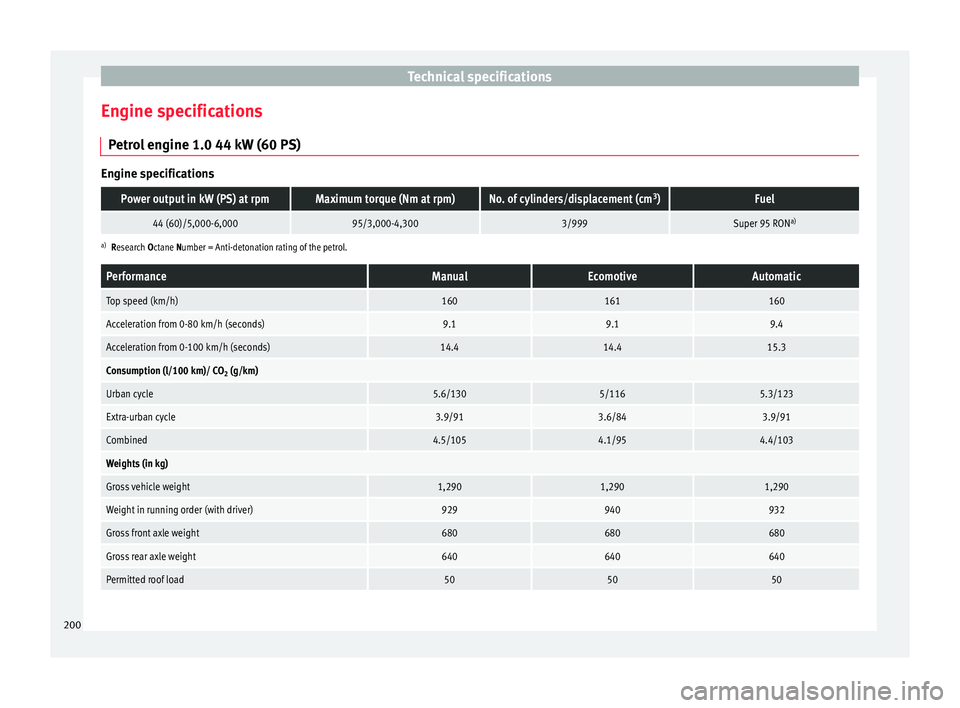
Engine specifications Petrol engine 1.0 44 kW (60 PS) Engine specificationsPower output in kW (PS) at rpmMaximum torque (Nm at rpm)No. of cylinders/displacement (cm
3
)Fuel
44 (60)/5,000-6,00095/3,000-4,3003/999Super 95 RON a)
a)
Research Octane Number = Anti-detonation rating of the petrol.
PerformanceManualEcomotiveAutomatic
Top speed (km/h)160161160
Acceleration from 0-80 km/h (seconds)9.19.19.4
Acceleration from 0-100 km/h (seconds)14.414.415.3
Consumption (l/100 km)/ CO 2 (g/km)
Urban cycle5.6/1305/1165.3/123
Extra-urban cycle3.9/913.6/843.9/91
Combined4.5/1054.1/954.4/103
Weights (in kg)
Gross vehicle weight1,2901,2901,290
Weight in running order (with driver)929940932
Gross front axle weight680680680
Gross rear axle weight640640640
Permitted roof load505050 200
Page 203 of 219

Technical features
Petrol engine 1.0 55 kW (75 PS) Engine specificationsPower output in kW (PS) at rpmMaximum torque (Nm at rpm)No. of cylinders/displacement (cm
3
)Fuel
55 (75)/6,20095/3,000-4,3003/999Super 95 RON a)
a)
Research Octane Number = Anti-detonation rating of the petrol.
PerformanceManualStart-StopAutomatic
Top speed (km/h)171172171
Acceleration from 0-80 km/h (seconds)8.38.39.2
Acceleration from 0-100 km/h (seconds)13.213.213.9
Consumption (l/100 km)/ CO 2 (g/km)
Urban cycle5.9/1375.1/1185.5/127
Extra-urban cycle4/933.7/864/94
Combined4.7/1084.2/984.5/105
Weights (in kg)
Gross vehicle weight1,2901,2901,290
Weight in running order (with driver)929940932
Gross front axle weight680680680
Gross rear axle weight640640640
Permitted roof load505050 201
Technical specifications
Advice
Operation
Safety
Page 204 of 219
Technical specifications
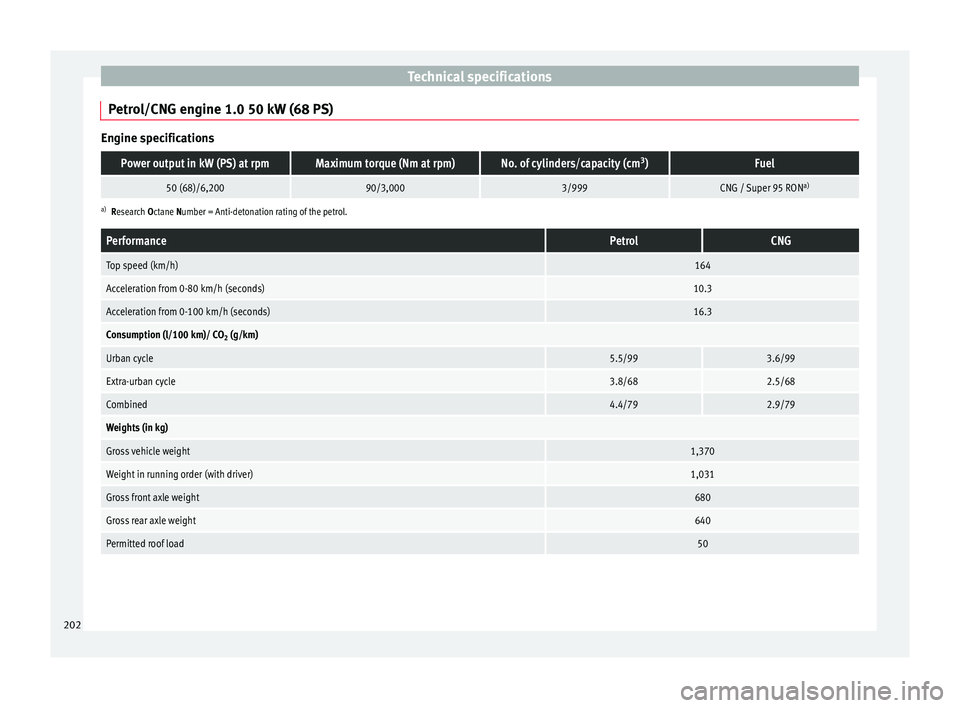
Petrol/CNG engine 1.0 50 kW (68 PS) Engine specificationsPower output in kW (PS) at rpmMaximum torque (Nm at rpm)No. of cylinders/capacity (cm
3
)Fuel
50 (68)/6,20090/3,0003/999CNG / Super 95 RON a)
a)
Research Octane Number = Anti-detonation rating of the petrol.
PerformancePetrolCNG
Top speed (km/h)164
Acceleration from 0-80 km/h (seconds)10.3
Acceleration from 0-100 km/h (seconds)16.3
Consumption (l/100 km)/ CO 2 (g/km)
Urban cycle5.5/993.6/99
Extra-urban cycle3.8/682.5/68
Combined4.4/792.9/79
Weights (in kg)
Gross vehicle weight1,370
Weight in running order (with driver)1,031
Gross front axle weight680
Gross rear axle weight640
Permitted roof load50 202
Page 205 of 219

Technical features
DimensionsLongitude3,557 mm
Width1,641-1,645 mm
Height, unladen1,478-1,489 mm
Wheelbase2,420 mm
Turning circle diameter a)approx. 9.8 m
Front track widtha)1,412-1,428 mm
Rear track widtha)1,408-1,424 mm
Ground clearance with
maximum authorised load109 mm
a)
Depending on the dimensions of the wheel trims and tyres,
there may be variations. CAUTION
● Special care should be taken when parking
in areas with high kerbs or fixed barriers. Ob-
jects protruding from the ground may dam-
age the bumper or other parts of the vehicle
during manoeuvres.
● Special attention is required when driving
through entrances, over ramps, kerbs or oth-
er objects. The vehicle underbody, bumpers,
mudguards and running gear, and the engine
and exhaust system could be damaged as
you drive over these objects. Capacities
Fuel tank capacity
Petrol enginesAround 35.0 l
, of which approximately 4.0 are the reserve.
Natural gas en-
gineNatural gas: approx. 11 kg; of whichmax. 1.5 kg reserve
Petrol: approx. 10 l; of which approx. 5 l reserve 203Technical specifications
Advice
Operation
Safety