clock Seat Mii 2016 User Guide
[x] Cancel search | Manufacturer: SEAT, Model Year: 2016, Model line: Mii, Model: Seat Mii 2016Pages: 232, PDF Size: 4.9 MB
Page 84 of 232
EmergenciesComplete operations only in the sequence giv-
en:
7.Insert the bulb holder in the headlight and turn it
clockwise as far as the stop.
8.Plug the connector
1 into the bulb holder. The
connector must audibly click into place.
9.Replace the wheel arch trim into its position.
10.Place the expansive rivet in the wheel arch trim
and bumper and press it completely inwards
››› Fig. 86 A
.
11.Securely screw the 2 retaining screws
››› Fig. 86
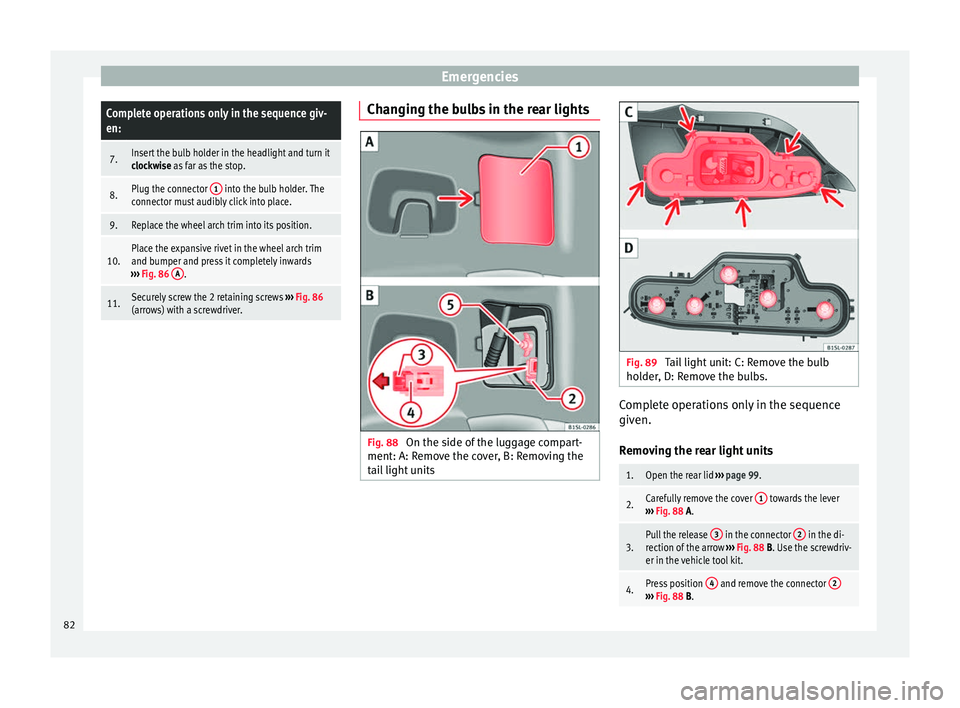
(arrows) with a screwdriver. Changing the bulbs in the rear lights
Fig. 88
On the side of the luggage compart-
ment: A: R emo
v
e the cover, B: Removing the
tail light units Fig. 89
Tail light unit: C: Remove the bulb
ho l
der
, D: Remove the bulbs. Complete operations only in the sequence
giv
en.
R emo
ving the rear light units
1.Open the rear lid ››› page 99.
2.Carefully remove the cover 1 towards the lever
››› Fig. 88 A.
3.Pull the release 3 in the connector 2 in the di-
rection of the arrow ››› Fig. 88 B. Use the screwdriv-
er in the vehicle tool kit.
4.Press position 4 and remove the connector 2›››
Fig. 88 B. 82
Page 85 of 232
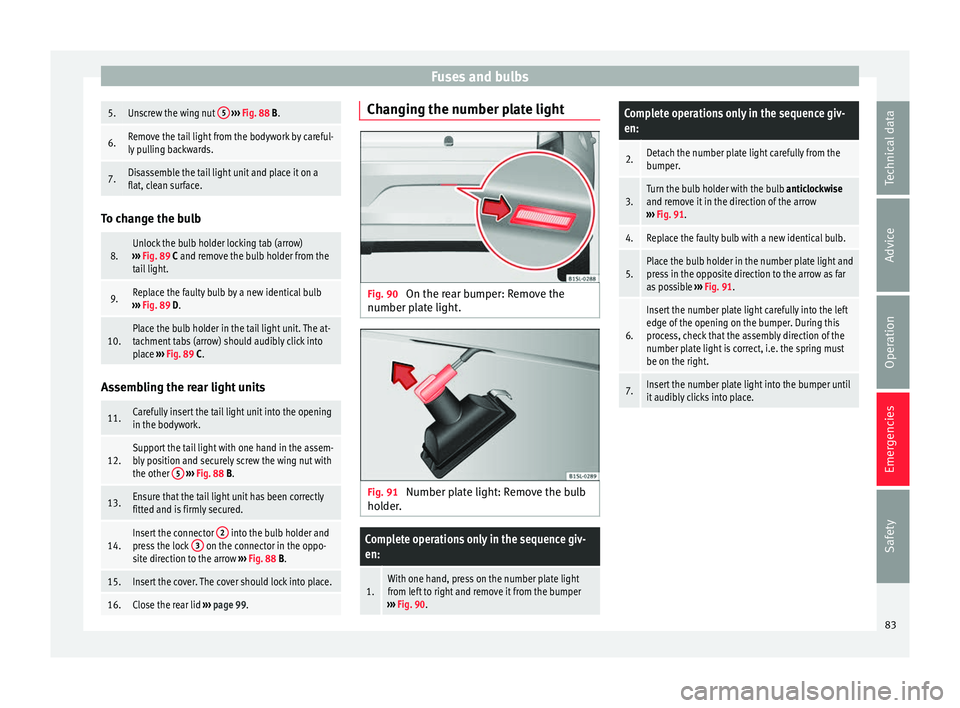
Fuses and bulbs5.Unscrew the wing nut
5
››› Fig. 88 B.
6.Remove the tail light from the bodywork by careful-
ly pulling backwards.
7.Disassemble the tail light unit and place it on a
flat, clean surface. To change the bulb
8.Unlock the bulb holder locking tab (arrow)
››› Fig. 89 C and remove the bulb holder from the
tail light.
9.Replace the faulty bulb by a new identical bulb
››› Fig. 89 D.
10.Place the bulb holder in the tail light unit. The at-
tachment tabs (arrow) should audibly click into
place ››› Fig. 89 C. Assembling the rear light units
11.Carefully insert the tail light unit into the opening
in the bodywork.
12.Support the tail light with one hand in the assem-
bly position and securely screw the wing nut with
the other
5
››› Fig. 88 B.
13.Ensure that the tail light unit has been correctly
fitted and is firmly secured.
14.Insert the connector 2 into the bulb holder and
press the lock 3 on the connector in the oppo-
site direction to the arrow ››› Fig. 88 B.
15.Insert the cover. The cover should lock into place.
16.Close the rear lid ››› page 99. Changing the number plate light
Fig. 90
On the rear bumper: Remove the
number p l
at
e light. Fig. 91
Number plate light: Remove the bulb
ho lder
.
Complete operations only in the sequence giv-
en:
1.With one hand, press on the number plate light
from left to right and remove it from the bumper
››› Fig. 90.
Complete operations only in the sequence giv-
en:
2.Detach the number plate light carefully from the
bumper.
3.Turn the bulb holder with the bulb anticlockwise
and remove it in the direction of the arrow
››› Fig. 91.
4.Replace the faulty bulb with a new identical bulb.
5.Place the bulb holder in the number plate light and
press in the opposite direction to the arrow as far
as possible ››› Fig. 91.
6.
Insert the number plate light carefully into the left
edge of the opening on the bumper. During this
process, check that the assembly direction of the
number plate light is correct, i.e. the spring must
be on the right.
7.Insert the number plate light into the bumper until
it audibly clicks into place. 83
Technical data
Advice
Operation
Emergencies
Safety
Page 98 of 232
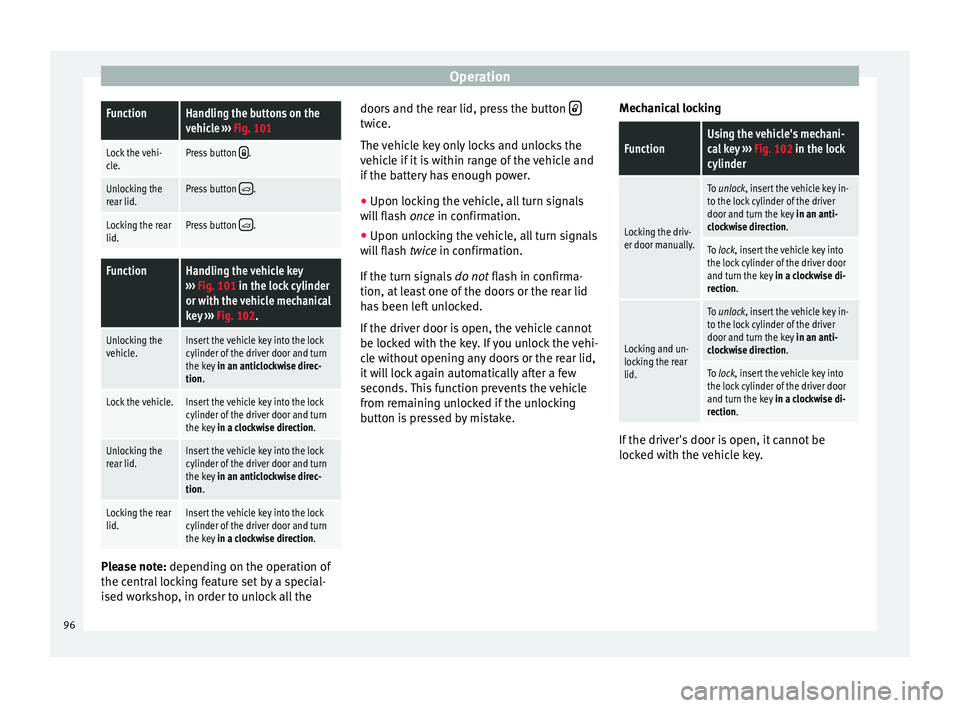
OperationFunctionHandling the buttons on the
vehicle
››› Fig. 101
Lock the vehi-
cle.Press button .
Unlocking the
rear lid.Press button .
Locking the rear
lid.Press button .
FunctionHandling the vehicle key
››› Fig. 101 in the lock cylinder
or with the vehicle mechanical
key ››› Fig. 102.
Unlocking the
vehicle.Insert the vehicle key into the lock
cylinder of the driver door and turn
the key in an anticlockwise direc-
tion.
Lock the vehicle.Insert the vehicle key into the lock
cylinder of the driver door and turn
the key in a clockwise direction.
Unlocking the
rear lid.Insert the vehicle key into the lock
cylinder of the driver door and turn
the key in an anticlockwise direc-
tion.
Locking the rear
lid.Insert the vehicle key into the lock
cylinder of the driver door and turn
the key in a clockwise direction. Please note: dependin
g on the oper
ation of
the c
entral locking feature set by a special-
ised workshop, in order to unlock all the doors and the rear lid, press the button
twice.
The
v
ehic
le key only locks and unlocks the
vehicle if it is within range of the vehicle and
if the battery has enough power.
● Upon locking the vehicle, all turn signals
wil
l flash once in confirmation.
● Upon unlocking the vehicle, all turn signals
wil
l flash twice in confirmation.
If the turn signals do not flash in confirma-
tion, at least one of the doors or the rear lid
has been left unlocked.
If the driver door is open, the vehicle cannot
be locked with the key. If you unlock the vehi-
cle without opening any doors or the rear lid,
it will lock again automatically after a few
seconds. This function prevents the vehicle
from remaining unlocked if the unlocking
button is pressed by mistake. Mechanical locking
FunctionUsing the vehicle's mechani-
cal key
››› Fig. 102 in the lock
cylinder
Locking the driv-
er door manually.
To unlock, insert the vehicle key in-
to the lock cylinder of the driver
door and turn the key in an anti-
clockwise direction.
To lock, insert the vehicle key into
the lock cylinder of the driver door
and turn the key in a clockwise di-
rection.
Locking and un-
locking the rear
lid.
To unlock, insert the vehicle key in-
to the lock cylinder of the driver
door and turn the key in an anti-
clockwise direction.
To lock, insert the vehicle key into
the lock cylinder of the driver door
and turn the key in a clockwise di-
rection. If the driver's door is open, it cannot be
loc
k
ed w
ith the vehicle key.
96
Page 101 of 232
Opening and closing
The childproof lock prevents the rear doors
fr om bein
g opened fr
om the inside. This sys-
tem prevents minors from opening a door ac-
cidentally while the vehicle is running.
This function is independent of the vehicle
electronic opening and locking systems. It
only affects rear doors. It can only be activa-
ted and deactivated manually, as described
below:
Activating the childproof lock
– Unlock the vehicle and open the door in
which y
ou wish to activate the childproof
lock.
– With the door open, rotate the groove in
the door usin
g the ignition key, anti-clock-
wise for the left-hand side doors ››› Fig. 105
and clockwise for the right-hand side
doors.
Deactivating the childproof lock – Unlock the vehicle and open the door
whose chi
ldproof lock you want to deacti-
vate.
– With the door open, rotate the groove in
the door usin
g the ignition key, anti-clock-
wise for the right-hand side doors, and
clockwise for the left-hand side doors
››› Fig. 105.
Once the childproof lock is activated, the
door can only be opened from the outside. The childproof lock can be activated or deac-
tivated b
y inserting the key in the groove
when the door is open, as described above.
Rear lid Introduction WARNING
Careless and unsuitable locking, opening and
clo s
ing of the rear lid can cause accidents
and serious injury.
● Open and close the rear lid only when no-
body is
in the way.
● Do not close the rear lid by pushing it down
with y
our hand on the rear window. This
could break and cause injury.
● Ensure the rear lid is locked after closing,
otherwi
se, it may open unexpectedly while
driving. A closed rear lid should be flush with
the corresponding parts of the bodywork.
● Always keep the rear lid closed while driv-
ing to av
oid toxic gases entering the vehicle
interior.
● Do not open the rear lid when there is a
load in
stalled, for example a carrier system.
Likewise, the boot hatch cannot be opened
when a load is attached to it, for example bi-
cycles. An open rear lid could close itself if
there is an additional weight on it. If necessa- ry, press down on the rear lid and remove the
loa
d.
● C
lose and lock both the rear lid and all the
other doors when
you are not using the vehi-
cle. Ensure that nobody remains inside the
vehicle.
● Never allow children to play inside or
around the
vehicle without supervision, espe-
cially if the rear lid is open. Children could
enter the luggage compartment, close the
rear lid and become trapped. Depending on
the time of the year, temperatures inside a
locked and closed vehicle can be extremely
high or extremely low resulting in serious in-
juries and illness or even death, particularly
for young children.
● Never leave children or disabled people
alone in the v
ehicle. If the vehicle key or the
central locking button is used, they may be
locked in the vehicle. CAUTION
Before opening the rear lid, ensure that there
is s
ufficient free space to open and close it,
for example if you are in a garage. 99
Technical data
Advice
Operation
Emergencies
Safety
Page 102 of 232

Operation
Opening the rear lid Fig. 106
On the vehicle key: button to unlock
and open the boot h
at
ch.Read the additional information carefully
› ›
›
page 9
If bicycles are attached to a rack on the boot
hatch, for example, in some cases, it may not
open automatically ››› . Remove the load
fr om the c
arrier and s
upport the open rear
lid.
Opening with central locking
● Press the button on the vehicle key
› ›
›
Fig. 106 for about one second to unlock
the boot hatch.
● OR: Press the button on the vehicle key
u nti
l
the rear lid opens automatically several
centimetres.
● Opening the rear lid with the button. Opening with the vehicle mechanical key
●
Insert the vehicle key into the lock cylinder
of the driver door and t
urn the key in an anti-
clockwise direction ››› page 94.
● Opening the rear lid with the button. WARNING
Unsuitable or careless unlocking and opening
of the r e
ar lid could cause serious injuries.
● If there is a loaded luggage carrier on the
rear lid, it
could be unlocked or open but not
recognised as such. An unlocked or open rear
lid could open unexpectedly while driving. Note
At outside temperatures of less than 0 °C
(+32 °F), the pre s
surised gas struts cannot
always automatically lift the rear lid. In this
case, open the rear lid manually. Closing the rear lid
Fig. 107
Rear lid open: hand grip Closing the rear lid
● Grab the handgrip inside the rear lid
› ›
›
Fig. 107 (arrow).
● Push the rear lid downwards until it locks
into pl
ace in the lock.
● Ensure that it is correctly closed by pulling
on it firmly
.
Locking the rear lid with central locking*
If you unlock the vehicle without opening any
doors or the rear lid, it will lock again auto-
matically after about 30 seconds. This func-
tion prevents the vehicle from remaining un-
locked if the unlocking button is pressed by
mistake.
Locking is only possible when the rear lid is
correctly and fully closed.
100
Page 103 of 232
Opening and closing
● The r e
ar lid i
s also locked by a central lock-
ing.
● If the vehicle rear lid is locked or unlocked
usin
g the button, when it is closed once
mor e it
w
ill lock automatically.
● A closed but not locked rear lid will lock au-
tomatic
ally at a speed above about 9 km/h
(6 mph).
Locking the rear lid with the vehicle mechan-
ical key
Locking is only possible when the rear lid is
correctly and fully closed.
● Insert the vehicle key into the lock cylinder
of the driver door and t
urn the key in a clock-
wise direction ››› page 94. WARNING
Unsuitable or careless closing and locking of
the re ar lid c
ould cause serious injuries.
● Never leave the vehicle unattended, or al-
low chi
ldren to play inside or around the vehi-
cle without supervision, especially if the rear
lid is open. Children could enter the luggage
compartment, close the rear lid and become
trapped. A locked vehicle can be subjected to
extremely high and low temperatures, de-
pending on the time of year, thus causing se-
rious injuries/illness and even death. Note
Before closing the rear lid, make sure that the
key h
as not been left inside the luggage com-
partment. Electric windows
Opening and c lo
sing the electric win-
dows Read the additional information carefully
› ›
›
page 11 WARNING
Careless use of the electric windows can
cau se seriou
s injury.
● Only operate the electric windows when
nobody i
s in the way.
● Never leave children or disabled people
alone in the v
ehicle if the doors are to be
locked. The windows cannot be opened in
case of an emergency.
● Always take all the keys with you whenever
you le
ave the vehicle. After turning off the ig-
nition, the windows can be opened and
closed for a short time using the buttons on
the door as long as the driver door or passen-
ger side door is not open. CAUTION
When the windows are open, rain can enter
the v ehic
le, dampening the interior equip-
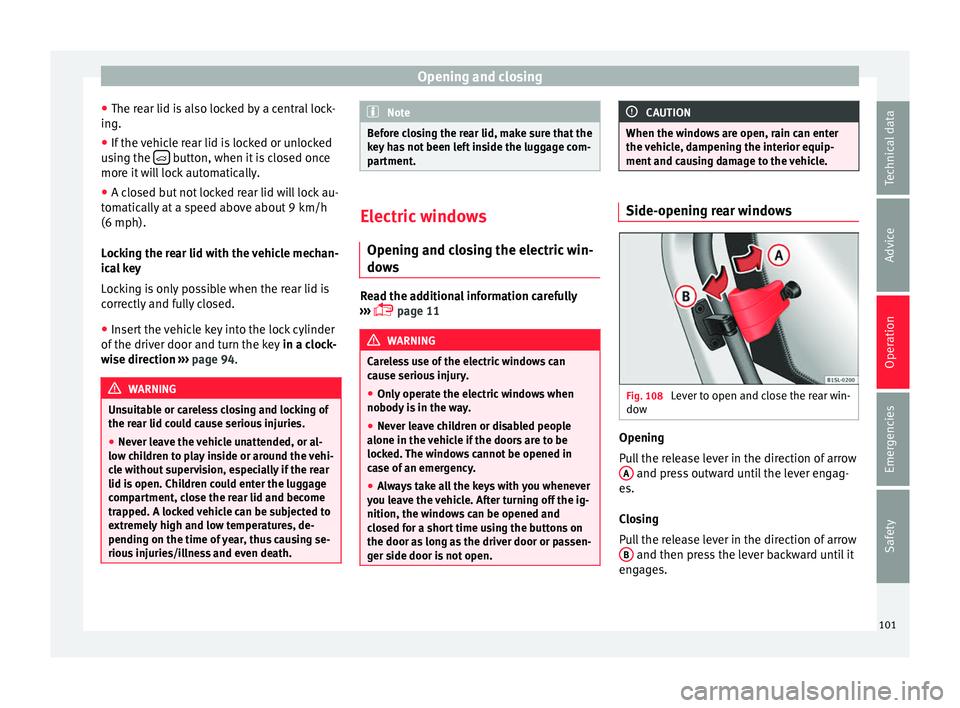
ment and causing damage to the vehicle. Side-opening rear windows
Fig. 108
Lever to open and close the rear win-
do w Opening
P
u
l
l the release lever in the direction of arrow
A and press outward until the lever engag-
e s.
C lo
sing
Pull the release lever in the direction of arrow B and then press the lever backward until it
en gag
es.
101
Technical data
Advice
Operation
Emergencies
Safety
Page 189 of 232
Checking and refilling levels
●
Never w ork
under the vehicle if it has not
been immobilized. If you must work under-
neath the vehicle with the wheels in contact
with the ground then it should be parked on
flat ground, the wheels should be prevented
from moving and the key should be removed
from the ignition.
● If you have to work underneath the vehicle,
you mus
t use suitable stands additionally to
support the vehicle, there is a risk of acci-
dent!. The jack is not intended for this kind of
work and its failure could lead to severe inju-
ries.
● Disconnect the Start-Stop system. WARNING
The engine compartment is a dangerous area
cap ab
le of causing serious injury.
● For all type of work, always take the utmost
precaution
s, work carefully and note the gen-
eral safety standards in force. Never take per-
sonal risks.
● Never work on the engine or in the engine
compar
tment if you are not familiar with the
necessary operations. If you are not sure
about procedures then visit a specialised
workshop to carry out the necessary work.
Working incorrectly can cause serious inju-
ries.
● Never open the bonnet if you see steam or
cool
ant escaping from the engine compart-
ment. This may cause serious burns. Always
wait until you cannot see or hear the sound of steam or coolant coming from the engine
comp
ar
tment.
● Always allow the engine to cool down be-
fore openin
g the bonnet.
● Contact with hot elements of the engine
and the exhau
st system can cause burns.
● Once the engine has cooled, follow the in-
structions
below before opening the bonnet:
– Engage the handbrake and place the gear
selector lever in N or the gear stick in
neutral.
– Remove the key from the ignition.
– Keep children away from the engine com-
partment and never leave them unsuper-
vised.
● When the engine is warm or hot, the cool-
ing sys
tem is pressurised. Do not unscrew
the cap on the expansion tank when the en-
gine is hot. Otherwise, coolant may spray out
under pressure causing burns and serious in-
jury.
– After cooling, carefully and slowly un-
screw the cap anticlockwise, gently
pressing down on it.
– Always protect your face, hands and arms
from hot coolant and steam using a large,
thick cloth.
● When refilling liquids, avoid spilling them
on part
s of the engine and the exhaust sys-
tem. Spilled liquids could cause a fire. WARNING
The high voltages of the electrical system can
give el ectric
shocks as well as causing burns
and serious injury and possibly even death!
● Never cause short circuits in the electrical
syst
em. The battery could explode.
● To minimise the risk of electric shock and
serious c
onsequences while the engine is
running or starting the engine, note the fol-
lowing:
– Never touch the electrical wiring of the
ignition system. WARNING
In the engine compartment, there are rotat-
ing p ar
ts that could cause serious injury.
● Never place your hands directly on or near
the radi
ator fan. Touching the rotor blades
could seriously harm you. The ventilator
works according to the engine temperature
and could start suddenly even when the igni-
tion is turned off and the key is removed.
● If any work has to be performed when the
engine is
started or with the engine running,
there is an additional, potentially fatal, safety
risk from rotating parts, such as the drive
belts, alternator, radiator fan, etc., as well as
from the high-voltage ignition system. Al-
ways work with the utmost caution.
– Always make sure that no parts of your
body, jewellery, ties, loose clothing and
long hair can be trapped by the rotating » 187
Technical data
Advice
Operation
Emergencies
Safety
Page 195 of 232
Checking and refilling levels
● If the l
ev
el is below the “MIN” mark, top up
with coolant. When the engine is hot it may
be slightly above the marked area.
Topping up the engine coolant level
● Always protect your face, hands and arms
from hot c
oolant and steam using a large,
thick cloth over the coolant expansion tank
cap.
● Remove the cap very carefully ›››
.
● Only refill using new engine c
oo
lant ac-
cording to SEAT specifications
( ›››
page 32)
››› .
● The engine coolant level should be be-
tw een the m
ark
s on the coolant expansion
tank ››› Fig. 170. Do not exceed the top level
of the marked area ››› .
● Screw on the cap tightly.
● If, in the event of an emergency, you have
no c oo
l
ant that is compliant to the required
specifications ( ›››
page 32), do not use
another type of additive. Instead, top up with
distilled water only ››› . Then re-establish
the c orr
ect
proportion of the mixture with the
correct additive as soon as possible
››› page 32. WARNING
Hot vapours and coolant can cause serious
burn s. ●
Never open the c oo
lant expansion tank if
steam or coolant is coming from the engine
compartment. Wait until you cannot see or
hear any steam or coolant escaping.
● Always wait until the engine has complete-
ly coo
led before very carefully opening the
expansion tank cap. Contact with hot ele-
ments of the engine can cause skin burns.
● When the engine is warm or hot, the cool-
ing sys
tem is pressurised. Do not unscrew
the cap on the expansion tank when the en-
gine is hot. Otherwise, coolant may spray out
under pressure causing burns and serious in-
jury.
– Carefully and slowly unscrew the cap an-
ti-clockwise, gently pressing down on it.
– Always protect your face, hands and arms
from hot coolant and steam using a large,
thick cloth.
● When refilling liquids, avoid spilling them
on part
s of the engine and the exhaust sys-
tem. Spilled liquids could cause a fire. Under
specific circumstances, the ethylene glycol
can catch fire. WARNING
If there is not enough anti-freeze in the cool-
ant sy s
tem, the engine may fail leading to se-
rious damage.
● Please make sure that the percentage of
additiv
e is correct with respect to the lowest
expected ambient temperature in the zone in
which the vehicle is to be used. ●
When the outs ide t
emperature is very low,
the coolant could freeze and the vehicle
would be immobilised. In this case, the heat-
ing would not work either and inadequately
dressed passengers could die of cold. CAUTION
● If ther e i
s no appropriate coolant liquid
available, fill it using distilled water, and
nothing else. Any other type of water may
lead to considerable rusting in the engine
due to its chemical components. This could
consequently damage the engine. If you have
not used distilled water but another type of
water to top up the coolant, a specialised
workshop must immediately replace all of the
fluid in the engine cooling system.
● Only top up coolant to the top level of the
marked ar
ea ››› Fig. 170. Otherwise the ex-
cess coolant will be forced out of the cooling
system when the engine is hot, causing dam-
age.
● If a lot of liquid coolant has been lost, wait
for the engine t
o cool down completely before
adding coolant. Extensive coolant loss is an
indication of leaks in the engine cooling sys-
tem. Have the engine cooling system inspec-
ted immediately by a specialised workshop.
Otherwise engine damage may occur.
● When refilling service liquids, ensure that
you put
the liquids into the right tank. Mak-
ing a mistake when refilling could cause seri-
ous malfunctions and damage the engine! » 193
Technical data
Advice
Operation
Emergencies
Safety
Page 208 of 232

Advice
The tyre pressure control lamp lights
up
If the tyre pressure of a wheel is much lower
than the value set by the driver, then the tyre
pressure control lamp ››› will light up.
WARNING
● When the tyr e pr
essure control lamp lights
up, reduce speed immediately and avoid any
sudden turning or braking manoeuvre. Stop
when possible, and check the tyre pressure
and status.
● The driver is responsible for maintaining
correct
tyre pressures. For this reason, tyre
pressure must be regularly checked.
● Under certain circumstances (e.g. when
driving in a s
porty manner, in winter condi-
tions or on a dirt track) the tyre control lamp
may light up belatedly or may function incor-
rectly. Note
If the battery is disconnected, the yellow
warnin g l
amp lights up after turning the
ignition on. This should turn off after a brief
journey. Spare wheel or temporary spare
wheel*
Fig. 177
In the luggage compartment: hand
c ontr
o
lled wheel for securing the spare wheel Removing the spare wheel
● Open the rear lid and lift the luggage com-
p ar
tment
shelf ››› page 123.
● If necessary, remove the boot variable floor
›››
page 123.
● Lift up the carpet from the recess and re-
move it
from the luggage compartment.
● If necessary, take out the vehicle tool kit
with the cont
ainer.
● Completely remove the hand controlled
wheel from the c
entre of the spare wheel
››› Fig. 177 by turning it in an anticlockwise
direction, and take out the spare wheel. Storing the replaced wheel
● Pull back the carpet.
● With the wheel rim facing downwards, sit-
uate the rep
laced wheel in the spare wheel
well so that the wheel rim central hole coin-
cides with the opening.
● Turn the hand controlled wheel with the
shank s
crewed clockwise until the replaced
wheel is secured.
● If necessary, store the vehicle tool in the
container
, inside the boot.
● Replace the carpet on the boot floor.
● Lower the rear shelf.
● Close the rear lid.
If the sp
are wheel is different to the rest of
the vehicle tyres
If the spare tyre is not the same as the tyres
that are mounted on the vehicle - for example
with winter tyres or the temporary spare
wheel - you should only use the spare tyre for
a short period of time and drive with extra
care ››› .
R efit
the norm
al road wheel as soon as possi-
ble.
Please observe driving advice:
● Do not drive faster than 80 km/h (50 mph).
● Avoid heavy acceleration, hard braking and
fas
t cornering.
206
Page 221 of 232
Index
Close . . . . . . . . . . . . . . . . . . . . . . . . . . . . . . . . . . . . 92 bonnet . . . . . . . . . . . . . . . . . . . . . . . . . . . . . . . . .
10
C lo
sing . . . . . . . . . . . . . . . . . . . . . . . . . . . . . . . . . . 92
bonnet . . . . . . . . . . . . . . . . . . . . . . . . . . . . . . . . . 10
electric windows . . . . . . . . . . . . . . . . . . . . . . . . . 11
luggage compartment . . . . . . . . . . . . . . . . . . . 100
panoramic sunroof . . . . . . . . . . . . . . . . . . . . . . . 11
windows . . . . . . . . . . . . . . . . . . . . . . . . . . . . . . 101
Clothes hook . . . . . . . . . . . . . . . . . . . . . . . . . . . . 119
Code number . . . . . . . . . . . . . . . . . . . . . . . . . . . . . 71
Coming Home lights . . . . . . . . . . . . . . . . . . . . . . . . . . . . . . . . . 105
Coming Home Function . . . . . . . . . . . . . . . . . . . . 105
Compartments . . . . . . . . . . . . . . . . . . . . . . . . . . . 116 centre console . . . . . . . . . . . . . . . . . . . . . . . . . 117
glove compartment . . . . . . . . . . . . . . . . 117, 118
passenger side . . . . . . . . . . . . . . . . . . . . 117, 118
sunglasses storage compartment . . . . . . . . . . 117
Conformity certification . . . . . . . . . . . . . . . . . . . . 180
control and warning lamps changing gear . . . . . . . . . . . . . . . . . . . . . . . . . . 144
Control and warning lamps airbag system . . . . . . . . . . . . . . . . . . . . . . . . . . . 63
brake system . . . . . . . . . . . . . . . . . . . . . . . . . . . 138
catalytic converter . . . . . . . . . . . . . . . . . . . . . . 151
City Safety Assist function . . . . . . . . . . . . . . . . 157
coolant . . . . . . . . . . . . . . . . . . . . . . . . . . . . . . . 192
cruise control . . . . . . . . . . . . . . . . . . . . . . . . . . 155
emission control system . . . . . . . . . . . . . . . . . 151
engine management . . . . . . . . . . . . . . . . . . . . 151
engine oil sensor . . . . . . . . . . . . . . . . . . . . . . . 189
ESC . . . . . . . . . . . . . . . . . . . . . . . . . . . . . . . . . . 138
for the seat belt . . . . . . . . . . . . . . . . . . . . . . . . . 53
fuel level . . . . . . . . . . . . . . . . . . . . . . . . . . . . . . 184
general view . . . . . . . . . . . . . . . . . . . . . . . . . . . . 24
generator . . . . . . . . . . . . . . . . . . . . . . . . . . . . . . 196
hill hold . . . . . . . . . . . . . . . . . . . . . . . . . . . . . . . 161 indication of brake pad wear . . . . . . . . . . . . . . 138
key . . . . . . . . . . . . . . . . . . . . . . . . . . . . . . . . . . . . 93
lights
. . . . . . . . . . . . . . . . . . . . . . . . . . . . . . . . . 103
locking the steering column . . . . . . . . . . . . . . 134
on the driver door . . . . . . . . . . . . . . . . . . . . . . . . 98
refuelling . . . . . . . . . . . . . . . . . . . . . . . . . . . . . . 185
tyres . . . . . . . . . . . . . . . . . . . . . . . . . . . . . . . . . . 205
vehicle battery . . . . . . . . . . . . . . . . . . . . . . . . . 196
Control lamp refuelling . . . . . . . . . . . . . . . . . . . . . . . . . . . . . . 184
Control units . . . . . . . . . . . . . . . . . . . . . . . . . . . . . 167 reprogramming . . . . . . . . . . . . . . . . . . . . . . . . . 167
Coolant checking the level . . . . . . . . . . . . . . . . . . . . . . . 192
control and warning lamps . . . . . . . . . . . . . . . 192
filler neck . . . . . . . . . . . . . . . . . . . . . . . . . . . . . 192
topping up . . . . . . . . . . . . . . . . . . . . . . . . . . . . 192
Cooling system checking the coolant . . . . . . . . . . . . . . . . . . . . 191
topping up with coolant . . . . . . . . . . . . . . . . . . 191
Correct position . . . . . . . . . . . . . . . . . . . . . . . . . . . 48 driver . . . . . . . . . . . . . . . . . . . . . . . . . . . . . . . . . . 48
Cruise control . . . . . . . . . . . . . . . . . . . . . . . . 24, 155 control and warning lamps . . . . . . . . . . . . . . . 155
operation . . . . . . . . . . . . . . . . . . . . . . . . . . . . . . 156
D Dangers in not using the seat belt . . . . . . . . . . . . 55
Dash panel . . . . . . . . . . . . . . . . . . . . . . . . . . . . . . . 87 airbag system . . . . . . . . . . . . . . . . . . . . . . . . . . 178
Data registry . . . . . . . . . . . . . . . . . . . . . . . . . . . . . 167
Data storage during the journey . . . . . . . . . . . . . 167
Daytime running lights . . . . . . . . . . . . . . . . . . . . 104
De-icing the locks . . . . . . . . . . . . . . . . . . . . . . . . . 175
Diagnostics connector . . . . . . . . . . . . . . . . . . . . . 168
Digital clock . . . . . . . . . . . . . . . . . . . . . . . . . . . . . . 88
Dimensions . . . . . . . . . . . . . . . . . . . . . . . . . . . . . . 216 Direction of rotation
tyre s . . . . . . . . . . . . . . . . . . . . . . . . . . . . . . . . . . . 41
Disabling the front passenger front airbag . . . . . 15
Display . . . . . . . . . . . . . . . . . . . . . . . . . . . . . . . 88, 89
Disposal belt tension device . . . . . . . . . . . . . . . . . . . . . . . 58
Door cylinder . . . . . . . . . . . . . . . . . . . . . . . . . . . . . . 8
Door lock . . . . . . . . . . . . . . . . . . . . . . . . . . . . . . . . . . 8
Door release lever . . . . . . . . . . . . . . . . . . . . . . . . . . 8 interior . . . . . . . . . . . . . . . . . . . . . . . . . . . . . . . . . 87
Doors . . . . . . . . . . . . . . . . . . . . . . . . . . . . . . . . . . . . 98 childproof locks . . . . . . . . . . . . . . . . . . . . . . . . . 98
emergency closing or opening . . . . . . . . . . . . . . 8
opening and closing . . . . . . . . . . . . . . . . . . . . . . 8
Drink holders . . . . . . . . . . . . . . . . . . . . . . . . . . . . 119 Centre console . . . . . . . . . . . . . . . . . . . . . . . . . 120
Driving automatic gearbox . . . . . . . . . . . . . . . . . . . . . . 147
data storage . . . . . . . . . . . . . . . . . . . . . . . . . . . 167
driving abroad . . . . . . . . . . . . . . . . . . . . . . . . . 152
driving through water . . . . . . . . . . . . . . . . . . . . 153
economical . . . . . . . . . . . . . . . . . . . . . . . . . . . . 149
fuel gauge . . . . . . . . . . . . . . . . . . . . . . . . . . . . . 184
fuel level too low . . . . . . . . . . . . . . . . . . . . . . . 184
parking downhill . . . . . . . . . . . . . . . . . . . . . . . . 142
parking uphill . . . . . . . . . . . . . . . . . . . . . . . . . . 142
starting on a slope . . . . . . . . . . . . . . . . . . . . . . 147
stopping on a slope . . . . . . . . . . . . . . . . . . . . . 147
through salt water . . . . . . . . . . . . . . . . . . . . . . 153
with a trailer . . . . . . . . . . . . . . . . . . . . . . . . . . . 163
Driving abroad headlights . . . . . . . . . . . . . . . . . . . . . . . . . . . . . 107
Driving in winter fuel consumption . . . . . . . . . . . . . . . . . . . . . . . 151
salt traces . . . . . . . . . . . . . . . . . . . . . . . . . . . . . 110
snow chains . . . . . . . . . . . . . . . . . . . . . . . . . . . . 41
tread depth . . . . . . . . . . . . . . . . . . . . . . . . . . . . 204
219