service Seat Toledo 2008 Owner's Guide
[x] Cancel search | Manufacturer: SEAT, Model Year: 2008, Model line: Toledo, Model: Seat Toledo 2008Pages: 289, PDF Size: 9.18 MB
Page 177 of 289
Driving
176•
Never park where the hot exhaust system could ignite inflammable
materials, such as dry grass, low bushes, spilt fuel etc.
•
Never allow vehicle occupants to remain in the vehicle when it is
locked. They would be unable to open the vehicle from the inside, and
could become trapped in the vehicle in an emergency. In the event of an
emergency, locked doors will delay assistance to occupants.
•
Never leave children alone in the vehicle. They could set the vehicle in
motion, for example, by releasing the handbrake or the gear lever /
selector lever.
•
Depending on weather conditions, it may become extremely hot or cold
inside the vehicle. This can be fatal.
Starting on an uphill*
This function is only included in vehicles fitted with ESP.This device helps when starting uphill.
These are the basic operation conditions: doors closed, brake pedal pressed
down and vehicle in neutral. The system gets activated on engaging gear.
After removing your foot from the brake pedal, the braking force is maintained
for a few seconds to prevent the vehicle from moving backward when put into
gear. This short space of time is enough to start the vehicle with ease.
This system also works when reversing uphill.
WARNING
•
If you do not start the vehicle immedi ately after taking your foot off the
brake pedal, the vehicle may start to roll back under certain conditions.
Depress the brake pedal or use the hand brake immediately.
•
If the engine stalls, depress the brake pedal or use the hand brake
immediately.
•
When following a line of traffic uphill, if you want to prevent the vehicle
from rolling back accidentally when starting off, hold the brake pedal down
for a few seconds before starting off.Note
The Official Service or a specialist workshop can tell you if your vehicle is
equipped with this system.Parking aid acoustic system* Rear parking aid
The parking aid system will use an acoustic signal to warn of
the approach of any object towards the rear of the vehicle.Description
The acoustic parking aid system will measure the distance between the rear
of the vehicle and any possible obstacle using four ultrasonic sensors located
on the rear bumper. The measuring range of the sensors starts at approxi-
mately and depending on the nature of the obstacle at a distance of:•
side of the rear bumper: 0.8 m
•
middle of the rear bumper: 1.5 m
Activation
The system is activated by engagement of the reverse gear. A brief acoustic
signal confirms the activation and correct function of the system.
WARNING (continued)
WARNING (continued)
Toledo_EN.book Seite 176 Dienstag, 20. Januar 2009 12:58 12
Page 178 of 289

Driving177
Safety First
Operating instructions
Practical tips
Te c h n i c a l D a t a
Reverse gear
The distance warning will begin as soon as an obstacle is detected by the
system. The frequency of the bleeps emitted by the system will increase
rapidly as the vehicle approaches the obstacle.
Within a short distance of about 25 cm, a continuous signal sounds (stop
signal). The driver should not reverse any further.
Trailer towing
For factory-fitted vehicles eith a towing
bar, the parking aid system will not be
activated by the engagement of the reverse gear when pulling a trailer, as the
trailer's electric connecter will be plugged into the vehicle.
Possible faults
If a continuous bleep sounds for some seconds when the reverse gear is
engaged, this indicates that there is a fault in the parking aid system.
If the fault continues until the ignition is turned off, the acoustic signal
warning of the fault will not be emitted every time the system is reactivated
(by engaging the reverse gear). Thus, the system ready indication will not
sound either. Have the fault repaired by an Authorised Service Centre as soon
as possible.
If there is no ready signal or no acous tic warning signal, then the parking aid
loudspeaker is faulty and may not warn of obstacles.
To ensure that the system works properly, the sensors must be kept clean and
free of ice and snow.
WARNING
•
The sensors have blind spots in which obstacles may not be detected.
•
Always look out for small children and animals because the system will
not always detect them. Always pay attention when reversing to avoid acci-
dents.
•
The parking aid is not a replacement for driver awareness. The driver
must take full responsibility for parking and other manoeuvres.Caution
•
Please note that low obstacles detected by the system may no longer be
registered by the sensors as the car moves closer, so the system will not give
any further warning. Certain kinds of ob stacles (such as wire fences, chains,
thin posts or trailer draw bars, high kerbs or painted railings etc) may not
always be detected by the system, so there is a risk of damaging the vehicle
in such cases.
•
In some cases, obstacles with uniform edges and bumps may not be
detected immediately by the system due to their geometry. Take special care
of this type of obstacle such as corners, rectangular objects, etc.., these can
cause damage to the vehicle.
•
Be especially careful when manoeu vring into a corner between two
perpendicular walls. Survey the approach of the wall to the side of the vehicle
(using the mirrors)
•
The parking aid system does not replace use of the mirrors for manoeu-
vres.
•
Distant ultra-sonic sources (hammers , tyres, construction machinery,
other vehicles with PDC) may interfere with the operation of the system.
•
Periodic cleaning of the sensors, take care not to damage or scratch them.
When cleaning with high pressure washers or steam cleaners, the sensors
should be sprayed for only a very short period and from a distance of more
than 10 cm.WARNING (continued)
Toledo_EN.book Seite 177 Dienstag, 20. Januar 2009 12:58 12
Page 190 of 289
Intelligent technology189
Safety First
Operating instructions
Practical tips
Te c h n i c a l D a t a
Caution
•
Never let the brakes “drag” by leaving your foot on the pedal when you do
not really intend to brake. This overhe ats the brakes, resulting in longer stop-
ping distances and greater wear.
•
Before driving down a long, steep gradient, it is advisable to reduce speed
and change to a lower gear (or move the selector lever to a lower gear position
if your car has automatic transmission). This makes use of engine braking
and prolongs the service life of the brakes. If you still have to use the brakes,
it is better to brake firmly at intervals than to apply the brakes continuously.Note
•
If the brake servo is not functioning due to a malfunction, or if the vehicle
has to be towed, you will have to press the brake pedal considerably harder
to make up for the lack of servo assistance.
•
If you wish to equip the car with accessories such as a front spoiler or
wheel covers, it is important that the flow of air to the front wheels is not
obstructed, otherwise the brakes can overheat.
Power steering (servotronic*)
The power steering assists the driver when turning the
steering wheel (with the engine running).The power steering assists the driver by reducing the force needed to turn the
steering wheel. In cars equipped with servotronic* power steering the degree
of power assistance is regulated electronically according to road speed.
The power steering will keep on working in spite servotronic* device fails. The
degree of power assistance will, however, no longer adapt to different
speeds. If the electronic regulating system is not working properly, this is
most noticeable when turning the steering wheel at low speeds (for instance when parking) – more effort will be requ
ired than usual. The fault should be
corrected by a qualified work shop as soon as possible.
The power steering does not work if the engine is off. In this case the steering
wheel is very hard to turn.
If the steering is held at its turning limit when the car is stationary, this will
place an excessive load on the power steering system. Turning the steering
wheel to its limit places a load on the sy stem, which causes noise. It will also
reduce the idling speed of the engine.
Caution
When the engine is running, do not tu rn the steering wheel to its limit for
more than 15 seconds. Otherwise, there is a risk of damaging the power
steering.
Note
•
If the power steering should fail at any time or the engine is switched off
(for instance when being towed), the car can still be steered. However, more
effort will be required to turn the steering wheel.
•
If the system is leaking or malfunctioning, please take the car to a quali-
fied workshop as soon as possible.
•
The power steering requires a special hydraulic fluid. The container is
located in the engine compartment (front left). The correct fluid level in the
reservoir is important for the power steering to function properly. The
hydraulic fluid level is checked at the Inspection Service.
Toledo_EN.book Seite 189 Dienstag, 20. Januar 2009 12:58 12
Page 191 of 289
Driving and the environment
190Driving and the environmentRunning-inRunning in a new engine
The engine needs to be run-in over the first 1,500 km.Up to 1,000 kilometres
– Do not drive faster than two thirds of top speed.
– Do not accelerate hard.
– Avoid high engine revolutions.
– Do not tow a trailer.
From 1000 to 1500 km
–Speeds can be gradually increased to the maximum road speed
or maximum permissible engine speed (rpm).During its first few hours of running, the internal friction in the engine is
greater than later on, when all the moving parts have bedded in.
For the sake of the environment
If the engine is run in gently, its life will be increased and its oil consumption,
reduced.
Braking effect and braking distance
The braking effect and braking distance are influenced by
driving situations and road conditions.The efficiency of the brakes depends directly on the brake pad wear. The rate
of wear of the brake pads depends to a great extent on the conditions under
which the vehicle is operated and the way the vehicle is driven. If you often
drive in town traffic, drive short distances or have a sporty driving style, we
recommend that you have the thickness of your brake pads checked by an
Authorised Service Centre more frequen tly than recommended in the Service
Schedule.
If you drive with wet brakes, for example, after crossing water areas, in heavy
rainfall or even after washing the car, the effect of the brakes is lessened as
the brake discs are wet or even frozen (in winter): The brakes should be
“dried” by pressing the pedal to restore full braking effect.
WARNING
Longer braking distances and faults in the brake system increase the risk
of accidents.•
New brake pads must be run in and do not have the correct friction
during the first 400 km. However, the reduced braking capacity may be
compensated by pressing on the brake pedal a little harder. This also
applies when new brake pads are fitted.
•
If brakes are wet or frozen, or if you are driving on roads which have
been gritted with salt, braking po wer may set in later than normal.
•
On steep stopes, if brakes are excessively used, they will overheat.
Before driving down a long steep stopes, it is advisable to reduce speed
and change down into a lower gear (or move the selector lever to a lower
Toledo_EN.book Seite 190 Dienstag, 20. Januar 2009 12:58 12
Page 194 of 289

Driving and the environment193
Safety First
Operating instructions
Practical tips
Te c h n i c a l D a t a
during this initial warm-up phase. It is therefore best to drive off immediately
after starting the engine. Avoid running the engine at high speed.
Periodic maintenance
Periodic maintenance work guarantees
that, before beginning a journey, you
will not waste fuel. A well-serviced engine gives you the benefit of improved
fuel efficiency as well as maximum reliability and an enhanced resale value.
A badly serviced engine can consume up to 10% more fuel than necessary.
Avoid short journeys
To reduce the consumption and emission of polluting gases, the engine and
the exhaust filtration systems should reach the optimum service tempera-
ture .
With the engine cold, fuel consumption is proportionally higher. The engine
does not warm up and fuel consumption does not regularise until having
driven some four kilometres. This is the reason why we recommend avoiding
short trips wherever possible.
Maintain the correct tyre pressures
Bear in mind that keeping the tyres at an adequate pressure saves fuel. If the
tyre pressures are just 1 bar too low, this can put the fuel consumption up by
as much as 5 %. Due to the greater rolling resistance, under-inflation also
increases tyre wear and impairs handling.
The tyre pressures should always be checked when the tyres are cold.
Do not use winter tyres all through the year: they will increase fuel consump-
tion by up to 10 %.
Avoid unnecessary weight
Every kilo of extra weight will put up the fuel consumption, so it is worth
checking the luggage compartment occasionally to make sure that no unnec-
essary loads are being transported.
A roof carrier is often left in place for the sake of convenience, even when it is
no longer needed. At a speed of 100-120 km/h your car will use about 12% more fuel as a result of the extra wind resistance caused by the roof carrier
even when it is empty.
Save electrical energy
The engine activates the alternator, whic
h produces electricity. With the need
for electricity, fuel consumption is also increased. Because of this, always
turn off electrical equipme nt when you do not need them. Examples of equip-
ment that use a lot of electricity are: the fan at high speeds, the rear window
heating or the seat heaters*.
Environmental friendlinessEnvironmental protection is a top priori ty in the design, choice of materials
and production of your new Seat.
Design measures for economical recycling•
Joints and connections designed for ease of dismantling
•
Modular construction to facilitate dismantling
•
Increased use of single-grade materials
•
Plastic parts and elastomers are labelled in accordance with ISO 1043,
ISO 11469 and ISO 1629
Choice of materials
•
Nearly all materials used can be recycled
•
Similar types of plastics grouped together for easy recycling
•
Recycled materials used in manufacture
•
Reduction of the plastic volatile components
•
CFC-free refrigerant in air conditioning
Compliance with prohibited materials laws : cadmium, asbestos, lead,
mercury, chrome VI.
Toledo_EN.book Seite 193 Dienstag, 20. Januar 2009 12:58 12
Page 195 of 289
Driving and the environment
194Manufacturing methods•
Use of recycled material fo r manufacturing plastic parts
•
Solvent-free cavity sealing
•
Solvent-free wax for protecting the vehicles in transit
•
Solvent-free adhesives
•
No CFCs used in production
•
Surplus materials used extensively for energy conversion and building
materials
•
Overall water consumption reduced
•
Heat recovery systems
•
Water-soluble paint
Driving abroadObservationsTo drive abroad, the following must be taken into consideration:•
For vehicles fitted with a catalytic converter ensure that unleaded petrol is
available for the journey. See the chap ter “Refuelling”. Automobile organisa-
tions will have information about service station networks selling unleaded
fuel.
•
In some countries it is possible that a vehicle model is sold under condi-
tions where some spare parts are not available or that the Authorised Service
Centres may only carr y out limited repairs.
SEAT importers and distributors will gladly provide information about the
technical preparation of your vehicle and also about necessary maintenance
and repair possibilities.
Adhesive strips for headlightsIf you have to drive a right-hand drive vehicle in a left-hand drive country, or
vice versa, the asymmetric dipped beam headlights will dazzle oncoming
traffic.
To prevent dazzling, you must apply stickers to certain parts of the headlight
lenses. Further information is available in your Authorised Service Centre.
In vehicles with self-directing headlights, the rotation system must previ-
ously be disconnected. To do this, please go to a specialist workshop.
Toledo_EN.book Seite 194 Dienstag, 20. Januar 2009 12:58 12
Page 196 of 289

Trailer towing195
Safety First
Operating instructions
Practical tips
Te c h n i c a l D a t a
Trailer towingInstructions to followYour vehicle may be used to tow a trailer when fitted with the correct equip-
ment.
If the car is supplied with a factory-fitted towing bracket it will already have
the necessary technical modifications and meet the statutory requirements
for towing a trailer. For the after-market fitting of a trailer towing bracket see
⇒ page 197.
Connectors
Your vehicle is fitted with a 12-pin co nnector for the electrical connection
between the trailer and the vehicle.
If the trailer has a 7-pin plug you will need to use an adapter cable. This is
available in any SEAT dealer.
Trailer weight / draw bar loading
Never exceed the authorised towing limit. If you do not load the trailer up to
the maximum permitted trailer weight , you can then climb correspondingly
steeper slopes.
The maximum trailer weights listed are only applicable for altitudes up to
1,000 m above sea level. With increasing altitude the engine power and
therefore the vehicle's climbing ability are impaired because of the reduced
air density. The maximum trailer weight has to be reduced accordingly. The
weight of the vehicle and trailer co mbination must be reduced by 10% for
every further 1,000 m (or part thereof). The gross combination weight is the
actual weight of the laden vehicle plus the actual weight of the laden trailer.
When possible, operate the trailer with the maximum permitted draw bar
weight on the ball joint of the towing bracket, but do not exceed the specified
limit. The figures for
trailer weights and draw bar weights that are given on the
data plate of the towing bracket are for certification purposes only. The
correct figures for your specific model, which may be lower than these figures
for the towing bracket, are given in the registration documents ⇒Section
“Technical data”.
Distributing the load
Distribute loads in the trailer so that heavy objects are as near to the axle as
possible. Loads carried in the trailer must be secured to prevent them
moving.
Tyre pressure
Set tyre pressure to the maximum permissible pressure shown on the sticker
on the inside of the fuel tank flap. Set the tyre pressure of the trailer tyres in
accordance with the trailer manufacturer's recommendations.
Exterior mirrors
Check whether you can see enough of the road behind the trailer with the
standard mirrors. If this is not the ca se, you should have additional mirrors
fitted. Both exterior mirrors should be mounted on hinged extension
brackets. Adjust the mirrors to give sufficient vision to the rear.
WARNING
Never transport people in a trailer. This could result in fatal accidents.
Note
•
Towing a trailer places additional demands on the vehicle. We recom-
mend additional services between the normal inspection intervals if the
vehicle is used frequently for towing a trailer.
Toledo_EN.book Seite 195 Dienstag, 20. Januar 2009 12:58 12
Page 199 of 289
Trailer towing
198If a towing bracket is to be fitted after the vehicle is purchased, this must be
completed according to the instructions of the towing bracket manufacturer.
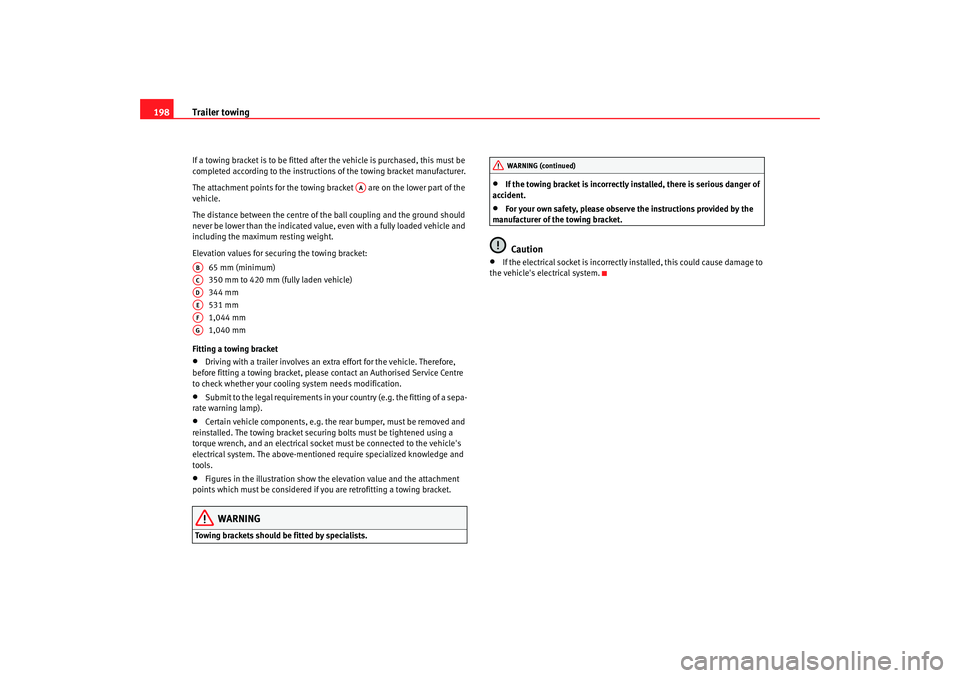
The attachment points for the towing bracket are on the lower part of the
vehicle.
The distance between the centre of the ball coupling and the ground should
never be lower than the indicated value, even with a fully loaded vehicle and
including the maximum resting weight.
Elevation values for securing the towing bracket:
65 mm (minimum)
350 mm to 420 mm (fully laden vehicle)
344 mm
531 mm
1,044 mm
1,040 mm
Fitting a towing bracket•
Driving with a trailer involves an extra effort for the vehicle. Therefore,
before fitting a towing bracket, please contact an Authorised Service Centre
to check whether your cooling system needs modification.
•
Submit to the legal requirements in your country (e.g. the fitting of a sepa-
rate warning lamp).
•
Certain vehicle components, e.g. the rear bumper, must be removed and
reinstalled. The towing bracket securin g bolts must be tightened using a
torque wrench, and an electrical socket must be connected to the vehicle's
electrical system. The above-mentione d require specialized knowledge and
tools.
•
Figures in the illustration show the elevation value and the attachment
points which must be considered if you are retrofitting a towing bracket.
WARNING
Towing brackets should be fitted by specialists.
•
If the towing bracket is incorrectly installed, there is serious danger of
accident.
•
For your own safety, please observe the instructions provided by the
manufacturer of the towing bracket.Caution
•
If the electrical socket is incorrectly installed, this could cause damage to
the vehicle's electrical system.
AA
ABACADAEAFAG
WARNING (continued)
Toledo_EN.book Seite 198 Dienstag, 20. Januar 2009 12:58 12
Page 200 of 289
Your vehicle maintenance and cleaning199
Safety First
Operating instructions
Practical tips
Te c h n i c a l D a t a
Your vehicle maintenance and cleaningGeneral notesRegular washing and care help maintain the value of your
vehicle.Your vehicle maintenance
Regular care and washing help to maintain the value of the vehicle. This may
also be one of the requirements for acknowledging warranty claims in the
event of bodywork corr osion or paint defects.
The best way to protect the car against environmental contaminants is to
wash and wax it frequently. The longer substances such as insects remains,
bird droppings, resinous tree sap, road dirt, industrial deposits, tar, soot or
road salt and other aggressive materi als remain on the vehicle, the more
damage they do to the paintwork. High temperatures (for instance in strong
sunlight) further intensify the corrosive effect.
After winter, a period when salt is put on the roads, it is important to have the
underside of the vehicle washed thoroughly.
Products for vehicle maintenance
Car care products are available in your Authorised Service Centre. Keep the
product instructions until you have used them up.
WARNING
•
Car care products can be toxic. For this, they must always be kept
closed in their original container. Keep them out of the reach of children.
Failure to comply could result in poisoning.
•
Always read and observe the instructions and warnings on the package
before using car care products. Improper use could damage your health or your vehicle. The use of certain products may produce noxious vapours;
they should be used in well ventilated areas.
•
Never use fuel, turpentine, engine oil, nail varnish remover or other
volatile fluids. These are toxic and highly flammable. Risk of fire and explo-
sion.
•
Before washing your vehicle, or carrying out any maintenance, switch
the engine off, apply your handbrake firmly and remove the key from the
ignition.Caution
Never attempt to remove dirt, mud or dust if the surface of the vehicle is dry.
Never use a dry cloth or sponge for clea ning purposes. This could damage the
paintwork or the windows of your vehicle. Soak dirt, mud or dust with plenty
of water.
For the sake of the environment
•
When purchasing products for your vehicle maintenance, select the ones
which are not harmful to the environment.
•
The leftovers of the car care products should not be disposed of with ordi-
nary household waste. Observe the disposal information on the package.WARNING (continued)
Toledo_EN.book Seite 199 Dienstag, 20. Januar 2009 12:58 12
Page 203 of 289
Your vehicle maintenance and cleaning
202A good quality hard wax product is available from your Authorised Service
Centre.
Regular wax applications help to prot ect the paintwork from environmental
contaminants ⇒page 199. It is also effective in protecting against minor
scratches.
Even if a wax solution is used regularly in the car washing tunnel, it is advis-
able to protect the paint with a hard wax coating at least twice a year.Polishing the paintwork
Polishing brings back gloss to the paintwork.Polishing is only necessary if the paint has lost its shine, and the gloss cannot
be brought back by applying wax. P olishing products can be purchased in
your Authorised Service Centre.
The car must be waxed after polishing if the polish used does not contain wax
compounds to seal the paint ⇒page 201, “Vehicle paint maintenance
requirements”.
Caution
To prevent damage to the paintwork:•
Do not use polishes and hard wax on painted parts with a matte finish or
on plastic parts.
•
Do not polish your vehicle in a sandy or dusty environment.
Caring for plastic parts
Solvents damage plastic parts.If normal washing fails to clean plastic parts, clean them with approved
solvent-free plastic cleaning and care products.
Caution
•
The use of liquid air freshener directly over the air vents of the vehicle may
damage the plastic parts if the liquid is accidentally spilled.
•
Cleaning products which contain solvents will damage the material.
Cleaning windows and exterior mirrorsCleaning windows
– Moisten the windows with commercially available, alcohol based glass cleaner.
– Dry the windows with a clean chamois leather or a lint-free cloth.
Removing snow
– Use a small brush to remove snow from the windows and mirrors.
Removing ice
–Use a de-icer spray.Use a clean cloth or chamois leather to dry the windows. The chamois
leathers used on painted surfaces are not suitable to clean windows because
they are soiled with wax deposits which could smear the windows.
Toledo_EN.book Seite 202 Dienstag, 20. Januar 2009 12:58 12