oil Seat Toledo 2012 User Guide
[x] Cancel search | Manufacturer: SEAT, Model Year: 2012, Model line: Toledo, Model: Seat Toledo 2012Pages: 249, PDF Size: 3.6 MB
Page 155 of 249
154Driving and the environment
New tyres
New tyres must be submitted to “running in”, given that initially their grip is
not yet at the maximum level. During approximately the first 500 km (120
miles) drive very carefully.
New brake pads
New brake pads do not yet provide maximum friction capacity. New brake
pads must be “run in” first. During approximately the first 200 km (120
miles) drive very carefully.
Catalytic converter
An exhaust gas emission control system (catalytic converter) that functions
perfectly is vitally important for vehicle operation that respects the environ-
ment.
Please observe the following indications:
● Refuel only using unleaded petrol ⇒ page 172, Unleaded petrol in pet-
rol engine vehicles.
● Do not add too much oil to the engine ⇒ page 177, Checking the en-
gine oil level;.
● Do not switch off the ignition while driving.
If you are required to drive in a country where unleaded fuel is not available
and when returning to a country where using a catalytic converter is obliga-
tory, the catalytic converter must be replaced.
WARNING
● Due to the high temperatures that the catalytic converter can reach,
the vehicle must be stopped so that the catalytic converter does not
come into contact with easily flammable material underneath the vehicle.
Risk of fire!
● Never use substances for additional underbody protection or anti-cor-
rosion for the exhaust pipes, the catalytic converter or the antithermic
screen. Risk of fire!
CAUTION
● Never completely empty the tank! An irregular fuel supply can cause ig-
nition faults, which can result in damage to a substantial amount of engine
parts and the exhaust system.
● Refuelling just once with leaded petrol disables the exhaust system!
Economical and ecological driving General notes
Fuel consumption, environmental impact and engine, brake and tyre wear
depend largely on three factors:
● personal driving style
● the conditions in which the vehicle is used
● prior technical conditions
By adopting an economical driving style and anticipating the traffic situa-
tion ahead, you can easily reduce fuel consumption by 10-15%.
Page 157 of 249

156Driving and the environment
Avoid driving at full speed
Fuel can be saved by driving at a slower speed.
Accelerating slowly not only considerably reduces fuel consumption, but al-
so reduces the environmental impact and vehicle wear.
If possible, you should never take advantage of the maximum speed of your
vehicle. Fuel consumption, exhaust emissions of toxic substances and
noise levels all increase very rapidly at higher speeds.
You can reduce fuel consumption by about one half if you do not drive faster
than three quarters of top speed.
Reduce idling
Idling also consumes fuel.
In a vehicle that does not have the START-STOP function, stop the engine in
traffic jams, level crossings and at traffic lights that remain red for a long
period of time. After 30-40 seconds with the engine switched off, the fuel
savings are greater that the quantity of fuel required to restart the engine
again.
When the engine is idling, a great deal of time is required in order for the
engine to reach operating temperature. When heating the vehicle, however,
engine waste and emissions of toxic substances are elevated. Therefore, im-
mediately begin driving after switching on the engine. Doing so avoids high
engine speeds.
Regular maintenance
A badly tuned engine unnecessarily consumes a large quantity of fuel. Conditions for economical driving can be created with regular maintenance
at an Official Service. Maintenance of your vehicle has positive repercus-
sions on traffic safety and conserving the value of the vehicle.
A badly tuned engine can result in fuel consumption that is 10% higher
than normal!
Additionally, check the
oil level after refuelling. Oil consumption depends
to a great extent on the engine load and engine speed. Depending on your
driving style, oil consumption can reach 0.5 litres per 1000 km (600 miles).
It is normal for the oil consumption of a new engine not to reach its mini-
mum level until after a period of running in time. Therefore, the oil con-
sumption of a new vehicle can only be judged correctly after covering 5000
km (3000 miles).
For the sake of the environment
● An additional reduction in consumption can be achieved using high-per-
formance synthetic oils.
● In order to detect leaks in good time, check the ground underneath the
vehicle regularly. If you notice stains from oils or other operating liquids,
contact an Official Service.
Note
We recommend that you have regular maintenance performed on your vehi-
cle a the SEAT Authorised Service.
Page 160 of 249

159
Driving and the environment
Unleaded petrol
Refuel only using unleaded petrol ⇒ page 154, Catalytic converter in petrol
engine vehicles. Automobile associations will provide information regarding
the network of petrol stations offering unleaded petrol.
Headlights
Your dipped beam headlights are adjusted in an asymmetrical formation.
The side of the road on which you are driving is illuminated more brightly.
If you are driving in a foreign country where traffic drives on the opposite
side of the road this will dazzle the oncoming traffic. In order to avoid daz-
zling oncoming traffic, it is essential to have the headlights adjusted at an
authorised SEAT dealer.
Note
You will receive information about the modification of the headlights at an
authorised SEAT dealer.
Preventing damage to the vehicle
In order to prevent damage to the vehicle, take special care:
● on roads in poor condition
● when mounting the kerb
● when approaching very steep ramps, etc.
● with the parts of the vehicle situated on the lower part of the vehicle, i.e.
the spoiler, the exhaust pipe, This applies especially to vehicles with a very low suspension (sport) and
when the vehicle is fully loaded.
Driving through water
Fig. 114 Driving through
water
To prevent the vehicle from being damaged when driving through water (i.e.
flooded roads), please observe the following:
● Determine the depth of the water before entering. The water can reach a
maximum height of below the door sill ⇒ Fig. 114.
● Drive at a maximum pace of walking speed. Driving at a higher speed
can cause a wave in front of the vehicle, which can cause water to enter the
engine air intake system or other parts of the vehicle.
● Never stop in the water, never reverse and never stop the engine.
● Before driving through water deactivate the START-STOP system
⇒ page 151.
Safety FirstOperating instructionsPractical TipsTechnical specifications
Page 166 of 249

165
Care of the vehicle and cleaning
Note
● Remove stains from fresh ball-pen and other inks, lipstick, shoe cream
and similar stains on the fabric (leather), upholstery and fabric trim as soon
as possible.
● We recommend that you visit an authorised SEAT dealer to clean and
care for the interior of your vehicle, due to the problems that may arise
when cleaning and caring for the interior of your vehicle and to the utensils
and knowledge required.
Washing the vehicle
The best protection of the vehicle from the harmful influences of the envi-
ronment involves frequent washing and waxing. The frequency with which
the vehicle is washed depends on many different factors, such as:
● Frequency of use
● Type of parking (garage, underneath trees, etc.)
● Time of year
● Weather conditions
● Environmental conditions
The longer substances such as insects, bird droppings, resinous tree sap,
road dirt, industrial deposits, tar, soot or road salt and other aggressive ma-
terials remain on the paintwork, the more damage they do. High tempera-
tures (for instance in strong sunlight) further intensify the corrosive effect.
After the winter season, it is important to have the underside of the vehicle
washed thoroughly. Automatic car washes
Your vehicle can be washed in an automatic car wash.
Before going through a car wash, be sure to take the usual precautions such
as closing the windows, etc.
If the vehicle has special accessories such as spoilers or a roof carrier or
two-way radio aerial, etc., it is advisable to consult the car wash operator
beforehand.
The windscreen wiper rubbers must be degreased after going after the car
wash and waxing.
Washing by hand
When washing the car by hand, use plenty of water to soften the dirt first
and rinse off as well as possible.
Then clean the vehicle with a sponge, glove or brush. Start on the roof and
work down. Use only slight pressure when cleaning the painted surfaces of
the vehicle. A car shampoo should only be used for very persistent dirt.
Rinse the sponge or glove thoroughly and often.
Wheels, sills and underside should be cleaned last. Use a second sponge
for this.
After washing, rinse the vehicle thoroughly and then dry with a chamois.
Safety FirstOperating instructionsPractical TipsTechnical specifications
Page 171 of 249
170Care of the vehicle and cleaning
CAUTION
● Avoid exposing leather to direct sunlight for long periods so that it does
not lose its colour. If the car is left for a prolonged period outdoors, cover
the leather so that it does not lose its colour.
● Sharp-edged objects on clothing, such as zips, rivets or belts can leave
permanent scratches and rough marks on the surface of the leather.
● Use of the mechanical steering wheel lock can damage the leather sur-
face of the steering wheel.
Note
● Use a suitable impregnating cream with ultra-violet protection at regular
intervals and after cleaning. The cream will nourish and moisturise the
leather, keep it supple and able to breathe. In addition, it will also help to
protect the surface of the leather.
● Clean the leather every 2 to 3 months and remove fresh dirt as necessa-
ry.
● Preserve the colour of the leather. A special coloured cream for leather
will renew the colour of more heavily worn areas as required.
● Leather is a natural material with specific properties. During vehicle use,
parts of the leather covers may change in appearance, such as folds or wrin-
kles, as a result of their use.
Seat belts
Keep the seat belts clean!
Wash soiled seat belts with mild, soapy water, removing any heavier dirt
with a soft brush.
Check the condition of all seat belts at regular intervals.
Very soiled belts may not retract properly.
WARNING
● The seat belts should never be removed from the vehicle for cleaning.
● Never clean using chemical products, as chemical detergents destroy
the fabric. Ensure that the seat belts do not come into contact with corro-
sive fluids such as acids, etc.
● If you find any damage to the belt webbing, belt fittings, the belt re-
tractor or the buckle, the belt in question must be replaced by an Official
Service.
● Make sure that the inertia reel seat belts are completely dry before
allowing them to retract.
Page 177 of 249

176Checking and refilling levels
Engine oil
General notes
The engine is factory-filled with a special multi-grade oil that can be used all
year round.
As the use of high quality oil is essential for the correct operation of the en-
gine and its long useful life, when topping up or replacement is necessary
use only those oils that conform to the requirements of the VW standards.
The specifications (VW standards) set out in the following page should ap-
pear on the container of the service oil; when the container displays the
specific standards for petrol and diesel engines together, it means that the
oil can be used for both types of engines.
We recommend that the oil change, indicated in the Maintenance Pro-
gramme, be performed by a Technical Service or a specialised workshop.
The correct oil specifications for your engine are listed in the ⇒ page 177,
Oil properties.
Service intervals
Service intervals can be flexible (LongLife service) or fixed (dependent on
time/distance travelled).
If the PR code that appears on the back of the “Maintenance Programme”
booklet is QG1, this means that your vehicle has the LongLife service pro-
grammed. If it has the codes QG0 or QG2 the interval service is dependent
on time/distance travelled.
Flexible service intervals (LongLife*)
Special oils and processes have been developed which, depending on the
characteristics and individual driving profiles, allow to extend the oil
change service (LongLife service intervals). Because this oil is essential for extending the service intervals, it
must only
be used observing the following indications:
● Avoid mixing it with oil for fixed service intervals.
● Only in exceptional circumstances, if the engine oil level is too low
⇒ page 177 and LongLife oil is not available, it is permitted to top up
(once) with oil for fixed service intervals ⇒ page 177 (up to a maximum of
0.5 litres).
Fixed service intervals*
If your vehicle does not have the “LongLife service interval” or it has been
disabled (by request), you may use oils for fixed service intervals, which al-
so appear in ⇒ page 177, Oil properties. In this case, your vehicle must be
serviced after a fixed interval of 1 year/15 000 km (10 000 miles) (whatever
comes first) ⇒ Booklet Maintenance Programme.
● In exceptional circumstances, if the engine oil level is too low
⇒ page 177 and you cannot obtain the oil specified for your vehicle, you
can put in a small quantity of oil conforming to the specification ACEA A2 or
ACEA A3 (petrol engines) or ACEA B3 or ACEA B4 (diesel engines) (up to 0.5
l).
Vehicles with diesel particulate filter*
The “Maintenance Programme” states whether your vehicle is fitted with a
diesel particulate filter.
Only VW 507 00 engine oil, with reduced ash formation, may be used in die-
sel engines equipped with particulate filter. Using other types of oil will
cause a higher soot concentration and reduce the life of the DPF. Therefore:
● Avoid mixing this oil with other engine oils.
● Only in exceptional circumstances, if the engine oil level is too low
⇒ page 177 and you cannot obtain the oil specified for your vehicle, you
can use a small quantity of oil (once) conforming to the VW 506 00,
VW 506 01, VW 505 00, VW 505 01 or ACEA B3/ACEA B4 specification. (up
to 0.5 l).
Page 178 of 249

177
Checking and refilling levels
Oil properties
Engine typeSpecificationPetrol without flexible service in-
tervalVW 502 00/VW 504 00
Petrol with flexible service inter-
val (LongLife)VW 504 00
Diesel. Engines with no Particu-
late Filter (DPF)VW 505 01/VW 506 01/VW 507 00
Diesel. Particulate Filter Engines
(DPF).
With or without flexible service in-
terval (with and without Long-
life) a)VW 507 00
a)
Only use recommended oils, otherwise you may damage the engine.
Engine oil additives
No type of additive should be mixed with the engine oil. The deterioration
caused by these additives is not covered by the warranty.
Note
Before a long trip, we recommend finding an engine oil that conforms to the
corresponding VW specifications and keeping it in the vehicle. This way, the
correct engine oil will always be available for a top-up if needed. Checking the engine oil level
Fig. 118 Engine oil dip-
sticks
The dipstick shows the engine oil level. ⇒ Fig. 118.
Checking oil level
– Park the vehicle on a level surface and ensure the engine is at
operating temperature.
– Switch the ignition off.
– Open the bonnet.
– Wait a few minutes for the engine oil to flow back to the sump
and remove the dipstick.
– Wipe the dipstick with a clean cloth and insert it again as far as
it will go.
– Then pull the dipstick out again and check the oil level.
Safety FirstOperating instructionsPractical TipsTechnical specifications
Page 179 of 249

178Checking and refilling levels
Oil level in area A
–
Do not top up oil.
Oil level in area B
–
Oil can be topped up. After topping up the oil level could be in
area A.
Oil level in area C
–
Oil must be topped up. After topping up the oil level should be
in area B.
It is normal for the engine to consume a certain amount of oil. Depending
on how you drive and the conditions in which the vehicle is used, oil con-
sumption can be up to 0.5 litres per 1000 km (621 miles). Oil consumption
can also be higher for the first 5000 km (3000 miles).
You should therefore check the oil level at regular intervals, ideally every
time you fill the tank or before setting off on a long trip.
When the engine is working hard, for instance during sustained motorway
cruising in summer, when towing a trailer or caravan or climbing on moun-
tain passes, the oil level should preferably be kept within area A
, but no
higher.
A warning lamp will appear on the instrument panel ⇒ page 67, Engine oil
if the oil level is too low. In this case, check the oil level as soon as pos-
sible. Top up with the required amount of oil.
CAUTION
● The oil level must never exceed area A ⇒ Fig. 118. Risk of damage to
the exhaust system!
● If the engine oil cannot be topped up under the given conditions, do
not drive on! Stop the engine and seek the professional assistance of an Of-
ficial Service, as this could cause serious damage to the engine. Topping up engine oil
–
Check the engine oil level ⇒ page 177, Checking the engine oil
level.
– Unscrew the cap from the filler opening.
– Put in the specified grade of oil 0.5 litres at a time ⇒ page 176.
– Check the oil level ⇒ page 177.
– Replace the oil filler cap carefully and push the dipstick all the
way in.
Changing engine oil
Engine oil must be changed with the frequency indicated in the Mainte-
nance Programme or according to the service interval indicator ⇒ page 57.
CAUTION
Do not mix engine oil with additives. Risk of damage to the engine! Damage
caused by these products is not covered by the warranty.
Note
Wash your skin thoroughly if it comes into contact with engine oil.
Page 180 of 249
179
Checking and refilling levels
Coolant
General notes
The cooling system is factory-filled with an anti-freeze product.
Coolant consists of a mixture of water and 40% anti-freeze additive. This
mixture gives the required anti-freeze protection at temperatures down to
-25 °C (-13 °F) and protects the cooling and heating system against corro-
sion. It also prevents scaling and raises the boiling point of the coolant con-
siderably.
The coolant concentration must not be reduced by adding water, even in
warmer seasons or in warm countries. The concentration of the anti-freeze
additive in the coolant must be at least 40 %.
If greater anti-freeze protection is required in very cold climates, the propor-
tion of the anti-freeze additive can be increased, but only up to 60 % (anti-
freeze protection down to approx. -40 °C (-40 °F)). Any excess in this propor-
tion would reduce the anti-freeze protection and affect the cooling effect.
Vehicles in countries with a cold climate are supplied with coolant protec-
tion down to around -35 °C (-31 °F). The proportion of anti-freeze additive in
these countries should always be at least 50 %.
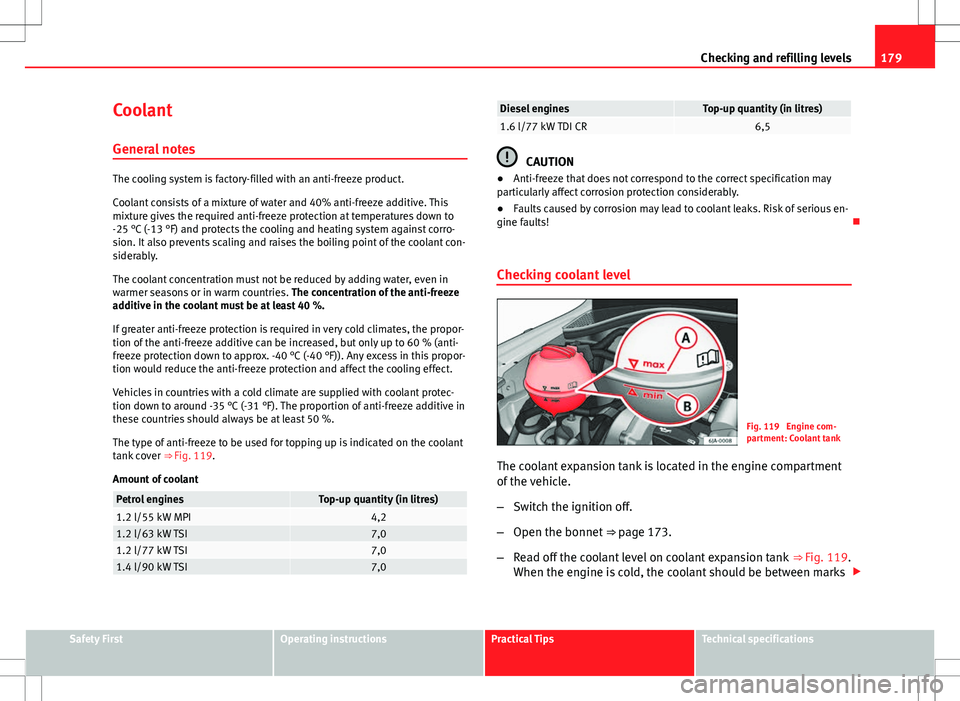
The type of anti-freeze to be used for topping up is indicated on the coolant
tank cover ⇒ Fig. 119.
Amount of coolant
Petrol enginesTop-up quantity (in litres)1.2 l/55 kW MPI4,21.2 l/63 kW TSI7,01.2 l/77 kW TSI7,01.4 l/90 kW TSI7,0
Diesel enginesTop-up quantity (in litres)1.6 l/77 kW TDI CR6,5
CAUTION
● Anti-freeze that does not correspond to the correct specification may
particularly affect corrosion protection considerably.
● Faults caused by corrosion may lead to coolant leaks. Risk of serious en-
gine faults!
Checking coolant level
Fig. 119 Engine com-
partment: Coolant tank
The coolant expansion tank is located in the engine compartment
of the vehicle.
– Switch the ignition off.
– Open the bonnet ⇒ page 173.
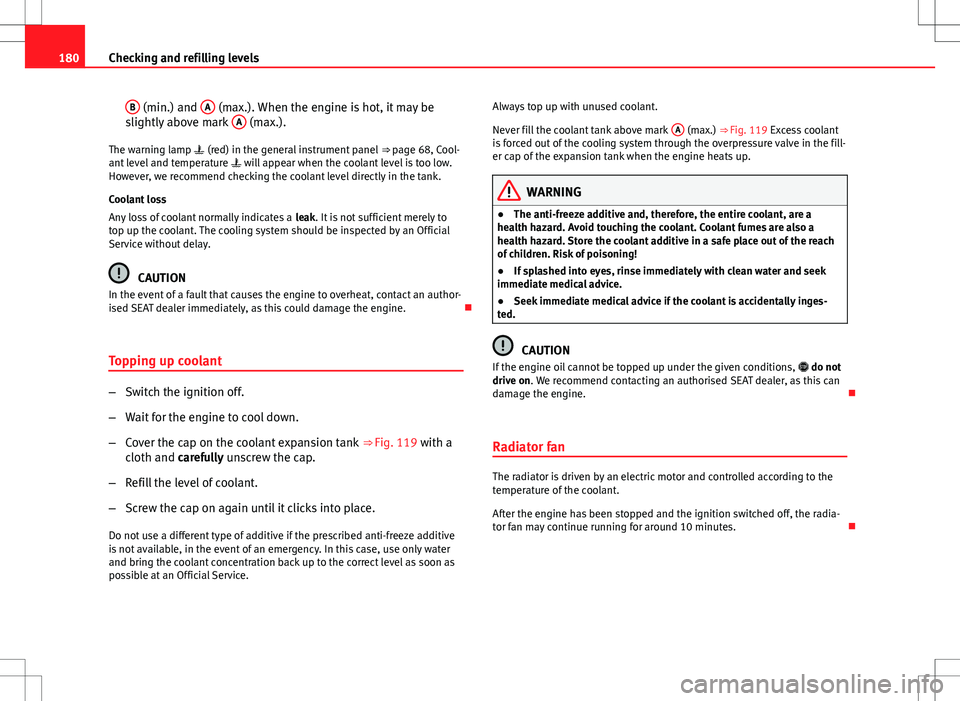
– Read off the coolant level on coolant expansion tank ⇒
Fig. 119.
When the engine is cold, the coolant should be between marks
Safety FirstOperating instructionsPractical TipsTechnical specifications
Page 181 of 249
180Checking and refilling levels
B
(min.) and A (max.). When the engine is hot, it may be
slightly above mark A (max.).
The warning lamp (red) in the general instrument panel ⇒ page 68, Cool-
ant level and temperature will appear when the coolant level is too low.
However, we recommend checking the coolant level directly in the tank.
Coolant loss
Any loss of coolant normally indicates a leak. It is not sufficient merely to
top up the coolant. The cooling system should be inspected by an Official
Service without delay.
CAUTION
In the event of a fault that causes the engine to overheat, contact an author-
ised SEAT dealer immediately, as this could damage the engine.
Topping up coolant
– Switch the ignition off.
– Wait for the engine to cool down.
– Cover the cap on the coolant expansion tank ⇒ Fig. 119 with a
cloth and carefully unscrew the cap.
– Refill the level of coolant.
– Screw the cap on again until it clicks into place.
Do not use a different type of additive if the prescribed anti-freeze additive
is not available, in the event of an emergency. In this case, use only water
and bring the coolant concentration back up to the correct level as soon as
possible at an Official Service. Always top up with unused coolant.
Never fill the coolant tank above mark
A
(max.) ⇒ Fig. 119 Excess coolant
is forced out of the cooling system through the overpressure valve in the fill-
er cap of the expansion tank when the engine heats up.
WARNING
● The anti-freeze additive and, therefore, the entire coolant, are a
health hazard. Avoid touching the coolant. Coolant fumes are also a
health hazard. Store the coolant additive in a safe place out of the reach
of children. Risk of poisoning!
● If splashed into eyes, rinse immediately with clean water and seek
immediate medical advice.
● Seek immediate medical advice if the coolant is accidentally inges-
ted.
CAUTION
If the engine oil cannot be topped up under the given conditions, do not
drive on. We recommend contacting an authorised SEAT dealer, as this can
damage the engine.
Radiator fan
The radiator is driven by an electric motor and controlled according to the
temperature of the coolant.
After the engine has been stopped and the ignition switched off, the radia-
tor fan may continue running for around 10 minutes.