instrument panel Seat Toledo 2012 Owner's Guide
[x] Cancel search | Manufacturer: SEAT, Model Year: 2012, Model line: Toledo, Model: Seat Toledo 2012Pages: 249, PDF Size: 3.6 MB
Page 143 of 249
142Driving
The HHC is activated on gradients of over 5 %, as the driver door is closed.
It only works to start on hills, moving both forwards and in reverse. It is not
activated during start-up down hill.
Anti-lock system (ABS)
The ABS system prevents the wheels locking during braking. This helps the
driver keep control of the vehicle.
The driver is made aware of ABS assistance by the pulsating of the brake
pedal and a characteristic noise.
Keep the brake pedal pressed down while the ABS is working. The ABS will
switch off when the brake pedal is released. Never brake intermittently
while the ABS is working!
Traction control system (ASR)
If the wheels start to slide, the ASR adapts the engine speed to the driving
conditions. Particularly in unfavourable conditions, ASR helps starting, ac-
celerating and hill starts.
The 1)
warning lamp in the general instrument panel flashes when the
system is working. Electronic differential lock
If one of the wheels starts to skid, the EDL brakes that wheel, transmitting
the driving force to the other wheels. This increases vehicle stability and im-
proves driving stability.
To prevent the disc brake of the braking wheel from overheating, the EDL
cuts out automatically if subjected to excessive loads. The vehicle will con-
tinue to function normally without EDL. The EDL will switch on again auto-
matically when the brake has cooled down.
Manual gearbox
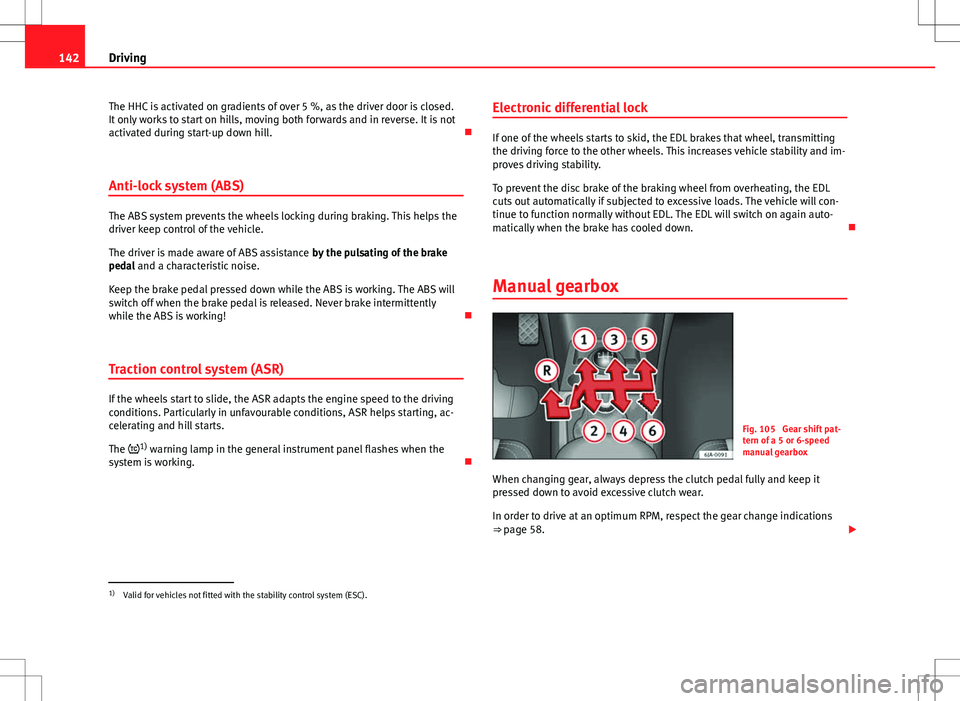
Fig. 105 Gear shift pat-
tern of a 5 or 6-speed
manual gearbox
When changing gear, always depress the clutch pedal fully and keep it
pressed down to avoid excessive clutch wear.
In order to drive at an optimum RPM, respect the gear change indications
⇒ page 58.
1)
Valid for vehicles not fitted with the stability control system (ESC).
Page 145 of 249
144Driving
The engine can only be started in positions P or N. If, on engaging the steer-
ing lock, switching the ignition on/off or starting the engine, the selector
lever is not in position P or N, the informative display will show Move the
selector lever to position P/N! or P/N is shown on the general instrument
panel display.
The engine can only be started in position P at temperatures below -10 °C
(14 °F).
Move the selector lever to position P when parking the vehicle on a flat sur-
face. On a slope, the handbrake should be firmly applied before moving the
selector lever to the park position. This reduces the load on the lock mecha-
nism while making it easier to move the selector lever from position P.
If, while the vehicle is moving, the selector lever is accidentally moved to
position N, release the accelerator and wait for the engine to idle before
moving it back into position.
Starting and driving
Starting
– Press and hold the brake pedal.
– Press and hold the interlock button on the selector lever knob
and move the selector lever to position ⇒ page 144 before re-
leasing the interlock button.
– Release the brake and press the accelerator.
Stopping
– The selector lever does not have to be moved to position N if
the vehicle is stopped for a short period, e.g. at junctions. Ap-
plying the brake is enough. However, the engine must remain
idling. Parking
–
Press the brake pedal.
– Apply the handbrake.
– Press the interlock button, move the selector lever to position P
and release the button.
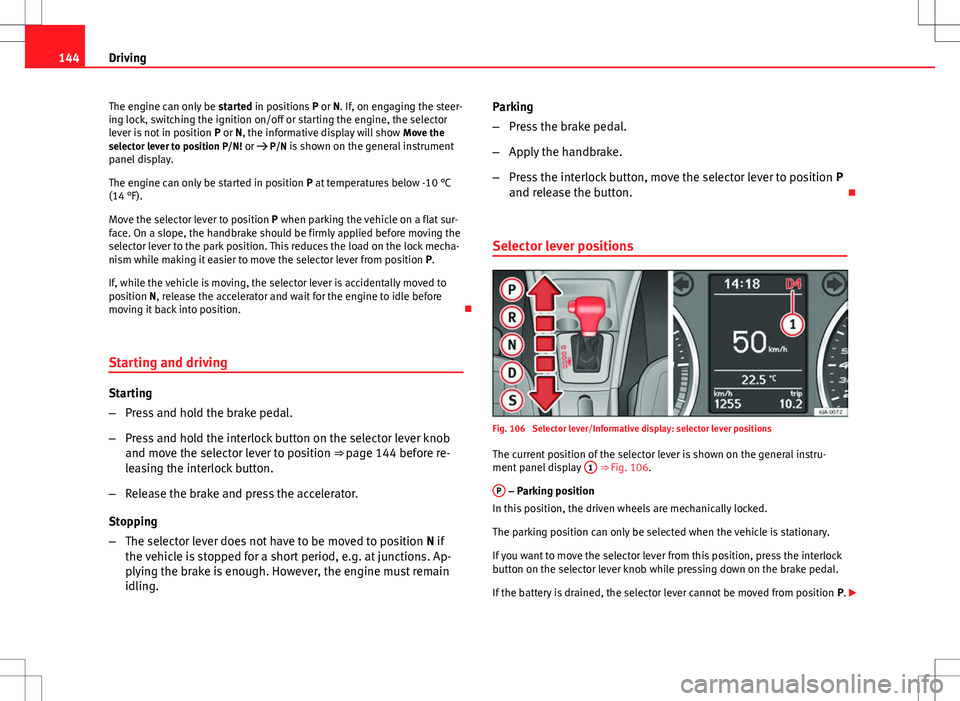
Selector lever positions
Fig. 106 Selector lever/Informative display: selector lever positions The current position of the selector lever is shown on the general instru-
ment panel display 1
⇒ Fig. 106.
P
– Parking position
In this position, the driven wheels are mechanically locked.
The parking position can only be selected when the vehicle is stationary.
If you want to move the selector lever from this position, press the interlock
button on the selector lever knob while pressing down on the brake pedal.
If the battery is drained, the selector lever cannot be moved from position P.
Page 147 of 249

146Driving
The manual gearbox can be activated when the vehicle is either moving or
stationary.
When accelerating, the gearbox automatically shifts up shortly before the
maximum engine speed is reached.
On shifting up, the gear is only engaged when there is no risk of engine
damage.
When the accelerator pedal is pressed down to the kick-down zone, the
gearbox will shift down in line with the road speed and engine speed.
Note
The kick-down function is also available in manual shift mode.
Selector lever lock
Automatic selector lever lock
The selector lever is locked in the positions P and N when the ignition is on.
Press down on the brake to unlock it. Remember, if the selector lever is in
positions P and N then the ⇒ page 73 warning lamp will light up on the
general instrument panel.
When the selector lever merely moves through position N (e.g. when moved
from R to D), the lever lock is not applied. This makes it possible, for exam-
ple, to rock a stuck vehicle backwards and forwards. The lock is only applied
if the brake is not pressed and the selector lever is moved to position N for
more than 2 seconds.
The selector lever lock is only activated in vehicles that are stationary or at
speeds of less than 5 km/h (3 mph). It is automatically switched off in posi-
tion N at higher speeds. Interlock button
The interlock button on the selector lever knob prevents the driver from in-
advertently engaging a gear. Press the button to unlock the selector lever.
Safety interlock for ignition key
1)
After switching off the ignition, you can only remove the ignition key if the
selector lever is in position P. When the ignition key is removed, the selec-
tor lever is locked in position P.
Kick-down feature
The kick-down feature allows maximum acceleration to be reached.
In any gear programme, press down fully on the accelerator for the automat-
ic gearbox to activate the kick-down feature. This function takes priority over
the gear programmes without taking into account the position of the selec-
tor lever (D, S or Tiptronic) and is used to reach maximum acceleration, us-
ing full engine power. Depending on the road speed and engine speed, the
automatic gearbox shifts down and the vehicle accelerates. It only shifts up
after the maximum engine speed has been reached.
Driving programmes
Your vehicle is equipped with an electronically-controlled automatic gear-
box. Shifting up or down depends on the programme selected.
For a calm driving style, the gearbox uses the most economic programme.
The gearbox shifts up as quickly as possible and shifts down as late as pos-
sible, thus increasing driving economy.
1)
Valid only for certain countries.
Page 150 of 249

149
Driving
Switching the parking aid system on and off
Parking aid is switched on when the ignition is on and reverse gear engag-
ed. This is confirmed by a short audible warning.
Parking aid is switched off when reverse gear is released.
WARNING
● Parking aid does not free the driver from responsibility when parking
or performing similar manoeuvres. Pay special attention to small children
or animals, as the parking aid sensors may not always be able to detect
them.
● Before reversing or parking, make sure there are no small obstacles,
e.g. stones, narrow pillars, towing brackets, etc. in front and behind the
vehicle. These obstacles may not always be detected by the parking aid
device.
● The surface of certain objects may not reflect the signals of the park-
ing aid sensors. Therefore, people wearing clothing of this kind may not
be detected by the parking aid system.
● Outside noise may interfere with the parking aid system. Under cer-
tain unfavourable circumstances, certain objects or people may not be
detected.
Note
● If a constant sound at a higher frequency is emitted for 3 seconds when
the system is switched on then there is a fault in the system. Please take the
vehicle to a specialised technical service to solve this fault.
● To ensure that the parking aid system works properly, the sensors must
be kept clean (e.g. free of ice).
● If the parking aid system is switched on when the automatic gearbox se-
lector lever is in position P, the acoustic signal will be interrupted (the car
cannot be moved). Cruise control
Introduction
The cruise control system allows you to drive at a constant speed of 30 km/
h (19 mph) or higher without having to press the accelerator. However, the
speed is only maintained within the margin permitted by the engine power
and the braking effect of the engine.
The warning lamp lights up on the general instrument panel if cruise con-
trol is switched on.
WARNING
● For safety reasons the cruise control system must not be used in
dense traffic or where roads conditions are poor (e.g. due to ice, aqua-
planing, loose grit, snow). Risk of accident!
● The programmed speed can only be re-established if it is not too high
for current traffic conditions.
● Always switch the cruise control system off after using it in order to
avoid involuntary use.
CAUTION
● The cruise control cannot maintain a constant speed when the vehicle is
moving downhill. The vehicle tends to accelerate under its own weight.
Therefore, shift down or use the brake pedal in good time to slow the vehi-
cle.
Note
● In vehicles with an automatic gearbox, the cruise control system cannot
be switched on if the selector lever is in position P, N or R.
● In vehicles with a manual gearbox, the cruise control cannot be switched
on if first gear or reverse gear is engaged.
Safety FirstOperating instructionsPractical TipsTechnical specifications
Page 152 of 249

151
Driving
To recover the set speed, briefly press switch B
in RES once you have re-
leased the brake or clutch pedal.
Switching off cruise control completely
– Move knob A ⇒ Fig. 110 ⇒ page 150 to OFF.
START-STOP*
Fig. 111 Instrument
panel: Start-Stop system
button
The START-STOP system helps save fuel and reduce harmful emis-
sions and CO 2.
The system is automatically switched on every time the ignition is
switched on.
The system automatically switches off the engine when the vehicle
is stationary, e.g. waiting at traffic lights.
The current status of the START-STOP system is displayed on the
general instrument panel display. Automatic engine shut down (Stop phase)
–
Stop the vehicle (if necessary using the handbrake).
– Shift to neutral.
– Release the clutch pedal.
Automatic engine start up (Start phase)
– Release the clutch pedal.
Switching the START-STOP system on and off
The START-STOP system can be switched on and off by pressing the
⇒ Fig. 111 button.
The warning lamp in the button will light up when the system is
switched off.
If the vehicle is in Stop phase when the button is pressed, the en-
gine will start immediately.
The START-STOP system works under complex driving conditions that are dif-
ficult to detect without specialist technology. The set of necessary condi-
tions for the correct operating of the START-STOP system are indicated be-
low.
Conditions for automatic engine shut down (Stop phase)
● Selector lever in neutral
● Clutch pedal not pressed
● Driver with seat belt fastened
● Driver door closed
● Bonnet closed
● Vehicle stationary
● The factory-fitted towing bracket is not electrically connected to a trailer
Safety FirstOperating instructionsPractical TipsTechnical specifications
Page 153 of 249

152Driving
● Engine at operating temperature
● Vehicle's battery sufficiently charged
● Vehicle not on a very steep slope
● Engine speed below 1200 rpm
● Vehicle's battery temperature is neither too high nor too low
● Sufficient brake system pressure
● Difference between outside temperature and set interior temperature
not too great
● Vehicle speed since last time the engine started was above 3 km/h (2
mph)
● Particulate filter ⇒ page 71 not being cleaned
● Front wheels not overly turned (steering wheel turned less than three
quarters of a turn)
Conditions for engine start up (Start phase)
● Clutch pedal pressed
● Max./min. temperature set
● Windscreen defrost function switched on
● High blower speed
● START-STOP button pressed
Conditions for automatic engine start up without driver involvement
● Vehicle moving at a speed of over 3 km/h (2 mph)
● Difference between outside temperature and interior temperature is too
great
● Vehicle's battery insufficiently charged
● Insufficient brake system pressure
If the driver seat belt is unfastened for more than 30 seconds in Stop phase,
the engine must be started using the ignition key. Please observe the mes-
sages on the general instrument panel display. Warnings on the instrument panel display (valid for vehicles not fitted with
an informative display)
FAULT: START-STOPFault in the START-STOP systemSTART-STOP IMPOSSIBLEEngine cannot be automatically shut
down
START-STOP ACTIVEAutomatic engine shut down (Stop
phase)
SWITCH OFF IGNITIONSwitch ignition off.START MANUALLYStart the engine manually
WARNING
● If the engine is switched off, neither the brake servo or the power
steering will work.
● Do not move the vehicle when the engine is switched off.
CAUTION
Switch off the START-STOP system ⇒ page 159 before driving through a
pool of water on the road.
Note
● The battery temperature may reflect the changes in outside temperature
after several hours. If the vehicle has been stopped outside at temperatures
below zero or in direct sunlight, for example, the battery temperature may
take several hours to reach the values required for the correct operating of
the START-STOP system.
● If the Climatronic system is operating automatically, this could impair
automatic engine shut down in certain conditions.
Page 163 of 249
162Driving the vehicle with a trailer
WARNING
● Exceeding the maximum established load per axle and the maximum
towing bracket load in addition to the maximum permitted load or the
load of the vehicle + trailer assembly can cause accidents and serious in-
juries.
● A sliding load could considerably affect the stability and safety of the
vehicle + trailer assembly, resulting in accidents and serious injuries.
Towing a trailer
Exterior mirrors
Check whether you can see enough of the road behind the trailer with the
standard rear vision mirrors. If this is not the case, you should have addi-
tional exterior mirrors fitted. Observe the relevant statutory requirements of
the country you are in.
Headlights
Before starting a journey, also check the headlight beam settings with the
trailer hitched up. Adjust the headlight range settings if necessary
⇒ page 96, Range control of main lights .
Driving speed
For your own safety do not drive faster than the maximum permitted speed
indicated on the trailer.
At all times, immediately reduce speed if you detect the slightest swaying
movement of the trailer. Never try to “return the trailer to a straight posi-
tion” by accelerating.
Brakes
Brake in due course! If the trailer has an overrun brake, apply the brakes
gently at first and then, firmly. This will prevent the jerking that can be caused by locking of trailer wheels. Change to a lower gear in good time be-
fore descending a slope in order to take advantage of the engine brake.
The trailer is incorporated into the vehicle anti-theft alarm system.
●
When the vehicle has a factory-fitted anti-theft alarm and a towing
bracket
● When the trailer is electrically connected to the vehicle via the towing
bracket socket
● When the vehicle electrical device and the towing bracket are operation-
al
● When the vehicle is locked and the vehicle anti-theft alarm device is ac-
tivated
Once the electrical connection is interrupted with the vehicle trailer locked,
the alarm sounds.
Always switch off the vehicle anti-theft alarm device before connecting or
disconnecting a trailer. The vehicle anti-theft alarm device could cause the
alarm to sound ⇒ page 88, Anti-theft alarm system.
Engine overheating
In the event that the coolant temperature gauge needle moves to the right
section of the scale or to the red area, immediately reduce speed. If the con-
trol lamp flashes on the general instrument panel, stop the vehicle and
switch off the engine. Wait several minutes and check the coolant level in
the tank ⇒ page 179.
Please observe the following indications ⇒ page 68, Coolant level and tem-
perature .
The coolant temperature can be reduced by switching on the heating.
Page 179 of 249

178Checking and refilling levels
Oil level in area A
–
Do not top up oil.
Oil level in area B
–
Oil can be topped up. After topping up the oil level could be in
area A.
Oil level in area C
–
Oil must be topped up. After topping up the oil level should be
in area B.
It is normal for the engine to consume a certain amount of oil. Depending
on how you drive and the conditions in which the vehicle is used, oil con-
sumption can be up to 0.5 litres per 1000 km (621 miles). Oil consumption
can also be higher for the first 5000 km (3000 miles).
You should therefore check the oil level at regular intervals, ideally every
time you fill the tank or before setting off on a long trip.
When the engine is working hard, for instance during sustained motorway
cruising in summer, when towing a trailer or caravan or climbing on moun-
tain passes, the oil level should preferably be kept within area A
, but no
higher.
A warning lamp will appear on the instrument panel ⇒ page 67, Engine oil
if the oil level is too low. In this case, check the oil level as soon as pos-
sible. Top up with the required amount of oil.
CAUTION
● The oil level must never exceed area A ⇒ Fig. 118. Risk of damage to
the exhaust system!
● If the engine oil cannot be topped up under the given conditions, do
not drive on! Stop the engine and seek the professional assistance of an Of-
ficial Service, as this could cause serious damage to the engine. Topping up engine oil
–
Check the engine oil level ⇒ page 177, Checking the engine oil
level.
– Unscrew the cap from the filler opening.
– Put in the specified grade of oil 0.5 litres at a time ⇒ page 176.
– Check the oil level ⇒ page 177.
– Replace the oil filler cap carefully and push the dipstick all the
way in.
Changing engine oil
Engine oil must be changed with the frequency indicated in the Mainte-
nance Programme or according to the service interval indicator ⇒ page 57.
CAUTION
Do not mix engine oil with additives. Risk of damage to the engine! Damage
caused by these products is not covered by the warranty.
Note
Wash your skin thoroughly if it comes into contact with engine oil.
Page 181 of 249
180Checking and refilling levels
B
(min.) and A (max.). When the engine is hot, it may be
slightly above mark A (max.).
The warning lamp (red) in the general instrument panel ⇒ page 68, Cool-
ant level and temperature will appear when the coolant level is too low.
However, we recommend checking the coolant level directly in the tank.
Coolant loss
Any loss of coolant normally indicates a leak. It is not sufficient merely to
top up the coolant. The cooling system should be inspected by an Official
Service without delay.
CAUTION
In the event of a fault that causes the engine to overheat, contact an author-
ised SEAT dealer immediately, as this could damage the engine.
Topping up coolant
– Switch the ignition off.
– Wait for the engine to cool down.
– Cover the cap on the coolant expansion tank ⇒ Fig. 119 with a
cloth and carefully unscrew the cap.
– Refill the level of coolant.
– Screw the cap on again until it clicks into place.
Do not use a different type of additive if the prescribed anti-freeze additive
is not available, in the event of an emergency. In this case, use only water
and bring the coolant concentration back up to the correct level as soon as
possible at an Official Service. Always top up with unused coolant.
Never fill the coolant tank above mark
A
(max.) ⇒ Fig. 119 Excess coolant
is forced out of the cooling system through the overpressure valve in the fill-
er cap of the expansion tank when the engine heats up.
WARNING
● The anti-freeze additive and, therefore, the entire coolant, are a
health hazard. Avoid touching the coolant. Coolant fumes are also a
health hazard. Store the coolant additive in a safe place out of the reach
of children. Risk of poisoning!
● If splashed into eyes, rinse immediately with clean water and seek
immediate medical advice.
● Seek immediate medical advice if the coolant is accidentally inges-
ted.
CAUTION
If the engine oil cannot be topped up under the given conditions, do not
drive on. We recommend contacting an authorised SEAT dealer, as this can
damage the engine.
Radiator fan
The radiator is driven by an electric motor and controlled according to the
temperature of the coolant.
After the engine has been stopped and the ignition switched off, the radia-
tor fan may continue running for around 10 minutes.
Page 182 of 249

181
Checking and refilling levels
Brake fluid Checking brake fluid level
Fig. 120 Engine com-
partment: Brake fluid res-
ervoir
The brake fluid reservoir is located in the engine compartment of
the vehicle.
– Switch the ignition off.
– Open the bonnet ⇒ page 173.
– Check the brake fluid level in the reservoir ⇒ Fig. 120. It should
be between the “MIN” and “MAX” marks.
The fluid level drops slightly after a period of time due to automatic com-
pensation for brake pad wear. This is quite normal.
However, if the level goes down noticeably in a short time, or drops below
the “MIN” mark, there may be a leak in the brake system. If the brake fluid
level in the reservoir is too low, this will be indicated by the warning lamp in
the instrument panel
⇒ page 66, Brake system .
WARNING
If the fluid level has dropped below the MIN mark, do not drive on.
Risk of accident! Seek professional help.
Changing brake fluid
Brake fluid absorbs moisture. Therefore, it gradually absorbs moisture from
the atmosphere. If the water content in the brake fluid is too high, the brake
system could corrode. The water content also reduces the boiling point of
the brake fluid.
The brake fluid must comply with one of the following standards or specifi-
cations:
● VW 50114
● FMVSS 116 DOT4
WARNING
Heavy use of the brakes may cause a vapour lock if the brake fluid is left
in the brake system for too long. This would seriously affect the efficien-
cy of the brakes and the safety of the vehicle.
CAUTION
Brake fluid damages the vehicle paintwork.
Safety FirstOperating instructionsPractical TipsTechnical specifications