steering Seat Toledo 2012 Owner's Guide
[x] Cancel search | Manufacturer: SEAT, Model Year: 2012, Model line: Toledo, Model: Seat Toledo 2012Pages: 249, PDF Size: 3.6 MB
Page 169 of 249
168Care of the vehicle and cleaning
Note
● Make sure, when washing the vehicle, that the least amount of water
possible enters the lock cylinders.
● We recommend the use of products from the selection of SEAT Original
Accessories to care for the door lock cylinder.
Wheels
Wheel trims
If you wash the vehicle regularly, you must also thoroughly wash the wheel
trims. Regularly remove any brake abrasion residue and road salt from the
wheels, otherwise the wheel material could be damaged. Repair any dam-
age to the wheel paintwork immediately.
Alloy wheels
After thorough washing, treat the wheels with a protective product for alloy
wheels. Do not use abrasive products to care for the wheels.
WARNING
Moisture, ice and road salt may affect braking efficiency. Risk of acci-
dent!
CAUTION
Heavy dirt on the wheels could lead to their misalignment. This could result
in vibrations being transmitted to the steering wheel that under certain con-
ditions may cause premature steering wear. This dirt must be removed.
Note
We recommend you leave paint damage repairs to a SEAT Authorised Serv-
ice. Underbody sealant
The underside of the vehicle is coated to permanently protect it from chemi-
cal and mechanical agents.
Given that damage to the
protective coating during driving cannot be com-
pletely ruled out, we recommend you check the condition of the protective
coating on the underbody and suspension at regular intervals, preferably
before the start and end of the coldest season of the year.
Authorised SEAT dealers have suitable special products and the necessary
facilities and are aware of the techniques required for their application. We
therefore recommend all touch-up work or additional anti-corrosion meas-
ures be performed by an authorised SEAT dealer.
WARNING
Do not apply underseal or anti-corrosion coatings to the exhaust pipes,
catalytic converter, particulate filter or heat shields on the exhaust sys-
tem. Once the engine has reached operating temperature, these substan-
ces could catch fire. Risk of fire!
Cavity waxing
All cavities on the vehicle exposed to corrosion are permanently factory-pro-
tected by a wax solution .
This wax solution does not need to be checked or touched up. Should wax
run out of the cavities at high ambient temperatures, remove it using a plas-
tic scraper and clean away any stains using lighter fluid.
Page 171 of 249
170Care of the vehicle and cleaning
CAUTION
● Avoid exposing leather to direct sunlight for long periods so that it does
not lose its colour. If the car is left for a prolonged period outdoors, cover
the leather so that it does not lose its colour.
● Sharp-edged objects on clothing, such as zips, rivets or belts can leave
permanent scratches and rough marks on the surface of the leather.
● Use of the mechanical steering wheel lock can damage the leather sur-
face of the steering wheel.
Note
● Use a suitable impregnating cream with ultra-violet protection at regular
intervals and after cleaning. The cream will nourish and moisturise the
leather, keep it supple and able to breathe. In addition, it will also help to
protect the surface of the leather.
● Clean the leather every 2 to 3 months and remove fresh dirt as necessa-
ry.
● Preserve the colour of the leather. A special coloured cream for leather
will renew the colour of more heavily worn areas as required.
● Leather is a natural material with specific properties. During vehicle use,
parts of the leather covers may change in appearance, such as folds or wrin-
kles, as a result of their use.
Seat belts
Keep the seat belts clean!
Wash soiled seat belts with mild, soapy water, removing any heavier dirt
with a soft brush.
Check the condition of all seat belts at regular intervals.
Very soiled belts may not retract properly.
WARNING
● The seat belts should never be removed from the vehicle for cleaning.
● Never clean using chemical products, as chemical detergents destroy
the fabric. Ensure that the seat belts do not come into contact with corro-
sive fluids such as acids, etc.
● If you find any damage to the belt webbing, belt fittings, the belt re-
tractor or the buckle, the belt in question must be replaced by an Official
Service.
● Make sure that the inertia reel seat belts are completely dry before
allowing them to retract.
Page 189 of 249

188Wheels and tyres
Note
● We recommend having all work on tyres and wheels carried out by an
authorised SEAT dealer.
● We recommend using wheels, tyres, hub caps and snow chains from the
SEAT Original Accessories programme.
Tyre useful life
Fig. 124 Side view of
tyres with tread wear in-
dicators
Tread wear indicator
The base of the side of the original tyres on your vehicle show 1.6 mm high
tread wear indicators ⇒ Fig. 124. The position of these indicators is given
on the tyre sidewalls by the letters “TWI”, triangular symbols or other sym-
bols. The useful life of the tyres depends primarily on the following factors:
Tyre pressure values
Under-inflation or over-inflation will considerably reduce the useful life of
the tyres and impair the vehicle's handling. Therefore, check the tyre pres-
sure, including the spare wheel, at least once a month and before any long
journey.
Inflation pressures for
summer tyres are listed on a sticker inside the fuel
tank flap. The pressures for winter tyres are 20 kPa (0.2 bar) above the sum-
mer values.
Always check the pressure when the tyre is cold. Do not reduce over-pres-
sure in warm tyres. The tyre pressures must be altered to suit notable
changes in the load being carried.
Driving style
Fast cornering, heavy acceleration and hard braking all increase tyre wear.
Wheel balancing
The wheels on new vehicles are balanced. Various factors encountered
when driving can cause them to become unbalanced, which results in vibra-
tion of the steering wheel.
The wheel must be rebalanced if a new tyre is fitted or if a tyre is repaired.
Incorrect wheel alignment
Incorrect front or rear wheel alignment causes excessive tyre wear, frequent-
ly on one side, and also impairs vehicle safety. If tyre wear is very irregular,
contact an Official Service.
Tyre damage
To avoid damage to tyres and wheels, only drive over kerbs or similar obsta-
cles slowly and at a right angle if possible.
Check tyres and wheels regularly for damage (punctures, cracks, blisters,
deformities, etc.). Remove any foreign objects embedded in outside of the
treads.
Page 194 of 249
193
Wheels and tyres
WARNING
● If the warning lamp lights up, slow down immediately and avoid
any severe braking or steering manoeuvres. Stop and check the tyres and
their pressure as soon as possible.
● Under certain conditions (e.g. sporty driving style, driving on loose
surfaces or in the winter) the warning lamp may take a while to light
up or may remain switched off.
● Despite the tyre pressure monitoring system, the driver remains re-
sponsible for maintaining the correct tyre pressure. You must therefore
check the tyre pressure often.
Note
● The tyre pressure monitoring system is not a replacement for regularly
checking the tyre pressure, as it is unable to recognise an even drop in pres-
sure.
● The tyre pressure monitoring system is unable to warn of a sudden drop
in tyre pressure, e.g. a puncture. In this case, try to stop the vehicle carefully
with no severe braking or steering manoeuvres.
● To ensure the tyre pressure monitoring system works correctly, the basic
setting must be performed every 10 000 km (6000 miles) or once a year.
Wheel bolts
The wheel bolts are matched to the rims. When installing different wheels,
e.g. to fit light alloy wheels or wheels with winter tyres, it is important to use
the correct wheel bolts with the right length and correctly shaped bolt
heads. The is essential for the secure fit of the wheels and for the proper
function of the brake system. Winter tyres
Winter tyres will significantly improve handling of the vehicle in winter road
conditions. The design of summer tyres (width, rubber compound, tread
pattern) gives less grip at temperatures below 7 °C (45 °F), on ice and snow.
This applies particularly to vehicles equipped with
wide section tyres or
high speed tyres (code letters H or V on the sidewall).
In order to preserve the performance of the vehicle as much as possible,
winter tyres must be fitted on all four wheels, the minimum depth of the
tread must be 4 mm and the maximum age must be 4 years.
You can use winter tyres of a lower speed rating if the maximum speed limit
of these tyres will not be exceeded, even if the maximum speed limit for the
vehicle is higher.
For the sake of the environment
Summer tyres should be fitted again in time, as they give better handling on
roads free of snow and ice and at temperatures over 7 °C (45 °F). Summer
tyres have a shorter braking distance, produce less rolling noise and do not
wear down as quickly. They also reduce fuel consumption.
Snow chains
Snow chains must only be used on the front wheels.
In winter road conditions, snow chains not only help to improve grip but al-
so improve the braking capacity.
For technical reasons snow chains may only be used on tyres with the fol-
lowing wheel rim/tyre combinations.
Safety FirstOperating instructionsPractical TipsTechnical specifications
Page 209 of 249
208Self-help
road. If the vehicle is towed with the rear wheels lifted off the road
the automatic gearbox will be damaged!
It is easier and safer to tow a vehicle with a towbar. A towrope
should only be used if you do not have a towbar.
Follow the instructions below when towing a vehicle:
Notes for the driver of the towing vehicle
– Engage the clutch very gently when starting to move or on vehi-
cles with automatic gearbox press the accelerator carefully.
– On vehicles with manual gearbox, the towrope must be taut be-
fore driving off.
The maximum towing speed is 50 km/h (31 mph).
Notes for the driver of the towed vehicle
– The ignition should be switched on so that the steering wheel
lock is not engaged and the turn signals, horn and windscreen
wipers and washers can be used.
– Put the gear lever in neutral or move the selector lever to posi-
tion N (automatic gearbox).
The brake servo and power steering only work when the engine is
running. Considerably more effort is required on the brake pedal
and steering wheel when the engine is switched off.
Ensure the towrope remains taut at all times when towing.
CAUTION
● Do not tow-start the engine. Risk of engine damage! In vehicles with a
catalytic converter, unburnt fuel could reach the catalytic converter and
catch fire in it. This could damage and destroy the catalytic converter. Use
the battery from another vehicle for help in starting the engine ⇒ page 206,
Starting the engine.
● If, due to a fault, there is no oil in the gearbox, the car may only be tow-
ed with the driven wheels lifted clear of the road and transported on a spe-
cial vehicle transporter or trailer.
● If normal towing is not possible or if the vehicle is to be towed for further
than 50 km (31 miles), the vehicle must be transported on a special vehicle
transporter or trailer.
● The towrope should be slightly elastic to reduce the loading on both ve-
hicles during towing. It is advisable to use a towrope made of synthetic fibre
or similar material only.
● Do not pull too hard with the towing vehicle and always take care to
avoid jerking the towrope. When towing on a loose surface there is always a
risk of overloading and damaging the anchorage points.
● Attach the towrope or towbar only to the towline anchorages or to the
removable towing bracket ⇒ page 161, or ⇒ page 209.
Note
● We recommend you use the towrope or towbar available in the SEAT
Original Accessories programme from authorised SEAT dealers.
● Towing a vehicle requires some experience. Both drivers should be fa-
miliar with the technique required for towing. Inexperienced drivers should
not attempt to tow away another vehicle or to have their vehicle towed.
● Note the legal regulations concerning towing, particularly those regard-
ing the signalling of the towed and towing vehicle.
● The towrope must not be twisted, as under certain circumstances this
could unscrew the front towline anchorage.
Page 212 of 249

211
Fuses and bulbs
Fuses in the dash panel
Fig. 140 Bottom of the
dash panel. Fuse cover
Fig. 141 Diagram of the
fuse box to the left/right
of the steering wheel
The fuses are located behind a cover below the steering wheel.
● Carefully tilt the cover in the direction indicated by the arrow and remove
it ⇒ Fig. 140.
● After changing the fuse, replace the cover on the dash panel in the di-
rection opposite that is indicated by the arrow so that the cover tabs fit into
the slots on the dash panel. Subsequently, press down on the cover to
close. List of fuses in the dash panel
NumberElectrical equipment1S - ignition2START-STOP
3Instrument panel, headlight range control, telephone, oil level
sensor
4ABS/ESC control unit5Petrol engine: cruise control6Reverse light (manual gearbox)7Switch, engine control unit, automatic gearbox8Brake switch, clutch switch, cooling fan
9Heating control panel, air conditioning control unit, parking
aid, electric window riser, radiator fan, windscreen wiper jets
10DC-DC converter11Exterior mirror control12Towing bracket control unit13Automatic gearbox control unit, automatic gear selector14Headlight range control15Vacant16Power steering, speed sensor, engine control unit17Radio (START-STOP ) daytime driving light18Heated mirrors19Ignition inlet20Engine control unit, fuel pump control unit, fuel pump
21Reverse light (automatic gearbox), fog lights with CORNER func-
tion
22Heating control panel, control unit of the climate control, tele-
phone, general instrument panel, steering wheel angle sensor,
multifunction steering wheel, automatic gearbox key lock
23Interior lighting, glove compartment and luggage compartment
lighting, side lights
Safety FirstOperating instructionsPractical TipsTechnical specifications
Page 213 of 249
212Fuses and bulbs
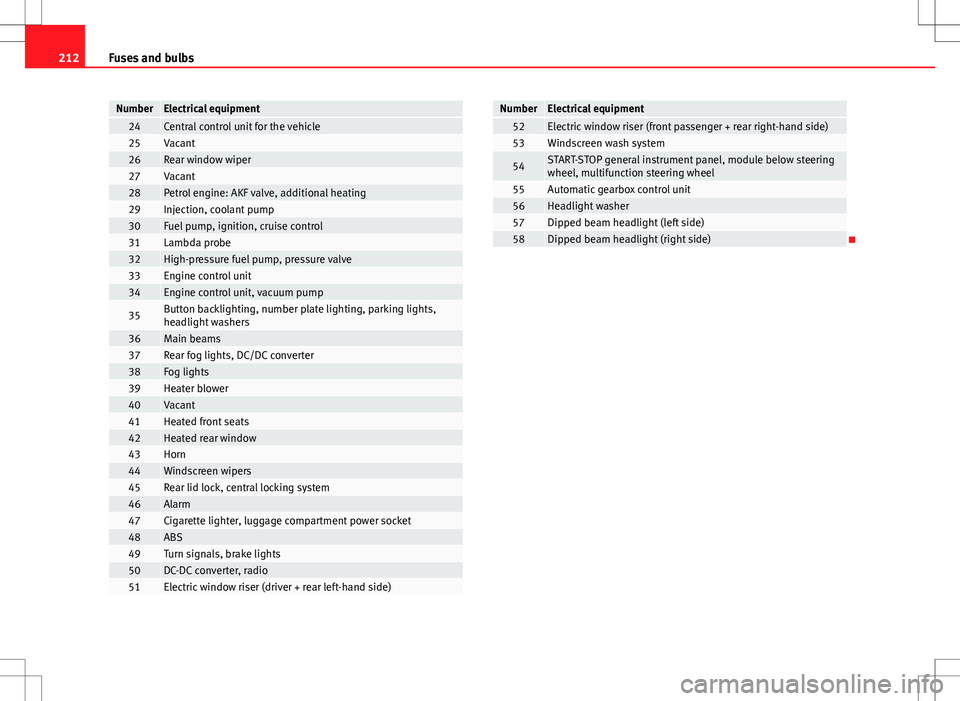
NumberElectrical equipment24Central control unit for the vehicle25Vacant26Rear window wiper27Vacant28Petrol engine: AKF valve, additional heating29Injection, coolant pump30Fuel pump, ignition, cruise control31Lambda probe32High-pressure fuel pump, pressure valve33Engine control unit34Engine control unit, vacuum pump
35Button backlighting, number plate lighting, parking lights,
headlight washers
36Main beams37Rear fog lights, DC/DC converter38Fog lights39Heater blower40Vacant41Heated front seats42Heated rear window43Horn44Windscreen wipers45Rear lid lock, central locking system46Alarm47Cigarette lighter, luggage compartment power socket48ABS49Turn signals, brake lights50DC-DC converter, radio51Electric window riser (driver + rear left-hand side)
NumberElectrical equipment52Electric window riser (front passenger + rear right-hand side)53Windscreen wash system
54START-STOP general instrument panel, module below steering
wheel, multifunction steering wheel
55Automatic gearbox control unit56Headlight washer57Dipped beam headlight (left side)58Dipped beam headlight (right side)
Page 214 of 249

213
Fuses and bulbs
Fuses in the engine compartment
Fig. 142 Diagram of
fuses in the engine com-
partment: version 1
Fig. 143 Diagram of
fuses in the engine com-
partment: version 2
List of fuses in the engine compartment
NumberElectrical equipment1Alternator2Vacant3Interior (version 1) ⇒ Fig. 142
Fuse block power (version 2) ⇒ Fig. 143
4Additional electric heating (version 1) ⇒ Fig. 142
Interior (version 2) ⇒ Fig. 143
5Interior
NumberElectrical equipment6Radiator fan, glow plug system control unit7Electric-hydraulic power steering8ABS9Radiator fan10Automatic gearbox11ABS12Central control unit13Additional electric heating
Note
Fuses 1-7 must be changed in a specialised service.
Safety FirstOperating instructionsPractical TipsTechnical specifications
Page 240 of 249
Index
A
ABS . . . . . . . . . . . . . . . . . . . . . . . . . . . . . . . . . . 142control lamp . . . . . . . . . . . . . . . . . . . . . . . . . 70
Accessories . . . . . . . . . . . . . . . . . . . . . . . . . . . . 195
Adjusting the seat belt height . . . . . . . . . . . . . . 29
Adjustment seats . . . . . . . . . . . . . . . . . . . . . . . . . . . . . . 108
steering wheel . . . . . . . . . . . . . . . . . . . . . . 137
Aerial . . . . . . . . . . . . . . . . . . . . . . . . . . . . . . . . . 165 see radio reception . . . . . . . . . . . . . . . . . . 167
Airbag . . . . . . . . . . . . . . . . . . . . . . . . . . . . . . . . . 31
Airbag covers . . . . . . . . . . . . . . . . . . . . . . . . . . . 37
Airbag system . . . . . . . . . . . . . . . . . . . . . . . . . . . 31 control lamp . . . . . . . . . . . . . . . . . . . . . . . . . 33
Curtain airbags . . . . . . . . . . . . . . . . . . . . . . . 41
Front airbags . . . . . . . . . . . . . . . . . . . . . . . . 35
Side airbags . . . . . . . . . . . . . . . . . . . . . . . . . 38
air conditioning air conditioning . . . . . . . . . . . . . . . . . . . . . 126
Air conditioning air conditioning . . . . . . . . . . . . . . . . . 129, 131
Climatronic . . . . . . . . . . . . . . . . . . . . . . . . . 132
Air recirculation manual air conditioning . . . . . . . . . . . . . . 131
Alarm . . . . . . . . . . . . . . . . . . . . . . . . . . . . . . . . . . 88
Anti-lock system . . . . . . . . . . . . . . . . . . . . . . . . 142
Anti-theft alarm system . . . . . . . . . . . . . . . . . . . 88 Armrest . . . . . . . . . . . . . . . . . . . . . . . . . . . . . . . 108
rear . . . . . . . . . . . . . . . . . . . . . . . . . . . . . . . 111
Ashtrays . . . . . . . . . . . . . . . . . . . . . . . . . . . . . . 118
Aspects to take into account before starting the vehicle . . . . . . . . . . . . . . . . . . . . . . . . . . . . . . . . 8
ASR . . . . . . . . . . . . . . . . . . . . . . . . . . . . . . . . . . 142 Assistance systems . . . . . . . . . . . . . . . . . . . 69
control lamp . . . . . . . . . . . . . . . . . . . . . . . . . 69
Assistance system ABS . . . . . . . . . . . . . . . . . . . . . . . . . . . . . . . 142
ASR . . . . . . . . . . . . . . . . . . . . . . . . . . . . . . . 142
START-STOP . . . . . . . . . . . . . . . . . . . . . . . . . 151
Assistance systems ABS . . . . . . . . . . . . . . . . . . . . . . . . . . . . . . . . 70
cruise control . . . . . . . . . . . . . . . . . . . . . . . 149
EDL . . . . . . . . . . . . . . . . . . . . . . . . . . . . . . . 142
ESC . . . . . . . . . . . . . . . . . . . . . . . . . . . . 69, 141
parking aid . . . . . . . . . . . . . . . . . . . . . . . . . 148
Audible warning . . . . . . . . . . . . . . . . . . . . . . . . . 21
Auto-check system . . . . . . . . . . . . . . . . . . . . . . . 64
Automatic disconnection of electrical equip- ment . . . . . . . . . . . . . . . . . . . . . . . . . . . . . . . . 186
Automatic gearbox . . . . . . . . . . . . . . . . . . . . . . 143 back-up programme . . . . . . . . . . . . . . . . . . 147
Driving programmes . . . . . . . . . . . . . . . . . 146
instructions for use . . . . . . . . . . . . . . . . . . 143
kick-down . . . . . . . . . . . . . . . . . . . . . . . . . . 146
manual release of the selector lever . . . . . 147
parking . . . . . . . . . . . . . . . . . . . . . . . . . . . . 144
Selector lever lock . . . . . . . . . . . . . . . . . . . 146 selector lever positions . . . . . . . . . . . . . . . 144
starting . . . . . . . . . . . . . . . . . . . . . . . . . . . . 144
stopping . . . . . . . . . . . . . . . . . . . . . . . . . . . 144
Tiptronic . . . . . . . . . . . . . . . . . . . . . . . . . . . 145
AUX-IN . . . . . . . . . . . . . . . . . . . . . . . . . . . . . . . . . 80
B
Back-up automatic gearbox . . . . . . . . . . . . . . . . . . . 147
Battery automatic disconnection of electricalequipment . . . . . . . . . . . . . . . . . . . . . . . . 186
changing . . . . . . . . . . . . . . . . . . . . . . . . . . . 186
charging . . . . . . . . . . . . . . . . . . . . . . . . . . . 185
checking acid level . . . . . . . . . . . . . . . . . . . 184
safety instructions . . . . . . . . . . . . . . . . . . . 182
winter service . . . . . . . . . . . . . . . . . . . . . . . 185
Before starting the vehicle . . . . . . . . . . . . . . . . . 8
Bonnet closing . . . . . . . . . . . . . . . . . . . . . . . . . . . . 175
opening . . . . . . . . . . . . . . . . . . . . . . . . . . . . 175
Brake assist . . . . . . . . . . . . . . . . . . . . . . . . . . . 141
Brake fluid checking . . . . . . . . . . . . . . . . . . . . . . . . . . . 181
brakes brake fluid . . . . . . . . . . . . . . . . . . . . . . . . . . 181
239
Index
Page 244 of 249
range control of main lights . . . . . . . . . . . . 96
rear fog light . . . . . . . . . . . . . . . . . . . . . . . . . 96
side lights . . . . . . . . . . . . . . . . . . . . . . . . . . . 94
switching lights on and off . . . . . . . . . . . . . 94
turn signals . . . . . . . . . . . . . . . . . . . . . . . . . . 97
Load . . . . . . . . . . . . . . . . . . . . . . . . . . . . . . . . . 227
Load compartment in the luggage compart- ment
see Loading the luggage compartment . . . 17
Loading the luggage compartment . . . . . . . . . . 17
Locking central locking system . . . . . . . . . . . . . . . . . 85
manual locking . . . . . . . . . . . . . . . . . . . . . . . 86
remote control . . . . . . . . . . . . . . . . . . . . . . . 87
Locking and unlocking from inside . . . . . . . . . . 85
Luggage compartment Category N1 vehicles . . . . . . . . . . . . . . . . . 113
hook . . . . . . . . . . . . . . . . . . . . . . . . . . . . . . 114
light . . . . . . . . . . . . . . . . . . . . . . . . . . . . . . . 113
manual release . . . . . . . . . . . . . . . . . . . . . . . 91
Manual release of the rear lid . . . . . . . . . . . 91
retaining elements . . . . . . . . . . . . . . . . . . . 113
retaining nets . . . . . . . . . . . . . . . . . . . . . . . 114
see rear lid . . . . . . . . . . . . . . . . . . . . . . . . . . 90
shelf . . . . . . . . . . . . . . . . . . . . . . . . . . . . . . 115
see also Loading the luggage compartment . .17
M
Maintenance Airbags . . . . . . . . . . . . . . . . . . . . . . . . . . . . . 33
Make-up mirror . . . . . . . . . . . . . . . . . . . . . . . . . . . . . 101 Manual
door locking . . . . . . . . . . . . . . . . . . . . . . . . . 86
release of the rear lid . . . . . . . . . . . . . . . . . . 91
Release of the selector lever . . . . . . . . . . . 147
Manual gearbox gear lever . . . . . . . . . . . . . . . . . . . . . . . . . . 142
MAXI DOT . . . . . . . . . . . . . . . . . . . . . . . . . . . . . . 62 main menu . . . . . . . . . . . . . . . . . . . . . . . . . . 63
Settings . . . . . . . . . . . . . . . . . . . . . . . . . . . . . 63
MDI . . . . . . . . . . . . . . . . . . . . . . . . . . . . . . . . . . . 80
Mirror exterior mirrors . . . . . . . . . . . . . . . . . . . . . . 106
Interior rear vision mirror with manual anti-dazzle adjustment . . . . . . . . . . . . . . . . . . 106
Modifications . . . . . . . . . . . . . . . . . . . . . . . . . . 195
Multi-function display function . . . . . . . . . . . . . . . . . . . . . . . . . . . . . 59
Multifunction display Memory . . . . . . . . . . . . . . . . . . . . . . . . . . . . . 59
operation . . . . . . . . . . . . . . . . . . . . . . . . . . . 60
Multimedia . . . . . . . . . . . . . . . . . . . . . . . . . . . . . 80
N
Number of seats . . . . . . . . . . . . . . . . . . . . . . . . . 20
O
Oil . . . . . . . . . . . . . . . . . . . . . . . . . . . . . . . . . . . 176 see engine oil . . . . . . . . . . . . . . . . . . . . . . . 177
Oil level checking . . . . . . . . . . . . . . . . . . . . . . . . . . . 177 Oil properties . . . . . . . . . . . . . . . . . . . . . . . . . . 177
On board computer
see multi-function display . . . . . . . . . . . . . . 59
Opening and closing electric windows button on driver door . . . . . . . . . . . . . . . . . . 92
control on the driver door . . . . . . . . . . . . . . 92
control on the rear door . . . . . . . . . . . . . . . . 92
Outside temperature . . . . . . . . . . . . . . . . . . . . . 60
Overview . . . . . . . . . . . . . . . . . . . . . . . . . . . . . . . 53
Overview of the engine compartment . . . . . . . 231
P
Paint see paint damage . . . . . . . . . . . . . . . . . . . 166
Paint damage . . . . . . . . . . . . . . . . . . . . . . . . . . 166
Parking parking aid . . . . . . . . . . . . . . . . . . . . . . . . . 148
Particulate filter . . . . . . . . . . . . . . . . . . . . . . . . . 71
Passenger see Correct sitting position . . . . . . . 11, 12, 13
Pedals . . . . . . . . . . . . . . . . . . . . . . . . . . . . . . . . . 17
Petrol see fuel . . . . . . . . . . . . . . . . . . . . . . . . . . . . 172
Physical principles of a frontal collision . . . . . . 22
Polishing paintwork see care of vehicle . . . . . . . . . . . . . . . . . . . 166
Power steering . . . . . . . . . . . . . . . . . . . . . . . . . 137
Preheating – warning lamp . . . . . . . . . . . . . . . . 70
Preventing damage to the vehicle . . . . . . . . . 159
243
Index